
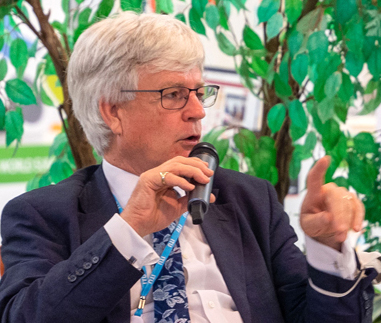
 During the recent ICTD2010 conference, Hari kindly brought together a group of us to discuss academic publishing in the field of ICT4D. Each speaker was to talk for about ten minutes, directing our ‘advice’ primarily towards those who may be less experienced in academic publishing. Whilst I absolutely love seeing, holding and smelling the first copy of one of my new books, or reading one of my new papers in an academic journal, or seeing authors that I respect referencing one of my publications in their own work, I now recognise that a system that I once admired has become fundamentally, perhaps fatally, flawed. There is sadly much that is not really scholarly and little at all that is value free in the world of academic publishing today. It does not foster the excellence or originality that it is intended to achieve. All too often it leads instead to a morass of mediocrity and replication.
Two comments in the distant past still haunt me:
- when my first academic paper was published, a friend and colleague said “congratulations, but you don’t expect anyone will read it do you”; and
- a senior colleague in a government department once said to me: “I don’t ever read academic papers, I get consultants to provide a short synthesis of them for me”.
The reality of academic publishing is that very few papers are ever actually read, and few people are ever influenced by what is written in journals.
Some of the most challenging problems to do with academic publishing are:
- Academic journals are fundamentally a way to ensure professional exclusivity. They are a means through which one group of academics excludes others from participating in their ‘mysteries’. Thus ‘apprentices’ have to learn the rituals and obey the rules if they wish to belong to this exclusive and privileged club.
- Because of the need for authors to obey the rules, journals all too frequently fail to promote the very innovation that is meant to be their life blood. There is a real danger that referees or editors will reject papers that are too innovative or fail to abide by the logics and requirements of a particular journal’s editorial board.
- Many citation cartels exist, whereby in order to boost their rankings in citation indices, academics agree to cite each other’s papers in their own works.
- There are also real issues surrounding the dominance of the English language, and far too few journal editors or reviewers are willing to pay heed to different cultural traditions of academic writing style. We should do much more to enable people from different linguistic backgrounds to get their papers published in the ‘top’ journals.
- Peer review is by no means the innocent, quality control exercise it is meant to be. Far too often academics use it as a way of preventing ideas that are contrary to their own from being published.
- Citation indices usually only incorporate the more prestigious journals, and thus often omit the more innovative and cutting edge papers.
- The emphasis on quantity rather than quality of publication means that vast numbers of dreadful papers are submitted to journals – and it is very frustrating for editors and referees to have to sift through the dross!
The net outcome of these is that far too many papers that are published are mediocre and tend to replicate existing knowledge. Moreover, many of these problems have become exacerbated over the last 20 years as academic publication in ‘top’ journals has become such an important part of research assessment exercises.
I offered five key tips for less experienced academics who wish to succeed in this environment:
- The most important tip is that one must realise that academic publishing is a game. New academics therefore have to learn the rules and play by them – if they want to achieve success in terms that the profession’s gatekeepers have defined. Once your career is established, then you are in a position to try to change the rules!
- Write something that is reasonably good and then submit it to a journal. Referees are bound to suggest revisions, and so don’t be hurt by the comments. Use them, alongside your own developing ideas, to improve the paper and resubmit it – in most cases it will eventually be published (as long as it is reasonably good in the first place!)
- Publish less, but publish better; focus on quality rather than quantity. When I was head of department, I remember encouraging colleagues to make sure that they published just two or three papers a year in major journals, and a book every three to four years.
- Remember that few people actually read academic journals. If you want your ideas to have an impact, it is therefore essential that you make them available in different formats and contexts – as, for example, through your own blog
- Only ever agree to have your supervisor’s name as an author on the paper if she or he has actually written a substantial amount of it! Good academics don’t need to have their names on your research – although it is always nice to recognise their advice in an acknowledgement.
Two final points are worth mentioning. The first is that publishing in a multidisciplinary field such as ICT4D is fraught with a particular set of additional difficulties. Where academic success is defined in large part through publication in prestigious journals, most academics seek to publish their work in their own discipline’s top-ranked journals. It is thus more prestigious for a computer scientist working in ICT4D to publish in a top computer science journal than in a new ICT4D journal. Those who edit cross-disciplinary journals often therefore find that the papers that are submitted to them are those that have been rejected by other more mainstream journals. Consequently, papers published in multidisciplinary journals are often of less good quality than those in the major single disciplinary journals. This does, though, provide editors of multidisciplinary journals with an opportunity to be innovative and creative in what and how they publish. Moreover, it is incumbent on those working in the field to support new journals that are indeed trying to break the mould of traditional academic arrogance and exclusivity.
Finally, we need to explore alternative modalities of publishing. Those of us working in the field of ICT4D should seek to use ICTs creatively to enable multiple voices from many different backgrounds to share their research findings. However, we still need to find appropriate business models to enable more open and free publication options to be created. Traditionally, journal publishers have added considerable value to the publication process, not least through funding the editorial and publication process. Such costs remain to be covered, and few ‘free’ journals have yet actually enabled high quality original academic papers to be widely disseminated. We also need to work creatively with existing publishers, since they have much to offer the publication process.
For some of my more detailed reflections on peer review see:
[For the presentations by Geoff Walsham, Cathy Urquhart and Shirin Madon as well as the full discussion see the video “Publishing ICT4D Research“ available from ICTD2010 videos and photos]


 Tim Unwin's Blog