
I have written elsewhere at some length on digital enslavement, the ways in which citizens across the world are increasingly being forced into sharing their data with global corporations who then profit from their use and sale (see: Freedom, enslavement and the digital barons and Power hierarchies and digital oppression). A recent journey on the London Underground (metro or subway for non-English speakers) reinforced this point and made me increasingly concerned, nay frightened, by the potential dystopia into which “we” are blindly walking, or (un)subtly being cajoled into accepting. Let me tell the tale, and then draw six observations from it. I end with some practical suggestions for reclaiming our freedom.

Transport for London (TfL) created the Oystercard in 2003 as a pre-paid card through which customers could pay for travelling on various forms of transport in London. It was marketed widely because it was easy to use; TfL have nevertheless gained a vast amount of data about passenger journeys from its use. I have always topped mine up with cash so that my financial expenditure on bank cards could not be linked directly with my travel. I also have a railcard that enables me to get reductions on certain forms of travel, but have long resisted linking this to anything else. Incidentally, I likewise refuse to use mobile payment apps such as Apple Pay, Venmo, Google Pay or ParrotMob, because I do not want them to exploit me further by using my data to generate additional profits at my expense. However, the price reduction on London travel by linking my railcard to my Oyster card has “persuaded” me in the end to link the two. Interestingly, I was not able to do this myself, and because there was no longer a ticket office I had to ask for assistance from the one TfL employee in the vicinity, who was overseeing control and security for 10 or more gates at one of London’s busiest terminals. I was very pleasantly surprised by how helpful and professional he was. He agreed that I was unable to do this myself, but he kindly took me to one of the ticket machines where he could access the relevant links and make the connection. The machine, though, did not take cash and so I could not top the card up; it would of course have accepted a payment card. I had to go back to the kind assistant, who then found the one machine in the area that did indeed take cash. En passim, he mentioned that in the future the machines will only take cards, and that it is likely that the Oyster card will soon be phased out to be replaced solely by bank card, or mobile payments (see many discussions, posts, documents and reports on TfL’s Project Proteus).
I tell this tale at some length because it perfectly captures the six interconnected aspects of our increasing entrapment, exploitation and enslavement through the use of digital tech that I wish to address here. Most will find the above account commonplace and innocent. I don’t, and I tell the story as a cautionary tale in the hope that it will help more people resist our ever increasing digital oppression. The meaning of the title should be clear. If we don’t use cash, through which it is extremely difficult to trace our movements and expenditure, we will lose it, and with it the freedom not to be surveilled and not to be exploited through the extraction of our personal data.
We increasingly have no option: cash or nothing
From a consumer perspective, it is remarkable how swiftly a “no cash” policy has come upon us. We are told that it is much easier to use cards, it is quicker, and we don’t have to carry around heavy weights of cash. A website aimed at foreign tourists, for example, notes that “Alas, various forms of transport – such as London buses – cannot even accept cash payments. Where cash is accepted, it is also often the most expensive way to pay. Cash is thus best avoided”
But how true really is this? If the machines are not working it can take much longer to pay by card and sometimes it is impossible; paying cash is swift when there is a competent human behind the till; and paper money really is not very heavy. Think of what we lose: the beauty of banknotes (see Virginia Hewitt’s Beauty and the Banknote, as well as the work she and I did together on banknotes in eastern Europe and the former Soviet Union); the feel of “real” money, rather than just a virtual transaction; and, above all else, it cannot easily be traced back to us as individuals. We are incresingly being forced into using cards not for these claimed benefits , but rather because it is in the interest of companies that we do so. What is particularlty worrying is that it is increasingly becoming impossible not to use cards. Even in such lovely, quirky coffee shops such as Store Street Espresso, I had to use a card.
The expanding use of cards increases the extent to which we are being tracked and monitored
At a relatively benign level, it is often argued that people make a conscious choice, and weigh up the relative benefits of using a card or not. However, I wonder how many people really do understand just how much information they are giving away when they use their bank or payment cards. How many are happy that they are being exploited in this way? Just as social media platforms extract vastly more data than most people realise (see Matilda Davies‘ recent piece on Every scary thing Meta knows about me — and you), so too do cards of all sorts, from credit and debit cards, to loyalty cards, to payments card and beyond. Again, the key point here is the rapidly growing scale at which this is happening. Not only, do we increasingly have to use cards, but the interconnectedness of the systems means that the extent to which we are being tracked and our data extracted is also dramatically on the increase. Why have we become so inured to this?
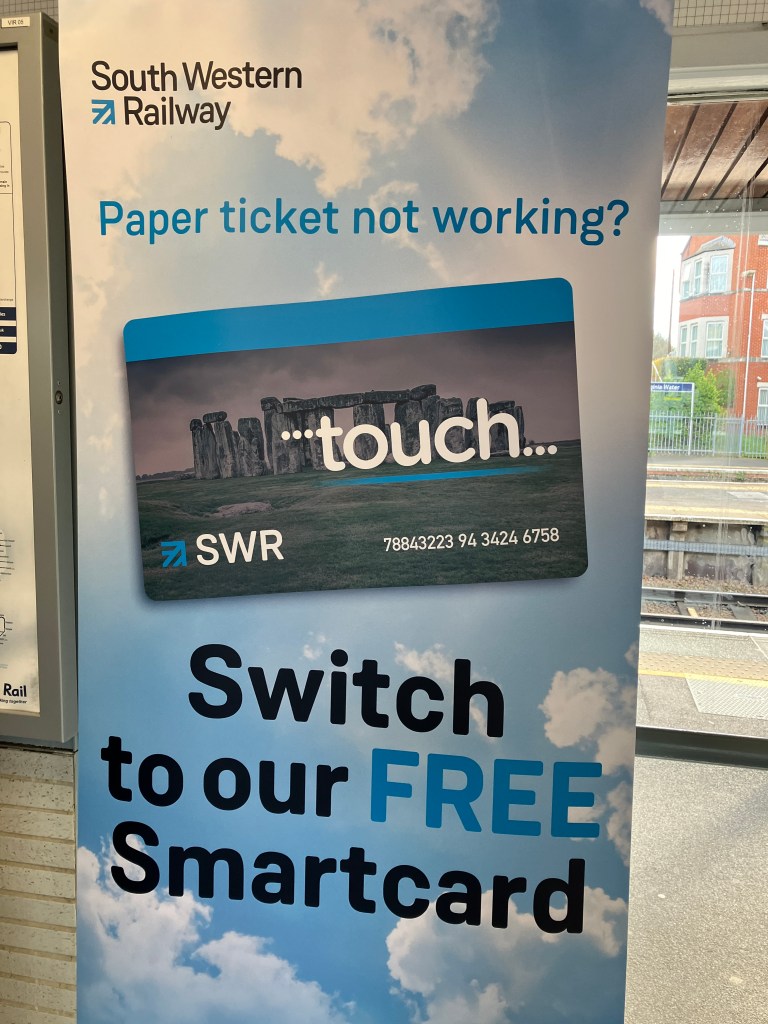
Our real-time travel is increasingly being connected to our expenditure, behaviours and purchases
Not only are our past purchases, transport journeys, and behaviours being tracked and analysed, but with the greater power of data management systems and ever more sophisticated machine learning algorithms, this information is now being used increasingly in real time to ensnare and exploit us. When these data are then cross-linked to biometric records and security cameras we become even more entrapped and exploitable by those who use and supply these technologies. Surfshark, for example, calculates that London has the fourth highest city density of CCTV in the world at 499 cameras per square km (read to the end to discover which are the top three citites – I was surprised!). Even using cash in London is now only a partial means of escaping from the ever greater real-time machine surveillance by state apparatuses, and enslavement by private sector companies.
Who benefits? Is it ever in our interests?
How much do we really benefit from such digital enslavement? Proponents of the use of digital tech in this way always point to the potential benefits of going cashless: it is quicker and easier; customers benefit from companies passing on savings from no longer employing human staff; and it is more consistent and accurate. Even if these were true, is it actually in the interests of citizen consumers? People will clearly respond in different ways, depending on their own circumstances, and how much they value their privacy and personal security. However, those who have lived in a different world, the world of the past, know that systems did indeed work then, and that the supposed benefits of digital tech are very much less than is claimed. Let me give but two examples:
- First, most payment machines at railway stations (certainly in the area around London) are poorly designed and it is often very difficult to find the best fare for a particular route. I have always found the staff at ticket offices to be much more knowledgeable about the best tickets to buy, and the complete transaction is frequently therefore swifter when talking to a human than using a machine. Machines also frequently do not work, which causes chaos. The difficulties that many elederly people and those with disablities have in using the machines is also of particular concenr.
- Second, the use of digital tech in this way deliberately limits human interaction. Yet we know that communal interaction is essential for human life. Increasing evidence suggests that rising mental health issues are in part due to this loss of real and physical regular communication, as a result of this being mediated by digital tech. Buying a ticket from a human actually requires communication, and can be a very valuable opportunity, especially for the lonely or the elderly. It also provides a reminder of exactly how much one is spending, esdecially if cash is used. Just passing a payment card over a device often means that customers have little knowledge of exactly what they are paying, and as a result we can frequently pay much more than we had intended.
It is surely the companies who benefit most from the implementation and use of digital tech, rather than citizen consumers. The companies who provide the tech, both hardware and software have all benefitted hugely from a shift from human labour to digital. So too have those companies providing the services, be they train operators or the digital finance institutions. When these become integrated as discussed above, the potential profits from combining data from different sources become even higher. Moreover, our data is then sold to others who also use it to enhance their profits. All this is extraction of profit from our individual actions (travelling and purchasing), and as we increasingly have fewer and fewer options, we increasingly lose our freedom and become enslaved.
Another dimension to this balance equation of “who benefits?” concerns the employment of staff. Lack of data makes it extremely difficult to calculate the overall costs and benefits of replacing human staff by machines, but companies are unlikely to make this transition if they did not see it in their long term interests. Moreover, replacing railway staff by machines reduces the risk of strike action by staff, thus making the system more reliable from the companies’ and citizen consumers’ perspectives. The dehumanisation of labour, though, is a very important issue in itself, and many staff made redundant in this process are unlikely to gain jobs in the tech sector that replaces them. It was therefore a very positive move in October 2023 when the UK Government rejected the planned closure of hundreds of ticket stations across the country in response to the most responded to public consultation of all time. The British public, when asked, clearly do not see much of this digitisation to be in their real interests.
The security dangers
There are also very real security dangers associated with the increased use of digital payments systems and cards. These come in two main forms: the dangers of immediate theft and loss of identity for citizen consumers; and the wider threat to companies and individuals of being hacked.
- First, the use of digital systems, especially when so much identity and financial information is stored on our mobile phones, means that it is much easier for criminals to steal such integrated information than it was previously, when everything was separated out. In the past, we did not often carry very large sums of cash around with us and few of us ever carried our passports or other identity documents, and yet those who steal mobile devices and access the information on them today are able to gain very rich rewards. Even just losing a phone can be devastating for many people.
- Second, the hacking risks for both companies and individuals remain very high. Imagine the impact were criminals and/or foreign states to close down all of the ticket machines across rail networks, or interfere with signalling networks. Such critical infrastructures remain vulnerable (see list of significant incidents by CSIS), and it is only a matter of time before more attacks are experienced. Banking systems are also vulnerable, with the Carnegie Endowment for International Peace listing some 200 cyber incidents targeting financial institutions between 2007 and 2022. Such incidents affect services, but other hacks are focused on the acquisition of identity-related information that affects some or all users of a particular service. There have for example been several hacks that have affected TfL customers, notably the 2020 report that Oyster Online accounts had been accessed maliciously, and the 2023 report that the Russian ransomware group C10p had attached a TfL supplier with 13,000 customer contact details being compromised.
There is no doubt that increasingly integrated data sets containing information about our identities, our location and travel patterns, our finances, and our behaviours make us more vulnerable to financial and identity theft than was previously the case. This places additional burdens on us to put in place our own safety and security mechanisms if we do not want to be overhelmed by those who use digital tech for malicious purposes.
Freedoms and digital enslavement
Freedom is the power to act, speak and think how we want; we are enslaved if we lose that freedom of choice. The above examples suggest that we increasingly have very much less choice and power to act how we choose to by those who restrict the ways in which we purchase goods; we are thus becoming enslaved. Increasingly we cannot avoid being surveilled and our data extracted from us when we travel in London, or indeed in many other places. We are being forced to use cards that enable us to be identified everywhere that we travel within the city. Imagine what a “malign actor” (state, company or civil society) could do with these data?
Moreover, I suggest that those who restrict our freedoms and enslave us in this way are acting very deliberately in their own interests, which are mainly pecuniary. We are moving ever more into what might be considered as a new “mode of production” whereby surplus profit is generated from our very selves. Worryingly, that is not so different from the profit generated from the harsh manual labour of slaves. It is a gentler form of slavery to be sure, softer, less immediately visible, and perhaps even more insidious. But it is no less real. I am not the first to refer to digital slavery in my written work (see for example Chisnall, 2020, who focuses especially on “alienation from self”), but it is a notion with which I have been grappling for several years, and the purpose of this post is very much to try to increase wider awareness of thse complex and difficult issues.
Reclaiming our freedom
There are many ways in our daily lives through which we can seek to resist this dangerous trend, and reclaim our freedom, the most important of which I currently see as being the following:
- Insist on our continued use of cash: use it or lose it. Paying for goods and services using cash is a very important way through which we are able to prevent others knowing how and on what we spend money and purchase things. Even this, though, is becoming more difficult as companies are increasingly also turning to video recordings of our transactions. If enough people continue to insist on using cash, though, we can together form a sufficient mass to prevent further inroads to this freedom. We should also be vocal about it, telling as many companies as possible why we are no longer using their services.
- Maintain as many multiple identities as possible. In the recent past it was not so difficult to create multiple identities. It was easy, for example, to create bank accounts in whatever name one wanted. Now, this is much more difficult, but it is still possible to create separate identities, for example by having several mobile phones, each linked to different sets of cards. Ultimately, these usually have to be linked to a single address, and therefore if companies understand this connection they can indeed join up the dots, but at least such actions we take can make it more complicated for them. For those with mutliple citizenship it becomes easier, since they can link different phones and cards to different manifestations of identity such as passports.
- Beware of video surveillance. It is increasingly difficult to avoid video surveillance, and readers of this post will have very differing views about the use of surveillance by states to monitor their citizens. That having been said, there is much available advice online about simple legal ways through which it is possible to reduce, or confuse, the effectiveness of such surveillance. However, I think it is a different matter when it comes to surveillance by companies of people’s shopping behaviours (see for example digifortUK, or secureredact), and it is perfectly legitimate to seek to avoid these especially in contexts where they might be used in combination with other data such as loyalty card use or payments. The challenge, of course is that video surveillance is becoming much more sophistictaed, with gait recognition systems being even more difficult to avoid than simple facial recognition (see for example, Harris et al., 2022; Recfaces; Privacy International, 2021).
- Minimise the integration of identity sources. In an increasingly inteconnected world, it is becoming ever more difficult to isolate different part of our lives, but ideally we should seek to minimise the linkage of different aspects of our identity. For example, many people create a separate obscure e-mail account (definitely not a Google mail account) that they never use themselves, but into which they direct all their “rubbish”. Whenever they make a purchase, they simply use this email address. Likewise they have distinct bank accounts and loyalty cards that they only use for partcular kinds of activity. Anything we can do to make it difficult for sophisticated digital systems to track us and combine our data, thereby shackling us like slaves, has to be a positive step towards freedom.
- Making clear and thought-through decisions about what we are happy for others, particularly states and companies, to know about us, and then protecting what we wish to remain private. One of the most insidious things about the creators of digital systems who enslave us is that they are not transparent in how they do so. Most people are blissfully unaware of the things that I have written about here, and are probably quite happy about it. They feel liberated and free through their use of digital tech, rather than being enslaved through it. It is incumbent therefore on all who care about these issues to seek to enlighten our fellow citizen consumers and help them reflect on their behavours, thereby gaining some emancipation and an ability to escape the shackles that bind them.
- Adopt as much as possible of the existing good advice on the safe, wise and secure use of digital tech. There is already a considerable amount of guidance on using digital tech safely, but it is insufficiently used. All too often when people are first trained in the use of these technologies they are told about all of the positives and few of the negatives. We need to have a much more balanced approach. Digital tech can be used to do good or to cause harm. We need to mitigate the harms to enable the good to flourish. Our own recent work in Nepal, South Africa and Brazil has highlighted how many different approaches can be tailored to the particular needs of specific communities. Other readilty available resources include those by Softwise, Kaspersky, the UK’s ICO and National Cyber Security Centre, and CyberWise.

Finally, we need to take time away from our use of digital tech and reclaim our sentient contact with the real word of nature that surrounds us. Several years ago, I coined the hashtag #1in7offline, to capture the idea that if you can’t spend a day a week offline, then at least try doing so for an hour every seven hours, and so on. Ultimately, we need to rediscover and cherish our “being in the world”, for it is precious. The only way to escape the tyranny of the digital barons (and the knights who fight for them) is to remove ourselves from their grasp while we still can. We can start to do this a step at a time, but we must do so. Otherwise, we willingly succomb into the new slavery that they seek so avariciously to impose upon us.
Notes:
According to Surfshark, Chennai, with 657 cameras per square km is highest, followed by Hyderabad with 480, and Harbin with 411.


 Tim Unwin's Blog