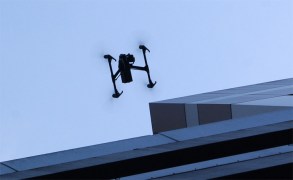
 The arrival of relatively cheap drones (or unmanned aerial vehicles, UAVs) that can be purchased and used by people other than the military and civilian “authorities” raises fundamental questions about privacy and security. To be sure, there is good evidence of the positive role that drones can play, particularly in providing humanitarian assistance, and in delivering supplies to remote regions, but insufficient attention is paid to their darker side. Increasingly, countries such as the UK are wisely seeking to control the use of drones near airports (see for example Civil Aviation Authority) and no fly zones are being created in sensitive areas (see noflydrones and the UK Air Navigation Order, CAP393). However, much less attention is paid to the implications of the use of drones for photographing or tracking individuals without their knowledge or permission. This is especially so when drones are used by those with malicious intent to monitor or photograph people’s activities in their homes or on their properties. In particular their use by burglars to scope properties is becoming increasingly common, and of growing concern to the police (The Guardian, 3rd April 2017).
One fundamental question that requires resolution is why, if people are allowed to fly drones over someone’s property, that person is not permitted to “take down” the drones? There seems to be a fundamental and unfair asymmetry here.
Broadly speaking there are three main ways through which drones can be taken down:
- by shooting them out of the sky with small missiles or guns;
- by catching them using larger, more powerful drones with nets; or
- by hacking their control software.
The first of these is problematic for most people, is probably illegal (except when used by the military and police), and could cause collateral injury to others. The second is undoubtedly feasible, and examples such as Delft Dynamic’s Dronecatcher, and the Tokyo police’s use of nets to catch suspicious looking drones, are becoming increasingly widespread. One of the best defences against unwanted drones is simply to use a more powerful drone fitted with a net to take them down.
Many drones, though, are susceptible to relatively simple hacking that takes advantage of insecurities in the wireless connections between users and their drones. The following articles present interesting advice for those wishing to hack drones and retain their privacy in the face of increasing drone surveillance:
- Nils Rodday, “Hacking a Professional Drone” (RSA Conference, 2016)
- Sander Walters, “How can drones be hacked? The updated list of vulnerable drones & attack tools” (2016)
- Wang Wei, “You can hijack nearly any drone mid-flight using this tiny gadget” (Hacker News, 2016)
- Dan Goodin, “There’s a new way to take down drones, and it doesn’t involve shotguns” (Arstechnica, 2016)
- April Glaser, “The US government showed just how easy it is to hack drones made by Parrot, DBPower, and Cheerson” (Recode, 2017)
- Pierluigi Paganini, “How to hack drones with just a $40 hardware from 2 km away” (Security Affairs, 2016)
- Kelsey Atherton, “This DIY device lets you hi-jack drones in mid-air” (Popular Science, 2016)
- Phil Sneiderman, “Here’s how easy it is to hack a drone and crash it” (Futurity, 2016)
- Ed Darack, “Drone hacking made easy” (Airspacemag, 2016)
Do please suggest additional resources of interest to those seeking to hack drones.
For those interested in the frightening potential for drones to be used as autonomous devices in warfare, this video produced to encourage the banning of autonomous lethal weapons is an absolute “must watch”. Much of this technology is already in existence, and being used to target and kill people who are deemed by the killer (currently most frequently a powerful state) to be undesirable. It is not difficult to envisage their widespread use, not only in warfare, in the future. All those responsible for developing such technologies have a responsibility to ensure that they are only used for good applications.
A more recent update, focusing mainly on “weapons” that can be fired to bring down drones with nets was published by the BBC in October 2018.


 Tim Unwin's Blog