In recent years I have tried, but often failed, to use “alt text” in my work when posting images online. I have failed dismally to go back and try to annotate all of the many images I have posted in the past, and I know I fail to be consistent in doing so in the present. Both of these failings are undoubtedly because of the time that this would take me, despite many platforms now encouraging its use, and my commitment to supporting people with disabilities (see my very old site at https://disabilityict4d.wordpress.com/).
For those who are unfamiliar with alt text it is the attribute in HTML that specifies alternative text for images, and is especially valuable for people with visual impairments, because it helps screen readers convey the meaning of images for them. The World Wide Web Consortium thus recommends that every image displayed through HTML should have alt text associated with it.
However, reflecting on this in the context of the increasing use of AI, has made me very aware of the ways in which alt text can be used by AI systems to describe images without the use of data labellers. At one level, this might be seen positively, because it can reduce the need for AI companies to use what is often termed “slave labour” to do the annotation (see Ganna Pogrebna, 2024). However, this would take away the very small income that such labour can generate, and is indeed valued in many parts of the world. Moreover, it is also a way that such images (or video) can be annotated for free for teh AI companies by the person doing the posting.
Much more worryingly, though, is the potential for alt text to be used maliciously. If, with their permission, I post an image of a friend/colleague online, and label this using alt text, their name will be forever attached to that image, and be a vehicle through which AI and search engines can identify them and link to further related images of them. This could, for example, readily be used to track and surveil them when travelling. However, it would be equally possible for someone else to write something unpleasant or abusive about a person as alt text on an image, and that too would be recorded so that AI could then be used to build very erroneous profiles of them.
I am inclined to think that the potential harms of this outweigh the benefits, although for innocent law-abiding people with visual impairments it would be an immense loss. Is this primarily a new way that the Digital Barons are deliberately exploiting us? Is that why platforms are incresingly encouraging us to include alt text when we post an image (as illustrated in the image above)?
I’m so grateful to the amazing award-winning Indian cartoonist Alok Nirantar (see @cartoonistalok) for sharing this challenging cartoon as a visual interpretation of the themes underlying my new book Digital Inclusion in an Unequal World(Routledge 2026). This image captures many aspects of the book, raising questions about who really benefits from digital tech (represented by the mobile phone): a rich young boy surfs the Internet, as an older and poorer man tries to hold on at the back to grasp some benefits; the direction of travel from the economically poor village to the smart city (shown below the mobile phone) also hints at the wider spatial implications of the processes of digitalisation.
An important dimension of the book is the inclusion of a diversity of voices and representations – not only images, but also 31 vignettes written by a rich diversity of people of different ages, ethnicities and experiences. Some of these are also available in audio, with new ones being made available on our podcast on a weekly basis. This visualisation is thus a great addition to the book, written by one of India’s best political cartoonists. It is indeed an honour that he crafted this cartoon for me. See Alok’s work on Facebook at https://www.facebook.com/CartoonistAlok.
Recent AI global summit in Geneva: the glitz and glamour of digital tech
The Internet and World Wide Web have been used to bring many benefits across the world, but they have also been used to cause very significant harms. To deny this, is to fall into the trap of scientism, science’s belief in itself. Science is not neutral and value free as many scientists would have us believe. Above all, scientific enquiry and innovation are not inherently “good”, however that is defined. Moreover, science is not necessarily the best or only way of making truth claims about our existence on planet earth.
The recent “Open Letter to the United Nations” by a distinguished group of 37 scientists, notably including Vint Cerf (described in the letter as Internet Pioneer) and Sir Tim Berners-Lee (described as Inventor of the World Wide Web), raises very important issues around the nature of digital technologies and the so-called multistakeholder model. In essence, it seeks to persuade those involved in the Global Digital Compact “to ensure that proposals for digital governance remain consistent with the enormously successful multistakeholder Internet governance practice that has brought us the Internet of today”.
While I profoundly disagree with the agenda and process of the Global Digital Compact, I do so from the other end of the spectrum to the arguments put forward in their Open Letter. I have three fundamental objections to their proposal: that they largely ignore their responsibility for the harms; that their interpretation of multistakeholderism as being bottom up is flawed; and that, in effect, they represent the corporate interests that have for long sought to subvert the UN system in their own interests.
Science and innovation are not necessarily good
The Internet and World Wide Web were originally invented by scientists (“engineers” as they are referred to in the Open Letter), who were caught up in the excitement of what they were doing. As many of their subsequent statements have suggested, I’m sure these engineers believed that they were doing good. Thus, as the letter goes on to state, the success of those involved in the subsequent development of the Internet and the Web “can be measured by where the Internet is today and what it has achieved: global communication has flourished, bringing education, entertainment, information, connectivity and commerce to most of the world’s population”. While they acknowledge later in their letter that there are indeed harms resulting from the use of the the Internet and Web, they say little about the causes of these harms , nor about the structures of power in their design and propagation. By claiming that the basic architecture of the Internet must not be changed, because it is empowering, they fail sufficiently to take into consideration the possibility that it was their original design of that architecture that was flawed and enabled the rise of the very many harms associated with it.
There is nothing inherently “good” about science; it serves particular sets of interests. Scientists are therefore as responsible for the harms, unintended or deliberate, caused by their inventions as they are for any “good” for which they are used. The letter claims that the technical architecture of the Internet and Web cannot on its own address the harms it is used to cause, but offers no evidence in suport of this argument. If the Internet and Web had not been created as they were, if the architecture had been different, might not the harmful outcomes have been avoided? Did the engineers and others involved take the time to consider the full implications of what they were doing? Did they consider the views of philosophers and social scientists who have studied the diffusion of innovations and their potential harms in the past? Or were they caught up in the technical interests of positivist science? I do not know the answer to these questions, but I do know that they are as responsible for the scale of the harms caused through the use of their inventions, as they are for any good.
On multistalkeholderism
The arguments of the Open Letter are based on the notion that multistakeholder processes have been “enormously successful” in bringing us “the Internet of today”, and that the Global Digital Compact should not damage these by replacing it with “a multilateral process between states”. Accordingly, the authors should also recognise that it is these same multistakeholder processes that have also brought us the harms associated with the Internet and Web. Moreover, the claim that this multistakeholder model of Internet governance is “bottom-up, collaborative and inclusive” is also deeply problematic. Just over a decade ago, I wrote a critique of multistakeholderism (see also my Reclaiming ICT4D) in which I highlighted that despite such aspirations and the efforts of those involved to try to achieve them, the reality is very different. Those arguments apply as much today as they did when I first wrote them. In essence, I argued that there are two fundamental problems in the practice of multistakeholderism: unequal representation, and the decision making process. I challenge the claim that in practice these processes are indeed bottom-up, collaborative and inclusive. The following are just some examples in support of my case:
The world’s poorest and most marginalised people and communities do not participate directly in these gatherings.
how many people with disabilities or ethnic minorities actually contribute directly?
Most of the organisations claiming to represent such minorities sadly usually have their own interests more at heart than they do of those they claim to speak for.
There is a very significant power imbalance between those individuals, organisations and states who can afford to participate in these deliberations and those who do not have the financial resources or time to contribute.
Small Island states are notable in their absence from many of these processes, simply because of the cost and time involved in such participation.
The large, rich global corporations can afford to engage and lobby for their interests, whereas the poorest and most marginalised face almost impossible difficulties in seeking to compete with them.
There are enormous linguistic and cultural barriers to full and active engagement.
This applies as much to the technical language and processes used in these deliberations as it does to the dominance of a few interrnational languages in the discussions.
The processes of consensus decision making are extremely complex, and require considerable experience of participation before people can have the confidence to contribute.
Almost by definition, minority voices are unlikely to be heard in such processes of reaching a consensus.
I could highlight many more examples of these challenges from my 25 years of experience in attending international “multistakeholder” gatherings, from the Digital Opportunities Task Force (DOT Force), to the regular cycle of subsequent WSIS, IGF, ICANN, and UN agency gatherings. This is not to deny that many such multistakeholder gatherings do indeed try to support an inclusive approach, but it is to claim that the reality is very different to the aspiration. The image below from the GDC’s page on its consultation process suggests where the power really lies.
It is surely no coincidence that the third of these sub-headings focuses on the $5tn+ represented by the market cap of private sector companies. This need not have been so. They could instead have given a clear breakdown of the exact numbers of submissions from different types of organisation.
The corporate interests underlying the UN digital system and the Global Digital Compact
It is somewhat ironic that this Open Letter is written by “scientists” who in reality largely represent or serve the interests of the digital tech companies, in an effort to roll back what they see as the growing interests of governments represented in the GDC drafts. In stark contrast, I see the entire GDC process as already having been over-influenced by private sector companies (see my 2023 critique of the GDC process). In theory, states should serve the interests of all their citizens, and should rightly be the sector that determines global policy on such issues. It is right that regulation should serve the interests of the many rather than the few.
Here I just briefly focus on three aspects of these challenges: the notion that the Internet is a public good or global commons that serves the interests of all the world’s people; the private sector representation of the scientific community; and the undermining of UN priorities and agendas by the private sector in their own interests. Before I do so, though, I must emphasise that there are many individual scientists who do seek to serve the interests of the poor rather than the rich, and a few of these do also have considerable knowledge and understanding of ethics and philosophy more generally. I also acknowledge the problem of what to do about disfunctional and self-seeking governments.
The Internet as public good
The arguments that the Internet and Web are public (or for some “common”) goods that should be kept free so that everyone can benefit, and at its extreme that access to the Internet should be considered a human right, are fundamentally flawed. People do not benefit equally from such goods (these arguments go back to Aristotle, and can in part be seen in Hardin’s Tragedy of the Commons). Those who benefit the most are the rich and powerful who have the finance, knowledge and ability to do so. This is why digital tech has become such a driver for increased global inequality at all scales. Those who are creating the contemporary digital system are doing so largely in the interests of global capital (for much more detail see my arguments in my Reclaiming ICT4D, Power hierarchies and digital oppression: towards a revolutionary practice of human freedom, and Freedom, enslavement and the digital barons: a thought experiment).
An unhealthy relationship between science and private sector companies
Not all science and innovation are funded or inspired by the interests of private sector corporations, but it is increasingly becoming so, especially in the digital tech sector. Not all scientists or engineers fail to consider the possible unintended consequences of their research and innovation, but many do. All of us have choices to make, and one of those is over whether we seek to serve the interests of the world’s poorest and most marginalised, or the interests of the rich and powerful. Moreover, it is important to recognise that historically it has usually been the rich and powerful who have used technology to serve and reinforce their own interests. There is a strong relationship between power and science (see my The Place of Geography, and Reclaiming ICT4D, both of which draw heavily on Habermas’s Critical Theory, especially Erkenntnis und Interesse). Scientists cannot hide behind their claim that science is neutral or value free.
These challenges are especially problematic in the digital tech sector. Thus, leadership and membership of entities such as the Internet Engineering Steering Group (IESG) of the Internet Engineering Task Force (IETF), the Internet Architecture Board (IAB), and the W3C (Board of Directors) are all heavily dominated by representatives from private sector companies and computer scientists with close links to such companies. It is just such people who have signed the Open Letter.
The private sector subverting the UN system in its own interests
It is entirely apropriate that there should be close dialogues between governments and private sector companies. Likewise, it is important for there to be dialogue between UN agencies and companies. Indeed, international organisations such as the ITU and the Commonwealth Telecommunications Organisation have facilitated such engagements between companies and governments since their origins, to ensure that informed decisions and agreements are reached about telecommunications and digital tech policy and practice across the world. However, despite the neo-liberal hegemony that aspires to roll back the role of government, it is still governments that wield the political power – rightly so.
Constructive criticisms of the Global Digital Compact are always welcome. There is, though, a strange irony that representatives of the very interests that played such a strong role in shaping the GDC should now be criticising the way it has developed. My earlier strident criticisms of the GDC were in part that it already reflected too much private sector interest, and that it would do little in practice to mitigate the very considerable harms and digital enslavement caused through the design and use of digital tech (see my Use it or lose it – our freedom). Perhaps I should therefore be grateful that computer scientists and corporate interests are so critical of the draft. This raises some important questions that could be explored in much further detail:
Could the architecture of the Internet and Web have been designed differently so as to ensure that it was not used to cause the harms and abuses that are so prevalent today? My hunch is that the answer to this is “yes”, but that it would have been much more difficult, and would have required very considerable more work and thought about its design at that early stage.
Are those who designed and created the Internet and Web responsible for these harms? Again my answer to this is “yes”, but I appreciate that not everyone will accept this. In origin, the earliest engineers and computer scientists working in this field were focused primarily on the “science” of these innovative technologies. I have never asked them the extent to which they considered the ethics of what they were doing at that time, or how much they examined the potential unintended consequences. However, almost all these “scientists” were the products of an education system and “scientific community” that was grounded in empirical-analytic science and logical positivism (see my critique in The Place of Geography). Moreover, these scientific communities were always closely engaged with private sector companies (and indeed with the USAn military-industrial complex). There is little doubt that the evolution of the Internet and Web over the last 20 years has been driven primarily by the interests of private sector companies, and they too must be brought to justice with respect to the damage they cause. As for the signatories of this Open Letter, if they claim to be responsible for its positive aspects, then they should also accept that they are responsible for its more reprehensible features.
What do we do now about it? This is the really important question, and one that is too complex for those involved in the Gobal Digital Compact to resolve. At best, the GDC can perhaps be seen as a statement of intent by those with interests in promulgating it. It can be ignored or kicked into the long grass. It is impossible to reach a sensible conclusion to these discussions in time for the so-called Summit of the Future in three months’ time. In the meanwhile, all of us who are interested in the evolution of digital technologies in the interests of the world’s poorest and most marginalised must continue to work tirelessely truly to serve their interests. One way we can do this is to work closely with those from diametrically opposed views to try to convict them of their responsibility to craft a fairer, less malevolent digital infrastructure. The geni is out of the box, but it is surely not beyond the realms of human ability to tame and control it. The “scientists” behind the Internet need to step up to their responsibilities to humanity, and start playing a new tune. Some are indeed doing just this, but we need many more to step up to the mark. The so called “bottom up, collaborative and inclusive model of Internet governance” has notwell “served the world for the past half century”. It has served some incredibly well, but has largely ignored the interests of the poorest and most marginalised, and has done immeasurable harm to many others. Governments have a fundamental role in helping scientists and companies to make a constructive difference through approproiate regulation and legislation. Whether or not they will choose to do so is another matter entirely.
I recently spent three hours completing an online financial expenses claim form for the finance department of our university relating to an overseas research trip. There were only 20 items of expenditure to be entered. However, each of the receipts had to be copied, reduced in size to suit the requirements of the software and uploaded into the system, along with separate details of the credit card payments for them. These had to be matched with numbered explanatory entries on another page of the online form, none of which could be automatically generated, and each of which required separate keyboard entry. On average, it therefore took me nine minutes per entry. I’m sure that anyone who has been forced to use Unit4’s Agresso software will know just what a cumbersome and time-consuming piece of software this is. Of course, it purports to reduce the time spent by staff in the accounts department, thus reducing the university’s expenditure on staffing, but this is at a significant cost in terms of the amount of time that I, as a user, have to spend. In the past, using hard copy receipts and forms, this task would have taken me much less than an hour to complete. My time is precious, and this represents a significant waste of time and money for myself and the university, over and above the costs that the university has incurred in purchasing the software and training staff in its use.
This is but one example of the ways in which digital tech is being designed and used to shift the expenditure of labour from the top downwards, and from the centre to the periphery (see my 2020 post on this for more examples). End users now have to do the work that those at the centre of networks (such as organisations, institutions, or governments) previously had to do; end users produce and upload the data that the centre formerly collected and processed. This is one of the main reasons why workers and citizens are now forced to spend considerably longer time and more effort completing mundane tasks, for the benefit of more powerful centres (and people) who give them no choice, and force them to conform to the digital systems that they control.
Examples of everyday digital oppression
There are many examples of this tendency, but the following currently seem to be most problematic (over and above the ever present challenge of spam, hacking and online fraud; I do not, though, address issues such as digital violence and sexual harassment here because I have written about them elsewhere, and want in this piece to focus instead on the everyday, normal processes through which structural imbalances are designed and enforced in the everyday use of digital tech):
The (ab)use of e-mails, especially when disseminated by the centre to groups of people. It is easy to send e-mails from the centre to many people at the periphery or down the hierarchy, but the total burden of time and effort for all the recipients can be enormous. This is particularly with respect to copy correspondence, which adds considerably to the burden (see my e-mail reflections written in 2010 but still valid!). It is increasingly difficult for many people to do any constructive work, because they are inundated with e-mails.
Being forced to download attachments and print them off for meetings. Some people “at the centre” still require those attending meetings to print off hard copies of documents before attending. This is quite ridiculous, since it vastly increases the total amount of time and effort involved. If hard copy materials are required, these should always be produced and distributed by the centre and not the end user.
Extending the working day through access to and use of digital tech. The above two observations are examples of the general principle that digital tech has been used very widely to extend the working day, without paying staff for this increase. The idea that e-mails can be answered at home after “work”, or personal training done in “spare time”, are but two ways through which this additional expropriation of surplus value is achieved.
Companies requiring users to complete online forms and upload information. This widespread practice is one of the most common ways through which companies reduce their own labour costs and increase the burden on those for whom they are intended to be providing services. Creating online accounts, logging on with passwords, and then filling in online forms has become increasingly onerous for users, especially when the forms and systems are problematic or don’t have options for what the consumer wants to enquire about. Such systems also take little consideration of the needs of people with disabilities or ageing with dementia who often have very great difficulty in interacting with the technology.
Users having to download information, rather than receiving it automatically at their convenience. Centres, be they companies or organisations, now almost universally require users to log on to their systems and go through complex, time-consuming protocols to gain access to the information that centres wish to disseminate (banks, financial organisations, and utility companies are notorious for this). In the past, such material was delivered to users’ letter boxes and could simply be accessed by opening an envelope. Again, this is to the benefit of the centres rather than the users.
Useless Chatbots, FAQs, online Help options and voice options on phone calls. Numerous organisations require consumers/users to go through digital systems that are quite simply not fit for purpose and often take a very considerable amount of users’ time (and indeed costs of connectivity). While some systems do provide basic information reasonably well, the majority do not, and require users to spend ages trying to find out relevant information. Many organisations also now make it very difficult for users to find alternative ways of communicating with them, such as by telephone. Even when one can get through to a telephone number and negotiate the lengthy and confusing numerical or voice recognition options, it frequently takes an extremely long time (often well over 30 minutes, or a 16th of the working day) before it is possible to speak with someone. Sadly, human responders once contacted are also often poorly trained and frequently cannot give accurate answers.
Having to use yet another digital system chosen by centres and leaders to exploit you in their own interests. There are now so many different online cloud systems for communicating with each other at work (or play), such as Microsoft’s Teams, Google’s Workspace, Slack, Trello, Asana, and Basecamp (to name but a few). None of us can expect to be adept at using all of them. However, leaders of organisations and teams generally impose their own preferred software solution (or those ordained by their organisation) on members. Rarely are they willing to change their own preferences to suit those of other team members. Hence, this reinforces power relationships and those lower down the food chain are forced to comply with solutions that may well not suit them.
Filling in forms online that are badly designed, crash on you, and often don’t have a save function for partially completed material. I am finding this to be an increasingly common and very frustrating form of hidden abuse. The number of times I have had to fill in forms online that take far longer than just writing a document or sending an e-mail is becoming ever greater. This is particularly galling when the software freezes or the save function does not work, and everything gets lost, forcing me to start all over again. The hours I have lost in this way (particularly in completing documents for UN agencies) are innumerable.
Time wasted in having to scroll through quantities of inane social media to find a message that someone has sent you and is complaining that you have not yet responded to it. The answer to this is simply not to use social media, and especially groups (see my practices), or to “unfriend” people who do this, but increasingly this is yet another means through which centres seek to control and exploit those at the peripheries or lower down the work hierarchy.
Centres simply failing to respond to digital correspondence, especially with complaints, and forcing users to keep chasing them online. I have lost count of the number of times I have had to fill in an online form, usually about something I have been asked to do by a company or agency, or concerning an appointment or complaint, only for them never to reply. This forces me to waste yet further time trying to contact them about why they haven’t responded!
This list of examples could be added to at great length, and mainly reflects my own current angst (for earlier examples see On managerial control and the tyranny of digital technologies). To be sure, not all digital systems are as appalling as the above would suggest, and credit should be given where due. The UK’s digital service, https://gov.uk is generally a notable positive exception to this generalisation, and I was, for example, very impressed when I recently had to use it to renew a passport. However, to change this situation it is necessary to understand its causes, the most important of which are discussed below.
The rise of digital capitalism and the causes of digital oppression
Five main causes lie at the heart of the above challenges. Underlying them all, though, is the notion that it is right and proper for companies to seek to expand their markets and lower their costs of production in the pursuit of growth. Capital accumulation is one of the defining (and problematic) characteristics of all forms of the capitalist mode of production, and new digital technologies have two key attributes in supporting this process: first, the use of digital tech very rapidly accelerates all forms of human interaction; and second, their use can replace much human labour (thus increasing the human labour productivity of those remaining in employment) . On the assumption that the cost of introducing digital tech is cheaper than the cost of human labour, then digital tech can be used dramatically to increase the rates of capital accumulation and surplus profit acquisition by the owners of the means of production. However, if there is insufficient demand in the market, not least because of falling purchasing power as a result of reduced levels of human labour, then the twin crises of realisation and accumulation will inevitably ultimately cause fundamental problems for the system as a whole. It must also be realised that (as yet) digital tech does not actually have any power of its own. The power lies with those who conceive, design, construct and market these technologies in their own interests. As the apparent AI ethical crisis at the moment clearly indicates, the scientists who support this process are as much to blame for its faults as are the owners of capital who pay them. Five aspects of this underlying principle can be seen at work in leading to the current situation whereby those at the system peripheries or the bottom of hierarchies are being increasingly oppressed through the uses of digital tech (as described in the examples above):
First, labour costs have generally long been perceived as being the critical cost factor in many industrial and commercial sectors. The digital tech sector has therefore been very adept at persuading other companies and organisations to do away with human labour and replace it with technology in the productive process. The labour that is left must be forced to work longer hours while also increasing its productivity. However, companies and organisations have also been persuaded that they can make further significant cost savings by ensuring that consumers and staff lower down the hierarchy do much of the work for themselves by, for example, filling in online forms and using chatbots as discussed above. Digital tech is used to shift the balance of time spent on tasks to the consumers or users. This insidious shift of emphasis is a classic expression of the digital oppression that is now increasing being felt by people across the world.
A second significant feature of capitalist enterprises is their need to create as uniform a market as possible so that they are then able sell as many of the same products or services as they can. This emphasis on uniformity requires users to adjust their previously diverse human behaviours to conform to the uniform digital systems that are imposed on them. It lowers overall costs, and enables markets rapidly to be expanded. We experience this every time we have to choose which of a number of options we are given on a phone call, or fill in an online form, where what we are concerned about does not easily fit in to any of the options we are given. Similarly, we encounter it every time someone wanting us to do something requires us to use their software package or app rather than our preferred one. Again, we encounter a different form of digital oppression.
Third, the increasing emphasis and reliance on digital systems means that the human labour remaining in organisations and companies becomes increasingly overstretched. Without adding to the amount of time that they work, staff having to use digital systems through which they are constantly bombarded with requests and actions become ever more oppressed. Furthermore, the difficulty of finding qualified and knowledgeable staff competent enough to give a good service to clients and customers, means that organisations are increasingly not capable of responding satisfactorily to those who don’t fit into the uniform-demanding digital systems that they now operate. This is why some companies make it as difficult as possible for clients and customers actually to speak with a human being among their staff, and why the quality of service they provide can be so bad. Some turn to call centres overseas, which often provide a dire service on poor quality phone lines staffed by people who cannot competently speak or understand the language of the customers.
Fourth, much of the software and systems that governments, organisations and companies are persuaded to buy by the tech sector is poorly designed, poorly constructed and poorly implemented. As but one example, in 2015 the abandoned NHS patient record system in the UK had “so far cost the taxpayer nearly £10bn, with the final bill for what would have been the world’s largest civilian computer system likely to be several hundreds of millions of pounds higher, according a highly critical report from parliament’s public spending watchdog” (The Guardian, 2015). The quality of design and programming in many apps, especially when outsourced to countries with very different cultures of coding, is often very low, and it is unsurprising that the functionality of many digital systems is so dire. Despite much rhetoric about human-computer interaction and user-centred design, the reality is that much tech is still built by people with little real knowledge and expertise in what users really want and how best to make it happen. All too often, they are themselves brought up within the culture of uniformity that limits real quality innovation.
Finally, the scientism (science’s belief in itself) that has come to dominate the tech sector and its role in human societies has largely served the interests of the rich and powerful, not least through the hope that aspirant digital scientists have to join that elite themselves. Ultimately, this serves the interests of the few rather than the many. Those on the peripheries or at the lower end of hierarchies have instead become increasingly oppressed and enslaved as a result of the propagation of digital tech across all aspects of human life (see my Freedom, enslavement and the digital barons: a thought experiment). It is becoming ever more crucial to challenge scientism, and counter the belief that science in general, and digital tech in particular, has the ability to solve all of the world’s problems.
What’s to be done
None of these challenges and none of the reasons underlying them need to be as they are. There is nothing sacrosanct or inevitable about the design, creation and use of digital tech. We do not need it to be as it is. It is only so because of the interests of the scientists who make it and the owners of the companies who pay them to do so.
There are numerous ways through which we can challenge the increasingly dominant hegemony of the digital tech sector in human society at both an individual and an institutional level. I concentrate here on suggestions for individual actions that can help us regain our humanity, leaving the discussion of the important regulatory transformations that are essential at a structural level for a future post. After all, it is only as individuals in our daily actions that we can ever regain any real power over the structures that oppress our “selves”. Any actions that can help change the underlying structures and practices giving rise to the oppressions exemplified at the start of this post are of value, and they will vary according to our individual space-time conjuctures. I offer the following as an initial step to what might be termed a revolutionary practice of digital freedom:
Create multiple identities for ourselves. As individuals we are much more complex than the uniformity that digital systems wish to impose on us. We are so much more than a single digital identity. Hence, we must do all we can to create multiple identities for ourselves as individuals, and resist in every way possible attempts to control and surveil us through the imposition of such things as single digital identities.
We must resist being forced to use specific digital technologies. We should always refuse to use digital tech when we can do something perfectly well without it. We must likewise very strongly resist attempts by companies, governments and organisations to force us to use a single piece of tech (hardware or software) to do something, and always demand that they provide a solution through our individually preferred technologies. At a banal level, for example, if you are happy with using Zoom and Apple’s Keynote, Mail, Numbers and Pages, you should never be forced by anyone to use Microsoft Teams or Google Workspace. If people or organisations are not willing to adapt to your individual needs they are probably not worth working with (or for) anyway. Many societies now require restaurants to provide details of all possible food preferences and allergies, so why should we accept being oppressed by digital tech companies who only wish us to conform to one uniform system?
We should never accept poor quality digital systems. If you cannot do something you want to through an organisation’s digital systems, then it is always worth complaining about it. Writing a letter of complaint, copied widely to relevant ombudsmen, is not only quicker than trying to use poor quality tech systems, but numerous complaints can cumulatively help to change organisations.
We must always challenge scientism, and emphasise the importance of the humanities in answering the questions that scientists cannot answer. Our particular structure of science primarily serves the interests of scientists, who work in very particular ways. This model of science is overwhelming dominant in the way in which digital tech is created. Although scientists can produce impressive results, they are not the guardians of all knowledge, and they are by no means always right. Almost every theory that has ever been constructed, for example, has at some later time been disproved. We must therefore resist all efforts to make science (or STEM subjects) dominant in our education systems. We must cherish the arts and humanities as being just as valuable for the future health of the societies of which we are parts.
We should identify and challenge the interests underlying a particular digital development. All too often innovations in digital tech are seen as being inevitable and natural. This is quite simply not the case. All developments of new technology serve particular interests, almost always of the rich and powerful. To create a fairer and more equal society this must change. The scientists who have developed generative AI, for example, are completely responsible for its implications, and it is ridiculous that they should now be saying that it has gone too far and should somehow be controlled. They did not have to create it as it is in the first place.
We need to implement our own digital systems to manage emails and social media. It is perfectly possible to reduce the amount of digital bombardment that we receive, but we need to manage this consciously and practically (see my Reflections on e-mails). Simple ways to start doing this are: file all copy correspondence separately; always remove yourself from mailing lists unless you really want to receive messages (you can always rejoin later); limit your participation in social media (especially WhatsApp) group; and keep a record of the time you spend each day doing digital tasks (it will amaze you) and think of how you could use this time more productively!
Take time offline/offgrid to regain our humanity. It is perfectly possible still to live life offline and offgrid. Many of the world’s poorest people have always done so. The more we are offline, the more we realise that we do not need always to be connected digitally. Some time ago I created the hashtag #1in7offline, to encourage us to spend a day a week offline, or, if we cannot do that, an hour every seven hours offline. Not only does this reduce our electricity consumption (and is thus better for the physical environment), but it also gives us time to regain our experience of nature, thereby regaining our humanity. The physical world is still much better than the virtual world, despite the huge amount of pressure from digital tech companies for us to believe otherwise. Remember that if we don’t use physical objects such as banknotes and coins, or physical letters and postcards, we will lose them. Think, for example, of the implications of this, not least in terms of the loss of the physical beauty of the graphics and design on banknotes or stamps, key expressions of our varying national identities (not again that digital leads to bland uniformity). Remember too that every digital transaction that we make provides companies and governments with information about us that they then use to generate further profit or to surveil us ever more precisely. Being offline and offgrid is being truly revolutionary.
to emphasise the long and diverse history of slavery across the world, and to highlight its differing historical expressions and complexities;
to recognise that we cannot change the past nor know the future with certainty, and can only act in the immediacy of the present; and
above all, in the light of the above, to encourage us all to do much more now to eliminate the scourge of modern slavery.
Context
It is easy to say or write that slavery is fundamentally wrong because of the loss of freedoms and violence usually[ii] associated with it. It is far more difficult, though, actually to do something constructive about eliminating slavery at the only time over which we have any control, the present.
The Black Lives Matter and associated anti-slavery protests in the UK in 2020 raised many questions (see image above). I was particularly challenged, for example, by the emphasis of those protesting on the past rather than on contemporary slavery. The majority of banners likewise seemed to highlight the wrongs of past slavery more than they did the wrongs of present slavery. My reflections here seek to grapple with why this was, and why it remains so.[iii] In the years since, there has been much more visible concern in Britain over reparations for past slavery, especially relating to the 18th and 19th centuries, than there has been real action to eliminate contemporary slavery: statues of people who had once been slave-owners have been torn down; streets have been renamed; universities, such as Manchester and Cambridge that have benefitted from donations from people who gained from the slave trade have undertaken enslavement inquiries; and institutions such as the National Trust have published reports on their links with historic slavery.
In part this is because of the overlapping interests between the Black Lives Matter movement and those protesting against slavery.[iv] However, slavery matters in its own right; it is not just a racial matter. In this piece I therefore seek to disentangle the issues of slavery and racism.[v] I want to focus primarily on slavery rather than race. I fully recognise that the two are often intertwined, and there are good reasons why people feel strongly about this intersection, but here I focus on broader issues relating specifically to slavery, and how we respond to the past. I begin with some personal reflections on the origins of my own interest in slavery, and then provide a short conceptual framework that includes a note on definitions of slavery, before highlighting what I see as some of the most difficult and problematic issues concerning slavery past, present and future. My purpose is to encourage us to shift our focus from the past about which we can change nothing, to the present where we do have the option to do something.
My interests in slavery
I have long been interested in slavery, from my days as a boy reading the Bible about the unfairness of Joseph being sold into slavery (Genesis 37) and my difficulty in trying to reconcile my own emerging moral views about slavery with some of Paul’s comments on slaves being obedient to their masters (Ephesians 6, Colossians 3, 1 Timothy 6, and Titus 2). However, I have taken a much more serious and academic interest in slavery since the mid-1970s. Three factors have been particularly important in helping to shape my current understanding of these issues.
First, my doctoral thesis in historical geography written in the second half of the 1970s focused in large part on the changing economic and social structures of medieval Midland England. I was fascinated to learn that slaves could sometimes have had better lifestyles than villeins within feudal society. In this I was heavily influenced by the writings of Marc Bloch (both his seminal La Société Féodale first published in 1939, but also in essays that have recently been collated under the title Slavery and Serfdom in the Middle Ages) and in the historical records with which I was working.
Second, some 20 years ago I encountered modern slavery in England for the first time as I sought to support someone who was trying to rescue a person who had been forced into slavery on their arrival to work in our country. This opened my eyes to the widespread existence of modern slavery in many parts of the UK, and it continues to haunt me as I continue to see such slavery within the country that I call home.
Third, my experiences working in Africa during the last 20 years have inevitably forced me to confront issues of colonial history and slavery, especially in Sierra Leone and Ghana. Despite its fraught history both as a Crown Colony until 1961 and then as an independent state since, Freetown and Sierra Leone always cause me to think about the potential for freedom in the human mind and the abolition of slavery;[vi] it is also salutary to recall that it is the home of Fourah Bay College which was founded in 1827 as the first western style university built in Sub-Saharan Africa.[vii] I like to think that there is a connection between freedom and knowledge.
Freetown, 2009
Likewise, I have many fond memories of working in Ghana. A visit to Cape Coast Castle in 2008, though, remains etched in my mind because of one very specific conversation that I had there while visiting the Castle and Dungeon. Initially the castle had been established as a small fort by the Swedish Africa Company in the middle of the 17th century, and it later became one of the most important “slave castles” along the former Gold Coast. Watching a group of European women who were very upset by what they saw, one of my close Ghanaian friends commented that he never quite understood why many Europeans became so emotionally distressed when visiting the castle. I was initially perplexed, but he went on to say that, after all, it was the African people living in the surrounding areas who had sold their awkward cousins and uncles, or people captured in conflicts as slaves to the Europeans in return for guns and other items that they wanted. Slavery had long been a way of life in the region, and had most definitely not been introduced by the Europeans. His matter of fact comments challenged much of what I had previously rather taken for granted about the Triangular trans-Atlantic slave trade.[viii] This trade was undoubtedly coercive, violent and exploitative, but its transactional character and the collaboration of African communities who were willing to sell other Africans for a price to European slavers needs to be recognised in any discussion of this particular expression of slavery.[ix]
Cape Coast Castle, 2008 (as rebuilt by the British in the 18th century)
On concepts and definitions
I have long enjoyed reading Onora O’Neill’s inspirational philosophical writings (see especially the collection of essays published as Justice Across Boundaries, 2016), and have found that many of my own ideas coincide quite closely with hers, especially around obligations, rights and justice (although I have tended to focus on the notion of “responsibilities” rather than “obligations”). In particular, she highlights the difficulties that arise in discussing the rights to compensation for actions in the distant past that are widely considered to be wrong today. Her work is well worth reading at length on this topic; I frequently return to it for clarity on these difficult issues. What follows is in part sparked by reflections on slavery in the contexts of these wider philosophical and conceptual debates. Three challenges seem particularly important.
First, no individual has any effective power over what her or his distant ancestors did in the past. If they have no power to change the past, what are their responsibilities? We might have had some influence on our own parents’ actions, and those who have known their grandparents might also have had a little influence on their lives. However, we cannot have had any actual influence on the lives and actions of those we never knew. If we have had no such influence, can we have any responsibility for their actions in the past? If we have no responsibility for those actions, why should we be criticised and condemned by others for the actions of our ancestors (individually and collectively)? These are real challenges in the context of slavery. It is not easy to clarify the logical reasons why the descendants of slave owners (and institutions they benefitted) should have received the opprobrium that has been cast on them by many of those today condemning slavery. This is regardless of how one might “judge” (itself a very problematic notion) those who were children of slave owners, but who argued vehemently for abolition in the 18th and 19th centuries, or even those who had owned slaves but then championed abolition.[x] Even John Locke, widely seen as being one of the founders of liberal democracy, has recently been savaged by historians and others because of his role in administering the British colonies in North America in the 17th century where slavery was widely practised.[xi]
Second, there are profound difficulties in “judging” the past by the standards of the present. As Hartley wrote in The Go-Between (1953), “The past is a foreign country: they do things differently there”. All societies evolve and change, but they all have mechanisms through which the few rich and/or privileged extract a surplus from the many poor and exploited (Karl Marx’s modes of production remain a powerful theoretical model of such change; for Marx and Engels, slave society was the earliest form of class society). There are, though, many conundrums within the idea of “criticising” past societies, not least because our present societies have emerged from them, and would be different if they had not existed. There is nothing we can do about changing past societies. Hopefully our present societies have evolved positively and are better than those of the past, although this is by no means always so! The key thing is that we need to learn the lessons of history; we need to understand the past so that we do not make the same mistakes our ancestors made then and there (at least as “judged” by our own societies). “Now” is the only time when we can actually do anything, and the choices we make in the present need to be made in the light of the past so as to help make a better future. As Tolstoy (1903) wrote in his short essay Three Questions, “Remember then: there is only one time that is important – now! It is the most important time because it is the only time when we have any power”. Such reflections also force us to consider how future generations will perceive our own actions. How, for example, will they consider our ineffectual efforts to abolish modern slavery? Might they see our enforced addiction to digital tech as but another, les immediately brutal, form of slavery, and today’s digital barons as equivalent to the slave masters of the past?
Third, these considerations also make it important to try to define what exactly slavery is. It is, though, very problematic to provide a clear and all-encompassing definition of slavery, not least because of the ways in which the notion and practices have varied and evolved over time (and may continue to do so in the future). Two key elements are central to any definition: a lack of “freedom”, and being under the absolute control of another person. Exactly what types of freedom and control are necessary to be considered as slavery are disputed and have changed over time. One way of addressing this is to define certain practices as being indicative of slavery, as with chattel slavery (treating someone as the personal property of another), bonded labour (where someone pledges themselves to work for another to pay off a debt), or forced labour or marriage (where someone is forced in some way to work or marry against their will). Another approach has been to adopt legal definitions agreed by conventions. The 1926 UN Slavery Convention, thus defines slavery as ”the status or condition of a person over whom any or all of the powers attaching the right of ownership are exercised”. In practice, it may be best to consider a spectrum of characteristics that comprise slavery, recognising that different people may choose to include some or all of these in their definitions. “Servitude” is thus considered by some to have many of the characteristics of, but to be less severe than, “slavery”. The European Court of Human Rights (2022), for example, has recently argued that servitude “is a particularly serious form of denial of freedom”, although it should be considered as an aggravated form of forced labour, and therefore although related to slavery it is not to be confused with it. “It includes, in addition to the obligation to provide certain services to another, the obligation on the “serf” to live on the other’s property and the impossibility of changing his status”.[xii] The relationship between “slavery” and “serfdom” has, though, also evolved over time. In origin, the words “serf” and “slave” come from the same root, namely the Latin servus (meaning slave; and from which the word servitude is also derived). However, serfs and slaves have generally been seen, at least from medieval times onwards, to be rather different categories. For some, the word “serfs” is a generic term to describe the group of people originally known as coloni, or tenant farmers in the late Roman period onwards, and whose status had generally become increasingly degraded. For others, it is even broader, and is often equated with the word “peasants” to refer to the mass of people at the bottom of the emerging class system in medieval and early-modern times, but above the status of slaves.[xiii]
These three conceptual framings underlie the ensuing sections on slavery in the past, in the present and in the future.
Four important observations about past slavery are all too frequently ignored or downplayed in contemporary public discourse, but I suggest should be considered in any reasoned discussion of slavery:
First, slavery was a normal and accepted aspect of society in many parts of the world for well over six millennia, whereas the abolitionist movement in Europe only really began in the mid-18th century, less than three centuries ago.[xiv] It must have been as unthinkable for the majority of people for most of history (and indeed pre-history) to have challenged slavery as it is now for someone to try to promote slavery.
Second, slavery was practised at some time in the past in most parts of the world. Slavery existed in most ancient civilizations as in the Babylonian and Persian Empires. It was common throughout the Roman world; slaves from what is now the UK were paraded in Rome. In the early Islamic states in West and North Africa it has been estimated that about one-third of the population were slaves; in East Africa, Zanzibar was the main port for slave trading to the Arabian peninsula. Slavery was widely practised in the Pre-Columbian cultures of Middle and South America. It formed a crucial element of the Ottoman Empire; in the 17th century it is estimated that a fifth of the population of Constantinople was probably slaves. Slaves remained fundamentally important throughout the Ottoman Empire until the 19th century, notably as the much feared Janissaries (elite infantry soldiers). Slavery was widespread for centuries in China, and was only abolished in 1909. The Triangular trade between Europe, Western Africa and North America, which features so prominently in current popular discourse on slavery was thus only one example of the very widespread pattern of global slavery. It is often forgotten that between the 15th and 18th centuries white Europeans from Italy, Spain, Portugal, France and England had also been sold into slavery by North Africans. Frequently slaves were captured as a result of warfare, sometimes there were regular expeditions to capture slaves, and often people sold themselves into slavery to pay off debts. This ubiquitous character of slavery raises interesting questions about the payment of reparations. Should Italy pay England for taking slaves during the period of Roman occupation? Should Turkey pay countries in the Balkans for the devşirme (blood tax) through which Christian boys were taken to become Janissaires? Should the rulers of states in the Arabian peninsula pay reparations to the countries of eastern Africa? Should Israel pay reparations to the surrounding countries from whence their ancestors took Canaanite slaves? The usual response to such questions is “No”, on the grounds that such reparations only apply to the recent past. But when is the past recent?[xv]
Third, it must be recognised that everyone in societies where slave ownership was practised benefitted to some extent from slavery, and it is not possible just to attribute blame to slave owners or traders and their descendants.[xvi] The butcher, the baker and the candlestick maker all benefitted from the wealth gained by those who invested in estates that used slave labour. All societies, past and present, have mechanisms and legitimation systems through which the rich can exploit the poor, and can thereby afford to live “better” lives and purchase luxuries. Slavery is just one mechanism through which such surplus extraction and exploitation occurs. Indeed, life for the poor in 18th and 19th century Britain was unbelievably harsh by modern standards. However, everyone (apart from the slaves) takes a share of the trickle-down financial benefit. The elite pay architects, artists and jewellers to produce what many societies now cherish as their cultural heritage, but this enabled these craftsmen to afford to buy paints, or beer, or clothing, which in turn benefitted the brewers, merchants and clothiers. Ultimately, almost everyone in the past, and not just slave owners or institutions that received gifts derived from slave ownership, benefitted in some way from slavery. It therefore seems highly problematic to pick out certain slave owners or institutions (and their descendants) in certain societies for retribution.
Fourth, it is likely that in most cases slavery did not generally collapse purely for moral grounds, but rather also for economic ones. The ultimate reason that slavery collapsed was often because it became too expensive to obtain and maintain slaves. We like to think that it resulted exclusively from some kind of enlightened belief, or a rise of moral virtue in the 19th century, and this may indeed have helped in some cases (as with the abolitionist movement in Britain), but there is little evidence to support the argument that a sudden rise in moral concern was usually the primary reason that slavery ended. As conflicts and wars reduced in frequency, it became less easy to capture people and enslave them. Moreover, the costs of feeding slaves could become prohibitive, especially at times of rising basic staple prices. Forcing slaves to cultivate land to feed themselves was also problematic since it took land and labour away from other forms of production, and yields were in any case often not high. Most importantly, new more efficient forms of labour exploitation (such as the factory system in the 19th century) and the mechanisation of agriculture, reduced the economic benefits of slave production.
Slavery: the present
As noted in the quotation from Tolstoy cited above, the present is a very special time, because it is the only time when we have any power. How we act in the present, though, depends very much on our understanding of the past. Four problematic issues seem worthy of reflection here about how we are acting in the present with respect to slavery.
First, it must be recognised and acknowledged that slavery still exists. It was not eliminated by the abolutionist movement in the 19th century. According to the latest Global Estimates of Modern Slavery, there are about 49.6 million people living in modern slavery, mostly in forced labour and forced marriage.[xvii] Roughly a quarter of these are children. To be sure, definitions of slavery have changed over time, but these figures compare with best estimates for the number of slaves transported from Africa to the Americas of around 12.5 million.[xviii] Modern slavery is real and present at a very large scale. We can choose to do something real and practical about it. It is as violent and horrendous as are most forms of past slavery. While much current media attention and political activity focuses on black slavery, colonialism and issues around restitution and reparations, we also need to focus on the reality of modern slavery across the world and do something to bring it to an end.
Second, the timing of the sudden upswelling of interest in slavery, the recent actions taken by many people and organisations to try to atone for the past, and the vehemence of commitment of many of those campaigning for reparations and against past slavery seem in part to represent a collective failure to understand and appreciate the impact of slavery, both in the past and at present. Having learnt about slavery as a child, and written and taught about slavery through much of my career,[xix] I find it hard to believe that so many people in Britain seem to have been unaware of the impact of slavery on our economy.[xx] Why did they not protest before 2020? The apparent sudden discovery of our role in the Triangular Trade, seems in part to reflect a failure in our education system to address the complexity of history, and especially to consider slavery in a global and holistic framework. In a society increasingly dominated by scientism (science’s belief in itself) it becomes more and more important for young people to study the disciplines of history and geography which play such a crucial role in shaping their sense of time and place. A good historical understanding of slavery throughout history and across the world would also help people have a much more nuanced and sensitive approach to understanding its complexities, and the reasons why we need to respond urgently to the continued existence of modern slavery.
Third, it is always easier to criticise people who cannot respond, especially in the past, than it is to act wisely in the present. As any political leader knows, it is much easier to criticise others, than it is actually to deliver policies that have positive outcomes. In the context of slavery, it is easy to stand up and protest, it is easy to adopt slick slogans, it is easy to blame people in the past, and it is easy to post critical comments on social media. This is especially so when those who lived through those times are completely unable to respond or tell their side of the story. It is very much more difficult to change existing practices, such as modern slavery, because that takes considerable time and effort, it is tough to do, it is expensive, and it is not easy to understand what really needs to be done. However, given now is the only time when we can influence things for the better, we should surely concentrate on what we can actually do something about, rather than spend so much time bemoaning something that we can never change. We can learn from the past to change the present.
Fourth, it is difficult to justify criticising people in the past, because we were not there and have no way of knowing how we would have behaved ourselves at that time. We might like to think that we would have acted in the past in accordance with our present moral compasses (if we recognise that we have such things), but the reality is that it is highly unlikely that we would have done so. We simply have no real way of knowing what we would have done if we had been living during past epochs when slavery was rife. Perhaps our biggest fear would have been the chance of being captured and sold into slavery ourselves. If we cannot guarantee that we would have opposed slavery then, it seems difficult to justify the opprobrium that we cast on those who benefitted from slavery in the past, especially if we are doing little to prevent it in the present.
In short, the logic of the above comments seems to point to a conclusion that we should focus our attention more on trying to stop modern slavery, because we can indeed do something about this, rather than spending most of our time criticising the actions of people in the past about which we can do nothing.
Slavery: the future
Such arguments have interesting implications when slavery in the future is considered. Again, four comments seem appropriate.
First, we might be able to reduce the extent of slavery in the future if we take action to do so now, and at the very least those who do indeed believe that slavery is wrong would then be acting according to their moral principles. This in itself raises many further difficult issues. Given that slavery still exists, and has therefore probably done so ever since human “civilizations” first emerged, is it somehow a “natural” human condition? Will slavery always exist? Even if this is the case, though, those of us who believe it is wrong can nevertheless still seek to take action now to reduce its extent in the hope that this will happen in the future.
Second, how will those in the future look back and see our actions today with respect to slavery? Just as we cannot influence the past, we will not be living when those in the future think about us. At one level, this question will not really matter, because we will be long dead and the thoughts of people in the distant future can have no real influence over us. Nevertheless, many people do wish to be remembered kindly. For those who do care how history will see them, if only the near history of their children and grandchildren, taking action now at a time over which we do have some control or power, would seem to be wise (although of course many people may not wish to be wise). How will our offspring and descendants judge us most positively: for acting to reduce the slavery that does exist and we can do something about, or for merely protesting about a past over which we could never do anything to change.
Third, if we do nothing about slavery today, there is a chance that those nearest and dearest to us might be forced into slavery in the future. This may be an unlikely scenario for many reading this post, but it is at least a logical possibility. Every one of the nearly 50 million people currently in slavery has parents, and possibly grandparents who may still be alive and know them. At least some, perhaps most, of these relatives will grieve that their offspring are enslaved. By acting today, we can reduce the chances of our children and further descendants becoming enslaved.
Finally, it is worth asking what future generations may consider about the nature of freedom and slavery in our societies today? I have recently spent much time pondering this question, and writing and speaking about digital enslavement as a new mode of production. Put simply, if we cannot live without using digital tech, have we become enslaved by the owners of the companies and governments who force us to use such technologies? If we cannot spend a day, let alone a week, without using digital tech, have we not become enslaved by those who make it?[xxi] Have we not willingly become “unfree”? The new slave masters expropriate a vast surplus from our data and everything that they know about us, and we seem unable to escape from giving this to them at no charge. Indeed, we have to pay significant amounts to be connected to the internet, just so as to enable them to exploit us further. What will future generations think? Will the likes of Bill Gates, Elon Musk, Mark Zuckerberg, Larry Page, Sergey Brin, and Jeff Bezos also have the work of their foundations and donations castigated, their virtual statues torn down, their reputations smashed, and their children’s children hated for the actions of their ancestors?[xxii]
In conclusion
It is difficult to draw firm conclusions from the above reflections, and everyone will have somewhat differing views about them. They are intended to raise difficult questions and encourage open debate on them. I have tried to focus on slavery alone, although clearly this intersects, especially at this time in history, with other categories of contemporary interest such as race and colonialism. However, these reflections are explicitly not intended to address either of these other two categories in any detail. Slavery has existed between and within many different races; it has transcended most modes of socio-economic, political and cultural formation. It is not unique to the Triangular Trans-Atlantic slave trade. There has been a considerable amount of research done on the history of slavery and very much more that needs to be done. However, history alone is not enough. It is the moral questions that we ask, and how we use them to shape the futures of the societies in which we live that, to me, matter most.
The above arguments suggest to me that it is more important to focus on trying to reduce contemporary slavery (and its possible variants in the future) than it is only to protest about the horrors and injustices of past slavery. Both are important, and this is not to belittle the value of highlighting the undoubted injustices of slavery in the past. However, we cannot change what has happened in the past, and it is surely therefore our responsibility to past slaves that we act now, when we can, to prevent slavery continuing into the future. Protesting is the easy bit; changing the future is when the going gets really tough. Others may well feel differently, and I certainly accept that we need a sound understanding of the past if we are to act wisely in the present. I began by reflecting on my surprise at how few of the anti-slavery and anti-racism protests that I saw in 2020 and 2021 focused on modern slavery. My hope is that those who read and engage with what I have written here may turn their anger at what they cannot change into energy to reduce the extent of slavery that remains all about us today. I also hope that they will strive to maintain the perceived freedoms that so many now cherish and take for granted, and yet are in very real danger of being taken away from us through the increasingly all-pervasiveness of digital enslavement.
[i] I am immensely grateful to several friends and colleagues who took time to comment on an earlier version of this draft and have undoubtedly helped me to improve it. I know that the issues it addresses are sensitive, but I hope that this final version strikes an appropriate balance as I seek to encourage us all to refocus our attention on how we eliminate the modern slavery (and especially violence against women) that continues to exist across the world.
[ii] I have deliberately used this word here because I remain struck by the reality that the lives of some slaves in the past were in many ways better than the lives of the poorest agricultural labourers.
[iii] There were indeed some banners relating to modern slavery, but from the protests and images that I saw these were in a minority.
[iv] This was also associated with transfers of ideology and practice from the US to the rather different context of the UK.
[v] This is not in any way to downplay the horrors of the slave trade between Africa and the Americas between the 17th and 19th centuries, but it is to try to explore fundamental principles associated with slavery per se rather than racism.
[vi] See for example, Abraham Farfán and María del Pilar López-Uribe (2020) The British founding of Sierra Leone was never a ‘Province of Freedom, https://blogs.lse.ac.uk/africaatlse/2020/06/27/british-founding-sierra-leone-slave-trade/. It is also important to note here that it was actually in the UK, a colonial and later imperial power, where the abolutionist movement first gained considerable traction, initially in the late 18th century and then especially from the 1830s onwards.
[vii] The Province of Freedom in what became Sierra Leone was first settled in 1787 by formerly enslaved black people, but this early settlement collapsed, and it was not until 1792 with an influx of more than a thousand former slaves from North America that the settlement of Freetown was firmly established through the agency of the Sierra Leone Company.
[x] See for example the life of John Newton who had been a slave, a captain of slave ships, and then championed abolitionism, as well as writing the famous hymns Amazing Grace and Glorious things of Thee are spoken.
[xiii] In my own work on medieval society, I found it helpful to avoid the generic word “serf” and stick to the terms actually in use at the time, such as villeins, cottars and bordars. In very general terms, in 11th century England there were two broad groups of rural people beneath the level of knights and lords: the free peasantry (freemen and sokemen) who comprised about 12% of the population recorded in Domesday Book of 1066; and the unfree (villeins representing about 40% of the population, alongside the poorer cottars and bordars) who worked the land in return for onerous obligations and services to the Lord. Beneath them all were the slaves, comprising perhaps 10% of the population, who had no property rights and could be bought and sold.
[xiv] Although Louis X of France published a decree in 1315 declaring that any slave arriving on French soil should be declared free, the widespread rise of abolitionism is usually dated to the emergence of The Enlightenment in the mid-18th century, and the activities of the Quakers in England and North America in the latter part of that century. Interestingly, although slavery was abolished during the French revolution, Napoleon restored it in 1802 as one means to try to retain sovereignty over France’s colonies.
[xvi] I have deliberately concentrated here on slavery in a global context, and not just on the current emphasis in European and North American societies on the trans-Atlantic slave trade. The horrors, misery and death associated with slavery in the context of European colonialism should not be trivialised, but at the same time their needs to be open and honest discussion about the existence of slavery in Africa long before the arrival of white Europeans.
[xviii] See https://www.slavevoyages.org/, as well as extensive other research by Franz Binder, Ernst van den Boogart, Henk den Heijer and Johannes Postma, James Pritchard, Andrea Weindl, Antonio de Almeida Mendes, Manuel Barcia Paz, Alexandre Ribeiro, David Wheat and José Capela.
[xix] especially in the context of my teaching of Marxist theory between the mid-1970s and the end of the 1990s. See also the work of the UCL Centre for the Study of the Legacies of British Slavery.
[xx] There has been very substantial research on slavery in the past, and the extent to which British society and the economy were shaped by it in the 18th and 19th centuries has long been well known. See for example the work of the Centre for the Study of the Legacies of British Slavery at UCL https://www.ucl.ac.uk/lbs/ which emerged from earlier funded research projects in the 2000s and 2010s, and also the useful short note by John Oldfield (2021) on abolition of the slave trade and slavery in Britain, https://www.bl.uk/restoration-18th-century-literature/articles/abolition-of-the-slave-trade-and-slavery-in-britain, which draws heavily on research dating back to the 1930s.
[xxi] Do consider using #1in7offline to promote the practice of having a day a week offline.
I have written many times before about the changing balances of power enforced by most digital technologies, but three recent incidents have focused my mind yet again on the shifting relationships of control brought about by the use of such technologies.
Tales from a worker…
I was invited to be a speaker at an online event using a particular technology with which I was not very familiar (Streamyard). I tried both of the browsers that I usually use (Firefox and Safari), and although the former enabled me to use some of Streamyard’s functionality, I could not do everything that I had wanted to use (and usually do) when giving an online presentation. Streamyard recommends Chrome, but I limit my use of Google products as much as possible, and refused to download it just so I could give one short presentation. I fear that the organisers did not appreciate my obduracy, and were surprised that I kept receiving error messages when trying to use some of Streamyard’s functionality.
I also belong to a civil society organisation that has recently gone over to using a particular app for managing the activities of volunteers. Previously, the administrator used to circulate details of rotas directly to the e-mail boxes of volunteers, letting us know when we were required and also providing reminders nearer the time. We have just received a message saying that the new automated system has been set up, and I have to check “my rotas” periodically to see what I am scheduled to do, and if necessary arrange swaps with others. Now, that obviously makes life easier for the administrator, but adds greatly to my time load because I have to log on to the system, negotiate its far from perfect functionality, see what I am down to do, and then note this in my diary. This is many more clicks than just opening an e-mail sent to me! The centre benefits; the volunteers have more work to do!
I was likewise doing some work for an organisation that uses Microsoft Teams, and when I requested a document, rather than it being sent to me I had to got into Teams, find where it was located (often in a crazily obscure sub-folder), download it onto my device (which often took some considerable time), and only then was I able to open the file and read it. If only someone could simply have sent it to me, or even just sent me an accurate link so I could open it online.
All of these examples illustrate ways through which digital technologies are being used to shift the balance of work away from administrators/managers at the “centre” and towards the employees/volunteers at the periphery, whilst concentrating the actual power ever more at the centre. My hunch is that the net wastage of time within such systems has gone up, that inefficiency has increased, and that the extraction of labour power from human employees has likewise increased. Digital technologies rather than improving the efficiency of systems, have become a means through which work/labour has not only increased but has also become very much more dehumanised and exploited by those at the “centre”.
Changing the balance of power
There are many ways through which such dehumanisation and exploitation take place, but the following are some of the most prevalent:
“Papers” for meetings: a historical legacy
I am old enough to remember the days when staff were sent papers (even in manilla envelopes) sufficiently far in advance before a meeting so as to be able to read and annotate them by hand. As an employee I received them, but it was the management/administration team who actually printed and distributed them. From the early- to mid-1990s, with the introduction of MIME, attachments became possible, and very swiftly, papers for meetings (and everything else as well) started to be sent by e-mail. In the early days, employees were often even required to print them off themselves and bring them to the physical meeting (a ridiculous multiplication of effort and expense). The balance of direction had shifted. No longer could the employee just open the package; now they had to save, open and print the files themselves – and that was in the days before you could bring your laptop to a meeting. Today, as digital systems have become ever more complicated and sophisticated, all the administrators have to do is upload documents once onto a centralised digital administration or management system, and then all relevant employees or users each have to log on, find the file, download it (be it on Basecamp, Trello, Asana, Teams, Slack, SAP, Google Drive, DropBox or wherever), and then read it. All of these stages take additional time for employees, and many are problematic and frustrating to use. While such systems clearly benefit the central generators of content, the total amount of time spent by all of the users who need to access it has increased.
Multiple overlapping systems: who decides which system to use?
For people only working in a single organisation and trained to use a single main digital system or environment, the time wasted in accessing digital content is bad enough. For those working across organisations, each with different systems, it becomes a whole lot worse. Not only are users encouraged to leave all of their systems on all the time so that they know what is happening or required immediately, but they are frequently also expected to reply instantaneously. This is neither possible nor sensible. Moreover, leaving your systems on means that others can see if you are there and contactable, which is not always helpful!
Extending the working day
This is perhaps the most obvious and yet insidious “benefit” of digital technologies. I’m old enough to remember the notion of a working day being “9 to 5” – although confess that I have always tended to spend longer “in the office” than that! However, even before COVID-19 helped to create a 24 hour working day, digital technologies have been used by employers dramatically to extend the working day, whilst at the same time claiming it is in the employees’ interests. This is particularly seen, for example, in the expectation by many managers that employees are contactable all hours of the day and night by e-mail, or even worse now through invasive social media messages. Long gone are the days when London commuters locked their safes, finished the day at 5 pm and got on over-crowded smoke-filled trains for the long commute to the suburbs. The commute has often now become the time to respond to digital messages, and once home people are then also frequently expected to do online training in the comfort of their homes. Travel to work, and the sanctuary of the home – all times previously free from employment-related labour – have now been incorporated into normal work expectations.
The all-seeing eye
More concerning than the extension of the working day, though, are the many ways through which employers now monitor every aspect of an employee’s work – reflecting both a collapse in trust, and an intent yet further to maximise extraction of the labour power of employees. This goes far beyond the use of digital fingerprints or retinal scans that check when an employee enters an employer’s premises, to the spatial monitoring of their personal digital devices and their every use of the employer’s digital management system; some are already microchipping their employees, in the name of making life easier for them (see for example, Metz, 2018; Schwartz, 2019).
Wasting time in digital meetings – just because we can meet, doesn’t mean we should waste so much time online in them!
Most face-to-face management meetings are a waste of time for the majority of people attending them. Invariably they are held for the sake of holding them, for the performance, and as a way of “management” controlloing “staff”. The proliferation of online meetings during COVID-19 has dramatically exacerbated this problem, and the difficulty of picking up the sensuous physical indicators between people has actually also often caused damaging misunderstandings that would have been less likely during a physical meeting. Just because it is possible for many people to participate in online meetings at all hours of the day and night does not actully mean that this is a valuable use of time. Participating in online meetings is rarely productive work!
Digitally enabled co-production of content is not always a good use of time
The potential for many people to work together in creating a single document can be greatly facilitated by the use of digital authoring tools. However, this crafting process can actually take much longer for people to interact with, and the net outcome is not necessarily any better than traditional editorial commentary systems. Working with different colleagues in various ways to craft texts through COVID-19 has been fascinating, and has reignited concerns I have previously had that most such usage of digital technologies actually increases the total time spent on “writing” without necessarily producing a better outcome. Furthermore, so called more “democratic” digital systems actually usually still contain subtle power structures. The first person to comment on a shared document, for example, exerts great influence on the remaining respondents. In contrast, where colleagues each respond to a central editor without seeing the comments of other team members, this “first respondent” bias is not present.
Why on earth would you want to attend a Zoom webinar where you aren’t even allowed to speak?
One of the greatest recent forms of control – and time-wasting – has been the proliferation of Zoom webinars, where an audience is invited to a view-only platform without being able to see each other or participate interactively beyond a limited chat facility. What a power relationship! Almost every company, international organisation (especially UN agencies) and civil society organisation I know has got on the bandwagon of inviting people to join Zoom webinars. If I were to accept all of the invitations I have received, my diary would be full mutliple times over every hour of the day and night! But most of these are dreadfully presented, and a complete waste of time, quite simply because it is much quicker to read something than it is to listen to someone talking to the background of a shared overcrowded and poorly designed slide deck! This is not to suggest that we should not try to use digital technologies to interact at a distance, but we should try to do so in as open and democratic way as possible (this is at least what we tried to do successfully with the ICT4D2020 Non-Conference, as well as with the launch of the Education for the Most Marginalised report #emmpostcovid19, or which more than 350 people were registered).
In conclusion
These are but a few of the countless ways through which digital technologies are being used to impose new systems of control, and to shift that balance of work and time away from the “centre” (or employer/manager) to the “periphery” (worker, employee, volunteer). In the academic part of my like, I encounter this increasing everyday exploitation in so many ways:
through the increased amount of time that online marking takes;
through the time-consuming online grant application forms that need to be completed,
in having to submit ghastly unintelligible spreadsheets online to report on grant expenditure;
through being required to use the frequently dreadful journal online processes when asked to review papers for them;
in being required to process and provide comments on job applications online;
in reviewing online fellowship and grant applications…
The list could go on, but my essential points are that many of us who experienced pre-online life find the new systems much more time consuming than they were previously, and most of them represent increasingly centralised control of professional working life. In the name of efficiency and democracy, many digital “solutions” actually create sytstems that are much less efficient and much more centralised and controlling than they were previously.
This is also a call for change; a call for the wise to say enough is enough. It is a call for those designing these systems to make them serve the interests of the workers rather than the masters, a call for the overthrow of the tyrannical powers of the digital barons, and a challenge to those who seek digitally to enslave the masses. We, the people, have the power in our hands to reject such control – all we need to do is to determine our own digital boundaries (for a summary of mine, read here), and make those who wish to control us instead to serve us through them. Above all, we need to reclaim our own physical and sensuous experience of reality, unmediated by the powers of digital control.



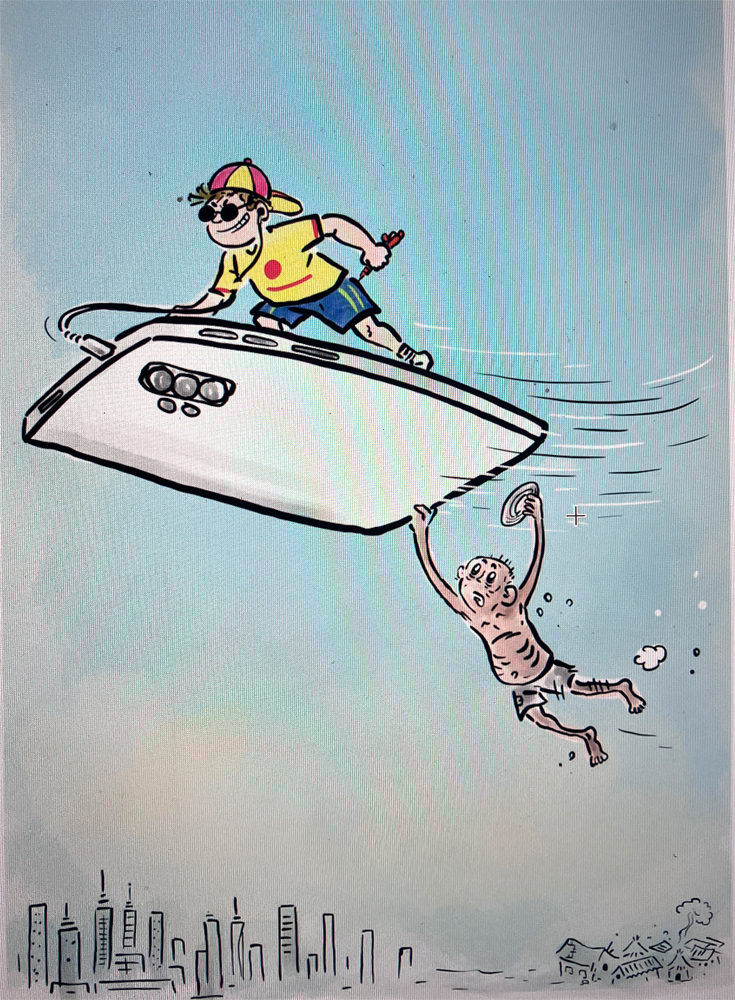












 Tim Unwin's Blog
