I am so very grateful to Tom Wambeke and the team at the Innovation Lab at the ITCILO (International Training Centre of the International Labour Organisation) who hosted a pre-launch event for my upcoming book, Digitial Inclusion in an Unequal World: an Emancipatory Manifesto on their magnificent campus in Turin on 1st December. It was a very special event – I have to admit to having been even more nervous than usual beforehand – and I was very humbled by the contributions of Tom himself, Ugo Vallauri, Ed Canela, Juan Carlos de Martin (Nexa Centre for Internet and Society, Polytechnic of Turin), and Fabio Nascimbeni (European Training Foundation), who were all most generous in their reflections. A copy of my presentation focusing on the UN and Innovation is available here.
Ugo VallauriFabio NascimbeniJuan Carlos de MartinEd Canela
It was also very special to have been inducted as the fifth person in the Innovation Lab’s Hall of Fame, for which I had to come up with a quotation that summarised my work. I’m most grateful to Tom and the team for this, and especially to the designer and graphic artist who put the plaque together!
The ITCILO campus is a very special place, on the southern outskirts of Turin, and it has a magical calm about it. What a great place for representatives of governments, private sector companies and labour organisations to come together to discuss important issues about the future of work! I happened to be there at the same time as their 2025 Winter Forum on Demographic Transitions: Understanding the Impact of Demographic Transitions on the World of Work, and I am so grateful to Rute Mendes for inviting me to contribute a short keynote in her session on 4th December. I spoke on “Reflections on digital tech and the demographic transition“, and my short presentation is available here.
Thanks again to everyone at the ITCILO who made this such a special visit to Turin.
I have previously written at some length about why the UN Secretary-General’s Global Digital Compact (GDC) is a deeply flawed agenda.[i] I will not repeat those arguments in detail here, but they do provide important context for the comments that follow. The first revision of the GDC text, published on 15 May 2024, provides a useful opportunity to review progress, and assess once again its strengths and fundamental weaknesses. This is timely following the recent WSIS+20 summit in Geneva, where many people I spoke with seemed to be vehemently against the GDC in private, but few were willing to make public statements about it – other than those with a vested interest in its agenda.
In summary
The essence of the GDC – and why it is so flawed – is captured in its scene setting opening paragraph:
1. Digital technologies are dramatically transforming our world. They offer immense potential benefits for the wellbeing and advancement of people, societies, and for our planet. They hold out the promise of accelerating the achievement of the Sustainable Development Goals.
There are three fundamental reasons why this is so problematic:
First it adopts and propounds an instrumental view of digital tech, claiming that these technologies are transforming our world.[ii] There has in contrast been much literature in recent years that emphasises that it is not the technologies that are actually doing this, but rather that these changes are caused, deliberately and also perhaps sometimes unintentionally, by those who conceive, design, produce and sell them.[iii] It is these people, those I often refer to as the Digital Barons,[iv] and their acolytes (or “knights” – not necessarily in shining armour) who are actually the ones changing the world. We must focus on them, rather than the technologies they create, if we wish to gain a sounder understanding of the causes of change, and therefore what we have to do to rectify them.
Second, this opening paragraph’s claim that “They offer immense potential benefits for the wellbeing and advancement of people, societies, and for our planet” tells but half the story. Digital technologies are designed and used to do both harms and positive things, but this scene-setting statement chooses only to focus on the latter. It thereby reinforces the widespread focus by those promoting the view that digital technologies (as well as science and innovation more generally) are inherently “good”. This is nonsense. There is some recognition later in the first revision draft of a small number of potential harms caused by digital tech, but by failing to call this out in the opening paragraph those drafting the document reinforce the view that the harms are somehow an aberration, and that digital tech is inherently good. Harms are central to digital tech.
Third, those drafting the document link the GDC directly to the achievement of the SDGs and Agenda 2030, seeing digital tech as a saviour that will magically accelerate their success. Connecting everyone in the world, even if that were possible, would not necessarily solve the problems of poverty and inequality. It might actually make them worse. The SDGs were fundamentally flawed in their design and very few of them have any hope of being achieved by 2030. Not only is the economic growth agenda underlying them actually causing greater relative poverty in the world, but the use of digital technologies is also at the heart of this accelerating inequality and the increased damage being caused to the natural physical world. It is time to start looking beyond 2030 if we are to have any hope of making the world a better, more equitable, and nature-friendly place for humanity.[v]
The opening paragraph of the GDC did not have to be written in this way. It could have been drafted to reflect a completely different understanding of the use of digital tech in our societies, but that would not have served the coalition of interests between global capital and the UN Secretary-General’s Office that lie at the heart of the GDC.[vi]
These introductory concerns suffuse the whole document and summarise the main reasons why I see the GDC as actually being harmful to the interests of the poor and marginalised. The next sections go on to address in more detail some of the problems associated with GDC in terms of its novelty and claimed necessity, its use of language, and its modality of delivery. The penultimate section then notes some of the more positive attributes of the draft, before the final section highlights its most egregious aspects.
There is little if anything new about the GDC.[viii] We have been discussing these issues for at least a quarter of a century, and there is a wealth of material written about them, not least generated by existing entities such as the WSIS Process, the Internet Governance Forum and ICANN. Yet much of this does not seem to be sufficiently recognised in the GDC first revision.[ix] It is almost as though the UN Secretary-General and those in his Secretariat have recently discovered the importance of digital tech, yet know very little about it, and nevertheless wish to claim leadership over the global digital-development agenda. This revised version of the GDC reads much like a partial synthesis of existing knowledge in the field, rather than a significant proposal to create an innovative, wise and forward looking document.[x]
Moreover, para 70 has the audaciousness to propose that “We recognize the role of the Secretary-General in leading UN system-wide collaboration on digital and emerging technologies”. Why should the UN Secretary-General, who is already very busy, and appears to have little in-depth knowledge about the interface between digital tech and development, be charged with leading this, when there are many other people in the UN system (not least DGs or SGs of UN agencies) who have many years of good experience and understanding in this field and would be better suited to the task?[xi] It is positive that he appears to have recognized the importance of the ways through which digital technologies are being used to create a new type of world, but surely the Secretary-General of the United Nations should be delegating this to someone else more experienced for the task and be focusing instead on the fundamental purposes of the UN, such as those articulated in Article 1, Paragraph 1 of the UN Charter, which emphasises the core purpose of the UN as it relates to peace:
“To maintain international peace and security, and to that end: to take effective collective measures for the prevention and removal of threats to the peace, and for the suppression of acts of aggression or other breaches of the peace, and to bring about by peaceful means, and in conformity with the principles of justice and international law, adjustment or settlement of international disputes or situations which might lead to a breach of the peace”.[xii]
This is to my mind a much more pressing need for the world in the mid-2020s, than is his attempt to take a lead on the global discourse on digital tech.[xiii]
Language and intent
There are also very real issues with the language used in the document, particularly from a legal perspective. Two key issues need further consideration: the distinction between “must” and “will” in the wording; and also who “we” actually refers to.
There are seven uses of the word “must”,[xiv] and 36 uses of “will” in the GDC First Revision. Generally in contractual parlance, “must” is used to impose an obligation, whereas “will” is used to refer to something in the future, but not necessarily to create an obligation, although the context of any such usage has important implications for its meaning.[xv] Although some will see many of the “musts” and indeed the “wills” in the GDC as desirable, it is unrealistic to think, for example, that any government (see below on who “we” are) could agree to a document that requires them to agree to all of the “musts” or even more loosely to all the “wills”. Some may aspire to many of these, but aspiration is fundamentally different from agreeing that they “must” do something.
Even more concerning is that nothing is said in the document about what might happen to a country, UN agency, or other entity that fails to deliver on an obligation relating to a “must” (or even a “will”). Furthermore, none of the “musts” appears to be time-bound in the document, and so are presumably meant to be started, if not completed, forthwith, and certainly by 2030; most of the “wills” are likewise merely aspirational, without any time limit.[xvi] Ten of the paragraphs in the GDC relating to commitments do specify a date, as in “we commit by 2030 to”, but another eight merely say “we commit to”. It is unclear whether this distinction between must and will is a result of loose drafting, or whether a distinction in meaning is indeed intended.
There is also ambiguity in the meaning of the words “commit” and “commitment” in the text. Overall, there are 63 commitments listed under the headings “we commit by 2030 to” and “we commit to”, but the character of these commitments varies from vague aspirations such as “increase the availability of digital technology platforms…:” (para 13b) and “Foster an open, fair, inclusive and non-discriminatory digital environment for all” (para 21a), to much more precise ones such as “Develop, through multistakeholder consultations, effective methodologies to measure, track and counter sexual and gender-based violence which occurs through or is amplified by the use of technology” (para 30e). Most are on the decidedly vague side, and despite a commitment in para 9 to “pursue meaningful and measurable actions”, no clear criteria are given to measure any of the commitments. It is difficult to see how anyone could agree to something that is not clearly defined and has no real means of evaluating whether or not it has been successful.[xvii] Most of the aspirations when looked at in detail are also unattainable.
Second, it remains very unclear as to exactly whom the word “we” refers in the Global Development Compact. The Office of the UN Secretary-General’s Envoy on Technology (OSET) states that “The Common Agenda proposes a Global Digital Compact to be agreed at the Summit of the Future in September 2024 through a technology track involving all stakeholders: governments, the United Nations system, the private sector (including tech companies), civil society, grass-roots organizations, academia, and individuals, including youth”.[xviii] Those attending the Summit are defined as “world leaders”,[xix] which narrows the field a bit, but is noticeably rather in contradiction to the GDC’s claim to include “grass-roots organizations, academia, and individuals, including youth”. In practice, Resolution 76/307 of the UN General Assembly on the modalities for the Summit of the Future makes clear that the action-oriented outcome document of the Summit will be agreed by consensus through intergovernmental negotiations (para 4), and therefore implies that it is governments who will make the final decisions. Given that the Summit is due to be held on 22 and 23 September, only three and a half months away, it is difficult to see how this might be achieved. Moreover, throughout the GDC there is mention of the importance of “multistakeholderism”[xx] (better as “multi-sector approaches”[xxi]) and language as noted above that implies a diversity of stakeholders must be included. This is recognised in Resolution 76/307 para 11 which requests the President of UNGA to draw up a list of relevant others who might participate in the Summit. At one level, it appears that “we” means everyone involved, at another it seems to imply governments, and at another UN agencies with the UN Secretary-General at the helm (as noted above). Reaching agreement amongst governments, the private sector and civil society about the complexity involved around the future governance of digital technologies by the deadlines required for the Summit seems palpably unrealistic. In practice, it is likely to be governments, heavily influenced by the private sector and global corporations, who will make the decisions. There is no guarantee that this will be in the interests of the vast majority of the world’s peoples, and especially of the poor, weak and marginalised.
Practicalities of delivering the GDC
Reaching agreement on the conceptualisation of the GDC is bad enough; putting any agreements into practice would be even worse. Who will serve as its Secretariat and be responsible for delivery ? How will entities actually make their commitments? How will these be monitored and reported? Who will pay for the very significant costs involved?[xxii] What will happen if an entity fails to deliver all the “musts”, “wills” and commitments”?
It is difficult to see how any single body could oversee and deliver all of the 63 GDC commitments, especially by 2030. Although it is not made explicit in the draft, the imprimatur that it gives to the UN Secretary-General would suggest that one option could be that it is intended for it to be delivered by OSET.[xxiii] However, the staffing of this office would seem to be insufficient in both quantity and relevant experience to be able to deliver on such an undertaking. While some people working within the orbit of the Office, mainly in an advisory capacity, do indeed have considerable expertise relevant to “digital and development”, this is by no means true of many of the staff there.[xxiv]
It is therefore good to see that the first revision of the GDC does indeed make reference to “building on” some of the existing UN structures that do indeed address these issues. This is welcome news, and runs counter to some of the earlier talk suggesting that the UN Secretary-General’s office was seeking to take central control over the future of digital tech and development. WSIS is thus mentioned 8 times, and it is reassuring to note that it states explicitly in para 5 that “We remain committed to the outcomes of the World Summit on the Information Society (WSIS) reflected in the Geneva Declaration of Principles and Plan of Action and the Tunis Agenda for the Information Society”. Likewise, the Internet Governance Forum (IGF) is mentioned four times, including the suggestion that “We consider that the Internet Governance Forum has a key role to play in amplifying the Compact’s purpose and objectives to a global multistakeholder constituency through its national and regional networks” (para 73). Such statements though, do not go far enough in challenging the perception that the GDC process is merely reinventing the wheel, is unnecessary, and is making the same mistakes that previous efforts to reach global agreements around digital tech have made in the past. They also still suggest that WSIS, the IGF, and other processes such as the United Nations Commission on Science and Technology for Development (CSTD) should be subservient to the Compact. Why is the Compact needed if it does not actually have the capacity to deliver anything worthwhile and substantive?
On the bright side
The first revision of the GDC does have some elements that many people will find welcome. Not least, this is because it repeats much of what has been said previously in numerous global fora about the governance of digital technology and its interface with international development.
Its five unexceptional main objectives are to:
“Close all digital divides and accelerate progress across the Sustainable Development Goals;
Expand inclusion in and benefits from the digital economy for all;
Foster an inclusive, open, safe and secure digital space that respects, protects and promote human rights;
Advance responsible and equitable international data governance;
Strengthen international governance of emerging technologies, including Artificial Intelligence, for the benefit of humanity”.
Nevertheless, the wording of some of these is deeply problematic for the reasons outlined in my introduction above, and are discussed further in the next section.
There are also numerous, small items of detail that can be welcomed:[xxv]
The potential of new risks to humanity (para 3), although note that these tend to be phrased as exceptions or aberrations, rather than as fundamental characteristics of digital technologies;
Shared responsibilities that are necessary to anticipate and mitigate risks (paras 3 and 63), although little is said about the practicalities and partnerships necessary to deliver this;
The emphasis placed on inclusive, open, safe and secure digital space (Objective 3, paras 14, 22-35), although many of these are aspirational and again fail to recognise sufficiently the explicit and deliberate harms caused by the design and use of much digital tech;
The attention paid to accessibility and affordability (para 8g), although even here the assumption is about full participation (which serves the interests of global capital and surveillance), and ignores the notion of the “right not to be connected”;
Developing and agreeing principles for environmental sustainability (paras 8e and 47), although there is an urgent need to go much further than what is anticipated here in the GDC and Summit of the Future more broadlyt;[xxvi]
The need for robust cyber-security and information integrity standards and capacity (paras 20, 28, 30, 32, 34, 35), although the scale of what is required here is not sufficiently emphasised;[xxvii] it is also especially positive to see the emphasis that is placed on child protection (paras 23c, 31c);
The emphasis on “human rights”, mentioned 32 times will be welcomed by many, but there is also a need for this to be balanced by an equivalent emphasis on “human responsibilities” that redresses the focus away from the individual and towards the community;[xxviii]
The attention paid to the gender-based abuse, and especially to sexual violence (paras 29-30), although this needs to emphasise that it is across the full spectrum of gender identities, and that such violence also occurs to many other minorities who require equal attention and protection;
The protection of privacy (para 38a), although this increasingly seems a lost cause; it is good to see para 38d highlighting that “data collection, access, sharing, transfer, storage and processing practices are transparent, secure and in compliance with international law”; and
The emphasis placed in Objective 5 (paras 47-61) on the governance of emerging technologies; although as discussed further below this is rather limited in scope
Why “into the long grass” is a good option for kicking the GDC[xxix]
If some people enjoy spending time on developing initiatives such as the GDC, think that it serves their own interests, and can find people to fund the process, then who is to stop them? However, no-one should be under any impression that the proposed GDC document and process will make any significant difference to, or improve the lives of the many. Rather, as hinted at the beginning of this piece, it largely reflects an intriguing attempt to include and balance the power between global capital and national governments. It is a document that serves the interests of the rich and powerful against the poor and the weak and the marginalised. The best thing that could happen to it is that governments and UN agencies should reject it outright and condemn the UN Secretary-General and his acolytes for having wasted so much time and money on a vanity project.[xxx] That is hardly likely to happen, and so the second-best option would simply seem to be to kick it into the long grass. The UN has an uncanny knack of being able to do this, and so it is perhaps the optimal outcome that can be expected.
The fundamental problem with the GDC is that it is a product of a global system that has become ever more focused on serving the interests of those with power, especially the digital barons and the countries where they choose to live, at the expense of the world’s poorest and most marginalised people. It is premised on the basic assumption that digital tech is inherently good. This is fundamentally flawed. Most digital tech is developed and designed to enslave as many people as possible, so that profit can be extracted from them. In so doing, it also has devastating negative impacts on the environment. Many people are happy with this, and see it as being positive. I do not see it in this way, and I believe passionately that the global community (if such a thing still exists, or has ever existed) needs a fundamental rethink about digital tech if we are indeed to have a future.
As I argued in my earlier critique on the origins of the Global Digital Compact in April 2023, if it were to exist at all, it should be forward looking and far reaching focusing on three core challenges:
The fundamental changes taking place in the relationship between machines and humans (focusing more on cyborgs than on the latest digital-fetish, AI);
The fundamental implications for the environment as a result of the techno-digital-innovation complex that we are deliberately creating and thus our survival on planet earth; and
The increased enslavement (loss of freedoms) of humans by machines and their designers (I here leave open the option that the machines may one day design themselves).
On a more practical note, many aspects of the present framing of the Global Digital Compact are deeply problematic, and it if were to be adopted would make the matters it claims to want to solve even worse. In addition to the three main problems embedded in the opening paragraph, and summarised at the start of this piece, the most significant of these are (in broadly chronological order as they appear in the first revision document):
Its emphasis on human rights (first in para 5, and then mentioned 31 further times; see also above) is deeply problematic because it fails sufficiently to address the responsibilities or obligations of governments and individuals. Furthermore, it creates a tendency to focus on individual rights rather than communal responsibilities.[xxxi] In essence, the present rapid expansion of the use of digital tech in most people’s lives is deeply threatening to many kinds of “freedom”,[xxxii] and can thus be suggested to be inherently harmful to existing human rights law. It is either näive or deliberately misleading to claim that “Our cooperation will harness digital technologies to advance these rights”.[xxxiii]
The notion of digital divides in para 7(1) (and 7 further times; see especially Objective 1, paras 10-17, and para 22) has long ago been shown to be deeply problematic.[xxxiv] Digital tech is actually being used to increase inequality and thus divides, and so it cannot be claimed that these can simply be closed thrieugh further use of digital tech. We need to recognise that its untrammelled use causes inequalities at all scales.
The claim that the cornerstone of the Compact is inclusivity in para 8(1) (and 18 further mentions of “inclusive) ignores the realty that the poorest and most marginalised do not have a voice in such forums. Despite some efforts by the UN system to include diverse voices, and representation from all states, it remains (and is likely to do so in the future) the case that governments of small and poor states cannot afford (both in terms of time and funding) to participate in many such international gatherings on digital tech.[xxxv] Moreover, it is extremely difficult for most civil society organisations to stand up to the physical and financial weight of private sector companies in participating in such “multistakeholder” gatherings.[xxxvi]
The conceptualisation of development embodied in the SDGs and Agenda 2030, as mentioned in para 8(b), is essentially grounded in an ideology of economic growth that actually increases relative poverty.[xxxvii] The notions of eradicating poverty and leaving no-one behind therefore become unachievable and meaningless. Relative poverty will always be with us; it is an inalienable accompaniment to the ecomomic system that we have created, and will only be made worse through expanding the use of digital tech in its present modality.[xxxviii] Using phrases such as “Emerging technologies offer new opportunities to turbocharge development” (para 8i) are undoubtedly true, but ignore the fact that these will also dramatically increase inequality and exploitation of the poor.
The claims in the Compact over the potential of digital tech to “empower all women and girls” (para 8d) are ill-considered and illusional. Women and girls cannot all be empowered when there are so many men who are hostile to this and do not understand what they need to do to change their mothers’, sisters’ and daughters’ lived experiences. Moreover, digital tech is usually used to accentuate existing socio-economic and cultural characteristics: where there is equality it can help to maintain this, but where there is inequality it is usually used to exaggerate it.[xxxix]
The Compact’s focus on environmental sustainability (first mentioned on para 8e, and then twice afterwards) is at best over-simplistic. It pays insufficient attention to the very significant harms that are caused to nature and the physical environment by the design and use of digital tech. To be sure, digital tech can be used positively to reduce carbon emissions and monitor environmental change, but the UN needs to adopt a very dramatic change of approach to this issue if real environmental sustainability is to be achieved, such as the holistic approach proposed by the Digital-Environment System Coalition (DESC).[xl] The compacrt’s aim, for example, to achieve “net-zero” (presumably meaning net-zero carbon emissions) takes no cognizance of the other environmental harms that will be caused in seeking to do so.
As noted above, private sector interests lie at the heart of the GDC, as evidenced by paragraphs such as the principle 8(j) “Innovation-friendly: Creativity and competition drive digital advances. Our cooperation will foster innovation and the potential for societies and businesses, regardless of size or origin, to reap the benefits of digitalization and thrive in the digital economy”. This is where the true interests behind the GDC are to be found, and do not provide the basis for a better world. Para 11(b) for example, places emphasis on new methods of funding, which in effect are designed to reduce the costs for the private sector in rolling out digital interventions from which they will reap profits.[xli]
The emphasis on capacity building in digital skills (para 13a), especially for women and girls (para 13c), is open to many different interpretations. In the context of the GDC, it seems as if this refers primarily to enabling everyone to have the skills to contribute to the digital economy, thereby increasing economic growth. However, it is essential that it also means training people in the safe wise and secure/private use of digital tech, so that they can limit the very significant harms that can be caused to them through such use. While the Compact does indeed refer to the importance of cyber security, again this seems to be primarily in the importance it has for the digital economy (see, for example, paras 20, 21i, and 13e ), rather than for the life-changing personal harms that its use can cause.[xlii]
The use of the term “best practices” (7 times) persists in the myth that such things exist.[xliii] The term is almost always used by some individual or entity wishing to promote (or more usually sell) their particular approach to as large a market as possible, preferably universally (hence “best”). In reality, there are many good practices that people or governments can choose from and adapt to implement something that works well in their local context.
The proposed commitment by 2030 to “Foster an open, fair, inclusive and non-discriminatory digital environment for all” (para 21a) is deeply problematic. Much depends on how the word “foster” is understood, but it is totally impossible for an open, fair, inclusive and non-discriminatory digital environment for all to be achieved by 2030. Moreover, there is no evidence or proposed mechanism to support how this might be achieved. As argued before in this piece, the digital tech companies thrive on inequality, and have shown little evidence of designing technologies that could deliver on such an aspiration, however desirable it might be.
The commitment to “Refrain from Internet shutdowns and ensure that any restrictions are in full compliance with international law, including with the principles of legality, necessity, proportionality and non-discrimination” (para 28d) may be well-meaning, but it is remarkably naïve to think that all governments and potentially malicious actors would agree to such a constraint.
Para 31 is problematic when it states “Call on digital technology companies and developers to engage with users of all ages and backgrounds to incorporate their perspectives and needs into the life cycle of digital technologies”. It is unclear why tech companies should consult babies (or old people in advanced stages of vascular dementia and Alzheimer’s disease) to understand their perspectives (see para 31a).[xliv] To be sure their interests should be considered, but as with so much of the document the actual wording lacks precision and is open to multiple interpretations.
The suggestion that “we” urgently need to “Call on social media platforms to enhance the transparency and accountability of their systems” (para 35) seems to lack the necessary bite, and avoids difficult questions around regulatory environments that different widely in various parts of the world. Yes, social media companies must be made to be more transparent and accountable, but just “calling on” them is unlikely to make any significant difference. Likewise it also seem far too late to try to “Empower individuals and groups with the ability to consider, give and withdraw their consent to the use of their data and the ability to choose how that data is used” (para 38). Although this is highly desirable, it seems completely unfeasible across every country in the world.
Why do we need yet another scientific panel on AI and emerging technolgies (para 53a), and what does it mean that this should be under the auspices of the UN? There are already countless forums where such issues are discussed, not least within UN agencies such as UNESCO and the ITU; there is no need for yet another one. Moreover, if this actually means that it should be under the auspices of the UN Secretary-General, there is little justification for it, and it would therefore largely seem to represent yet another power-grab by those surrounding him.[xlv] Can the UN affrd the proliferation of such bodies?
Why does para 58 use the inappropriate and divisive terminology “North-South, South-South and triangular collaboration”, when the word “global” would suffice? The use of such terms implies geographical determinism that is innacurate and unhelpful.[xlvi]
Ultimately, much of the document would seem to be based on the requirement for more funding to be made available to those wishing to implement and benefit from the contents of the GDC. This is acknowledged directly in para 65 which is a plea for governments, international financing entities, and companies to make financial pledges in support of the Compact. Such pledges are notoriously hard to monitor, and their precise impact is almost impossible to measure. Some companies may wish to contribute to raise their visibility in apparently “doing good”, and further contributing to the SDGs, but in practice they will also largely be the ultimate beneficiaries.[xlvii]
In conclusion
The processes leading to, and the first revision of the Global Digital Compact text are part of the problem and most definitely not a solution for the future use of digital technologies in the interests of everyone living in the world and those yet to be born. It is an outcome of the processes leading to the global digital crisis that gave rise to its birth. Those involved in crafting it are those resposible for the crisis. They are incapable of shaping a solution that will serve the world’s poorest and most marginalised peoples.
It is time for a fundamental rethink of the role of the UN Secretariat and its Secretary General. The issues that the Global Digtial Compact seeks to resolve are already being discussed by every UN agency, and by the governments of countries across the world. There is no need for this Global Digtial Compact. The document is deeply flawed, and for the reasons discussed above will not achieve its proposed outcomes. It is primarily a product of the coalition of interests between private sector companies and the UN system that serves both at the expense of the world’s poorest and most marginalised people and communities.
Its failure lies above all else in its genesis, and is well summarised by its opening paragraph. If we, the global we, are indeed to move forward, we need to recall that digital technologies have no power of themselves, that they can be used to do much harm as well as good, and that the economic growth model at the heart of the SDG agenda will never serve the interests of the world’s poor.
[v] Note too that the allocation of SDGs to many paragraphs of the GDC often seems to be quite random and rather difficult to justify – although that is in part a fault of the SDGs themselves which are often difficult to differentiate.
[vi] Not least as they are represented in the Office of his Envoy on Technology.
[ix] Although see further below on the GDC’s claims that it aims to build on the work of entitites such as the WSIS Process and the IGF. It is hard to find anything that the GDC actually adds to existing processes.
[x] It would actually be an interesting experiment to use different General Purpose AI systems to draft such a document and see how it differed from that produced through the GDC consultation process. Perhaps all of the submissions could be entered into such a system and a new draft constructed from them.
[xi] To be sure, Guterres graduated in the early 1970s with a degree in engineering, but neither this nor his subsequent career would seem to make him suitable to lead UN system-wide collaboration on digital tech. Having graduated, he worked briefly as a physics instructor and joined the Socialist Party in 1974. In 1976 he was elected to parliament, and became very much more active in national politics and the wider international Socialist movement, eventually becoming Prime Minister in 1995 (serving until 2002). Although focusing particularly on the economy, finance, planning and territorial administration, his time in politics provided him with little experience in digital tech and development. Thereafter, his UN experience from 2005 was likewise almost exclusively as High Commissioner for Refugees (a role he served in until 2015), and again in this capacity he had little real opportunity to become a global specialist in digital tech and development. See Britannica (2024) António Guterres https://www.britannica.com/biography/Antonio-Guterres, and United Nations Secretary-General biography https://www.un.org/sg/en/content/sg/biography (7 June 2024)
[xiii] The revised draft of the Pact for the Future, which is the core document of the UN Secretary General’s Summit of the Future rightly has Peace and Security as one of its key objectives (Section 2), but it is salient to note that the GDC is one of only two banner headings/sections on the summit’s website, the other being the Declaration of Future Generations. More generally, the Pact for the Future also suffers from many of my criticisms of the GDC. Although it claims to focus on the practicalities of how we can together create multilateral solutions for a better tomorrow, most of it is vague and aspirational, with very little chance of having any real impact in terms of improving the lives of the world’s poorest and most marginalised peoples.
[xiv] GDC First Revision, Para 2 “Our cooperation must leave no one behind and increase the potential for all states, communities and individuals to fully harness the benefits of technology”, para 6 “Our cooperation must be agile and adaptable to the rapidly changing digital landscape”, para 8c “All human rights, including civil, political, economic, social and cultural rights, and fundamental freedoms, must be respected, protected and promoted online and offline”, para 8l “Our cooperation must be capable of identifying, assessing, tracking and adapting to emerging technologies”, para 12 “…we must ensure that people can meaningfully use the Internet and safely navigate the digital space”, para 26” We recognize that the Internet is a critical global facility for inclusive and equitable digital transformation. To fully benefit all, it must be stable, secure and unfragmented”, and para 29 “We must urgently prevent and address sexual and gender-based violence which occurs through or is amplified by the use of technology, all forms of hate speech and discrimination, mis- and disinformation, cyberbullying and child sexual exploitation and abuse”.
[xvi] Only four of the “wills” (two in para 11 and two in para 43) are in sections relating to commitments by 2030.
[xvii] The document does make brief mention of the set of targets developed by the ITU and the Office of the UN Secretary-General’s Envoy on Technology developed in 2022 https://www.itu.int/itu-d/meetings/statistics/umc2030/ (although little has yet been heard on the progress that was meant to be achieved on these by 2026), but does so in rather general terms of commitment to “Agree on common targets, indicators, and metrics for universal meaningful and affordable connectivity, building on the work of the ITU, and integrate these into international, regional and national development strategies” (Para 11(a)). Interestingly, targets are only specifically mentioned in two other places in the GDC First Revision.
[xx] There are numerous mentions in the GDC of multistakeholder (10, and one mention of multi-stakeholder) engagement, the private sector (14), civil society (5), and academia (2), and the implications for their potential engagement in the GDC process. A key problem of the GDC is that there is next to nothing about the precise mechanisms for such collaboration and engagement, and nothing about the penalties that those who fail to adhere to its principles will face.
[xxii] Paras 60 and 61 thus refer to the Global Fund AI and Emerging Technologies for Sustainable Development, which “should be put into operation with an initial amount of 100 million US dollars at launch in 2025, financed by voluntary contributions from public, private and philanthropic sources”. This seems largely to be a means of creating extra funding for private sector companies to roll out these new technologies to the poorer countries of the world, thus enhancing their markets and increasing their profits.
[xxiv] It is difficult to identify the exact numbers of staff involved in OSET, and the website of the Office of the Secretary-General’s Envoy on Technology does not provide their details. LinkedIn nevertheless mentions between 11 and 50 staff: https://www.linkedin.com/company/un-tech-envoy (10 June 2024))
[xxv] The paragraph numbers are not exhaustive but merely illustrative.
[xxvii] A strong case can be made for shifting towards an attitude where all digital tech should be considered first as a threat, rather than thinking that it is actually good and that harms are an aberration.
[xxix] Rejecting the GDC outright would save governments and the peoples of the world a great deal of time that could be better spent doing other things, but as with so many global summits and agendas few people want to rock the boat too much, and it is easier simply to kick them into the long grass by agreeing to parts of documents in general terms subject to further revision and discussion.
[xxx] This was not my term for it, but was suggested to me by a good friend and colleague attending the WSIS process in May 2024.
[xxxiii] The commitment to “Establish appropriate safeguards to prevent and address any adverse impact on human rights arising from the use of digital and emerging technologies” (para 23b) is naïve and completely unachievable, and shows little understanding of how and why digital technologies are designed and used. It should be removed, or rephrased to be more realistic of what can actually be delivered.
[xxxv] See also, for example, para 37 calling for “the equal participation of all countries” in international data governance. Although this might be desirable, it is completely unrealistic.
[xxxvi] As noted above the term “multi-sector” is far preferable to “multistakeholder” when collaboration between governments, the private sector and civil society are being referred to. It can also be noted that many civil society organisations have been co-opted by corporations to their agendas, and are no longer realistically an independent voice.
[xxxvii] See also, for example, claims that AI has immense potential “to accelerate progress across all the SDGs”. Little is said about the enormous harms that could be created by so doing.
[xxxviii] It is also salient, and interesting, to note that in the Bible Matthew 26:11 reports Jesus as having said “The poor you will always have with you”. For further on relative and absolute poverty, as well as on economic growth and inequality, see my 2010 piece Development as ‘economic growth’ or ‘poverty reduction’, as well as my 2007 critique of Jeffrey Sachs’ work in “No end to Poverty”, Journal of Development Studies, 45(3), 929-953.
[xxxix] See the work of our TEQtogether initiative which involves men and women working together to transform men’s attitudes to women and technology.
[xl] See, for example, our recent contribution to the WSIS+20 meeting in Geneva in May 2024.
[xli] Typical of these are initiative such as Giga (para 11b) which inter alia make it cheaper for companies to exploit education systems and the data they glean from children and teachers across the world. Expanding the market lies at the heart of the capitalist economic system that underlies such practices.
[xlii] It is good, therefore, to see mention of cyberbullying and child sexual exploitation in para 29, but much more attention could be paid to such harms throughout the document.
[xliv] This para reads: We… “Call on digital technology companies and developers to engage with users of all ages and backgrounds to incorporate their perspectives and needs into the life cycle of digital technologies”.
[xlv] Similar arguments would apply to para 53(b) which commits to the UN creating an an International Contact Group on AI Governance.
[xlvii] The most sensible option would seem to be for no-one to provide any financial support for the Compact, which would be one way of kicking it into the long grass, and then the only wasted money would have been the cost of having drafted and discussed it at the Summit of the Future.
I have frequently been asked in recent weeks about my thoughts on the UN Secretary General’s Global Digital Compact (GDC). It is far from easy to summarise these, not least because the actual compact is not due to be agreed until the “Summit of the Future” in September 2024. Any such comments can therefore only be about its overall objectives and the process so far. However, I am deeply sceptical of both, and consider the compact to be fundamentally flawed in concept, design and practice. In essence, it largely reflects an elitist view, dominated heavily by the corporate tech sector, focused on a technologically deterministic ideology, that will do little or nothing to serve the interests of the poorest and most marginalised.[i]
For those who don’t have time to read this entire post, it argues in essence that:
The Global Digital Compact is a result of the ways in which the ideologies and practices of digital tech companies have come to dominate UN rhetoric arounddigital tech;
The issues it addresses, the questions it asks, and the ways in which the consultation is constructed, largely serve the interests of those companies, rather than those of the world’s poorest and most marginalised individuals and communities; and
It fails to address the most significant issues pertaining to the role of digital tech and the science underlying it, notably the future relationships between machines and humans, the environmental harms caused by the design and use of digital tech, and the increasing enslavement (loss of freedoms) of the majority of the world’s people through and by the activities of digital tech companiesof all sizes.
For the long read, read on… (also available as a .pdf here).
Context of the Global Digital Compact.
As the Digital Watch Observatory has so accurately commented, “The GDC is the latest step in a lengthy policy journey to have, at least, a shared understanding of key digital principles globally and, at most, common rules that will guide the development of our digital future”. Like all such initiatives, however, it reflects a very specific set of interests, and it is helpful to begin by briefly trying to unravel these.
There has been concern for a long time about the increasingly large number of overlapping international multi-stakeholder gatherings that have been created by different interest groups to discuss the interlinkages between digital tech and human life (for a detailed discussion of the origins of these, see my Reclaiming ICT4D, OU, 2017). Three are particularly interesting: ICANN, WSIS, and the IGF. The Internet Corporation for assigned Names and Numbers (ICANN) created in 1998 was initially designed as a mechanism to transfer the policy and technical management of the DNS to a non-profit organisation based in the USA, and largely reflects private sector interests in the Internet. The World Summit on the Information Society (WSIS) process began with Summits in Geneva and Tunis in 2003 and 2005, that brought together UN agencies, governments and the private sector, and has since evolved to discuss and report on 14 action lines relating to the “information society”. In large part it serves the interests of UN agencies responsible for delivering on these in the context of the SDGs. The claim that WSIS initially placed insufficient emphasis on the needs and interests of civil society led to the foundation of the Internet Governance Forum (IGF) first convened in 2006 essentially as a discussion forum without any direct decision-making authority.
WSIS, Geneva, 2003
All of these processes and institutions make claims to multi-stakeholderism (but define these in rather different ways), and all frequently discuss very similar themes and topics, again largely reflecting the varied interests of those participating. Many of the same people (or those who can afford it) are to be found at all three gatherings, discussing similar issues in similar cavernous conference centres. In addition to these three main international gatherings, countless other more focused series of gatherings and events are held, such as those convened by ISOC and IEEE, alongside the regular series of digital events convened by different UN agencies such as the ITU, UNCTAD and UNESCO, as well as specific conferences such as the ICT4D series or the GCCS London Process (Global Conference on Cyber Space) meetings between 2011 and 2017 that initially focused on cybersecurity. Again each of these represents and serves the interests and agendas of different interest groups.
A fundamental problem with the sheer quantity and frequency of these gatherings is that only large, powerful and rich entities are really able to participate in them all. Despite the efforts of many convenors to make some of these events more open and accessible, online and hybrid events have not yet really made a significant positive impact into opening up international discourse on digital tech and the Internet, so that small states and economically poorer entities can participate fully and effectively. Frustration with the proliferation of such meetings, and the urgency of the issues relating to digital tech for the planet and its human inhabitants has therefore precipitated calls for there to be a single, overarching framework for coordination. At first sight, this may seem to be a reasonable proposition, but it is essential to dig beneath the surface to understand the interests underlying the formulation of the Global Digital Compact, and its likely impact and conclusions. It is these interests that have shaped the new discourse, and especially the questions being asked in the ongoing global consultation due to close at the end of April 2023 These reflect a particular agenda, that will not serve the interests of the mass of the world’s population, and especially the poorest and most marginalised.
ICANN meeting in Singapore, 2014
Origins
I remember about a decade ago talking with a young and enthusiastic member of the UN’s Office of Information and Communication (OICT) who surprised me by saying that they intended to take over all co-ordination of digital tech within the UN system. He came from a technical background, and appeared to know little about the vast amount of work that had been done in recent years by those of us working at the interface between technology and “international development”. In origin, the OICT was essentially the entity providing UN personnel with appropriate digital tools and processes to collaborate effectively, and in my understanding at that time it was nothing to do with the UN’s support for global policy making or programme/project implementation relating to digital tech on the ground.[ii] Other UN bodies such as the ITU, UNESCO, UNDP, and UNDESA had years of experience in supporting global digital policy and practice. This conversation nevertheless reflected four crucial features: competition within the UN system; the power and ambition of people within the UN Secretariat based in New York (USA); the dominance of a technical and scientistic perspective; and the energy and arrogance of youth. I thought little more of this conversation, unwisely dismissing it as mere aspiration, that could not possibly succeed, especially given the good work being done on digital tech for development (or ICT4D) by my many good friends in other UN agencies. Little did I know then about some of the ways in which the UN system operates, and the interests that it serves.[iii]
At about the same time, there was widespread ongoing discussion within the UN system and beyond about the post-2015 development goals. I had personally argued vehemently that the world needed some very clear statements, and perhaps targets, relating to digital tech in the proposed new goals, but there seemed little appetite for this among most of those involved in shaping them.[iv] In my role as Secretary General of the Commonwealth Telecommunications Organisation (CTO), I nevertheless co-ordinated a statement on the role of ICTs in the post-2015 Development Goals by all of our members (mainly governments but also companies), which was published on 7 October 2014 laying out 8 principles, and proposing one goal and three targets. The document concluded that “For ICTs to be used effectively for development interventions, there must be affordable and universal access”. Ironically, it took the UN system (The Office of the United Nations Secretary-General’s Envoy on Technology and the International Telecommunication Union) until April 2022 to create a set of 15 aspirational targets for 2030 that were intended to achieve “universal and meaningful digital connectivity in the decade of action” (see further below). I cannot help but think that I should have pushed even harder for the proposal that we crafted eight years earlier within the CTO. If we had been able to achieve what we then proposed, much of the subsequent turmoil and wasteful infighting represented by the recent actions of the UN Secretariat could have been avoided.
In July 2018, the UN Secretary General’s office then announced the convening of a High-Level Panel on Digital Cooperation (HLPDC) “to advance proposals to strengthen cooperation in the digital space among Governments, the private sector, civil society, international organisations, academia, the technical community and other relevant stakeholders”.[v] It is not easy to identify exactly how and why this process was initiated, especially when reasonably good co-ordinating mechanisms already exist within the UN system, notably the Chief Executive’s Board (CEB) and the High-Level Committee on Programmes (HLCP).[vi] However, the composition of the Panel would seem to support the persistent rumours that a former President and CEO of ICANN might have persuaded the government of an Arab Gulf state, both with strong private sector connections, to lobby the UN Secretary General’s Office to create such a panel. The panel itself had 20 members, who according to its terms of reference were meant to be “eminent leaders from Governments, private sector, academia, the technical community, and civil society led by two co-chairs”.[vii] The two co-chairs (Melinda Gates and Jack Ma) were both heavily involved in successful private sector entities and had little prior engagement in implementing programmes that might beneficially impact the world’s poorest and most marginalised through digital tech. Although half of the panel were women, and there was indeed also some “youth” representation, the overall panel was almost exclusively made up of individuals from the private sector, rich countries, and academics with interests in innovation and the latest advanced technologies. Only three people had any substantial involvement with civil society, and the voices of the poor and marginalised, especially from small island developing states (SIDS) were largely absent. I would even venture to suggest that almost none of the panel had any real practical engagement on the ground with, or substantial understanding of, the use of digital technologies in international development, other than from a top-down, corporate or scientistic perspective (see more below). However, the small secretariat was led by two people, one of whom did indeed have substantial expertise and understanding of many of the crucial issues around the use of digital tech in development.
Once created the panel did then consult quite widely. As the Geneva Internet Platform (digwatch) summarised, “Between June 2018 and June 2019 the Panel organised several in person meetings, discussions, workshops, international visits to the Silicon Valley, China, India, Kenya, Belgium and Israel as well as online meetings”. This led to the publication in June 2019 of the panel’s short report The Age of Digital Interdependence.[viii]Many of the people participating in these meetings did indeed have good experience of the interface between digital tech and international development, and a considerable number of civil society organisations also participated in the discussions. However, I was struck by three things: first, the questions being asked mainly reflected the interests of the UN Secretariat and those on the panel; second there was very little new being said; and third the choice of countries visited excluded many of the poorest and most marginalised.[ix] Many, if not most, of the participants in the consultations were regular attendees at global gatherings such as the IGF, WSIS annual forums and ICANN meetings, and their collective knowledge already existed in the global community. It was fun to meet up with them again in a new virtual space, although many of us reflected during the process that we were just repeating what we had long been saying many times previously. There was absolutely no need to go to the expense and complexity of creating a panel of “experts” who actually had little real knowledge themselves of the key issues.
The outcome of these deliberations was nevertheless presented in June 2020 as the Secretary-General’s Roadmap for Digital Cooperation. In large part this reflects some fine work by the HLPDC secretariat in trying to mesh these discussions with existing and well-established principles of good practice in the field. The roadmap highlighted eight key areas for action:
Achieving universal connectivity by 2030—everyone should have safe and affordable access to the internet.
Promoting digital public goods to unlock a more equitable world—the internet’s open source, public origins should be embraced and supported.
Ensuring digital inclusion for all, including the most vulnerable—under-served groups need equal access to digital tools to accelerate development.
Strengthening digital capacity building—skills development and training are needed around the world.
Ensuring the protection of human rights in the digital era—human rights apply both online and offline.
Supporting global cooperation on artificial intelligence that is trustworthy, human-rights based, safe and sustainable and promotes peace.
Promoting digital trust and security— calling for a global dialogue to advance the Sustainable Development Goals.
Building a more effective architecture for digital cooperation—make digital governance a priority and focus the United Nation’s approach.
It is scarcely surprising that all of these had featured prominently in the WSIS Action Lines that were developed during and following the summits in 2003 and 2005. There was very little at all new in them, although of course they were presented as being novel and important.[x] Moreover, the roadmap also included the rather bizarre statement that “the United Nations is ready to serve as a platform for multi-stakeholder policy dialogue on…emerging technologies”.[xi] Somehow, the entire effort of UN agencies over the last decade, when the UN was already providing platforms for such dialogue seemed to have been quietly ignored. I have long puzzled over this, but on reflection it is only really intelligible in the context of my earlier discussion with staff at OICT. What it really seems to have meant was that the UN Secretariat under the Office of the Secretary General was now going to take central stage in providing that platform. This was reiterated in the UN General Assembly’s assertion in 2020 (GA resolution 75/1) that “the United Nations can provide a platform for all stakeholders to participate in such deliberations.” This only makes sense if it refers to the central Secretariat of the UN providing the platform.
The UN Secretary General then proceeded with establishing the office of his Envoy on Technology, and in January 2021 appointed the former Chilean diplomat and long-term UN official Fabrizio Hochschild[xii] to the role, despite being aware that complaints had previously been raised about his behaviour. If that was not worrying enough, immediately on his appointment Hochschild acknowledged on Twitter that he did not know much about the interface between digital tech and international development:
Five days after his appointment, Hochschild was placed on leave, pending an investigation into his behaviour, and a year later it was reported that he was no longer employed by the UN. It is very hard to understand how the UN Secretary General could have appointed someone with so little knowledge of the field, and with such a dubious track record of behaviour in the UN to such an important role.[xiv] Either it reflects incompetence, ignorance, or once again the effect of specific interests working behind the scenes within the UN system to achieve both individual and organisational goals.
The Office of the Tech Envoy nevertheless continued its work under the interim leadership of the Assistant Secretary-General for Policy Coordination and Inter-Agency Affairs. In September 2021 the UN Secretary General then produced his next report, Our Common Agenda, which followed on from GA resolution 75/1 a year earlier. This rambling (wide-ranging) and aspirational document was in part an attempt to salvage something from the impending wreckage of Agenda 2030 and the SDGs. As its summary states, “Our Common Agenda is, above all, an agenda of action designed to accelerate the implementation of existing agreements, including the Sustainable Development Goals”.[xv] The seventh of its twelve commitments was on improving digital cooperation, and slimmed down the earlier list of issues in the Roadmap… to seven key proposals forming an agenda for the new Global Digital Compact:
Connect all people to the internet, including all schools
Avoid internet fragmentation
Protect data
Apply human rights online
Introduce accountability criteria for discrimination and misleading content
Promote regulation of artificial intelligence
Digital commons as a global public good
However, Our Common Agenda says little as to how these are to be achieved. It has been fascinating to watch the activity of senior UN officials and their staff in different agencies scurrying to position themselves in response to these proposals, seeking to protect their existing portfolios of activities and gain advantage over others in delivering these agendas. The initiative has, though, in some instances also led to increased dialogue and positive collaboration between like-minded individuals and agencies.
Our Common Agenda thus provided the foundations for the Global Digital Compact which will be agreed at the ambitiously titled Summit of the Future in September 2024. The important thing to remember about this is the interests that underlie its creation as outlined above. These are primarily global capital, the advocates of neo-liberalism, and the rich and powerful states and para-statal entities, as well as the UN and its agencies. This is all too evident in the language used in Our Common Agenda. Some examples of this include statement such as:
“The Fourth Industrial Revolution has changed the world” (p.62). This is a damaging myth. The so-called 4IR is just a construct developed by those promoting a heroic vision of technological scientism, and it ignores the argument that the current rapid expansion of digital tech is merely a product of the existing logic of capitalism.[xvi]
“The Internet has provided access to information for billions, thereby fostering collaboration, connection and sustainable development” (p.62), largely ignoring the fact that it is also a means through which people are increasingly exploited and harmed (although see below).
The Internet “is a global public good that should benefit everyone, everywhere” (p.62), without recognising that the notion of global public goods is frequently used by those companies that can afford it to extract surplus profit and exploit users for their own corporate gain.
“Reaffirming the fundamental commitment to connecting the unconnected”, without acknowledging the rights of people to remain unconnected.
There are, though, importantly also some positive signs of a more nuanced and balanced approach to these issues in Our Common Agenda, including recognition that
“Currently the potential harms of the digital domain risk overshadowing its benefits” (p.62), although these harms are all too often ignored by those advocating a belief that digital tech is a solution to all the world’s problems, especially those relating to the SDGs.
“Serious and urgent ethical, social and regulatory questions confront us, including… the emergence of large technology companies as geopolitical actors and arbiters of difficult social questions without the responsibilities commensurate with their outsized profits” (pp.62-63). I would agree with this observation, although it is 20 years too late, and the horse has already bolted.
As well as driving the GDC forward, the Office of the Secretary General’s Envoy on Technology has over the last year also developed its nine areas of ongoing work, based largely on the Roadmap, and working with the ITU produced in April 2022 the new set of targets for universal and meaningful connectivity by 2030 referred to above. In June 2022, The UN Secretary General eventually appointed a new Tech Envoy who was none other than the Executive Director and Co-Lead of his High-Level Panel on Digital Cooperation, an Indian diplomat with a recent tech background in AI and lethal autonomous weapons systems.[xvii] Several months later in October 2022 Sweden and Rwanda were appointed as co-facilitators to lead the intergovernmental process on the Global Digital Compact,[xviii] and in January 2023 the process of consultation on the Compact began in earnest.[xix] Informal discussions were held with member states, observes and stakeholders in January and February 2023, and stakeholders have been invited to contribute to the online consultation to be concluded at the end of April 2023.[xx] In parallel, a series of eight thematic “deep dives” are being held between March and June 2023 based on the seven GDC proposal areas and a concluding “dive” on accelerating progress on the SDGs. Great emphasis is being placed on an open and inclusive process.
Still image from recording of UN informal consultation with Member States and observers, 30 January 2023 (video at https://media.un.org/en/asset/k15/k15tc09dqf). Interestingly, the opening statement by Ambassador Claver Gatete from Rwanda emphasised the need “To consider all that science can offer”. How many representative of SIDS and the least deveoped countries are participating?
However, the fundamental problem with the Global Digital Compact is in the way that its consultation process is structured. Although respondents can submit supplementary information, the main survey invites comment specifically on the seven proposal areas or themes, focusing on two aspects: core principles that should be adhered to, and commitment to bring about these principles. The focus on these seven themes is deeply problematic because they do not necessarily represent the most important issues that need to be discussed around the future of digital tech and humanity, and largely reflect the interests of those who shaped the lengthy process giving rise to the compact as described in the section above. The entire structure of the GDC thus mainly serves the interests of ambitious (and/or rich) individuals, organisations and countries, that often have little real understanding of, or care for, the lives of the world’s poorest and most marginalised people. Responses within this framing will thus serve to reinforce the power of those interests rather than changing them fundamentally. Every one of the seven areas listed for comment is presented as a positive assertion, and all could be contested. For example,
Why should internet fragmentation be avoided? Whose interests does this mainly serve?
Why should the focus be on the application of human rights online? Surely this should also be matched by a focus on responsibilities?[xxi]
Whose interests does the notion of digital commons as a global common good really serve? Is it not a mechanism through which the rich can access and exploit something that is claimed as a common good, as with the exploitation of space by satellite companies.
Why is there no thematic question about the environmental impact of digital tech? Digital tech causes immense harm to the environment, alongside the positive benefits that its advocates claim it provides.
Why does the theme around connecting people to the Internet only emphasise education? Surely the seven “basic needs” of air, water, food, shelter, sanitation, touch, sleep and personal space are at least as important, as too more simply are health and security?
Why is there no question focusing on the implications of increasing integration between humans and machines that threatens the very nature of human life?
The example of the way in which the interface between digital tech and education is presented in the GDC agenda mirrors the account thereof in Our Common Agenda which provides a classic example of the ways in which very specific interests coalesce:
“Summit preparations will involve governments, students, teachers and leading United Nations entities, including the United Nations Educational, Scientific and Cultural Organization (UNESCO), the United Nations Children’s Fund (UNICEF) and the International Telecommunication Union (ITU). They will also draw on the private sector and major technology companies, which can contribute to the digital transformation of education systems”.[xxii]
This quotation for example clearly indicates the interest of three UN agencies. It is also aspirational in thinking that it is actually feasible to bring together not only the views of governments but also of students and teachers in any comprehensive, representative and rigorous way. Above all, though, it makes very explicit the positive role of the private sector and especially technology companies. No mention is made of civil society organisations, or other important stakeholders. It represents a vision where the involvement of the private sector is seen as being overwhelmingly positive. It fails to acknowledge that connecting every school will enable private sector companies to expand their markets, to extract huge amounts of data from schoolchildren and teachers to improve their systems, and to increase their profits dramatically.
The growth agenda, innovation and science
Underlying these issues with the GDC is a fundamental problem with UN agendas around international development and the SDGs more widely. This is the belief that economic growth will eliminate poverty. In recent years, this is turn has been supplemented by what I call the “innovation fetish”, whereby governments and UN agencies alike have become beguiled by the idea of innovation, and particularly innovation in the digital tech sector, to deliver on their economic growth ideology.
In essence, most mainstream development agendas over at least the last 25 years have been driven by the obsession that economic growth is the solution to poverty reduction. This is based largely on a conceptualisation of poverty as being absolute, and that economic growth will necessarily reduce or, as is often claimed, eliminate it. However, economic growth raises the potential for relative poverty actually to increase; the rich get richer and the poorest stay where they are, or are even further immiserated.[xxiii] Aligned with the dominant agenda of neo-liberalism, this has encouraged governments across the world to find ways of fostering economic growth driven primarily by the private sector. In the telecommunication sector, for example, this is expressed clearly in the way in which most regulators focus more on the interests of the telecom companies as drivers of growth than they do on equity issues in terms of delivering services to the most marginalised. The innovation fetish that emerged during the 2010s was conceptualised and implemented largely as an accelerator of this trend, bringing renewed vitality to the idea that science and innovation are crucial for increasing economic growth and thus improving human well-being. This applies as much at the national or local scale as it does at the international. The UK’s Department for International Development (DFID) thus produced a new strategy in 2012 for innovation and evidence-based approaches to humanitarian crises,[xxiv] and later in the decade considerably expanded its emphasis on innovation, particularly with respect to digital tech. As DFID’s senior innovation advisor commented in 2019, “We need to acknowledge the increasingly digital world that we live in. It’s not that innovation is synonymous with digital, but it’s making the most of new technologies and the digital economy”.[xxv] Within the UN system, the latter part of the 2010s also saw a dramatic increase in emphasis on innovation, for example through the creation of the UN Innovation Network in 2015. I distinctly remember sitting in a meeting of the HLCP when innovation was being discussed, and almost everyone in the room appeared hugely impressed by it! Perhaps this was in part because the UN leadership was strongly advocating it; perhaps too it was in part because few of them actually understood what was being said. Innovation is inherently associated with good things, even though most innovations fail. Above all, though, it almost inevitably serve the interests of those involved in innovation, especially scientists and the wider system of private sector companies and corporations, particularly in the tech sector.
These interests, full of the optimism of entrepreneurship, have convincingly beguiled governments, civil society organisations and UN agencies more widely that they have the means to solve all of the world’s problems, particularly with respect to economic growth and international development. Yet, all too often they turn out to be solutions in search of a problem, as has classically been the case with blockchain. They are grounded in the widespread belief that “Science” and the dominant current scientific method are not only the best, but also the only way that truth about the world can be conceptualised and expressed. However, while such scientism has proved to be very good at explaining in great detail how things work and how they can be developed, it has led to the creation of a “Science” that does not have the ability to reflect on its own construction.[xxvi] It lacks a moral compass. It is completely unable to address the thought that just because something can be done does not mean that it should be done. With its emphasis on what is (the “positive”) it does not have the ability to address what should be (the “normative). Scientists are fully responsible for the science that they do, both for its potential benefits, but also for its unintended negative consequences. They have a choice. They can serve the interests of global capital, or they can instead address issues of equity and equality, and work to create a fairer and more equal society.
A fundamental problem with the Global Digital Compact is thus that it is based on this flawed belief that trying technically to resolve challenges with detailed aspects of how the digital economy operates effectively will actually improve the life experiences of the majority of the world’s people. The seven issues it raises are all concerned with making the digital tech sector more efficient within a neo-liberal framework, so that the owners and shareholders of private sector companies can extract yet further profit and surplus value as more and more people are enslaved within their virtual worlds. It does not address the fundamental questions about the role of science, about the innovation fetish, about the kind of world that most people want to live in, or the false consciousness that has been woven about the good of science and technology,
The co-option of the UN by digital global capital
The last 25 years have seen the gradual permeation (or subversion) of international discourse within the UN system by global capital. This is nowhere clearer than in discussions and practices around the role of digital tech within international development. Having had the privilege of leading one of the early development partnerships between governments, private sector companies, civil society organisations and international organisations specifically using digital tech to achieve development outcomes, I have long been conscious that some of what we did may have contributed to this process. However, I still consider that we had checks and balances in place to ensure that the ultimate beneficiaries were indeed some of Africa’s poorest and most marginalised children.[xxvii] I also like to believe that most of our partners were well-intentioned and altruistic. Nevertheless, it has been remarkable to think back to the end of last century and compare the relatively low extent to which private sector companies were engaged in and with the UN system then, and the very considerable extent to which they are now involved. As I argue above, the entire process leading to the creation of the Global Digital Compact, and especially the Secretary General’s HLPDC, has been very heavily influenced by the private sector. Indeed, it is possible to suggest that it represents one of the very best examples of the co-option of the UN by global capital.[xxviii]
There are at least six main reasons why private sector digital tech companies have become so influential within the UN system:
The UN has insufficient funds to fulfil its ambitions, and is therefore eager to attract external sources of funding for its work, either through donations or partnerships.
Telecommunication companies have been involved in international agencies such as the ITU and the CTO since their foundations in the 19th and early 20th centuries. Close relationships between companies and governments were central to the emergence and growth of the sector, and international agreements were necessary to enable efficient communication between different parts of the world.[xxix]
Most UN agencies do not have the relevant technical and scientific expertise possessed by the private sector to be able sufficiently to understand the creation and use of digital tech to develop appropriate policy guidance and programme implementation.
Digital tech companies feature very prominently in driving forward the economic growth agenda that the UN system has deemed essential for delivering the SDGs.[xxx]
Digital tech has also been pitched by these companies as a highly effective technical solution to many of the most pressing issues facing humankind.
These companies, driven by an apparently inexhaustible desire to expand their markets and develop new ways to extract ever greater surplus value, have identified UN agencies and the Secretariat as a perfect vehicle for achieving these ambitions.
However, In a prescient paper published in 2007, Jens Martens identified eight important risks and negative side effects associated with partnerships between the UN and the private sector:[xxxi]
Growing influence of the business sector in the political discourse and agenda setting.
Risks to reputation: choosing the wrong partner
Distorting competition and the pretence of representativeness
Proliferation of partnership initiatives and fragmentation of global governance
Unstable financing – a threat to the sufficient provision of public goods
Selectivity in partnerships – governance gaps remain
Trends toward elite models of global governance – weakening of representative democracy
All of these have come to pass to a greater or lesser extent. There is no excuse for anyone in the UN not to have been aware of them. The leadership of the UN has therefore been complicit in this process whereby global governance has been co-opted by the private sector. Many might have done so in the belief that this was the only way to deliver the MDGs and the SDGs, but these agendas have failed.
This is not to say that the private sector cannot contribute hugely to international development, and that close relationships between governments and the private sector are not essential for the development of wise policies and practices especially relating to the creation and use of digital tech. However, it is to argue that the balance of power and influence has shifted far too far towards the tech companies and global corporations, whose fundamental interest is to make profits for their owners, staff and shareholders. Companies go bust if they cannot make profits. This is fine, but using digital tech to serve the interests of the poor can never be led by the profit motive. There needs to be a fundamental realignment towards wise government and a streamlined UN system[xxxii] so that the profit-focused drive to rapid economic growth and expansion can be moderated by citizen-focused policies and practices in the interests of all. To be fair, Our Common Agenda does indeed briefly emphasise a commitment to renewing the social contract between governments and their people, and to using measures other than GDP to measure development outcomes, but it is extremely unclear how these ambitions will be delivered, and as long as the private sector (and economists!) retain their power within the UN system this seems unlikely to change substantially in the near future.
A final point that also needs to be made is that although some of the intended outcomes of the GDC may be desirable for many stakeholders, they will be very complex to deliver, and there is little evidence that the UN Secretary General or the Office of his Envoy on Technology have the capacity or support to be able to deliver them sufficiently comprehensively and rigorously in the time scale envisaged. The Summit of the Future is only 17 months away. The Russian invasion of Ukraine is still continuing, tensions between the USA and both China and Russia are increasing, and new political configurations are emerging in the eastern Mediterranean and South-West Asia. This makes it extremely difficult to imagine global agreement on the issues that the GDC aspires to address. Moreover, discussions on subjects such as whether we should have multiple Internets or a single global internet, how to ensure good ethical use of new technologies such as AI, or how to get the balance right over digital privacy concerns have been ongoing for many years and involve fairly intractable positions. Now does not seem to be a good time to try to resolve them.
Constructive alternatives: a ten point plan
As mentioned earlier, I am surprised that so many people and organisation seem to be signing up to the UN Secretary General’s Global Digital Compact Agenda (or at least the agenda that staff in the UN Secretariat have given him to front up), especially when so many conversations I have had in private with individuals in government, the private sector, civil society and various parts of the UN over the last year seem to consider it to be deeply problematic. Clearly, part of the agenda for UN agencies is that they need to be seen to be being supportive of the Secretary General, and this is entirely understandable, especially when they have strong interests in the outcomes. However, national governments, companies, and civil society organisations can indeed opt out. If, as I surmise, the GDC process is not going to produce anything new or of value – it simply cannot do so in the time available – then there is little to lose by not participating. To be sure, there is a natural fear of being left out of the decision making process (but most of the world’s population is already left out), and of not being able to influence something that could perhaps have some value, but if enough entities indeed choose not to contribute then this would not only be a reflection of what they really think about the process, but it would help to ensure that it cannot be seen to have legitimacy as a representation of global opinion.
It is easy to be critical, but much harder to implement wise policies and practices. To conclude constructively, though, I offer the following as an alternative set of propositions about how we can move towards a more substantial and sustainable future for global deliberations around the future of digital tech:
First, it is much better to try to do a few things well, than to fail in trying to do too much. Few of the 169 SDG targets and 232 unique indicators,[xxxiii] for example, seem likely to be achieved by 2030, not least because there are just too many for them to be realistically addressed.[xxxiv] Likewise, the recently agreed digital targets[xxxv] already seem to be unachievable; it is no excuse that they are merely called “aspirational targets”. Instead we need to identify two or three of the most important issues relating to digital tech, and ensure that they are appropriately considered, that binding wise agreements are reached about them, and that practices are implemented to deliver on them.
Second, for me, the most important issue is how to achieve equity in the impact of digital tech, so that rather than increasing inequalities digital tech can be appropriately used by the poorest and most marginalised to enhance their lives. My views on this have changed little since I helped to draft the paper on the role of ICTs in the post-2015 development agenda agreed by the CTO’s members in 2014. Yet the untied world community has made little headway over the last decade in achieving this.
Third, there are enormous chasms of trust between governments in different parts of the world, between governments and UN agencies, and between UN agencies (including the UN Secretariat) themselves.[xxxvi] One way in which this can be reduced is to begin with areas where agreement is most likely to be achieved, and then move on to more intractable areas. The example most often given about an area of common agreement concerning digital tech is on the harms caused by child online pornography. Yet despite numerous global initiatives, and the work of individual organisations such as the Internet Watch Foundation,[xxxvii] the scale of this problem seems to have become worse rather than better. If we cannot make progress on this small area of deep concern, how can the UN Secretary General’s ambitious GDC be expected to have an impact.
Fourth, it needs to be realised that some of the most difficult issues around the future of digital tech require many long discussions held privately and confidentially between the most powerful global players, be they governments or corporations.[xxxviii] People of good will – and they exist in most governments and companies that I have worked with – must be given the time and space to build trust, and work collaboratively to achieve outcomes in the interest of us all. It might be that these need to take place between representatives of the leadership of regional groupings of states rather than trying to reach agreement between every state within the UN. However, realistically, it is the most powerful players who will have to commit to resolving these issues in the interests of all.
Fifth, those engaged in these global deliberations around the future of digital tech need to be realistic rather than idealistic. There is far too much posturing and over-ambitious rhetoric in much of the present work of the UN Secretary General and those working most closely with him on this issue. Naïve gestures help no-one, least alone the world’s poorest and most marginalised people.
Sixth, those involved in these discussions must stop trying to reinvent the wheel, and instead learn from the wealth of existing knowledge that has been built up in the 20 years since the first gathering of the World Summit on the Information Society held in Geneva. The ongoing GDC consultation is highly unlikely to add anything new, and what matters most is the process through which agreement can be gained on what needs to be done collectively to address the future of the machine-human interface.
Seventh it is crucial that we abandon the naïve belief in technological determinism that dominates so much rhetoric and practice in the GDC discourse. Digital tech is not a solution to the world’s problems, but their use is often the cause of many of them. It is essential to shift the balance of discussion to one which recognises that the design, construction and use of digital tech serves very specific interests, and that they cause both negative harms and positive benefits. Emphasis needs to be on identifying and mitigating the harms so that the benefits can be enjoyed by all.
Eighth, there needs to be a fundamental restructuring of the UN system, so that its decisions are informed by, but less influenced by, the private sector.[xxxix] As this paper has suggested, the GDC process is part of the problem not its solution.
Ninth, rather than centralising control of the digital dialogue within the central UN Secretariat, and a specific office for a Tech Envoy,[xl] it would seem to make far more sense to situate discussion and debate within and through existing UN mechanisms and agencies that have very real and well established expertise.[xli] This would require resourcing them appropriately to deliver sensible outcomes. Surely the CEB and HLCP, with appropriate resourcing, could have been tasked with taking this agenda forward? After all, the HLCP was established to be responsible to the CEB specifically “for fostering coherence, cooperation and coordination on the programme dimensions of strategic issues facing the United Nations system”.[xlii] Furthermore, the UN should seek to reduce the plethora of its events and conferences around digital tech, to reduce the very considerable overlap and duplication of effort.
Finally, everyone involved in these processes needs to place much more emphasis on learning from the past rather than failing through adherence to the innovation fetish. There is a vast wealth of collective knowledge about the interface between technology and human society, and increasing amounts of relevant research are being produced at an ever increasing pace. All we really need is the will actually to do something wise about it, in the interests of the many rather than the few.
[i] Throughout this piece, I have deliberately avoided naming individuals partly because I am more concerned in the structural aspects of the processes surrounding the emergence of the Global Digital Compact, but also because some of what I write is conjecture and I do not want to appear in any way to be criticising the actions of individuals, some of whom remain good friends.
[ii] Interestingly, the remit and role of the Chief Information Technology Officer today is summarised as follows on the OICT site: “All Secretariat entities report to Mr. Bernardo Mariano Jr., Chief Information Technology Officer, Assistant Secretary-General, on issues relating to all ICT-related activities, resource management, standards, security, architecture, policies, and guidance. The Office is headquartered in New York City”.
[vi] Although the CEB and HLCP are often criticised, my own experience of working with them suggests that they have huge potential to support effective collaboration between UN agencies.
[x] I cannot help but wonder how many of the panel had attended the original WSIS Summit Meetings in Geneva and Tunis, or had followed the existing processes noted earlier in this paper.
[xi] See https://www.un.org/techenvoy/content/about: “The United Nations Secretary-General’s Roadmap for Digital Cooperation responds to the report of the High-Level Panel, setting out the Secretary-General’s vision and noting that ”the United Nations is ready to serve as a platform for multi-stakeholder policy dialogue on…emerging technologies”.”
[xv] Our Common Agenda, p.3 https://www.un.org/en/content/common-agenda-report/assets/pdf/Common_Agenda_Report_English.pdf. Note my strong belief that the failure of the SDGs was built into their creation, and that they have significantly harmed the lives of the world’s poorest and most marginalised by their emphasis on economic growth rather than equality and equity. To be more positive, Our Common Agenda does address some of these issues, and to that extent its commitment to renewing the social contract between governments and their people, and to using measures other than GDP to measure development outcomes are to be welcomed.
[xxvi] See Unwin, T. (1992) The Place of Geography, Longman which draws heavily on the work of the German social theorist Jürgen Habermas, and especially his books Theory and Practice and Knowledge and Human Interests (English translation titles).
[xxix] The ITU, for example, highlights that “Today, ITU is unique among United Nations agencies in bringing together not just 193 Member States, but also over 800 private sector companies and international and regional organizations, as well as more than 150 academic institutions” https://www.itu.int/en/mediacentre/backgrounders/Pages/itus-evolving-membership.aspx.
[xxxi] Martens, J. (2007). Multistakeholder partnerships: Future models of multilateralism? Berlin, Germany: Friedrich Ebert Stiftung; see also Unwin, T. (2005) Partnerships in Development Practice: Evidence from Multi-Stakeholder ICT4D Partnership Practice in Africa, Paris: UNESCO for the World Summit on the Information Society (93 pp.)
[xxxvi] But one indication of the moribund state of the UN is the observation that the Presidency of the UN Security Council is currently held by a country that has invaded another sovereign state and in so doing has committed heinous atrocities at a scale not often witnessed in recent years.
[xxxviii] Note the wording here, focusing on “powerful” rather than “important”. We need to recognise existing power structures, and work within them while at the same time trying to change them for the better.
[xl] The Tech Envoy, Amandeep Singh Gill’s personal background is primarily as an Indian diplomat (having joined the Indian Foreign Service in 1992, and serving thrice at headquarters in New Delhi in the Disarmament and International Security Affairs Division, 1998-2001, 2006-2010 and 2013-2016; https://www.crunchbase.com/person/amandeep-singh-gill). Although his bio on the Office of the Secretary-General’s Envy on Technology says that he is “A thought leader on digital technology” (https://www.un.org/techenvoy/content/about), the experience he has in this field is primarily in digital health and AI, alongside his interests in nuclear disarmament. His role as Project Director and CEO of I-DAIR only began in 2021, and built on his work as one of the two co-leads of the HLPDC process (2018-19). Furthermore in November 2023 Renata Dwan, someone with very considerable experience in disarmamenet and peace, as well as experience of management in international organisations, was appointed as Special Adviser to the UN Secretary-General’s Envoy on Technology. Her experience and undertstanding of digital tech and international development remains unclear.
[xli] In the interests of transparency, it would be useful to know how much the UN Secretary General’s entire digital exploration has cost, and how this money might have been spent better to achieve more desirable outcomes..
Note: The UN SG’s new publication “Our Common Agenda Policy Brief 5 A Global Digital Compact — an Open, Free and Secure Digital Future for All” was published in May 2023 and is available at https://www.un.org/…/our-common-agenda-policy-brief… – much of the content is deeply worrying (for the reasons outlined above) – and indeed some of it harmful to the interests of the world’s poorest and most marginalised.
The soundbites from the widely acclaimed success of COP 27, especially around the creation of a loss and damage fund (see UNCC Introduction to loss and damage), made me look once more at the realities of global CO2 emissions to see which countries are actually generating the most CO2, which are improving their performance, and which are suffering most. Sadly, this only made me appreciate yet again that the over-simplifications that occur during so many UN gatherings such as COP appear to be more about political correctness and claiming success than they do about developing real solutions to some of the most difficult challenges facing the world.
The UN Climate Press Release on 20 November summarised the outcomes relating to the fund as follows: “Governments took the ground-breaking decision to establish new funding arrangements, as well as a dedicated fund, to assist developing countries in responding to loss and damage… Parties also agreed on the institutional arrangements to operationalize the Santiago Network for Loss and Damage, to catalyze technical assistance to developing countries that are particularly vulnerable to the adverse effects of climate change”.
Unfortunately, it is not quite as easy as it might seem to validate the claim underlying this that it is the rich countries who do most of the pollution and should therefore compensate the poor countries where the most harmful damages from CO2 occur (see, for example, ThePrint, India; UN News, noting that “Developing countries made strong and repeated appeals for the establishment of a loss and damage fund, to compensate the countries that are the most vulnerable to climate disasters, yet who have contributed little to the climate crisis”; and BBC News, “A historic deal has been struck at the UN’s COP27 summit that will see rich nations pay poorer countries for the damage and economic losses caused by climate change”). How should it be decided, for example, which countries should be donors to this fund, and which should be beneficiaries from it? Pakistan, which led much of the discussion around the need for richer countries to fund the poorer ones, was actually the 27th largest global emitter of CO2 in 2019; China was the largest contributor, and India the 3rd largest.
The Table below, drawing on World Bank data (2022), gives the various rankings of the top 30 countries in terms of CO2 emissions per capita in 2019, and CO2 total emissions in 1990 and 2019, as well as the change in ranking of the latter two columns.
Rank
Country
CO2 metric tons per capita 2019
Country
CO2 total emissions kt 1990
Country
CO2 total emissions kt 2019
Change in rank 1990-2019
1
Qatar
32.474
United States
4844520
China
10707219.7
+1
2
Kuwait
22.022
China
2173360
United States
4817720.21
-1
3
Bahrain
20.266
Russian Federation
2163530
India
2456300.05
+4
4
United Arab Emirates
19.330
Japan
1090530
Russian Federation
1703589.97
-1
5
Brunei Darussalam
16.132
Germany
955310
Japan
1081569.95
-1
6
Canada
15.431
Ukraine
688620
Germany
657400.024
-1
7
Luxembourg
15.306
India
563580
Iran, Islamic Rep.
630010.01
+12
8
Saudi Arabia
15.285
United Kingdom
561770
Indonesia
619840.027
+16
9
Oman
15.282
Canada
538661
Korea, Rep.
610789.978
+6
10
Australia
15.238
Italy
532860
Canada
580210.022
-1
11
United States
14.673
France
356240
Saudi Arabia
523780.029
+11
12
Palau
13.888
Poland
350210
Mexico
449269.989
+2
13
Trinidad and Tobago
12.323
Mexico
269580
South Africa
439640.015
+3
14
Turkmenistan
12.263
Australia
263630
Brazil
434299.988
+6
15
Korea, Rep.
11.799
Korea, Rep.
247680
Turkiye
396839.996
+11
16
Russian Federation
11.797
South Africa
247660
Australia
386529.999
-2
17
Kazakhstan
11.457
Kazakhstan
237250
United Kingdom
348920.013
-9
18
Czechia
9.820
Spain
214950
Vietnam
336489.99
+59
19
Japan
8.541
Iran, Islamic Rep.
198470
Italy
317239.99
-8
20
Netherlands
8.504
Brazil
197900
France
300519.989
-9
21
Libya
8.381
Romania
172630
Poland
295130.005
-9
22
Singapore
8.307
Saudi Arabia
171410
Thailand
267089.996
+11
23
Belgium
8.096
Czechia
150200
Malaysia
253270.004
+23
24
Malaysia
7.927
Indonesia
148530
Egypt, Arab Rep.
249369.995
+10
25
Germany
7.912
Netherlands
148380
Spain
239979.996
-7
26
Poland
7.774
Turkiye
139200
Kazakhstan
212110.001
-9
27
Estonia
7.672
Korea, DPR
123330
Pakistan
190570.007
+15
28
China
7.606
Uzbekistan
117770
United Arab Emirates
188860.001
+16
29
Iran, Islamic Rep.
7.598
Belgium
109310
Ukraine
174729.996
-22
30
South Africa
7.508
Venezuela, RB
101630
Iraq
174559.998
+9
Many important observations can be made from these figures, and I highlight just a few below:
Per capita emissions
The highest per capita emitters are generally those in countries with recently developed hydrocarbon-based economies, such as Qatar, Kuwait, Bahrain, the UAE and Brunei Darussalam, and generally not in the old rich industrial economies of Europe.
Surprisingly, quite a few European countries such as the UK, Denmark and Spain (ranked 52nd-54th) actually lie well outside the top 30 highest emitters
The twelve lowest per capita emitters for which data are available (not shown here) are all African countries.
There are many fewer countries above the world average, at 4.47 metric tons per capita (which would rank 61st) and many more ranked beneath it, implying that the highest emitters are much higher than the lowest are low: Qatar at 32.47, has 28 metric tons per person more than the average; yet, 55 countries have emissions per capita of <1 metric ton.
Total emissions
60% of total CO2 emission are generated by people living in five countries (China, 31.18%, the United States 14.03%, India 7.15%, the Russian Federation 7.15%, and Japan 3.15%). Eleven further countries, all producing more than 350,000 kt CO2 annually account for a further 16.68% of emissions. More than three-quarters of emissions in 2019 were therefore from people in just 16 countries.
Those countries with the lowest total emissions are nearly all small island states (SIDS; not shown in the Table), but note that these were not necessarily the lowest per capita emitters.
The changes in total emissions since 1990 are also very interesting. The highest increases within the top 30 were Indonesia (+16) and Iran (+12), although much higher risers came into the top 30 from below, including Vietnam (+59), Malaysia (+23), UAE (+16) and Pakistan (+15).
These data do not make easy reading for policy makers, campaigners and the UN system as a whole, all of whom like to have simple answers and short soundbites. The world is unfortunately too complex and messy for these. As the world’s popultion passes 8 billion (2.8 times what it was when I was born), population growth is the dominant factor in determining total country-based emissions, but economic growth (following the US-led carbon-based capitalist mode of production) has also played a significant part. The big risers in total emissions are countries with large populations and/or with high economic growth rates over the last 30 years. Neither of these should be surprising. Poor countries, with low economic growth and relatively small populations are never likely to be amongst the largest consumers of energy. Overall, the biggest factor determining total CO2 emissions over the last century, and especially in the last 50 years, has been human population growth (see my recent post on “climate change”). Moreover, there has for long been an intricate and complex relationships between humans and carbon: the carbon cycle and the production of oxygen are essential for human life, and our economic systems have also been driven by carbon as a fuelfor centuries. These complexities make it extremely difficult, if not impossible, to argue that we need to create two groups of countries: one being the recipients of funding (from a loss and damage financial facility), and the other being contributors to it. Instead, we need to work collaboratively together to transform the underying factors causing environmental change, of which CO2 emissions are actually only but a small part.
That is not, though, to say that there should not be much greater global effort to work together to resolve the environmental problems caused by our centuries old carbon-based economy (as well as those caused by so-called renewable energy). It is also completely separate from moral arguments suggesting that there should be a shift in wealth distribution from the rich to the poor. However, these should not be conflated into over-simplistic statements and assertions about responsibililty for climate change, such as those being promoted by UN agencies and mainstream media at the end of COP 27. It is also to reassert that we need to work together with renewed vigour collaboratively across sectors and disciplines to understand better the complex interactions that humans have with the environments in which we live, and then to make wise decisions how to implement them in the interests of all the world’s peoples and not just those of the rich and privileged parts of the world.
The above draft was written on 21 November 2022 (and has been revised slightly subsequently)
In response to the above, Olof Hesselmark kindly asked why I had not added further details also about the spatial distribution of CO2 emissions – something that as a geographer I care greatly about! I responded that I hadn’t wanted to complicate matters further, but also that I guess it was because I am aware in my own mind of these spatial distributions, and the country names (and sizes) are in-built into my consciousness! However, they do add an important additional element of complexity to the discussion, and I am delighted that he has agreed for me to add his slightly cropped map of CO2 emissions per sq km below:
I’m not entirely sure which projection this is, but my preference for such maps is Eckert IV, or other equal area projections such as Gall-Peters or Mollweide that place less visual emphasis on the apparent size of countries in high latitudes. This map nevertheless highlights the varying densities of emissions, with China, Europe and the USA being high, and Africa and Latin America being low. It should also be emphasised that there are enormous differences within countries, as well as between them, with urban-industrial environments generally being much higher in their CO2 emissions than sparsely settled rural ones.
A different perspective once again is thus from the Smithsonian Magazine‘s 2009s map below (carbon emissions from 1997-2010), which does indeed show how a very few areas contribute the largest amount of CO2 emissions.
“Climate change” causes nothing! Yes, read that again, “climate change” causes nothing. It is a result, not a cause. Yet, as delegates at COP27 continue to bemoan the impacts of climate change, promote ways of limiting carbon emissions, and redress the global balance of power and responsibility – as well as enjoying themselves, feeling important, serving their own interests, and basking in the glory of greenwashing (at last there is something on which I can agree with Greta Thunberg about!) – the adverse environmental impacts of digital technologies go almost un-noticed.
This series of three posts seeks to redress this balance, and argues for a fundamentally new approach to understanding and trying to improve the impacts of digital technologies on the environment. It situates the climate change rhetoric within the wider context of human impact on the environment (of which climate is but one element). The first of these posts provides a critique of much of the rhetoric concerning climate change, the second articulates the case for a new approach to understanding the relationships between digital tech and the environment, and the third provides positive suggestions for the next steps that need to be taken if we are indeed to use digital tech wisely to help manage our human relationships with the environment. Throughout it emphasises the need to understand the interests underlying the present rhetoric and practice around the interactions between digital tech, climate change and the environment.
The rhetoric of climate change: itself part of the problem
Changes in the earth’s climate are very real, and have existed since long before humans could appreciate them. The dramatic impact of humans on the world’s weather patterns and climate that have occurred over the last century, though, have only really been recognised and appreciated more widely in the last 40 years, in large part as a result of the dramatic increase in funding given to scientists working in this field. Climate activism and the UN’s interest in appearing to try to do something about it are relatively recent phenomena (the first COP meeting was held as late as 1995). It is fascinating to recall that ground-breaking works in the 1960s and early 1970s about human impact on the environment, such as Rachel Carson’s (1962) Silent Spring, and the Club of Rome’s (1972) Limits to Growth report, focused on a much more holistic view that paid surprisingly little explicit attention to climate. Five key inter-related concerns with the current dominant rhetoric about “climate change” can be teased out from these basic observations.
Over-simplified rhetoric of “Climate change” hides the significance of human impact
The term “climate change” has become so bowdlerized that is has lost any real value. At best, in common parlance it can be interpreted as being a shortened form of “human induced climate change”, but this shortening hides the fundamental importance of “people” as being the main cause of the changes in climate and weather patterns that are being experienced across the world. The expression “climate change” is actually just a collective observation of a series of aggregated changes in weather patterns across the world. It has no explanatory or causative power of its own. It is we humans who are causing fundamental changes to the environment, and these go far beyond just climate. We still know far too little about the complex interactions between different aspects of the world’s ecosystems to be able to predict how these will evolve with any real certainty. “Keep it Simple Stupid”(KISS) quite simply does not work when discussing human induced climate change.
Externalising “climate change”
The use of the term “climate change” also has much more subtle and malign implications, because it externalises our understanding of impacts and thus the actions that the global community (and every one of us living on this planet) need to take. Rather than human actions being seen as the fundamental cause that they are, externalising the idea of “climate change” as a cause means that the focus is subtly turned to finding ways to limit “climate change” rather than actually to change our underlying human behaviours. The classic instance of this is the focus on reducing carbon emissions by developing renewable energy sources – without actually changing our consumption patterns. The very considerable emphasis within the digital tech community on reducing its own carbon emissions and inventing ways through which digital tech can be used to contribute to “green energy” (typified by the ITU’s emphasis thereon) is but one example of this (see further in Part 2). Moreover, at a very basic level, the emphasis on carbon although important, has tended to reduce the attention paid to other contributors to global warming, such as Nitrous Oxide (N2O) which has a Global Warming Potential (GWP) 273 times that of CO2, or Methane (CH4) which has a GWP of 27-30 times, for a 100-year timescale (USA EPA, 2022).
The focus on climate means that wider environmental impacts tend to be ignored
Focusing on “climate change” in general, and rising temperatures (global warming) in particular, has had a very serious negative impact on the ways in which other environmental parameters are considered and affected. In essence, “climate impact” often trumps most other environmental considerations, even when at a local scale other environmental impacts may actually be very much more serious. In reality, climate is but a part of the wider interconnected world in which we live, and for a more sustainable future it is essential to adopt a comprehensive ecosystem approach to understanding the full environmental impacts of any intervention. But one example of this is the way that batteries are now required to store “renewable” energy from solar panels or wind turbines, and the resultant serious environmental degradation caused by mining for lithium in Chile, Australia, Argentina and China (note too that total global reserves of lithium in 2018 were only 165 times the annual production volume, and demand is increasing rapidly).
Sustainable development, climate change and economic growth.
I have long argued that the term “sustainable development” is a contradiction in terms, and that the Sustainable Development Goals (SDGs) alongside the UN’s Agenda 2030 are deeply flawed, not only in implementation but also in design (see Unwin, 2015, 2016, 2017, 2018, 2021 and 2022). In essence, while development is largely defined in terms of economic growth, it is difficult to see how it can be compatible with sustainability when defined as the maintenance of valued entities. A deep flaw in much of the global “climate change” rhetoric about the use of renewable technologies to replace energy based on hydrocarbons is that it still tends to be combined with an economic growth agenda based on technical innovation. It does little, if anything at all, about changing global consumption patterns, the “perpetual growth” model, and the underlying capitalist mode of production (see Unwin, 2019). Indeed, elsewhere, I have often reflected on what a “no-growth” model of society might look like.
One of the core problems with the dominant global rhetoric around climate change (as expressed particularly in COP27, but also in much popular activist protest) is that it does not sufficiently tackle the fundamental challenge of population growth and increased consumption. The two simplified graphs below illustrate the scale of this basic problem.
The broad similarity in these two curves is striking. More than anything else, it has been the overall global growth in population over the last two centuries, enabled in large part by the enterprise associated with the individualistically based capitalist mode of production that has driven the environmental crisis of which “climate change” is but a part. The controversial film Planet of the Humans (Produced by Michael Moore) makes similar arguments, and it is unfortunate that its many critics have tended to focus more on some of its undoubtedly problematic points of detail rather than the crucial message of its overall argument (see Moore on Rising). The “capture”of the UN system by global corporations, exemplified by the large numbers of business leaders attending COP27, seems to confirm one of Moore’s core arguments that these companies are now driving much of the climate change agenda.
If the world’s peoples really want to “mitigate the effects of climate change”, there needs to be a dramatically more radical change to our social, cultural, political and economic systems than has heretofore been imagined, and this needs to begin with a shift to more communal rather than individualistic systems, a focus on reducing inequalities rather than maximising economic growth, and the crafting of a more holistic approach to environmental issues rather than one primarily focussing on carbon reduction to “solve” “climate change”.
Who benefits most: understanding the interests behind “climate change” rhetoric
Social movements, economic practices, cultural behaviours and political systems do not just happen, they are created by those who have interests in making them happen and the power to do so. This is as true of the “climate change” rhetoric and movement as it is of any other. Five particular groups of people have shaped and sought to take advantage of this. First, have been the scientists who have believed in the importance of this issue and have sought to build their careers around it. Academic careers are not neutral, and the story of how they built coalitions and peer networks, influenced research councils and political groups, and helped to forge a global “climate change” agenda that served their own interests is a fascinating one that remains to be told. Second, have been private sector businesses and corporations big and small who have sought to influence global policy and profit from a shift from hydrocarbons to renewable energy. This has been fuelled by the fetish for innovation, and the idea that technological change can inject a new impetus to economic growth. Their lobbying of governments to subsidise many of the start-up costs of renewable energy technologies, to overturn existing environmental legislation to permit the creation of new industrial landscapes in the name of solving”climate change”, and to enable consumers to afford to purchase them through further subsidising their energy costs, has been hugely successful. The global capitalist system, utterly dependent on economic growth, is ultimately leading ever more rapidly to its own environmental catastrophe. Third have been those who enjoy the thrill and camaraderie of political activism who have found in the simple “climate change” mantra something that will unite many of their common interests. Fourth, has been the UN system with all of its distinct agencies, each of which has found a cause around which to promote its identity as contributing in a worthwhile way for the benefit of humanity. Finally, have been the politicians, eaager to be seen to be doing “good”, and to contribute to a worthy international cause, in the interests of enhancing their own political careers.
The trouble is that it is not “climate change” itself that is the problem. Instead it is these interests, shaping the rhetoric of climate change, that have helped to exacerbate the very real environmental damage that is being caused to this planet. Self-interestedly promoting the rhetoric of “climate change” is of course much easier than it is to tackle the real roots of the problem, which lie in the economic, political, social and cultural processes that they too have crafted over the last half-century.
Part 2 of this trilogy of posts examines how these arguments apply in the context of the digital tech sector, and Part 3 calls for a dramatic new approach to balancing the environmental harms and benefits of the creation and use of such technologies,
Delegates at the London International Model UN conference, 25 February 2022
It was a real privilege to have been invited to give the keynote address at the 2022 London International Model UN conference held at Central Hall, Westminster on 25th February. After much discussion with the organisers we agreed that I would use the occasion to challenge the delegates with some of the problems I see facing the UN as an organisation, and offer some recommendations as to how these can be addressed. With the invasion of Ukraine by Russia the day before, I considered fundamentally revising what I had intended to say, until I realised that much of what I had prepared was even more relevant following the events of the previous 24 hours.
The event was recorded by the organisers, but for those wishing to have an outline of what I said it is available in .pdf format here (with low resolution images). I was delighted to receive so many questions, and I very much hope that my answers were able to provide further insights into my thinking on these matters.
It was a wonderful opportunity to engage in intergenerational dialogue, and I am most grateful to Luna, Savvas and Siddarth, as well as other members of the Secretariat, for all of their organisation and bringing together so many inspirational young people in London to discuss the important issues facing the world today.
The choice of blue and yellow flowers for my “thank you bouquet” was brilliantly appropriate!
The 2021 ITU Facts and Figures report highlighted that 2.9 billion people, or 37% of the world’s population, have still never used the Internet. Implict in this, as in almost all UN initiatives relating to digital technology, is the ideal that everyone should be connected to the Internet. Hence, many global initiatives continue to be designed to create multi-stakeholder (or as I prefer, multi-sector – see my Reclaiming Information and Communication Technologies for Development) partnerships to provide connectivity to everyone in the world. But, whose interests does this really serve? Would the unconnected really be better off if they were connected?
Walking in the Swiss mountains last month, and staying in a place where mobile phones and laptops were prohibited, reminded me of the human importance of being embedded in nature – and that of course we don’t really need always to be digitally connected.
Although I have addressed these issues in many of my publications over the last 20 years, I have never articulated in detail the reasons why people might actually be better off remaining unconnected: hence this thought experiment. There are actually many sound reasons why people should consider remaining unconnected, and for those of us who spend our lives overly connected we should think about disconnecting ourselves as much as possible. These are but a few of these reasons:
Above all, we were born to be a part of the physical world in which we live. Virtual realities may approximate (or even in some senses enhance) that physical world, but they are fundamentally different. Those who spend all of their time connected miss out on all the joys of living in nature; those who are unconnected have the privilege of experiencing the full richness of that nature.
Those who are unconnected do not have to waste time sifting through countless boring e-mails or group chats to find what is worthwhile, or the messages in which they are really interested.
The unconnected cannot give away for free their valuable data from which global digital corporations make their fortunes.
Being unconnected means not harming the physical environment through the heavy demands digital technologies place on our precious natural world (see the work of the Digital-Environment System Coalition – DESC)
Those who are unconnected do not suffer the horrors of online harassment or digital violence.
The unconnected are not forced by their managers to self-exploit by doing online training once they are home after a day’s work, or answer e-mails/chat messages sent by their managers at all hours of the day and night.
Those who are not online don’t have to run the risk of online scams or phishing attacks that steal their savings – and the poor suffer most when, for example, their small amounts of money are stolen.
The unconnected can largely escape much of the digital surveillance now promulgated by governments in the name of “security” and “anti-terrorist” action.
The unconnected do not suffer from digital addictions to online games, gambling, or pornography.
Ultimately, being connected is akin to being enslaved by the world’s digital barons and their corporations; if you cannot stop using digital tech for a few days, let alone a week, surely you have lost your freedom?
Despite the fine sounding words of those leading global connectivity initiatives, is it really the poorest and most marginalised who are going to benefit most from being connected? Surely, this agenda of global connectivity is being driven mainly in the interests of the global corporations that will be paid to roll out the tech infrastructre, or that will benefit from exploiting the data that we all too willingly give them for nothing? Does not, for example, digital financial inclusion benefit the financial and tech companies and institutions far more than it does the poorest and most marginalised? This is not to deny that digital tech does indeed have many positive uses, but it is to ask fundamental questions about who benefits most.
I remember visiting a village in Africa with colleagues who couldn’t understand why the inhabitants didn’t want mobile phones. Walking over the hills to see their friends was more important to them than the ease of calling them up. This post owes much to that conversation.
We all need to ask the crucial questions about whose interests our often well-intentioned global digital connectivity initiatives really serve. If we wish to serve the interests of the poorest and most marginalised, we must become their servants and not the servants of the world’s rich and powerful; we must be humble, and learn from those we wish to serve.
And the world’s rich and privileged also need to take care of ourselves; if we have difficulty living a day without being connected, surely we have indeed become enslaved? We need to regain our freedom as fully sentient beings, using all of our senses to comprehend and care for the natural world in which we live. May I conclude by encouraging people to think about using the hashtag #1in7offline. Take one day a week away from digital tech to experience the wonders of our world, unmediated by the paltry digital alternative. Or try taking a week away from the digital world every seven weeks. If you cannot do this, ask yourself why!
Side entrance to the UN in Geneva (slightly altered)
COVID-19 has accelerated the restructuring of the global world order that was already underway in the late 2010s.[i] If anyone remains in doubt about this, they might ponder the differences between the ways in which China and the USA were able to respond to the pandemic. They could also reflect on the map of China’s expanding economic reach recently published by the World Government Summit.[ii] This does not mean that one regime is “right” and the other “wrong”; what it does imply, though, is that this is the reality with which individuals and states need to come to grips.
This post explores the extent to which the UN remains fit for purpose, and whether it has the capacity to adjust appropriately to this evolving political economy in the 2020s. An earlier draft was shared with people whose views on these matters I respect, and it has been revised substantially in the light of their recommendations.[iii] A second post will follow focusing on suggestions for how to resolve the issues raised here.[iv]
Context
It is often said that if the UN didn’t exist, the world community would have to create such an organisation, but that it would be very different from the UN we have today.[v] Although established in the aftermath of the global 1939-45 war, with a commitment to maintain “international peace and security, developing friendly relations among nations and promoting social progress, better living standards and human rights”,[vi] today’s UN is largely a product of the neo-liberal,[vii] free-market political and economic establishment that has sought to impose its ideologies, will, and “best practices”[viii] on the world since the 1970s. Few would agree that the (hopefully) noble ambitions of the first 50[ix] countries to sign its Charter on 26 June 1945 have been achieved. There remains an absence of peace and security in many parts of the world, numerous nations are far from friendly with their neighbours, and global inequalities remain hugely divisive.
Despite the efforts of large numbers of very committed and able individuals working within UN agencies, it is time for a fundamental rethink of the structures, agendas, practices and rationale of the UN system.[x] This needs to go well beyond the limited United to Reform agenda launched by the present Secretary General in 2017.[xi] With nine years to go until the end of the UN’s Agenda 2030, now is the time to consider putting in place very substantial structural changes that can make the UN fit for purpose for the middle of the 21st century.
This reflection addresses seven of the most important interconnected challenges facing the UN. These vary in relevance across different UN agencies, but they are especially apparent in the context of the promotion of ICTs as a solution to the world’s “development” challenges.[xii] It is written very much from the perspective of a “critical friend”.[xiii] The comments that follow apply equally to the UN system and Secretariat as a whole, as well as to the practices of its specific specialised organisations, agencies and funds.
Seven Challenges
1. Diversity and power: who runs the UN?
The problem: the UN largely serves the neo-liberal political interests of the USA and its allies.
There has long been a commitment within the UN to appointing officials and staff at all levels from as diverse a range of countries and backgrounds as possible. Nevertheless, challenges remain in the range of countries from whom senior officials are engaged.[xiv] Those with senior roles in the UN do not satisfactorily represent the existing balance of national power or population size in different countries of the world; India and China are considerably under-represented.
It is difficult to gain overall figures for the nationalities of senior officials across the UN system, but data concerning the nationality of those whose duty station is New York starkly illustrates the scale of this problem.[xv] Not only is the UN Headquarters located in the USA (New York), but the number of US citizens employed in these roles vastly overwhelms those from other countries.[xvi] The US has 6.34 places per hundred million people, whereas India has 0.72 and China 0.28. To be sure, China now has four citizens as heads of specialised organisations and agencies (FAO, ICAO, ITU, and UNIDO) and one research and training institute (ITCILO) based outside New York, but the majority of agency heads and senior staff still represent the policies and practices of the neo-liberal free-market governments that have dominated their home countries over the last 50 years. Some UN agencies have also been criticised overtly for being essentially vehicles for the implementation of US policy. The President of the World Bank has thus traditionally always been a US citizen nominated by the US government, and UNICEF has also been subject to such criticisms, [xvii] despite the crucially important work that it does, and the strong commitment of many of its staff to improving the lives of the world’s children.[xviii]
In the face of such US dominance, China has been quietly working behind the scenes to increase its representation and influence within the UN, and its contribution to the overall budget had risen to 12% of the total in 2020.[xix] Feltman has thus suggested that this growing influence of China within the UN is inevitable, and that the US needs to compete actively if it wishes to retain its position as the UN’s most powerful member. [xx] Xi Jinping’s The Governance of China makes striking reference to China’s role as a “major country” and what it needs to do to ensure that it does indeed serve in this capacity globally.[xxi]
2. Leadership: quality and diversity
The problem: the UN does not appoint the most capable and appropriate people to senior leadership positions
There are very capable and well-intentioned people working within the UN system; many of these are committed to using its reach primarily to make the world a better place. However, as in any large organisation, this is by no means true of everyone, and both the processes through which people are elected or appointed into positions of leadership, and the calibre of many of them to provide the vision, energy and management required are often lacking.
Processes of election and appointment to high-level roles in the UN vary between agencies, but when elections are involved they are often hot-beds of political intrigue and reflect the complexities of block-voting and garnering international support for candidates. Whereas some states hold lavish events to support their candidates, others consider that such activities are inappropriate. I have often felt hugely sorry for very able candidates who have worked hard to try to get elected, but fail through no fault of their own – and often in large part through the failure of their own national governments sufficiently to promote them. The net result is that the most competent candidates are not always elected or appointed to the top positions in the UN.
A second challenge is that many candidates do not have the appropriate skills or experience for the roles to which they are appointed. Many are politicians or officials who have not reached the highest positions in their own countries, and yet are still eager to be selected for UN roles so as to find an alternative lucrative way of concluding their own careers. UN posts at most levels are very well-remunerated, and for those who want the opportunity to travel internationally and build high-level personal networks they are indeed an attractive proposition. Whilst the level of scandals of the past within the UN has diminished, as when the head of WIPO was forced to step down early in 2008,[xxii] the UN appointments process still does not always get it right. A classic recent case was the appointment of the first UN tech envoy at the start of 2021. Not only did he admit in one of his first tweets after he had been appointed that he was “a relative newcomer to the field”,[xxiii] but he was placed on leave almost immediately on appointment following complaints about his personal behaviour while previously serving as a UN Under Secretary-General and Special Advisor.[xxiv] Regardless of the rights or wrongs of this specific case, it is surprising that the UN could proceed with such an appointment when it was already known within the system that unresolved complaints had been made against him.
3. Scale and role: a big UN or a small UN?
The problem(s): what size should the UN be; should its agencies aspire to be implementers of development interventions themselves, or should they instead provide guidance and good practices for governments to implement?
The UN was not originally created to “rule the world” or to be a body that implemented “international development”. It was rather intended primarily to maintain peace and security and to enhance friendly relations between nations and their governments. Over time, it has become ever larger, accreting numerous additional activities to its portfolio, and particularly taking on a very wide range of “development” activities, intended to improve living standard and to promote human rights. As its catalogue of failures has increased, particularly with respect to peace and security,[xxv] it has sought to create for itself an even greater role in implementing “development” interventions (see section 4 on the SDGs below).
As the UN continues to grow at a time of increasing financial exigency, its core role must be re-examined and justified.[xxvi] A fundamental question is whether UN agencies should be trying to implement initiatives and projects themselves at scale (a “big UN”), or instead be giving guidance, advice and support to governments so that they can better craft initiatives in the interests of their own people (a “small UN”)? To put it very simply, does the share of the taxes paid by citizens across the world to their own governments and then given to the UN represent value for money, and is it used wisely in their overall interests.[xxvii] Are the transaction costs too high in supporting development interventions through the UN system? In democracies, people can elect new governments; but global citizens cannot elect new UN officials.
A challenge, though, with recommending that the UN should primarily seek to support governments in implementing their own initiatives, rather than UN agencies delivering such initiatives themselves, is that not all governments are trusted by their citizens.[xxviii] Here, I adopt Locke’s principle that people have both a right and a duty to overthrow governments that do not serve their interests. I see the UN’s role therefore as primarily being to help governments indeed improve the services that they offer their people, because neither the private sector nor civil society theoretically have the interests of all of the citizens as their responsibility. It has to be governments who above all have the responsiblilty for reducing inequalities in the countries that they govern.
The UN and its agencies are mandated to undertake activities recommended and agreed by the governments comprising their membership. In some instances there are clear needs for global agreements between multiple countries that will hopefully provide potential benefits for all, as with the international maritime regulations (IMO), the treatment of refugees (UNHCR), managing the world’s radio-frequency spectrum (ITU) or reducing changes to the environment resulting from human activities (UNEP). However, in many other contexts there is not a strong or clear-cut argument for global agreements, and it is not always easy to justify a role for the UN, especially in terms of the implementation of “development” agendas (see section 4 below). It is fundamentally important, for example, to consider whether UN agencies should themselves design, fund and implement programmes such as teaching girls to code across the world, or should they instead use their resources to help governments to design and implement relevant programmes in their own contexts? Should UN agencies run capacity development programmes to train any- and every-one in digital skills, or should they instead use their limited resources to train governments (both politicians and civil servants) to design and implement their own such national or regional programmes more effectively? Answers to these questions are in part dependent on ideological positions, but it would seem that UN-designed and implemented approaches tend to lead to (i) greater dependency of governments and thus peoples on the UN, (ii) less contextually relevant initiatives, and (iii) less value for money than were the UN to focus primarily on helping governments develop better programmes of their own.
4. The failed Sustainable Development Goals (SDGs) and Agenda 2030
The problem: the SDGs have already failed, but the UN persists in their propagation primarily in its own interests, so that UN agencies can claim they are doing something worthwhile.
I have written at length since 2015 about the reasons why the SDGs have already failed, especially in the context of digital technologies,[xxix] and many others are increasingly challenging their rationale and effectiveness. Three issues are particularly important for this critique of the UN system.
First, the SDGs largely serve the interests of those organisations that have designed and promoted them, rather than the voiceless poor and marginalised. In particular, they serve to enable as many UN agencies as possible to have a clear role in their implementation, either individually or collaboratively. Since 2015, most UN agencies have thus prioritised these agendas, and have sought very clearly in their rhetoric to show how they are delivering on specific goals and targets. This has meant that in some contexts attention has shifted away from very important areas that were considered in insufficient detail, or not at all, in the SDGs. The SDGs (and SDG17 in particular) have also become a rallying call through which the private sector can contribute to, and some would say subvert, the global development sector. Once again, the neo-liberal hegemony is serving its own interests in retaining power and influence.
Second, the SDGs focus primarily on increasing economic growth rather than reducing inequalities. They have therefore served the interests of private sector companies, especially large global corporations, more than they have most of the world’s poorest and most marginalised people and communities. The recent increased attention being paid to inequalities, especially during the COVID-19 pandemic is to be welcomed, but it is too little and has not led to a major realignment of the SDGs themselves. Moreover, at least half of the 10 SDG10 (inequality) targets have at best tenuous links with actually reducing inequalities.
Third, the SDGs have spawned yet another industry in terms of the data required to be able to tell whether they have succeeded or not.[xxx] The companies, organisations (including UN agencies) and individual consultants who have developed these tools, created the data, and written numerous reports thereon have certainly benefited from the SDGs. Whether the poor and marginalised in whose name this work is supposedly being done have benefited as much remains to be seen.
5. Duplication, overlap and reinventing the wheel
The problem: the UN system is beset by duplication of effort, overlap, and reinvention of the wheel between agencies, and even in larger agencies between the various silos within them.
Despite the opportunities provided by the SDGs for collaboration, all too often agencies compete with each other for “ownership” thereof, and the central UN Secretariat is also increasingly competing with the agencies mandated with specific responsibilities. In summary, the UN suffer from three man challenges around these issues: it is riven by competition and overlap of effort between agencies, in part driven by the personal agendas of their leaders; there is increasing competition in certain fields between the aspirations of the central UN Secretariat and the UN’s many separate agencies;[xxxi] and all too often these agencies themselves seek to take on activities that others outside the UN system are already doing, often actually much better than the UN could ever do in its present format.
A classic example of this was the work of the UN Chief Executives Board for Co-ordination (CEB) and the High Level Committee on Programmes in 2018 and 2019 to develop and reach agreement between agencies on system-wide strategies for the future of AI, the future of work, and the future of education. UNICEF and UNESCO brought together 21 UN agencies to develop a cogent approach to what the UN needed to do at a system-wide level to enhance the delivery of appropriate and relevant learning and education, and their report was welcomed by the CEB in May 2019.[xxxii] Very shortly thereafter, though, the relatively new DG of UNESCO launched a high-profile initiative on the Futures of Education: Learning to Become, with a “distinguished” Commission to consider inputs received from the various consultation processes.[xxxiii] This was a clear attempt to place the organisation once again very much at the centre of UN work in education, and made no mention of the recent UN system-wide efforts to co-ordinate efforts between agencies more closely. Most of the effort and good will generated in trying to reach a UN system wide approach to the future of learning was dissipated and lost. One cannot but ask “what was the point” of the HLCP and CEB’s work to this end?
Another classic case of duplication and re-inventing the wheel was the creation in 2018 by the UN Secretary General on the High-Level Panel of Digital Cooperation, co-chaired by Melinda Gates and Jack Ma, whose recommendations ultimately led to “his” Roadmap for Digital Cooperation.[xxxiv] The full stories of the machinations behind the creation of the panel and roadmap, as well as the subsequent bizarre appointment process of the Secretary General’s Digital Champion remain to be told (see also section 2 above). Despite the best efforts of the panel’s Secretariat, though, many of the consultations largely repeated discussions that had been held many times before by those involved and added little new to global understanding. Much of the report contains well-known platitudes, and although civil society was involved in the consultations upon which the recommendations were based, the dominant voices were largely those of governments, UN agencies and the private sector. Paradoxically, whilst its overt aim was to enhance digital co-operation, in practice it also served as a means through which different UN agencies could claim primacy in various areas of the digital agenda, not least as expressed through their roles as “Champions” in the Roundtable discussion (as with the ITU and UNICEF on global connectivity, UNICEF and UN Global Pulse on Digital Public Goods, UN Women on digital inclusion and data, or OHCHR on digital human rights). It remains to be seen whether the emerging architecture of this agenda will indeed enable greater co-operation or instead lead to greater division within the UN system on matters digital, but six months after the newly appointed technology envoy was put on administrative leave there remains little leadership and direction. Perhaps its main outcome will have been its efforts to revitalise the Internet Governance Forum (IGF) as something other than merely the talking shop that it was originally designed to be.
6. Scale and Finance
The problem: the UN’s ambitions go well beyond the budget available to fund them.
The increasing aspirations of UN agencies come at a time when budgets are tight and many donors are reluctant to increase funding because they believe that other organisations can deliver better results, especially with respect to development outcomes. The UK Multilateral Development (formerly Aid) Review thus warned in 2016 that funding for the FAO, IOM and UNESCO was at risk unless their performance improved, having already ceased core funding to UNIDO, ILO, UNISDR and UN Habitat as an outcome of its previous review in 2011.[xxxv]
Consequently, UN agencies have increasingly turned to other sources of funding, particularly from private sector companies and global corporations, but also in some instances from individual donations, as with UNICEF. Some of the implications of this are addressed in section 7 on partnerships, but it is important here to note that all too often staff in UN agencies see the private sector primarily as a source of funding the initiatives that the agency wants to implement, rather than truly benefitting from a company’s specific industrial or technological expertise, their business acumen, or their management strengths. This is particularly so in initiatives linked to digital technologies. If a company’s business model is not sustainable, then it will go bust; companies therefore have much to contribute to an understanding of sustainability within the context of the SDGs. The private sector of course has immense value in driving economic activity, and can contribute hugely to appropriate development interventions. It is just that its real strengths are rarely appreciated by most of those working in and for UN agencies.
The increasing need for funding to boost the aspirations of the leadership of UN agencies, linked in part to their own personal ambitions, but also the mandates that they negotiate with their member states, gives rise to potential conflicts of interest for the UN. Many governments also see the involvement of private sector companies in their own countries that have been developed through liaison with UN agencies as a way to deliver their own agendas, which are not always exclusively in the interests of their people, and especially the poorest and most marginalised. Governments also do not always fully appreciate or account for the financial risks in taking on large loans for “development” projects be they from China, the World Bank, or the USA.
It must therefore be asked whether the UN and its specialised agencies should actively be seeking to increase funding through sources other than national government regular member contributions, or whether they should cut their coats to suit their cloth? After all most UN agencies were never intended in origin to be implementers of development interventions. A strong argument can therefore be made that if UN agencies were indeed truly serving the needs of member states, then members should indeed fund them to deliver those needs.
7. Partnerships and the restructuring of global governance
The problem: the SDG agenda, the lack of UN funding, and the opportunistic behaviour of many global corporations mean that the private sector has been able to subvert the UN’s global governance structures in its own interest.
I have written much previously about the potential and challenges of partnerships with the private sector and civil society in international development,[xxxvi] and I remain committed to their positive potential. The reality, though, is all too often that they work primarily in the interests of private sector companies, despite their usual claims that they are intended to benefit the poor and marginalised.
In a comprehensive and hugely prescient 2007 review of the potential of partnerships in the context of the UN, Jens Martens highlighted seven governance concerns relating to its growing trend of partnerships with the private sector:[xxxvii]
These predictions have all come to pass to a greater or lesser extent, and what is of most concern is that few global leaders seem to consider any of them to be a real problem. The advocates of neo-liberalism and those promoting the ever-increasing role of the private sector in national and international governance, at the expense of states, seem to have achieved their objectives, subtly and surreptitiously behind the scenes. The rise to power of the private sector within the UN system over the last 20 years is quite remarkable, and this is especially so with respect to digital technologies and the pharmaceutical sectors.
The prominent emphasis on partnerships within the UN system has also had practical problems, notably the lack of transparent and effective partnership structures, and confusion over the concept of mutistakeholderism. On the first of these, it is remarkable how many, often widely-acclaimed “partnerships” or coalitions within the UN are based on at best flimsy partnerships structures. The UN Global Compact[xxxviii] can claim to provide a mechanism through which companies can support the UN, but it remains voluntary, and few individual agencies have their own internal structures and agreements about how they should engage systematically and rigorously with partners. It is well known, not least through some of the excellent work of the World Economic Forum,[xxxix] that a rigorous and comprehensive framework must be created early on for a partnership to have any chance of success. Sadly, failure to design such comprehensive frameworks beforehand means that all too often UN partnership do not achieve what they set out to do, and even sometimes what they claim to have done.
There are also fundamental problems with the notion of multistakeholderism,[xl] since different people and organisations define it in varying ways. While it is usually taken to mean partnerships that in some way involve governments, the private sector and civil society, the word itself only really means that many stakeholders are involved. Frequently, this is little more than subterfuge, moving away from the increasingly discredited notion of Public-Private Partnerships (PPPs), but still focusing mainly on the interactions between the private sector and governments, through co-opting favourable others (from civil society or academia)[xli] within them. Partnerships that combine civil society on equal terms with governments and companies, are much better termed “multi-sector” (reflecting the three sectors).[xlii]
In conclusion
Most people in the world have little if any understanding of what the UN is, have never heard of most of its agencies, and are completely unaffected by its actions.[xliii] The arguments for a small, efficient and highly focused UN system would seem to be powerful in the face of such criticisms.[xliv] The diversity of interests represented by national states and regional blocks requires a competent, and highly professional organisation for mediation and the sharing of good practices in the interests of global peace, harmony and well-being.
This reflection has highlighted seven of the most pressing and interconnected challenges affecting the ability of the UN system to function effectively, especially in serving the interests of the vast majority of the world’s people, and also particularly in the context of the use of digital technologies. In summary, these are:
The UN does not serve the interests of the majority of the world’s people, and needs to be restructured so that it does.
It has grown haphazardly and surreptitiously in its own interests so that it is now far too big and ambitious, but has neither the funding nor the capacity to deliver its agendas effectively.
The SDG project and Agenda 2030 largely serve the UN’s own interests, has already failed, and will achieve little in reducing the inequalities that are all too prevalent across the world.
There is an immense amount of waste within the UN system, with an excess of duplication, overlap and reinvention of the wheel; the world’s poor can ill-afford such excess.
A large UN is living beyond its means, and has thus increasingly had to turn to other sources, and especially the private sector, for funding.
The consequent loosely defined “partnerships” that have been constructed, subvert the UN’s governance structures and have increasingly led it to serve the interests of the rich and powerful against the poorest and most marginalised.
Finally, with some notable exceptions, the quality, experience, expertise and diversity of leadership within the UN system are not appropriate for the tasks that it has taken upon itself.
In essence, the neo-liberal hijacking of the UN system has made the UN part of the problem rather than part of the solution. It is time for change. Part Two suggests some of the radical changes that need to be made for the UN to become the sort of organisation that many of its employees hoped that it could be when they joined it, and that the 7.9 billion people of the world urgently need to avoid the many crises that continue to beset us all.
[iii] Among the many piece of helpful advice were suggestions: to shorten it; to tighten the argument around fewer key issues; to refer overtly to “corruption” (a word with which I have problems as discussed in this piece); to tone down some of the language, so that the audiences it is intended for may be more prepared to listen (my earlier suggestion that the UN was bloated did not go down too well; however, I had not even referred to the USA as being neo-imperial in the first draft); to clarify use of terms such as “neo-liberal”; and to justify the focus on governments, when many of these are seen to be problematic. I have tried to do all of these, and remain grateful for everyone’s comments.
[iv] Parts one and two will be available to download separately in.pdf format once completed.
[vii] By the term neo-liberalism, I refer to market-oriented reform intended to enhance free-market capitalism and the reduction of state influence in the economy and society. While this is a term that I deliberately continue to use to refer to changes that took place initially in the USA and Europe from the 1970s onwards, I recognise that it is less popular among many academics and politicians in the USA. I use the term explicitly to argue that neo-liberalism should be replaced by greater state control and regulation in the interests of the poorest and most marginalised, so that global inequalities fostered by neo-liberalism can be reduced.
[x] I have many hugely able and committed friends who work within the UN system, and have great admiration for the work that they do. This commentary should in no way be seen as a personal criticism of them, but is rather an account of the structural challenges that they face in trying to fulfil their aspirations of a better world.
[xii] My observations are all grounded in practice, and friends and colleagues will recognise the details of some of our shared experiences, although they are presented here in a generalised form so that specific institutions or individuals can usually not be identified. I hope that they are taken in the constructive sense in which they are intended. Where relevant, references to other works that have referred to the matters addressed are also included in footnotes.
[xiii] Although, as although as Chairholder of a UNESCO Chair some might say that I have indeed been within the system since 2007!
[xiv] While some recent progress has been made with respect to gender, the UN is also poor in terms of the inclusion of people with disabilities within its constituent bodies. It was thus a very real pleasure to meet some years ago with W Aubrey Watson, who was appointed in 2014 as Antigua and Barbuda’s Permanent Representative to the UN, the first ever person with a declared disability to hold such a role. See https://www.who.int/bulletin/volumes/94/2/16-030216/en/.
[xvi] The scale of this problem is reinforced when countries with smaller populations are also included, and it is salient to note that many European countries such as France, Germany, Italy and Norway each have four such officials, with Sweden having five and the UK seven; Canada has ten such officials.
[xxv] Some might seek to claim otherwise, but the continuation of widespread war and violence into the 21st century, from the Gulf Wars, to Afghanistan, Syria, North Africa, Yemen, Mozambique and Ethiopia suggests that whilst there have indeed been no major global wars to compare with the 1939-45 war, the UN has failed to bring peace and security to many millions of people.
[xxviii] I dislike using the word “corruption”, which commentators on an early draft suggested I should raise here. Often, the word “corruption” seems to be used to disparage others, when actually it refers merely to a different moral framework to that of the person using the word. Many bankers and government officials in north America and Europe are in this sense as corrupt as officials in other parts of the world who believe it is right to give their family members jobs once they are in positions of power. This probably reflects my antipathy towards universalism, and my celebration of diversity and relativism.
[xxxi] This is also a notable problem within the Commonwealth, where the Commonwealth Secretariat instead of collaborating constructively with the leading Commonwealth Associated Organisations, often seeks to compete with them, frequently reflecting the personal agendas of staff in the Secretariat.
[xxxvi] See,for example, Unwin, T. (2015) Multistakeholder partnerships, in: Mansell, R, and Ang, P.H. (eds) The International Encyclopedia of Digital Communication and Society, Chichester: John Wiley & Sons, and Unwin,T. (2017) Reclaiming Information and Communication Technologies for Development, Oxford: OUP.
[xxxix] Unwin, T. and Wong, A. (2012) Global Education Initiative: Retrospective on Partnerships for Education Development 2003-2011, Geneva: World Economic Forum
[xli] Given that most universities are now in effect businesses, I prefer to see them as falling within the private sector rather than as separate sector.
[xlii] Although within the UN system (such as UNESCO) the term sector is often used to describe the different parts of an agency and is thus deemed to be inappropriate to be used to refer to partnerships.
[xliii] With reference to the UN’s flagship SDGs for example, a 2020 survey by YouGov in the UK suggested that 56% of people in Britain were not at all aware of the targets, while 27% had heard of them but were unfamiliar with what they involve.
[xliv] The UN’s own survey in 2020 for UN75 (https://www.un.org/sites/un2.un.org/files/un75report_september_final_english.pdf) suggested that 60% of respondents believed the UN has made the world a better place, but more than half see is as remote from their lives. Although more than a million people across the world contributed, the survey design itself was problematic.
Recently I was asked by the GFA Consulting Group to provide some short comments and reflections (just a few sentences) in response to four questions, the answers to which will be incorporated as part of a final chapter in an important new Toolkit on Education and Digitisation in Development Cooperation being developed by them together with GIZ (Sector Programme Education) and BMZ (Division 402, Education), and due to be published in April 2020 [as: BMZ, Toolkit – Education and Digitalization in Development Cooperation, to be published in 04/2020]. It is always interesting to try constructively to answer questions that contain inbuilt assumptions with which I don’t necessarily agree! They have kindly agreed that I can share them here for wider commentary and feedback. This is how I responded:
1) How can digitalization contribute to achieving the educational objectives of the Agenda 2030?
“Digitalization by itself contributes little to enhancing education, and can often actually cause more harm than good. The introduction of digital technologies into educational systems must be undertaken in a holistic and carefully planned way. It needs to be designed and implemented “at scale”, beginning in the poorest and most marginalised contexts: in isolated rural areas, for people with disabilities, for out of school children, and for girls in patriarchal societies. Only then will it begin to reduce the inequalities in learning provision, and help to provide children and adults alike with the skills they need to empower themselves”.
2) Which digital technologies will bring about revolutionary changes in the education sector in the future?
“Digital technologies by themselves cannot bring about any changes, let alone revolutionary ones! To claim otherwise propagates the damaging reductionist myth of technological determinism. Technologies are designed by people who have specific interests and for particular purposes. We need to begin with the education and not the technology. Hence, people with exciting ideas about how to improve education – particularly in the most challenging circumstances – should be encouraged to develop new technological solutions to the most pressing problems that they identify. These challenges include enabling teachers to have the right skills and understanding to help children learn, ensuring that relevant content is available in the optimal formats to enable children to live fulfilled lives, and creating systems to ensure efficient resource use in educational systems”.
3) What will be the most pressing challenge in the educational development cooperation sector in the future and how can the use of digital technologies help to overcome it?
“The most important challenge in educational systems is to ensure that there are sufficient well-trained and committed teachers and facilitators employed to inspire new generations of learners. It is estimated that around 69 million new teachers are needed if the educational objectives of Agenda 2030 are to be reached. We must ensure therefore that digital technologies are used efficiently and effectively to support in-service and pre-service training for educators, to provide effective learning resources for them to use with learners, and to enable them to be supported by efficient administrative and assessment schemes. This is without doubt the most pressing challenge”.
4) What needs to happen in order to utilize the potential of these digital innovations for education in partner countries?
“Four simple things are needed:
Partner countries (and indeed donors) must give education the highest priority in their development programmes. Many people talk about the importance of education, but it is only rarely given sufficient emphasis and resources. We need to reiterate over and over again that ignorance is far more expensive than education!
We need to put in place effective mechanisms through which good practices in the use of digital technologies in education can be shared and implemented. We must stop reinventing the wheel and repeating the mistakes made with digital technologies in the past. Far too many resources are wasted in developing pilot projects that will never go to scale and will not enhance learning opportunities for the most marginalised.
We must begin by implementing effective systems of using digital technologies in teacher training. Only once teachers and learning facilitators have been effectively trained should digital systems be rolled out across schools.
Finally, we need to ensure that we also minimise the harm that digital technologies can be used for in education and learning. The benefits of digital technologies can only be achieved if systems are put in place to mitigate the harm that they can be used for”.
I think it is likely that these were not the sort of answers that they were expecting, but I very much hope that they provoke discussion that may lead to changes in the way that governments, companies and civil society organisations seek to implement the use of digital technologies in education. Not surprisingly, they are very much in line with the work that I had the privilege of helping 21 UN agencies develop for the UN’s Chief Executive Board last year entitled Towards a United Nations system-wide strategic approach for achieving inclusive, equitable and innovative education and learning for all. It is so important that we all work together to develop sound policies and practices that do not reinvent the wheel or duplicate other onoging initiatives. Above all, we must begin with the education and learning, and not with the technology!
Back in 2015 I wrote a short post about the role of ICTs in what I saw as being the probable failure of the SDGs. Having attended far too many recent international meetings, all of which have focused to varying extents on how ICTs will contribute positively to the SDGs, I am now even more convinced that they have already failed, and will do very little to serve the interests of the poorest and most marginalised.
My 2015 post focused on five main issues. In summary, these were:
There are far too many goals (17) and targets (169). This has already led to diffusion of effort and lack of focus, not only within the ‘global system’, but also in individual countries.
Target setting is hugely problematic. It tends to lead to resources being directed too much towards delivering measurable targets and not enough to the factors that will actually reduce inequalities and empower the poorest.
The SDGs remain largely concerned with absolute poverty rather than relative poverty. The SDGs will do little fundamentally to change the structural conditions upon which the present world system is based, which remain primarily concerned with economic growth. Although SDG 10 (on inequality) is a welcome addition, it is all too often ignored, or relegated to a minor priority.
These goals and targets represent the interests of those organisations driving the SDG agenda, rather than the poorest and most marginalised. I suggested in 2015 that these were primarily the UN agencies who would use them to try to show their continued relevance in an ever-changing world, but they also included private sector corporations and civil society organisations
The need to monitor progress against the goals/targets will further expand the “development industry”, and consultants and organisations involved in such monitoring and evaluation will benefit hugely.
Subsequently, in 2017 I was part of the ITU’s collective book venture published as ICT-centric economic growth, innovation and job creation, in which I led on the second chapter entitled “ICTs, sustainability and development: critical elements”. This chapter argued that serious issues need to be addressed before there can be any validity in the claim that ICTs can indeed contribute to sustainable development. The present post seeks to clarify some of the arguments, and to summarise why the SDGs and Agenda 2030 have already failed. There are in essence five main propositions:
Inherent within the SDGs is a fundamental tension between SDG 10 (to reduce inequality within and among countries) and the remaining goals which seek to enhance “development” by increasing economic growth. Most of the evidence indicates that the MDGs, which were almost exclusively focused on economic growth as the solution to poverty, substantially increased inequality, and ICTs played a very significant role in this. The SDGs are likewise fundamentally focused on economic growth, in the belief that this will reduce absolute poverty, while quietly ignoring that such growth is actually increasing inequality, not only between countries but within them.
There is also a fundamental tension between the notions of “sustainability” (focusing on maintaining and sustaining certain things) and “development” (which is fundamentally about change). Although there has long been a belief that there can indeed be such a notion as “sustainable development”, this tension at its heart has been insufficiently addressed. What is it that we want to maintain; what is it that we want to change? ICTs are fundamentally about change (not always for the better), rather than sustaining things that are valued by many people across the world.
The business models upon which many ICT companies are built are fundamentally based on “unsustainability” rather than “sustainability”. Hardware is designed explicitly not to last; mobile ‘phones are expected to be replaced every 2-3 years; hardware upgrades often require software upgrades, and software upgrades likewise often need hardware enhancements, leading to a spiral of obsolescence. (For an alternative vision of the ICT sector, see the work of the Restart Project)
The ICT industry itself has had significant climatic and environmental impacts as well as giving rise to moral concerns: satellite debris is polluting space; electricity demand for servers, air conditioning, and battery charging is very significant; and mining for the rare minerals required in devices scars the landscape and often exploits child labour. We have not yet had a comprehensive environmental audit of the entire ICT sector; it would make much grimmer reading than most would hope for or expect! In 2017, the World Economic Forum even posted an article that suggested that “by 2020, Bitcoin mining could be consuming the same amount of electricity every year as is currently used by the entire world”.
Finally, the SDGs have already failed. In their original conceptualisation, each country was meant to decide on, and set, the targets that were most relevant to their needs and priorities. As some of us predicted at the time, the number of goals and targets was always going to be a challenge for countries, especially those with limited resources and capacities to make these decisions. Few, if any countries have actually treated the targets seriously. Instead, the development industry has blossomed, and various organisations have set up monitoring programmes to try to do this for them (see, for example, UN Stats, OECD, Our World in Data). If countries haven’t actually established targets, and do not have the baseline data to measure them, then it will be impossible to be able to say whether many targets have actually been reached.
The SDGs serve the interests of UN agencies, and those who make huge amounts of money from the “development industry” that seeks to support them. Private sector companies and civil society see the Goals as a lucrative source of profits since governments and international organisation are prioritising spending in these areas. This is why the original choice of goals and targets for the SDGs was so important; people and organisations can make money out of them.
There is much debate over whether target setting, as in the MDGs and SDGs, serves any value at all. Despite many claims otherwise, the MDGs failed comprehensively to eliminate poverty. It must therefore be asked once again why the UN system decided to create a much more complex and convoluted system of goals and targets that was even more likely to fail. The main reason for this has to be because it served the interests of those involved in shaping them. They do not and will not serve the interests of the poorest and most marginalised. We are already nearly one-fifth of the way from 2015 to 2030, and the SDGs have not yet properly got started. They have therefore already failed. It is high time that governments of poor countries stopped even thinking about the SDGs and instead got on and simply served the interests of their poorest and most marginalised citizens. They could begin to do so simply by spending wisely for their poorest citizens the money that they waste on attending the endless sequence of international meetings focusing on how ICTs can be used to deliver the SDGs and eliminate poverty! ICTs can indeed help empower poor people, but to date they have failed to do so, and have instead substantially increased inequality, both between countries and within them. We need to reclaim ICTs so that they can truly be used to empower poor people.


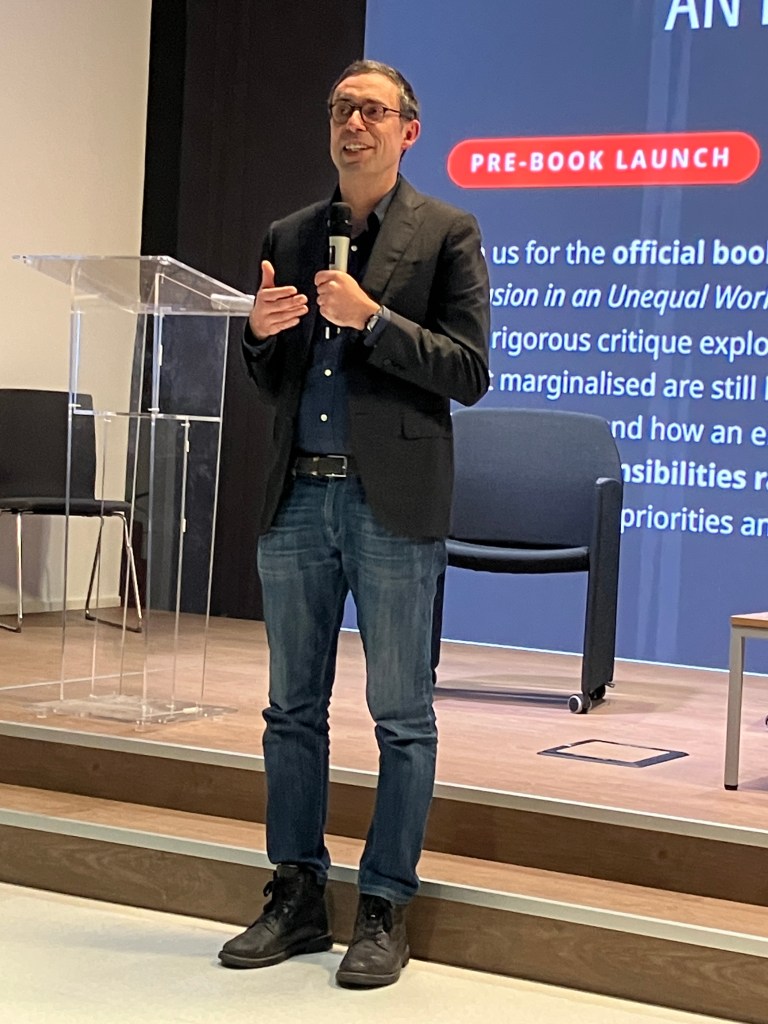
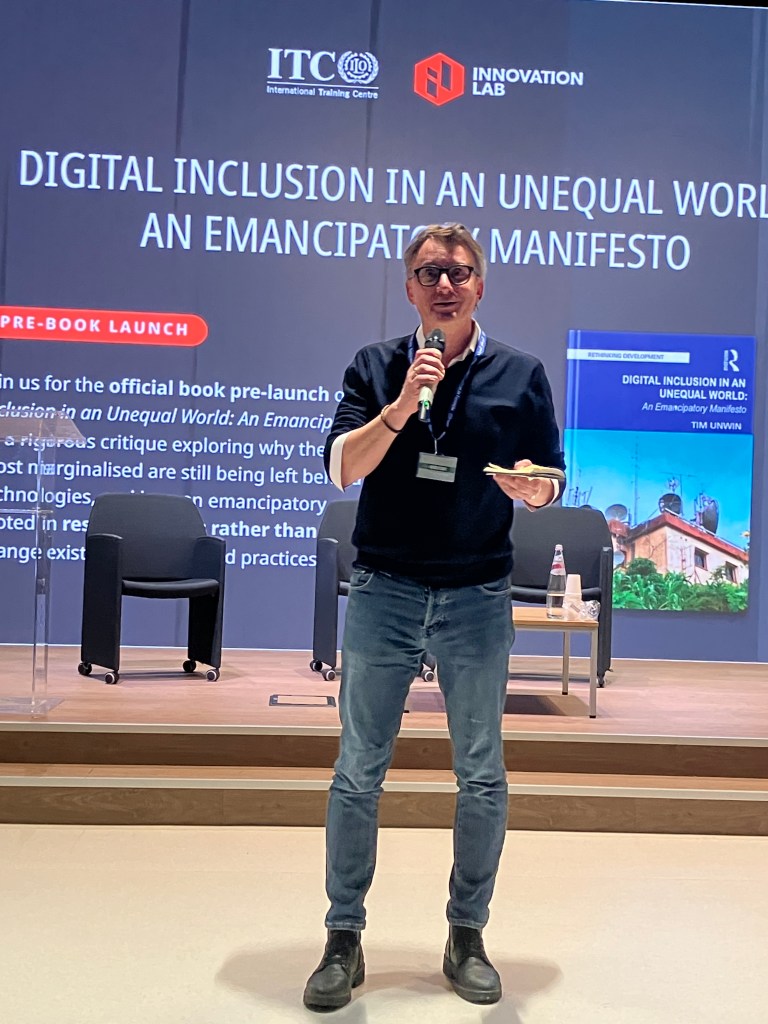
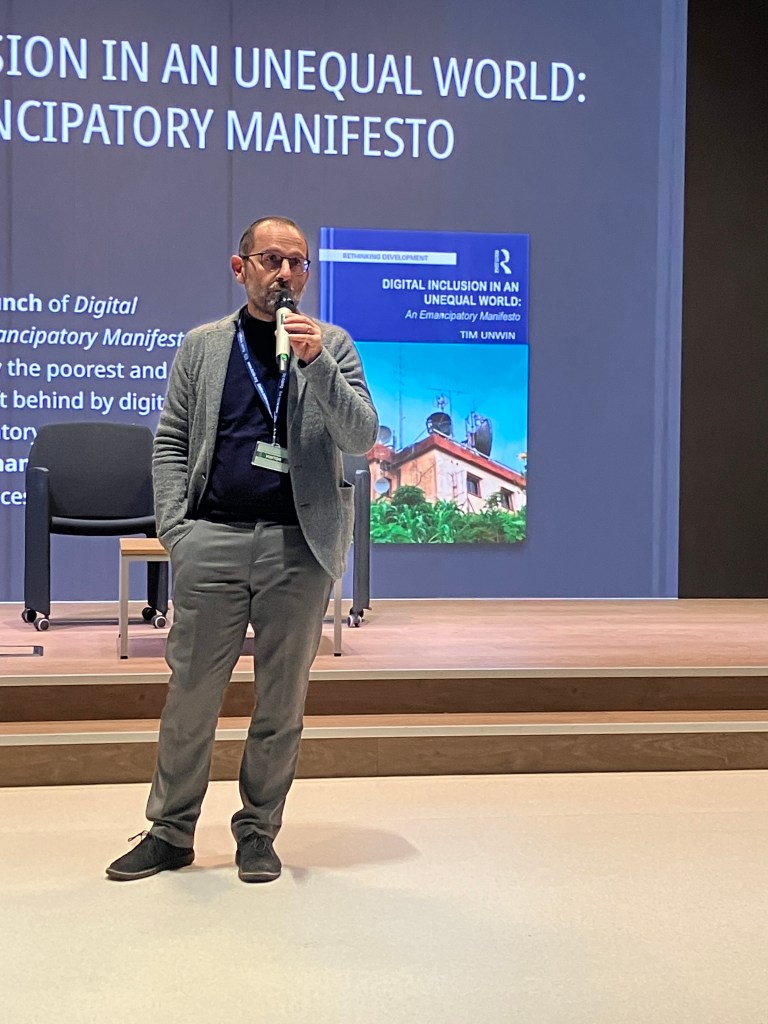

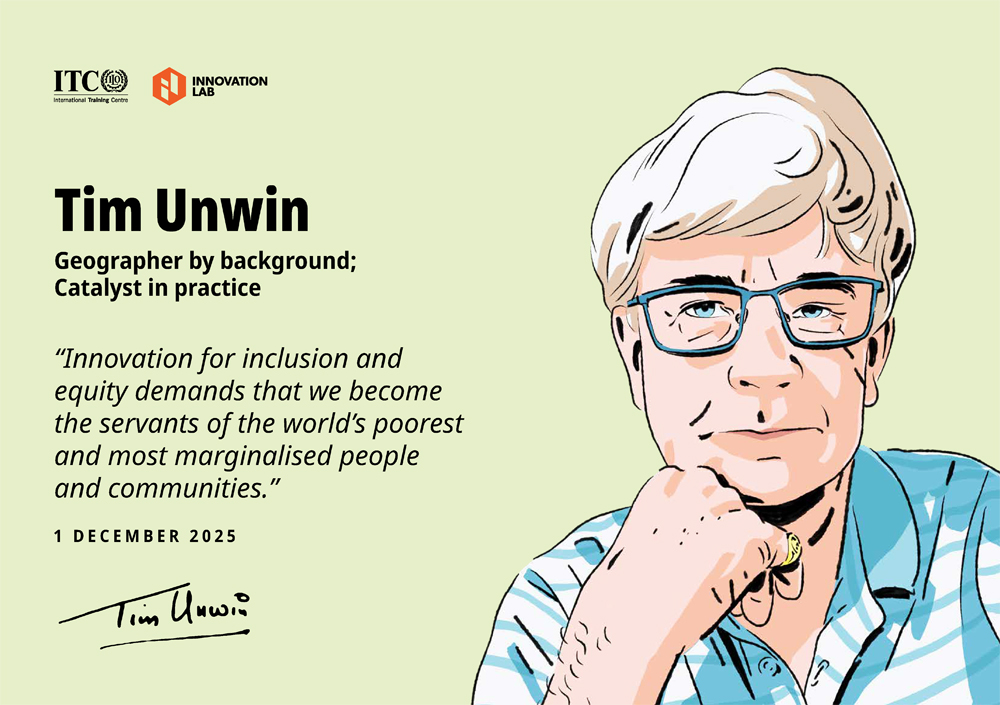








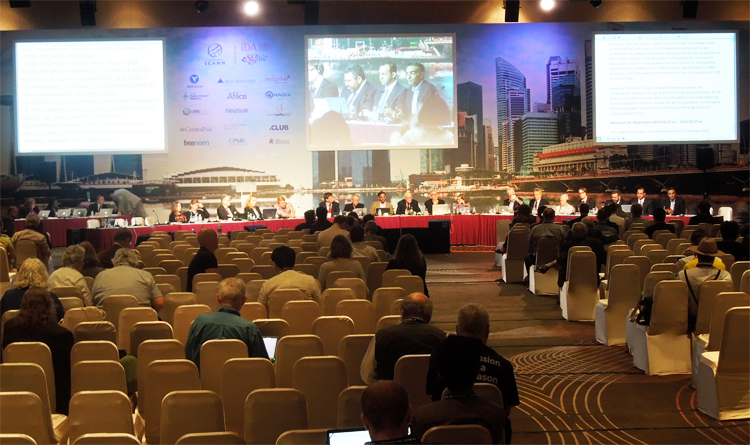
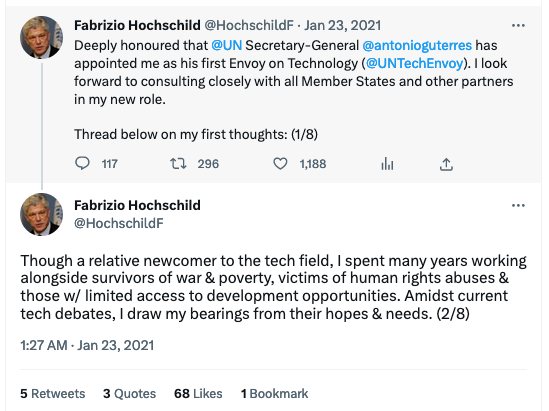
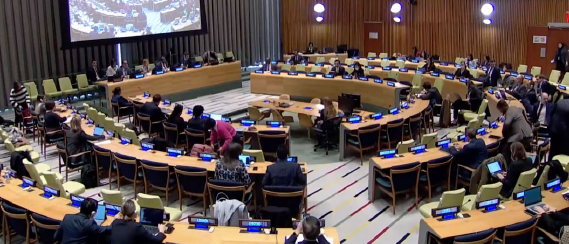


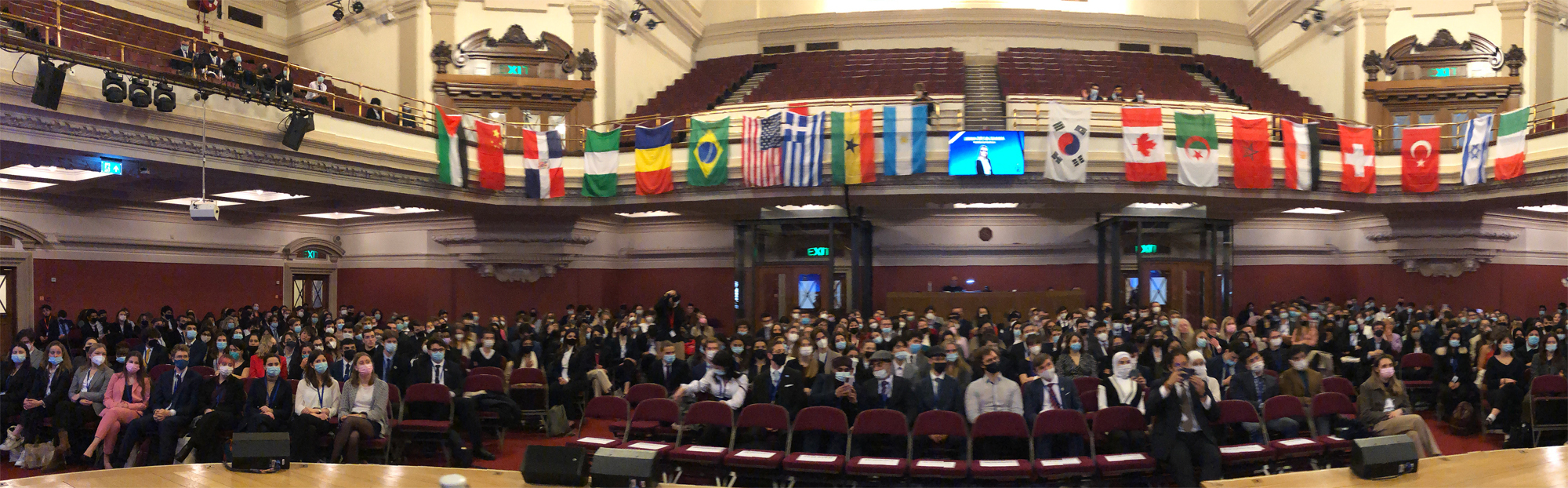





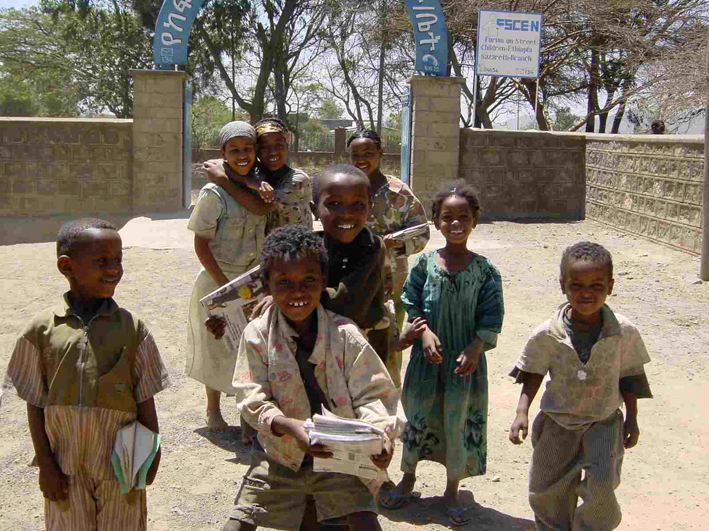 Recently I was asked by the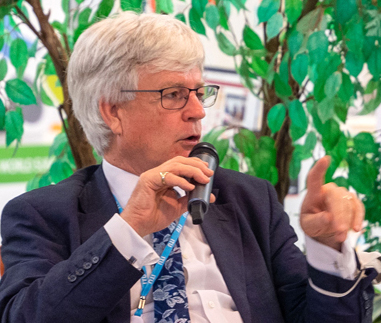

 Tim Unwin's Blog