Tag Archives: universities

The brave new world of a free market university system in the UK

The Browne review places the final nail in the coffin for the belief that universities are about anything other than economic interest.  From henceforth, university education in the UK has become a commodity to be bought and sold in a free market for individual benefit. Overthrown are beliefs that university education is about intellectual curiosity, about moral judgement, and about communal interest.

The short-sighted stupidity and naïvety of the recommendation that universities should be able to charge market prices for their offerings must, be challenged.  Even for those who see the world purely through an economic lens, the arguments against Browne’s recommendations should be convincing. Imagine a world where:

  • British students increasingly live at home and turn to high quality distance-based courses provided more cheaply by excellent universities, often in other countries;
  • Many students go overseas to study in countries where education is free, thus making a huge cost-saving in gaining a degree and contributing to the local economies of the countries where they study (rather than the UK);
  • Many UK universities shut down, because students realise that the courses they offer are a complete waste of time and do not give them any additional lifetime earning expectations; and
  • Employers, realising even more than they do at present that UK universities do not provide the skills for which they are looking, increasingly employ people without degrees, and give them tailored training courses (often collaboratively with other employers) to ensure that they have the expertise required.

These are just some of the likely economic impacts of the recommendations that are now before government.  The net outcome will be a dramatic reduction in the UK higher education sector, a shift overseas in the amount spent on fees and maintenance by UK born students, an increase in unemployment of former university staff who are unable to gain any other form of employment, and a decline in the wider contribution of the higher education sector to the UK economy.

Even on economic grounds, a decision to let universities charge whatever fees they think the market will stand is fundamentally flawed.  So, even for those who do not care about the social divisiveness, the intellectual sterility, and the communally destructive effects of such policies, these arguments should at least carry some weight!


1 Comment

Filed under Higher Education, UK, Universities

The Browne Review of Higher Education

Can anyone tell me why Lord Mandelson (the former Business Secretary) chose John Browne (Baron Browne of Madingley) to chair the review of higher education in the UK that is due to report on 12th October?  Given his background, and the wider political agenda of which the review is a part, the report’s conclusions can never really have been in question:

  • Browne spent almost his entire career at BP, beginning as an apprentice in 1966 and rising to Group Chief Executive of the combined BP Amoco group in 2007
  • He was one of the most highly paid executives in the UK, with a reported £5.7 million salary in 2004
  • According to some, he was the person most responsible for cost cutting at BP that many attribute to having led to the Texas City refinery explosion in 2005 and most recently the Deepwater Horizon Explosion in 2010.

In short, he is a businessman, who was paid a salary that most people can only dream of, and built his ‘success’ on cuts.  Although he is a Fellow of the Royal Society, a Fellow of the Royal Academy of Engineering, and a Fellow of the Institute of Physics (amongst others), he has shown that he has little real understanding of the purpose of universities, the issues and challenges facing academic and students, and the crucial role that high quality research and teaching must play in Britain’s future.

Surely even he is intelligent enough to understand that increasing fees twofold or threefold will mean that many students will no longer be able to afford to go to university, or will choose instead to go to universities elsewhere in countries  that still believe in the provision of free, high quality university education. A free market in higher education cannot serve the interests of students, of the country, or of university excellence.

Just because Browne was able to earn such a large salary having gained a Physics degree from Cambridge and a Business Master’s degree from Stanford, does not mean that every graduate will be able to do likewise.  Only a few are able to earn the grossly inflated salaries that now seem to be so prevalent amongst senior executives in major corporations and the bankers who brought our financial systems to the point of crisis that has been so damaging to our economy.

A more intelligent and sympathetic Chair might just have led to a more creative and viable future for our once great universities.

Links to my reflections on:

Together, we might just be able to salvage a small number of high quality universities from the impending bonfire of the vanities.

2 Comments

Filed under Higher Education, UK

Jobs or degrees for young people in the UK

It’s that time of year again: school exam results, and pictures of happy young people getting the results for which they hoped, alongside grim stories of those who have failed to make the grade! “Desperate for a degree?” in the Metro on 28th August, ‘”Carnage’ as pupils scramble for university places“, or “Universities swamped in mad dash for places” in the Times

Much of this reporting is highly misleading, especially concerning the difficult decisions young people are facing when they do not get the results that they had wanted. The Metro, for example, comments that “”Up to 200,000 youngsters were expected to miss out on higher education places despite record A-level results”.  Not a bit of it.  Why should anyone think they are missing out?

To be sure, it is very unfortunate when school leavers do much less well at their A levels than expected.  However, they should always have kept one of their university options as a safety net, in case of this eventuality.  There is absolutely no point in keeping  an offer of AAA and another of AAB, when realistically there is a possibility that you might get BBB.  Moreover, there is a fundamentally misplaced assumption that anyone who gets A levels – even low grades – should automatically be able to go to a university!  Why?  University entry is not an automatic right. It should be reserved for those who can benefit most from it, and can best use the opportunity to enhance their knowledge and understanding.

Although youth (18-24 year olds) unemployment in the UK fell by 16,000 over the last month, it is still 324,000 according to the Centre for Economic and Social Inclusion.  Many young people are therefore choosing to try to go to poor quality universities, rather than entering the ranks of the unemployed.  Even with average student debt around £25,000 after three years, this is seen as being desirable primarily as a lifestyle choice.  The expectation is that graduate salaries will more than enable this debt to be paid off.  Anyway, at this age, who really cares?

There is little point, though, in many young people with poor A levels scrabbling to go to a university.  Many degrees offer few skills that will ever be of relevance in the job market. Indeed, employers regularly complain about the low skill levels of graduates in the UK! These people would be far better off starting on apprenticeships or entering the work environment immediately. They would not saddle themselves with debt, and in many instances their career prospects are just as good as those of graduates.  Moreover, by the time they are 21 they will have three years of income over and above their peers who waste three years simply ‘having a good time’ at university.  Graduate employment is tough – it is currently estimated that there are now some 70 people searching for every graduate job!  So, instead of going to university, those young people who are not really interested in academic studies should turn to the job market (see report in the Sunday Times on the university of life!).

This is really where we are failing young people.  Youth unemployment is far too high.  We need to encourage more apprenticeship schemes, and create opportunities for more young people to be gainfully employed.  It is far better for them to be working productively rather than costing tax payers money simply to enable them to gain increasingly worthless degrees at low quality universities.  Better still, we should close down half of these so-called universities, and instead create training institutes that would enable young people to gain the skills needed  to compete successfully in the global employment market!

So let’s stop fooling ourselves. Very few young people are actually missing out on university places!

Leave a comment

Filed under Higher Education, UK

Illiterate UK graduates find it hard to get a job!

I was interested to read a report by Jack Grimston in the Sunday Times on 1st August under the headline “Top firms forced to reject ‘barely literate’ graduates”.  What amused me is that anyone should find this surprising!  For years, schools have paid insufficient attention to the teaching of good English, and most university academics simply do not have the time to correct the spelling, punctuation and grammar of essays written by students.

The report commented that:

  • “Waitrose and other blue-chip employers are struggling to fill graduate trainee schemes, despite receiving thousands of applications, because candidates fail to fill in forms properly and sometimes seem barely literate”
  • “Will Corder, UK recruitment adviser at Kimberly-Clark, the manufacturer of brands such as Kleenex and Andrex, said his company had been able to recruit only eight graduate trainees, fewer than in previous years. One candidate, asked how he or she had developed leadership skills, replied: “At church Im [sic] in charge of some organisation.” Corder said: “Surprisingly, it is particularly bad among those doing master’s degrees — bad grammar, bad spelling and they do tend to be very, very verbose and say very little”
  • A shortage of qualified university and school leavers is holding back the economic recovery, according to early findings by the Institute of Directors in a poll of members.“A surprising number have vacancies they are unable to fill,” said Mike Harris, the institute’s head of skills, who will present his findings to Vince Cable’s business department. “They cite lack of skills and bad attitude. They are flagging up clearly that it is a real struggle to find workers and this is holding back recovery.”
  • “Recruiters complain of applicants unable to spell company names, answer simple questions or provide information instead of vacuous buzzwords”

This is a damning indictment of the British higher education system.  Whilst I would be one of the last to say that a university education should purely be about providing skilled employees for top firms, it is critically important that academics listen to what employers say.  The message is clear: universities are turning out graduates who often seem barely literate, and more worryingly still who have a poor attitude to the workplace.  Surprise, surprise!

2 Comments

Filed under Higher Education

Changes to A-levels: improving the quality of learning?

A report in today’s Sunday Times, highlights concerns expressed by the Education Secretary Michael Gove, about the structure of assessment in British secondary education.  As the paper reported, “Michael Gove wants to see A-levels become more academically rigorous and to scrap AS-levels, which are in the first year of the sixth form … He is responding to complaints by universities that the current A-level system, introduced in 2000, fails to prepare pupils for in-depth study”.

As the Sunday Times goes on to observe, Gove “will invite universities to design new A-levels, modelled on the new Cambridge Pre-U qualification, taken by a number of leading state and independent schools in preference to A-levels. Gove said: ‘We will see fewer modules and more exams at the end of two years of sixth form and, as a result, a revival of the art of deep thought'”.

There is absolutely no doubt that in terms of academic rigour most students who are educated in the British education system today lack many of the skills required to undertake a traditional university education successfully.  This is one of the factors underlying the dumbing down of standards in British universities that has occurred over the last decade.  The reform of A-levels may therefore be able to contribute to the training of young people’s minds so that they can better cope with the intellectual rigours required of a high quality university education.

However, this is only part of the story.  Many young people work incredibly hard for their A-levels, and perform outstandingly well at good universities – even under the present system.  Our secondary schools also provides them with a diversity of skills and other experiences that were simply not available a decade ago.  Such skills are important – but do not necessarily fit them for intellectually rigorous university degrees. Let us not decry the huge achievements of our young people who have gained excellent A-level grades over the last decade, and their teachers who have struggled to help them learn whilst also navigating the ever increasing amount of regulation imposed on them.

Yes, universities are indeed about training people’s minds, encouraging them to think beyond the confines of existing knowledges, and developing the incredibly important skill of critical analysis.  But we should not expect 50% of our young people to be interested in doing this, or indeed to be able to do it successfully!  We do need rigorous ways of accessing people’s aptitude to enter a high quality university system, and the present AS and A2 system has undoubtedly failed to do this.  However, so-called university courses that cater for the apparent demand for dumbed down mass higher education system do not need rigorous A-levels as a mechanism for judging the quality of applicants. If you can get into a university today with C, D and E grades under the present A-level system, it seems to be to be very clear that these universities are not actually interested in the skills that new, more rigorous and intellectually challenging A-levels might provide.

We must have an intellectually vibrant and challenging university system in this country.  But until it is accepted that this means we need fewer universities, and that other forms of further education are more appropriate for perhaps a quarter of our young people, tinkering with the examinations that young people  undertake at the end of secondary education will make little difference.

Leave a comment

Filed under Higher Education

University fee rises: the time for protest is now!

The Sunday Times today reports that the review panel on university funding chaired by Lord Browne is likely to recommend that “universities would be allowed to increase fees well above the inflation rate each year – possibly by as much as £1,000 – as they move towards a free market”. The report also suggests that “Leading research universities could charge students an estimated £7,000 a year while fees for science undergraduates could rise to £14,000”.

Those who value scholarship, scientific excellence, and equality of opportunity in higher education must now take all forms of peaceful political action to oppose this proposal that would be catastrophic for universities in the UK.

It is scarcely surprising that the review panel is recommending such a free market approach to universities:

  • Responsibility for higher education currently rests with a government department called “The Department for Business, Innovation and Skills”, presided over by Lord Mandelson.  The priorities of this Department are on the role of universities in supporting UK PLC and on developing business solutions, rather than on the value of universities in their own right.
  • The review is led by Lord Browne, former Chief Executive of BP.  Why, oh why, was someone who took his company to near disaster (look at the current crises facing BP), and who was one of the most highly paid executives in the UK, asked to lead such an important review?  Surely there were scholars or scientists who understood the true value of universities, who could have done this better?
  • Most UK university Vice Chancellors are so concerned with maintaining funding for their institutions that they have forgotten their most important role which is to provide scholarly vision and leadership.  They have become co-conspirators in this move to a free market in higher education, where only the richest (or most corrupt) will be able to survive.

These factors combine to provide a recipe for disaster – all that the key actors in policy making can see is the need to generate more income to fund existing levels of student education at universities, and the only solution they can come up with is to raise fees, based on the ludicrous logic that higher education is a private good for which individuals should be willing to pay.  I have previously commented at length on the flawed logic of this, and so will not repeat myself here.

However, three arguments seem to me to be unassailable:

  • Universities are facing a funding crisis because of the mistaken belief that we need to have 50% of our young people gaining a university education.  There is no proof that providing a university education (which is in any case becoming increasingly second-rate) for this number of people is good, either for them or for society at large. The easiest way to reduce costs is simply to reduce the number of places on offer at universities.
  • Many students (although by no means all) waste their time at university.  It is a lifestyle choice which is preferable to being unemployed.  One of the reasons there are currently so many applications for university places is quite simply that it is tough to find a job during the economic downturn.  Instead, let’s make gaining a university place more competitive, so that only those who are really committed to scholarship and scientific excellence gain a place.
  • Rather than imposing sweeping cuts across all universities, it would make much more sense to close those that do not provide learning or research opportunities of a high enough standard.  Why are we so unwilling to close entire universities?  Businesses go bust and people are made unemployed.  The same should happen to the least successful universities.

The Browne review is focusing on the wrong questions.  It is trying to find ways to fund an over-bloated, self congratulatory, but in reality increasingly mediocre higher education sector.  Instead, let’s take a knife to the sector, and cut out the rot before it infects us all.  Let’s have a more streamlined, outstanding and successful university sector, where there is real competition amongst students to gain places that will give them a truly excellent education, rather than a dumbed-down, penny pinching, higher education environment where all that matters is getting large numbers of students through the door to make financial ends meet.

For those who believe that it is inevitable that students should pay fees to attend university, it is worth remembering that there are some enlightened countries, such as Finland, where people value universities so much that attendance remains free – even for students from overseas!

2 Comments

Filed under Higher Education

Less than half of the students accepted at UK universities have A levels!

A recent report in the Sunday Times noted that according to UCAS figures only “49.8% of the 425,000 British students accepted at universities across the UK for full-time degrees starting last autumn had taken A-levels, down from nearly 70% in 1999”.  This is a remarkable figure, and reinforces my views abut the dumbing down of UK higher education that has taken place over the last decade.

To be sure, there are many reasons why A levels are no longer seen as the gold standard exam used for university entrance, but as the Sunday Times report goes on to argue, there are huge implications of this change.  Certainly, universities are now taking students from much more diverse backgrounds, and with different qualifications, which is all to the good – providing of course that these students have the intellectual capacity to cope with the rigorous demands of a quality higher education system.

One of the things that really concerns me about this, though, is that as the Sunday Times notes many schools are “pushing academically bright pupils towards vocational exams to improve league table positions. The result is the students have almost no chance of gaining entry to academic courses at top universities, shutting them out of highly paid jobs”. The article goes on to quote Anna Fazackerley, head of education at the Policy Exchange think tank, who claimed that “Vocational courses can be hugely worthwhile… However, many children from less wealthy backgrounds are pushed into less academic courses simply because their school has low aspirations for them and one eye firmly on league tables.”

This is worrying on two grounds: first, that such students appear to be being excluded from the best universities (however defined) because of decisions made by school teachers so as to ensure their success in the league tables; second, that the argument helps to perpetuate the myth that universities are only about creating graduates who will get high paid jobs.  We must never forget that universities should be about so much more than just enabling people to get better paid jobs!

Over the last 20 years, governments and those working in the higher education sector have combined to create a system that is fundamentally flawed, and fails to provide the intellectual and scholarly leadership that we so desperately need in this country.  Since 1992, when the former polytechnics and universities were merged, attempts have continued to create a unified higher education system – driven largely by the flawed belief that we need half of our young people to go to ‘university’.  We need to recognise that these have failed.  We are increasingly creating a system that delivers neither on academic excellence, nor on giving people the high level vocational qualifications that they want or need.

I wish to retain the idea of a “university” as a community of scholars and learners, all of whom are committed to the advancement of knowledge for the good of society.  Universities should not simply be about providing people with technical skills that certain people deem to be useful.  In the UK, we are indeed in need of people with an outstanding technical education; students doing dumbed down degrees at so-called ‘univeristies’, are not gaining the skills that either they, or our economy, require.  We also need outstanding scholars and scientists who are able to push forward the boundaries of knowledge; sadly, our present so-called ‘university’ system is likewise failing to deliver the excellence that it might be capable of – and it is expected to do so with increasingly severe funding cuts!

Leave a comment

Filed under Higher Education

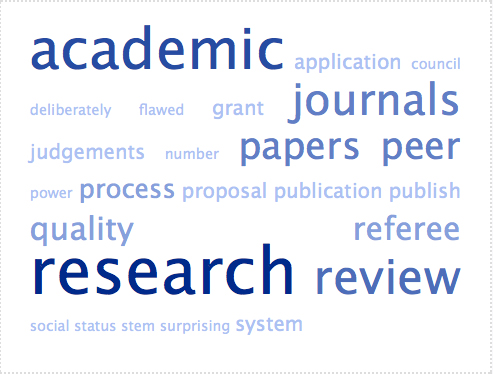
Peer review – implications of ‘corruption’

Two separate events that occurred at the start of this month have made me reflect once again on the many myths surrounding the ‘hallowed’ peer review process on which so much academic credibility is seen to lie.

First, I received an e-mail from a friend for whom I had written a reference in connection with a grant application that they had submitted to one of the UK’s Research Councils.  They had received the disappointing news that despite two strong references, a third referee had been highly critical of the proposal, casting aspersions on their professional expertise and on the quality of the proposed research.  I was appalled by this.  The research proposal was one of the best I have recently read, and from what the Research Council said of the comments of the ‘third’ referee, they seemed to me to be completely inappropriate.  Either the referee was ignorant of the research field, or they had vested interests in ensuring that this research was not funded.

By coincidence, at about the same time, the BBC picked up on an open letter sent by a group of scientists last July that also criticised the traditional peer review process, but this time with respect to journal articles.  As the BBC Science Correspondent Pallab Ghosh commented, “Stem cell experts say they believe a small group of scientists is effectively vetoing high quality science from publication in journals. In some cases they say it might be done to deliberately stifle research that is in competition with their own”. The 14 scientists had written that “Stem cell biology is highly topical and is attracting great interest not only within the research community but also from politicians, patient groups and the general public. However, the standard of publications in the field is very variable. Papers that are scientifically flawed or comprise only modest technical increments often attract undue profile. At the same time publication of truly original findings may be delayed or rejected”.  To try to overcome this, they proposed that “when a paper is published, the reviews, response to reviews and associated editorial correspondence could be provided as Supplementary Information, while preserving anonymity of the referees”.

Peer review is one of the fundamental principles upon which the edifice of academic reputation – and financial reward – is based.  However, the system is inherently  flawed, and I find it somewhat surprising that it still retains such power.  Six issues warrant particular consideration:

  • First, peer review is based on a belief that ‘science’ is in some way value free; that individual prejudice, political beliefs, or social agendas have no effect on academics’ judgements as to the quality of research.  Whilst many academics do indeed try to reach impartial judgements about the quality of work that they review, they undoubtedly bring biases to such judgements as a result of their own lives and research practices.  Moreover, editors of journals and Research Council panels exercise immense power through their choices of whom to ask to act as referees for papers or grant applications.  Science is not, and never has been, value free.
  • Academic status is in part based upon the number of citations a paper receives.  Academics thus seek to publish in the most prestigious journals that have high citation indexes.  For a very long time, cartels of academics have therefore operated, deliberately citing each other’s works so as mutually to raise their profiles and status. Academics are only human, and it is scarcely surprising that they operate in this way.  There is nothing exceptional about this.  Some of us may not think it right, but it happens.
  • One way that new ideas can begin to find voice is through the creation of new journals.  However, these take time to become established, and when status relies so much on having papers published in the most prestigious journals, it remains very difficult for new approaches and ideas to find widespread expression in this way; rarely do the most eminent academics deliberately choose to publish in new and ‘unimportant’ journals!
  • Those who run the major journals and sit on grant-giving Research Council Boards have immense power, and most do their very best to be fair in the judgements that they reach.  However, by definition, the peer review system is designed more to endorse existing approaches to intellectual enquiry, rather than to encourage innovative research.
  • None of this would matter particularly, and could merely be dismissed as irrelevant academic posturing, if there was not so much money involved.  Academic prestige and income depend fundamentally on success in publications and grant applications.  The UK’s Research Councils thus invest some £2.8 billion annually in support of research, and it is crucial that this is dispersed wisely.  It is therefore extremely sad – albeit typical – that in the case of my friend who had their grant application rejected, there was no right of appeal against the decision.  Panel chairs and editors must have the guts to stand up and recognise when they see flawed decisions being made by referees.  It is thus extremely encouraging to see that some Research Councils, notably EPSRC, are trying to create exciting new ways to support research that do not place excessive emphasis on traditional peer review processes.
  • Finally, there is now a good case for exploring alternative ways of judging research ‘quality’.  ‘Publishing’ papers openly on freely available websites, and then assessing their quality by the number of ‘hits’ that they get would, for example, be a rather more democratic process than that through which a small number of ’eminent’ academics judge their peers.  Of course this would be as open to abuse as existing systems, but at least it would present an alternative viewpoint.

We must debunk the myth that there is something ‘pure’ or ‘objective’ about academic peer review.  It is a social process, just like any other social process.  It has strengths and weaknesses.  For long, it has served the academic community well.  However, as the 14 stem biologists who raised the lid of Pandora’s Box implied, it is a system that fails to encourage the most original research, and instead supports the system that gave rise to it.  After all, that is not so surprising, is it?

5 Comments

Filed under Higher Education

University Funding

The Higher Education Council for England (HEFCE) announced today its provisional funding distribution to universities and colleges in England for 2010-11.  The main decisions by the HEFCE Board were as follows:

  • “£4,727 million recurrent funding for teaching. This represents an increase of 0.4 per cent in cash terms or a decrease of 1.6 per cent in real terms, compared with 2009-10.
  • £1,603 million recurrent funding for research. This represents a £32 million or 2 per cent increase in cash terms (maintained in real terms) on the £1,571 million allocated for the 2009-10 academic year.
  • £562 million in capital funding, which represents a 14.9 per cent reduction in cash terms on the 2009-10 allocation.
  • £294 million in special funding for national programmes and initiatives. This represents a 7 per cent reduction in cash terms on 2009-10.
  • £150 million for the Higher Education Innovation Fund (HEIF), which compares with £134 million in 2009-10. This represents an 11.9 per cent increase”.

Responses from the university sector were not surprisingly highly critical.  As the BBC reported,  this represented a cut of £449 million, with teaching budgets being reduced by £215 million, a cut in real terms of 1.6% on 2009-10 levels, research being frozen, and the buildings budget being cut by 15%.  It is estimated that these cuts will lead to a reduction in student places in England of about 6,000 compared with 2009-10 levels.

Such cuts add fuel to the universities’ demands to be allowed to charge students higher fees.  But in an election year, the student vote may delay such apparently inevitable fee increases.  Again, as the BBC notes, “Students campaigning against an increase in tuition fees are targeting MPs who hold seats in a “hit list” of university cities in England. The National Union of Students says MPs must support their campaign against higher fees – or lose the student vote. Among the MPs identified as targets by students are three ministers – John Denham, Ben Bradshaw and Hilary Benn – and the chief whip, Nick Brown”.

While these cuts are in large part driven by the need for the government to reduce the deficit brought about by its efforts to overcome the financial crisis of 2008-9, they do highlight some important questions:

  • Do we already have too many students going to university?
  • What is so special about the notion that it is healthy to have 50% of our young people going to university?
  • Are universities providing appropriate learning opportunities for those who study there?

I live in hope that these cuts might be used sensibly to help provide responses to these questions.  Rather than trying to support an increasingly second-rate university system that fails not only its students and academics, but also the wider society of which we are all part, surely the time has come for a cull of universities?  Should we not close those that are least effective, and turn them into institutions that would provide the technical skills and expertise that our country so badly needs?  Let us stop pretending that half of our population somehow has a right to go to university, and instead use the limited amounts of funding available to support a truly outstanding research and learning culture in institutions that can properly call themselves universities.

For some practical suggestions on how we might achieve this, see my comment on “Solving the crises facing UK universities

1 Comment

Filed under Higher Education

Mandelson at the Learning and Technology World Forum

Following Ed Balls and Gordon Brown, Peter Mandelson gave an enthusiastic and committed speech today at the Learning and Technology World Forum held in London at the Queen Elizabeth II Conference Centre.  He argued strongly that the UK Higher Education sector can, and should, play a significant role in helping to expand Britain’s ‘exports’.  Amongst some of the many things he said, were the following:

  • Britain has a very strong higher and further education sector
  • Over the last decade real term funding for research in Britain has doubled
  • There is now a real challenge to develop this resource into one equipped for a digital knowledge economy
  • British higher education needs to pioneer new forms of learning – especially ones that fit around work or distance
  • We need to develop alternatives to the traditional  3 year university degree programmes for students straight out of school
  • We need to build on online and distance based degrees to support people wishing to gain degrees
  • The UK’s higher education sector must diversify and change its models – enabling it to fit into new ways of living to suit the individual ways of students
  • ICTs can make the whole process of learning more efficient – he claimed that efficiencies have saved more than £ 1 billion in HE staff time since 2005 – and this represents a huge area for international collaboration
  • We have to focus on to the fact that what we can do together in collaboration will enable us to get more out of this
  • Britain is a pioneer in online learning
  • He concluded by saying that the key is seeing the digital revolution as an agenda where the benefits of international collaboration are not zero sum

Despite the concerns that I have over much of this agenda (see my previous blogs on Mandelson’s vision for higher education) his comments today provided a clear statement of the government’s commitment to using ICTs innovatively to support alternative forms of higher education.

Leave a comment

Filed under Higher Education