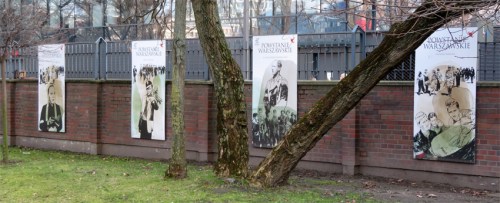
Images on the garden perimeter at the Warsaw Uprising Museum
Participating in the 12th TIME Economic Forum in Warsaw, especially on a day when the Government prohibited the holding of such large-scale events (because of Covid-19), provided an opportunity to visit and reflect on some of the city’s history, and indeed the history of Poland more generally. It was a stark reminder of human inhumanity. It was also, though, an opportunity to appreciate the efforts made in Europe since 1945, and especially through the creation of the European Union, to try to ensure that such almost unbelievable horrors do not happen again in our continent. We should surely do more not to promote them in other parts of the world.
Katyn
I began by reflecting on the implications of the Katyn Massacre in 1940 when some 22,000 Polish officers and members of the intelligentsia were massacred by the Soviet People’s Commissariat for Internal Affairs (NKVD) at the instigation of Lavrentiy Beria and with Stalin’s approval. Although Katyn is some 850 kms to the east of Warsaw, I still find it hard to believe that so many countries were complicit in the Soviet denial of this atrocity, even if this was in the broader interests of retaining Soviet support in the war against Nazi Germany. The elimination of so many leading military and academic figures (including half the Polish officer corps as well as 20 university professors, 300 physicians; several hundred lawyers, engineers, and teachers; and more than 100 writers and journalists) makes the Polish intellectual resurgence in the second half of the 20th century all the more remarkable. It is hard to think that I first hosted a Polish academic colleague in the UK (Prof Wiesław Maik from the Nicolaus Copernicus University in Toruń) 36 years ago and only 44 years after the massacre. Then, and in my subsequent meetings with academic colleagues from Poland, I have always been impressed by their rigour and commitment.
The Warsaw Ghetto
Not much remains of the Ghetto in the vibrant modern city of Warsaw with its new high-rise business centre. But hidden away, almost invisible, tiny traces can be found. I am grateful to a friend for pointing out where I could find an old gate to the Ghetto at the intersection of Grzybowska and Żelazna streets.
The wall surrounding the Warsaw Ghetto began to be constructed in April 1940, and consisted initially of some 307 hectares, but was gradually reduced in size, making life inside ever more miserable. It is very hard today to envisage the horrors that the Jews living inside had to face. It was from here that they were deported by the Nazis to concentration camps, with some 254,000 Ghetto residents being sent to Treblinka in the summer of 1942. By the time it was demolished in May 1943 following the Warsaw Ghetto Uprising, it is estimated that at least 300,000 Jewish inhabitants had been killed, with some 92,000 dying of hunger and related diseases.
The Warsaw Uprising


Nearby the remnants of the Ghetto wall is the museum of the 63 day Warsaw Uprising in August-October 1944 (sadly closed when I tried to visit). This was the largest uprising by any European resistance group during the 1939-45 war, and was timed to coincide with the retreat of the German army in the face of the Soviet advance. However, the Soviet Army did not continue its progress, which gave the German army time to regroup, crush the Uprising, and subsequently largely destroy the city of Warsaw. Despite some support from British and US forces, the uprising was doomed to failure without the continued advance of the Soviet forces. It has been estimated that 16,000 Polish resistance fighters were killed, with around 6,000 more being badly wounded; somewhere between 150,000 and 200,000 civilians are also estimated to have been killed, mainly in mass executions. On a sunny day, at the edge of the modern business centre of Warsaw, it is hard to imagine the horrors and violence of what happened.
The destruction and rebirth of the old city of Warsaw
Following the Uprising, the Germans implemented what had been a long-intended plan to destroy the city as part of its Germanization of Central Europe. They had even drawn up designs (by Hubert Gross) to create a “New German City of Warsaw” as early as 1939. However, although they must have known in 1944 that they would soon be defeated, and there was then little to be gained from destroying the city, they nevertheless proceeded to raze it to the ground in vengeance for the Uprising. Between September 1944 and January 1945, some 85-90% of all the buildings in Warsaw were destroyed. The scale of devastation is only too visible from the many photographs taken following Hitler’s defeat, and can be seen on various plaques in the city following its designation as a UNESCO World Heritage Site in 1980.
With amazing energy, the Polish people set about rebuilding the old city between the late-1940s and the 1970s, and as the imahges below attest it is hard today to believe that everything we see now is less than 80 years old.
Seeing the modern city of Warsaw, alongside its ancient heart once again beating strongly, I find it incredibly difficult to comprehend the horrors and violence experienced by the Polish people, especially during the 1939-45 war. I have always been impressed by the diligence, generosity and energy of the friends I have made from Poland, and those of us in Britain should all be grateful to them for their contribution to our economy in recent years. Being here makes me realise once again the tremendous strides we have made in Europe during my lifetime – one of the longest periods of prolonged peace in the continent’s history. This owes much to the work of those who sought to rebuild the continent after 1945, and to the activities of the various European institutions that they constructed, not least the European Union. It makes me even more sad that so many people in Britain chose to follow those of our so-called leaders who for their own selfish interests and political ambitions sought to separate us from the EU in the forlorn hope that Britain might once again be “Great” (alone). We must never forget the enormous sacrifices made by so many people that we might live in peace. I for one am grateful to have had this opportunity to be reminded once again of the sacrifices made by the Polish people, and am privileged to have had the chance to express my own thanks by participating in the TIME Economic Forum, which captured so well the economic vibrancy and energy that characterise Poland in the 21st century. Dziękuję…

Dance during the TIME gala dinner
 The
The 

 Tim Unwin's Blog