Category Archives: Africa

Majeka House – a lovely place to stay near Stellenbosch

For anyone seeking a comfortable and relaxed place to stay while exploring the wineries of Cape Province in South Africa I can thoroughly recommend the Majeka House, just outside Stellenbosch.  Hidden away in a quiet residential area, the hotel provides a wonderful oasis of luxury in which to unwind at the end of a busy day of tasting!  With a warm welcome, beautifully hand-crafted rooms, great views, a relaxing pool, and the fine Makaron Restaurant (one of the top 20 in South Africa), it is a very special place to stay.

This slideshow requires JavaScript.

Breakfasts are delicious, although I definitely preferred the anti-oxidant juice to the green revitaliser!  Also, beware the white pebbles in the birdcage at dinner – I dread to think of the teeth damage if someone bit hard on them!  As the above pictures illustrate, though, the food was innovatively presented, and of very high quality.  Make sure you book in advance, because the restaurant gets very full!

2 Comments

Filed under Africa, Restaurants, Wine

My favourite South African Wines…

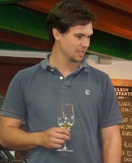
ThelemaA visit to the Cape Province of South Africa last week in order to help select wines for the Athenaeum provided a great opportunity to learn something about  recent changes in the wine industry in the Cape and to taste some of the really excellent wines that are now being produced there.  It is some 40 years since I last visited Stellenbosch and Paarl, and it is great to see the quality of wines now being made in the region.

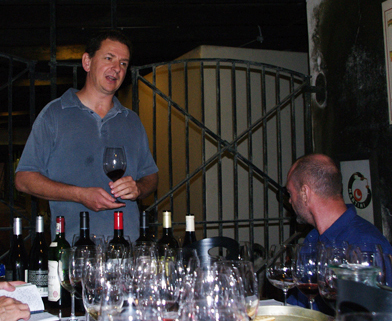
Thanks to Stuart and George who arranged the itinerary, and the hospitality of many amazing wine makers, we had the privilege of tasting nearly 200 wines from Stellenbosch, the Cape Peninsula, Franschhoek and the hinterland of Hermanus.  While this represented only a small fraction of the many wines now being made in South Africa, it did highlight three significant things for me:

  • First, the quality of the wines has improved very dramatically indeed over the last 15 or so years.  There are without doubt now some really excellent wines being made in South Africa, and they are very good value indeed, with many of the best wines being priced at under ZAR 250 (£15) a bottle.  We scarcely tasted a poor bottle, and it was difficult to choose those that I preferred best for my list of favourite wines below!
  • Second, South African wine makers have definitely learnt and understood the importance of terroir. Given my geographical wine “upbringing” in Burgundy, I have always argued that the physical environment has a very important role in determining the character of a wine, and it is good to see the increasing differentiation that now exists in the planting locations of different grape varieties in the Cape area.  Many of the wines we tasted emanated from some of the cooler vineyard locations, higher up on the mountain slopes, in windier locations, and closer to the sea.
  • Third, South Africa’s vineyards have to be amongst the most beautifully situated in the world, with many of them being in very picturesque locations, as I hope the pictures below illustrate.  Whilst leafroll virus is a serious problem for grape-growers, it does have the merit of turning vines a beautiful red colour in the autumn!

This slideshow requires JavaScript.

Despite the pleadings of my colleagues, I am still not convinced by many of the Chenin Blanc wines we tasted, perhaps with the exception of some of the sweet dessert wines.  I’m sure that some of my reticence stems from tasting too many rough Steen wines when I was younger!  While I recognise that modern good quality Chenin Blanc wines are indeed being made, I simply don’t particularly like them, finding the astringent flavours that I encountered in my youth all too often still to be present.  Likewise, I have to confess not really to liking wines made from the Pinotage grape.  All too often they too retain bitter flavours, and I found many of those we tasted to be rather unbalanced and poorly structured – with one delicious exception!

So, to conclude, my favourite wines, in alphabetical order of producers were:

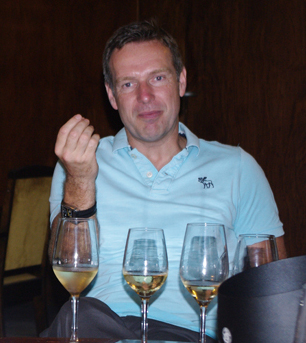
  • 4Buitenverwachting (with MD Lars Maack)

    • 2009 Christine – excellent open fruity nose; 14.5% alcohol; rich, rounded, soft tannins; red fruit flavours; 45% Cabernet Franc contributes to tobacco and chocolate flavours (with 45% Cabernet Sauvignon and 10% Merlot); well balanaced and good length
  • Chamonix (with Wine-maker Gottfried Mocke)

    • 2011 Pinotage – a very unusual wine made in a similar style to Ripasso, combining fresh wine refermenting with air dried grapes; half-picked very young and undergoes carbonic maceration; other half desiccated and refermented with first picking; grown at 440 m 9on Greywacke soils; 14.5% alcohol; kept mainly in one-year-old Pinot Noir barrels; dark red with complex green and dark fruit flavours; very soft tannins.
    • 2012 Chardonnay Reserve – 13.5% alcohol; 14 months in 228 l French oak; 30 year old vines which show character and personality; 80% barrel fermented with 20% in 600 l concrete eggs, which enable wine to be oxygenated and the lees stay in suspension for longer than using other fermenters; high acidity early grapes are put into concrete, with later pickings going into barrels; always goes through malo-lactic; tries to pick fruit at lower sugar levels to make wines more in a Burgundian style; 65% new oak used for this vintage, which remains very evident; need to keep for some time.
  • 5Cape Point (with Wine-maker Duncan Savage)

    • 2011 Late Harvest Noble 8 – only made when conditions are right, with some 2000 half bottles being produced in 2011; 160 grams residual sugar; 10.5% alcohol;  Sauvignon Blanc and Semillon botrytised blend; rich balanced fruit flavours; good length; acidity balances out the rich fruit; dried apricot flavours.
  • Delheim (with Viticulturist Vic Sperling)

    • 102009 Vera Cruz Shiraz – we had the last bottle in the cellar sadly; produced from bush vines; 14.5% alcohol; rich, intense fresh red fruits on the nose; fruity flavours of plums and jam; good length and complexity; their Vera Cruz wines are only made in years when the fruit is good enough; a powerful wine to be kept for a while.
    • 2013 Edelspatz Noble Late Harvest – botrytised Riesling from Simonsberg Mountain; good acid balance; not overly rich; classic slight petrol nose, but well structured and luscious flavours of honey and apricots.
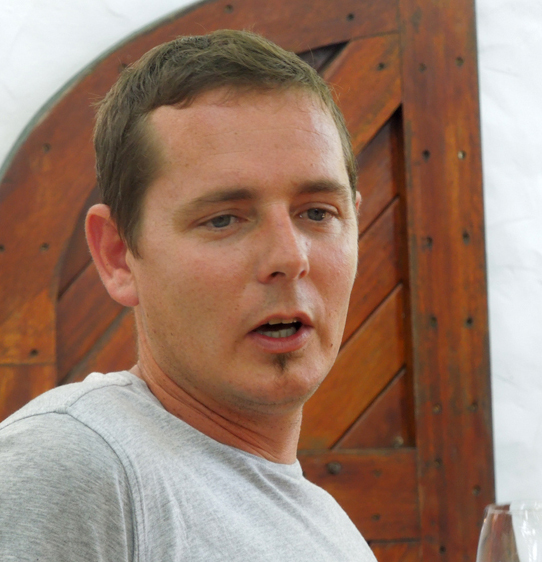
  • Glenelly (with Wine-maker Luke O’Cuinneagain)

    • 12012 Oaked Chardonnay – light golden colour; blanche toasted 500 l barrels designed to keep as much natural fruit flavour as possible; fresh with good fruit expression; distinctive pear flavour, with slight citrus touches; richer and softer than their unoaked Chardonnay; good structure and depth.
    • 2010 Syrah – designed to be like a northern Rhône wine; 100% whole bunch fermented; purple-red colour; very clean, with slight smell of bacon; white pepper and floral aromas; relatively low alcohol at 13.9%; soft tannins, but needs time to develop.
  • Klein Constantia (Wine-maker Matthew Day)

    • 22013 Sauvignon Blanc – made with free-run juice from grapes from across the property; very pale in colour; up-front nose of gooseberry and blackcurrant leaves; 4 months in steel on lees; fresh in mouth, with balanced acidity on edge of tongue; quite light and eminently drinkable
    • 2008 Vin de Constance – classic dessert wine made from Muscat de Frontignan grapes, left to dry on the vine; good rich flavours of candied orange, with other fruits including a slight pineapple taste; good depth and length; balanced acidity.
  • Meerlust (with Chris Williams, Cellar Master)

    • 62012 Pinot Noir – a serious wine; lovely rich nose; has been made since 2004 on coolest hilltops, which catch the breeze being only 3 kms from the sea; vines grown on decomposed granite; picked at 4-6 tonnes per hectare; vinified in small batches, some with natural fermentation; has an interesting liquorice nose; quite soft tannins; needs keeping for several years.
    • 2009 Rubicon – excellent Bordeaux blend style wine (69% Cabernet Sauvignon, 20% Merlot, 10% Cabernet France and 1% Petit Verdot); very rich and intense rich blackcurrant fruit flavours; complex; good length; well structured; definitely for keeping.
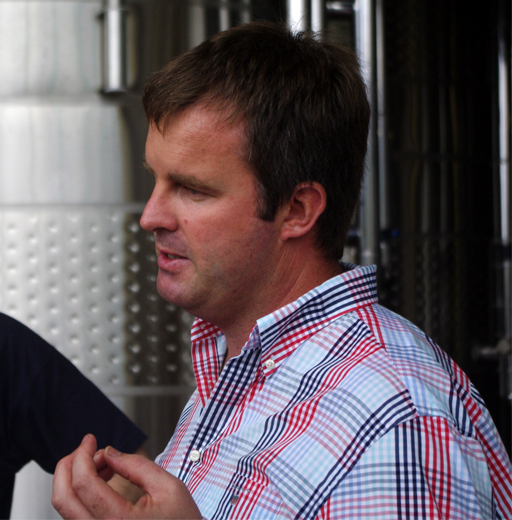
  • Newton Johnson (with Bevan Newton Johnson, MD)

    • 32012 Family Vineyards Pinot Noir – really good wine, clean, well structured, medium length, and rich complexity of Pinot flavours resulting from use of grapes from three adjacent vineyards (20% from Mrs. M, 30% from Block 6, and 50% from Windansea); first made in 2008/9; red fruit rather than vegetal.
    • 2012 Windansea Pinot Noir – Pinot Noir from a single vineyard which has more clay than adjacent ones, giving a deeper colour; a bit closed and more restrained than the fruitier more open Mrs. M and Block 6; well structured with good acid balance; excellent finesse; red and black berry fruits.  A really excellent wine.
  • Spier
    • 21 Gables Sauvignon Blanc – hand harvested; made from grapes grown in Durbanville near the Atlantic on red gravel and clay soils; nose of new mown hay; acidity clearly felt at edge of tongue; but well structured; rich complex flavours of gooseberry and slight asparagus; 13.5% alcohol.
  • Thelema (with Cellar Master Gyles Webb)

    • 82011 Cabernet Sauvignon “The Mint” – made from the first Cabernet Sauvignon vines they planted, with eucalyptus trees nearby, which give the wine a distinctive minty nose and flavour; mid-red colour; well-balanced and good structure; will be long-lived.
  • Vergelegen (with Wine-maker Andre van Rensburg)

    • 2011 Merlot – the first 100% Merlot wine made at Vergelegen since 1998; although Andre sees himself mainly as a Cabernet Sauvignon producer, he believes they have the environment to produce excellent Merlot; lovely soft nose and very gently tannins; still a bit young, and lacking a bit in length, but overall very pleasant.
    • 72010 DNA – Cabernet Franc does well at Vergelegen, but the yield needs to be reduced down to around 4 tonnes per hectare; aim is to pick the fruit as late as possible; mid-red, quite intense colour; 65% Cabernet Franc, Merlot 21% and Cabernet Sauvignon 13%; fantastic high notes on nose; very soft tannins; not as strong a smoky nose as I would have expected with this amount of Cabernet Franc; wine is designed to be fruity rather than green.  Wine is made in recognition of Andre’s respect to Cheval Blanc, with the DNA often being thought of as being similar to terroir.  Others might think that it is short for “Dickhead ‘n Arsehole”!  Incidentally, the label is not a fingerprint, but rather the contours of a hill!

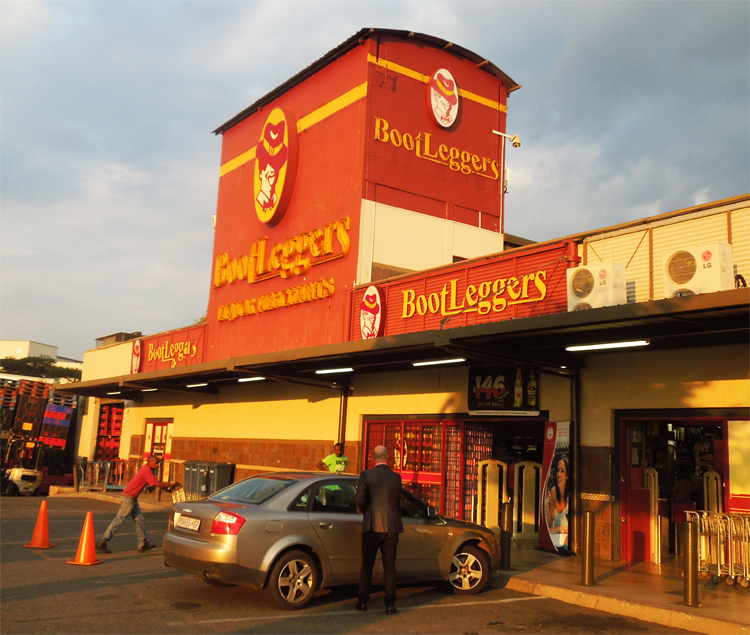
Finally, I have long appreciated the work that Charles Back has done at Fairview, and particularly his BootLeggerscommitment to social change in the region.  In 1997 he helped establish The Fairvalley Workers Association, which aims to help workers at Fairview to have their own land, and he was also the driving force behind the Fairvalley wine brand that is owned by the Workers Association, with profits from the sale of their wines (made using cellar facilities at Fairview, and FairTrade certified) being used to support community development initiatives.  Being in South Africa enabled me to access further wines that it is difficult to get in the UK, and so I particularly enjoyed the opportunity to explore the shelves of Bootleggers in Fourways Crossing and purchase additional wines, including some of Fairvalley’s remarkably good value 2009 Cabernet Sauvignon, which was delicious with boerewors, as well as  a bottle of Fairview’s 2010 Goat-Roti (Syrah/Viognier blend) that went especially well with barbecued fillet steak!

For those looking for somewhere quiet and relaxing to stay while exploring the vineyards of the Cape, I thoroughly recommend Majeka House, just outside Stellenbosch, which also houses the excellent Makaron Restaurant!


4 Comments

Filed under Africa, Photographs, Restaurants, Wine

Locusts at Walter Sisulu Botanical Garden

A short visit to Johannesburg provided an excellent opportunity to visit the beautiful Walter Sisulu Botanical Garden to learn something about the rich diversity of plant and bird life in South Africa.  While there, we encountered hundreds of locusts, and not only saw the devastation that they were doing to some of the plants, but also the amazing beauty of their colours when in flight.  They looked more like brightly coloured small birds than they did green locusts! Trying to capture them in photographs was, though, far from simple, not least since they would show no visible signs of taking off, and then suddenly lift off into the air and speed away.  Even using very fast shutter speeds it was difficult to capture them!  I hope, though, that the selection of images below captures not only their beauty, but also of the damage that they do.


This slideshow requires JavaScript.

Leave a comment

Filed under Africa, Photographs, Uncategorized

Jordan Wine Estate, Stellenbosch

It is some 40 years since I was last in Stellenbosch – and how it has changed!  Today, I had the privilege of being introduced to the wines of Jordan Wine Estate by Gary and Kathy Jordan – in the company of some good friends.  It is great to see the impact that UC Davis has on far-flung parts of the world, and also to meet wine-makers who combine expertise in geology and economics to produce some really very good wines!  Terroir is definitely alive and well here.  Sadly, I’m not yet able to share the flavours of the wines virtually, but I hope that the images below capture something of the beauty of this part of South Africa, as well as the care and attention to detail that marks out wine-making at Jordan Wine Estate!  Have to say that I particularly enjoyed the 2011 Cobblers Hill – and the lunch!

This slideshow requires JavaScript.

Leave a comment

Filed under Africa, Photographs, Wine

If m-learning is the answer, what is the question?

I was very privileged that Adrian Godfrey asked me to say a few words to introduce the session on m-education that the GSMA convened earlier today at the Mobile World Congress in Barcelona.  It was good to be with a fun group of panelists, and I hope that we gave them some food for thought.

So, this is what I said.  It was designed to be provocative, but its intent was to emphasise that there are many different interests in the use of mobile devices for learning, and that if we are going to take advantage of the enormous potential that they can offer for the poorest and most marginalised then we need to recognise these interests, and work together in carefully crafted partnerships to deliver effective learning opportunities.

“If m-learning is the answer, what is the question?
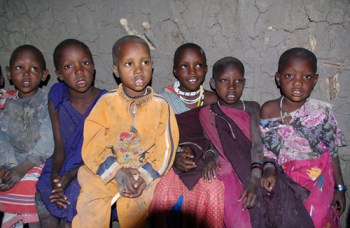
MaasaiLess than two weeks ago, I was in northern Tanzania.  Walking across the dry savannah, I entered the thorned enclosure of a boma, or small village. I was welcomed by the Maasai chief’s son, who engaged me in conversation.  I remembered seeing striking images in the international media around 2007 of Maasai warriors, resplendent in their red, “lion proof” robes, holding mobile ‘phones to their ears, and knowing that I was due to speak a world away, here in Barcelona today, I slowly began to explore the question of mobile telephony.  I should not have done so.  The conversation left me embarrassed and humbled.

As my friends used their smart-phones to take photos, I asked “Does anyone in the village have a mobile phone?”

“No” he said, in his excellent English.

One of my friends asked “Would a mobile ‘phone not be useful to call your friends in other villages?”

“Why?” he responded, “I can walk two or three hours to see them”.

And I admired his life.

Earlier, he had shown me the small hut where young children were learning the alphabet and counting in English. So I gently sought to explore the benefits of mobile learning: “But if you had a smart-phone, could you not use it to get learning resources for your children?”.

He looked bemused. My question meant little to him.  He had asked for chalk and books.

I changed the subject.

Of course, many Maasai – and indeed poor people in rural areas across Africa – do indeed use mobile ‘phones, for a wide range of purposes.  But this brief conversation re-emphasised many of the challenges of mobile-learning, and highlights the importance of the question: “if m-learning is the answer, what is the question”.

Let me therefore tease out just four of these questions here in my opening comments:

If m-learning is the answer, what is the question?
How do we increase our data traffic?”  To me, this is one of the most important questions –  all too often asked behind the closed doors of the luxurious offices of mobile operators – that is answered by the term “m-learning”.  It is nothing to do with education or learning. There is far more data capacity in the world than is currently used.  The arrival of the submarine cables across Africa in recent years has transformed connectivity, and much remains unused.  Mobile networks are expanding rapidly, but again there is insufficient demand for their use. Hence, it is crucial for operators to encourage the development of more services if they are to generate the profits that they seek.  Mobile banking has been one such successful service emanating from Africa; now mobile health services, and mobile-learning are seen as important means of moving beyond the simple data requirements of social media apps.

If m-learning is the answer, what is the question?
“How can we gain external funding from governments and donors so that we can extend our networks?”
The costs of putting networks into low-density rural areas, far from the fibre backbones of most countries, greatly outweigh the likely returns, at least in the short term. It is “uneconomic”.  In many poorer countries of the world, operators have been able to gain lucrative revenue opportunities from those living in the relatively small dense urban areas, and have been able to circumvent requirements to provide universal coverage, that would benefit all citizens. Hence, operators are always seeking to find sources of co-financing that can help them extend their networks into “marginal” areas.  Where they have to pay taxes into Universal Service (or Access) Funds, they naturally want a share back in extending networks.  They need a handle to persuade governments, and indeed donor agencies, to provide resources to enable them to extend their infrastructure. How better than to persuade them that by so doing they will enable all of their citizens to benefit from the opportunities that m-learning has to offer.  “If you will help fund the networks, you can then use them to ensure that every citizen has access to m-learning, alongside m-health and m-gov”.  This makes real sense.  With the drive to deliver the Millennium Development Goals, the thirst by the international donor community to ensure that “their” targets are reached, and the aspirations of “enlightened” governments really to deliver valuable services to their citizens, m-learning really is the answer.

If m-learning is the answer, what is the question?
“What is the best market opportunity for our company?”
  Education is no longer of value largely for its own sake; it is a commodity to be bought and sold; it has become a vibrant market.  Hence, there are considerable profits to be made by everyone in the education industry.  The company could be an app-developer, eager to find the “killer” education-app.  It could be a publisher, eager to extend its sales.  It could be a teaching company (often known as schools), eager to grow the market for the services offered by its teachers.  Academics in research companies (sometimes still known as universities) are eager to compete to gain prestigious research grants to study, or perhaps more usually to “prove”, the potential of m-learning, and fuel this thriving industry. The explosion of mobile telephony, and the expectation that it will soon become ubiquitous opens up vast new possibilities for companies to extend the reach of their educational “solutions”.  We truly can achieve education for all, if only we can ensure that the poorest people can still afford a cheap smartphone, and that we can have universal network coverage.   And that is the point, it is education for all. Unlike “health”, which is mainly for those who are ill, learning is something that everyone “must” do.  It is institutionalised in our education systems, and now we are all encouraged to partake in lifelong learning.  Education is 24 x 7 x 365 x 80 or so, depending on how long we live – the magic multiplier number is 6,384,000 times the number of people in the world! This is a market indeed.

If m-learning is the answer, what is the question?
“How can we reach the most marginalised in our societies, and give them the highest possible quality of learning opportunity?”
  I guess this is the question that most people would have expected me to begin with. Of course m-learning provides a wealth of opportunity for the enlightened, the altruists, those who care about reducing the inequalities that digital technologies otherwise enhance, and hopefully some governments and civil society organisations, who are committed to providing quality learning opportunities for the poorest and most marginalised in our societies – those living in isolated rural areas, street children, people with disabilities.  The ubiquity of networks and devices, their mobility – anywhere, anytime – and their simplicity of use, all make mobile devices – be they phones, tablets or laptops, wonderful platforms for learning.

But we still need to work harder to find what works best. We still need high-quality, locally produced content, and above all we still need teachers trained in ways of using these technologies in the best interests of pupils.  Perhaps mobile devices may even one day free us completely from what many people see as being the shackles of an outmoded school system…”
3 Comments

Filed under 'phones, Accessibility, Africa, Commonwealth, Development, Education, ICT4D

Contributions to GSMA MWC Ministerial discussion on mobile-learning

It was great to be on Monday’s panel on “Why put ‘mobile’ in education?” hosted by Adrian Godfrey during the GSMA’s Mobile World Congress Ministerial Programme in Barcelona.  Mike Trucano set the panel underway by giving an important keynote on “Education, jobs and national productivity – why mobile education matters”, which was as usual full of down-to-earth sensible suggestions.  I suggested that governments should try cloning him, and each then have one clone to help them implement effective ICT and education initiatives.

Rebecca Walton (British Council) then hosted a panel discussion that also included Carolina Jeux (Telefónica), Chris Penrose (AT&T), and Tarek Shawki (American University, Cairo), asking us each a pre-set question to get the ball rolling.  Mine was “What are the three things that policy makers should know about mobile technologies in education, and what are the three things that governments should do?”.  This is actually much tougher than it might appear – keeping the list down to only three things each!

Here was my response:

Three things policy makers should know about mobile technologies in education:

  • The focus should be on the learning and not on the technology
  • Never ignore the content – far too many initiatives focus on putting equipment into schools or into learners’ hands – but often there is insufficient relevant content – and pupils do not always know how to access this themselves
  • It is essential to provide high quality training for teachers in how to use technologies in the classroom – and particularly mobile devices of all kinds. Keep mobile switched on in classrooms (and beyond)!

Top three things governments should do:

  • Approach mobile learning in a holistic and integrated way – bringing together all relevant ministries – ICTs, energy, education…
  • Focus on the most marginalised.  The market will take care of the majority, and it is the responsibility of states to deliver services for their poorest citizens. Hence, governments must implement programmes to support those living in isolated rural areas, and that will enable people with disabilities to gain the benefits of mobile learning
  • Begin by ensuring that the basic infrastructure is in place – electricity and connectivity (preferably mobile broadband) as far as possible making this universal.

I wonder what your three answers to these questions might be?

1 Comment

Filed under 'phones, Accessibility, Africa, Commonwealth, Development, Education, ICT4D

CTO visit to the Ngorongoro crater in Tanzania

The final day of the Commonwealth Telecommunications Organisation’s Digital Broadcasting Switchover Forum (DBSF) 2014 provided an opportunity for delegates to continue their discussions whilst visiting the magnificent Ngorongoro crater, a UNESCO World Heritage Site situated some three hours drive west of Arusha.  This event, along with many other aspects of the Forum was supported by the Tanzania Communications Regulatory Authority (TCRA), and I would like to take this opportunity to thank Professor John Nkoma (Director General, TCRA) for all of the effort that his magnificent team put into making this what was widely regarded as one of the best ever DBSF event convened by the CTO.  Particular thanks are especially owed to Habbi Gunze (Director of Broadcasting Affairs at TCRA) and to Innocent Mungy (Head of Corporate Communications, TCRA) for everything that they did to ensure that participants were able to hold fruitful and valuable discussions on Africa’s progress towards digital broadcasting switchover by August 2014.

The photos below provide a summary of the magnificent experiences that delegates had in the Ngorongoro crater, and also on the journey between Arusha and the crater.  As I hope these images indicate, the crater itself was very much bigger than I had been expecting and the range of wildlife was truly amazing.

This slideshow requires JavaScript.

After visiting the crater, we spent some time in a small Maasai boma.  A group of children were gathered in one of the tiny huts that served as a pre-school, and it was fun to sing ABCDEFG… with them, and hear them count from one to 10 in very good English.  It reminded me of the images that appeared around 2007 in European and north American media of Maasai warriors with their mobile ‘phones, giving the impression that such devices were becoming more or less universal amongst the Maasai, and were transforming their lives.  I asked one of the chief’s sons whether there were mobile ‘phones in the village, and slightly perplexed he said “No”.  One of my colleagues then asked whether he felt ‘phones would be useful for communicating with friends, and the “warrior’s” response was fascinating, saying much about the resilience of Maasai culture.  “Why do I need a mobile ‘phone?”, he said.  “If I want to see a friend, I walk, perhaps two or three hours to see them”.  I envied him.  What a privilege to walk through such a wonderful landscape, and not to feel the pressures of our modern digital lives.  Perhaps I should not have asked my next question, but he was proud of the children’s learning skills, and wanted to improve his own education.  So, I asked “But if you had a mobile ‘phone, could you not use it to access books and information so that you could learn?”  I should not have asked, because the question embarrassed him.  It reflected a world so different from his own, that it was incomprehensible.  I felt embarrassed too that, although he had given permission, friends with me were using their smart-phones to take pictures of the boma.  I left feeling very challenged.  I’ve long felt that we should never impose digital technologies on the lives of others.  Of course many people think that mobile ‘phones could indeed make the lives of the Maasai very much “better”, but it would certainly be at a cost.  I left just wanting to find a way to give them books for their children, which is what he had asked for.  Perhaps then we could make time to help work with the villagers to design technologies that might enable them to live the lives they want to, rather than the lives so many of “us” want to impose on them of being both a market and a labour force.

4 Comments

Filed under Africa, Photographs

Commonwealth Telecommunications Organisation’s Digital Broadcasting Switchover Forum, Arusha

Just under 200 people (including regulators, the private sector and civil society groups) have come together to discuss critical issues surrounding the switchover/transition from analogue to digital broadcasting at the Commonwealth Telecommunications Organisation’s Digital Broadcasting Switchover Forum (#DBS2014) taking place from 11th-14th February 2014.  We were delighted that Hon Dr. Fenella E. Mukangara (Minister of Information, Youth, Culture and Sport of the United Republic of Tanzania) was able to open the Forum this morning.

With Nkoma and Mukangara

In my welcome address, as well as thanking the government of Tanzania and especially the Tanzania Communications Regulatory Authority, I took the opportunity to highlight four particular issues:

  • The importance for Africa –  digital transition/switchover has considerable potential, especially in terms of the diversity of services it can offer, as well as the digital dividend it will provide through the reallocation of spectra.  However, it must be used to  serve the interests of all of Africa’s people, especially the marginalised, such as people with disabilities and those living in sparsely populated rural areas.
  • The potential for Africa – people living in Africa should not be only learning from the experiences of other parts of the world in terms of good practices (part of the purpose of this Forum), but should also be developing innovative solutions for the context of Africa, that can in their turn be used in other international contexts. We must build on the richness of African innovation.
  • The challenges facing Africa – some of the many challenges facing Africa include:
    • it is not easy to deliver transition/switchover solutions at a cost that everyone can afford;
    • we must not fall into the trap of being forced to deliver to a time-schedule that may not  be realistically feasible;
    • ensuring indeed that the poor and marginalised – those who often currently benefit most from analogue radio and television – can indeed still afford to do access digital broadcasting;
    • ensuring quality standards of equipment such as set top boxes; and
    • ensuring that appropriate information is shared with everyone in a diversity of languages.
  • My own experiences of switchover – I recall my parents being really concerned about switchover in England, not fully understanding what was involved, but they were grateful that a free service for elderly people was provided to put in a set top box and help them to use it effectively.  My mother can now benefit from all that digital TV can offer! This particularly reminds that it is not so much the technology that is the challenge, but rather that the most difficult thing to get right is how to ensure that everyone, and particularly the elderly, the spatially marginalised and those with disabilities, can really benefit from digital switchover.

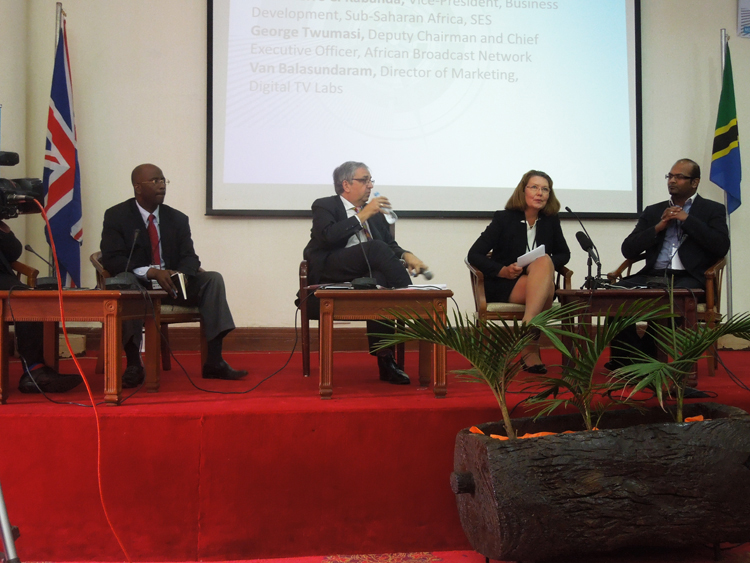
Sirpa OjalaImage from session on the future of African broadcasting

Leave a comment

Filed under Africa, ICT4D

Reflections on “corruption”…

I have long argued that people tend to use the word “corruption” mainly to describe cultural practices that differ from those with which they are familiar.  It is a term that is almost always used negatively. Re-reading Transparency International‘s 2013 Corruption Perceptions Index has very much reinforced this view, but in a way that I suspect will not be expected by those who read what follows!

Corruption TI

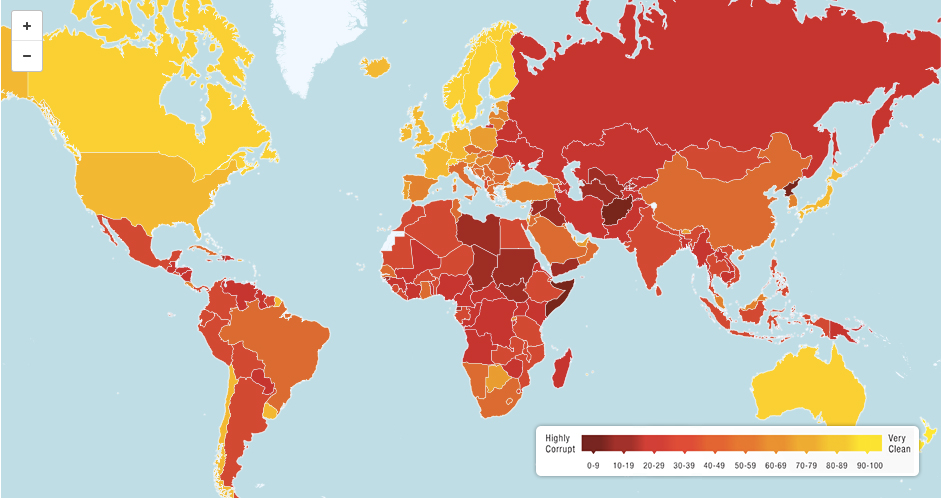
I have huge admiration and respect for the work of Transparency International. The map above shows the perceived levels of public sector corruption in 177 countries in the world.  In brief, it indicates that 69% of countries have a score of less than 50%, indicating a serious corruption problem.

However, what stands out most to me about this map is that it is very largely the countries of northern Europe, northern America, and Australasia that are perceived as being least corrupt.  The yellow “holiness” is so marked against the “evil” red of corruption that swathes most of the rest of the world!

Corruption according to Transparency International can be defined  “Generally speaking as ‘the abuse of entrusted power for private gain’. Corruption can be classified as grand, petty and political, depending on the amounts of money lost and the sector where it occurs”.

Three ideas seem particularly pertinent in this context:

  1. The notion of corruption is intimately tied up with the nature of capitalism.  Put simply, the apparently least corrupt countries according to this definition are generally the most advanced capitalist countries.  This suggests that it serves capitalist interests to try to reduce “corruption” as much as possible. It is interesting to ponder why this might be.  One reason may be that reducing the abuse of entrusted power for private gain actually reduces the tendency for the rate of profit to fall.  However, it is difficult to see how this might happen, and it seems in stark contrast to a fundamental characteristic of capitalism which is that it is actually designed to ensure the maximum possible private gain for the capitalists.  I guess the reality may be that limiting or preventing private gain from entrusted power actually enables the market (i.e. the principles of capitalism) to flourish as effectively as possible.  By extension a reduction of all entrusted power (i.e. limiting the power of the state) could be seen to enhance the power of the market, and therefore increase the potential for private gain of those who do not hold political power.  Hence, keeping the power of the state as small as possible, and ensuring that it functions in a way that does not lead to private gain for the holders of power in the state, will ensure that the maximum surplus profit is available to the leaders of global corporations and their shareholders.
  2. However, it is very clear that there is also corruption in the leading capitalist states.  The countries shaded yellow on the above map may be perceived as being less corrupt than others, but corruption still abounds in them!  Hence, there is huge hypocrisy when leaders (and indeed others) in the “yellow” countries accuse those in the “red” countries of being corrupt.  Those in the banking sector, for example, who pay themselves and their staff huge salaries are surely also using their positions of power for private gain?  The amount of money spent in US Presidential elections is also an indication of the way in which “money speaks”: Obama thus raised $715,677,692 in the 2012 elections, and Romney raised $446,135,997.  Together, this sum of money was worth more than the GDP of 25 countries in 2012 (according to UN figures).  One needs huge amounts of money to be elected President of the US, and those who contribute this money expect the policies that the President introduces to benefit them – for private gain.  Likewise, in the UK in 2012, Michael Meacher in a letter to the Guardian newspaper noted that “that the richest 1,000 persons, just 0.003% of the adult population, increased their wealth over the last three years by £155bn. That is enough for themselves alone to pay off the entire current UK budget deficit and still leave them with £30bn to spare”.  Is not this also a form of corruption?
  3. Corruption is seen differently in countries where rampant capitalism and private financial gain may not be seen as the most important priorities.  According to the Transparency International report, most countries in the world are perceived as having a serious corruption problem.  This poses an interesting question: might their systems of priorities actually in some ways be better?  If they were not, why do these systems persist?  For a person living in a culture where ties to family and tribe are more important than individual private financial gain, it must seem very wrong not to give employment opportunities to members of one’s family, regardless of actual ability. Likewise, where personal loyalty matters more than direct monetary return, supporting a friend to achieve their particular job aspirations would seem much more appropriate than ensuring that there is a “fair” competence based application process.  Giving gifts to reciprocate for generous hospitality is merely a different way of redistributing and sharing financial benefits.  Moreover, much of what passes for probity in the “yellow” countries actually tends to be a smokescreen for traditional modes of “corruption”.  The appointments process is invariably biased through friendship ties – not least through the reference system and the use of headhunters – and is never purely competence based.  Likewise, the UK’s honours system is still very largely determined by personal friendship networks, rather than necessarily by ability or contribution to the common good.

In short, I am more than ever convinced that “corruption” is simply a pejorative term that people use to describe political, social and economic systems that are  different from their own.  In a world dominated by capitalist interests, it is scarcely surprising that less-advanced capitalist economies are perceived as being more corrupt than those where the search for individual gain and success is highest.  Yet this very focus on individual gain in capitalist societies is itself fundamentally “corrupt”, since it detracts from the communal good which, at least for me, is ultimately far more valuable.  I suggest that we may have much more to learn from the mutually supportive social and cultural networks that underlie such “corrupt” regimes, than we do from the economic interests that determine definitions of probity in the capitalist heartland. However, this is because I believe that the common good is far more important than private individual gain.

5 Comments

Filed under Africa, Commonwealth, Development, Entrepreneurship, Universities

Summary of Keynote for COL’s PCF7 in Abuja

Despite limited digital connectivity, I just thought I would upload a short summary of my upcoming keynote at the Commonwealth of Learning’s Seventh Pan-Commonwealth Forum this afternoon to encourage productive debate!  Its central argument is that we are not delivering as effectively as we could in using ICTs for education at all levels, because of very explicit interests that are serving to limit this effectiveness. (Later on 17th December: the slides that accompanied the keynote have now been made available by COL)

Good practices

I begin with a short overview of ten good practices that need to be in place to ensure effective use of ICTs in education:

  1. It’s the learning that matters, not the technology
  2. Teachers must be involved from the beginning
  3. Sustainability built in from the start
  4. Supporting infrastructure must be in place
  5. Appropriate content must be developed
  6. Equality of access for all learners
  7. Continual monitoring and evaluation
  8. Appropriate maintenance contracts
  9. Using the technology 24/7
  10. Good practices, rather than best

So, why are these not done?

I focus here first on the observation that ICTs generally increase inequalities unless very specific actions are taken to ensure that the poorest and most marginalised are able to benefit.

I then explore the various interests that tend to limit delivery of the above ten practices, focusing especially on the activities of the private sector, and especially hardware and software companies, connectivity companies and content developers.

In so doing, I also draw on some of the increasing amount of empirical evidence that the use of computers in education is actually damaging learning.

Implications for innovation

In the final section, I explore some of the implications of these trends for innovation and creativity, paying specific attention to five themes:

  1. Content replication
  2. Memory
  3. Language and literacy
  4. Personalised searching
  5. Privacy and failure

In conclusion

In drawing these reflections to an end, I argue that one way forward is to work towards new and effective models of multi-stakeholder partnerships for education, that address education as something much more important, much more complex, and much more exciting than merely as a vehicle for economic transformation.

Leave a comment

Filed under Africa, Commonwealth, Development, Education, Higher Education, ICT4D