CTO visit to the Ngorongoro crater in Tanzania

The final day of the Commonwealth Telecommunications Organisation’s Digital Broadcasting Switchover Forum (DBSF) 2014 provided an opportunity for delegates to continue their discussions whilst visiting the magnificent Ngorongoro crater, a UNESCO World Heritage Site situated some three hours drive west of Arusha.  This event, along with many other aspects of the Forum was supported by the Tanzania Communications Regulatory Authority (TCRA), and I would like to take this opportunity to thank Professor John Nkoma (Director General, TCRA) for all of the effort that his magnificent team put into making this what was widely regarded as one of the best ever DBSF event convened by the CTO.  Particular thanks are especially owed to Habbi Gunze (Director of Broadcasting Affairs at TCRA) and to Innocent Mungy (Head of Corporate Communications, TCRA) for everything that they did to ensure that participants were able to hold fruitful and valuable discussions on Africa’s progress towards digital broadcasting switchover by August 2014.

The photos below provide a summary of the magnificent experiences that delegates had in the Ngorongoro crater, and also on the journey between Arusha and the crater.  As I hope these images indicate, the crater itself was very much bigger than I had been expecting and the range of wildlife was truly amazing.

This slideshow requires JavaScript.

After visiting the crater, we spent some time in a small Maasai boma.  A group of children were gathered in one of the tiny huts that served as a pre-school, and it was fun to sing ABCDEFG… with them, and hear them count from one to 10 in very good English.  It reminded me of the images that appeared around 2007 in European and north American media of Maasai warriors with their mobile ‘phones, giving the impression that such devices were becoming more or less universal amongst the Maasai, and were transforming their lives.  I asked one of the chief’s sons whether there were mobile ‘phones in the village, and slightly perplexed he said “No”.  One of my colleagues then asked whether he felt ‘phones would be useful for communicating with friends, and the “warrior’s” response was fascinating, saying much about the resilience of Maasai culture.  “Why do I need a mobile ‘phone?”, he said.  “If I want to see a friend, I walk, perhaps two or three hours to see them”.  I envied him.  What a privilege to walk through such a wonderful landscape, and not to feel the pressures of our modern digital lives.  Perhaps I should not have asked my next question, but he was proud of the children’s learning skills, and wanted to improve his own education.  So, I asked “But if you had a mobile ‘phone, could you not use it to access books and information so that you could learn?”  I should not have asked, because the question embarrassed him.  It reflected a world so different from his own, that it was incomprehensible.  I felt embarrassed too that, although he had given permission, friends with me were using their smart-phones to take pictures of the boma.  I left feeling very challenged.  I’ve long felt that we should never impose digital technologies on the lives of others.  Of course many people think that mobile ‘phones could indeed make the lives of the Maasai very much “better”, but it would certainly be at a cost.  I left just wanting to find a way to give them books for their children, which is what he had asked for.  Perhaps then we could make time to help work with the villagers to design technologies that might enable them to live the lives they want to, rather than the lives so many of “us” want to impose on them of being both a market and a labour force.

Commonwealth Telecommunications Organisation’s Digital Broadcasting Switchover Forum, Arusha

Just under 200 people (including regulators, the private sector and civil society groups) have come together to discuss critical issues surrounding the switchover/transition from analogue to digital broadcasting at the Commonwealth Telecommunications Organisation’s Digital Broadcasting Switchover Forum (#DBS2014) taking place from 11th-14th February 2014.  We were delighted that Hon Dr. Fenella E. Mukangara (Minister of Information, Youth, Culture and Sport of the United Republic of Tanzania) was able to open the Forum this morning.

With Nkoma and Mukangara

In my welcome address, as well as thanking the government of Tanzania and especially the Tanzania Communications Regulatory Authority, I took the opportunity to highlight four particular issues:

  • The importance for Africa –  digital transition/switchover has considerable potential, especially in terms of the diversity of services it can offer, as well as the digital dividend it will provide through the reallocation of spectra.  However, it must be used to  serve the interests of all of Africa’s people, especially the marginalised, such as people with disabilities and those living in sparsely populated rural areas.
  • The potential for Africa – people living in Africa should not be only learning from the experiences of other parts of the world in terms of good practices (part of the purpose of this Forum), but should also be developing innovative solutions for the context of Africa, that can in their turn be used in other international contexts. We must build on the richness of African innovation.
  • The challenges facing Africa – some of the many challenges facing Africa include:
    • it is not easy to deliver transition/switchover solutions at a cost that everyone can afford;
    • we must not fall into the trap of being forced to deliver to a time-schedule that may not  be realistically feasible;
    • ensuring indeed that the poor and marginalised – those who often currently benefit most from analogue radio and television – can indeed still afford to do access digital broadcasting;
    • ensuring quality standards of equipment such as set top boxes; and
    • ensuring that appropriate information is shared with everyone in a diversity of languages.
  • My own experiences of switchover – I recall my parents being really concerned about switchover in England, not fully understanding what was involved, but they were grateful that a free service for elderly people was provided to put in a set top box and help them to use it effectively.  My mother can now benefit from all that digital TV can offer! This particularly reminds that it is not so much the technology that is the challenge, but rather that the most difficult thing to get right is how to ensure that everyone, and particularly the elderly, the spatially marginalised and those with disabilities, can really benefit from digital switchover.

Sirpa OjalaImage from session on the future of African broadcasting

Reflections on “corruption”…

I have long argued that people tend to use the word “corruption” mainly to describe cultural practices that differ from those with which they are familiar.  It is a term that is almost always used negatively. Re-reading Transparency International‘s 2013 Corruption Perceptions Index has very much reinforced this view, but in a way that I suspect will not be expected by those who read what follows!

Corruption TI

I have huge admiration and respect for the work of Transparency International. The map above shows the perceived levels of public sector corruption in 177 countries in the world.  In brief, it indicates that 69% of countries have a score of less than 50%, indicating a serious corruption problem.

However, what stands out most to me about this map is that it is very largely the countries of northern Europe, northern America, and Australasia that are perceived as being least corrupt.  The yellow “holiness” is so marked against the “evil” red of corruption that swathes most of the rest of the world!

Corruption according to Transparency International can be defined  “Generally speaking as ‘the abuse of entrusted power for private gain’. Corruption can be classified as grand, petty and political, depending on the amounts of money lost and the sector where it occurs”.

Three ideas seem particularly pertinent in this context:

  1. The notion of corruption is intimately tied up with the nature of capitalism.  Put simply, the apparently least corrupt countries according to this definition are generally the most advanced capitalist countries.  This suggests that it serves capitalist interests to try to reduce “corruption” as much as possible. It is interesting to ponder why this might be.  One reason may be that reducing the abuse of entrusted power for private gain actually reduces the tendency for the rate of profit to fall.  However, it is difficult to see how this might happen, and it seems in stark contrast to a fundamental characteristic of capitalism which is that it is actually designed to ensure the maximum possible private gain for the capitalists.  I guess the reality may be that limiting or preventing private gain from entrusted power actually enables the market (i.e. the principles of capitalism) to flourish as effectively as possible.  By extension a reduction of all entrusted power (i.e. limiting the power of the state) could be seen to enhance the power of the market, and therefore increase the potential for private gain of those who do not hold political power.  Hence, keeping the power of the state as small as possible, and ensuring that it functions in a way that does not lead to private gain for the holders of power in the state, will ensure that the maximum surplus profit is available to the leaders of global corporations and their shareholders.
  2. However, it is very clear that there is also corruption in the leading capitalist states.  The countries shaded yellow on the above map may be perceived as being less corrupt than others, but corruption still abounds in them!  Hence, there is huge hypocrisy when leaders (and indeed others) in the “yellow” countries accuse those in the “red” countries of being corrupt.  Those in the banking sector, for example, who pay themselves and their staff huge salaries are surely also using their positions of power for private gain?  The amount of money spent in US Presidential elections is also an indication of the way in which “money speaks”: Obama thus raised $715,677,692 in the 2012 elections, and Romney raised $446,135,997.  Together, this sum of money was worth more than the GDP of 25 countries in 2012 (according to UN figures).  One needs huge amounts of money to be elected President of the US, and those who contribute this money expect the policies that the President introduces to benefit them – for private gain.  Likewise, in the UK in 2012, Michael Meacher in a letter to the Guardian newspaper noted that “that the richest 1,000 persons, just 0.003% of the adult population, increased their wealth over the last three years by £155bn. That is enough for themselves alone to pay off the entire current UK budget deficit and still leave them with £30bn to spare”.  Is not this also a form of corruption?
  3. Corruption is seen differently in countries where rampant capitalism and private financial gain may not be seen as the most important priorities.  According to the Transparency International report, most countries in the world are perceived as having a serious corruption problem.  This poses an interesting question: might their systems of priorities actually in some ways be better?  If they were not, why do these systems persist?  For a person living in a culture where ties to family and tribe are more important than individual private financial gain, it must seem very wrong not to give employment opportunities to members of one’s family, regardless of actual ability. Likewise, where personal loyalty matters more than direct monetary return, supporting a friend to achieve their particular job aspirations would seem much more appropriate than ensuring that there is a “fair” competence based application process.  Giving gifts to reciprocate for generous hospitality is merely a different way of redistributing and sharing financial benefits.  Moreover, much of what passes for probity in the “yellow” countries actually tends to be a smokescreen for traditional modes of “corruption”.  The appointments process is invariably biased through friendship ties – not least through the reference system and the use of headhunters – and is never purely competence based.  Likewise, the UK’s honours system is still very largely determined by personal friendship networks, rather than necessarily by ability or contribution to the common good.

In short, I am more than ever convinced that “corruption” is simply a pejorative term that people use to describe political, social and economic systems that are  different from their own.  In a world dominated by capitalist interests, it is scarcely surprising that less-advanced capitalist economies are perceived as being more corrupt than those where the search for individual gain and success is highest.  Yet this very focus on individual gain in capitalist societies is itself fundamentally “corrupt”, since it detracts from the communal good which, at least for me, is ultimately far more valuable.  I suggest that we may have much more to learn from the mutually supportive social and cultural networks that underlie such “corrupt” regimes, than we do from the economic interests that determine definitions of probity in the capitalist heartland. However, this is because I believe that the common good is far more important than private individual gain.

Summary of Keynote for COL’s PCF7 in Abuja

Despite limited digital connectivity, I just thought I would upload a short summary of my upcoming keynote at the Commonwealth of Learning’s Seventh Pan-Commonwealth Forum this afternoon to encourage productive debate!  Its central argument is that we are not delivering as effectively as we could in using ICTs for education at all levels, because of very explicit interests that are serving to limit this effectiveness. (Later on 17th December: the slides that accompanied the keynote have now been made available by COL)

Good practices

I begin with a short overview of ten good practices that need to be in place to ensure effective use of ICTs in education:

  1. It’s the learning that matters, not the technology
  2. Teachers must be involved from the beginning
  3. Sustainability built in from the start
  4. Supporting infrastructure must be in place
  5. Appropriate content must be developed
  6. Equality of access for all learners
  7. Continual monitoring and evaluation
  8. Appropriate maintenance contracts
  9. Using the technology 24/7
  10. Good practices, rather than best

So, why are these not done?

I focus here first on the observation that ICTs generally increase inequalities unless very specific actions are taken to ensure that the poorest and most marginalised are able to benefit.

I then explore the various interests that tend to limit delivery of the above ten practices, focusing especially on the activities of the private sector, and especially hardware and software companies, connectivity companies and content developers.

In so doing, I also draw on some of the increasing amount of empirical evidence that the use of computers in education is actually damaging learning.

Implications for innovation

In the final section, I explore some of the implications of these trends for innovation and creativity, paying specific attention to five themes:

  1. Content replication
  2. Memory
  3. Language and literacy
  4. Personalised searching
  5. Privacy and failure

In conclusion

In drawing these reflections to an end, I argue that one way forward is to work towards new and effective models of multi-stakeholder partnerships for education, that address education as something much more important, much more complex, and much more exciting than merely as a vehicle for economic transformation.

Transform Africa 2013 and a celebration of Rwanda

I had the great privilege – especially as a white Yorkshireman – to be invited to chair the session on Smart Education at Transform Africa 2013 held in Kigali, Rwanda – a conference led by Africans, for Africans.  It is some five year since I was last in Rwanda, and the changes that have been made in the country over this time, especially in the field of ICTs, are palpable.

It was really excellent to hear seven Presidents of east African countries champion the potential of ICTs to transform Africa, whilst also being realistic about the challenges that still remain in using them effectively to contribute to the social, political and economic development of their countries.

It was also good to experience some of the musical heritage of Rwanda – and even to have the chance of learning yet another different style of African dance!  This was especially so at the launch of Rwandapedia this evening – an excellent resource for those wishing to learn more about Rwanda’s turbulent history over the last 20 years or so.  Congratulations, too, to the Panorama Restaurant at the Des Mille Collines for what has to be one of the best dinners I have recently had in Africa!

The photos below catch but a glimpse of some of my experiences here over the last few days.

This slideshow requires JavaScript.

My keynote address at CTO Forum 2013 in Abuja

The Commonwealth Telecommunications Organisation is convening its Annual Forum and Council meeting in Abuja, kindly hosted by the Federal Ministry of Communication Technology and the Nigeria Communications Commission on behalf of the Federal Government of Nigeria, on the theme of Innovation through Broadband.  This is something I care passionately about, and my team permitted me to give a keynote opening address.  Several people have already asked me for the text – and so provide an abbreviated version below, which omits the diplomatic niceties and my heartfelt thanks to all who have made this event possible.

“Over the next few days we address critically important themes, and I specifically wanted to say a few words to challenge us all now, at the beginning of this event.  Quite simply, we cannot deliver on the title of this Forum, “Innovation through Broadband” unless we actually have broadband.  Many of the CTO’s members have less than 5% of their population connected to the Internet; my own country, the UK, still has 17% of its households not connected. For those of you from the corporate sector, this is indeed a great market opportunity!  However, the case I want to put before you is that, more importantly than merely the economic agenda, is a moral agenda.  These technologies are so important, so powerful, so life-changing, that we fail our brothers and sisters if we do not ensure that they too have access to broadband.

There are three simple things I would like you to take away from what I say this morning:

  1. Boy on streetFirst, the expansion of ICTs over the last decade has made the world a more unequal place.  Put simply, these technologies are hugely powerful.  Those who have access to them, and know how to use them, can benefit immensely.  But those who do not have access, who only have an old style mobile ‘phone, who cannot afford the costs of connectivity, are becoming increasingly disadvantaged.  This is not only a moral agenda, but also a very practical social and political one, because sooner or later, the disadvantaged will – and I have no doubt about this – seek to redress the balance by taking action into their own hands, as we see across so many parts of the world today. We must, and again there has to be no doubt about this, ensure that everyone has access to the Internet.  I am delighted to see that we have a session specifically on women and children at this Forum, and that (for a change) we do indeed have a distinguished woman on the platform here at the start.  But this is not enough.  As most of you know, I champion the use of ICTs by people with disabilities – at least 10% of the world’s population; we have to do more for them, so that they too can benefit from the use of ICTs.  Access for all is therefore my first point.
  2. Wheelchair computer technicianSecond, we need to develop new models through which such access can be provided at an affordable price to those who do not currently have access.  This is an immense challenge.  Put simply, the market will deliver solutions for many of our peoples.  We must therefore ensure that regulatory environments enable the market to deliver for the greatest number possible.  Regulators and companies must work together in an environment of trust to ensure that this happens.  However, the market will not deliver for everyone – for those living in the most peripheral rural areas, for the elderly, for those with severe disabilities.  Here, I believe passionately that we need to craft innovative multi-stakeholder partnerships to ensure such delivery.  These need to involve governments, the private sector, civil society, international organisations and bilateral donors in providing solutions that will serve the needs of everyone in our societies.  This is not easy.  Everyone talks ‘partnerships’ but few ICT4D partnerships have truly been successful.  It is here that the CTO can offer much in terms of partnership brokering, and working with all of our members to deliver such partnerships practically on the ground.  As many of you will know, broadband is one of the CTO’s six priority areas, and it is highly appropriate that we are here in Nigeria shortly after they have published their national broadband plan. … This emphasis on partnerships is also why I am so delighted that the CTO has joined the Alliance for Affordable Internet, and that they have privileged us by launching this very important initiative here in Abuja.My second point, is thus the need for carefully crafted multi-stakeholder partnerships to help deliver affordable broadband for all those for whom the market itself will not deliver solutions.
  3. children 2But third, providing broadband connectivity is only a beginning.  If we do not work with the poorest and most marginalised in our societies, truly to understand their needs, and then develop solutions that will be of explicit benefit to them, as much as to the privileged rich and elites, then the divisions within our societies will only increase yet further.  This is why this Forum focuses on “Innovation through Broadband”.  These innovations must not just be concerned with how to make yet greater profits from the telecommunications sector, or for governments to raise yet more revenue through levies and spectrum auctions – however important these are.  No.  This is only part of the story.  We are simply failing in our duties as responsible citizens, and indeed decent human beings, if we do not enable everyone to benefit from broadband: the young orphaned girl, bringing up her younger brother in the slums; the widow, gleaning an existence in the forests far from the capital city; the child soldier who had his arms lopped off and is now begging on the streets…

 My three messages are, I hope clear:

  • Enabling everyone to have access
  • The importance of multi-stakeholder partnerships to serve the most marginalised, and
  • Working with the poor and marginalised to enable them to develop solutions that are fundamentally in their interests

Distinguished colleagues and friends.  My final thanks are to you for being here.  We have a packed programme of inspirational speakers – I often think our events are far too packed!  Take time to talk with each other.  Use Wednesday morning to hold bilateral meetings and engage in productive discussions.  We are the privileged.  We are the elite – whether we like it or not.  We therefore have immense responsibilities.  The CTO has brought us all together.  But this is not enough.  I want every one of you to make a commitment – here and now in this room – not just to listen, not just to speak, but to act.  The time is almost too late.  The inequalities generated by ICTs have almost become too big for us to overcome.  Now is the time to make a difference.  Now is the time to turn rhetoric into reality.”

Barriers to learning through mobile devices in Africa

Screen-Shot-2013-06-07-at-17.36.39-300x159I had the pleasure of participating in the Planet Earth Institute‘s discussion on mobile technology for education in Africa, held on 5th June at the House of Lords.  It’s interesting how such occasions, where one has to speak on the spur of the moment about important issues, provide a spur for innovative and creative thinking.  The mix of the people, and the sharing of ideas really can generate new thoughts.

The main point that I tried to convey throughout the event was that it is the learning that matters.  Far too many initiatives are technology-led, rather than needs driven.  Hence, mobile devices are absolutely not the solution for African education, although they can indeed help to deliver certain new kinds of learning opportunity.  After all, as I mentioned, many years ago I engaged in mobile learning when I read books on long car journeys!

Screen-Shot-2013-06-07-at-17.31.05At one point, we were asked to think about the barriers preventing the spread of m-learning in Africa, and I want here to expand a little on the five ‘Cs’ that I came up with.  To be sure, they are a little contrived, but I do think that if these barriers can be overcome, then some real progress can be made:

  1. Connectivity.  To me, this is one of the biggest challenges for any ‘mobile-‘ initiative.  Certainly people have developed simple SMS based learning solutions, and games that can function on basic phones and devices, but the difference between these and what can be done on smart-phones is huge.  Smart-phones enable engagement with the wealth of resources on the web, and offer a completely different learning experience for people of all ages and backgrounds – if they can afford them (Cost!).  So, providing mobile broadband solutions that everyone can access seems to me to be the most important challenge facing those who want to deliver high quality learning experiences through mobile devices.  Hence, initiatives such as the work of the Broadband Commission and the Alliance for the Affordable Internet are of particular importance – but we must turn the rhetoric into reality!  That’s one reason why the Commonwealth Telecommunications Organisation has placed such emphasis on the importance of mobile broadband in its current strategic plan.
  2. Charging (electricity).  By this, I mean the importance of ensuring that it is easy and cheap to charge mobile devices everywhere.  Electricity is absolutely essential for all digital technologies, and is all too often insufficiently considered when developing such initiatives.  For those off the main grid, it is essential that simple, cheap and accessible means of recharging devices are developed and shared widely across the continent. Likewise, developing batteries that last much longer than at present is also an important consideration.  My experiences in 2011 in rural China have given me lots of ideas about how this can be achieved – and where there are supplies of running water I have been very impressed with some of the micro-hydro initiatives that have been developed in south-east Asia.
  3. Communication rather than content.  I have often written about this, but it seems to me that the really innovative thing about mobile-phones is that they enable entirely new ways of communication.  Yet, far too often they are seen primarily as devices to supply/enable content consumption.  I believe passionately that learning should not simply be about learning and regurgitating – yet our education systems seem to focus more and more on encouraging people to take on board accepted ‘truths’.  Learning, should be about thinking for oneself, and coming up with new solutions to old problems!  This is often best achieved through communication and interaction – the debating of ideas – and not just through digesting existing knowledge.  Far too often, digital technologies associated with learning have reinforced regurgitation, rather than encouraging new ways of thinking.  Hence, I want to shift the balance towards using devices for communication – they are, after all, mobile phones – rather than just for content consumption.
  4. Calculating (effective monitoring and evaluation).  This is a bit contrived, but I could not think of a better ‘C’ for ‘monitoring and evaluation’!  By ‘calculating’, I mean that we need to calculate the impact of our initiatives on learning achievements.  Although many people talk about the importance of monitoring and evaluation, there is far too little good and effective work in this area.  If we do not understand the real effects, including the unintended consequences, of the use of mobile devices in learning, then we cannot really determine how best to implement initiatives at scale.  We must also be much more open about our failures so that others can learn from our experiences.  Hence, the lack of quality monitoring and evaluation is a real barrier.
  5. Commitment.  This is hugely important.  There must be real commitment to using mobile devices effectively for learning, rather than simply using content provision as a means of selling more mobile devices!  I fear that all too often, ‘m-‘ initiatives are driven  too much by commercial interests, often in alliance with those who see ICTs as some kind of silver bullet that will transform society for the better, rather than by the real health, learning or governance needs and aspirations of people.

At the end, I was asked by Lord Boateng to sum up my thoughts about barriers, and simply said that the biggest barrier of all was our imagination!  If we really focus on the learning, and develop innovative solutions whereby everyone can use mobile devices to enhance their lives, wherever they are living, then, and only then, can we talk about real m-development.

Drought, poverty and famine in East Africa

Am I the only one who feels distinctly uneasy about the rhetoric surrounding the impending famine in East Africa?  Of course, we should do everything we can to sustain those who are starving.  Of course the images in our media of starving mothers and dying children are harrowing, but that it was they are intended to be.

I am minded of discussions that I once participated in at the offices of a major bilateral donor on the subject of their new programme of planned support for Ethiopia.  This was almost a decade ago, but I recall being shocked at how little support was intended for simple things such as the creation of effective small scale irrigation systems and grain storage facilities.  Drought happens.  It always has, and it always will.  Fluctuations in climate occur regardless of any human induced climate change.  Hence, programmes of development assistance should be doing all that they can to ensure that food production in poor countries is increased and that surpluses are retained to enable governments to withstand the droughts that will always come again.

According to DFID’s web-site the current top priorities for  its funding for Ethiopia are:

  • Addressing the underlying causes of poverty and fragility through new support for wealth creation, peace and security and tackling the effects of climate change
  • Ensuring better access to basic services, enabling millions of people to go to school, drink clean water and access basic health care”

Note that there is nothing here about agricultural production or food security.  Other donors are little different.  Might not more attention to sustaining effective agricultural production so that the devastating impact of drought could be mitigated have been sensible, so that the misery and suffering of so many poor people could have been reduced?  If some of the large sums of money now being spent on famine relief had been spent instead on effective drought mitigation methods, the severity of the crisis could have been reduced.

But this is not just the fault of donor policy.  The governments of the affected countries must also take their share of the blame.  Lawlessness, war, violence and high levels of military expenditure do not make for a stable background against which effective rural development programmes can be implemented. Piracy on the high seas is not a particularly good means of encouraging sustained agricultural production that could reduce the impact of drought.  For too long, governments of some poor countries have continued on development strategies that do not sufficiently address the needs of the poor, relying on the richer countries of the world to come to the rescue when their peoples are starving.  There will come a time when taxpayers in countries providing development assistance will start to realise just how inappropriate much so-called development expenditure really is, and ask questions about the continuing sense of helping such governments with continuing ‘aid’.  DFID is spending £331 million a year on average in support of the Ethiopia government until 2015.  This aid has clearly had insufficient impact on the ability of the country to prevent mass hunger.

For how long will people continue to respond to the media images pulling at our heart-strings to persuade us to fund the errors in development policy that mean that so many people in East Africa are now starving? The impending famine is not ultimately caused by drought, but rather by the policies of national governments, both donors and recipients of development assistance alike. The time has come for a radical re-think of such development assistance.  The time has also come for people to demand real and effective change from their governments in poor countries, so that the impact of drought will never again be felt in the way that the poor of East Africa are now suffering.

New ITU report on the role of ICTs in advancing growth in the least developed countries

The ITU has just published a very important report on the role of ICTs in enhancing development in the least developed countries.  I was privileged to have been asked to write the foreword, in which I made the following comments:

  • “This important ITU report focuses explicitly on the experiences of people living in the world’s ‘Least Developed Countries’ (LDCs). It addresses not only how and why ‘outsiders’ have been eager to offer new ICTs as a means to encourage their ‘development’, but also how technical innovation can occur in some of the poorest countries of the world. Above all, it suggests that there is nothing automatic about the potential contribution of ICTs to ‘development’ processes, however these are defined. If marginalised people and poor countries are to take advantage of ICTs in transforming their fortunes, then specific efforts need to be made to address their needs and aspirations. The market by itself will not deliver on the information and communication requirements of the poorest and most marginalised people and communities”, and
  • “This exciting report points in many directions. It highlights both the successes and the failures of ICT initiatives and developments over the last decade, particularly with respect to LDCs. It emphasises the many challenges that still need to be overcome before we can claim that these technologies really have had the equalising benefits that many attendees at WSIS had hoped for. However, above all, it provides suggestions for innovative ways forward through which some of the poorest countries in the world can grasp the potential of ICTs to enhance the lives of their peoples”.

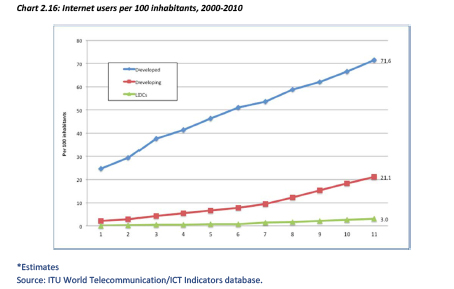
The charts and graphs contained within the volume provide very important evidence that many of the poorest countries and people in the world have not yet benefited from the potential of ICTs, and that very substantial effort is needed to ensure that ICTs do not actually lead to further increases in the differences in access between the world’s richer and poorer people.  This is essential reading for all involved in ICT4D.

Speech at the launch of the British Academy’s Working with Africa Report

Following Professor Graham Furniss’s opening remarks, I was invited to speak in my role as Chair of the Commonwealth Scholarship Commission in the UK at the launch of the British Academy’s new report entitled “Working with Africa: Human and Social Science Research in Action” on 3rd March 2011.  My  short speech outlined the importance of the British Academy’s funding programmes, the difficulties facing African universities and academics, and the ways through which the Commonwealth Scholarship Commission (CSC) is seeking to support them in partnership with like-minded organisations.

I began by thanking  Graham Furniss, not only for his work at the British Academy in driving forward many of their African initiatives, but also for joining the CSC as a new Commissioner.  I then emphasised the quality of the research featured in Working with Africa and thoroughly recommended it to the audience as a good read.  I highlighted in particular the value of the British Academy’s past small grants programme, noting that small amounts of funding can go a long way in supporting outstanding and innovative research in the humanities and social sciences.  This is particularly true for UK researchers near the beginnings of their careers, but it is also very important for establishing networks and partnerships as exemplified by the Academy’s support for research in Africa.

Despite such funding, I emphasised the many challenges faced by African researchers, and the very difficult financial, infrastructural and capacity issues that African universities had to overcome.  I argued  that years of global emphasis on primary education in Africa had left the higher education sector in a very diminished state.  I also made the point that whilst much international emphasis is placed on support for scientific research designed to reduce poverty, research in the social sciences and humanities is at least as, if not more, important.  Such research helps develop understandings of critical issues concerned with governance, social equality, the law, cultural diversity and economic change.

Finally, I highlighted the critical role of the Commonwealth Scholarship Commission in supporting research and professional development in Africa.  The last decade has seen a transformation in the Commission’s activities, so that far from being a traditional awarder of basic scholarships, it now provides seven different kinds of award, including distance-based studentships as well as professional and academic fellowships.  Moreover, evidence from the CSC’s monitoring and evaluation programme clearly indicates the value that these have in terms of development impact.  The Commission is delighted that it continues to have the strong support of the UK government, and that DFID will be providing some £20 million a year towards its programme of awards in developing countries in the 2011-15 period.  To be effective, though, it is important that we work together in partnership.  I concluded by reiterating my thanks to the British Academy and also emphasising the need for the Commission and the Academy to work closely together in the future to achieve our shared objectives of enhancing scholarship in African universities.