The opportunity to spend a few days of holiday in Antigua was not one to be missed – even if it was in the middle of the ‘so-called’ Hurricane Season! Never having been to the island before, the first challenge was to find a hotel. This was by no means easy, since most were shut for September, and those that were open were mainly offering all-inclusive deals. Can you imagine having to eat in the same hotel restaurant every night, and being stuck on a beach miles from anywhere? Well, if you do, read no further!
 Restless as we are, and eager to explore as much of where we are staying as possible, we searched long and hard to find a small, relatively hidden away, privately owned hotel. The result was the Catamaran Hotel in Falmouth Harbour – not far from Nelson’s Dockyard – and in the much-to-be-preferred south of the island (although only 30 minutes from the airport). The hotel advertises itself as “a peaceful getaway in an idyllic location” – and that it really was! From the first moment we arrived, the receptionist Annique made us feel incredibly welcome – and even offered us a room upgrade. The small hotel is right on the beach, with large self catering rooms. Although I don’t usually like using air conditioning, it was definitely necessary at this time of year, when the weather was regularly over 30 degrees C in the daytime, with high humidity as well. For most of the week we were here, we were the only guests, and had the swimming pool, a sailing dingy (thanks Robert for the great training), and the small beach all to ourselves. Just nearby is the excellent Bailey’s supermarket which provides most of the daily necessities (including excellent cherry coconut ice cream, plenty of Carib beer, and well-priced Cavalier rum), and a little further afield is the bit smarter Crab Hole Liquors at Cob Cross (where there is also a pharmacy).
Out of season, Antigua is incredibly quiet, with many of the restaurants and facilities shut. The two restaurants just by the Catamaran (the Captain’s Quarters and Cambusa) were both closed, as were most other restaurants on the island! Hence, a car was absolutely essential for getting around! We did our best to travel almost every road, and visit most of the island’s historical sites and beaches! Whilst the north-west of the island is where most of the light industry is located, with houses scattered almost everywhere across the countryside, the south is largely unspoilt with beautiful steep sloping wooded hillsides, and magnificent beaches. Sadly, many of the beaches have large modern hotels on them, largely preventing access to the beaches, and in some instances, as at Half Moon Bay, these hotels have simply been left to decay following storm damage.
Amongst our favourite beaches were:
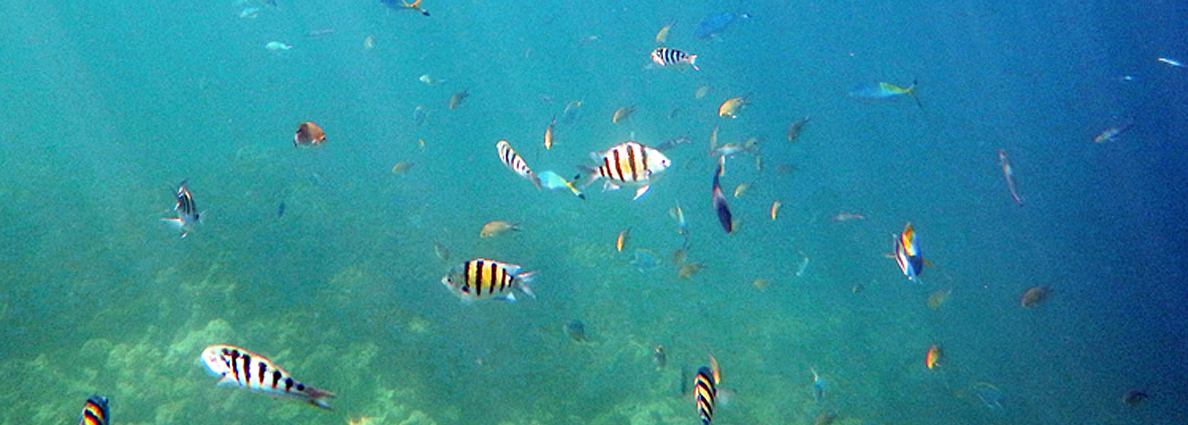
 Rendezvous Bay (near to Falmouth in the south of the island) – needs quite a steep 30 minute walk (each way) to get to unless you have a 4 wheel drive vehicle, but definitely well worth the effort. Sadly, rumour has it that it is subject to development – which would be a huge pity. We had the bay almost to ourselves, and there were lots of fish to be seen snorkeling
 Windward Bay (near Nelson’s Dockyard in the south of the island) – again, needs a short walk, but definitely worth it.
- Pigeon Beach – a public beach popular with local people, and very near Nelson’s Dockyard. It is a short sail from the Catamaran – but do watch out for the poisonous Manchineel Tree!
- Long Bay (in the north-east) – despite there being a hotel there, and even at this time of the year with lots of people, there were lots of fish to be seen snorkeling, especially at the eastern end.
- Half Moon Bay (south-east of the island) is beautiful, despite the decaying hotel!
- Morris Bay on the south-west coast is also the nicest beach on that part of the island.


Looking at some of the luxury hotels on the island – way beyond our price range – the nicest seemed to be:
- the Carlisle Bay hotel – for those who can afford at least US$ 674 a night! Perhaps one day!
We took the time to visit many interesting parts of the island – and for those wanting to explore, rather than just getting sunburnt on a beach, the following were definitely worth visiting:
 Betty’s Hope – an old ruined sugar plantation – with a small museum – in the central east of the island
- Fig Tree Drive – from the centre to the south-west of the island – through lush wooded hillsides, with an opportunity to buy the delicious Antiguan black pineapples from roadside stalls
- Wallings reservoir – a Victorian reservoir just off Fig Tree Drive, with walking trails up into the hillsides
- Christian Valley – an agricultural station with trails (hard to find!) from which a rich variety of
 birdlife is visible (sadly now named Obama Mountain National Park – formerly Boggy Peak – seems after all quite appropriate!)
 - Nelson’s Dockyard – definitely worth visiting – the reconstructed 18th century dockyard where Nelson was based between 1784 and 1787 – a haven for English ships during their battles in the region, offering good protection against storms.


 As for restaurants, most were closed! We were very pleased, though, that Trappas was open (in English Harbour on the road to Nelson’s Dockyard) most of the days we were here, offering largely European style food, but with a touch of Caribbean flavour. The food was well-cooked, reasonably priced (ECD 25 for a starter, and ECD 50 for a main course), and there was a good atmosphere with locals and tourists alike. Nearby, the Mad Mongoose opened while we were here, and offered a livelier atmosphere (must definitely be very lively in season), with slightly cheaper, but still tasty, food.
The only bad eating experience we had was when we were tired and needed a quick drink and lunch in St John’s – and very unfortunately chose to sit down in Cheers. We thought the menu was in ECD (in line with most other restaurants) and only when the bill came, given to us by the unpleasant and supercilious front of house ‘waiter’, did we discover that a simple prawn salad cost US$ 27! Please avoid this horrid place at all costs! Much better would be to go to the nearby Quay Bar and Grill, which seemed much more atmospheric and well-priced – although sadly we did not eat at it!
Below are just a few photos that try to capture just what the beautiful island of Antigua is like out of season. When all of the yacht crews are here it must be very different, and much, much more lively, but taking a risk of the odd storm or even hurricane, and putting up with the higher temperatures and humidity, Antigua is definitely worth getting to know out of season!