Category Archives: Development

Closing dates approaching for exciting jobs at Commonwealth Telecommunications Organisation

The Commonwealth Telecommunications Organisation is currently advertising vacancies for three exciting roles, as well as opportunities for Professional Fellowships.  The closing dates are rapidly approaching!  These are ideally suited to people who want to make a real difference on the ground in the use of ICTs for effective development

Manager, and Head of Capacity Development and Training Division
Closing Date: 15th September 2013

Manager, and Head of Events and Conferences Division
Closing Date: 20th September 2013

Senior Officer, Operations Division
Closing Date: 20th September 2013

Commonwealth Professional Fellowships
Please share with colleagues and friends who might be interested, and encourage them to apply!  Do note that all applicants must be from Commonwealth countries that are Full Member Countries of the CTO.

Leave a comment

Filed under Commonwealth, Development, ICT4D

Latest round of Commonwealth Scholarships for citizens of ‘developing’ Commonwealth countries announced

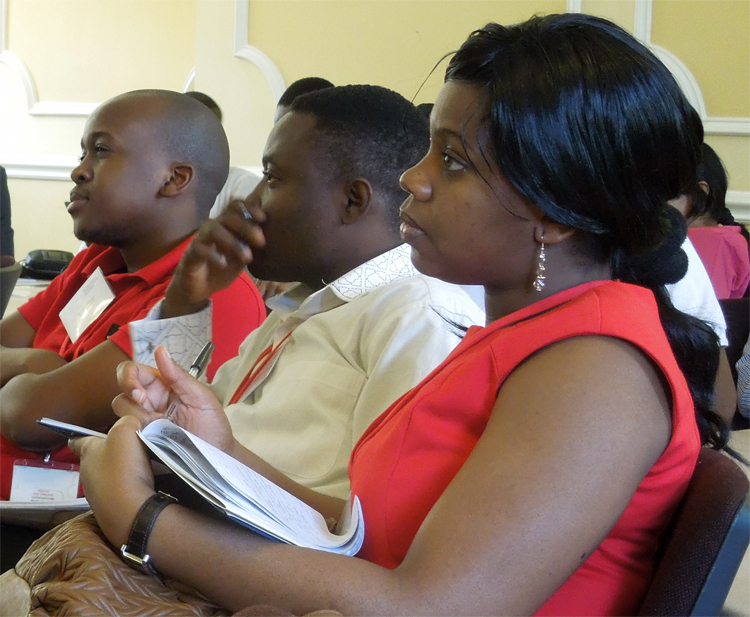
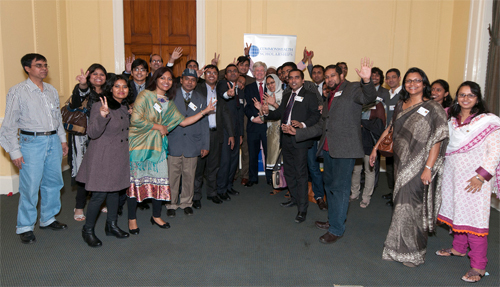
Pakistan smallThe Commonwealth Scholarship Commission has just announced its application process for scholars wishing to study in UK universities for Master’s and PhD degrees from the 2014-15 academic year .  Its Electronic Application System is now live, and will close on 3rd December 2013.  All applications need to be made through national nominating agencies – full details of which are available on the Commission’s website.  Summary details of the application process taken directly from the Commission’s site are given below:

Commonwealth Scholarships – developing Commonwealth country citizens

Commonwealth Scholarships for students from developing Commonwealth countries are offered for Master’s, PhD, and split-site (PhD) study in the UK. These scholarships are funded by the UK Department for International Development (DFID).

Nominations

There is a nominating agency for Commonwealth Scholarships in each Commonwealth country. In addition, universities and university bodies in a number of developing Commonwealth countries are invited to nominate candidates to the CSC.

Each year, the CSC invites each nominating agency/university/university body to forward a specific number of nominations. Each nominating agency/university/university body is responsible for its own selection process, and in most cases they will set their own closing date, which will be before the CSC’s deadline for nominations (17 December 2013).

Approximately 300 scholarships are awarded each year. The CSC invites around three times more nominations than scholarships available – therefore, nominated candidates are not guaranteed to get a scholarship. There are no quotas for scholarships for any individual country. Candidates nominated by national nominating agencies are in competition with those nominated by universities/university bodies, and the same standards will be applied to applications made through either channel.

Terms and conditions and eligibility

Applications are considered according to the following selection criteria:

  • Academic merit of the candidate
  • Quality of the proposal
  • Likely impact of the work on the development of the candidate’s home country

See Selection criteria – 2014 Commonwealth Scholarships for developing Commonwealth country citizens for further details.

Please note that the CSC does not impose any age limit on applicants for its awards, but national nominating agencies may do so in line with their own priorities.

Candidates may also find the Feedback for unsuccessful candidates in 2013 useful.

Levels of study

You can apply for a Commonwealth Scholarship for the following levels of study:

  • Master’s (one-year courses only)
  • PhD
  • Split-site, where the CSC supports one year’s study at a UK university as part of a PhD being undertaken in your home country

All subject areas are eligible, although the CSC’s selection criteria give priority to applications that demonstrate strong relevance to development.

You are requested to apply for a course of study at a UK university with which the CSC has a part funding agreement.

How to apply

All applications must be made through your nominating agency (or university/university body, if applicable) in your home country. You must check with them in the first instance for specific advice on how to make an application and for their own closing date. The CSC cannot accept any applications direct from candidates.

The CSC expects all Commonwealth Scholarship candidates to be nominated by an approved nominating agency/university/university body, and to have completed an application form using our Electronic Application System (EAS).

Full help on how to apply using the EAS is provided in our guides, which should be read in full before making any attempt to use the EAS.

The EAS will close to applicants on 3 December 2013 and no further applications can be made after that date. The CSC will not accept any applications which are not submitted via the EAS to the nominating agency/university/university body in the candidate’s home country.

How to access the EAS

Please note that all enquiries about these scholarships should be directed to the nominating agency/university/university body in your home country.

Leave a comment

Filed under Development, Education, Higher Education, Universities

How will we communicate in 2113?

ScholarsAn invitation to speak on the theme of “How will we communicate in 2113?” at the third annual Commonwealth Residential School meeting at Cumberland Lodge provided an interesting opportunity (at least for me!) to explore some fascinating interests “at the edges” of communication and technology.

The outline of what I intended to say focused around the following themes:

  • Grounding prediction
  • Are there any certainties?
  • How do we communicate today, and why?
    • In whose interests?
  • Trends in communication and technology
  • Extending into the foreseeable future

In particular, I explored the implications of seven trends:

  • The observation that technology can be used for “good” or for “evil” – challenging the many instrumental views of technology in development that so often dominate thinking today
  • Making the case that technology is increasing inequality rather than reducing it – too few people really understand this, but to me it is critically important, and has very significant implications for the future
  • Those in power use technology to remain in power: both states and global corporations.  This is one of the key drivers for how ICTs will be designed and used in the future
  • The ways in which our understandings of privacy have been changed as a result of recent developments in ICTs, and the implications for the relationships between citizens, states, and global corporations
  • Cambridge telephone statueThe ICT sustainability crisis – not only in terms of the energy demands of ICTs, but much more importantly the ways through which corporations generate much of their profit through  making users buy new hardware and software on a regular basis
  • The implications for learning and literacy of next generation ICTs – we will no longer need to learn to read and write, we will be able to understand people speaking any language, and the changes to the brain caused by no longer needing to remember things.
  • The blurring of the human and the machine – and whether or not we want to become cyborgs (encouraging participants to see one of my favourite films – Blade Runner – and also to see the recently released Cloud Atlas!).

One of the fun things about the session was that for the first time I used Promethean’s ActivInspire to gauge participants’ thoughts on a range of issues around their current usage of ICTs.  This did not throw up any particularly novel views from the participants – although 25% felt that Edward Snowden was wrong in exposing the NSA’s mass surveillance programme, with 56%  agreeing that he was right to do so.

Ultimately, I found myself arguing that we have some very important ethical decisions that need to be made here and now with respect to our relationships with ICTs, because there are many forces at play that are seeking to make us increasingly intertwined, and unless we act very soon we may already be far too far down the path to turn back.

Leave a comment

Filed under Development, Ethics, ICT4D

A new global partnership: the report of the high-level panel on the post-2015 development agenda

The long awaited report of the High-Level Panel of Eminent Persons on the Post-2015 Development Agenda, entitled A New Global Partnership: Eradicate Poverty and Transform Economies through Sustainable Development, was published just a few days ago on 30th May.  The 27 member panel responsible for the report included representatives from government, business and civil society from all regions of the world. Their  optimistic report suggests that we can and must eliminate extreme poverty by 2030.

Unfortunately, as evidenced in the title of the report itself, this has been a missed opportunity, and the new agenda will do little to change the lives of the world’s poorest and most marginalised people.  It is more of the same, rather than a radical departure from the MDG consensus of the last 15 years.  By retaining a largely absolute definition of poverty, and claiming that it actually can be eliminated through economic growth, this agenda will serve further to increase inequalities in the interests of the world’s richest individuals and countries.  The focus of the report on the ‘economic’, on the myth of ‘sustainable’ development, and on fundamental misunderstandings about the interests underlying ‘partnerships’ all mean that the proposals will be unable to deliver on the needs of the world’s poorest and most marginalised peoples.

The panel reached consensus on five transformational shifts that it claimed are necessary to achieve the elimination of poverty:

  1. Leave No One Behind: The MDGs aimed to halve extreme poverty (now defined as people earning less than $1.25 a day). The High Level Panel report proposes ending poverty by 2030 – as it says, “We should ensure that no person – regardless of ethnicity, gender, geography, disability, race or other status – is denied universal human rights and basic economic opportunities”.  This focus on previously excluded groups is indeed a step forward, although there is little agreement on how it can be achieved.
  2. Put Sustainable Development at the Core: The report seeks to bring together the social, economic and environmental aspects of development, focusing especially on a desire to “halt the alarming pace of climate change”.  It is a shame that so little is said about the political and cultural agendas that are such a critical part of ‘development’.  It also fails to recognise the highly contentious character of the notion of “sustainable development” which increasing numbers of people now see as being a contradiction in terms!
  3. Transform economies for jobs and inclusive growth: This proposal lies at the heart of the agenda.  The report emphasises that “We call for a quantum leap forward in economic opportunities and a profound economic transformation to end extreme poverty and improve livelihoods”.  From DFID’s overview of the report, this means “a much greater focus on promoting jobs through business and entrepreneurship, infrastructure, education and skills, and trade”. This places the economy rather than social justice, cultural meaning, or political practice at the heart of the development agenda.  Imagine the impact that this high-level transformative shift would be if it had been reworded to read “Transform societies to ensure social justice and equality of opportunity”!
  4. Build peace and effective, open and accountable institutions for all: The report claims that “Freedom from fear, conflict and violence is the most fundamental human right, and the essential foundation for building peaceful and prosperous societies”.  This places the agenda firmly upon a human rights basis, but does little to focus attention on the individual and collective responsibilities that are essential to make this happen.
  5. Forge a new Global Partnership: The report emphasises that “Perhaps the most important transformative shift is towards a new spirit of solidarity, cooperation, and mutual accountability that must underpin the post-2015 agenda”.  I completely agree that partnership is crucial for effective delivery of development interventions, but the report fails sufficiently to address the complexity of delivering partnerships on the ground, and the interests that underlie them.

The illustrative 12 universal goals and 54 national targets associated with the recommendations make interesting reading.  As the report emphasises, “the shape of the post-2015 development agenda cannot be  communicated effectively without offering an example of how goals might be framed”. For ease of information, these are summarised below:

1. End Poverty

  • Bring the number of people living on less than $1.25 a day to zero and reduce by x% theshare of people living below their country’s 2015 national poverty line
  • Increase by x% the share of women and men, communities, and businesses with secure rights to land, property, and other assets
  • Cover x% of people who are poor and vulnerable with social protection systems
  • Build resilience and reduce deaths from natural disasters by x%

2. Empower Girls and Women and Achieve Gender Equality

  • Prevent and eliminate all forms of violence against girls and women
  • End child marriage
  • Ensure equal right of women to own and inherit property, sign a contract, register a business and open a bank account
  • Eliminate discrimination against women in political, economic, and public life

3. Provide Quality Education and Lifelong Learning

  • Increase by x% the proportion of children able to access and complete pre-primary education
  • Ensure every child, regardless of circumstance, completes primary education able to read, write and count well enough to meet minimum learning standards
  • Ensure every child, regardless of circumstance, has access to lower secondary education and increase the proportion of adolescents who achieve recognized and measurable learning outcomes to x%
  • Increase the number of young and adult women and men with the skills, including technical and vocational, needed for work by x%

4. Ensure Healthy Lives

  • End preventable infant and under-5 deaths
  • Increase by x% the proportion of children, adolescents, at-risk adults and older people that are fully vaccinated
  • Decrease the maternal mortality ratio to no more than x per 100,000
  • Ensure universal sexual and reproductive health and rights
  • Reduce the burden of disease from HIV/AIDS, tuberculosis, malaria, neglected tropical diseases and priority non-communicable diseases

5. Ensure Food Security and Good Nutrition

  • End hunger and protect the right of everyone to have access to sufficient, safe, affordable, and nutritious food
  • Reduce stunting by x%, wasting by y%, and anemia by z% for all children under five
  • Increase agricultural productivity by x%, with a focus on sustainably increasing smallholder yields and access to irrigation
  • Adopt sustainable agricultural, ocean and freshwater fishery practices and rebuild designated fish stocks to sustainable levels
  • Reduce postharvest loss and food waste by x%

6. Achieve Universal Access to Water and Sanitation

  • Provide universal access to safe drinking water at home, and in schools, health centers, and refugee camps
  • End open defecation and ensure universal access to sanitation at school and work, and increase access to sanitation at home by x%
  • Bring freshwater withdrawals in line with supply and increase water efficiency in agriculture by x%, industry by y% and urban areas by z%
  • Recycle or treat all municipal and industrial wastewater prior to discharge

7. Secure Sustainable Energy

  • Double the share of renewable energy in the global energy mix
  • Ensure universal access to modern energy services
  • Double the global rate of improvement in energy efficiency in buildings, industry, agriculture and transport
  • Phase out inefficient fossil fuel subsidies that encourage wasteful consumption

8. Create Jobs, Sustainable Livelihoods, and Equitable Growth

  • Increase the number of good and decent jobs and livelihoods by x
  • Decrease the number of young people not in education, employment or training by x%
  • Strengthen productive capacity by providing universal access to financial services and infrastructure such as transportation and ICT
  • Increase new start-ups by x and value added from new products by y through creating an enabling business environment and boosting entrepreneurship

9. Manage Natural Resource Assets Sustainably

  • Publish and use economic, social and environmental accounts in all governments and major companies
  • Increase consideration of sustainability in x% of government procurements
  • Safeguard ecosystems, species and genetic diversity
  • Reduce deforestation by x% and increase reforestation by y%
  • Improve soil quality, reduce soil erosion by x tonnes and combat desertification

10. Ensure Good Governance and Effective Institutions

  • Publish and use economic, social and environmental accounts in all governments and major companies
  • Increase consideration of sustainability in x% of government procurements
  • Safeguard ecosystems, species and genetic diversity
  • Reduce deforestation by x% and increase reforestation by y%
  • Improve soil quality, reduce soil erosion by x tonnes and combat desertification

11. Ensure Stable and Peaceful Societies

  • Reduce violent deaths per 100,000 by x and eliminate all forms of violence against children
  • Ensure justice institutions are accessible, independent, well-resourced and respect due-process rights
  • Stem the external stressors that lead to conflict, including those related to organised crime
  • Enhance the capacity, professionalism and accountability of the security forces, police and judiciary

12. Create a Global Enabling Environment and Catalyse Long-Term Finance

  • Support an open, fair and development-friendly trading system, substantially reducing trade-distorting measures, including agricultural subsidies, while improving market access of developing country products
  • Implement reforms to ensure stability of the global financial system and encourage stable, long-term private foreign investment
  • Hold the increase in global average temperature below 2⁰ C above pre-industrial levels, in line with international agreements
  • Developed countries that have not done so to make concrete efforts towards the target of 0.7% of gross national product (GNP) as official development assistance to developing countries and 0.15 to 0.20% of GNP of developed countries to least developed countries; other countries should move toward voluntary targets for complementary financial assistance
  • Reduce illicit flows and tax evasion and increase stolen-asset recovery by $x
  • Promote collaboration on and access to science, technology, innovation, and development data

As will be clear from this listing, this appears to be something of a “shopping list” reflecting the interests of those who put the agenda together.  The gaps are perhaps as interesting as the things that are actually included in the list!  Given my own interests in the uses (and abuses) of ICTs in and for development, I am particularly disappointed that so little is mentioned about them in the 54 targets listed above (although see Goal 8).  Given the importance of the Internet, and the role of ICTs in the global economy, it is both surprising and disappointing to find so little amongst the goals or targets.  Likewise, whilst women and girls are acknowledged in a specific goal, the 10-15% of the world’s population who are recognised as having some kind of disability are not explicitly mentioned in a target at all.

Given the ‘management’ of the world’s development discourse, it is scarcely surprising that this report has turned out as it has, but I remain deeply saddened and frustrated that this important opportunity has been largely wasted.  Yes, there are of course some good things in the report, but I do wish that there had been the collective will really to address the underlying causes of poverty head on.  Sadly, what I wrote back in 2007 in my paper entitled “No end to poverty” remains as valid today as it did then (for a summary see this blog post)!

2 Comments

Filed under Development, ICT4D

The Internet and Development: a critical perspective

9780199589074_140I am delighted to see Bill Dutton’s magisterial edited The Oxford Handbook of Internet Studies (Oxford University Press, 2013) just published.  This is a really excellent and authoritative review of current research on all aspects of the Internet, with some 26 chapters from leading figures in the field.  The 607 page book is divided into five main parts:

  1. Perspectives on the Internet and Web as objects of study
  2. Living in a network society
  3. Creating and working in a global network economy
  4. Communication, power, and influence in a converging media world
  5. Governing and regulating the Internet.

Two of the real strengths of the book as an introduction to the field of Internet studies are the very readable style of most of the chapters, and the comprehensive bibliographies that accompany them.

I was delighted to have been asked to write the chapter on the Internet and Development, which Bill suggested should be sub-titled “a critical perspective”!  As I write in the summary, “This chapter explores research on the complex inter-relationship between the Internet and ‘development’, focusing especially on the effects of the Internet on the lives of some of the poorest people and most marginalised communities.  Much of the literature on Information and Communication Technologies for Development (ICT4D) suggests that the Internet can indeed bring very significant benefits in the ‘fight against poverty’ (see, for example, Weigel and Waldburger 2004; Rao and Raman 2009; Unwin 2009), but other research is marshalled in this synthesis to challenge this assumption.  In essence, I argue that the expansion of the Internet serves very specific capitalist interests, and that unless conscious and explicit attention is paid to designing interventions that will indeed directly serve the needs of the world’s poorest people, then the Internet will only replicate and reinforce existing structures of dominance and control. This argument supports the need for more research that challenges taken-for-granted assumptions about the Internet and development”.

In essence, the Internet is not some benign force for good as is so often supposed.  Instead it is being shaped and reshaped by a relatively small group of people with very specific interests.  It is absolutely essential that those committed to trying to ensure that digital technologies are used to serve the interests of all peoples in the world, and particularly the poorest and most marginalised, do indeed continue to challenge many of the all too often taken for granted assumptions that the Internet is necessarily automatically a force for positive “development”.

1 Comment

Filed under Development, ICT4D

Accelerating development using the Web

George Sadowsky’s new edited book entitled “Accelerating development using the Web: empowering poor and marginalised populations” has just been launched at the WSIS Forum in Geneva.  This contains some really excellent material, and is an important resource for those interested in exploring ways through which the Web can be used by some of the world’s poorest and most marginalised people to enhance their lives. Generously supported by the Rockefeller Foundation, and produced in partnership with the World Wide Web Foundation and the UNDP, this book is designed as “a compendium of articles by recognized experts describing the real and potential effects of the World Wide Web in all major aspects of economic and  social development”.  Many of the authors combine academic and practical experience, and so this book is much more than just an arid digest of academic thinking on the subject.  It also challenges many of the taken for granted assumptions about the Web, and examines the structural conditions that limit its use by the poorest of the world’s people.  Chapters cover the following main themes:

  • Chapter 1 – Introduction (George Sadowsky)
  • Chapter 2 – Fundamental Access Issues (Michael Jensen)
  • Chapter 3 – Technical Access Issues (Alan Greenberg)
  • Chapter 4 – Policy Access Issues (Cynthia Waddell)
  • Chapter 5 – Governance (Raúl Zambrano)
  • Chapter 6 – Agriculture (Shalini Kala)
  • Chapter 7 – Health (Najib Al-Shorbaji)
  • Chapter 8 – Education (Tim Unwin)
  • Chapter 9 – Commerce and Trade (Torbjörn Fredriksson)
  • Chapter 10 – Finance (Richard Duncombe)
  • Chapter 11 – Gender (Nancy Hafkin)
  • Chapter 12 – Language and Content (Daniel Pimienta)
  • Chapter 13 – Culture (Nnenna Nwakanma)
  • Chapter 14 – Conclusion

It was great fun working with George and the team on this project, and I do hope that those who read it will find a sense of our commitment, enthusiasm and, at times, outrage.  The Web is in danger of becoming a vehicle through which greater divides are created in our societies.  We have to take specific actions if the enormous benefits that it can provide are to be made available to all of the world’s people.  This is most definitely not the same as saying that access to the Web should be a human right – something that I  most profoundly disagree with.  However, it is most certainly to suggest that we cannot simply take it for granted that providing Internet access will without question benefit the poor. If the poor and the marginalised are indeed to benefit from the Web, there have to be clear mechanisms that enable them to use it to deliver on their needs and aspirations.

1 Comment

Filed under Development, ICT4D

Reflections on multi-stakeholder partnerships for education

At the end of the last decade, I had the real pleasure of working with colleagues at the World Economic Forum and UNESCO on their Partnerships for Education initiative.  Amongst many other things, this generated a number of useful materials for anyone interested in developing such partnerships in the future – but note that these are now based on the UNESCO site at http://www.unesco.org/pfore/ (and not at the former PforE site!).

I was therefore really delighted when Alex Wong at the Forum invited me last year to work with him on writing a reflection on all that the World Economic Forum’s Global Education Initiative (GEI) achieved.  My one condition was that anything we wrote should reflect not only the successes, but also the problems and challenges faced by the initiative!  I think we often learn more by our failures than our successes.  In writing the report, we interviewed many of those who had been involved in the GEI’s various initiatives, and sought to craft a document that included many of their insightful comments.

This report has recently been published, under the title Global Education Initiative: Retrospective on Partnerships for Education Development 2003-2011 (Geneva: World Economic Forum, 2012).  As well as providing an overview on all of the diverse elements of the GEI, it draws together our reflections on the nine key things necessary for the implementation of successful multi-stakeholder partnerships for education:

  • High level leadership
  • A partnership broker that is knowledgeable about the education sector
  • That broker also being trusted and neutral
  • Beginning with the educational outcomes in mind
  • The central role played by Ministries of Education
  • Effective project management
  • Adequate and timely resourcing
  • Consistent strategy and flexible delivery and
  • Effective internal and external communication

The sixty page report contains much more than this, though, and I really hope that it will provide a useful guide for anyone thinking of using multi-stakeholder partnerships to deliver effective educational initiatives.

1 Comment

Filed under Development, Education

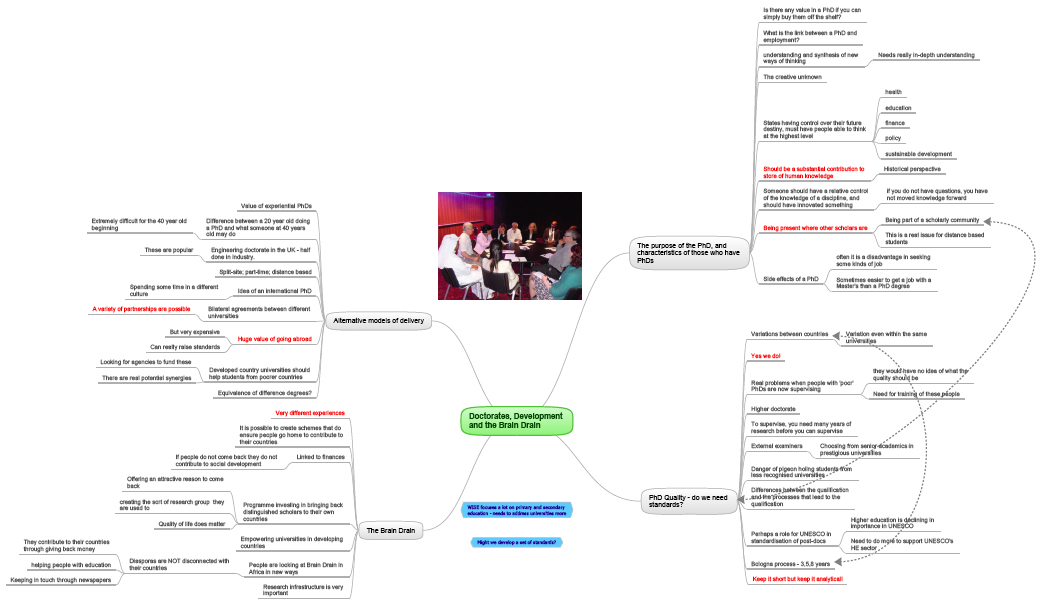
ACU Session at WISE 2011: Doctorates, development and the brain drain

I was delighted to be able to help the Association of Commonwealth Universities run a workshop on “Doctorates, development and and brain drain” at the recent World Innovation Summit for Education (WISE) held in Doha from 1st-3rd November.  This focused on four key themes:

  • the purposes of a PhD and the characteristics of those who have PhDs
  • the quality of a PhD; do we need standards?
  • alternative modes of delivery for doctorates
  • the brain drain

Although the number of participants was small, the discussion was highly interesting, and the mind map below attempts to capture what we discussed (click WISE 2011 for a .pdf version).

Leave a comment

Filed under Commonwealth, Development, Education, Higher Education, Postgraduate supervision, Universities

US poverty: a good example to follow?

Official US date recently released shows that the number of US citizens living in poverty rose to a record 46 million last year.  Yet the world is encouraged to believe that the US model of ‘democracy’ and ‘economic growth’ is the one that should be followed to eliminate poverty.  Surely there is a contradiction here?

The BBC reports the release of these data as follows: “The number of Americans living in poverty rose to a record 46.2 million last year, official data has shown. This is the highest figure since the US Census Bureau started collecting the data in 1959. In percentage terms, the poverty rate rose to 15.1%, up from 14.3% in 2009. The US definition of poverty is an annual income of $22,314 (£14,129) or less for a family of four and $11,139 for a single person. The number of Americans living below the poverty line has now risen for four years in a row, while the poverty rate is the biggest since 1993. Poverty among black and Hispanic people was much higher than for the overall US population last year, the figures also showed. The Census Bureau data said 25.8% of black people were living in poverty and 25.3% of Hispanic people. Its latest report also showed that the average annual US household income fell 2.3% in 2010 to $49,445. Meanwhile, the number of Americans without health insurance remained about 50 million. The data comes as the US unemployment rate remains above 9%”.

Is it not time that global organisations, aid agencies, and governments across the world stopped pretending that economic growth leads to a reduction of poverty?  Capitalism fundamentally depends on the maintenance of inequalities: between rich and poor countries, between rich and poor people.  The increase in US poverty revealed in these data reinforces such arguments.  The US ‘system’ enables Bill Gates and Warren Buffet to acquire huge wealth, while large numbers of their compatriots are consigned to poverty.

Freedom carries responsibilities.  The focus of US capitalism on the freedom of the individual at the expense of the wider public good is surely not a model that the world should be encouraged to follow.  As the BBC report notes, 50 million people in the US do not have health insurance.  While the rich can have the benefit of the latest medical research, such care is beyond the means of the poor.

These figures should be seen as a wake up call to economists and politicians across the world.  Unfettered capitalism, fueled by a self-reinforcing cycle of individual greed, can never lead to a reduction in poverty.  Only when governments act explicitly to support the most marginalised in their societies can we begin to redress the balance.

Leave a comment

Filed under Development, Politics

Back copies of journals seeking a new home …

I am seeking to dispose of back copies of the journals I have collected over the last 30 years as an academic – but cannot find anyone who might be interested in having them!  I hate to see them simply going to a shredder, but even organisations that send publications to universities without the resources to purchase them now seem to shred back issues and use the money to support online subscriptions instead.

So, if anyone knows of a good home for the following journals, please let me know:

  • Advances in Horticultural Science (since c.1990)
  • Annals of the Association of American Geographers (since c.1980)
  • Area (since c. 1970)
  • Australian Wine Research Institute Technical Review (since c.1990)
  • Children’s Geographies (since 2002)
  • Environmental Ethics (since c.1995)
  • Geographical Journal (c. 1985-2000)
  • Journal International des Science de la Vigne et du Vin (since c.1990)
  • Journal of Geography in Higher Education (since c. 1985)
  • Landscape History (since 1980)
  • Philosophy and Geography (since 2001)
  • Professional Geographer (since c.1980)
  • Third World Quarterly (since c. 1990)
  • Transactions of the Institute of British Geographers (since c.1970)
  • Treballs de la Societat Catalana de Geografia (since c. 2000)
  • Vitis (since c. 1990)

It seems a great waste to consign these journals to a skip, but unless I have requests for them by the end of September they will have to be shredded.  Please help find a home for them!

6 Comments

Filed under Development, Education, Higher Education