Category Archives: ICT4D

CTO is currently advertising for post of Head of Research and Consultancy

The Commonwealth Telecommunications Organisation (CTO) is seeking to appoint a Manager to serve as Head of its Research and Consultancy Division. This exciting opportunity would suit applicants from diverse backgrounds, including academia, the private sector and the international development community. Ideally, candidates for this role will have worked for at least five years within a university research environment, a top-tier consultancy, or within the research department of a leading company within the Telecoms, Media, or Technology sectors. The key role of this position is to manage the delivery of the CTO’s research and consultancy work, both for member organisations and other entities working in the field of ICT for Development. It is expected that applicants will be able to attract new research and consultancy projects, and also to undertake some of this work themselves. The appointment will be at Manager level with a starting salary in the range £36,000-£38,938, and it will be permanent subject to satisfactory performance and a 6 month probationary period. The closing date is 1st September 2013.

Outline Job Description:

The successful applicant will:
  • Lead, manage and motivate staff in the Research and Consultancy Division
  • dentify appropriate research and consultancy opportunities for the CTO, and manage their effective delivery
  • Undertake research and consultancy work in their own areas of expertise
  • Manage the CTO’s priority areas and their advisory boards
  • Manage the CTO’s alumni networks
  • Ensuring that the CTO’s website is updated in all areas of its research and consultancy activities
  • Be responsible for the effective control and management of the Division’s finances, in collaboration with the Finance and Administration Department
  • Lead relationships with relevant entities in one or more of the CTO’s regions
  • Lead the CTO’s work in one or more of its priority areas.
  • Assist in any other aspect of the CTO’s work as assigned by the Secretary General, or by the Head of the Operations Department

Leave a comment

Filed under Commonwealth, ICT4D, Universities

#EFF7: Access and Quality in Education – can we achieve both?

The latest Education Fast Forward debate is due to be held tomorrow, 17th July 2013, at 13.30 GMT+1.  The debate, featuring Carol Bellamy and Andreas Schleicher on Access and Quality in Education – can we achieve both? can be joined live from the EFF site.  Can also be followed on Twitter at #EFF7.

Education Fast Forward (EFF) brings together leading global experts and change agents from the world of education to discuss the topics that matter most. The forum addresses the key challenges facing governments, educators and employers both now and in the future, and aims to find practical resolutions.

Quality and access to education continue to top the list of education priorities in countries across the world. According to UNESCO in 2010 59 million primary school-age children were not enrolled in school and 31 million primary school-age children had dropped out of school. An additional 32 million repeated a grade. These figures are truly shocking but is access to education enough? Students today live in an entirely different world to 10, even 5 years ago. The digitally connected world is bringing down boundaries and making education more fluid. Pupils are increasingly demanding a more personalised working environment with instant access to data and collaborative team work as the norm.

EFF7 will look at key questions such as How can we balance the needs of access and quality and how do we measure quality? Can we achieve both? What will be the drivers and who will champion the students? What are we doing to address the issue of an education system that is still failing many students, leaving them poorly prepared for work or enterprise?

Leave a comment

Filed under Education, ICT4D

Barriers to learning through mobile devices in Africa

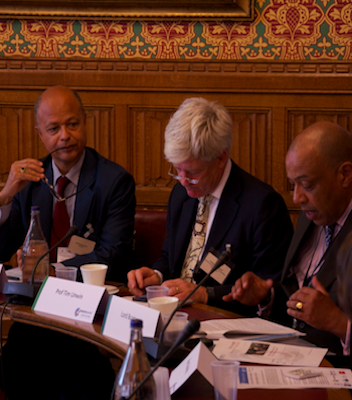
Screen-Shot-2013-06-07-at-17.36.39-300x159I had the pleasure of participating in the Planet Earth Institute‘s discussion on mobile technology for education in Africa, held on 5th June at the House of Lords.  It’s interesting how such occasions, where one has to speak on the spur of the moment about important issues, provide a spur for innovative and creative thinking.  The mix of the people, and the sharing of ideas really can generate new thoughts.

The main point that I tried to convey throughout the event was that it is the learning that matters.  Far too many initiatives are technology-led, rather than needs driven.  Hence, mobile devices are absolutely not the solution for African education, although they can indeed help to deliver certain new kinds of learning opportunity.  After all, as I mentioned, many years ago I engaged in mobile learning when I read books on long car journeys!

Screen-Shot-2013-06-07-at-17.31.05At one point, we were asked to think about the barriers preventing the spread of m-learning in Africa, and I want here to expand a little on the five ‘Cs’ that I came up with.  To be sure, they are a little contrived, but I do think that if these barriers can be overcome, then some real progress can be made:

  1. Connectivity.  To me, this is one of the biggest challenges for any ‘mobile-‘ initiative.  Certainly people have developed simple SMS based learning solutions, and games that can function on basic phones and devices, but the difference between these and what can be done on smart-phones is huge.  Smart-phones enable engagement with the wealth of resources on the web, and offer a completely different learning experience for people of all ages and backgrounds – if they can afford them (Cost!).  So, providing mobile broadband solutions that everyone can access seems to me to be the most important challenge facing those who want to deliver high quality learning experiences through mobile devices.  Hence, initiatives such as the work of the Broadband Commission and the Alliance for the Affordable Internet are of particular importance – but we must turn the rhetoric into reality!  That’s one reason why the Commonwealth Telecommunications Organisation has placed such emphasis on the importance of mobile broadband in its current strategic plan.
  2. Charging (electricity).  By this, I mean the importance of ensuring that it is easy and cheap to charge mobile devices everywhere.  Electricity is absolutely essential for all digital technologies, and is all too often insufficiently considered when developing such initiatives.  For those off the main grid, it is essential that simple, cheap and accessible means of recharging devices are developed and shared widely across the continent. Likewise, developing batteries that last much longer than at present is also an important consideration.  My experiences in 2011 in rural China have given me lots of ideas about how this can be achieved – and where there are supplies of running water I have been very impressed with some of the micro-hydro initiatives that have been developed in south-east Asia.
  3. Communication rather than content.  I have often written about this, but it seems to me that the really innovative thing about mobile-phones is that they enable entirely new ways of communication.  Yet, far too often they are seen primarily as devices to supply/enable content consumption.  I believe passionately that learning should not simply be about learning and regurgitating – yet our education systems seem to focus more and more on encouraging people to take on board accepted ‘truths’.  Learning, should be about thinking for oneself, and coming up with new solutions to old problems!  This is often best achieved through communication and interaction – the debating of ideas – and not just through digesting existing knowledge.  Far too often, digital technologies associated with learning have reinforced regurgitation, rather than encouraging new ways of thinking.  Hence, I want to shift the balance towards using devices for communication – they are, after all, mobile phones – rather than just for content consumption.
  4. Calculating (effective monitoring and evaluation).  This is a bit contrived, but I could not think of a better ‘C’ for ‘monitoring and evaluation’!  By ‘calculating’, I mean that we need to calculate the impact of our initiatives on learning achievements.  Although many people talk about the importance of monitoring and evaluation, there is far too little good and effective work in this area.  If we do not understand the real effects, including the unintended consequences, of the use of mobile devices in learning, then we cannot really determine how best to implement initiatives at scale.  We must also be much more open about our failures so that others can learn from our experiences.  Hence, the lack of quality monitoring and evaluation is a real barrier.
  5. Commitment.  This is hugely important.  There must be real commitment to using mobile devices effectively for learning, rather than simply using content provision as a means of selling more mobile devices!  I fear that all too often, ‘m-‘ initiatives are driven  too much by commercial interests, often in alliance with those who see ICTs as some kind of silver bullet that will transform society for the better, rather than by the real health, learning or governance needs and aspirations of people.

At the end, I was asked by Lord Boateng to sum up my thoughts about barriers, and simply said that the biggest barrier of all was our imagination!  If we really focus on the learning, and develop innovative solutions whereby everyone can use mobile devices to enhance their lives, wherever they are living, then, and only then, can we talk about real m-development.

1 Comment

Filed under Africa, Higher Education, ICT4D

A new global partnership: the report of the high-level panel on the post-2015 development agenda

The long awaited report of the High-Level Panel of Eminent Persons on the Post-2015 Development Agenda, entitled A New Global Partnership: Eradicate Poverty and Transform Economies through Sustainable Development, was published just a few days ago on 30th May.  The 27 member panel responsible for the report included representatives from government, business and civil society from all regions of the world. Their  optimistic report suggests that we can and must eliminate extreme poverty by 2030.

Unfortunately, as evidenced in the title of the report itself, this has been a missed opportunity, and the new agenda will do little to change the lives of the world’s poorest and most marginalised people.  It is more of the same, rather than a radical departure from the MDG consensus of the last 15 years.  By retaining a largely absolute definition of poverty, and claiming that it actually can be eliminated through economic growth, this agenda will serve further to increase inequalities in the interests of the world’s richest individuals and countries.  The focus of the report on the ‘economic’, on the myth of ‘sustainable’ development, and on fundamental misunderstandings about the interests underlying ‘partnerships’ all mean that the proposals will be unable to deliver on the needs of the world’s poorest and most marginalised peoples.

The panel reached consensus on five transformational shifts that it claimed are necessary to achieve the elimination of poverty:

  1. Leave No One Behind: The MDGs aimed to halve extreme poverty (now defined as people earning less than $1.25 a day). The High Level Panel report proposes ending poverty by 2030 – as it says, “We should ensure that no person – regardless of ethnicity, gender, geography, disability, race or other status – is denied universal human rights and basic economic opportunities”.  This focus on previously excluded groups is indeed a step forward, although there is little agreement on how it can be achieved.
  2. Put Sustainable Development at the Core: The report seeks to bring together the social, economic and environmental aspects of development, focusing especially on a desire to “halt the alarming pace of climate change”.  It is a shame that so little is said about the political and cultural agendas that are such a critical part of ‘development’.  It also fails to recognise the highly contentious character of the notion of “sustainable development” which increasing numbers of people now see as being a contradiction in terms!
  3. Transform economies for jobs and inclusive growth: This proposal lies at the heart of the agenda.  The report emphasises that “We call for a quantum leap forward in economic opportunities and a profound economic transformation to end extreme poverty and improve livelihoods”.  From DFID’s overview of the report, this means “a much greater focus on promoting jobs through business and entrepreneurship, infrastructure, education and skills, and trade”. This places the economy rather than social justice, cultural meaning, or political practice at the heart of the development agenda.  Imagine the impact that this high-level transformative shift would be if it had been reworded to read “Transform societies to ensure social justice and equality of opportunity”!
  4. Build peace and effective, open and accountable institutions for all: The report claims that “Freedom from fear, conflict and violence is the most fundamental human right, and the essential foundation for building peaceful and prosperous societies”.  This places the agenda firmly upon a human rights basis, but does little to focus attention on the individual and collective responsibilities that are essential to make this happen.
  5. Forge a new Global Partnership: The report emphasises that “Perhaps the most important transformative shift is towards a new spirit of solidarity, cooperation, and mutual accountability that must underpin the post-2015 agenda”.  I completely agree that partnership is crucial for effective delivery of development interventions, but the report fails sufficiently to address the complexity of delivering partnerships on the ground, and the interests that underlie them.

The illustrative 12 universal goals and 54 national targets associated with the recommendations make interesting reading.  As the report emphasises, “the shape of the post-2015 development agenda cannot be  communicated effectively without offering an example of how goals might be framed”. For ease of information, these are summarised below:

1. End Poverty

  • Bring the number of people living on less than $1.25 a day to zero and reduce by x% theshare of people living below their country’s 2015 national poverty line
  • Increase by x% the share of women and men, communities, and businesses with secure rights to land, property, and other assets
  • Cover x% of people who are poor and vulnerable with social protection systems
  • Build resilience and reduce deaths from natural disasters by x%

2. Empower Girls and Women and Achieve Gender Equality

  • Prevent and eliminate all forms of violence against girls and women
  • End child marriage
  • Ensure equal right of women to own and inherit property, sign a contract, register a business and open a bank account
  • Eliminate discrimination against women in political, economic, and public life

3. Provide Quality Education and Lifelong Learning

  • Increase by x% the proportion of children able to access and complete pre-primary education
  • Ensure every child, regardless of circumstance, completes primary education able to read, write and count well enough to meet minimum learning standards
  • Ensure every child, regardless of circumstance, has access to lower secondary education and increase the proportion of adolescents who achieve recognized and measurable learning outcomes to x%
  • Increase the number of young and adult women and men with the skills, including technical and vocational, needed for work by x%

4. Ensure Healthy Lives

  • End preventable infant and under-5 deaths
  • Increase by x% the proportion of children, adolescents, at-risk adults and older people that are fully vaccinated
  • Decrease the maternal mortality ratio to no more than x per 100,000
  • Ensure universal sexual and reproductive health and rights
  • Reduce the burden of disease from HIV/AIDS, tuberculosis, malaria, neglected tropical diseases and priority non-communicable diseases

5. Ensure Food Security and Good Nutrition

  • End hunger and protect the right of everyone to have access to sufficient, safe, affordable, and nutritious food
  • Reduce stunting by x%, wasting by y%, and anemia by z% for all children under five
  • Increase agricultural productivity by x%, with a focus on sustainably increasing smallholder yields and access to irrigation
  • Adopt sustainable agricultural, ocean and freshwater fishery practices and rebuild designated fish stocks to sustainable levels
  • Reduce postharvest loss and food waste by x%

6. Achieve Universal Access to Water and Sanitation

  • Provide universal access to safe drinking water at home, and in schools, health centers, and refugee camps
  • End open defecation and ensure universal access to sanitation at school and work, and increase access to sanitation at home by x%
  • Bring freshwater withdrawals in line with supply and increase water efficiency in agriculture by x%, industry by y% and urban areas by z%
  • Recycle or treat all municipal and industrial wastewater prior to discharge

7. Secure Sustainable Energy

  • Double the share of renewable energy in the global energy mix
  • Ensure universal access to modern energy services
  • Double the global rate of improvement in energy efficiency in buildings, industry, agriculture and transport
  • Phase out inefficient fossil fuel subsidies that encourage wasteful consumption

8. Create Jobs, Sustainable Livelihoods, and Equitable Growth

  • Increase the number of good and decent jobs and livelihoods by x
  • Decrease the number of young people not in education, employment or training by x%
  • Strengthen productive capacity by providing universal access to financial services and infrastructure such as transportation and ICT
  • Increase new start-ups by x and value added from new products by y through creating an enabling business environment and boosting entrepreneurship

9. Manage Natural Resource Assets Sustainably

  • Publish and use economic, social and environmental accounts in all governments and major companies
  • Increase consideration of sustainability in x% of government procurements
  • Safeguard ecosystems, species and genetic diversity
  • Reduce deforestation by x% and increase reforestation by y%
  • Improve soil quality, reduce soil erosion by x tonnes and combat desertification

10. Ensure Good Governance and Effective Institutions

  • Publish and use economic, social and environmental accounts in all governments and major companies
  • Increase consideration of sustainability in x% of government procurements
  • Safeguard ecosystems, species and genetic diversity
  • Reduce deforestation by x% and increase reforestation by y%
  • Improve soil quality, reduce soil erosion by x tonnes and combat desertification

11. Ensure Stable and Peaceful Societies

  • Reduce violent deaths per 100,000 by x and eliminate all forms of violence against children
  • Ensure justice institutions are accessible, independent, well-resourced and respect due-process rights
  • Stem the external stressors that lead to conflict, including those related to organised crime
  • Enhance the capacity, professionalism and accountability of the security forces, police and judiciary

12. Create a Global Enabling Environment and Catalyse Long-Term Finance

  • Support an open, fair and development-friendly trading system, substantially reducing trade-distorting measures, including agricultural subsidies, while improving market access of developing country products
  • Implement reforms to ensure stability of the global financial system and encourage stable, long-term private foreign investment
  • Hold the increase in global average temperature below 2⁰ C above pre-industrial levels, in line with international agreements
  • Developed countries that have not done so to make concrete efforts towards the target of 0.7% of gross national product (GNP) as official development assistance to developing countries and 0.15 to 0.20% of GNP of developed countries to least developed countries; other countries should move toward voluntary targets for complementary financial assistance
  • Reduce illicit flows and tax evasion and increase stolen-asset recovery by $x
  • Promote collaboration on and access to science, technology, innovation, and development data

As will be clear from this listing, this appears to be something of a “shopping list” reflecting the interests of those who put the agenda together.  The gaps are perhaps as interesting as the things that are actually included in the list!  Given my own interests in the uses (and abuses) of ICTs in and for development, I am particularly disappointed that so little is mentioned about them in the 54 targets listed above (although see Goal 8).  Given the importance of the Internet, and the role of ICTs in the global economy, it is both surprising and disappointing to find so little amongst the goals or targets.  Likewise, whilst women and girls are acknowledged in a specific goal, the 10-15% of the world’s population who are recognised as having some kind of disability are not explicitly mentioned in a target at all.

Given the ‘management’ of the world’s development discourse, it is scarcely surprising that this report has turned out as it has, but I remain deeply saddened and frustrated that this important opportunity has been largely wasted.  Yes, there are of course some good things in the report, but I do wish that there had been the collective will really to address the underlying causes of poverty head on.  Sadly, what I wrote back in 2007 in my paper entitled “No end to poverty” remains as valid today as it did then (for a summary see this blog post)!

2 Comments

Filed under Development, ICT4D

Stockholm Internet Forum 2013: enabling an Internet for all

I have been privileged to have been asked to write a provocative thought piece for this year’s Stockholm Internet Forum to be held next week (22nd-23rd May in Stockholm).  In this, I argue that to date ICTs have actually increased, rather than reduced, inequality in the world.  Much more serious effort therefore must be made to ensure that the poorest and the most marginalised of the world’s people should have access to the Internet.  This is a moral, rather than an economic, agenda.

In writing the paper, I was asked to suggest what I think are some of the most important policy actions that need to be taken.  These are summarised below:

  1. Although ICTs and the Internet do indeed have the potential to help transform the lives of poor people, technologies have generally always been used primarily by those in power to maintain their positions of power.  Hence, we must begin by making a firm commitment to ensuring that we will enable the poorest and most marginalised to have similar connectivity to that through which the world’s richest now benefit.
  2. Regulation must be made to work efficiently and effectively, so that the market can indeed deliver for as many people as possible.  This requires that regulators adopt a fair pricing policy, not seeking to reap too many additional financial benefits for governments, but rather placing primary emphasis on the means through which as many people as possible can access commercially available Internet connectivity.
  3. In some contexts, Universal Service (or Access) Funds can provide a means whereby states can direct additional resources specifically to the needs of poor and marginalised communities.  However, to date, many such funds have failed to deliver on their expectations, and they remain unpopular among companies providing telephony and broadband services who see them primarily as a tax that reduces their potential to deliver services more cheaply than could be provided by the state or civil society.
  4. Effective multi-stakeholder partnerships between states, the private sector, civil society and international organisations are an essential element in delivering connectivity to the poorest and most marginalised communities. Such partnerships are not easy to implement, but given the complexity of the technologies, the diversity of interests involved, and the need for financial investment, they remain essential.
  5. The need for collaboration and co-operation between international initiatives designed to support broadband for all.  Duplication of effort is wasteful of precious resources, and seeking to reinvent the wheel means that many lesson from previous failures are not sufficiently learned.
  6. There needs to be a passion amongst the world’s leading researchers to design innovative solutions that are focused particularly on reducing the costs of access to the Internet as well as provision of electricity, rather than reaping the maximum profits from so doing.
  7. One of the reasons for the high cost of Internet access in many of the poorest countries is that companies have sought to extract high short-term returns on investment.  Investing in what were previously seen as public sector utilities is a challenging business, but ultimately governments have the responsibility for ensuring that all of their peoples can have access to and benefit from such utilities, and must therefore play a significant role in their support.
  8. Without reliable sources of electricity, any use of ICTs is impossible.  Innovative solutions to the provision of electricity, particularly in rural areas are thus an essential precursor for Internet access.
  9. Finally, Internet access that is affordable by the poor, together with the electricity necessary to power it, are not enough by themselves.  Digital resources and peer communities that deliver on and support the content and communication needs and aspirations of poor people and marginalised communities must be developed and made as widely accessible as possible.

Clearly, there are many more actions that need to be taken, but I do think that these can make a significant difference, albeit in different measures and balance in different countries.  I hope that one of the outcomes of the Forum will be that everyone present can commit to taking real action to enable the world’s poorest and most marginalised to benefit from the potential of the Internet.

4 Comments

Filed under ICT4D, Politics

Great new book on evaluating communication for development

I have always had huge admiration for the work (research and practice) that Jo Tacchi does.  It is therefore great to see her latest book, written together with June Lennie, published at the end of last year: Evaluating Communication for Development:a Framework for Social Change (Routledge, 2012).

As the publisher’s blurb notes, “Evaluating Communication for Development presents a comprehensive framework for evaluating communication for development (C4D). This framework combines the latest thinking from a number of fields in new ways. It critiques dominant instrumental, accountability-based approaches to development and evaluation and offers an alternative holistic, participatory, mixed methods approach based on systems and complexity thinking and other key concepts. It maintains a focus on power, gender and other differences and social norms. The authors have designed the framework as a way to focus on achieving sustainable social change and to continually improve and develop C4D initiatives. The benefits and rigour of this approach are supported by examples and case studies from a number of action research and evaluation capacity development projects undertaken by the authors over the past fifteen years.

Building on current arguments within the fields of C4D and development, the authors reinforce the case for effective communication being a central and vital component of participatory forms of development, something that needs to be appreciated by decision makers. They also consider ways of increasing the effectiveness of evaluation capacity development from grassroots to management level in the development context, an issue of growing importance to improving the quality, effectiveness and utilisation of monitoring and evaluation studies in this field.

The book includes a critical review of the key approaches, methodologies and methods that are considered effective for planning evaluation, assessing the outcomes of C4D, and engaging in continuous learning. This rigorous book is of immense theoretical and practical value to students, scholars, and professionals researching or working in development, communication and media, applied anthropology, and evaluation and program planning”.

1 Comment

Filed under Communication, ICT4D

ICT4D Collective and Centre recognised as world’s 10th top science and technology think tank

ICT4D-72dpiforwebI am deeply humbled that the ICT4D Collective and Research Centre that we tentatively created at Royal Holloway, University of London, back in 2004 has just been recognised as the world’s 10th top Science and Technology Think Tank in the 2012 Global GoTo Think Tank Report launched at the World Bank and the United Nations in New York last week.  This accolade is all the more special because the ranking is based very largely on peer review, and therefore reflects the opinions of many people in the field who I respect enormously.  More than 1950 experts and peer institutions participated in the ranking process for the report which was produced by the Think Tanks and Civil Societies Program at the University of Pennsylvania.

Boy on streetThe Collective was established above all else to bring together colleagues who are committed to undertaking the highest possible quality of research in the interests primarily of poor people and marginalised communities.  Its work is premised on the assumption that ICTs can indeed be used to support poor people, but that we need to work tirelessly to overcome the obstacles that prevent this happening.

LogoIn 2007, we were delighted that the Collective and Centre was given the status of the UNESCO Chair in ICT4D, and although I am now only an Emeritus Professor at Royal Holloway, I am very privileged that for the time being I retain this title while also serving as Secretary General of the Commonwealth Telecommunications Organisation.  It is great to be able to draw on my past research and teaching experience in this new role, to help governments across the Commonwealth use ICTs effectively and appropriately for their development agendas.

Then, in 2009 Royal Holloway, University of London, formalised the position of the ICT4D Collective by creating a new multidisciplinary research centre on ICT4D, that brought together expertise primarily from the schools and departments of Geography, Computer Science, Management and Mathematics (Information Security), with contributions also from colleagues in Earth Sciences, Politics and International Relations, and Information Services.  This provides really excellent opportunities to develop new research at the exciting boundaries between disciplines.

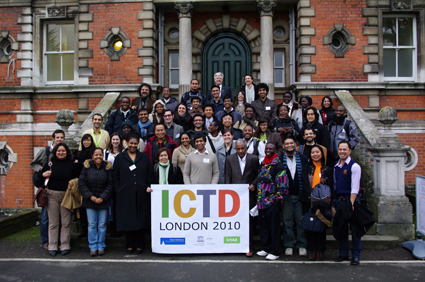
Scholars 1Over the eight years of the existence of the ICT4D Collective, we have focused on a wide range of activities, but have particularly sought to serve the wider interests of all researchers and practitioners working in the field of ICT4D.  We were thus delighted to host the 2010 ICTD conference, which brought more than 500 colleagues to our campus, and we were immensely grateful to the generous sponsorship from global institutions that enabled us to provide scholarships for people to attend from across the world (pictured above).  We have also focused much attention on supporting doctoral researchers, and it is excellent to see them now flourishing in their subsequent careers.

LanzhouMost recently, under new leadership, the Centre is continuing to thrive, and has launched an exciting ICT4D strand within its established Master’s programme on Practising Sustainable Development.  In 2012, a Branch of the UNESCO Chair in ICT4D was also established at Lanzhou University in China, reflecting the growing collaboration between our two institutions, and recognising the huge importance that China is increasingly playing not only in terms of the practical implementation of ICT initiatives, but also into research in this area.

A huge thank you to all who suggested that the ICT4D Collective and Centre should be recognised in this way.  It is a massive spur to us all to keep up the work that we have been doing, and to share it more effectively with all those interested in, and committed to, using ICTs to support poor people and marginalised communities.

The top 20 ranking of Think Tanks in Science and Technology from the 2012 Global GoTo Think Tank Report is given below:

1. MIT Science, Technology, and Society Program (STS) (United States)
2. Max Planck Institute (Germany)
3. RAND Corporation (United States)
4. Center for Development Research (ZEF) (Germany )
5. Information and Technology and Innovation Foundation (ITIF) (United States)
6. Battelle Memorial Institute (United States)
7. Technology, Entertainment, Design (TED) (United States)
8. Institute for Future Technology (IFTECH) (Japan)
9. Consortium for Science, Policy, and Outcomes (CSPO) (United States)
10. Information and Communication Technologies for Development (ICT4D) (United Kingdom)
11. Science and Technology Policy Research (SPRU) (United Kingdom)
12. Institute for Basic Research (IBR) (United States)
13. Council for Scientific and Industrial Research (CSIR) (South Africa)
14. African Technology Policy Studies Network (ATPS) (Kenya)
15. Bertelsmann Foundation (Germany)
16. International Institute for Applied Systems Analysis (IIASA) (Austria)
17. Energy and Resources Institute (India)
18. The Energy and Resources Institute (TERI) (India)
19. Santa Fe Institute (SFI) (United States)
20. African Center for Technology Studies (ACTS) (Kenya)

14 Comments

Filed under Higher Education, ICT4D, ICT4D conferences, ICT4D general, ictd2010, Photographs, Postgraduate supervision, Universities

The Internet and Development: a critical perspective

9780199589074_140I am delighted to see Bill Dutton’s magisterial edited The Oxford Handbook of Internet Studies (Oxford University Press, 2013) just published.  This is a really excellent and authoritative review of current research on all aspects of the Internet, with some 26 chapters from leading figures in the field.  The 607 page book is divided into five main parts:

  1. Perspectives on the Internet and Web as objects of study
  2. Living in a network society
  3. Creating and working in a global network economy
  4. Communication, power, and influence in a converging media world
  5. Governing and regulating the Internet.

Two of the real strengths of the book as an introduction to the field of Internet studies are the very readable style of most of the chapters, and the comprehensive bibliographies that accompany them.

I was delighted to have been asked to write the chapter on the Internet and Development, which Bill suggested should be sub-titled “a critical perspective”!  As I write in the summary, “This chapter explores research on the complex inter-relationship between the Internet and ‘development’, focusing especially on the effects of the Internet on the lives of some of the poorest people and most marginalised communities.  Much of the literature on Information and Communication Technologies for Development (ICT4D) suggests that the Internet can indeed bring very significant benefits in the ‘fight against poverty’ (see, for example, Weigel and Waldburger 2004; Rao and Raman 2009; Unwin 2009), but other research is marshalled in this synthesis to challenge this assumption.  In essence, I argue that the expansion of the Internet serves very specific capitalist interests, and that unless conscious and explicit attention is paid to designing interventions that will indeed directly serve the needs of the world’s poorest people, then the Internet will only replicate and reinforce existing structures of dominance and control. This argument supports the need for more research that challenges taken-for-granted assumptions about the Internet and development”.

In essence, the Internet is not some benign force for good as is so often supposed.  Instead it is being shaped and reshaped by a relatively small group of people with very specific interests.  It is absolutely essential that those committed to trying to ensure that digital technologies are used to serve the interests of all peoples in the world, and particularly the poorest and most marginalised, do indeed continue to challenge many of the all too often taken for granted assumptions that the Internet is necessarily automatically a force for positive “development”.

1 Comment

Filed under Development, ICT4D

Passwords, PIN numbers and cybersecurity

Ever since one of my websites was hacked a few months ago, I have taken a much more personal interest in issues of cybersecurity.  Whilst I have spoken and written many times on the subject, it is only when things really affect you in a personal way that you begin to gain different understandings of the issues.  It represents a shift from a theoretical understanding to a practical one!

I thought I knew most of the various recommendations concerning password and PIN security, and that I had indeed followed them.  However, no digital system is ever completely secure, and the level of sophistication now being used by those intent on stealing identity data, particularly with respect to banking information, is becoming very much more sophisticated.

There are many well known organisations providing advice and recommendations, such as Sophos, Symantec and Kaspersky Lab, but there are rather few places where all of this information is brought together in a single place.  The level of insecurity, and the apparent disinterest among vast numbers of people in doing much about their digital security is not only surprising, but is also deeply concerning.  So, in this posting, I have tried to bring together some of the more interesting observations that have recently been made about passwords and PIN numbers, in order to try to persuade people to take action on this really rather important topic!

Most popular PIN codes and iPhone passcodes
There are numerous articles on the most popular PIN codes – in other words the ones that no-one should actually use! One of the best is Daniel Amitay‘s experiment, where he used Big Brother’s passcode set up screen as a surrogate to estimate iPhone passcode usage, and discovered that the top ten codes listed below represented 15% of all passcodes used:

  1. 1234
  2. 0000
  3. 2580
  4. 1111
  5. 5555
  6. 5683
  7. 0852
  8. 2222
  9. 1212
  10. 1998

None of these are surprising, given that they represent easily remembered structures around the keypad. The passcode 1998 features because it is a year of birth and as Amitay goes on to point out other birth years also feature highly among passwords.

What is perhaps even more worrying is that research by Sophos in 2011 suggested that 67% of consumers do not even use any passcode on their ‘phones, so that a passer-by can access all of the information on the ‘phone without even having to bother to hack the code.

Four digit codes are also commonly used by banks to enable customers to access money through cashpoint machines (ATMs).  Research summarised by Chris Taylor (on Mashable) notes that 27% of people use one of the top 20 PINs for their banking, with the most popular number (1234) being used by a massive 11%.  The top 20 PIN codes he lists are as follows:

  1. 1234 (10.7%)
  2. 1111 (6.0%)
  3. 0000 (1.9%)
  4. 1212 (1.2%)
  5. 7777 (0.7%)
  6. 1004 (0.6%)
  7. 2000 (0.6%)
  8. 4444 (0.5%)
  9. 2222 (0.5%)
  10. 6969 (0.5%)
  11. 9999 (o.5%)
  12. 3333 (0.4%)
  13. 5555 (0.4%)
  14. 6666 (0.4%)
  15. 1122 (0.4%)
  16. 1313 (0.3%)
  17. 8888 (0.3%)
  18. 4321 (0.3%)
  19. 2001 (0.3%)
  20. 1010 (0.3%)

Chris Taylor goes on to comment that although there are 10,000 possible combinations of four digits, 50% of people use the most popular 426 codes!  As he says, “Pick up an ATM card on the street, and you have a 1 in 5 chance of unlocking its cash by entering just five PINs. That’s the kind of Russian Roulette that’s going to be attractive to any casual thief”.

There is therefore  really quite a high probability that even without watching someone enter their PIN number and then stealing the card, or using sophisticated technology to ‘crack’ someone’s PIN code, criminals would have a pretty good chance of accessing someone’s bank account just by using the most popular codes above.  The implication for users is clear: use a PIN code that is not among the most common!

Passwords
The situation is scarcely better with passwords that people use for their online digital activities. Numerous surveys have all pointed to the same conclusion, that a very small number of passwords continue to be used by large numbers of people.  These change a bit over time, and vary depending on cultural context and country, but the message is clear.  Even without sophisticated programmes to crack passwords, those wishing to access personal information can achieve remarkable success just by trying to use the most common passwords!  The most common passwords, in other words those to be avoided, are listed below:

Splashdata 2012

Sophos Naked Security 2010, based on leaked Gawker Media passwords

1

password

123456

2

123456

Password

3

12345678

12345678

4

abc123

lifehack

5

qwerty

qwerty

6

monkey

abc123

7

letmein

111111

8

dragon

monkey

9

111111

consumer

10

baseball

12345

11

iloveyou

0

12

trustno1

letmein

13

1234567

trustno1

14

sunshine

Dragon

15

master

1234567

16

123123

baseball

17

welcome

superman

18

shadow

iloveyou

19

ashley

gizmodo

20

football

sunshine

21

jesus

1234

22

michael

princess

23

ninja

starwars

24

mustang

whatever

25

password1

shadow

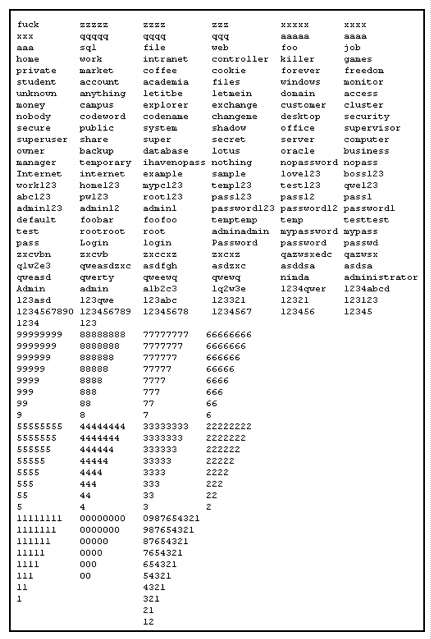
A slightly more sophisticated approach is that adopted by those wishing to break into networks by testing them automatically against a much larger number of different passwords.  One of the best publicised accounts of this was the Conficker worm, which used the passwords in the chart below to try to access accounts (Sophos, 2009):
Worm

Again, this clearly indicates that considerable care needs to be taken in choosing passwords, and ensuring that they are at the very least more complex than those listed above.

Tips to reduce the risk of fraud through mobile devices and digital technologies
Much has been written about sensible advice for reducing the risk of fraud through mobile passcodes, banking PINs and online login passwords.  Such tips will never eliminate really determined people from hacking into your identity, but a few simple steps can at least make it more difficult for the less determined.  These include:

  • Always secure your ‘phone with a PIN code, or better still a password (iPhone users can do this simply in Settings>General>Passcode Lock).  This will help to prevent all of your contacts, photos, e-mails and other personal information being accessed immediately by anyone who picks up your ‘phone.
  • Reduce the time before your ‘phone automatically locks so that it is as short as possible, preferably no more than a minute
  • Always use complex passwords, that preferably include lower case and upper case letters, numbers and special characters
  • Use passwords that are at least 8 characters and preferably more than 12 characters in length
  • Frequently change your passwords at random intervals, so that possible hackers are unaware when to expect changes
  • Use different passwords for different accounts, so that if one password is ‘broken’ this will not permit access to your other accounts
  • Think about using a service that tests the strength of a proposed password (such as The Password Meter, Microsoft’s password checker, or Rumkin’s strength test) – for the hyper-security-conscious person, it is probably best to do this from a computer other than your own!
  • Never, under any circumstances give your passwords or PIN codes to other people

Ultimately, passwords and PIN numbers are just part of a wider defence needed against digital theft.  Human action, be it using the ‘phone in an unsafe public place or unfortunately responding to a phishing attack, is still the cause of much digital grief.  As I write, Sophos has just for example reported a phishing attack through a security breach on the Ethiopian Red Cross Society’s website purporting to be a Google Docs login page.

If the worst happens, and you do lose a ‘phone there are at least two important things to do:

  • Ensure you have software on the ‘phone that can enable you to track it (as with the Find My iPhone app, or for Android ‘phones there are apps such as Sophos’ Mobile Security app)
  • If there is no chance of getting the ‘phone back, then remotely delete all of its content as swiftly as possible, remembering that if it has been backed up on a laptop or cloud facility, then all of the data can be restored at a later date.

Working together, and sharing good practices in personal digital security we can do much to help reduce digital identity theft.


3 Comments

Filed under 'phones, ICT4D general

Commonwealth Telecommunications Organisation – vacancy for Head of Operations Department

The Commonwealth Telecommunications Organisation (CTO) is seeking to appoint a new Head of its Operations Department, managing the delivery of its three operations divisions (research and consultancy, capacity development and training, and events and conferences).  This exciting opportunity would suit applicants from diverse backgrounds, including the private sector and the international development community.  The appointment will be at Director level with a starting salary in the range £60,000-£66,150. Closing Date 15th February 2013.

The successful applicant will

  • Manage the CTO’s Operations Department, consisting of three divisions, with heads of these divisions being direct reports:
    • Research and Consultancy
    • Capacity Development and Training
    • Events and Conferences
  • Develop the Operations Department’s activities in line with the CTO’s Strategic Plan, so as to deliver effective, value for money services for the CTO’s members and others
  • Ensure that the Operations Department delivers on its financial targets
  • Contribute to the activities of the Operations Department in areas of own expertise.
  • Be responsible for oversight and development of one or two of the CTO’s six niche focus areas
  • Be responsible for oversight and development of the CTO’s activities in one or two regions of the Commonwealth.
  • Provide support and report directly to the Secretary General of the CTO
  • Liaise closely with the Head of the Finance and Administration Department and the Head of Corporate Services to ensure effective collaboration between Departments in delivering the CTO’s mission.

The successful applicant will have the following proven experiences and characteristics:

Essential

  • Excellent timely delivery against business targets
  • At least ten years of management experience within the broad field of ICTs, preferably with a development focus
  • Successful management of small teams charged with delivering ambitious financial targets
  • Strong sense of the need for accuracy and precision in delivery
  • Ability to set high individual and team standards
  • At least ten years direct experience of two or more of the areas of activity of the CTO’s operational divisions
  • An excellent team player, committed to helping staff build their careers within an organisation
  • Excellent international networking skills across different groups of stakeholders in ICT for Development

Desirable

  • Strong affinity with delivering ICT based activities through multi-stakeholder partnerships
  • Good knowledge of Commonwealth organisations and agendas
  • Experience of working in a multi-cultural environment and preferably in two or more regions of the Commonwealth (Africa, Asia, Caribbean, Europe, Pacific)
  • Fluency in the English language, as well as working knowledge of at least one other language.

Application procedure

The CTO is committed to providing a challenging and stimulating workplace, where all staff can fulfil their career ambitions in a diverse and supportive environment. It places considerable emphasis on the importance of teamwork, alongside its commitment to delivering the best possible value for money services to all of its members. People work for the CTO primarily because they believe in its commitment to using ICTs to help make a difference to the lives of some of the poorest and most marginalised people in the Commonwealth.  All employees must be citizens of Full Member Countries of the CTO at the time of employment.

All applications, including a curriculum vitae and a letter of application should be submitted to recruitment@cto.int by 15th February 2013.

Full details are available at http://www.cto.int/about-the-cto/working-with-us/current-vacancies/director-and-head-of-operations-department-full-time/

Leave a comment

Filed under ICT4D