Category Archives: ICT4D

Advice for students on ICT4D programmes…

I’ve just had a great question posed to me by Brooke Kania: “I was just wondering, what are you looking for in students who are coming out of IDEV or ICT4D programs – what do you think the field needs from academic training? What advice would you give to aspiring ICT4D professionals?”.  The question is easy; the answer is not!  Fueled by a couple of very good glasses of Chianti, let me have a go at responding.  Here then are the ten things I would look for, and also some reflections as to why:

  • A willingness to cross boundaries.  The great thing about ICT4D is that it is not (yet) a specific discipline, but brings together people from many different backgrounds.  Exciting things happen at the edges!  Get a computer scientist and a philosopher talking together, and great things can happen.  The only trouble is that most academic ‘life’ is now about becoming the global expert in a tiny field of academic enquiry, and despite the rhetoric of interdisciplinarity, old disciplinary boundaries remain strong!
  • Understanding the real needs of users.  Far too many ICT4D projects are invented by academics who have little clue about what the real needs of users actually are, and they are then surprised that the projects fail!  In part, this reflects the tyranny of the one year Master’s programme or three-year PhD, that limits the potential for a researcher to go into the field, really discover what would then make a difference to the lives of poor people, and then work with them to develop technologies that can really serve their interests.
  • Humility.  The Academy is all too often about ‘experts’ and people who claim to ‘have all the answers’.  In my experience, that is the death of enquiry and exploration.  There is much truth in the statement that “the more I know, the more I realise how little I know”.  Interestingly, I think I have met more ‘bright’ people outside universities than I have within them!  Far too often, academics create a language of obfuscation, to prevent others from understanding how ignorant they really are!
  • Being technically sound. ICT4D is fundamentally about technology – not necessarily in an instrumentalist way, but it is definitely concerned with technology, both how it is shaped by society, and also how it shapes society.  It is therefore essential that everyone working in the field of ICT4D does indeed have some technical grasp of technology.  That does not mean the impossible, in other words that everyone must understand all the relevant technologies, but it does mean that we should all have some pertinent technical expertise.  Thank goodness that  I learnt to programme in Fortran as a student!
  • A focus on really understanding ‘development’.  This is difficult, very difficult.  There are many definitions of what development is about, but anyone working in the field of ICT4D must address this question in their own way.  For me, development is about addressing the appalling inequalities that exist in our societies, and this is something very, very different from the hegemonic view that development is actually mainly about economic growth.  Capitalist economic growth can never eliminate poverty, and the sooner we abandon this misguided nonsense the sooner the world’s poor and marginalised people will be able to live the lives to which they aspire.
  • Get some real ‘development’ experience!  This is tricky for a student, but it is really impossible to understand the challenges and intricacies of ‘development’, however we define it, unless we have experienced it practically on the ground.  For some 20 years I did research and taught about development, but I never worked for a development agency, the private sector, or civil society organisation in that time.  In six months working for a bilateral donor agency, I learnt more about the practice of development than I did in most of my previous research on the subject!
  • Recognition that ICT4D is a moral, rather than a technical agenda.  This is closely linked to the above point, but I think it is different.  ICT4D should be about the normative – what should be – rather than what actually is.  Academics are generally quite good about describing what exists, but far too few go beyond this to suggest what they think should happen in the light of their analyses .  This is irresponsible!  Academics are hugely privileged, and they abrogate the trust placed in them by society if they do not use their research to make the world a better place.  They can only do this by having a vision for what the world could be like, and then engaging in political action to help shape that world.
  • An ability to engage in critical analysis.  This should lie at the heart of all academic enquiry, but all too often it doesn’t!  Far too much academic research repeats the obvious, albeit dressing it up in grandiose terms.  If we want to explain or understand a phenomenon, we have to keep asking the question “why?”.  I read so many papers that fail to do this!  If the interviews, questionnaires, or experiments that are undertaken do not seek to say why something is observed, then they remain purely descriptive and fail to add to our real understanding.  If you are a social scientist, just look at the questions asked in interviews, focus groups or questionnaires.  There will usually be many “what?”, “where?”, “when” or “who?” questions, but far fewer “how?” questions, and even fewer “why?” questions!  If we do not ask “why?”, we fail really to move knowledge forward.
  • Freedom to fail!  Far too much academic work is about getting students to regurgitate accepted truths – especially the opinions of those who teach them!  What we do not seem to allow students is the opportunity to experiment and fail.  I tend to think that people generally learn more from their mistakes than they do from their successes.  So, my advice would be to try something new, and not worry about the risk of failing.  That is where true innovation comes from.  In job interviews, I often tend to ask people about one of their failures, and then get them to think about what they learnt from it.  Those who claim never to have failed, don’t come up to the mark – especially in my book!
  • Be a good team player. It was difficult to think of a tenth piece of advice – there is so much that could be said.  However, I am convinced that ICT4D is about good team work.  None of us have all the necessary skills, and so if we are going to develop appropriate solutions, we must be able to work effectively together.  Far too much academic work is now about individual success – and we have lost the collective enterprise that so inspired me as a young academic.  Wisdom, scholarship and development are above all collective enterprises, and we need to embark on them together.

So, Brooke, I hope this gives you some ideas of my thinking right now.  Don’t get me wrong, this is not a tirade against the Academy.  Far from it.  Universities are a hugely precious element in our societies, and I value them enormously.  It is just, I fear, that too many institutions and individual academics have lost their way, and have become merely another tool in the hands of those who do not want us to be free.  Ultimately, it is hugely difficult for those committed to implementing real change in our societies to be based within universities; I have tremendous respect for those who remain fighting for their integrity and sanity.  ICT4D is about engagement, not just about writing papers in academic journals that few people will ever read.  Those who determine our research agendas should be the world’s poor and marginalised.

10 Comments

Filed under Higher Education, ICT4D

Digital Wars by Charles Arthur – excellent new book

Rarely do I use my blog to write book reviews, but rarely do I enjoy books as much as Charles Arthur’s new Digital Wars: Apple, Google, Microsoft and the battle for the Internet.  Not only is this highly informative, but it is extremely well written. I used every spare moment – in other words take offs and landings on recent flights, when laptops have to be switched off – to read it!  He somehow manages to craft an exciting thriller out of what could have been written in a very arid and boring way – the recent history of Apple, Google and Microsoft.  This really excellent book builds on Arthur’s journalistic work over the last 25 years, and combines deep insights about the evolution of these companies with fascinating interviews with people who have been involved from the inside in their evolution.

Digital Wars begins with accounts of some of the key personalities involved – Bill Gates, Steve Jobs, Larry Page and Sergey Brin.  His story then kicks off with Steve Ballmer’s elevation to CEO at Microsoft, and the aftermath of the Antitrust trial, which Arthur sees as having had an enormous effect on the company.  At a rapid pace, the book is then structured around four themes:

  • development and control of “search” – seen primarily as a conflict between Google and Microsoft
  • the innovative shaping of a digital music industry, in which Apple outplayed Microsoft
  • the creation of smartphones
  • the emergence of tablets

This book is a “must read” for anyone who really wants to understand some of the changes that have taken place in the ICT industry over the last 15 years.  In some ways, the book can be read as being about the demise of Microsoft, and the rise of Google to be the lead player in search, and Apple the dominant force in digital music (iTunes) and top-end telephony (iPhone).  However, it is much more than this.  Arthur manages to weave into the text fascinating insights into leadership, the ways through which small individual decisions – both good and bad – can shape the future of whole corporations, and the ebb and flow of recent corporate takeovers.

Do get hold of a copy and read it.  There is much to be learnt about the past from Digital Wars to help us shape the future.

Leave a comment

Filed under Entrepreneurship, ICT4D

Mobiles, Social Media and Democracy

The Commonwealth Telecommunications Organisation (CTO) and the ICT4D Collective and UNESCO Chair in ICT4D at Royal Holloway, University of London convened a session on Mobiles, Social Media and Democracy (#SocMed4Dem) on 15th March at the ICTD2012 conference hosted by Georgia Tech in Atlanta.

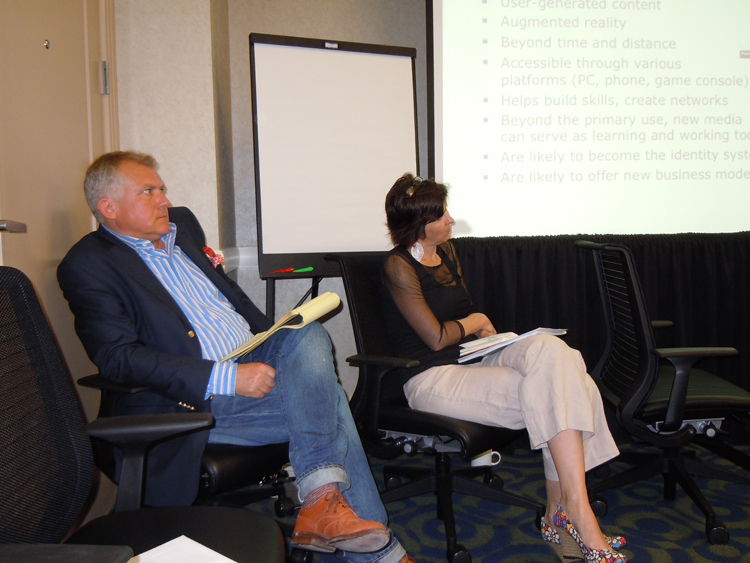
This began with a debate on the motion that This house believes that the use of mobile supported social media is an effective means of promoting democracy.  Breakfast planning, led to a slight change of schedule!  So, the session began with Mario Maniewicz (Chief of Department, Enabling Environment and E-applications, ITU) providing an overview of some of the issues surrounding this complex subject.  Then the debate began in earnest.  Katrin Verclas (Co-Founder and Editor of MobileActive.org) set the ball rolling arguing vehemently in favour of the motion, to be followed by a sound rebuttal by Adam Salkeld (Head of Programme, Tinopolis).  Then the real challenge – both for me and the audience!  To balance things up, I filled in the gap by seconding the motion in favour – even though I would have preferred to speak against the motion.  Half way through, when I was arguing that anarchy is the only true form of democracy, I suddenly realised that one might say things that one does not necessarily actually mean when one is debating.  My short intervention should have had a health warning!  And the debate concluded with a brilliant tour-de-force by Alan Fisher (Senior Correspondent, Washington DC, al Jazeera).  After numerous interventions from the floor, the final vote (including contributions by Tweets) was 21 in favour and 19 against!  Thanks to Caitlin Bentley so much for video streaming the debate and managing the Twitter feed!

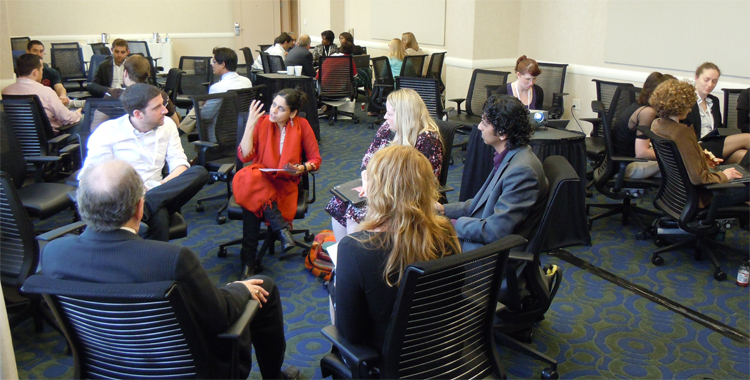
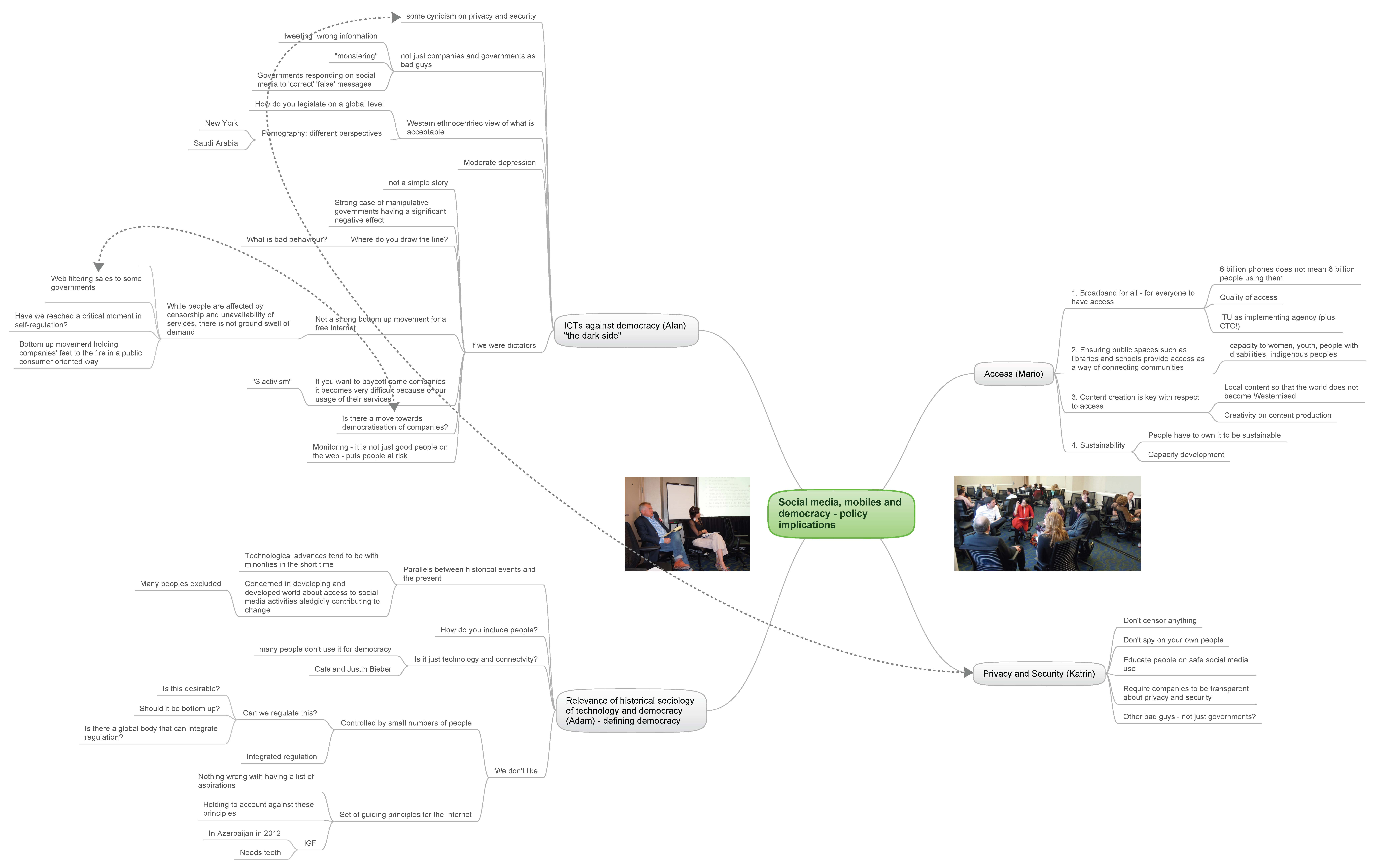
After the ‘refreshments’ break, we broke up into small discussion groups, each chaired by one of the speakers, to explore the policy implications of four of the most important themes to emerge from the debate: access (chaired by Mario), privacy and security (chaired by Katrin), the relevance of historical sociology of technology and democracy (chaired by Adam), and ICTs against democracy: the ‘dark side’ (chaired by Alan).

The mind map below provides a summary of the fascinating discussions as presented in the final closing plenary.

Click on the image for a large sized (readable) version!

Video of the debate

Caitlin Bentley has compiled a ‘story’ of the #SocMed4Dem debate at #ICTD2012 at http://storify.com/cbentl2/mobiles-social-media-and-democracy

2 Comments

Filed under 'phones, ICT4D

Never ever, ever, ever fly through Atlanta’s Hartsfield Jackson (so-called) International Airport

I have just spent almost two hours trying to escape from Atlanta’s so-called international airport, and have to say that it was without any doubt, far and away the worst experience I have ever had trying to leave an international airport – and I only had hand luggage!  The slowness, rudeness, incompetence, inefficiency and downright unpleasantness of the people and machines were unbelievable.

First, we had to queue for well over an hour to get through the passport check, fingerprints and retinal scans. We were herded like cattle through a very slow moving roped off set of alleyways.  There were only a handful of officials on duty, with many ‘gates’ empty.  It was designed to raise our temperatures, and if I had not been in a hurry it would have been faintly amusing listening to the comments in the queue.  The ‘officials’ seemed to be spending as long as they possibly could with each person arriving; there was no sense of urgency at all. Then, nearing the end, when I was in line to be ‘checked’, the officious official who was guiding us to the scanning point ordered me to move one foot to the left!  I could not believe it.  There was a wide open space and I had to move one foot to the left.

The sense of power and control that these unpleasant people have is quite unbelievable.  It is rather like many of those on baggage security checks across the world who take joy in making life as miserable as possible for travelers, ordering them around!

At last, I was in front of the person who was going to take my fingerprints and retinal scan.  In the old days – and they were good, very good – only criminals had their fingerprints taken.  Just think what the US government might do with all of our biodata.  So, I decided to be nice, and got a word in first, asking him what kind of day he had had, saying he looked as tired as I did.  It worked!  He smiled!  He had started work at 5.30 this morning, with a break for lunch, and it was by that time nearly 8.45 in the evening!  Anyway, I will give him credit – he processed me politely and swiftly, for which I am very grateful.  I certainly had vastly better treatment than many others in the queue.

I was lucky!  I only had hand luggage so did not then have to wait for any checked baggage – but I’m sure it would  in any case have come through by then!  So, next we had to queue to hand in our customs declaration form – just to show we were not bringing in anything that might be against US regulations.  Fortunately, I went through that fairly swiftly.  Any normal person would expect then to be able to walk out of the airport and get a taxi.

But no, not at Hartsfield Jackson International Airport.  Wait for it.  Can you imagine what happened next?  Yes, another bag check and full body scan. And this was simply to get out of the airport! I had to join yet another snaking queue, to have my bags checked.  Yet again, jackets off, shoes off, computers out with everything being put in trays.  Officials shouted at us to get in the correct lines.  One poor gentleman from India, was totally confused as to whether he was being shouted at or not.  And the stench!  I have no idea what it was, but it was definitely the most evil smell I have encountered in any airport in the world!  And then the body scan. Everything, even handkerchiefs has to be taken out of pockets, and some of us were chosen to be placed in this scanning device.  No notices about what it would do, any potential health issues, or what would happen to the images after they had been taken.  I was simply forced through.

At last, I thought I was free.  But they did not like the look of my laptop and notepad, so back it had to go through the bag scanner.  Even then, when of course nothing was found, it took a good 20 minutes to walk to the shuttle train that took me to the concourse from whence I was at last able to get a taxi.

How nice it was to see an Ethiopian driver, who brought with him a sense of history, of culture and of hospitality.  What on earth was he doing here in this land of oppression I asked myself.  What horrors had he left to make his home in this neo-fascist place I had arrived in.

It made me think of all the other airports I have visited recently.  Perhaps the best comparison is with Beijing airport.  What luxury!  What efficiency!  What civility!  It is so easy to get through Beijing, and one is treated with dignity and hospitality by the Chinese officials.  Perhaps this is a reflection that China has become the world superpower, and because it does not try to impose democracy on other countries at the end of a gun or bomb, it does not have to be so preoccupied with ‘protecting its borders’.  In Atlanta, the symbolism of officials shouting and ordering people around, herding them like cattle in pens, scanning them for biodata and personal information, reminds me of the fall of other empires.  Petty bureaucrats who get their kicks out of being deliberately unpleasant. The use of machines to control people’s freedom.  The sense of oppression and foreboding.

And then, I often hear USAns complaining about Heathrow airport.  What absolute hypocrisy and cheek! Heathrow is bliss compared with Atlanta.

You have been warned!  Never travel through Atlanta airport if you can possibly avoid it.  Better still, avoid Atlanta itself!  What a pity, I have such good friends here.

3 Comments

Filed under Ethics, Story-telling

Google and Facebook: privacy and security

I have long been critical of Google, but two thing have recently begun to make me begin to think again.  First, they have developed an amazing App – Google Translate!  Whilst the translations are by no means perfect, the idea behind the App is brilliant.  At its best, you can speak the phrase that you want translated, and the App will then give you a translation in more than 60 different languages, all as text and some as a sound file.  Using such software, someone can speak a phrase in Indonesian and then the App will translate it so that someone else can hear the phrase in Portuguese or Russian or Czech.  This is really beginning to use the potential of mobile technologies to help people from many different backgrounds communicate with each other.

However, this is not the main purpose of this note.  Anyone who uses Google software cannot but be aware of the changes to Google’s privacy policy that are due to come into force on 1st March.  This is the important thing – Google, for a change, appears to be trying to be much more open than ever before in explaining the reasons why it is adopting new privacy policies.  As they say, “We’re getting rid of over 60 different privacy policies across Google and replacing them with one that’s a lot shorter and easier to read. Our new policy covers multiple products and features, reflecting our desire to create one beautifully simple and intuitive experience across Google”. In clarifying the reasons for this, Google claims that it will make it easier to work across Google, it will be tailored for users, it will be easier to share and collaborate, that its fundamental principle of protecting user privacy has not changed, and that it helps users understand how Google uses their data.

Google has five core privacy principles:

  1. “Use information to provide our users with valuable products and services.
  2. Develop products that reflect strong privacy standards and practices.
  3. Make the collection of personal information transparent.
  4. Give users meaningful choices to protect their privacy.
  5. Be a responsible steward of the information that we hold”.

However, are these principles really as sound as they at first sight appear?  Google’s profits have been built around the fundamental notion that it encourages consumers to give information to the company that is of considerable value to Google  in exchange for ‘free’ services, such as the world’s best search engine, e-mails and document sharing.

An alternative perspective is offered by those who see this as a deliberate move to combine information about individuals from across the platforms that it now owns, and use this to generate even greater profits.  As the BBC has commented, “Critics have hit out at Google’s decision to merge personal data from YouTube, Gmail, search, social network Google+ and dozens of other services”.  As the BBC report goes on to note, “Data is a hugely valuable commodity as firms seek ways of making money from users’ web habits with ever more targeted adverts”.

It is not only Google, though, that is combining aspects of its various services, and the information it gleans from them.  As the competition between Google and Facebook hots up, Facebook is also combining the different data it holds about people.  Again, as the BBC comments “Facebook is also moving to merge people’s data, with tweaks to how user information is displayed. Its new feature, Timeline, shares users’ past history on the site in a more readable way. While it does not expose any more information that was previously available on its traditional profile page it does makes it easier to view older posts. Currently the system is voluntary, but Facebook is making it compulsory”.

The forthcoming IPO (initial public offering) of Facebook provides an interesting opportunity to reflect on the balance of power between the top valued companies that have built their businesses on the technologies of the Internet, and an apparently endless desire by people to find out about each other and share information about themselves.  A recent report by Keith Woolcock in Time Business captures this well: “The upcoming IPO of Facebook, the flak surrounding Twitter’s decision to censor some tweets, and Google’s weaker-than-expected 4th-quarter earnings all point to one of the big events of our times: The crazy, chaotic, idealistic days of the Internet are ending. Once, the Prairies were open and shared by everyone. Then the farmers arrived and fenced them in. The same is happening to the Internet: Apple, Amazon and Facebook are putting up fences — and Google is increasingly being left outside. The old Internet on which Google has thrived is still there, of course, but like the wilderness it is shrinking. Often these days, we sign up for Facebook or Amazon’s private version of the Internet. At other times, we use a smartphone and download an App instead of using Google search. Investors are already placing their bets on who the winners of the new Internet will be: Over the past five years Amazon’s shares, despite their recent fall, have risen 370%. Apple’s are up 438%. Google’s, meanwhile, have merely risen by 17% in all that time.  It is still the early days of this long-term trend, but my hunch is that this gap in performance will widen over the coming year — and that Google’s long slow decline has already begun”.

Perhaps I should start feeling sorry for Google after all.  At least I began this blog by encouraging people to start using their great translation App!  Ultimately, though, we should all reflect a bit deeper on what it is we are giving away for free when we sign up for a service that is free for us to use.  We should all also be much more careful about just how much information about ourselves we make available publicly – just in case one day we regret the profit that others have made out of it!

Leave a comment

Filed under ICT4D

Donating Computers to Schools

A young acquaintance from Europe visiting a country many miles away sent me an e-mail saying that she was about to set out on a programme to donate computers to schools, and asking my advice. Such enquiries are hard to answer.  On the one hand I want to support such commitment and enthusiasm, but on the other I know just how problematic so many such initiatives have been.

This is how I responded:

There are many initiatives that have been set up to ‘deliver’ computers into schools (and other places), many of which have been unsuccessful. Some of these have used refurbished computers (such as Computer Aid); others have been donated new by NGOs. Invariably, they are ‘given’ by people who know what computers can do – often based on their own experiences – and think that it would be great if less advantaged people could benefit likewise. However, invariably this is not a good use of money and resources. As you can imagine, there is a huge literature on this – but I guess your connectivity may not be that good in terms of wanting to download information!

So, a few key tips are:

  • begin with the teachers and ensure that everything is led by them, and integrated into what and how they teach.
  • much better to contribute to expanding an existing successful initiative, rather than starting up something from scratch
  • don’t try and reinvent the wheel – build on existing experience and good practices
  • ensure that there is effective electricity and connectivity – as well as the money to pay for it
  • ensure that any content is in local languages and integrated with the curriculum
  • ensure that the use of the computers is also about communication and not just content
  • use of computers in schools is far more than just teaching people to learn how to use office skills – so make sure they are really used for education
  • try to ensure that the computers are used 24/7 – by for example running adult training courses in the schools out of hours
  • try to identify how the computers can be used to generate an income, so that the school can then have enough money to buy more and replace the ones that break
  • ensure that there is technical back up and support, so that if minor things go wrong (like a plug being accidentally pulled out), then people can simply fix it
  • do not have a printer (it gets very expensive on paper and ink and usually breaks swiftly)
  • think of using COWS (Computers on Wheels) that can be rolled around from classroom to classroom, rather than having a computer lab
  • if there are only one or two computers, make sure that they do not finish up (unused) in the head teacher’s office
  • build usage of the computers around community needs – involving parents, siblings and the wider community – so that everyone can see their worth
  • if teachers and children have mobile ‘phones, think of building the learning solutions around them, rather than around computers

I wonder how others would have advised my young acquaintance…

7 Comments

Filed under Education, ICT4D

Data on Internet and social media usage

One of the interesting things about the Internet is actually how difficult it is to find out detailed and accurate information about its usage, especially with respect to social media. The International Telecommunications Union does, though, provide some useful high level data.  Given all of the emphasis on the apparent ‘ubiquity’ of Internet use, these provide some very salient reminders that in 2011

  • some 35% of the world’s population use the Internet – which means that 65% still do not!
  • although 45% of Internet users are under 25, 75% of the world’s under-25s still do not use the Internet.
  • there are twice as many mobile-broadband as there are fixed-broadband subscribers across the world

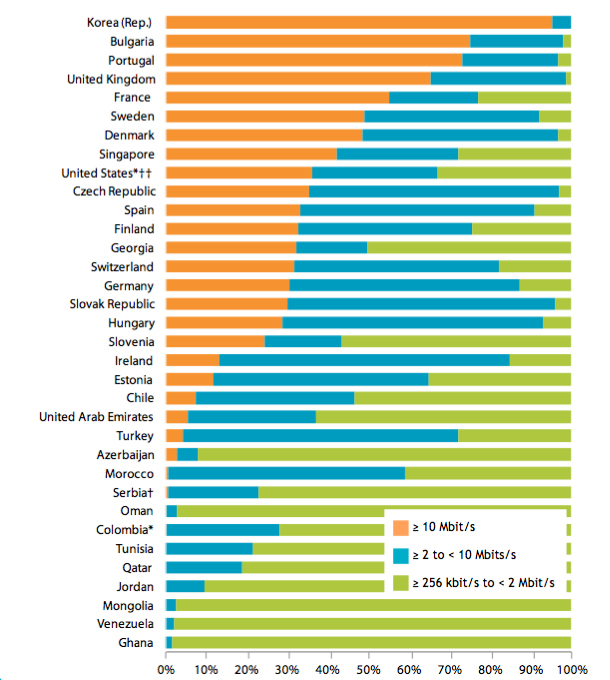
It is not just connectivity, though, that matters.  The available bandwidth and speed of connectivity are also crucial.  The following ITU graph (click on image for larger version) thus illustrates the enormous contrasts that still exist in this respect:

Whereas more than 95% of fixed broadband connections in South Korea have advertised speeds of ≥ 10 Mbit/s, some 98% of connections in Ghana, Venezuela and Mongolia have speeds of ≤ 2 Mbit/s.

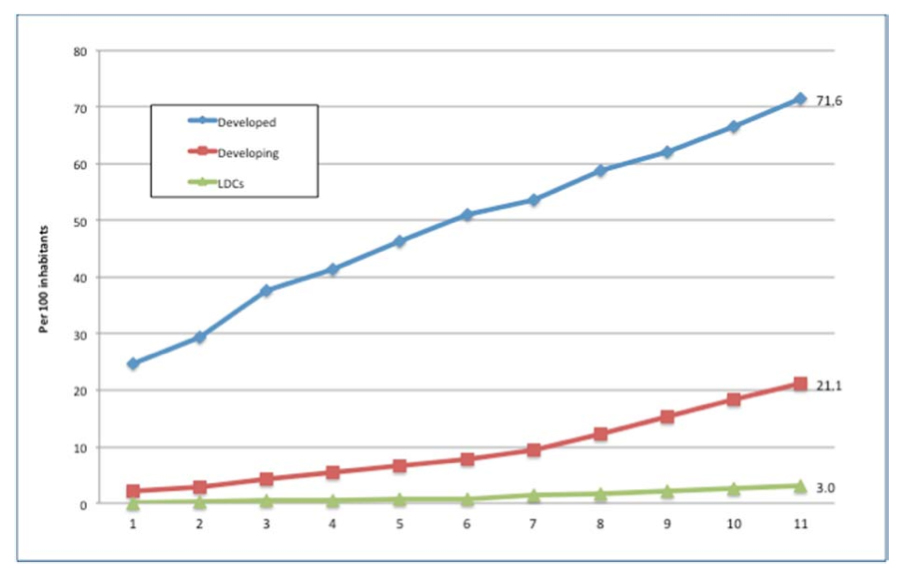
Of equal concern is the observation that the least developed countries are being left further and further behind in the race for digital connectivity.  In a striking report on the role of ICTs in the “least developed countries”, the ITU  shows this particularly graphically in the chart below (click on image for larger version), which illustrates the percentages of people who are Internet users:

This shows, for example, that the difference between the percentage of Internet users in the “developed” and the “least developed” countries in 2000 was only about 25 people per 100, whereas by 2010 it had leaped to more than 68 people per 100.  Despite growth in the number of Internet users in the developing countries, they were likewise still 50 people per 100 behind the “developed” countries in 2010.  The differences between rich and poor are thus getting dramatically bigger rather than lessening.

As 2012 gets underway, let us all commit ourselves more strongly than ever before to ensuring that these trends are reversed, and that the world’s poorest and most marginalised are indeed able to benefit from the ICTs that so many people living in the richest countries of the world now take for granted.

One aspect of data on Internet usage that I find particularly frustrating is the difficulty of finding accurate information on social media usage.  This is especially important when there is so much rhetoric about the ways in which such media are transforming social, economic, political and cultural life.  It seems to me that, once again, this may well be true of the world’s richest 10% or so of people, but is scarcely true of the majority!

Facebook, for example, is renowned for how little information it shares, with its statistics page only giving very sparse information about five categories of data, including the ‘fact’ that there are 800 million active users.  But what does “Active Users” mean?  According to Facebook it is people who have returned to the site in the last 30 days, although we are told that half of these (c.400 million) use Facebook every day.  If the world’s population is taken as being ‘approximately’ 6.984 billion, that means that about 1 in 17.46 people are using Facebook every day.  Before we get too carried away with the enormity of this figure, we should recognise that this is only 5.7% of the world’s population, which means that a huge 94.3% of the world’s people do not use Facebook daily!

It is likewise not that easy to find out detailed data from Twitter, although officially some 177 million Tweets were sent on 11 March 2011.  In the above vein, though, it should be noted that this is equivalent to only 1 per every 2.5% of the world’s population (some useful sites providing more comprehensive visual summaries of data on Twitter include MarketingGum and digitalbuzz, although these are becoming rather dated; see also report on CMSWire). In September 2011, Twitter announced that it had 100 million active global users logging in once a month – but again this only represents 1.4% of the world’s population!

When we read about how Facebook and Twitter are going to change the world, we therefore need to think very carefully about whose world, and the kind of world they might create.  To be sure, digital technologies have enormous potential to serve the interests of the poorest and most marginalised, and the numbers of users of services such as Twitter and Facebook are indeed increasing impressively, but with such low levels of global reach they are not yet the dominant force that many would claim them to be – or indeed some users might like to think they are!  So, how many people have more than 1000 followers on Twitter?!

1 Comment

Filed under ICT4D

Findings from research on mobile use amongst marginalised groups in China

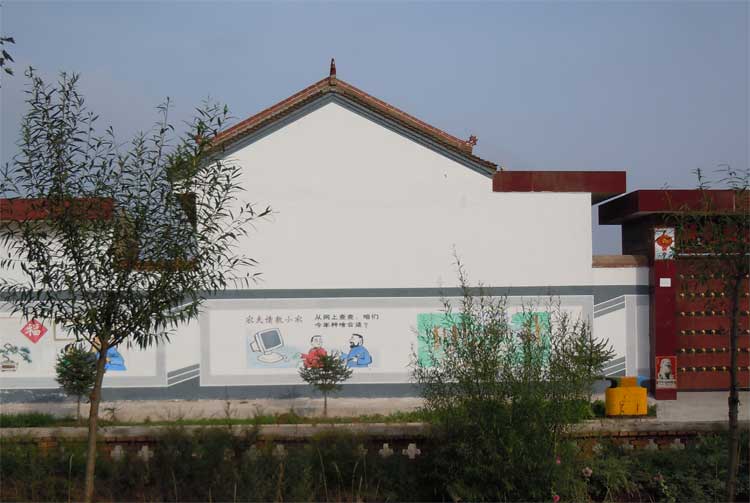
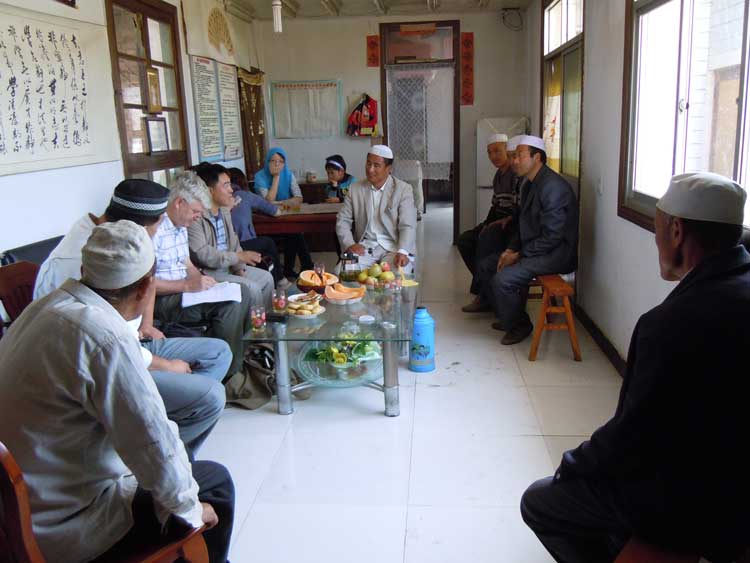
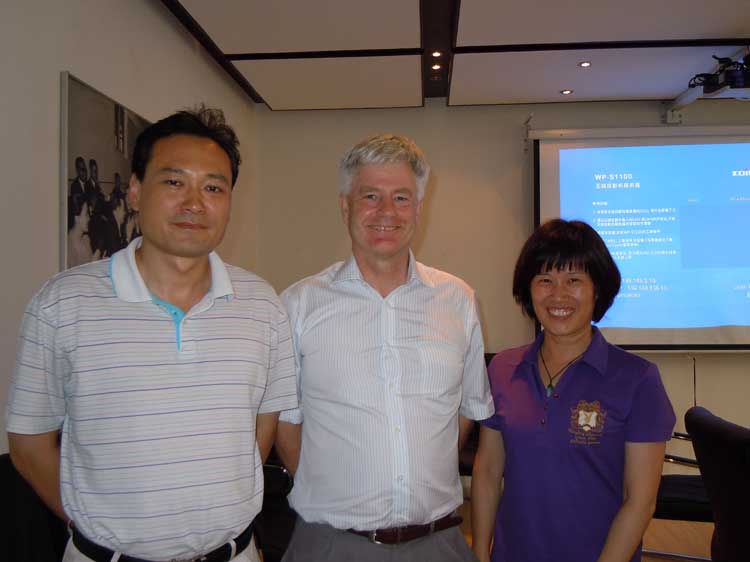
I spent five weeks this summer undertaking research in Beijing and Gansu thanks to a UK-China Fellowship for Excellence from the Department for Business, Innovation and Skills.  The central purpose of my research was to explore the information and communication needs of poor and marginalised communities, especially people with disabilities (in Beijing) and farmers in rural areas (in Gansu Province).  I learnt so much – and probably more from the informal discussions than I did from the  focus groups and interviews that I conducted!  Many thanks are due to Professor Ding Wenguang and Chen Fei for all of their help and assistance in arranging meetings, and translating our dialogues.

The premises underlying my research were that:

  • all too often, new software and hardware are designed for the mass market, and then need to be ‘adapted’ to suit the ‘needs’ of poor and marginalised people
  • frequently, well-intentioned new technologies are developed in some of the richer parts of the world and then ‘applied’ in poorer countries; researchers are then surprised that there is little take up for their products
  • hence, we still need to get a much better understanding of the needs of these communities, and focus much more on designing technologies explicitly with their interests in mind
  • China has 18% of the world’s population, and so the market size of marginalised communities makes it worth developing products commercially for them

The resultant data are so rich that it is difficult to summarise them in detail.  However, the following seem particularly pertinent

Rural areas

  • The diversity of people and communities in rural areas of China is replicated in a diversity of needs.  ‘One size fits all’ solutions are not appropriate, yet the size of the market for particular groups is nevertheless very large given China’s overall population
  • Almost everyone already has at least one mobile ‘phone – mobiles are already widely used for information and communication, even for Internet access.  There are real implications for Africa – if electricity and connectivity can be provided
  • Economic information is particularly desired – especially on such things as agricultural input prices and market prices – particularly by men.  I was surprised at how dominant and significant this was.
  • There seem to be important gender differences in usage – women placed greater emphasis on social communication and health information; young male migrant workers in contrast seemed dominated by a desire to use mobile broadband to meet with girls.
  • Value for money is important – c. RMB 2-3 per month is all that most people are willing to pay for subscription services
  • Trust of source of information is also very important – there seems to be a lot of bogus messaging – and differing views as to what kind of organisation was most trustworthy.
  • There is real potential for village level training in effective use of mobiles – especially by women for women
  • For many users, the existing functionality of mobiles is more than they can cope with

Disabilities

  • There is huge potential for innovative hardware and software solutions – many interesting ideas were proposed
  • There is therefore a large opportunity for sharing good global practice with colleagues in China in the use of ICTs for people with disabilities in China
  • Information about location and direction is crucial for blind people – we need to think more innovatively about how to deliver on this
  • Screen size and configuration (not touch screen) are very important for blind people – Blackberry wins out over iPhones here!
  • There is an enormous opportunity for audio books (not only for blind people). Perhaps a civil society organisation could develop this, and even market audio books to generate income.
  • Security code challenges are important for blind people
  • Shopping information – much potential for RFID and 2D bar codes for blind people.
  • A powerful text scanner and reader in a mobile phone for blind people would be useful
  • Visualisation and touch/vibration of sound could also be developed further

There is a huge agenda ahead, and I am enthusiastic about ways in which we can encourage delivery on some of these exciting opportunities.  Thanks so much to BIS, Lanzhou University and Peking University for supporting this research, and to all those who contributed through their wisdom and hospitality

4 Comments

Filed under 'phones, China, ICT4D

Resources for sharing development knowledges

Sitting in an interesting meeting of the International Advisory Group of IDS’s MK4D (Mobilising Knowledge for Development) initiative, it struck me that there are now a number of  similar initiatives, all trying to tackle the sharing of development knowledges in rather different ways, and yet no central place where these are all listed.  So, here is a list of some of the ones that I think are most interesting (sorted alphabetically!):

  • bytesforall – a citizen’s network in South Asia that identifies, discusses and builds network on emerging issues related to ICT and its impact to development
  • Comminit – The Comunication Initiative Network, where communication and media are central to social and economic development
  • Development Gateway – an international nonprofit organization with the mission to reduce poverty and enable change in developing nations through information technology (includes the Zunia programme)
  • Eldis – based at IDS and aiming  to share the best in development policy, practice and research (within the MK4D package for work at IDS)
  • Global Development Learning Network – cooordinated by the World Bank, the Global Development Learning Network (GDLN) is a partnership that collaborates in the design of customized learning solutions for individuals and organizations working in development
  • IDRC/CRDI (Canada’s International Development Research Centre) – supporting applied research to find local solutions that will have lasting impacts on communities around the world.
  • IICD – using ICTs to help people in Africa and Latin America access the information that can transform their lives
  • infoDev – supports global sharing of information on information and communication technologies for development (ICT4D), and helps to reduce duplication of efforts and investments
  • R4D (Research4Development)- the portal to DFID centrally funded research
  • Zunia Knowledge Exchange

3 Comments

Filed under ICT4D

Survey of mobile learning use by students

While in China recently, I was working with a group of colleagues to explore how students (undergraduate, Master’s and Doctoral) there are using mobile phones in support of their learning.  We designed a survey that is now being implemented to gain a broad understanding of such usage. Much previous research has focused on the effectiveness of specific ‘m-learning’ interventions, but what interests us is how students may (or may not) be using mobile ‘phones in a sense ‘organically’ to support their learning.

The idea then came that it would be very interesting to draw some international comparisons about the use of mobile learning, and so we have developed a short online survey that takes only between 10 and 15 minutes to complete. It would be great if you could circulate this link to any students that you know, and encourage them to complete the survey:

We would also like to make the survey available in different languages, and if there is anyone who might feel able to translate it into their own languages please let me know, so that I could send you a version in a text format for translation.  Any such assistance would of course be acknowledged with thanks in the reports that we write!

Do please publicise this as widely as possible.  Hopefully, the survey will be interesting for students to participate in!  The results will be posted in due course at http://www.ict4d.org.uk .

Leave a comment

Filed under 'phones, ICT4D, Universities