Category Archives: ICT4D

UNESCO publishes report on ICTS for people with disabilities

UNESCO has recently published a short report by a group of experts on “ICT for persons with disabilities“.

This presented the following recommendations to UNESCO for consideration:

“Making UNESCO ICT-accessible
The group of experts recommended that UNESCO should ensure overall accessibility of persons with disabilities. To achieve this goal the Organization should improve its online presence and the accessibility of its website. It should also create accessible physical environment, develop appropriate procurement and recruitment policies, and ensure training and retaining of the employees.

Mainstreaming ICT in inclusive education
UNESCO is encouraged to foster effective use of ICT that are accessible, adaptive and affordable for person with disabilities. Specific guidelines and tools are needed to teach persons with disabilities and to ensure that corresponding ICT competencies are embedded in initial teacher training.

Mobilizing resources and international cooperation
The experts stressed the importance of identifying arguments for shifts in policy practices and determining funding opportunities where UNESCO could get involved. It is important to cooperate with organizations of persons with disabilities in order to get the best possible input and to have credible action lines and projects for funding.

Creating an information and knowledge access ecosystem
This recommendation focuses on “touch points”, such as WorldWide Web, broadcasting, publishing, languages, etc., in the system in which people and humans interact with information and services. It also includes e-governance, which could be used to promote e-voting and e-democracy initiatives for citizen participation in an accessible way, as well increase participation in cultural activities.”
Leave a comment

Filed under Accessibility, ICT4D

Reflections on Open Educational Quality Initiative discussions

The Open Educational Quality Initiative’s (OPAL) workshop at UNESCO in Paris on 8th and 9th November offered a valuable opportunity to explore a range of issues relating to how we can build on Open Educational Resources to encourage Open Educational Practices.

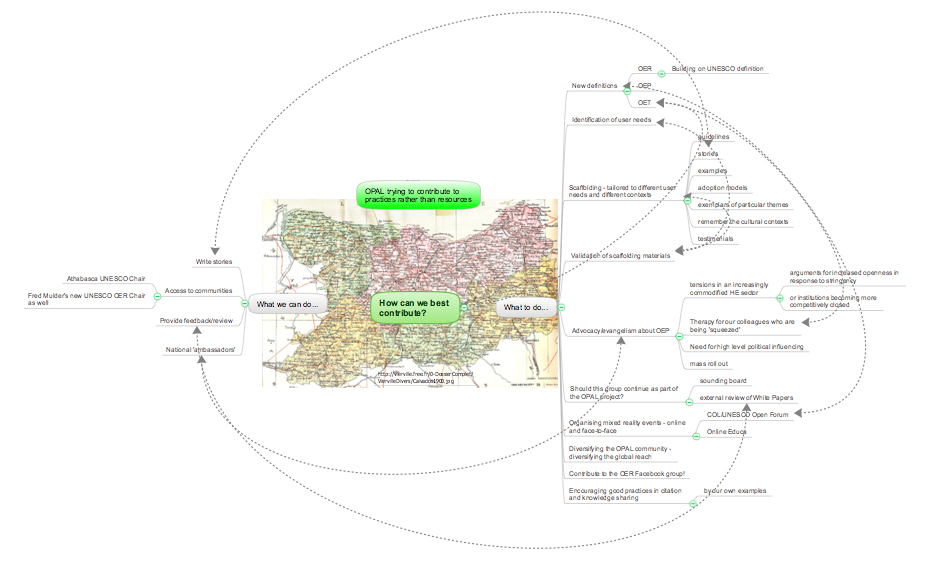
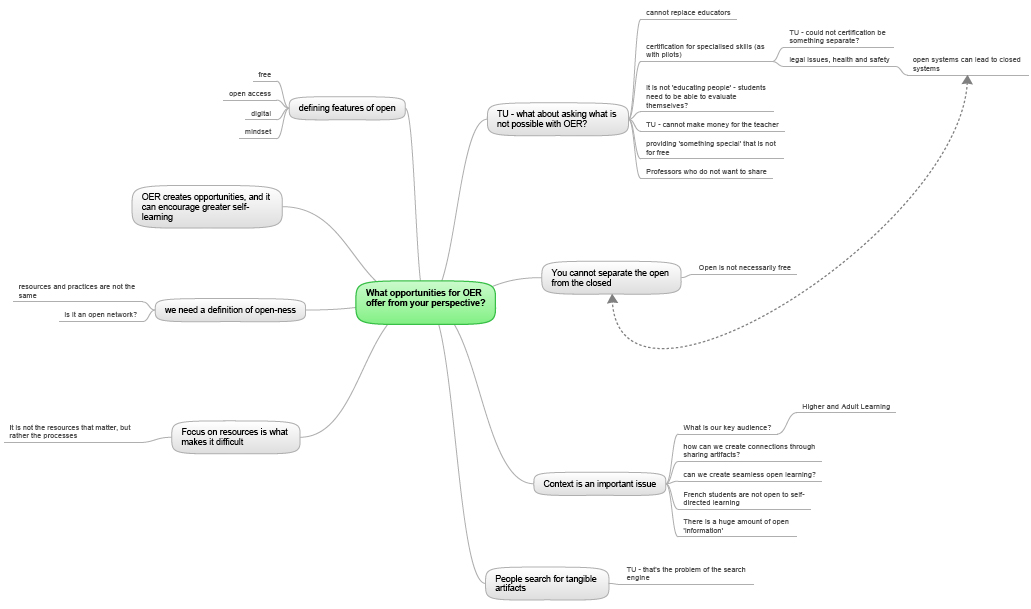
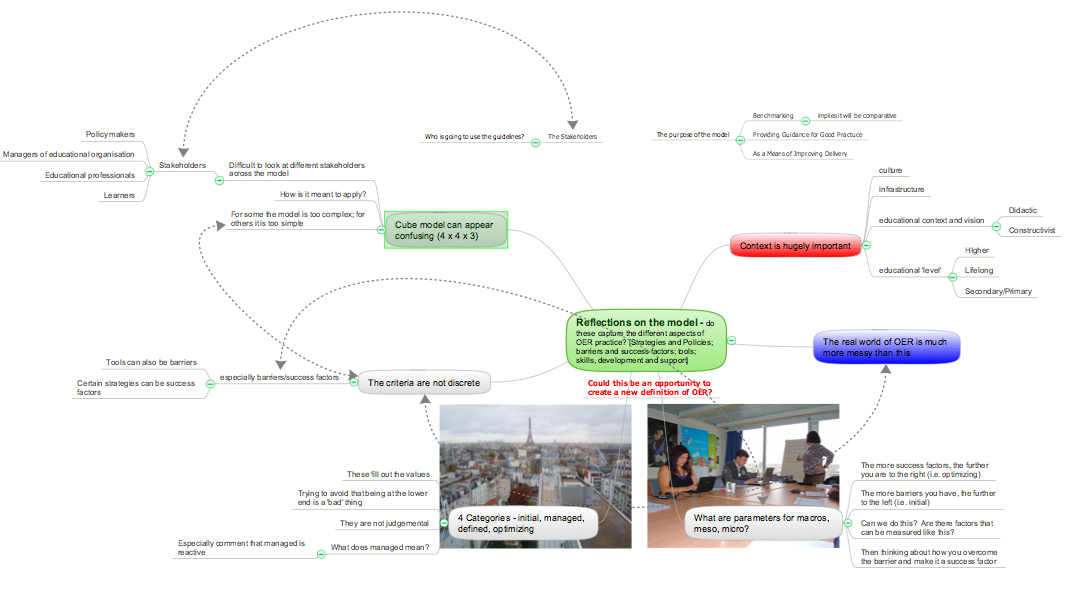
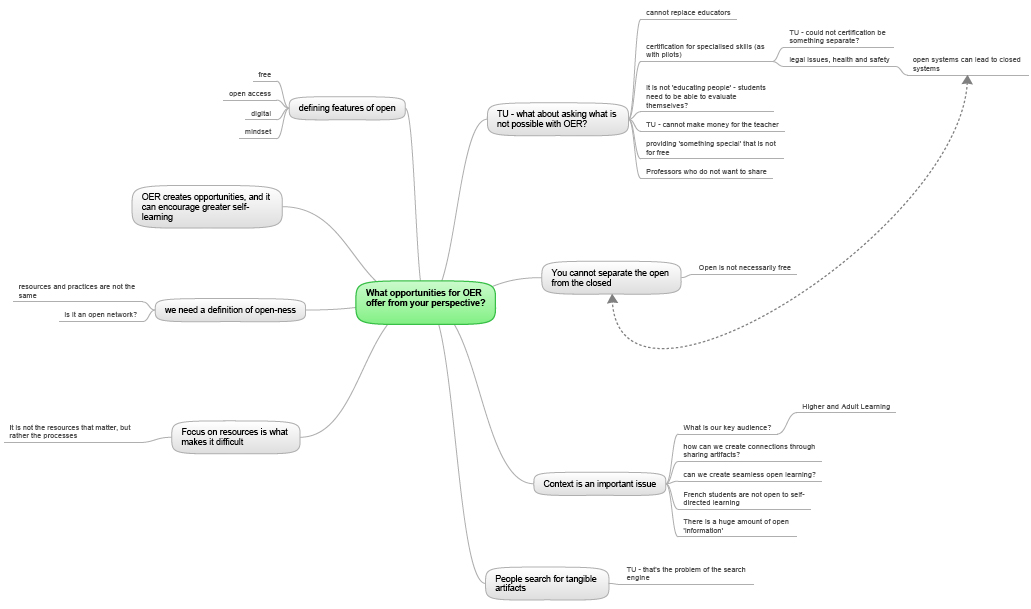
Below are the mind maps I constructed from our discussions on the following themes (click on the image to get higher resolution and larger versions!). Thanks to everyone who contributed to shaping my thoughts in these ways.

What are the main opportunities offered by Open Educational Resources?


What are the key challenges for preventing the implementation of the OPAL vision?


Reflections on the OPAL model – does it capture the different aspects of OER practices?


How can we best contribute?

Thanks to everyone who put this interesting gathering together – especially Ulf and Gráinne. Everything can be followed up on the OPAL site and its Cloudworks environment.

1 Comment

Filed under Higher Education, ICT4D

Development as ‘economic growth’ or ‘poverty reduction’

Will economic growth lead to poverty reduction?  I believe passionately that the market will never serve the interests of the poorest and most marginalised.  This seems to me to be so clear and obvious that it scarcely needs defending!  However, I am becoming increasingly worried that such opinions are very much in the minority. The dominant, hegemonic view amongst most of those working in the field of development really does seem to be that economic growth will indeed eliminate poverty.

Following my recent keynote at m4Life on 28th October, at which I argued that we need to develop ways in which mobiles can be used to support marginalised groups, such as people with disabilities, I was very strongly challenged by an African colleague, whose views I respect.  In essence, she accused me of being a typical western academic who does not really understand Africa, and that if I did I would know that most Africans wanted economic growth. By focusing on the poorest, she suggested that my views were tantamount to arguing that Africans should remain poor. I felt deeply hurt by these accusations, and am still smarting from their vehemence some two weeks later! I actually don’t know why, they hurt so much, but perhaps it is because I have elsewhere argued strongly that Africa is indeed rich, and that we need to help build on its richness rather than always describing it as being poor!  The irony is that the paper I have written on this has continually been rejected by academic journals – quite possibly because it too does not conform to accepted dogma!

I clearly need to learn to express my arguments more convincingly.  This is a brief attempt to do so in the form of some basic principles:

  • The potential for inequality to increase is inherent within all economic growth.
  • Economic growth, defined in absolute terms, cannot therefore eliminate poverty (see my critique of Jeffrey Sachs, for example, in ‘No end to poverty’)
  • If economic growth proceeds unchecked, it will inevitably lead to increased inequality that will ultimately fuel social and political unrest at a range of scale
  • A fundamental role of states is thus to intervene in the market to ensure that the poorest and most marginalised are not excessively disadvantaged.
  • Given that the market serves the interests of the majority of people, it is incumbent on those who care about reducing inequalities specifically also to address the needs and interests of the poor.
  • Such an argument can be justified both on moral grounds (that it is just), and also on socio-political grounds (to reduce potential violence)
  • With reference to mobile technologies, therefore, all I was doing in my keynote was to argue that companies, entrepreneurs, app developers, and all those claiming to use ‘mobiles for development’ should seek to address the needs of the poor and marginalised, alongside those of global corporations and their shareholders.
  • This is premised upon a belief that ‘development’ is about rather more than just economic growth, and includes notions of equality of opportunity and social justice.

These arguments are developed more fully in:

15 Comments

Filed under Africa, Development, Ethics, ICT4D, Photographs

Watching the watchers watching…

In recent months I seem to have posted several photos of ongoing surveillance, generally by people acting on behalf of the state.  Perhaps I should start a collection of these!  So, here is another one (Camden CCTV again) patrolling the streets near Euston.  I wonder how much footage they take and what they do with the images.

This is what Camden Council’s website has to say on this under the heading of “enforcement”: “We have responsibility for the enforcement of the borough’s parking and moving traffic regulations and this is carried out by Civil Enforcement Officers (CEOs) (formerly known as Parking Attendants) and through the use of CCTV. The scheme is part of the Association of London Government’s (ALG), the Mayor of London and London Borough of Camden’s commitment to the travelling public to keep London moving and ease congestion.”

What an amazing upgrade, Parking Attendants can now be confused with Chief Executive Officers!

Camden’s more detailed account goes on to say that this is done:
  • “to stop traffic congestion
  • alienate inconsiderate motorists
  • free up the bus lane to combat delays for commuters
  • to allow the free flow of traffic
  • improve journey times for bus users”

Am I the only one who finds words such as “enforcement”, “alienate” and “combat” just  a tiny bit worrying?  So, let’s keep watching the watchers…

Leave a comment

Filed under Ethics, Photographs, UK

UK government set to re-examine Google’s infringements of privacy

Great to see the announcement reported by the BBC that Britain’s privacy watchdog is to re-examine the personal information that Google has gathered from private wi-fi networks.

As the BBC article commented, “The Information Commissioner’s Office had investigated a sample earlier this year after it was revealed that Google had collected personal data during its Street View project. At the time, it said no “significant” personal details were collected. But Google has since admitted that e-mails and passwords were copied. … Google’s admission of more detailed data has prompted further action by the ICO. “We will be making enquires to see whether this information relates to the data inadvertently captured in the UK, before deciding on the necessary course of action, including a consideration of the need to use our enforcement powers,” a spokesman said.‬ Google’s director of privacy Alma Whitten said the company would work with the ICO to answer its “further questions and concerns”.”

Leave a comment

Filed under Ethics, UK

ICT4D Partnerships

I cannot resist the fun of trying to express ICT4D ideas in different ways, and  always enjoy playing with tag clouds when I am writing.  An excuse to revisit the chapter on partnerships in my recent edited book on Information and Communication Technologies for Development, led me to generate this cloud.  I just thought I would share it as a summary statement of my thoughts on the subject of ICT4D policy and partnership!  Thanks to TagCrowd for the crunching!

Leave a comment

Filed under ICT4D

Many popular Android apps share location and unique identifiers with advertisers

A recent report on the BBC website notes a study by researchers from Intel Labs, Penn State and Duke University which shows that “Some of the most popular apps written for Google’s Android phones do not tell users what is done with data they gather… . Half of 30 applications studied share location information and unique identifiers with advertisers”. Two-thirds of these popular third-party apps showed suspicious handling of personal data.

Information from the ‘phones was sent to advertisers without the users being told that data was being shared with them.  As the BBC report goes on to note,  “Some apps gathered and despatched location information even when an application was not running and some sent updates every 30 seconds.”

Whilst users should always be wary of downloading any apps that they do not necessarily trust, this seems to be yet another example of Google not being the fully trustworthy company that it would like people to believe it is.  It would be a relatively simple matter to ensure that all users are automatically warned about this when software is downloaded. As the researchers conclude, “Android’s coarse-grained access control provides insufficient protection against third-party applications seeking to collect sensitive data”.

This is definitely a powerful reason why Android ‘phones should be avoided, and once again raises serious concerns about Google’s lack of ethical probity.

Leave a comment

Filed under Ethics, ICT4D

Scholarships for ICTD2010

Thanks to the generous support of the conference sponsors, the ICTD2010 conference organisers have recently been able to announce a further call for scholarships.  All applications must be on the appropriate form, and need to satisfy at least one of the following criteria:

  1. Have had a paper accepted, or be a speaker in an accepted session (including posters, workshops and demos) at the conference.
  2. Be from a country ranked below 100th on the latest Human Development Index (as at 1st June 2010)
  3. Be studying for a postgraduate degree
  4. Be on a low income (if applying on these grounds, the most recent payslip must be attached as proof of income)

Those who submitted unsuccessful applications in the first round will automatically be reconsidered, and must not submit new applications (otherwise they will be excluded).

More than 60 scholarships were awarded in the first round (from more than 170 applications), and it is hoped that a further 20 scholarships may be offered, covering some or all of the following: registration fee, accommodation and travel.

Leave a comment

Filed under Development, ICT4D

Reflections on e-mails

I remember the days when as a young academic I looked forward to receiving perhaps 10 letters a day; now, I receive well over 100 e-mails a day, and there is an expectation that I should respond to them all as soon as possible. How am I expected to be creative and innovative?  E-mails have been one of the most damaging things to productive and innovative work.  I hugely admire colleagues who have resisted the onset of e-mails, and simply invite those who want to contact them to write to them in ‘hard copy’. A colleague in a global organisation recently told me that he had a backlog of more than 6000 unanswered e-mails.  This is completely unacceptable.  We need to take more control over our lives – and our e-mails!

Some of the greatest abuses of e-mail (over and above Spam) include the following:

  • Organisations that send all of the paperwork for meetings as attachments, and then expect attendees to print them off before they attend the meeting.  This is completely unacceptable.  If hard-copy is required, then it is much more efficient and cheaper for the central organisation to print multiple copies and then disseminate these to attendees.  It is of course far easier for organisations simply to send out e-mails, but this passes on the work load of printing out to the attendees!
  • The above is even worse when the convener of a meeting sends the papers out electronically a couple of hours before the meeting starts and still expects recipients to read them beforehand!
  • People who set their preferences to reply to all, and thereby send vast numbers of e-mails to people who really do not want to receive them!
  • People who expect e-mails to be answered almost immediately!  Why should this have become so widely accepted?
  • Excessive use of copy e-mails.  Anyone who has worked in certain kinds of organisation (such as the Civil Service) will be only too familiar with this syndrome! People who are unwilling or unable to take responsibility for their actions always copy their bosses in to an e-mail!  Likewise certain control-freak bosses always want to micro-manage their staff and demand to be copied in!
  • People who send an e-mail to someone in the same room asking them a question, rather than getting up and actually talking with them!  It’s OK if the e-mail is to send an attached document, but otherwise it is much more efficient simply to go and discuss the matter with them.

So, here are some tips on what I think is good e-mail usage that might help reduce such abuses and enable us to retain some sense of our humanity:

  • When on leave, set a rule that files all incoming e-mails in a separate folder, and have an out of office message that tells everyone that their e-mail has been archived and if they want you to read it they should send it again when you return.  Rest assured that this will infuriate people, but just think about it.  If you have only 100 e-mails a day, and go on leave for 10 days that will mean that you will have 1000 e-mails awaiting you on return.  Even if you only spend a minute on each e-mail it would take just under 17 hours to respond to these on return.  You have better things to do.
  • Set a rule that sends all of your copy correspondence to a separate folder, and have an automated response that says something to the effect that you try to read copy correspondence once a week, and if the sender really wants you to read it more urgently than this they should send it to you as a direct respondent.  Again, this can infuriate abusers of copy correspondence, but it certainly cuts down on the number of unwanted e-mails you will receive!
  • A friend told me of a colleague who only responds to 38 e-mails a day – and lets everyone know this.  If you don’t get into the top 38, then tough luck!  I have not yet quite got round to doing this.
  • A variant on this is simply to set an amount of time each day to respond to e-mails – perhaps an hour –  and then just delete all those that have not been answered.
  • Colour code your e-mails into certain categories, and then sort them automatically according to priority.  Just so you know, my list in descending order of priority is as follows: family (red), friends (blue), my postgraduate students (green), Commonwealth Scholarship Commission (orange), ICT4D  colleagues (pale blue), Institute of Masters of Wine (Burgundy), and then others (black).  I don’t always get through all of my high priority e-mails, but it does mean that people know where they stand.
  • Set a rule that automatically deletes all incoming out of office messages before you ever even see them!
  • Always switch off your e-mail software if you are trying to do anything productive – and keep it off for as long as possible.  Never leave it running in the background.
  • Try to read your e-mails at set times of day – such as first thing in the morning – and then simply do as much as you can before switching your e-mail software off and  then start again the next morning.
  • If people are pushy and ask why you have not responded immediately to their e-mails, simply put them lower down in your list of priorities! They will soon learn.
  • Have a standard attempted response rate to important e-mails of 48 hours – and let people know this.  No-one should expect an e-mail to be read or responded to immediately.
  • Never respond to work related e-mails at the weekend.
  • I’m thinking of creating an automated response to all of my e-mails letting people know what my e-mail strategy is and apologising if they don’t receive an answer!

Enough for now….

Oh yes, and I am developing an automated e-mail answering system that learns how I usually respond to certain kinds of e-mail and then does this automatically for me.  It is great fun, but does mean that people don’t always get the messages that they expect to receive….

5 Comments

Filed under ICT4D

ICT4D extracts on Amazon.com

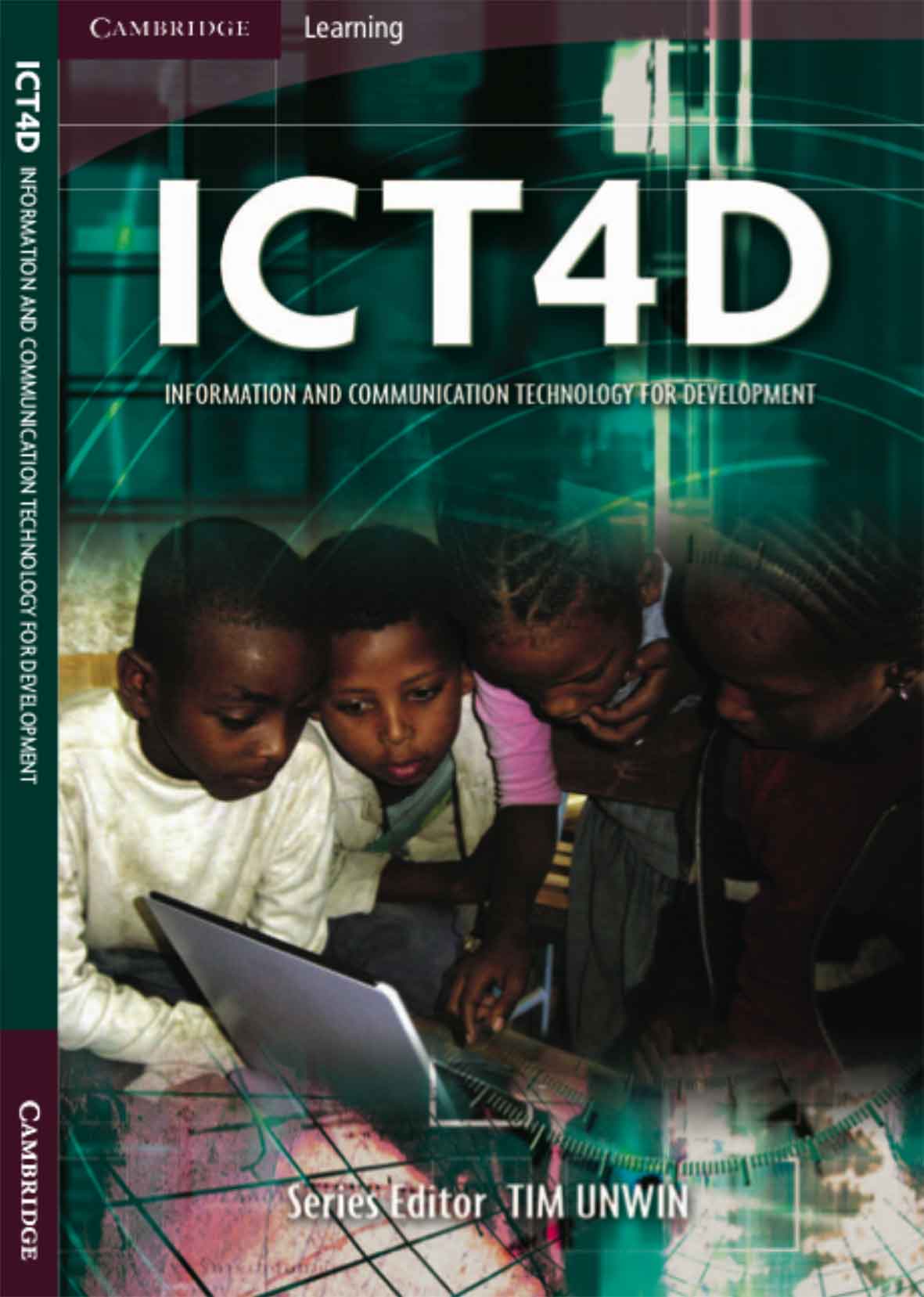
ICT4D BookFor those who cannot afford the (low) price of my edited ICT4D book (published by CUP in 2009), the first chapter as well as the contents page and index can be accessed from Amazon.com!

A summary of the contents is as follows:

  1. Introduction
  2. Development agendas and the place of ICTs
  3. Information and communication in development practices
  4. The technologies: identifying appropriate solutions for development needs
  5. ICT4D implementation: policies and partnerships
  6. ICTs, enterprise and development (Michael Best and Charles Kenny)
  7. ICTs in education: catalyst for development (Michelle Selinger)
  8. e-Health: information and communication technologies for health (Yunkap Kwankam, Ariel Pablos-Mendez and Misha Kay)
  9. e-Government and e-governance (James Guida and Martin Crow)
  10. Information and communication technologies for rural development (Bob Day and Peter Greenwood)
  11. Conclusions

The book itself can readily be ordered directly from Cambridge University Press.

Reviews include:

Leave a comment

Filed under ICT4D