Category Archives: ICT4D

Scholarships for ICTD2010

Thanks to the generous support of the conference sponsors, the ICTD2010 conference organisers have recently been able to announce a further call for scholarships.  All applications must be on the appropriate form, and need to satisfy at least one of the following criteria:

  1. Have had a paper accepted, or be a speaker in an accepted session (including posters, workshops and demos) at the conference.
  2. Be from a country ranked below 100th on the latest Human Development Index (as at 1st June 2010)
  3. Be studying for a postgraduate degree
  4. Be on a low income (if applying on these grounds, the most recent payslip must be attached as proof of income)

Those who submitted unsuccessful applications in the first round will automatically be reconsidered, and must not submit new applications (otherwise they will be excluded).

More than 60 scholarships were awarded in the first round (from more than 170 applications), and it is hoped that a further 20 scholarships may be offered, covering some or all of the following: registration fee, accommodation and travel.

Leave a comment

Filed under Development, ICT4D

Reflections on e-mails

I remember the days when as a young academic I looked forward to receiving perhaps 10 letters a day; now, I receive well over 100 e-mails a day, and there is an expectation that I should respond to them all as soon as possible. How am I expected to be creative and innovative?  E-mails have been one of the most damaging things to productive and innovative work.  I hugely admire colleagues who have resisted the onset of e-mails, and simply invite those who want to contact them to write to them in ‘hard copy’. A colleague in a global organisation recently told me that he had a backlog of more than 6000 unanswered e-mails.  This is completely unacceptable.  We need to take more control over our lives – and our e-mails!

Some of the greatest abuses of e-mail (over and above Spam) include the following:

  • Organisations that send all of the paperwork for meetings as attachments, and then expect attendees to print them off before they attend the meeting.  This is completely unacceptable.  If hard-copy is required, then it is much more efficient and cheaper for the central organisation to print multiple copies and then disseminate these to attendees.  It is of course far easier for organisations simply to send out e-mails, but this passes on the work load of printing out to the attendees!
  • The above is even worse when the convener of a meeting sends the papers out electronically a couple of hours before the meeting starts and still expects recipients to read them beforehand!
  • People who set their preferences to reply to all, and thereby send vast numbers of e-mails to people who really do not want to receive them!
  • People who expect e-mails to be answered almost immediately!  Why should this have become so widely accepted?
  • Excessive use of copy e-mails.  Anyone who has worked in certain kinds of organisation (such as the Civil Service) will be only too familiar with this syndrome! People who are unwilling or unable to take responsibility for their actions always copy their bosses in to an e-mail!  Likewise certain control-freak bosses always want to micro-manage their staff and demand to be copied in!
  • People who send an e-mail to someone in the same room asking them a question, rather than getting up and actually talking with them!  It’s OK if the e-mail is to send an attached document, but otherwise it is much more efficient simply to go and discuss the matter with them.

So, here are some tips on what I think is good e-mail usage that might help reduce such abuses and enable us to retain some sense of our humanity:

  • When on leave, set a rule that files all incoming e-mails in a separate folder, and have an out of office message that tells everyone that their e-mail has been archived and if they want you to read it they should send it again when you return.  Rest assured that this will infuriate people, but just think about it.  If you have only 100 e-mails a day, and go on leave for 10 days that will mean that you will have 1000 e-mails awaiting you on return.  Even if you only spend a minute on each e-mail it would take just under 17 hours to respond to these on return.  You have better things to do.
  • Set a rule that sends all of your copy correspondence to a separate folder, and have an automated response that says something to the effect that you try to read copy correspondence once a week, and if the sender really wants you to read it more urgently than this they should send it to you as a direct respondent.  Again, this can infuriate abusers of copy correspondence, but it certainly cuts down on the number of unwanted e-mails you will receive!
  • A friend told me of a colleague who only responds to 38 e-mails a day – and lets everyone know this.  If you don’t get into the top 38, then tough luck!  I have not yet quite got round to doing this.
  • A variant on this is simply to set an amount of time each day to respond to e-mails – perhaps an hour –  and then just delete all those that have not been answered.
  • Colour code your e-mails into certain categories, and then sort them automatically according to priority.  Just so you know, my list in descending order of priority is as follows: family (red), friends (blue), my postgraduate students (green), Commonwealth Scholarship Commission (orange), ICT4D  colleagues (pale blue), Institute of Masters of Wine (Burgundy), and then others (black).  I don’t always get through all of my high priority e-mails, but it does mean that people know where they stand.
  • Set a rule that automatically deletes all incoming out of office messages before you ever even see them!
  • Always switch off your e-mail software if you are trying to do anything productive – and keep it off for as long as possible.  Never leave it running in the background.
  • Try to read your e-mails at set times of day – such as first thing in the morning – and then simply do as much as you can before switching your e-mail software off and  then start again the next morning.
  • If people are pushy and ask why you have not responded immediately to their e-mails, simply put them lower down in your list of priorities! They will soon learn.
  • Have a standard attempted response rate to important e-mails of 48 hours – and let people know this.  No-one should expect an e-mail to be read or responded to immediately.
  • Never respond to work related e-mails at the weekend.
  • I’m thinking of creating an automated response to all of my e-mails letting people know what my e-mail strategy is and apologising if they don’t receive an answer!

Enough for now….

Oh yes, and I am developing an automated e-mail answering system that learns how I usually respond to certain kinds of e-mail and then does this automatically for me.  It is great fun, but does mean that people don’t always get the messages that they expect to receive….

5 Comments

Filed under ICT4D

ICT4D extracts on Amazon.com

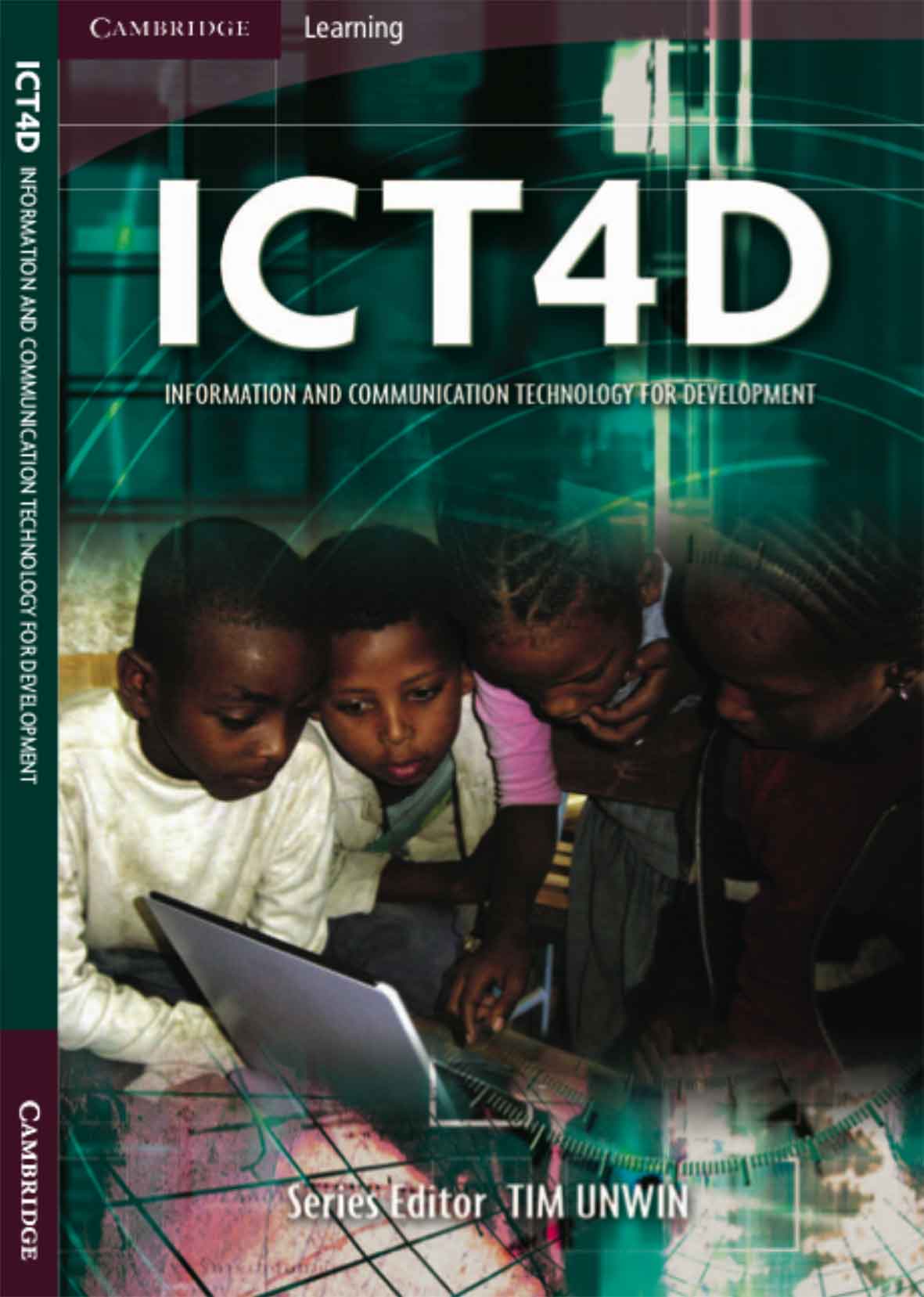
ICT4D BookFor those who cannot afford the (low) price of my edited ICT4D book (published by CUP in 2009), the first chapter as well as the contents page and index can be accessed from Amazon.com!

A summary of the contents is as follows:

  1. Introduction
  2. Development agendas and the place of ICTs
  3. Information and communication in development practices
  4. The technologies: identifying appropriate solutions for development needs
  5. ICT4D implementation: policies and partnerships
  6. ICTs, enterprise and development (Michael Best and Charles Kenny)
  7. ICTs in education: catalyst for development (Michelle Selinger)
  8. e-Health: information and communication technologies for health (Yunkap Kwankam, Ariel Pablos-Mendez and Misha Kay)
  9. e-Government and e-governance (James Guida and Martin Crow)
  10. Information and communication technologies for rural development (Bob Day and Peter Greenwood)
  11. Conclusions

The book itself can readily be ordered directly from Cambridge University Press.

Reviews include:

Leave a comment

Filed under ICT4D

IPID Annual Conference at UPC Barcelona

The International Network for Postgraduate Students working in ICT4D (IPID) is currently (9th-10th September 2010) holding its 5th annual conference at the Universitat Politècnica de Catalunya in Barcelona. A wealth of current postgraduate research in ICT4D is being presented around the following themes:

  • gender
  • e-agriculture
  • rural communities
  • online communities
  • e-government
  • technology
  • ICT in education
  • e-health
  • entrepreneurship
  • networks

The conference is being broadcast live at http://www.canalupc.tv/media/simposium-upc-uoc .

Ismael Peña Lopez’s comprehensive blog on the conference.

Leave a comment

Filed under ICT4D, ICT4D conferences

Reflections on the Internet and Development

Just finished writing a chapter about the Internet and Development, and am surprised at the vehemence of my own conclusions:

In conclusion…

Three important and inter-related conclusions can be drawn from this short overview of research on the Internet and development.  First, it must be remembered that the Internet is but one of a number of new digital ICTs.  Whilst many have given it predominance, “Internet use has spread much less rapidly in low-income countries than other ICTs – notably broadcast radio … and television and, more recently, mobile telephony” (Souter 2007: 33).  As Souter (2007: 33) goes on to emphasise, ultimately “the potential of the Internet can only be achieved if effective access is available”, and this requires the availability of the ICT infrastructure and reliable electricity at an affordable price for the poor, and that it provides relevant information that is not available more cheaply through other means.  If the world’s poor are truly to benefit from the Internet, then far more attention needs to be paid explicitly to ways in which they can indeed use it to their real advantage, thereby enabling them to benefit at the expense of the world’s rich. Only then will relative poverty be reduced.

Second, the success of the Internet in delivering development objectives depends very much on how such objectives are defined.  Much research and practice has focused on the hegemonic notion that development is about economic growth, and there are convincing arguments that the Internet can indeed contribute to such an objective.  However, even here, it is evident that the presence of the Internet alone will not in most instances contribute to the economic well-being of the poorest and most marginalised. From a relativist perspective, focusing particularly on social equality, the evidence is far more uncertain.  Numerous studies (Huyer and Hafkin 2007), for example, show how women in patriarchal societies are increasingly marginalised by their exclusion from access to the Internet.  Likewise, if development is seen as being concerned with freedoms, then the ambivalent character of the technology of the Internet is once more revealed.

A final important characteristic of the Internet in the context of development has been its dehumanising and alienating effects.  Just as factory production in the 19th century made humans appendages of machines (Lukács 1923), so too in the 21st century has the Internet made people ever more the appendages of computers.  In so doing, users are becoming further alienated from the physical world of nature and creativity, and ever more constrained by those who design the virtual realities of which we are now part.  What is remarkable about this is that in the name of progress, such virtual worlds are accepted and applauded as being ‘good’ and where the future lies (Carr 2008). Such arguments need to be strongly countered if we are to retain the very essence of what makes us human.  By enabling people to work away from their offices, by dramatically reducing the constraints of time and space on production, consumption and exchange, the Internet has enabled owners of capital to exploit their workforces far more efficiently and effectively than ever before, whilst at the same time making them think that they are enjoying it.  Imagine a world where one was not expected to answer the hundred or so e-mails that arrive every day, and where one actually had time to think, be creative and enjoy the physical experience of being human!  Paradoxically, the poor and marginalised, those without access to the Internet, may ultimately actually be very much richer than the bankers, traders and business executives who have become the new proletariat of the digital age, quite simply because the poor without access to the Internet are not bound by its dehumanising, unspoken and constraining rules.”

I guess it is now time for me to take a digital break!

1 Comment

Filed under ICT4D

ICTs and Urban Micro-enterprises in Mumbai

P.Vigneswara Ilvarasan and Mark Levy have just made available the final report from their exciting and innovative IDRC funded research on the use of ICTs by urban micro-enterprises in Mumbai, employing fewer than 20 hired workers.  This is one of the most important analyses of ICTs and entrepreneurs that I have recently read.  The methodology is much more rigorous than that of most research in the field of ICT4D, which means that considerable credence can be placed on the reliability of the results. Some 329 male owners or managers of micro-enterprises, and 231 female owners were interviewed between April and June 2009, and a further 102 men and women were surveyed in September and November 2009.

Whilst I might have some quibbles over definitions – surely in general usage, the term micro-enterprise is used to refer to much smaller units than those employing 20 people – this is a really excellent piece of research that deserves widespread citation.  Its key findings are:

  • “Nearly everyone who owned or managed a microenterprise—regardless of sex—had a mobile phone.
  • Many female and male microentrepreneurs who owned or managed microenterprises and who used a mobile for business communication reported that the year-over-year income of their business had risen.
  • Urban microentrepreneurs experience different levels of economic growth depending on how they use their mobiles for business communication.
  • The positive impact of mobile phones on microenterprises might emerge only after two years of use. Microentrepreneurs who owned a mobile for two years or less saw some growth in business income; those who had begun to use their mobile more than two years earlier experienced even greater income growth.
  • Levels of PC ownership and usage at home and work were low.
  • Few microentrepreneurs frequented Internet cafés for business purposes.
  • Only small numbers used their mobiles for the full range of business-enhancing activities.
  • Consideration of a microentrepreneur’s full repertoire of ICT use showed a positive relationship with microenterprise growth, especially when other factors such as gender and motivation were also taken into account.
  • Compared to women-owned microenterprises, microenterprises owned or managed by men had much greater increases in business income, although female owned microenterprises also experience some growth
  • The more positive a female microentrepreneur felt about her status and power because of her business, the more she was motivated to use ICTs in support of her business.
  • The more that a woman entrepreneur used mobile phones, workplace computers, etc., the more her microenterprise grew, especially businesses in the trade sector of the informal economy.”

Thanks Vignesh and Mark for enriching us with this important study.

2 Comments

Filed under Entrepreneurship, ICT4D

Glitch with using Google Mail View – be warned!

Wow – managed to track down an elusive error!  Has anyone else come across this glitch? Guess they must have….

A colleague was transferring data from a large number of .doc forms completed in Microsoft Word into an Excel spreadsheet, and instead of downloading the .doc files, simply opened them in Google Mail’s View function.  However, the data ‘appeared’ different to what was shown when the files were downloaded and opened in Word – so, most of the figures incorporated into the spreadsheet were actually wrong.  Basically, Google View represented the figures  incorrectly.

The problem seems to have been because the forms on the original .doc documents had been completed using drop-down menus, and therefore that the View function did not pick these up correctly.  There was no way of knowing that the figures were wrong, unless the original files were actually opened and checked.  I wonder how many other people have therefore incorporated incorrect data into their work as a result of this glitch?

So, don’t rely on Google Mail’s View function if your document includes such things as drop-down menus!  Just wondering, is this actually a subtle way of Google trying to undermine Microsoft?

1 Comment

Filed under ICT4D

UK Government switches off child database

I have previously raised concerns about the creation of the national ContactPoint database of all children that was put in place in 2009. I’m therefore delighted to note that this is to be shut down.

The BBC  reports that the “£235m government database containing the records of England’s 11 million children has been switched off. … Within two months of the switch-off all the data collected for the system is to be destroyed, although the information will still remain in the social services, education and health departments it had been gathered from. But there have been concerns that there is nothing collating key information centrally in one place. The system, which has been running since January last year, was always controversial and was set to cost a further £41m a year. After successive delays, it was rolled out to only 15,000 users, out of the initial target of 330,000. The system was used by doctors, social workers, schools, charities and other individuals involved in the protection of children. Many said it was useful in tracking children and discovering the truth about the way they are cared for. …  But civil liberties groups criticised it as intrusive and disproportionate.”

While it is of course crucial that we find ways to try to ensure that all those seeking to support “children at risk” can share information efficiently, the creation of a national database of information about all children raised huge ethical issues.  Whilst it seems that the reason for the closure of ContactPoint was largely on cost grounds, it is good to see that this represents at least a small step back from the excessive use of ICTs by the UK state to maintain databases of information so that it can more effectively monitor and control the country’s population.

Leave a comment

Filed under Ethics, ICT4D, UK

Google waves goodbye to Wave

So perhaps Google is not so all-seeing and all-wise after all.  After a year of dismal take-up, Google has decided to stop developing Wave as a stand-alone product according to Urs Hölzle (Senior VP Operations and Google Fellow) in an update on Google’s official blog on 4th August 2010.

Wave was launched in 2009 with a great fanfare – and was described by Google at the time as “how e-mail would look if it were invented today”.  In essence, it combined e-mails with instant messaging and features to allow people to collaborate in real time on documents.

However according to Urs Hölzle on Google’s blog, “Wave has not seen the user adoption we would have liked. We don’t plan to continue developing Wave as a standalone product, but we will maintain the site at least through the end of the year and extend the technology for use in other Google projects”

For other reports:

  • BBC Report on 5th August 2010

Leave a comment

Filed under ICT4D

ICTs and Special Educational Needs in Ghana

Godfred Bonnah Nkansah and I are delighted that our paper on the contribution of ICTs to the delivery of special educational needs in Ghana has just been published in Information Technology for Development, 16(3), 2010, 191-211. The paper not only provides rich empirical evidence of the usage and potential of ICTs in the special educational needs sector in Ghana, but also argues strongly that much more attention should be paid to the positive benefits that ICTs can bring to the lives of people with disabilities across Africa.

Abstract
This paper explores three main issues in the context of Ghana: constraints on the delivery of effective special educational needs (SEN); the range of information and communication technologies (ICT)-based needs identified by teachers, pupils and organizations involved in the delivery of SEN; and existing practices in the use of ICTs in SEN in the country. It concludes that people with disabilities continue to be highly marginalized, both in terms of policy and practice. Those involved in delivering SEN nevertheless recognize that ICTs can indeed contribute significantly to the learning processes of people with disabilities. Governments across Africa must take positive action to ensure that such experience with ICTs can be used to enable those with SEN to achieve their their full potential, whether in special schools or included within mainstream education.

For media comments on this research see:

  • The Commonwealth Secretariat News

2 Comments

Filed under Accessibility, Africa, Education, Ethics, ICT4D