Very many thanks to Caitlin, Ati, Ben and Ettie for all of their help in packing the delegate bags for ICTD2010 this morning! Given the larger than expected numbers attending, not all delegates will be able to have the full suite of sponsor materials in their bags, but the first 550 delegates to collect bags will indeed have a bag, hard copy programme and digital card with the papers, programme and session materials on it!
Category Archives: ICT4D
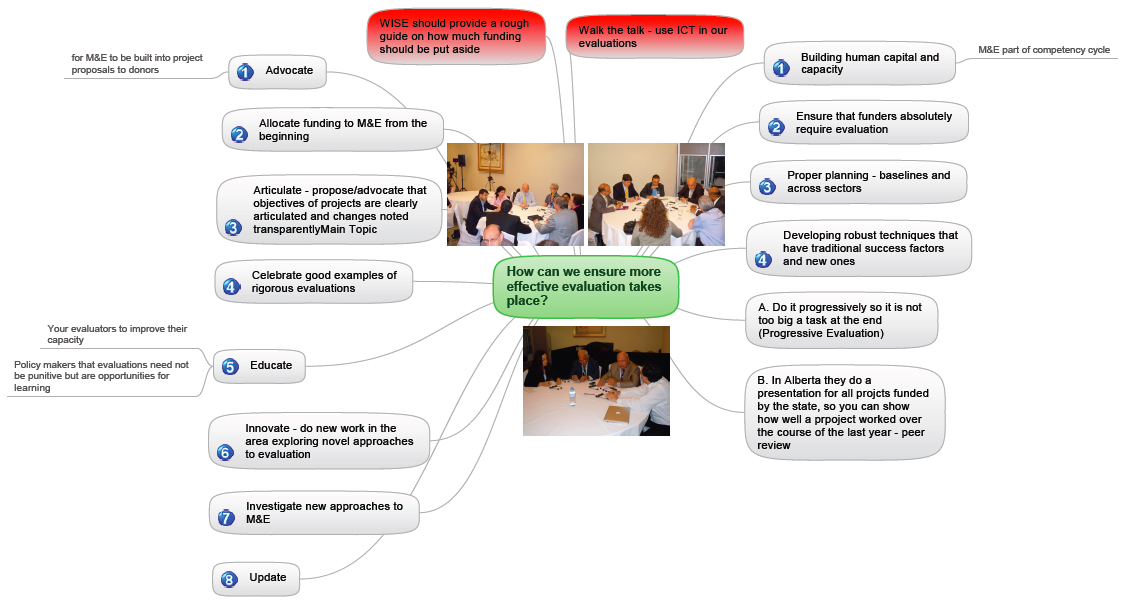
Monitoring and Evaluation of ICT in Education initiatives: reflections from WISE
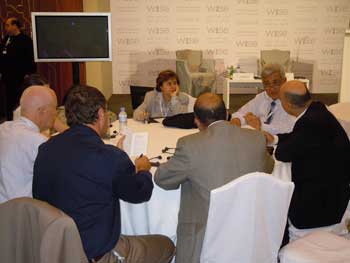 The second WISE (World Innovation Summit for Education) summit provided an opportunity for colleagues from Education Impact to host a lively and highly participatory workshop designed to contribute to more effective monitoring and evaluation of ICT in education activities, focusing particularly on developing countries.
It was premised on two assumptions:
- that there is too little monitoring and evaluation of ICT for education initiatives, and much of what is undertaken is of poor quality; and
- that it is important to differentiate between monitoring (the process of continuing self-reflection within organisations and individuals aimed at improving their performance) and evaluation (the review of outcomes against targets, often undertaken by external agencies)
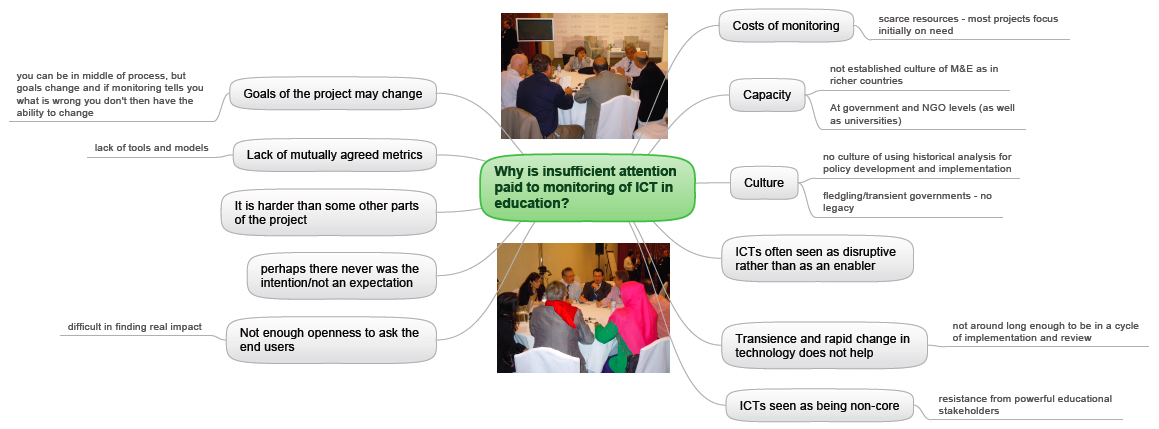
The workshop began by identifying the reasons why there is so little effective monitoring
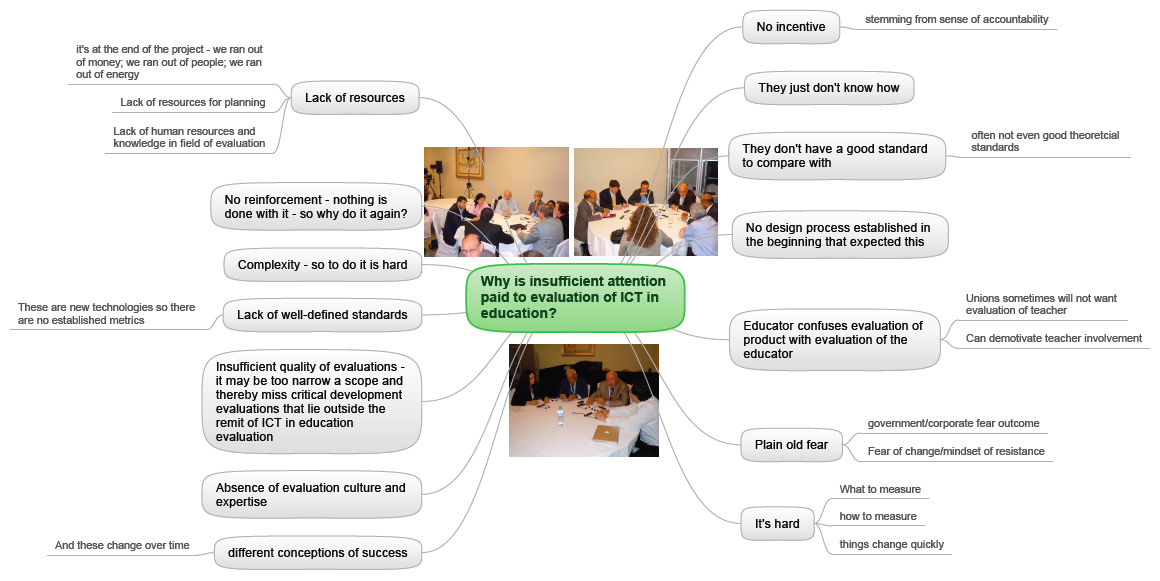
and then why there is so little good and effective evaluation
This was then followed by a discussion of how we can ensure better monitoring

and the things that need to be put in place to ensure better evaluation.
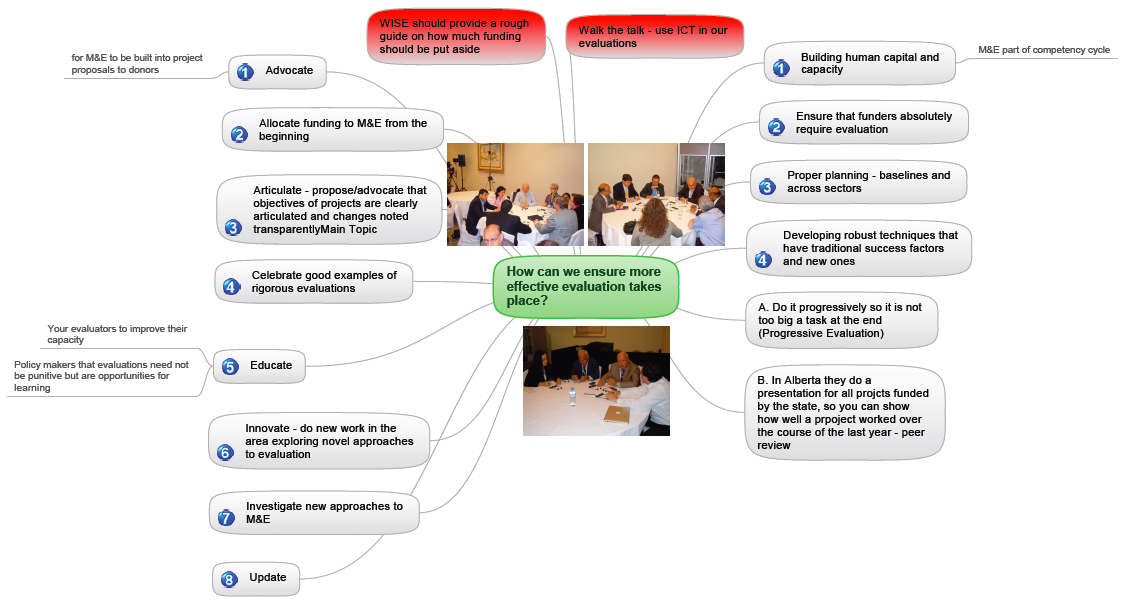
Clicking on the above mind-maps enables them to be viewed at full size!
ICTs, citizens and the state: moral philosophy and development practices
Great to see my latest paper just published in The Electronic Journal on Information Systems in Developing Countries – thanks to Mark Levy and Vignesh Ilvarasan for all their editorial work on this.
The paper examines the moral implications of the use of ICTs in e-government initiatives, focusing especially on national databases, identity cards, and surveillance technologies. It suggests that in resolving debates over these, we need to reach ethical resolutions concerning notions of trust, privacy, and the law. It also draws attention to the ethical problems that emerge in linking the notion of of Universal Human Rights with the introduction of ICTs in developing countries.
As I argue in the paper, “The really difficult ethical questions that arise from this are about how we judge whether it is better for poor and marginalised communities for such egovernment initiatives to have been introduced, or whether they might actually be more advantaged if their governments did not spend vast sums of money on their implementation. Just because it is possible to implement national citizen databases, to use biodata for ID cards, and to introduce sophisticated digital surveillance mechanisms does not mean that it is right to do so”.
Filed under Development, Ethics, ICT4D
UNESCO publishes report on ICTS for people with disabilities
UNESCO has recently published a short report by a group of experts on “ICT for persons with disabilities“.
This presented the following recommendations to UNESCO for consideration:
“Making UNESCO ICT-accessible
The group of experts recommended that UNESCO should ensure overall accessibility of persons with disabilities. To achieve this goal the Organization should improve its online presence and the accessibility of its website. It should also create accessible physical environment, develop appropriate procurement and recruitment policies, and ensure training and retaining of the employees.
Mainstreaming ICT in inclusive education
UNESCO is encouraged to foster effective use of ICT that are accessible, adaptive and affordable for person with disabilities. Specific guidelines and tools are needed to teach persons with disabilities and to ensure that corresponding ICT competencies are embedded in initial teacher training.
Mobilizing resources and international cooperation
The experts stressed the importance of identifying arguments for shifts in policy practices and determining funding opportunities where UNESCO could get involved. It is important to cooperate with organizations of persons with disabilities in order to get the best possible input and to have credible action lines and projects for funding.
Creating an information and knowledge access ecosystem
This recommendation focuses on “touch points”, such as WorldWide Web, broadcasting, publishing, languages, etc., in the system in which people and humans interact with information and services. It also includes e-governance, which could be used to promote e-voting and e-democracy initiatives for citizen participation in an accessible way, as well increase participation in cultural activities.”
Filed under Accessibility, ICT4D
Reflections on Open Educational Quality Initiative discussions
The Open Educational Quality Initiative’s (OPAL) workshop at UNESCO in Paris on 8th and 9th November offered a valuable opportunity to explore a range of issues relating to how we can build on Open Educational Resources to encourage Open Educational Practices.
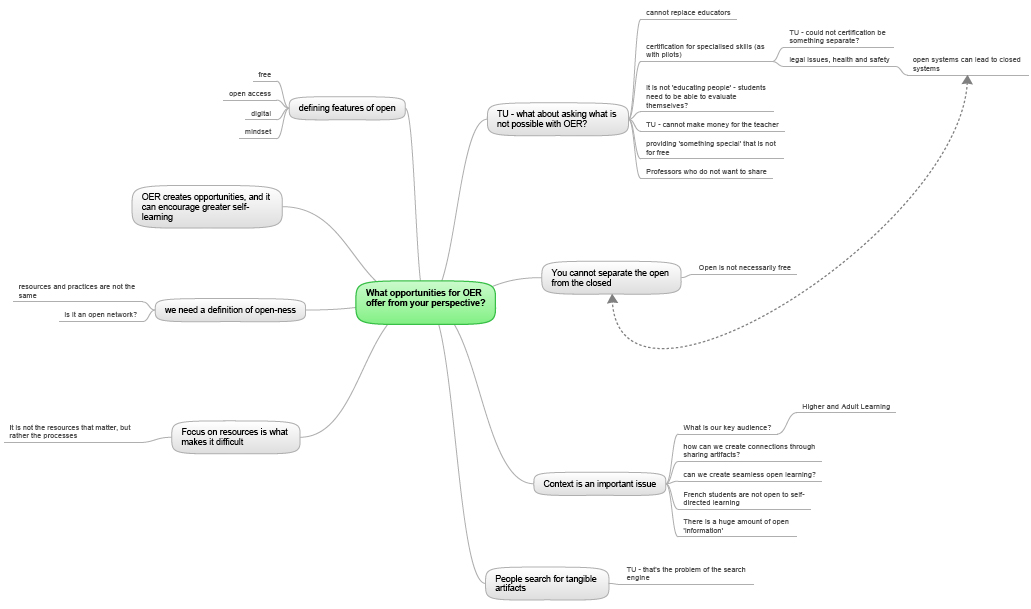
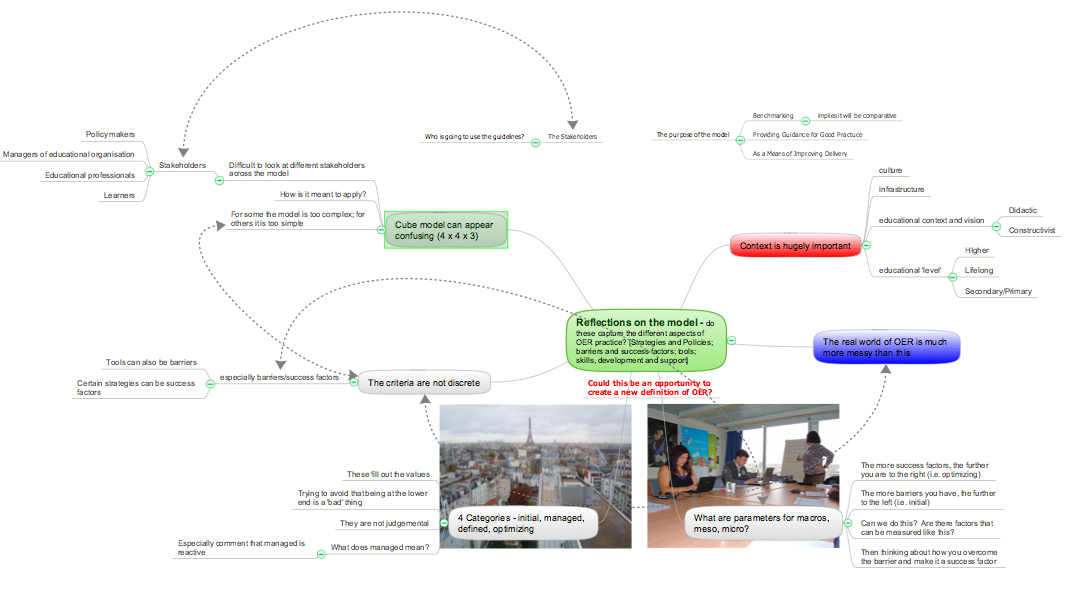
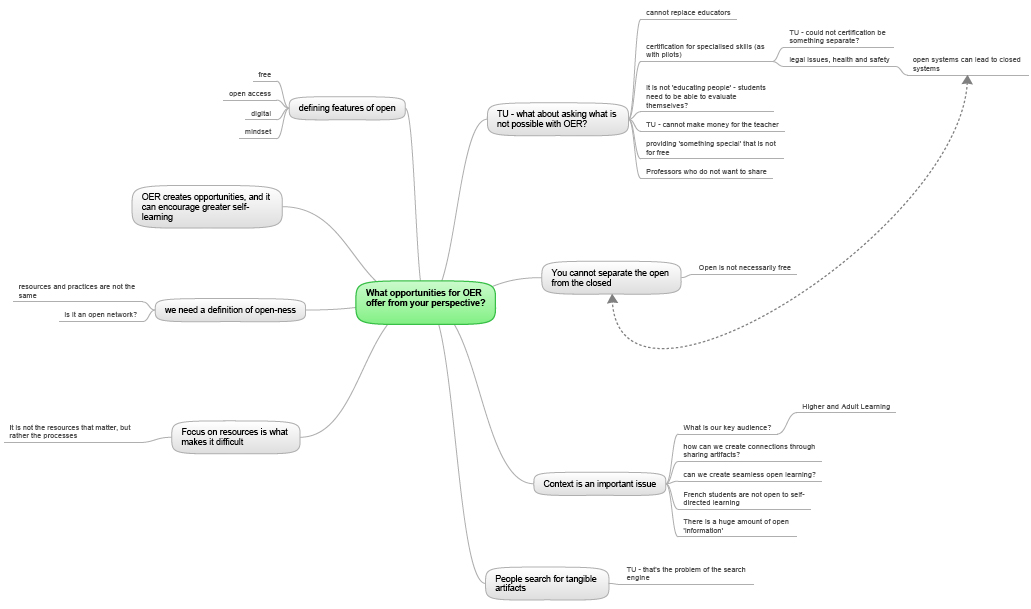
Below are the mind maps I constructed from our discussions on the following themes (click on the image to get higher resolution and larger versions!). Thanks to everyone who contributed to shaping my thoughts in these ways.
What are the main opportunities offered by Open Educational Resources?
What are the key challenges for preventing the implementation of the OPAL vision?
Reflections on the OPAL model – does it capture the different aspects of OER practices?
How can we best contribute?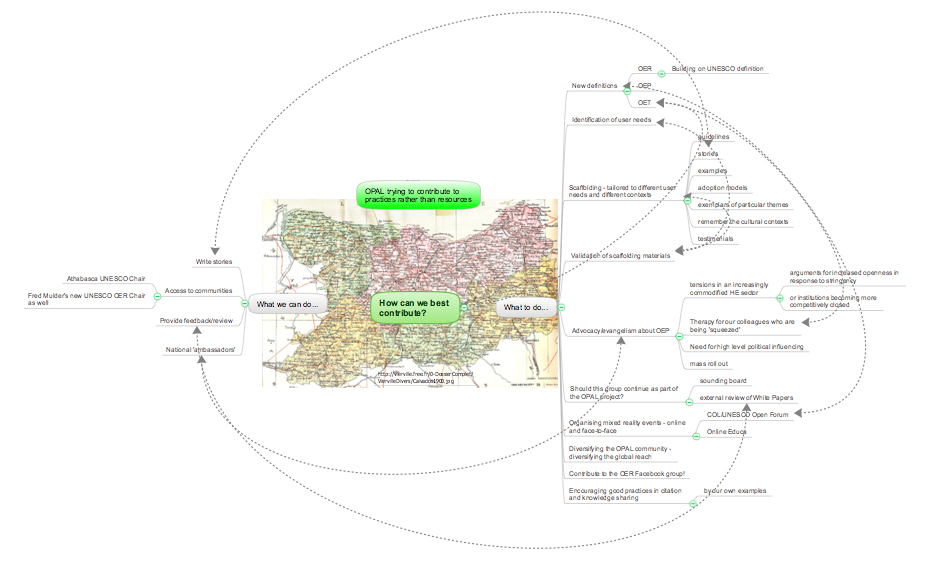
Thanks to everyone who put this interesting gathering together – especially Ulf and Gráinne. Everything can be followed up on the OPAL site and its Cloudworks environment.
Filed under Higher Education, ICT4D
Development as ‘economic growth’ or ‘poverty reduction’
 Will economic growth lead to poverty reduction? I believe passionately that the market will never serve the interests of the poorest and most marginalised. This seems to me to be so clear and obvious that it scarcely needs defending! However, I am becoming increasingly worried that such opinions are very much in the minority. The dominant, hegemonic view amongst most of those working in the field of development really does seem to be that economic growth will indeed eliminate poverty.
Following my recent keynote at m4Life on 28th October, at which I argued that we need to develop ways in which mobiles can be used to support marginalised groups, such as people with disabilities, I was very strongly challenged by an African colleague, whose views I respect. In essence, she accused me of being a typical western academic who does not really understand Africa, and that if I did I would know that most Africans wanted economic growth. By focusing on the poorest, she suggested that my views were tantamount to arguing that Africans should remain poor. I felt deeply hurt by these accusations, and am still smarting from their vehemence some two weeks later! I actually don’t know why, they hurt so much, but perhaps it is because I have elsewhere argued strongly that Africa is indeed rich, and that we need to help build on its richness rather than always describing it as being poor! The irony is that the paper I have written on this has continually been rejected by academic journals – quite possibly because it too does not conform to accepted dogma!
I clearly need to learn to express my arguments more convincingly. This is a brief attempt to do so in the form of some basic principles:
- The potential for inequality to increase is inherent within all economic growth.
- Economic growth, defined in absolute terms, cannot therefore eliminate poverty (see my critique of Jeffrey Sachs, for example, in ‘No end to poverty’)
- If economic growth proceeds unchecked, it will inevitably lead to increased inequality that will ultimately fuel social and political unrest at a range of scale
- A fundamental role of states is thus to intervene in the market to ensure that the poorest and most marginalised are not excessively disadvantaged.
- Given that the market serves the interests of the majority of people, it is incumbent on those who care about reducing inequalities specifically also to address the needs and interests of the poor.
- Such an argument can be justified both on moral grounds (that it is just), and also on socio-political grounds (to reduce potential violence)
- With reference to mobile technologies, therefore, all I was doing in my keynote was to argue that companies, entrepreneurs, app developers, and all those claiming to use ‘mobiles for development’ should seek to address the needs of the poor and marginalised, alongside those of global corporations and their shareholders.
- This is premised upon a belief that ‘development’ is about rather more than just economic growth, and includes notions of equality of opportunity and social justice.
These arguments are developed more fully in:
- Godfred Bonnah Nkansah and Tim Unwin (2010) The contribution of ICTs to the delivery of Special Educational Needs in Ghana: practices and potential, Journal of Information Technology for Development, 16(3), 191-211
- Tim Unwin (ed.) (2009) ICT4D, Cambridge: Cambridge University Press.
- Tim Unwin (2007) No end to poverty, Journal of Development Studies, 45(3), 929-953
- Tim Unwin (2004) Beyond budgetary support: pro-poor development agendas for Africa, Third World Quarterly, 25(8), 1501-1523
Filed under Africa, Development, Ethics, ICT4D, Photographs
Watching the watchers watching…
 In recent months I seem to have posted several photos of ongoing surveillance, generally by people acting on behalf of the state. Perhaps I should start a collection of these! So, here is another one (Camden CCTV again) patrolling the streets near Euston. I wonder how much footage they take and what they do with the images.
This is what Camden Council’s website has to say on this under the heading of “enforcement”: “We have responsibility for the enforcement of the borough’s parking and moving traffic regulations and this is carried out by Civil Enforcement Officers (CEOs) (formerly known as Parking Attendants) and through the use of CCTV. The scheme is part of the Association of London Government’s (ALG), the Mayor of London and London Borough of Camden’s commitment to the travelling public to keep London moving and ease congestion.”
What an amazing upgrade, Parking Attendants can now be confused with Chief Executive Officers!
Camden’s more detailed account goes on to say that this is done:
- “to stop traffic congestion
- alienate inconsiderate motorists
- free up the bus lane to combat delays for commuters
- to allow the free flow of traffic
- improve journey times for bus users”
Am I the only one who finds words such as “enforcement”, “alienate” and “combat” just a tiny bit worrying? So, let’s keep watching the watchers…
Filed under Ethics, Photographs, UK
UK government set to re-examine Google’s infringements of privacy
Great to see the announcement reported by the BBC that Britain’s privacy watchdog is to re-examine the personal information that Google has gathered from private wi-fi networks.
As the BBC article commented, “The Information Commissioner’s Office had investigated a sample earlier this year after it was revealed that Google had collected personal data during its Street View project. At the time, it said no “significant” personal details were collected. But Google has since admitted that e-mails and passwords were copied. … Google’s admission of more detailed data has prompted further action by the ICO. “We will be making enquires to see whether this information relates to the data inadvertently captured in the UK, before deciding on the necessary course of action, including a consideration of the need to use our enforcement powers,” a spokesman said. Google’s director of privacy Alma Whitten said the company would work with the ICO to answer its “further questions and concerns”.”
ICT4D Partnerships
 I cannot resist the fun of trying to express ICT4D ideas in different ways, and always enjoy playing with tag clouds when I am writing. An excuse to revisit the chapter on partnerships in my recent edited book on Information and Communication Technologies for Development, led me to generate this cloud. I just thought I would share it as a summary statement of my thoughts on the subject of ICT4D policy and partnership! Thanks to TagCrowd for the crunching!
Filed under ICT4D
Many popular Android apps share location and unique identifiers with advertisers
A recent report on the BBC website notes a study by researchers from Intel Labs, Penn State and Duke University which shows that “Some of the most popular apps written for Google’s Android phones do not tell users what is done with data they gather… . Half of 30 applications studied share location information and unique identifiers with advertisers”. Two-thirds of these popular third-party apps showed suspicious handling of personal data.
Information from the ‘phones was sent to advertisers without the users being told that data was being shared with them. As the BBC report goes on to note, “Some apps gathered and despatched location information even when an application was not running and some sent updates every 30 seconds.”
Whilst users should always be wary of downloading any apps that they do not necessarily trust, this seems to be yet another example of Google not being the fully trustworthy company that it would like people to believe it is. It would be a relatively simple matter to ensure that all users are automatically warned about this when software is downloaded. As the researchers conclude, “Android’s coarse-grained access control provides insufficient protection against third-party applications seeking to collect sensitive data”.
This is definitely a powerful reason why Android ‘phones should be avoided, and once again raises serious concerns about Google’s lack of ethical probity.


 Tim Unwin's Blog