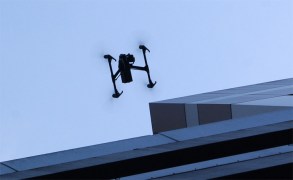
 The arrival of relatively cheap drones (or unmanned aerial vehicles, UAVs) that can be purchased and used by people other than the military and civilian “authorities” raises fundamental questions about privacy and security. To be sure, there is good evidence of the positive role that drones can play, particularly in providing humanitarian assistance, and in delivering supplies to remote regions, but insufficient attention is paid to their darker side. Increasingly, countries such as the UK are wisely seeking to control the use of drones near airports (see for example Civil Aviation Authority) and no fly zones are being created in sensitive areas (see noflydrones and the UK Air Navigation Order, CAP393). However, much less attention is paid to the implications of the use of drones for photographing or tracking individuals without their knowledge or permission. This is especially so when drones are used by those with malicious intent to monitor or photograph people’s activities in their homes or on their properties. In particular their use by burglars to scope properties is becoming increasingly common, and of growing concern to the police (The Guardian, 3rd April 2017).
One fundamental question that requires resolution is why, if people are allowed to fly drones over someone’s property, that person is not permitted to “take down” the drones? There seems to be a fundamental and unfair asymmetry here.
Broadly speaking there are three main ways through which drones can be taken down:
- by shooting them out of the sky with small missiles or guns;
- by catching them using larger, more powerful drones with nets; or
- by hacking their control software.
The first of these is problematic for most people, is probably illegal (except when used by the military and police), and could cause collateral injury to others. The second is undoubtedly feasible, and examples such as Delft Dynamic’s Dronecatcher, and the Tokyo police’s use of nets to catch suspicious looking drones, are becoming increasingly widespread. One of the best defences against unwanted drones is simply to use a more powerful drone fitted with a net to take them down.
Many drones, though, are susceptible to relatively simple hacking that takes advantage of insecurities in the wireless connections between users and their drones. The following articles present interesting advice for those wishing to hack drones and retain their privacy in the face of increasing drone surveillance:
- Nils Rodday, “Hacking a Professional Drone” (RSA Conference, 2016)
- Sander Walters, “How can drones be hacked? The updated list of vulnerable drones & attack tools” (2016)
- Wang Wei, “You can hijack nearly any drone mid-flight using this tiny gadget” (Hacker News, 2016)
- Dan Goodin, “There’s a new way to take down drones, and it doesn’t involve shotguns” (Arstechnica, 2016)
- April Glaser, “The US government showed just how easy it is to hack drones made by Parrot, DBPower, and Cheerson” (Recode, 2017)
- Pierluigi Paganini, “How to hack drones with just a $40 hardware from 2 km away” (Security Affairs, 2016)
- Kelsey Atherton, “This DIY device lets you hi-jack drones in mid-air” (Popular Science, 2016)
- Phil Sneiderman, “Here’s how easy it is to hack a drone and crash it” (Futurity, 2016)
- Ed Darack, “Drone hacking made easy” (Airspacemag, 2016)
Do please suggest additional resources of interest to those seeking to hack drones.
For those interested in the frightening potential for drones to be used as autonomous devices in warfare, this video produced to encourage the banning of autonomous lethal weapons is an absolute “must watch”. Much of this technology is already in existence, and being used to target and kill people who are deemed by the killer (currently most frequently a powerful state) to be undesirable. It is not difficult to envisage their widespread use, not only in warfare, in the future. All those responsible for developing such technologies have a responsibility to ensure that they are only used for good applications.
A more recent update, focusing mainly on “weapons” that can be fired to bring down drones with nets was published by the BBC in October 2018.
 I was re-reading the introductory chapter of my
 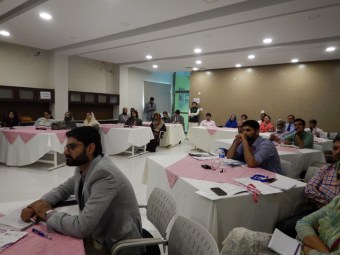 It was great to be back in Islamabad to participate in the second two-day workshop organised by the
  Understanding the ICT4D landscape, in which the main speaker was Dr. Ismail Shah, the Chairman of the
  Serving the most marginalised: accessibility and disability, with a plenary by
  Full details of the event can be found on the
  I am delighted to see my chapter on ICTs, sustainability and development just published in the ITU’s new book on
 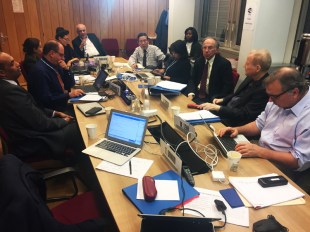 It is the first time I have actually worked on such a collectively authored project, and its publication says much about the willingness of all involved to collaborate supportively together under the leadership of Ahmed and Bill Lehr, who was later brought on board to co-edit the book. Each of us took the lead on a single chapter, but everyone contributed to the ideas contained within the book. The process of negotiation and discussion around the concepts and ideas within each chapter was fascinating, especially since it required us to hone our arguments very finely and precisely. Most of the contributors were economists, and although at times I struggled with accepting some of their arguments, I know that their contributions very much improved the chapter on which I led. Moreover, I am very grateful to Ahmed as editor, for letting me write what I did, since it enabled me to craft my most critical piece of work on the sustainability of the ICT sector.
 The second chapter (on which I led) examines the interface between ICTs and sustainability, especially focusing on environmental issues and the conditions that need to be in place for ICT initiatives to be sustainable socially and economically. It focuses specifically on the importance of universal infrastructure, the affordability of technologies, the need for appropriate skills and awareness, and the importance of locally relevant content. For these to be delivered, the chapter emphasises that those who develop policies and implement programmes and projects to use ICTs to promote sustainable development need to address issues of empowerment, focus on the needs of the poorest, develop innovative technological solutions and new business models, legislate new kinds of regulation through which governments facilitate the ICT and telecommunication sector, and ensure that there is effective security and resilience within the systems being developed. The chapter concludes with a brief analysis of the role of multi-stakeholder partnerships in implementing such initiatives.
 I recall a wonderful conversation a couple of years ago with a Maasai chief in Tanzania. He was speaking with a group of techies about the use of mobile devices, and they were trying to persuade him of the value of mobile phones, even just to call his friends in a village the other side of the hills. He, wisely, remained unconvinced. For him, walking across the hills, enjoying the landscape, spending time experiencing the physicality of nature, and just thinking about life, were a crucial part of going to, and speaking with, his friend in the next village.
 ICTs will never deliver on reducing inequalities in the world unless there is a fundamental sea-change in the attitudes of those leading the global private sector corporations that currently shape the world of the Internet. It is perfectly logical for them to sign up to the SDGs formulated by the UN system, and to seek to show that expanding their digital empires will necessarily deliver the SDGs. This is a powerful additional weapon in their armoury of market expansion and profit generation. The problem is that these agendas will continue to increase inequality, and as yet remarkably little attention has been paid to how ICTs might actually help deliver SDG10. Until corporations and governments really treat the link between ICTs and inequality seriously, peoples of the world will become every more divided, and if poverty is defined in a relative sense then poverty will actually increase rather than decrease as a result of roll out of the Internet.

 Tim Unwin's Blog