
I have long been troubled by the widely accepted and increasingly used terms Global South and Global North.[i] Those who wish to use them for political purposes or to highlight the factors that they claim cause inequalities across the world will of course continue doing so, but there are at least six main reasons why I find it a misleading and problematic choice of terminology. I list these below just to help explain why I don’t uses these terms, and I hope my comments may also encourage others to do likewise.
- Above all, the use of such terminology implies some kind of spatial causality, usually around the idea of the North exploiting the South in the present and/or the past. This strikes me as being surprisingly similar to the now widely discredited notion of environmental determinism, advocated by the likes of Ellsworth Huntington and Ellen Churchill Semple in the late 19th and early 20th centuries (for a wider discussion, see my The Place of Geography, 1992). There is not something universal about living in the North (whatever that means), or about the North itself that makes it inherently more powerful and dominant than the South.[ii]
- I remain confused about why the word “Global” is at all necessary. What does it add? In 1980, the Brandt Report entitled North-South: a Programme for Survival, managed to convey very similar meaning, but much more succinctly,[iii] and indeed also drew a much more nuanced wavy line between the two regions. To be sure, there are those who want to use the term global to represent some kind of global solidarity, especially in the South, but this is more aspirational than real (see also comments on relative usage of the terms below)
- In an absolute global sense, the geographical north is the northern hemisphere, and the south the southern hemisphere. Yet, there are problems with such usage to refer to per capita economic wealth and human well-being. It is often forgotten that the South Asian countries of Bangladesh, India, Pakistan and Sri Lanka, for example, are all in the northern hemisphere. Likewise, many more African countries are in the northern hemisphere than are in the southern.[iv] The rich countries of Australia and New Zealand are in contrast in the southern hemisphere.
- There is also much economic poverty in the northern hemisphere and much richness in the southern. If large absolute regions are being considered it is in some ways more accurate to consider the Tropics (between the Tropic of Cancer and the Tropic of Capricorn) as being economically poorer/more exploited than either of the areas to the north and the south. Such suggestions, though are dangerously close once again to falling down the slippery slope of environmental determinism.
- North and South can also, though, be interpreted in a relative sense. Given that only 10-12% of the world’s population actually lives in the Southern Hemisphere, this relative approach is certainly a more realistic one to trying to grapple with the differences between states. It is nevertheless also problematic as a framework for explaining wealth differences (or indeed most other differences).
- Countries or regions further north are sometimes poorer in per capita wealth then those further south and vice versa. Canada’s per capita income is less than that of the USA; Mozambique and Angola are poorer than South Africa. In the UK, the widely used term North-South divide actually refers to a poorer northern region and a richer southern one.
- I’m afraid that the argument that I sometimes hear that the use of the terms is only an approximation and simplification and it doesn’t really matter if they are inaccurate holds no water with me. Using such terms reinforces inaccurate understandings of cartography and geodesy, and supports looseness of meaning and language. I wonder how many people, for example consider that India is in the Global South, and thus think it is also in the southern hemisphere? Moreover, all too frequently we read or hear comments such as “The Global North generally correlates with the Western world”.[v] If that is the case, surely “Western” would be a better term to use than Northern. But we need to remember then that everywhere Western is west of some East.
- A significant problem is therefore that seeking to carve the world up into binary divisions is overly simplistic and usually harmful, for all but those who persist in using or imposing them. There are enormous differences between the continents and countries within both the so-called Global South and the Global North, and it is this rich diversity that we must cherish in multi-layered ways and understandings. Those who seek to impose an ill-fitting binary distinction generally do so in their own interests. Sometimes this is for the sake of simplicity, but as the above brief comments highlight such simplicity can be very misleading. At other times it has just become a lazy shorthand. As that well known “source of all knowledge” tells us “The Global South is a term generally used to identify countries in the regions of Latin America, Africa, Asia and Oceania”.[vi] Well, why not instead just use the actual geographical names Latin America, Africa, Asia and Oceania? This source goes on to comment that “Most of humanity resides in the Global South”.[vii] It is interesting to ponder what this actually means. As noted above this is certainly not true if South here is referring to the Southern Hemisphere.
In brief, this is a call for meaning, clarity and precision. If we mean that techno-capitalism domiciled in the states of the USA, Canada, the countries of Europe, the Gulf and Australia/New Zealand increasingly controls and exploits the rest of the world then let’s say so rather than couching our language in a mealy mouthed meaningless “geographical” distinction between North and South. But even this is an over-simplification of a different kind. What about China and indeed Russia? Those who really believe that there is something about being “Northern” that makes people dominant, aggressive and exploitative, and something about being “Southern” that makes them ripe for exploitation, believe on. But such dreams will not improve the lives of the world’s poorest and most marginalized wherever they are found. It is indeed a great disservice to the many rich indigenous cultures, traditions, livelihoods, and social formations to be found in Latin America, the Caribbean, Africa, Asia and the Pacific. We must always ask ourselves in whose interest words are used. Who benefits most from the use of the terms Global North and Global South?
[i] Apparently first used by Carl Oglesby in 1969 in “Vietnamism has failed … The revolution can only be mauled, not defeated”. Commonweal, 90.
[ii] Despite this notion having been long discredited, I do think it is time that the environmental factors influencing human behaviour are revisited in a more sensitive and sensible way by geographers. The influence of day and night length variations on cultural behaviours in high latitudes is, for example, a fascinating topic of enquiry.
[iii] Two words rather than four; Brandt, W. (1980) North-South: a Programme for Wurvival; Report of the Independent Commission on International Development Issues, Cambridge, Mass.: MIT Press.
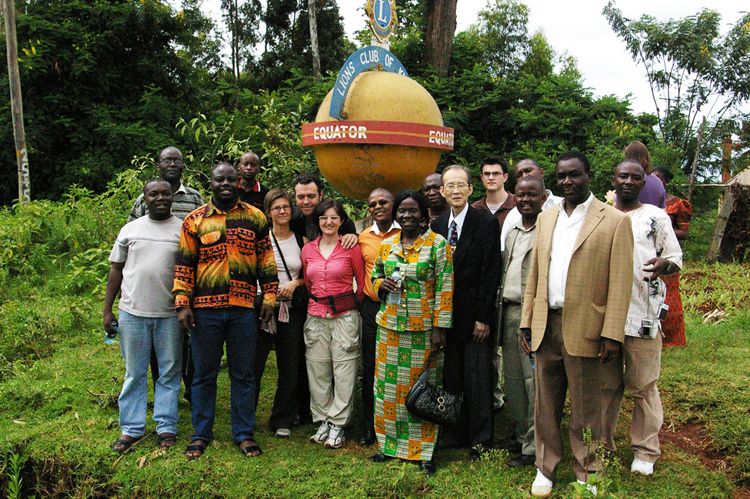
[iv] The equator runs through southern Somalia, Kenya, Uganda, the Congos, and Gabon.
[v] From the widely used popular source of knowledge about everything, Wikipedia, https://en.wikipedia.org/wiki/Global_North_and_Global_South, 30 March 2023.
[vi] Wikipedia, https://en.wikipedia.org/wiki/Global_North_and_Global_South, 30 March 2023.
[vii] Wikipedia, https://en.wikipedia.org/wiki/Global_North_and_Global_South, 30 March 2023.
 It is much easier to enjoy change if you treat it in a positive way. Think about all the good things: no need to travel to work; spending time with those you love (hopefully); doing things at home that you have always wanted to! Treat the next few weeks or months as an opportunity to do new and exciting things. Discover your home again! (Although this highlights the huge challenges facing the homeless).
 If at all possible, it is absolutely essential to have separate sleeping and working places so that you remain sane. There is much evidence that trying to sleep in the same place in which you work can confuse the mind, and may tend to make it continue to work when you want to go to sleep – even subconsciously – rather than enabling you to rest. You are likely to be worried about the implications of Covid-19, and so it is essential that you do all you can to ensure a good night’s sleep. This may not be easy for many people, but you should still try not to work in your bedroom! And don’t continue working too late – give your body the time it needs to relax and rest.
 It is incredibly easy to put on weight when working at home, even if you think you are not doing so! This is bad for your health, and bad for morale. It’s easy to understand why this happens: many people commute to work, and even if not cycling, they walk from their transport node to their office; homes are smaller than offices, and so you generally walk more at work than at home; and often you will go out of the office during the daytime, perhaps for lunch, but you can’t do this if you are self-isolating. There are lots of things, though, that you can do to rectify this: walk up and down stairs several times a day (never take the lift); ensure that you go for a short walk every hour (even if it is just 20 times around your home); if you have some outdoor space, take up gardening (it uses lots of muscles you never thought you had!); and even if you don’t decide to buy a stationary bike (actually much cheaper than joining a gym), you can still exercise with a resistance band, or even use bags of sugar as weights!
 When you don’t have to catch public transport, or cycle/drive/walk to work it is terribly easy to be lazy, and let time slip by without focusing on the tasks in hand. Most people like to feel they have achieved something positive every day. One way to ensure this is to plan each day carefully. And don’t forget to give yourself treats when you have achieved something – whatever it is that you enjoy!
 This is closely linked to planning – but don’t just spend all your time relaxing, or doing nothing but work! It’s important to maintain diversity in life. If your boss expects you to work a 10 hour day, then make sure that you do (hopefully s/he won’t). But even then you have 14 hours each day to do other things (please try and get 7 hours of sleep – it will help to keep you fit and well)! I find that having a colour coded diary with a clear schedule helps me manage my life – even though I tend to work far too much! The trouble is I enjoy my work!
 Many people who now have to work at home because of Covid-19 will not have had much experience previously at doing this. It can come as a shock getting to see other aspects of a loved one’s life. Tensions are bound to arise, especially if you are trying to work when your children are at home because school has been closed. It can help to have a thorough and transparent discussion between all members of a household (including the children) to set some ground rules for how you are going to manage the next few weeks and months. This can indeed be challenging, and will frequently require revisiting, but having some shared expectations can help reduce the tensions that are bound to arise. Listening (however difficult it is) often helps to lower tension.
 The clothes we wear represent how we feel, but can also help shape those feelings. It is amazing what an effect it can have if you get dressed smartly when you are feeling low. Likewise, most people like to dress in more relaxed clothing when they stop working, and we don’t usually sleep in the same clothes that we have worn during the day. Just because you are working at home, doesn’t necessarily mean that you will work well in your pyjamas (and imagine if you are suddenly asked to join a conference call without time to change!). The simple message is that we should continue to take care of ourselves, just as if we were going out to work or to a party!
 Enjoy the physicality of life. Don’t always feel you have to be online in case “work” wants to get in touch. None of us are that important. The world will get by perfectly well without us! There is a lot of evidence that being online late at night can also disturb our sleep patterns. Remember that although we are increasingly being programmed to believe that digital technology gives us much more freedom in how we work, it is actually mainly used by the owners of capital further to exploit their workforces by making them work longer hours for no extra pay!
 Being self-isolated at home will mean that you have vastly more time on your hands than you can ever imagine (as long as you don’t work all day and night). Use it creatively to do something that you have always thought about doing, but never had the time before. Read those books that you always wanted to. Learn a musical instrument. Learn to speak a new language (Python or Mandarin). Take up painting. Discover how to cook delicious meals with limited resources. Photograph the wildlife in your garden. Grow your own vegetables. Make beer. Even just plan your next (or first) holiday.
 power of the computer (perhaps female) that is actually most valued. Moreover, the use of USB “sticks”, often phallic in shape, can be seen as a clear example of this male/female gendering associated with heterosexual sex. The use of such sticks to infect computers with viruses can also, for example, be likened to the spread of sexually transmitted diseases in humans. The shift away from the use of such male and female connectors to the increasingly common use of WiFi and Bluetooth can in turn perhaps be seen as one way through which this gendering might be being broken down, although much more research needs to be done to explore the gendering of all aspects of digital technologies.

 Tim Unwin's Blog