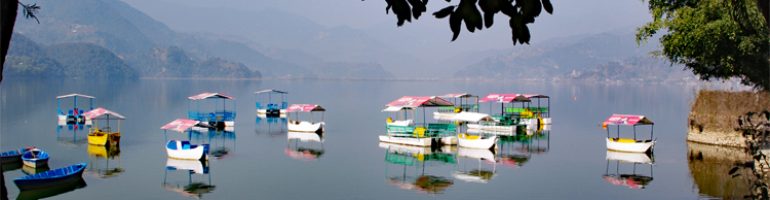
Working with my dear friend and colleague, Sudhir Wanmali, in what was then rural South Bihar (now Jharkhand) in the mid-1970s was one of the most influential times of my life. It taught me so much: that rural people are universally exploited by those living in urban areas; that rural life in South Asia is incredibly hard; and that South Bihar (as it was then known) is amazingly beautiful. I very much hope that the images below show something of that inspiration, but they cannot sufficiently capture the smells and sounds of rural life in India in the 1970s.
Category Archives: Photographs
Agriculture and rural life in South Bihar, 1976-1977
Filed under agriculture, India, Jharkhand, Photographs, Rural, South Bihar
Small towns and villages in South Bihar and West Bengal, 1976 and 1977
Continuing digitizing the slides from my research and travels in India in 1976 and 1977, I share here some pictures of small towns and villages in what was then South Bihar (now Jharkhand) and West Bengal. These include pictures of the towns of Chaibasa and Chakradharpur, as well as several villages in this beautiful part of India. I remember particularly the paintings on the walls of the houses in the villages, and some of the writing on them as well, not least the slogan “Fight for malaria”! The pictures here also show the sadness of smallpox, with the solitary gravestone, and also other such stones which I was told marked village boundaries. There are also images of tile and brick making, and the sequence closes with a village school, which I had forgotten about but now makes me think of all of the other schools, particularly in Africa, that I have visited in the last 15 or so years. Other rural, agricultural scenes will follow in a future post!
Filed under India, Photographs
Jamshedpur 1976-1977
Continuing my visual reflections of India in 1976 and 1977, I spent much of my time there based at the Xavier Labour Relations Institute in Jamshedpur, in what was then South Bihar, now Jharkhand. This was an amazing oasis of peace, calm and intellectual discourse, at the edge of the “steel town” of Jamshedpur. Interestingly, my photographs do not entirely capture my memories, but they do reflect the smart houses of the rich, the dominance of the Tata Iron and Steel Company (TISCO), the Jubilee Gardens park, the street stalls where I bought a copy of the Communist Manifesto, the vibrant somewhat frightening energy of the Muharram celebrations, the hazardous scaffolding, the peace of the nearby river, and the Gurkha guards who befriended me at the XLRI. They are still vivid in my mind, and I hope that by sharing these images from 40 years ago others may glimpse into the past of this fascinating town.
Filed under India, Photographs
Fatehpur Sikri, January 1977
In January 1977 I was fortunate to be able to visit Agra, and took the opportunity to visit the amazing old city of Fatehpur Sikri, which was founded in 1569 by the Emperor Akbar, and served as the capital of the Mughal Empire from 1571 to 1585. It represents a wonderful amalgam of different architectural styles, but was abandoned shortly after its construction because the lake that supplied the city with water dried up, and increasing turmoil with the Rajputana areas made it insecure. I also particularly remember seeing a leper settlement just outside the city walls, but couldn’t bring myself to photograph the poverty and misery I saw there. Digitizing my slides from almost 40 years ago, I thought that others might like to see something of what I experienced there.
Filed under India, Photographs
Taj Mahal, January 1977
I had the enormous privilege of visiting India in 1976 and 1977, and in January 1977 went to Agra, from where I traveled the short distance to the Taj Mahal on the banks of the Yamuna River. It was a wonderful experience, and I particularly remembered the fine beauty of all the inlaid stone. Digitizing some of my slides, now almost 40 years afterwards, I just thought that it would be nice to share these here, so that others could enjoy the calmness and serenity of this beautiful mausoleum commissioned in 1632 by Shah Jahan to house the tomb of his favorite wife, Mumtaz Mahal.
Filed under India, Photographs
Dehumanization: cyborgs and the Internet of Things
[Just written this, the beginning of Section 6.5 of my new book on ICT for Development – thought it might be of interest]
I distinctly remember once walking down Queen Victoria Street in London, and looking down through a window beneath street level to see row upon row of computers, each with their human attached, working away at delivering some unknown products. It so reminded me of my early readings of Marx’s (1976) Capital, and the dehumanization of labour through the factory system that was designed to extract yet greater surplus value for the capitalists. Although people like to think that they are in control of their ICTs, this is increasingly not the case. Office workers come into their open plan work spaces, and ‘their’ computers force them to log in so as to access the information and communication tools necessary to do their work.
All too often, people communicate together by mobile devices even when they are in the same room (Figure 6.1); the art and skill of face to face conversation is swiftly being eroded, mediated instead through technology. Internet addiction is now widely recognised as a compulsive-impulsive spectrum disorder (Block, 2008) involving excessive use, withdrawal, tolerance and negative repercussions (see also Cash et al., 2012), with rehabilitation centres being created across the world, from China to the USA, in order to try to help addicted people.
Figure 6.1: Young people communicating at the Hotel International and Terminus, Geneva, 2013
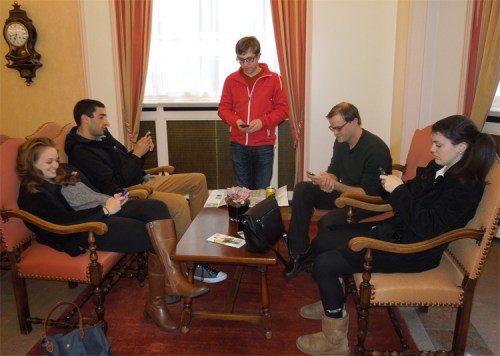
Source: Author, 19 May 2013 (taken with permission of all five people shown in the photograph).
One particularly prescient early image of the relationship between humans and technology is Villemard’s depiction in 1910 of how he thought a school might look in 2000, showing books being dropped into a machine that transforms the information, which then passes through electric cables into each pupil’s headsets. Conceptually, this is not that different from the online learning systems that now increasingly dominate classrooms on both rich and poor countries alike.
Figure 6.2: Villemard’s 1910 image À l’École, depicting how he thought a school might look in 2000.
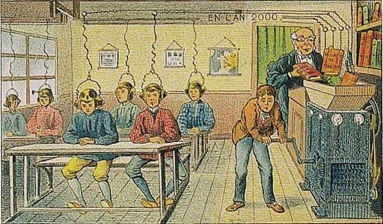
Source: http://expositions.bnf.fr/utopie/grand/3_95b1.htm, accessed 3 August 2016.
In the GSMA’s Mobile World Congress held in Barcelona in February 2014 smartwear was all the rage, and I remember thinking as I walked past Sony’s advertisement for Xperia on the metro platform wall (Figure 6.3) that there were things about my life that I would definitely not want to log, and would certainly not want others to have access to by hacking either my devices or the cloud servers where they might be stored. Yet countless people have purchased such devices, and regularly have their health data automatically uploaded so that companies can analyse it and generate profits without paying them anything in return. This is an extreme example of Big Data surplus extraction, because not only do people have to buy the devices in the first place, and sometimes the software, but they also then give the data to the companies for no recompense, and generally receive little back individually that might actually enhance their health.
Figure 6.3: Sony’s poster “Log your life with SmartWear” on the wall of a metro station in Barcelona during Mobile World Congress, 2014

Source: Author, 28 February 2014
[now time to write the actual section that explores the increasingly interwoven character of machines and humans, especially as ICTs are increasingly being advocated as a way to enhance development]
Filed under ICT4D, Photographs, Uncategorized
The stained glass of Chartres Cathedral
Traveling south across France provided an opportunity to stop off overnight at the wonderful old medieval town of Chartres in the Beauce plain to the north of the river Loire in France. At the centre of the old town is the magnificent Gothic cathedral, rebuilt in the first quarter of the 13th century after the earlier Romanesque cathedral had been burnt down by fire in 1194. In the summer, it is now beautifully lit in a son et lumière display at night. The cathedral has one of the most extensive and beautiful sets of medieval stained glass windows in the world, and it was wonderful to see these with the morning sunshine flooding through them. The glass was largely donated by the rich guild members of the town between 1210 and 1240 and beautifully portray scenes from the bible alongside those from daily life in the 13th century. I particularly like those of agricultural production and wine making, captured in the selection of my photographs below. These also include a beautiful earlier blue window of the Virgin and Child that survived the fire of 1194, and was reincorporated into a 13th century window.
Filed under France, Photographs
World Interfaith Harmony Week, 1-7 February
A chance posting by a friend on Facebook asking if anyone knew of good examples to celebrate the UN’s World Interfaith Harmony week, made me reflect on two interesting recent examples that I would just like to post here, both in acknowledgement of the importance of this issue, but also to encourage others to seek out and celebrate inter-faith dialogue.
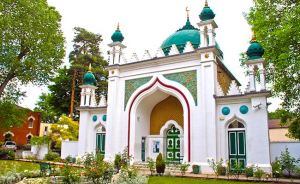 I know that it is just a tiny drop in the ocean, but last week in the town of Woking in the UK there was a meeting of the Christian deanery synod which had invited leaders of the nearby local Shah Jahan mosque, Britain’s first purpose built mosque, to speak about their faith and what it means to be a Muslim in the UK today. The meeting was not without its challenges – I was saddened to see the Muslim speakers initially sitting at the back of the church before being invited to the platform – but if such local initiatives could be replicated and built on much more widely, we might just create a world where people can live together in greater understanding and peace. Having lived in Woking for much of my early life, I always remember passing the mosque and being fascinated by the nearby cemetery, now thankfully restored and renovated.
Second, I was privileged recently to be invited by a group of former Commonwealth Scholars now back home living in Pakistan to dinner at Des Pardes in the village of Saidpur on the edge of Islamabad. It is a very different and physical representation of what peaceful co-existence could be like. I know it has been reconstructed as a model village, in large part to attract tourists, but visiting there I was particularly struck by the juxtaposition of the reconstructed Hindu Temple and a Sikh Gurdwara (until quite recently a post office) with nearby Islamic architectures, indicative not only of a past where peoples of different faiths did live (relatively) peacefully together, but also of a will to instill such understandings in the present day. It made me think again about all of the horrors of partition in 1947, and indeed afterwards. I hope that my pictures below capture just a bit of this very special place, shared with some brilliant people.
Filed under Pakistan, Photographs, Politics, Restaurants, Universities
Murree, Pakistan, 1946-2016
My father spent time in Pakistan in 1946, and it is some 70 years since then that I now have the privilege of visiting the country for the first time. During the 1939-45 war, he had served in the Signals with the 8th Indian Division, and had been in North Africa, and then fought with them up the eastern coast of Italy. At the end of the war he had returned with them to India, and particularly to the north-west, in the towns of what became Pakistan after partition in 1947. The time he spent here was one of the happiest of his life, and I particularly remember stories he told about the times he spent in Murree and Tret to the north east of Rawalpindi. Islamabad had not even been thought of by then.
The opportunity to run a workshop for the Ministry of IT and another under the auspices of the Inter-Islamic Network for IT over the last fortnight provided me with a chance to visit some of the places he had known and told me about many years ago, and it was wonderful to experience the magic of the landscape and generosity of the people in this particular part of Pakistan.
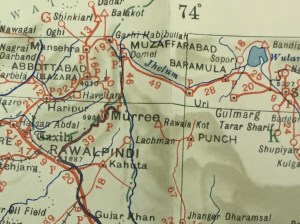 Just before I left, my mother showed me an old map, dating from 1945, on which he had depicted the route he had followed across India, highlighted with a black pen. The map as a whole provides fascinating insights into what the sub-continent looked like before the traumatic events of partition in 1947. Murree is clearly shown, as befits its role as the summer capital of the Punjab Province until 1864, and its beautiful position as well as its relatively cooler climate makes it clear why it was such a popular location, particular for the British living in India. Indeed, it had recently snowed when I visited, even though the weather was much warmer only a relatively short distance away in Islamabad.
My father had taken some pictures of his time at Murree, and in the village of Tret approximately mid-way between Murree and Islamabad in April 1946, and these provided me with an amazing opportunity to compare how things had changed. First, was the view of the mountains of Kashmir from Kashmir Point in Murree
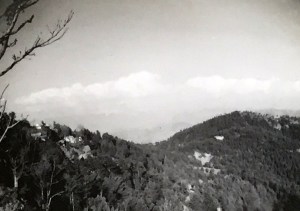
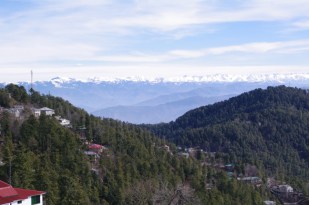
It was extraordinary to have been able to find almost exactly where he must have stood to take his photograph, and almost equally interesting to note how rather little must have changed since he had been there. He would certainly have recognised my photographs!
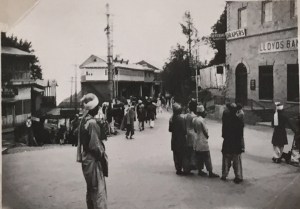
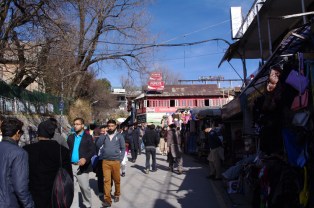
He had also taken a photograph of a street scene in Murree, which included a Lloyds Bank building. Unfortunately I was not able to find it any more, but the accompanying photograph shows how very much more crowded the streets are today than they were 70 years ago!
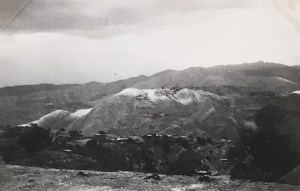
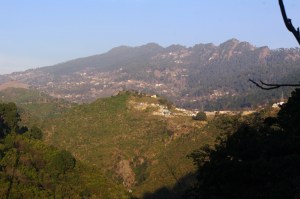
My father clearly loved the mountains and landscapes, and took several photographs of these. Again, I attach one below (labelled “Hills from Murree Road – 5000 feet”), together with one of the hills between Tret and Murree today, albeit from a different viewpoint. Both pictures illustrate a typical settlement on the top of the hills in the mid-distance, but a contrast between them is the difference in forest cover.
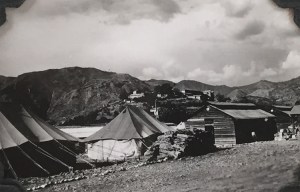
I was not able to find exactly where he was based while in Tret, but the photo on the left below shows a 1946 view of the military encampment there with the village in the background on the hill top, and to the right my 2016 photo which might just be of the same buildings. The photo on the right is also particularly interesting because it shows many black flags flying on the buildings, indicating that these houses belong to some of the Shia minority.

Sadly I was not able to locate the old regimental animal lines shown in the picture on the left below, but have matched it with a view of Tret today on the right. My father had been a keen polo player, and had become very fond of one of his horses (Bellezza) in particular, and I recall him being very sad that he had to leave the horse behind on his next assignment. Remarkably, on returning to Islamabad, a friend told me that the old polo ground is still there, and had managed to survive encroachment from the bus station. Next time I visit Pakistan I will have to return and try to find it.
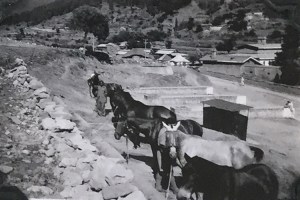
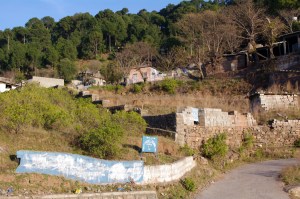
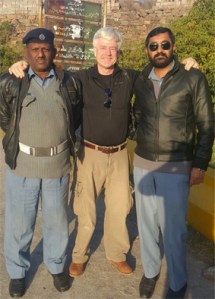
I’m so grateful to everyone who made this visit possible and particularly colleagues in the Ministry of IT, my security team (below), and Asim Malik who accompanied me.
Filed under ICT4D, Photographs
Reflections on hip replacement surgery – getting fit again!
Just under a month ago, I underwent hip replacement surgery. However much I tried to find out about the actual surgery and the “getting fit again” process beforehand, the reality was somehow not quite what I had expected, and so I just thought I would note some reflections here for anyone else considering, or undergoing, this amazing operation! The two most important things to say are that:
- It is an amazing operation; and
- It’s really important to remain positive throughout the whole recuperation process, which is why I am calling it “getting fit again”.
 So, in the first place, why should one consider having a hip replacement? Quite simply, in my case, the increasing pain from osteoarthritis was making life ever more painful and difficult, waking me up at night and really making it unpleasant to go for long walks, let alone runs or skiing! Everyone said that the operation would transform my life, and the brilliant consultant with whom I spoke reassured me that this would indeed be the case. However, here was my first challenge: at only 60 I felt really quite upset that my body was beginning to need such interventions. I still felt young, and it was really difficult to come to terms with the implications of aging. So, this was where it mattered to be positive, and to look forward to seeing all the things that a new hip would enable.
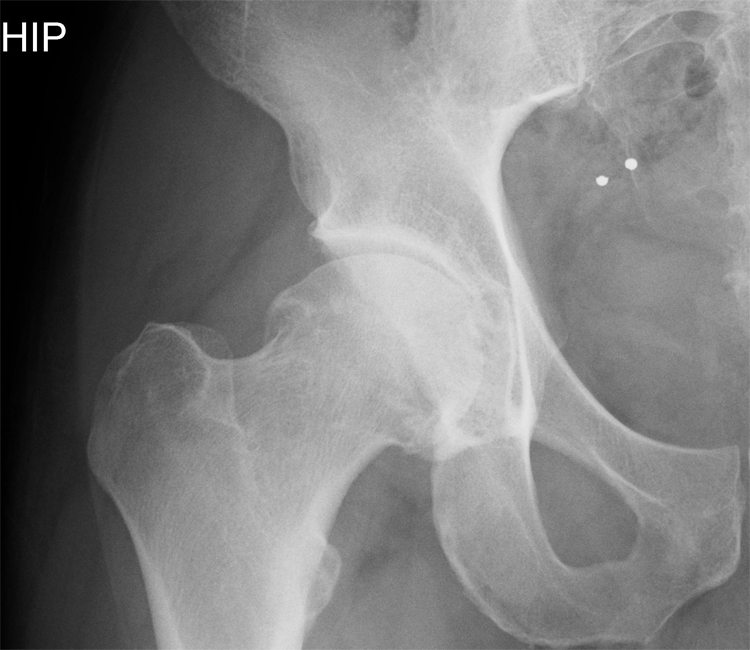
As the time drew closer to the operation, I also remember feeling very ‘strange’ about the idea of part of my body being taken away and replaced by a metal and ceramic “new hip”! I hadn’t expected to feel quite like this, but the loss of “integrity” was something I had to come to terms with.
I’m sure that many things helped me address my concerns in the run-up to the operation: the assurance and matter-of-factness of the surgeon, the care taken by the nurse to reassure me during the pre-operation discussions, and the advice given in advance as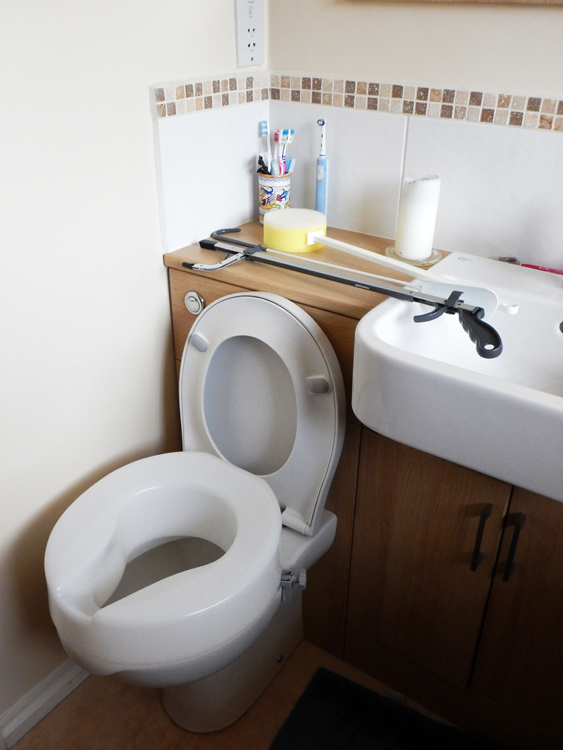 to the exercises I would need to do. One key message for the “getting fit again process” was that the angle between my back and my thigh should never be less than 90 degrees for the month after the operation. This necessitated getting various bits of equipment, not least a raised toilet seat, a long shoe horn, a grabber to pick things up with, and a sponge on a long arm for the shower (all shown on the adjacent image)! Several people advised that I should get other equipment, but these four items were really all that was needed. The final preparation was to make sure that I had a seat with arms that was high enough to ensure that my knee was lower than my hips when I sat down- again the 90 degree rule! This actually proved to be quite a challenge, because we did not have seats with arms, and all were too low. The solution was to get an old office chair that could be raised to the right height, and move it around the house. Hard cushions for raising the level of seats outdoors were also essential! I have to confess that I hadn’t realised the importance of chair arms, but normally when one gets up from a seat one leans forward, and that would mean the angle between back and thigh going well below 90 degrees! So, I had to learn how to get up from sitting by pushing on the chair arms! Incidentally, another rule was never to cross my legs for five weeks after the operation – again, not easy to obey, especially towards the end of the time once the pain was less.
So, with all the preparations complete, but still with much trepidation, the day of the operation came. As ever when one goes into hospital, lots of tests needed to be done, and so there was much waiting around. I just wanted to get it over and done with – but watching a test match on TV helped to pass the time away. I wasn’t quite ready, though, when the anaesthetist asked me what kind of anaesthetic I wanted: a spinal block, or a general anaesthetic. My immediate reaction was that I quite fancied the spinal injection since I could watch what was going on, and it served to reduce the pain in the immediate hours after the operation! However, he made two observations that changed my mind: the first was that I really should not try to interfere in the operation, and I just thought that I could get so interested that I would be asking questions as to what was going on; and the second was that I would need a catheter, something I really did not want, but more about that later! So, I opted for the general anaesthetic, and woke up a couple of hours later!
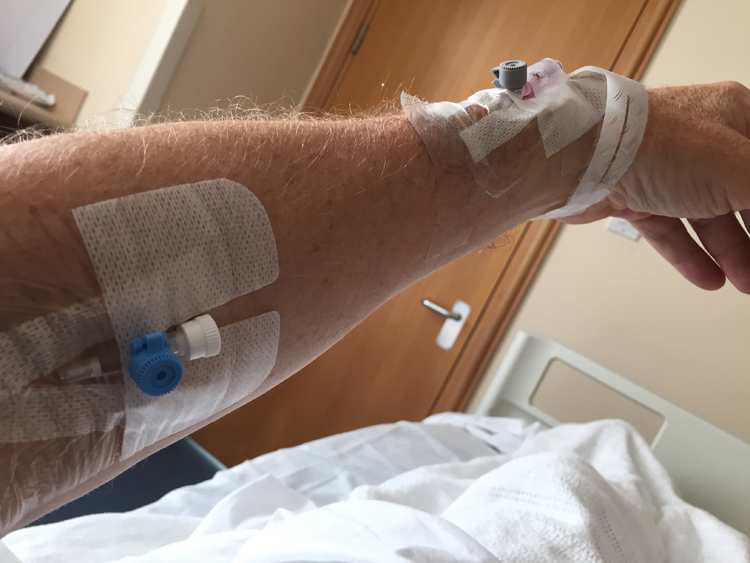 It is not easy to recall exactly what I felt like when I woke up, because of the drugs I was on to reduce the pain, but the after-effects of the anaesthetic gave me a rather blurred sense of reality! I’ve not often had general anaesthetics before, but as on previous occasions they left me feeling rather “low”, and this time was no exception. I was also plugged in to a drip, a drain, and something to help my breathing! However, already as soon as I woke up I felt a different sensation in the hip. The horrible aching pain deep inside was replaced by a much sharper pain on the outer part of the hip, and around the incision that had enabled the surgeon to do the operation.
However, there was no time to rest. As soon as I was awake enough my new exercise regime kicked in! My first night, I stood up only five hours after the operation; the next day I was walking on crutches; and the next day I could take a couple of paces without crutches. After only four nights in hospital I was released. All of the hospital staff were amazingly supportive, and the physiotherapists made sure that I went for short walks every day as well as doing my exercise regime three times a day! Again, this was where being positive made such a difference. I was indeed determined to get fit again. It was, though, very strange, because this involved having to think consciously about how to walk again. The operated leg didn’t seem to want to do what I had previously taken for granted, and I really had to think about how to walk! This involved (I think) kicking the leg forward consciously onto the heel and then rolling onto the toes. Another tricky and indeed quite painful thing was learning how to get into and out of bed! This involved standing by the bed, pushing the operated leg slightly forward and then sitting down, before swiveling round towards the un-operated leg side, lifting that leg first, and then trying to get the other leg into bed!
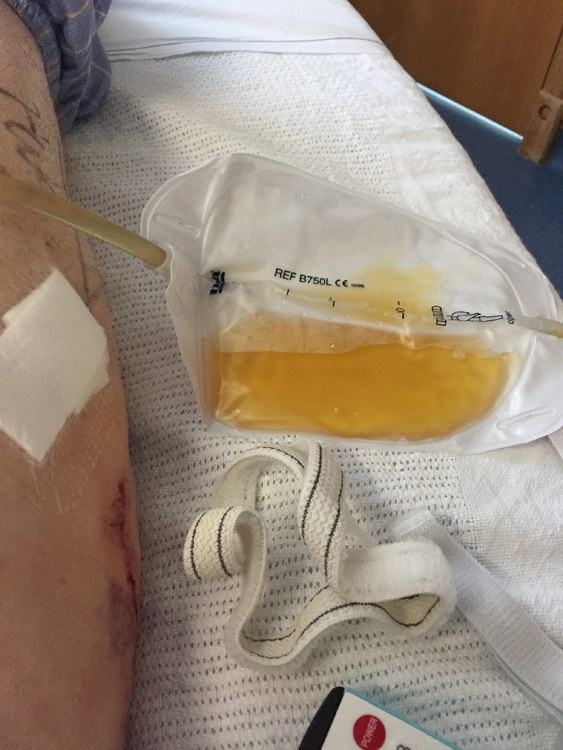 The pain of the operation, though, was nothing compared with the difficulty and pain I had in peeing! The anaesthetic had made it difficult for me to go to the loo, and my bladder filled up to such an extent that they were concerned that this could affect the hip. So, I had to have a catheter drain put in the second night just to release all of the urine! Unfortunately, it did not prove easy to put this in (several attempts were necessary), and so once it was removed I was in considerable pain. Of course, this caused very much greater pain when I tried to pee again!!!! For anyone who has not experienced this, it is difficult to describe, but the nearest description is something like razor blades cutting me inside when I tried to pee. Of course this in turn meant that I had an uncontrollable reaction that made me stop peeing, and so my bladder filled up again, meaning that they had to insert another catheter. All I can say is that the pain of trying to pee was very, very much worse than the pain resulting from the operation, and if I hadn’t had the catheter problems I would honestly be saying that the pain of the actual hip replacement was really relatively minor, and very much less than I had expected! It took a good fortnight before I could go to the loo again without pain.
Once home, the exercise regime started in full force, and it is here that my determination to do all of the exercises and focus on “getting fit again” came into force. I felt exhausted and totally disinterested in doing anything for the first few days, but having to do the exercises three times a day gave me some focus. Learning to walk properly, first with two crutches and then with one took some time. I was doing two 10-minute walks a day by the second half of the first week, rising to two 15-minute walks or one 30-minute walk by the start of the second week, and then regularly doing at least 30 minutes a day by the beginning of the third week. I had been determined only to use one crutch by the second week, but found that I walked with less of a limp if I used two crutches for balance. Still, it really is not easy to walk properly again even now, 26 days after the operation, both because of the lingering aching pain, but also just because the leg will still not do quite everything it is told to!
Another positive thing has been the opportunity to go “swimming” especially on hot days. I must confess to being someone who prefers baths to showers, and not being able to have a bath for five weeks has therefore made me long for a nice hot luxuriating bath when I am again allowed to. However, being able to do my exercises in a swimming pool adds a different experience to the “getting fit again” routine, especially since the water takes the weight of the body and actually enables me to do much more. If I am very careful in how I use my new hip, I can also swim gently, which is very liberating!
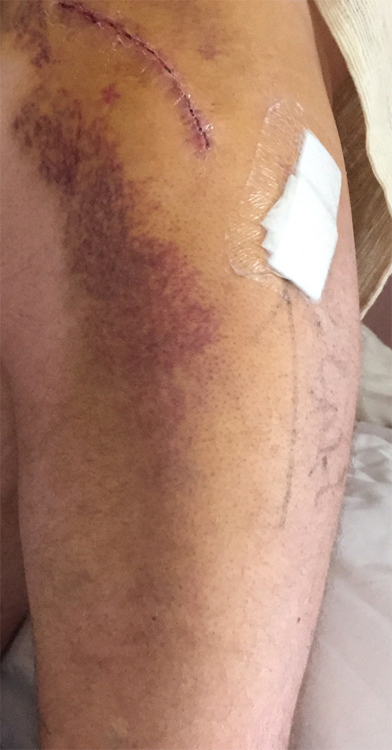 For anyone concerned about the size of a hip replacement wound, and how quickly it heals, I have
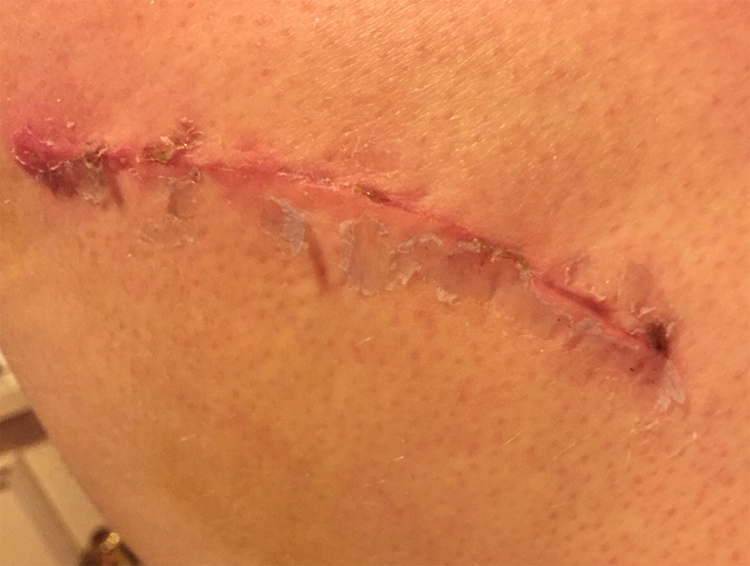 been amazed at the pace of the healing process, shown in the adjacent pictures, with the left one being the bruising after 8 days, and the right one showing the wound (much closer with most of the bruising having gone) after 16 days. The wound itself is only about four inches long!
The biggest challenges have been sleeping, dealing with the ever slowing pace of recovery, and having to wear compression stockings. One thing about hip replacements is that you have to sleep on your back for about five weeks after the operation (the same rule as not crossing your legs!). For those of us, like me, who are used to sleeping in other positions this can be a real challenge – especially since I am not a good sleeper at the best of times. I also found it difficult in the early stages to deal with the pain at night (despite pain killers and the occasional sleeping pill), and only now after three-and-a-half weeks am I beginning to get back into anything like a vaguely normal sleep pattern. Being so tired means that I don’t have the energy to do all the things I want to, and so there is a tendency to fall into a downward spiral.
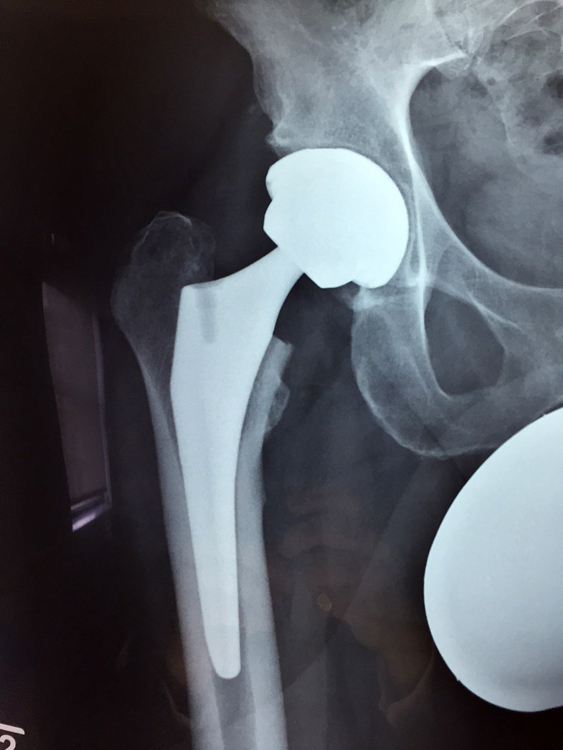 Then, the pace of recovery also slows down with each day (a kind of negative exponential curve), and I find this quite difficult to deal with. In the first few days, I felt I was making huge progress very swiftly, but by the end of the second week it became more difficult to see regular improvements. I know I am continuing to get better on a daily basis, and have now started walking completely without crutches all day, but the dull pain, and the inability still to do many things is incredibly frustrating. This is much more of a psychological thing than a physical one, but having been “out of action” and not able to drive or do much for myself is very wearing. I just want to be completely fit again so that I can be revitalised and use my new hip (shown adjacent!) to its full potential.
Having to wear compression stockings to prevent deep vein thrombosis (DVT) is also very wearing, and in hot weather it is incredibly uncomfortable – again especially at night. I had not previously realised quite how serious concerns over DVT were with hip replacements, and not being allowed to fly long-haul for three months afterwards has certainly caused some considerable problems with respect to my work commitments. However, on a more mundane level, wearing the stockings to help prevent DVT is very frustrating, and still requires assistance since I cannot bend down to put them on!
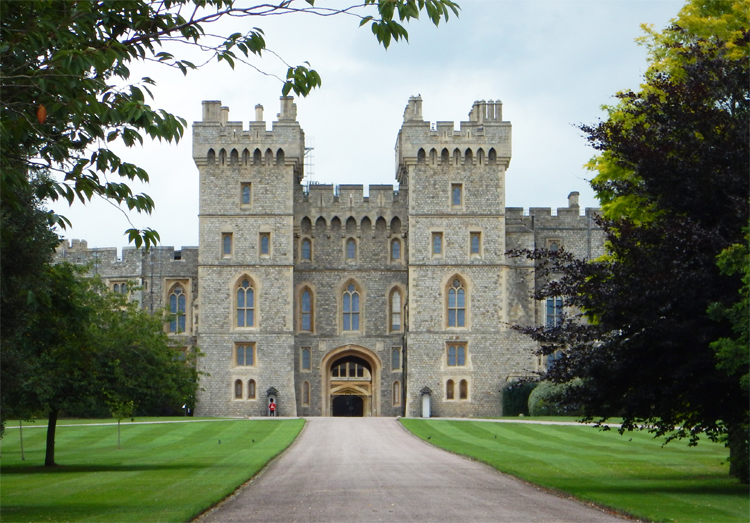 So, a real tip for anyone facing this operation, as indeed with many other operations, is that it’s very important to find especially nice things to do during the recovery period. I have found that having very special things to look forward to helps immensely (such as visiting Windsor last week), because it gives a sense of purpose and pleasure when the pain and tiredness have a tendency to become overwhelming.
Finally, I just want to pay tribute to the amazing surgeon, anaesthetist, nursing staff and physiotherapists who made my stay in hospital such a great experience, and to everyone who has helped care for me and keep me up-beat over the last three weeks. I am really looking forward to continued progress, and really being fit again!
Filed under Photographs

 Tim Unwin's Blog