
One of my reasons for so strongly supporting the ITU and UN Women led EQUALS (gender equality in the digital age) initiative was my realisation that there continues to be a surprising amount of sexual harassment at international ICT events, as noted in my blog post on the subject in May 2016. I still firmly believe that all organisations convening such conferences and events should have a set of guidelines advising participants on appropriate behaviours, not least since such behaviours are heavily culturally influenced, and people may not always realise what is expected behaviour in another culture.
However, my management and leadership experience has sadly taught me that sexual harassment in the workplace, especially in the ICT sector, remains far too prevalent. I have always tried to put appropriate policies in place if they did not previously exist in the organisations where I have worked, and personally to support those who considered that they were being harassed. I have also encouraged organisations to provide training where relevant, and always to include sexual harassment within wider staff training programmes on bullying. However, I realise that I have never provided specific guidance on my blog to advise people on how to respond to being harassed. When people are sexually harassed, they often feel helpless and do not know where to turn. Recommended responses to harassment also vary in different legal systems and cultures. So, to make amends , I thought it might be helpful to provide the following set of links that provide a wealth of helpful material:
- Australian Human Rights Commission: Sexual Harassment – information for employees. A useful summary of information in an Australian context.
- Avocats Murielle Cahen: Que faire en cas de harcèlement sexuel. Conseils d’un cabinet d’avocats français
- Aware: What can you do if you are sexually harassed. Advice from the Singaporean Association of Women for Action and Research.
- BBC. What do do if you think you are being sexually harassed at work. A 2017 piece by Holly Wallis and Laura Lea. Very useful for people in the UK.
- Citizens Advice: Sexual Harassment. An excellent, clearly written guide on how to respond to sexual harassment in the UK.
- Feminist Majority Foundation. Sexual harassment fact sheet. Quite detailed information from a USAn feminist perspective.
- FindLaw. Sexual Harassment: actions you can take. FindLaw is part of Thomson Reuters, and this link provides useful advice primarily from a USAn perspective.
- Forbes. What to do if you’re being sexually harassed at work. Advice in 2016 from Kerry Hannon, mainly from a USAn perspective
- Healthdirect: sexual harassment. Advice from the Australian government health service.
- Legalline.ca: What to do if you are sexually harassed. Advice from a Canadian perspective.
- Que faire spécifiquement en cas de harcèlement sexuel au travail? Conseils du Centre LAVI (Loi fédérale sur L’aide aux Victimes d’Infractions) de Genève.
- Worksmart: What should I do if I’m being sexually harassed? Advice from the UK’s TUC on sexual harassment.
Summarising the above, it seem that there are five main pieces of immediate advice:
- Know your organisation’s staff handbook and always follow the guidance contained within it on sexual harassment.
- Talk with your harasser immediately, tell them that you do not like being harassed, and ask them to stop. This may not always be easy, but it is important that they know you feel harassed. If it helps, have a friend with you when you tell them.
- Document everything, and put the date on every note. Preferably, do this in a handwritten form in a notebook that can be used as a consecutive record of what has happened. Do not simply type it on your work laptop or computer that could be hacked by someone else.
- Report it in writing to the appropriate person in your workplace immediately if any touching is involved, or if you receive explicit demands for sex. If you are being harassed by the person to whom you are meant to be reporting, or if the head of the company or organisation is the person who is harassing you, there should be a nominated alternative person who should be informed. This might be the Head of Human Resources, or if the head of the organisation is concerned it could be the Chairman of the Board or Council.
- Find support. Many organisations and companies have someone whose role is to provide such first line support or provide direction to an appropriate source of help. People who are harassed sometimes feel guilty, or blame themselves, even though they have done nothing to encourage such harassment.
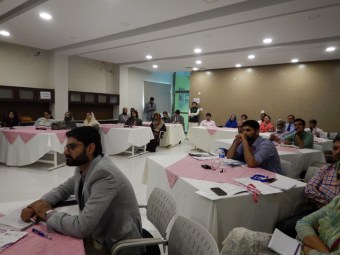 It was great to be back in Islamabad to participate in the second two-day workshop organised by the
  Understanding the ICT4D landscape, in which the main speaker was Dr. Ismail Shah, the Chairman of the
  Serving the most marginalised: accessibility and disability, with a plenary by
 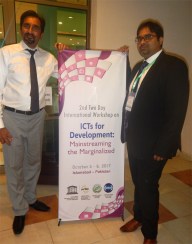 Full details of the event can be found on the
  I am delighted to see my chapter on ICTs, sustainability and development just published in the ITU’s new book on
  It is the first time I have actually worked on such a collectively authored project, and its publication says much about the willingness of all involved to collaborate supportively together under the leadership of Ahmed and Bill Lehr, who was later brought on board to co-edit the book. Each of us took the lead on a single chapter, but everyone contributed to the ideas contained within the book. The process of negotiation and discussion around the concepts and ideas within each chapter was fascinating, especially since it required us to hone our arguments very finely and precisely. Most of the contributors were economists, and although at times I struggled with accepting some of their arguments, I know that their contributions very much improved the chapter on which I led. Moreover, I am very grateful to Ahmed as editor, for letting me write what I did, since it enabled me to craft my most critical piece of work on the sustainability of the ICT sector.
 The second chapter (on which I led) examines the interface between ICTs and sustainability, especially focusing on environmental issues and the conditions that need to be in place for ICT initiatives to be sustainable socially and economically. It focuses specifically on the importance of universal infrastructure, the affordability of technologies, the need for appropriate skills and awareness, and the importance of locally relevant content. For these to be delivered, the chapter emphasises that those who develop policies and implement programmes and projects to use ICTs to promote sustainable development need to address issues of empowerment, focus on the needs of the poorest, develop innovative technological solutions and new business models, legislate new kinds of regulation through which governments facilitate the ICT and telecommunication sector, and ensure that there is effective security and resilience within the systems being developed. The chapter concludes with a brief analysis of the role of multi-stakeholder partnerships in implementing such initiatives.
 I recall a wonderful conversation a couple of years ago with a Maasai chief in Tanzania. He was speaking with a group of techies about the use of mobile devices, and they were trying to persuade him of the value of mobile phones, even just to call his friends in a village the other side of the hills. He, wisely, remained unconvinced. For him, walking across the hills, enjoying the landscape, spending time experiencing the physicality of nature, and just thinking about life, were a crucial part of going to, and speaking with, his friend in the next village.
 ICTs will never deliver on reducing inequalities in the world unless there is a fundamental sea-change in the attitudes of those leading the global private sector corporations that currently shape the world of the Internet. It is perfectly logical for them to sign up to the SDGs formulated by the UN system, and to seek to show that expanding their digital empires will necessarily deliver the SDGs. This is a powerful additional weapon in their armoury of market expansion and profit generation. The problem is that these agendas will continue to increase inequality, and as yet remarkably little attention has been paid to how ICTs might actually help deliver SDG10. Until corporations and governments really treat the link between ICTs and inequality seriously, peoples of the world will become every more divided, and if poverty is defined in a relative sense then poverty will actually increase rather than decrease as a result of roll out of the Internet.
 The first time I visited Chandni Chowk (Moonlight Square) in Old Delhi was more than 40 years ago in 1976 (picture to the right). I remember its vibrancy, the vivid colours, the energy, the diversity of smells, the complexity of everything that was there. It fascinated me. I got lost. I wandered. I explored back alleyways. I emerged, having felt something of the depth of Delhi; the ever living past in its present.

 Tim Unwin's Blog