Prolegomena on Human Rights and Responsibilities

Waking early after yesterday’s flight to Port of Spain, and sitting above the Gulf of Paria, watching the swallows sweeping past my window, has given me time to reflect on something I have been meaning to write for ages.  I have long argued that both the notion of “Universal Human Rights”, and its acceptance as being a default position in much international discourse, has been hugely damaging for poor and marginalised peoples, and should be replaced by a Human Responsibilities agenda.  I first articulated elements of this argument in my 2010 paper on “ICTs, citizens, and the state: moral philosophy and development practices“, and also shared some thoughts on this at the Stockholm Internet Forum in 2013, but have never had the time to develop this into a more formal account (see also my pieces on balancing democracies and DFID’s approach to development aid).   Suffice it to say, that I still don’t have the time to do this in the detail it warrants, but I want to take the opportunity to share the outline of the argument here.  One day, I will craft the more formal account!

Caveats
Lest I am misunderstood, I want to begin by highlighting three important caveats that underlie what follows:

  1. In my earlier accounts, I argued strongly that we should disband the notion of Human Rights altogether. I now accept that making such an absolute and dogmatic approach is too antagonistic because the notion of Human Rights is too heavily embedded in global thinking and policy making.  Hence, my present position suggests that the Human Rights agenda needs to be balanced by a Human Responsibilities Agenda.
  2. Most of those who advocate a “responsibilities” approach to these matters do so from a neo-liberal or broadly “right-wing” stance; I very much want to distance myself from such a position, and instead see my arguments as being profoundly radical.  Indeed, as I hope to show below, I see the Human Rights approach being one that largely reinforces the status quo, in the interests of those in power.
  3. I also want to be very clear that I am not in any way suggesting that we should not put in place some kind of mechanisms to prevent the almost unimaginable horrors that have been, and continue to be, committed all too often across the world by some people on others.  As I write, the ongoing massacres of Yazidis and Christians by the so-called Islamic State/Caliphate are an all too shocking reminder of the continual savagery, and what some would decry as evil, that can be found across the world today.  However, I do not think that a Human Rights agenda actually prevents such atrocities; if it did, would they still be promulgated?

The fundamental premise
The fundamental premise that I seek to illustrate through the arguments that follow is that the Universal Declaration on Human Rights has supported the legitimacy of a particular kind of social formation, often called capitalism, that has a tendency to lead to greater inequality in the world rather than substantially improving the lives of the poorest, most marginalised and most vulnerable.  I argue, that this must be balanced by a Human Responsibilities agenda that places at least as much emphasis on the responsibilities of states and of individuals to the least advantaged in our societies.  It is insufficient simply to say they have rights; we all have responsibilities to act.

Strands in the argument
The various strands of my argument need fully qualifying, referencing, and linking together more cogently, but more or less in chronological order they are as follows:

  1. The idea that humans have rights is a relatively recent one in human evolution.  There is much debate about the origins of ideas associated with human rights, but I suggest that it is actually very recent.  Far too often, advocates of human rights agendas seek to identify obscure elements of past legal texts as the precursors of modern thinking on the subject, as with elements of the Cyrus cylinder dating from the 6th century BC (see for example United for Human Rights).  However, it is very difficult to sustain such arguments, and many are based on ex post facto reasoning.  One of the most interesting things about the human rights agenda is that most of the world’s religions have little if anything to say actually about human rights. For humanists, who reject the project of religions, human rights can be interpreted as part of human emancipation from the darkness of religion. However, for those who hold to the beliefs of religions such as Christianity and Islam, although they are very much concerned with what being human really means, and they challenge many of the perceived evils of the societies in which they were formed, there is actually remarkably little if anything in them about the precise idea of humans having rights.  Magna Carta, the great charter agreed between the Barons and King John in England in 1215, is often seen as providing the initial framework for the modern concept of human rights through its inclusion of the clause that “No Freeman shall be taken or imprisoned, or be disseised of his Freehold, or Liberties, or free Customs, or be outlawed, or exiled, or any other wise destroyed; nor will We not pass upon him, nor condemn him, but by lawful judgment of his Peers, or by the Law of the Land. We will sell to no man, we will not deny or defer to any man either Justice or Right”.  It was in the 17th century, though, in the writing of Hobbes and Locke that a more formal concept of human rights can be seen as having evolved in the context of the emergent Enlightenment and social contract theory.  The essence of their argument was that in seeking to resolve their conflicting desires for peace and power, people cede some of their rights to the sovereign in return for protection.  This notion lies at the heart of social contract theory that was developed further in the 18th century by authors such as Rousseau, and reached political fruition in the French Declaration of the Rights of Man and of the Citizen in 1789.
  2. There is nothing universal about human rights. Point (1) above emphasises that the notion of human rights has evolved; it has not therefore been universally accepted throughout history.  A counter to this particular logic is, of course, the different logic that there has always been a universal, and it is only now becoming increasingly revealed and understood over time.  These two logics need resolution, but it is not only a matter of time and history.  Space and geography matter!  Different cultures have evolved different belief systems and ontologies, and there have been many contrasting arguments about universals.  Having long reflected on this, my overwhelming conclusion is that about the only widely accepted moral position is the Golden Rule of “do as you would be done by”.  I have always been challenged, for example, by the rights of cannibalism.  For a cannibal, it is her or his right to eat someone; for the person being eaten, it is clearly her or his right to remain alive. There are also clearly ongoing debates as to what should be included in human rights agendas, some of which are discussed further below, but the fact that there is little universal agreement across cultures on exactly what should be considered a human right is itself an illustration of the suggestion that there are few if any universals.
  3. Instead, human rights should be seen as a means through which a dominant ideology is imposed on others. To understand human rights, it is essential to understand where (the geography) and when (the history) of its emergence.  It is no coincidence that modern thinking on human rights emerged in 17th century Europe.  It did not emerge in Africa, Asia or the Americas.  It emerged hand in hand with the rise of individualism, in contrast with what was seen as the cloying hand of communal practices.  Enclosure provided the opportunity for individual profit from the land, instead of the traditional common and open field systems.  This was essential for the emergence of capitalism, vested fundamentally in private property rights, through which individuals could generate profit.  It was likewise no coincidence that the Universal Declaration of Human Rights was adopted by the UN in 1948 in the immediate aftermath of the 1939-45 war.  To be sure, it was in part a response to the horrors of the holocaust, but it must be asked, for example, why there was not the creation of a similar declaration after the very different kind of horror of the 1914-18 war?  It is also no coincidence that the drafting committee was chaired by Eleanor Roosevelt, wife of the US President.  Although its nine members did indeed include representatives from Chile, China, Lebanon and the USSR, the dominant voice was that of the capitalist “West”, represented by Australia, Canada, France, the UK and the USA.  The vast populations and cultures of Africa and South Asia were omitted and ignored.  The case I develop below is that the Universal Declaration of Human Rights has thus become a vehicle through which global capitalism has sought to impose a universal hegemony on what is seen as being right. It is, though, not actually in the interests of the poor and marginalised, but rather serves the interests of the rich and powerful.  To develop a new world order, we must therefore abandon the declaration, and replace it with an agenda that stresses the importance of communal traditions.  Interestingly, such traditions are often seen to be grounded in many African practices, that were all too clearly ignored by the drafting committee.

  4. SkullsThe human rights agenda has failed to save those who have suffered at the hands of violent people who have no belief in human rights.  It may be that the Universal Declaration of Human Rights has indeed reduced the amount of horror and violence meted out in the world over the last 66 years.  Unfortunately, though, we have no means of measuring this; there are no counterfactuals.  We take it on trust.  However, it is very clear that unimaginable violence – from Rwanda to Syria and Iraq – has continued, regardless of the declaration.  Let us never forget the horror and violence that men and women commit against each other, but let us ask whether the human rights approach is indeed the most powerful vehicle we can have to challenge this.
  5. The human rights agenda has become devalued and all-inclusive. One of the prime drivers for the Universal Declaration was undoubtedly the experiences of Allied troops who discovered the atrocities committed by Axis powers during and at the end of the 1939-45 war.  This found expression in Article 3: “Everyone has the right to life, liberty and security of person”.  Yet, look at the hypocrisy even with the comment that “everyone has the right to life”: some states in Eleanor Roosevelt’s own country , the USA, still regularly take the lives of their citizens executed as the result of the passing of a death sentence, let alone taking the lives of innocent people killed elsewhere in the “war against terror”.  Even more important than this, though, is the point that far too many things that are much less important than “life” are now considered to be human rights.  Taken to the extreme, this has found expression in arguments that access to ICTs should be seen as a human right. Simplifying, this argument in essence is based on the logic that (1) education is a human right, (2) access to the Internet is crucial for education, and therefore (3) access to the internet is also a human right.  As I have argued elsewhere, it is arrant nonsense to argue in such a way, but to understand why this is happening one needs to understand the interests underlying such arguments, because they are indeed powerful.
  6. The interests underlying a human rights agenda.  Capitalism, especially as practised and promoted in the USA, is fundamentally driven by the need for people to be “free”.  It is this freedom as a right that lies at the heart of the human rights agenda.  It is not for nothing that the Universal Declaration of Human Rights begins with the statement that “Whereas recognition of the inherent dignity and of the equal and inalienable rights of all members of the human family is the foundation of freedom, justice and peace in the world” (my emphasis).  In a Marxist interpretation, freedom is essential for two simple things that capitalism is reliant upon: the freedom of individuals to sell their labour power (the essential source through which profit is created for the capitalist), and the freedom of individuals to purchase products (the mechanism through which such profit is realised).  This was why it was so important for capitalism to overthrow “unfree” communism: so that a vast number of new labourers and consumers would be created, who were free to choose where and how they worked, and what they purchased.  Individual-ism had to replace communal-ism.  This was where the great con (even better and more subtle than that in The Sting) was played; it was largely done in the name of freedom.  To revert to the example of access to the Internet as being a human right, it can readily be seen that this argument is driven fundamentally by those who will benefit from the Internet being made available to everyone, be they corporations selling the technology, to educationalists eager to promote/sell their ideas through the Internet.  Yet how free are we?  Some may think they are free to search all human knowledge on the Internet, but in reality they are paying, and usually giving far more information away about themselves than actually they are gaining; that is the source of profit of the global search engine and social media corporations.  Are we not becoming mere appendages of the machines in front of which so many of us sit day in, day out, answering e-mails and losing our humanity?

Towards an alternative: communal solutions and a responsibilities approach
The forces of capitalism are indeed powerful, and even if they were not necessarily consciously embedded in the foundation of the Universal Declaration, they have since usurped it and now drive forward the human rights agenda primarily as a means through which they can generate further surplus profit at the expense of the poor and the marginalised.  Make something a human right, someone is then expected to provide it, and this then becomes a business opportunity.  The trouble is that actually all too often no-one provides it.

Masks[this was as far as I got in Trinidad; further reflections in the land of Serendib, and a most comfortable gentle flight home courtesy of Sri Lankan Airlines, enables me to continue]

Hence, I want to argue that at the very least we need to redress the balance by advocating for a human responsibilities agenda; deep down I would still prefer to have a responsibilites agenda replace the rights-based agenda, but as I note above too many people make too much money out of the rights agenda for this to be feasible in the short term.  Hence, I offer a compromise!

Elements in support of a radical responsibilities agenda go something like this:

  1. Human rights have failed; we need an alternative.  As noted in (4) above, the notion of human rights seems neither to have had a significant impact on improving the lives of the poorest of the poor, nor on those who suffer from states and people determined to mutilate and massacre them.  Over the last 20 years, the world has become more unequal, fuelled in part by the uses made of new Information and Communication Technologies; violence and hatred are rife, fuelled by individualistic human greed.  Human rights, despite all the claims made for it has simply not delivered.  I come close to thinking that all war and killing is a crime (despite arguments that claim that there is indeed something called a “Just War”), and that to define some incidents as being war crimes, whereas others are not is hugely problematic (but this enters a different, albeit fascinating discussion of war – perhaps the topic of a future blog post!).  The fundamental point here is that the fear of retribution by the international community has seemed to have done little to limit the worst abuses conceivable by the minds of those dedicated to inflicting horror.  At least we must ask if there could just be an alternative.
  2. Shifting the emphasis to communal traditions.  As will be clear from the above, I see the root of much of the ‘problem’ of human rights as being its fundamental emphasis on the rights of individuals.  Do we as individuals really have rights?  What makes humans have rights, other than their claim that they do?  Might this not be false ideology based on the views of a rich and powerful minority?  In many cultures, the value of the community has traditionally been seen as being higher than that of the individual.  Indeed, the self sacrifice of many individuals to protect their communities, can be seen as reflecting the species survival, and thus essentially communal, nature of humanity.  In particular, although there is much dispute over it, traditions such as Ubuntu in eastern Africa, the Gacaca courts in Rwanda, and Indaba in Nguni cultures, all reflect an important African communal emphasis.  So too, I would argue, is the Christian tradition, drawing in part on the parable of the Good Samaritan (Luke 10), but also the notion of Christ as a servant king (Luke 22), that places emphasis primarily on service.  Christ’s two fundamental requests (Mark 12) are that we should love God, and love others as ourselves.  There is nothing here about human rights, but rather an emphasis on our communal responsibilities. We have choices – to be individualistic and greedy, overly concerned with some presumed rights, or to serve others.  Indeed, in Hobbes’ and Locke’s original formulations, it was to try to resolve this conflict between greed and peace, that the notion of giving up certain assumed rights was born.  Perhaps if we placed greater emphasis on responsibilities, we might draw nearer to crafting a world which actually better helped achieve the objectives for which the human rights agenda has sought but failed to deliver.
  3. Responsibilities of states.  Simply to say that individuals have rights, and therefore that states have a duty to ensure that these rights are delivered on is not enough.  I assert that we must ensure that we embed in legislation the fundamental responsibilities of states to deliver certain things for their citizens, accepting that these might well differ between cultures and contexts.  The richness and diversity of humanity is one of our strengths, and we should not seek always to identify universals, which as I state above seem to me primarily to be ways through which the rich and powerful impose their view of the world on others.  The private sector’s unending pursuit of profit can never benefit the poorest and most marginalised; capitalism is built fundamentally on inequality.  Hence, the role of states is primarily to mediate these excesses, and ensure that the poor can also live at peace without fear for their lives and livelihoods (in line with 17th century social contract arguments).  It is only states that can achieve this. States therefore have fundamental responsibilities to their citizens, and if rulers fail to deliver on these they should be overthrown.
  4. And the responsibilities of individuals.  Not only are states made up of individuals, but it is as individuals that we communicate and interact with each other.  I can say to a person: “You have rights.  Jolly good.  The state will deliver on your rights. I need do nothing”.  Or, I can think, “I have a responsibility to that person.  I should therefore act in certain ways to them”.  Responsibility is about action; rights are about inaction.  The human rights agenda has been a way that we can be absolved of our responsibilities to each other.  I am seeking to reverse this so that we do indeed take action as individuals for each other.  It may only appear to be a subtle difference, but to me it requires an entirely different emphasis and way of thinking.  The responsibilities agenda means quite simply that states have responsibilities to their citizens, and as individuals we have responsibilities to each other.
  5. Who pays for human rights and responsibilities? I have long been challenged about the disconnect between human rights, and payment for delivery of those rights.  Many argue that “the right to education” is a human right, but that it is fine for this to be delivered by the private sector.  This seems to imply that someone might have a right to education, but that they would have to pay for it.  I find this logic unsatisfactory.  It is akin to saying you have a “right to life”, but you have to pay for it, which would seem to be a licence for highway robbers to take lives!  It seems to me that if you have to pay for a right it is not actually a right.  Poor people are highly likely to be disadvantaged, for example, in a society where health and education have to be paid for.  Again, this would seem to reinforce the arguments in (6) above, which suggest that some of the most powerful advocates of human rights are those who seek to exploit them for monetary gain.  This would certainly seem to be the case for those who want to make access to the Internet a human right!  If we replace such a logic, though, by one that says that states have responsibilities to ensure that all of their citizens have, for example, free housing, health and education, this would require societies to find ways to deliver on this, through mechanisms such as taxation.  Once again, the responsibilities agenda ia about the common good, rather than the individual greed and selfishness of the human rights agenda.

It is difficult to summarise complex arguments drawn from many sources in just a few lines, and this post is already overly long!  However, I would love to hear back from anyone who would like to point out the flaws in my outline argument, so that I can incorporate responses in my more formal, rigorous and detailed argument.  Who knows, it might evolve into one of my next books!

My  aim is to persuade people that we must balance any universal human rights agenda by a human responsibilities agenda.  This will require a radical rethink of all those reductionist arguments, especially by those in the UN system, that simply see human rights as the fundamental grounding for so much of their work.  I hope that, at the very least, my arguments here challenge such a supposition, and go some way to persuading others that the human rights agenda is part of a capitalist conspiracy that claims to make people free, but actually enslaves and dehumanises them.


 

9 Comments

Filed under Uncategorized

The damaging mythology of “Digital Natives”

The publication of Ofcom’s latest Communications Market Report, which provides interesting information about significant differences in usage of communications media, has led to a plethora of media commentaries perpetuating the mythology around the usage of the term “Digital Natives”.  A Guardian report  thus comments that “The advent of broadband in the year 2000 has created a generation of digital natives, the communication watchdog Ofcom says in its annual study of British consumers. Born in the new millennium, these children have never known the dark ages of dial up internet, and the youngest are learning how to operate smartphones or tablets before they are able to talk.”.

Ofcom summarised its report as follows: “Ofcom carries out research to help understand people’s awareness of technology and communications. Our research on people’s digital aptitude found that:

  • We’re at our most tech savvy between 14 – 15 years old – with an average score of 113
  • Over 60% of people aged over 55 score below average
  • Six-year-olds show the same confidence with technology as 45 year olds”

In this short post, I do three things: first, highlight the damaging effects that over-simplistic usage of terms such as “Digital Natives” can cause;  second, explore why such terms persist, and hence the notion of mythology; and third, point to  problems with the data upon which the Ofcom report’s conclusions are drawn.

Against the notion of “Digital Natives”
I had thought that the mythology surrounding “Digital Natives” had long been debunked, especially by the really excellent arguments propounded by my good friend Mark Weber, in his presentation on “Fear and Awe of the Digital Native“.  For anyone who has not read it, I strongly urge you to do so!  Rather than repeat all of Mark’s arguments, let me merely highlight four of the reasons why he suggests that it is a dangerous concept:

  • “Generational division simplifies picture
  • Assumes that ‘just because’ someone is young they have the necessary skill set to deal with modern economy
  • Presumes a level playing field for the young, ignores economic and social problems & differences
  • Places unwanted pressure on the young”

These are critical issues that must not be ignored, but I would like briefly here to develop four particular points that are in part alluded to by Mark:

  • Not everyone who is young is digitally literate, nor is everyone who is old digitally incompetent! Simply to categorise people in this way can be hugely damaging, not least to their self esteem.  If we wish to encourage older people to use technology, because of its assumed benefits to them, it is decidedly unhelpful to castigate them as being resistant to technology, or unable to learn about it.  Many older people are hugely competent at using digital technologies, and indeed teach younger people how to use them! Using Ofcom’s sample question test, for example, I scored more than 55% above the average score for people my age!!!
  • These differences are in large part structurally determined, rather than merely a factor of age.  Much more research needs to be done on reasons why people use digital technologies in particular ways, but there are very many structural reasons why people in particular age groups might respond to such surveys in particular ways (see below for problems with the actual questions asked in the Ofcom survey).  There are clear reasons why older people might not be as familiar with digital technologies as younger ones, not least because they may consider that they have better things to do with their time!  Moreover, not having access to the technologies, not being able to afford them, or their design being difficult to use can all affect such usage.  Elderly people with visual impairments or motility challenges find small digital devices difficult to use.  Most, although definitely not all, common digital technologies are not designed for use by people with disabilities, and similarly as people become older they too are often actually specifically marginalised by the technologies.
  • It implies that digital technologies are on the whole “good” and “beneficial”; we should all want to be natives! This again is part of the mythology surrounding “Digital Natives”.  However, as needs to be repeated over and over again, digital technologies have both positive and negative effects.  The word “native” is generally seen as being positive, and therefore it focuses attention mainly on the positive aspects of  the use of such technologies.  Sadly, the term “Digital Immigrants”, which is often used to refer to those older people learning how to use the technologies, has become associated with the more widely pejorative usage of the word “Immigrant”.  This is extremely unfortunate, because immigrants are actually often the people who bring in new ideas, and lead to changes for the better in a society! The notion that all digital technologies are definitely good must be debunked.  One need only think of the challenges of cybercrime, child online pornography, or the increased work load cause by e-mails to realise that being a “Digital Native” can actually be hugely damaging and dehumanising!
  • The notion of “Digital Natives” is a simple concept, that is easily remembered, but it is therefore highly dangerous because it implies some kind of causative power. There is nothing necessarily about young people that makes them any more adept at using digital technologies than older people.  The Ofcom report emphasises that, based on their survey, “Six-year-olds show the same confidence with technology as 45 year olds”, but this merely expresses confidence rather than ability.  If six-year-olds regularly play with digital technologies more than do older people, then it is hardly surprising that they have more confidence in their usage.  This does not mean that they are necessarily better at using the technology, or that older people cannot learn how to use it.  Persistence in the use of the term will only encourage older people to think that they are less able to use the technologies than they actually are, and might therefore further limit their potential benefit gains from digital technologies.  This is not to deny the considerable evidence that humans have greater difficulty remembering things, or learning new things as they get older, but it is to decry the arguments that suggest that there is something particularly about digital technologies that makes them harder than other new things for older people to learn.

Why do people still persist in using the term “Digital Native”?
The idea of students as “Digital Natives” and teachers as “Digital Immigrants” as first postulated by Mark Prensky in 2001 is indeed catchy, and it is not surprising that it became popular.  Like many popular concepts, it has an element of truth in it, and it appeals to those who like binary divides and simplicity.  Prensky’s paper concluded, “So if Digital Immigrant educators really want to reach Digital Natives – i.e. all their students – they will have to change. It’s high time for them to stop their grousing, and as the Nike motto of the Digital Native generation says, “Just do it!” They will succeed in the long run – and their successes will come that much sooner if their administrators support them”.  As founder and CEO of a game-based learning company, Prensky was  eager to encourage as many teachers as possible to adopt digital technologies in their learning, and this has been at the heart of the ‘interests’ that have subsequently underlain much use of the terminology.

Those who advocate the use of the term “Digital Natives” do so very specifically, so as to encourage even greater adoption of digital technologies, not only in the field of learning, but also more widely.  “Immigrants” are encouraged to adopt ever more technology so that they can become as proficient and ‘naturalised’ as are the “Digital Natives”.  Hence, a fundamental driver for use of this terminology is the profit motive of global ICT corporations, eager to ensure that as many people as possible are locked in to the new digital world that they are creating.

In the field of e-learning, a fear that teachers often have, especially in some of the poorer countries of the world, is that their role will be usurped by the machine, and that as “Digital Immigrants” they will be left behind by their students, the “Digital Natives”.  The traditional role of the teacher, as someone with knowledge to impart, rather than as someone helping others to learn, is thus seen as being fundamentally undermined by the use of digital technologies such as computers, the Internet and mobile ‘phones.  In such contexts, the use of an overly simple divide between Natives and Immigrants can be hugely damaging.  Instead, a more sophisticated approach to incorporating digital technologies in learning is required, recognising that it is a transformation for both teachers and students, and that only by working together can they develop a shared appreciation of the benefits that such technologies can bring.

Problems with research based on self-reporting
Interestingly, the Ofcom report itself does not actually use the words “Digital Natives”, but it does provide interesting information about how different age groups self-report on technology usage. Herein, though, lies a fundamental problem with the report, which is that the age-related conclusions are largely based on simple self-reporting questions that do not actually provide a reliable basis for the conclusions drawn.  As the sample questions indicate, the responses to one section require the person completing the questionnaire to give one of the following five answers to the question “Thinking about the following gadgets and services – which statement best describes your knowledge and understanding?”:

  • I use them
  • I know a lot about them, but I haven’t used them
  • I know a bit about them, but I haven’t used them
  • I’ve heard of them but don’t know much about them
  • I’ve never heard of them.

This relies on those responding to differentiate between “not much”, “a bit”, and “a lot”; one person’s “not much” could be another’s “a lot”.  Moreover, there is an inbuilt bias in such questions, because the same amount of knowledge abut technology is actually a much smaller percentage of an older person’s overall knowledge than it would be of a child’s knowledge.  This would tend to lead to younger people thinking that their digital knowledge about something was actually “a lot”, whereas an older person might see this as actually being “not much”!  The gadgets chosen are also somewhat problematic, including smart glasses such as Google Glass, smart watches, and 3D printers, not least because very few people actually use them as yet, and so the results will be biased to particular age groups that use them.

Another set of questions requires respondents to answer whether they “agree strongly”, “agree”, “disagree” or “disagree strongly” with a set of statements that include:

  • I like working out how to use different gadgets
  • My friend and family ask what I think about new gadgets
  • I know how to use lots of gadgets
  • I wouldn’t know what to do without technology

These questions are likely to be more comparable and reliable than the first batch discussed above, but similar challenges of interpretation can be found with most of them.  How, for example, does one quantify “lots of gadgets”? Moreover, agreeing strongly with the last of these would presumably lead to a high score, whereas only some reflection is required to suggest that it is actually deeply worrying for anyone to answer anything other than “strongly disagree”!

A further set of questions invites respondents to describe usage in terms of “regularly”, “sometimes”, “hardly ever” and “never” with respect to technologies such as online TV and text messaging:

  • I watch TV shows online (e.g. BBC iPlayer, 4OD)
  • I prefer to contact friends by text message than by phone call (e.g. by SMS, BBM, iMessage)

Again, these assume that all groups of respondents will differentiate between categories in the same way.  “Regularly”, for example, could be interpreted as “regularly, once a week”, whereas it would seem to be meant to mean very frequently!  Likewise, the difference between “sometimes” and “hardly ever” is not easy to define.

The Ofcom report has certainly provided interesting data about the use of communication technologies in Britain today, and it must be stressed once again it did not specifically use the words “Digital Natives”.  However, it must be emphasised that much of the data upon which it is based is somewhat problematic, and focused very much on perceptions rather than actually how people use technologies.  These are, though, clearly related, and there is no question that people from different backgrounds, cultures, ethnicity, gender and age all use devices in different ways.  The way on which journalists have picked up on the term “Digital Native” is, though, disappointing, and continues to promote what I see as a damaging mythology.  It is great to know I am not alone, and that today “The Herald” in Scotland also runs an article called “Myth of the digital native”!


12 Comments

Filed under Development, Education, ICT4D, Social Networking

Dissatisfaction with Virgin Media’s advertising and complaints management – eventually with a happy ending

My original post…

Not having had a response to the e-mails I have sent to Virgin Media complaining about their misleading advertisements and poor complaints management, I thought I would share the evidence more widely. I have long been frustrated by the poor quality of Virgin’s service, but wonder actually if any other company is better!  So, to summarise my frustration over the most recent incident:

1. The advertisement – or hook
I received an e-mail from Virgin (below) encouraging me to upgrade to 50Mb broadband – definitely desirable!  It mentioned no extra monthly cost, but did specify a P&P cost of £5.99.  It had also mentioned that I would receive 5 free HD channels for the same monthly charge.

Virgin costs

I should have thought about it, because saying “from £5.99” could mean anything – even £599.00!  I did, though, rather foolishly expect the charge to be £5.99, and so was surprised when my order receipt came back showing that postage and packing was £9.99 (as below).

Virgin order

When I later received a new statement of the cost, they had in reality only charged me £5.99!  So why did they say £9.99 on the above?

2. Delivery date
I should have known there would be problems here!  In their original response, they gave me a delivery date of 10th July.  However, on 11th July they sent me advance notice of the delivery date which was to be on 15th July (“between 8AM and 9PM”) but no mechanism for letting them know whether or not I might be in that day.  As it happened, this was not going to be possible, so I sent them an e-mail asking if I could change the date.  Needless to say there was no reply.  Fortunately, a great neighbour received it for me.

3. Installation – two hours
I guess for most people the installation should be simple – rip out the old, and put in the new.  To be fair, the new hub has four ethernet ports and two bands at 2.4 GHz and 5GHz, and the set-up instructions were clear to use.  So, I got it up and running relatively quickly.  The challenge was that I had previously run my Mac Airport Express from my old hub (without any problems), and once plugged in to my new hub it would no longer work.  OK, you could say that I had no need for it, but I wanted the added security, and everyone’s computers were configured to the old network.  Try as I could, I could not reconfigure the Airport Express, and after exploring various threads about this discovered that I needed to upgrade its firmware.  Next problem, I could not do this running Mavericks!  Eventually, I worked out that using one of our old computers running an archaic version of OSX it might be possible to upgrade the firmware.  Success, but only after 2 hours!

4. No HD TV after all that!
One of the reasons for going with the new package was that it had advertised that it came with 5 free HD channels:

Virgin HDI clearly had not thought this through sufficiently, thinking it meant what it said: “5 amazing HD channels for no extra monthly fee”!  What they did not say was that I needed a new TV set-top box, since I did not already have HD.  However, they knew perfectly well that I did not have this, and so should have tailored the original advert to me accordingly!  Indeed, the real factor why I went for the offer in the first place was that I wanted the HD – and it appeared to be at no extra cost!  The 50Mb/s, although useful, was not really that much faster in practice, and it is only the download speed!  The upload speed is less than 4 MB/s.

5. The complaint
Try finding from their website  how to write to Virgin Media to register a minor dissatisfaction, or complaint.  It is almost impossible!  Eventually, I did find a form to fill in from their site – but it may not have been to the correct department!  I also wrote an e-mail responding to one of those they sent to me.  Needless to say, I have not yet had a reply!

I do just wish that their marketing material was more accurate, and that they provided a better level of personal service in terms of the information provided!

Subsequently – towards a happy ending…

My original post was written on 20th July, and now on 4th August I can report a more-or-less happy ending!  Following my complaint to Vodafone, I did receive a ‘phone call, and after some discussion my helpful and polite interlocutor explained that almost everyone now had a HD set top box, and they had assumed therefore that I had one.  To this, I pointed out that they should have known that I did not have one, and their systems could easily be tailored to provide personalised marketing.  He did, though, kindly agree to send me a new free set top box so that I could indeed benefit from the 5 (!) free HD channels.  Brilliant – or so I thought.  So, on a Sunday, I set about connecting the box – only to find that I could only ‘phone them to make the final connection between Monday and Saturday. Why didn’t I think that might be a problem?  Oh well, missed the Commonwealth Games that evening, but not a big miss in the long run, and I could at least do e-mails instead (mad indeed!).  Come Monday, all connected!  However, the remote controller did not work.  I tried everything – new batteries, re-booting, finding different codes to connect to my TV…  Nothing!  So, yet again, I ‘phoned Vodafone.  The polite interlocutor took me through everything I had tried, but again no success.  So, he agreed to send me a new remote  – taking 4-5 days to arrive.  To be sure, I could use the buttons on the set top box to control it in the meanwhile, but scrolling through channels one by one to find the right one is far from easy.  Come Friday, I came home to find that a new remote had arrived.  Lo and behold, insert the batteries and “wow!” it worked.  Why was it not that simple to start with?

Thank you Vodafone for eventually getting me up and running – but what dreadful marketing and service!

Leave a comment

Filed under ICT4D, UK

Trust, privacy and digital security

The pace with which the UK government is forcing through legislation to permit its security agencies legally to gather information about the use of digital technologies by people living in the UK raises ethical issues of the utmost importance. In the past, I have very much emphasised the significant concerns that citizens should have about the use of their ‘digital lives’ by both global corporations and governments. In so doing, I have sought to emphasise the interesting conjuncture of ideas surrounding the three concepts of trust, privacy and the law that lie at the heart of such discussions (for some early thoughts, see my 2010 paper on ICTs, citizens and states).

One of the most remarkable things about digital technologies, and particularly the extremely rapid expansion of social media, has been the ways that people have been willing to make so much information available for public view that was previously considered to be ‘private’. Why, for example, if people are providing so much of their information on-line for free should they have any concerns about whether or not governments make use of this? Social media companies have benefited hugely from the willingness of people to give for free without thinking too much about the consequences, and so too have those providing search engines and location based digital services.  So why should governments not likewise use this information?

In trying to unravel some of the complexities of these issues, it is useful to contrast two very different perspectives on what privacy actual is:

  • The dominant view would seem to follow Etzioni (2005) in accepting that privacy is in effect a good that can be weighed up against other goods. From this perspective, people are willing to give up some of their ‘privacy’ in return for various perceived benefits. Hence, people seem to be willing to let companies use information about their e-mail or search engine usage, in return for having a ‘free’ e-mail account or the ability to search the Internet for ‘free’ for some information that they want to find. Similarly, it can readily be argued that governments can, and indeed should, be permitted to pry into the lives of individuals in order to protect all citizens, especially if a justification, such as preventing potential ‘terrorist’ action can be provided.
  • An alternative type of definition of privacy, though, is offered by Friedman (2005) who instead sees privacy as a means through which we have power over our own lives. He emphasises the asymmetric power relationships between states and citizen. Few citizens, for example, possess their own tanks or fighter aircraft, and few have the digital analysis technologies that large corporations and governments possess. As he suggests, in referring to the state, ‘limiting its ability to protect us from bad things done to us by ourselves or by other people, may not be such a bad deal’.

In the past, I have very much supported Friedman’s arguments, and on balance still do. However, this is where notions of ‘trust’ become so important. From conversations in many different countries, I have come to the clear view that where people do not trust their governments, then they are much more willing for their digital lives to be known by companies, but where they do trust their governments then the reverse is the case. Governments have the power to do very bad things to their people, and digital technologies have the potential to offer them very large amounts of knowledge indeed in support of such actions.

The interesting observation to be made here is that it is actually the companies, be they ‘phone operators or social media corporations, that actually already collect this information on a regular basis, and indeed use it to generate their profits. Whilst there is much angst against governments for wanting to access some of this information, I am surprised at how little concern there actually is about the uses that companies already make of such information. Again, in part, this comes down to trust, but I think this is only in part. Companies seem to me to be much more circumspect in telling people actually what data they collect and how they use it. They leave the governments to take the flack in wanting to access such information!

The arguments currently being debated as the Data Retention and Investigatory Powers Bill moves through the UK Parliament are ultimately derived from social contract theory. In essence, building on the ideas of Hobbes and Locke in the 17th century, the idea that citizens are willing to give up some of their rights to governments in return for protection of their remaining rights has become central to much of the way in which our governance systems work. Following Etzioni’s line of thought, citizens might therefore consider giving up some of their privacy in return for greater protection from other citizens (or ‘terrorists’) who for whatever reason wish to do them harm. It becomes incumbent for governments therefore to show that there is indeed a very considerable increase in the potential threat to citizens from ‘terrorism’, or indeed any other harmful effects, if they want to pry further into citizens’ privacy.

This is, in effect, what the UK government is seeking to do, without perhaps illustrating the full extent of the threat. As I learn more about these matters, and speaking with many people who I have come to trust over the last couple of years, I am becoming increasingly aware of just what the level of threat is, and I am much more persuaded by the arguments that some greater surveillance might indeed be necessary. However, the challenge for a government is that it is difficult for it to indicate just what these threats are because of the obvious security implications, and so citizens have to place a lot of emphasis on trusting their governments.

How can this be achieved? The most important thing in building trust on such matters is to have as full, open and transparent a debate as possible amongst relevant stakeholders. Rushing legislation through Parliament is therefore unwise, unless the level of threat is very severe indeed. I cannot judge this, but unfortunately recent failures of trust over such things as the UK’s support for the USA in the invasion of Iraq over ‘weapons of mass destruction’, make it very difficult for people to believe a UK government of any political colour on such matters.

MPs would therefore be wise if they are to pass this Bill to insist that immediately in its aftermath a wide-ranging and fully transparent consultation should take place, so that the issues are debated openly and constructively. This will take a considerable amount of time, but will ultimately be worth it, not only in rebuilding trust, but also in reaching a wise decision on how to balance privacy and security.

This does not, though,  resolve the concerns raised by Friedman, with whom my own allegiance really lies. The balance of power between states and their citizens is indeed unequal, and there must be mechanisms whereby governments and their servants can be held to account for their actions and misdemeanours. It is here where I believe the law is so important, and it seems to me that judges have a particularly crucial role to play in determining the appropriate balance. The separation of the judiciary from the executive is another important heritage of the British political system, and one that is shared to a greater or lesser extent in many Commonwealth countries. Whatever outcomes are agreed on in the consultation that I encourage, they must be enshrined in a very carefully constructed legal framework that can indeed insist on the severest of penalties for misuse of the powers that are being discussed in Parliament as I write.


Leave a comment

Filed under Commonwealth, Development, Ethics, ICT4D, Politics, UK

Amazing moon over Virginia Water

Going for a short wander down the garden late last night, I could not help but see the amazing moon – so large and bright! Although I am not an astronomer, and don’t have a telescope with a camera, the sight of the moon behind one of the trees in the garden was so beautiful that I just had to photograph the view – and of course the moon itself!  It’s the first time I have ever taken a photo’ that so clearly shows the craters on the moon (click on the image for a larger version!).

I discovered this morning that this phenomenon is know as a “perigee supermoon”, and it occurs as a result of the elliptical orbit of the moon around the earth.  Apparently, there are going to be five such moons in 2014, with the next being on 10th August!

Leave a comment

Filed under Photographs, UK, Uncategorized

Education Fast Forward – 10th Debate

Education Fast Forward is a great initiative that brings together leading global experts and change agents from the world of education to debate key topics in contemporary education. The forum addresses many of the challenges facing governments, educators and employers both now and in the future, and aims to find practical resolutions.

Today’s debate (June 25, 2014 at 1pm BST) is entitled Better teaching for better learning: Results of the OECD Teaching and Learning International Survey (TALIS).

The lead debaters will be the OECD’s Andreas Schleicher, Acting Director and Special Advisor on Education Policy to the Secretary-General and Professor Michael Fullan former dean of the Ontario Institute of Education Studies in Education. Plus specially invited guests.  Andreas will be revealing the results of the TALIS survey and looking at what conditions teachers face and how this data can influence policy to make sure that teachers have the best environment possible to create effective learning environments.

The debate will be live streamed at www.PrometheanPlanet.com/EFF  – there is no need to register, just click to view. The debate can also be followed on Twitter @effdebate and  questions and comments can be posted to #EFF10.

 EFF10

 So sorry that I cannot be there personally! Hoping that the debate goes really well, and looking forward to following up on the outcomes.

Leave a comment

Filed under Development, Education

ICT4D Post at University of Cape Town

The University of Cape Town Department of Computer Science is seeking to make a permanent appointment at Professorial level in 2015. The candidate for this position will be a highly-motivated individual with a PhD in Computer Science and an excellent track record in leadership, teaching and research. The successful candidate will be expected to develop and teach Computer Science courses at undergraduate and postgraduate levels, supervise postgraduate students and provide a leadership role in academic strategy, research and innovation. The candidate should also demonstrate the ability to initiate research programmes, secure external funding, and develop industry and academic partnerships.

The Department hosts the UCT interdisciplinary Centre in ICT for Development. A specialist in ICT for Development would be preferred, but candidates with interests in any field of Computer Science are invited to apply. Our BSc Honours degrees are accredited by the British Computer Society and we have a large cohort of MSc and PhD students.

The annual remuneration package for 2014, including benefits, is R887 399 plus a 10% annual scarce skills allowance.

Application process:

To apply, please e-mail the completed UCT Application form (HR201) and all other relevant documentation as indicated on the form, plus a 2-3 page research and teaching statement, with the  subject line “Professor: Computer Science” followed by the reference number, to Ms Edith Graham at recruitment04@uct.ac.za

Address: Staff Recruitment and Selection, University of Cape Town, Private Bag X2, Rondebosch, 7700.
Telephone: +27 21 650 5405 Departmental website: http://www.cs.uct.ac.za

The application form can also be downloaded at http://web.uct.ac.za/depts/sapweb/forms/hr201.doc

An application which does not comply with the above requirements will be regarded as incomplete.

Reference number: SR031 /14 Closing date for applications: 15th September 2014

UCT is committed to the pursuit of excellence, diversity and redress. Our Employment Equity Policy is available at http://www.uct.ac.za/downloads/uct.ac.za/about/policies/eepolicy.pdf

Leave a comment

Filed under ICT4D, Universities

Multistakeholderism and consensus decision making in ICT4D

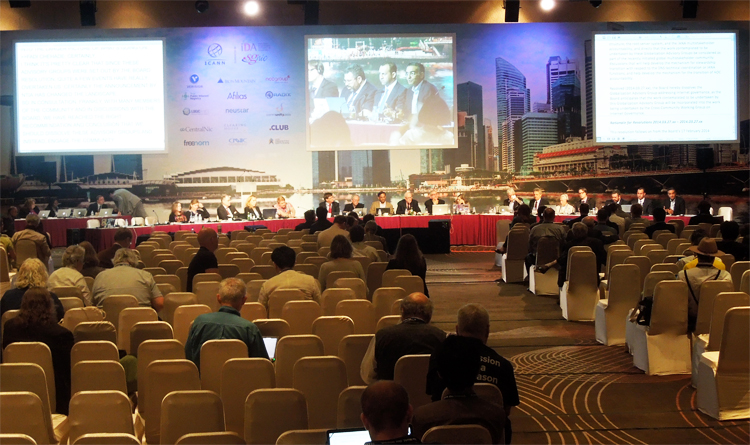
ICANNOne of the fundamental challenges facing ICANN, and regularly articulated at its recent 49th meeting in Singapore, is how to reach consensus amongst the many different stakeholders with interests in the future of the Internet.  Having been doing research over the last 15 years on how to ensure success in multi-stakeholder partnerships (see for example my recent 2013 post, and an older 2012 post on partnerships in education) as well as working with a range of groups on consensus decision making, I find these discussions fascinating, not least for their theatrical quality but also for the apparent lack of knowledge exhibited on the very extensive research that has already been done on managing multi-stakeholder partnerships.

Two  intersecting themes seem relevant, not only to ICANN, but also more widely to the many other ongoing international debates on global governance, particularly with reference to ICTs. These are hugely complex issues, far too challenging to resolve in a simple blog post, but what I want to do here is summarise what I see as being the main issues that require resolution:

  • Multi-stakeholderism representation.  I have to admit hugely to disliking the term multistakeholderism, despite the fact that I frequently plead for people to use the term “multi-stakeholder” rather than “public-private” to refer to the kinds of partnership that are necessary to deliver effective ICT for development initiatives.  “Multi-stakeholder” is preferable because it emphasises that such initiatives require a more diverse set of stakeholders than just the private and public sectors, and that they particularly need to involve civil society. Most research on multi-stakeholder partnerships has focused on how to bring partners together to deliver particular initiatives at a national or local scale, and far less in the context of reaching international agreements (although see Jens Martens’ important work on the latter). The use of the term “multi-stakeholder” has nevertheless been clearly recognised by ICANN (albeit defining it in a very particular way, as treating “the public sector, the private sector, and technical experts as peers”), but a fundamental challenge is to identify the means through which each group can, or should, be represented in international discussions on critical ICT issues.  Four issues seem particularly problematic and pertinent:
    • Defining multi-stakeholders groupings.  Most work on multi-stakeholder partnerships recognises a triadic typology of  “states”, the “private sector” and “civil society”.  However, there are additional types of entity over and beyond these that might be involved under these headings, including international organisations, foundations, and indeed user groups.  These are sometimes treated as sub-sets of civil society, but on other occasions as distinct entities in their own right that could be grouped into additional categories.
    • Numbers and scale.  In global bodies concerned with international treaties, such as UN bodies including the ITU, governments usually have the dominant say, albeit that this say is increasingly being challenged. It is relatively easy to choose the entities that represent governments – they are, after all, finite in number – but for the private sector and especially civil society it becomes much more problematic.  UNDESA’s integrated Civil Society Organizations (iSCO) System thus currently maintains a database of more than 24,000 entries (see also the UN Global Compact’s list).  How can representation from this diversity of stakeholders be included, especially when it is often unclear who exactly these civil society organisations represent?
    • Representative democracy.  Invariably it is only the larger and richer companies and civil society organisations that are able to participate in major international gatherings – often quite simply because of the cost of so doing – although many UN bodies do indeed welcome civil society participation once they have been recognised in some way as members.  In crafting such partnerships, and in line with the notion of representative democracy, there can be value in seeking to involve some kind of representative mechanism, whereby stakeholders elect from their membership people or institutions to speak on their behalf. This prevents the decision making process becoming too unwieldy, but those not elected onto the “Board” can feel aggrieved and not-represented.
    • Governance structures.  The mechanisms for selecting representatives also depend heavily on the kinds of governance structure that are deemed to be appropriate for the purpose in hand. Even here there are difficulties because someone has to determine these criteria in the first place.  At a simplistic level, it would be possible to imagine a multi-stakeholder decision making body made up of a set number of members from each of the three key sectors of “governments”, “companies” and “civil society”.  Within this, there would then need to be mechanisms for determining how the elections would take place, and what the constituencies should be.  In the ITU, for example, members of the Council and the Radio Regulation Board are elected based upon regional groupings.
  • Consensus decision making and democratic representation.  One of the most fascinating aspects of seeking to reach global agreement on particular issues is the choice of the process that is used to seek consensus. When combined with representative mechanisms, most consensus building models use an aggregative process, whereby agreement is sought at one level (for example the “local”), and then representatives from that level  meet at a higher level (such as the “regional”) to seek wider consensus.  This can be a very effective mechanism for reaching consensus, but the ways in which the governance of such structures operate can lead to very different outcomes.  This is highly pertinent to discussions about governance of the Internet and ICTs. Six main principles and issues seem particularly pertinent here:
    • Consensus building requires good will on behalf of all of those involved.  Put simply, if there is not a desire to reach agreement on the part of some of those involved, then no amount of skilled negotiation will reach a successful outcome.  The first stage of any consensus building process must therefore be the need to convict all participants of the benefits of reaching a consensus.  Ultimately, those not willing to commit to this need to be excluded in the interests of reaching agreement among those who are willing to engage in the process.
    • Generally speaking, it often makes sense to try to reach agreement on the most contentious issues at the lowest/local scale, because most time can usually be devoted to reaching consensus here.  For example, if it is expected that different ethnic groups have very different views on a subject, then it makes sense for the difficult issues to be resolved at the lowest scale that can combine these multiple different ethnic perspectives.  However, this does not always work, since unexpected disagreements can emerge later in the process, which can prevent the final reaching of a consensus.
    • Moderation of the consensus building process requires great skill and patience.  All too often, inexperienced chairs or moderators are charged with seeking to reach agreement among a particular constituency, and this can rapidly lead to dissatisfaction and disenfranchisement with the entire process.
    • The choice of representatives to carry forward the discussion at a higher level is critical.  Such people need to combine excellent negotiation skills with empathy for the different perspectives that they need to represent.  They also need to be trusted by their constituencies.
    • Despite a tendency to wish to return to the lowest level to get final agreement on the principles agreed at a higher level, this often leads to the unraveling of the process.  This is largely because consensus decision making requires skillful bargaining, and not everyone involved at the earliest stages of a process may be aware of the issues that emerge later in the process that require resolution.  It is, though, particularly useful if the higher level discussions are open to participation from anyone who wishes to be an observer from the lower levels in the process, since this can serve as a useful check on the probity of the representatives and negotiators.
    • Ultimately, those involved in building consensus need to adhere to the fundamental negotiating principle that they should focus particularly on “What can’t you live with; what can’t you live without“!

If, and it is a big if, the global Interent governance agenda is seen as being concerned with reaching agreement amongst “governments”, “private sector companies” and “civil society”, then drawing on the above two main alternative model structures can be conceptualised:

  • Model A – initial consensus building at a national level
    • The lowest level discussions take place in national forums that bring together representatives of governments, the private sector and civil society
    • National representatives (not necessarily drawn from governments) then meet to reach regional consensuses, such as for East, North, Southern and West Africa.
    • Finally, representatives from these global regions meet to thrash out global agreements.
  • Model B – initial consensus at a sectoral level
    • The lowest level discussions take place in regional sector-specific global forums one in each region (such as East, North, Southern and West Africa) for representatives of governments, another for the private sector and a third for civil society.
    • Representatives from each of these regional sector meetings (or indeed subdivisions within them) then meet to reach a global consensus.  For example, there would be a global private sector meeting bringing together regional private sector representatives, and similar fora for governments and for civil society.
    • Finally, representative of each of the three main groupings meet at a global meeting to bring together the three broad swathes of governments, the private sector and civil society.

To date, it would seem that Model B has often been the preferred modality of consensus building in discussions about Internet and ICT governance. The ITU, for example, holds regional meetings in advance of its major conferences, where it seeks to reach agreement on key issues.

Significantly, most of the major international bodies working in the field of ICTs and the Internet claim in some way to be multi-stakeholder. However, the driving force for each entity usually tends to be from one or the other sectors, be they governments, the private sector or civil society.  Against this context, broadly speaking, ICANN (a private sector, non-profit corporation) has tended to focus on the interests of the private sector, the IGF as a multi-stakeholder policy dialogue (purportedly supporting the UN Secretary General) is widely seen as being the main vehicle for civil society participation, and the ITU is the UN agency generally accepted as being a predominantly governmental body (although defining itself as a “public-private partnership”).  A real challenge is how to bring these together – or whether indeed there is actually real interest in so doing.  Attempts to create a truly global forum, including the ill-fated Global Alliance for ICTs and Development (GAID) have largely failed, although the WSIS+10 process led by the ITU and involving other UN agencies continues to strive to bring a wide range of participants together.

This post is already too long, and barely scratches the surface of these complex issues!  However, we have to find a way to stop holding the same conversations in different circles, and actually create structures and consensuses that serve the interests of the poorest and most marginalised!


4 Comments

Filed under ICT4D, Politics, Uncategorized

Religions in the UK’s 2011 census: David Cameron and his critics

The rather strange and surprisingly vehement exchange of views that has erupted following the UK Prime Minister, David Cameron’s, comments about “faith and the importance of Christianity in our country”,  and those who wrote a letter to the Daily Telegraph criticising his “characterisation of Britain as a ‘Christian country'”, made me explore some of the data that has been published on religious affiliation in the UK.  I found the results somewhat surprising.

Cameron’s critics claim that “Repeated surveys, polls and studies show that most of us as individuals are not Christian in our beliefs or our religious identities”.  So, I turned to the England and Wales Census of 2011, and the reports on it from the Office for National Statistics (ONS) for an update of the situation.  The question on religion was the only voluntary question in the 2011 census, and yet interestingly only 7.2% chose not to answer it.  This might be taken as suggesting that questions about religious affiliation are indeed something that do matter to the majority of people.  As the ONS notes, though, defining religion or religious affiliation is indeed complex: “The question (‘What is your religion?’) asks about religious affiliation, that is how we connect or identify with a religion, irrespective of actual practise or belief. Religion is a many sided concept and there are other aspects of religion such as religious belief, religious practice or belonging which are not covered in this analysis”.  The questions we ask undoubtedly influence the answers we get!

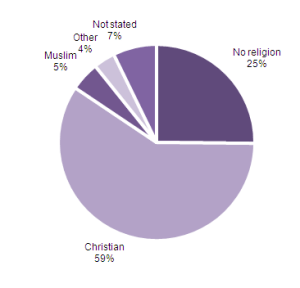
The responses to this question need to be treated with caution, but according to the census, the largest religion in the 2011 Census was Christianity with 33.2 million people, representing a substantial and surprising 59.3% of the population.  Muslims were the next largest religious group, although with only 4.8% of the population.  25.1% of the population said that they had no religion.  Of the other main religious groups: 817,000 people identified themselves as Hindu (1.5% of population); 423,000 people identified as Sikh (0.8% ); 263,000 people as Jewish (0.5% ) and 248,000 people as Buddhist (0.4% ).

sctrfigure1_tcm77-290493Religious affiliation, England and Wales, 2011 (Source: ONS)
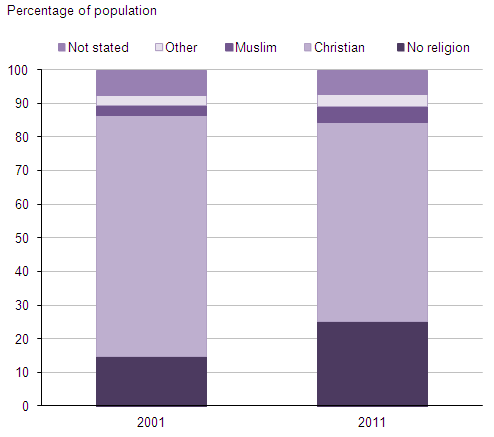
According to these figures, I find it very hard to accept the views of Cameron’s critics at face value.  As comparison with the 2001 census shows (see below), things are undoubtedly changing.  There has certainly been an increase in those reporting “no religion”, from 14.8% of the population in 2001 to 25.1% in 2011.  Likewise, there has been a substantial decline in those reporting to be Christian, from 71.7%  in 2001 to 59.3%  in 2011.

sctrfigure3_tcm77-290499Change in religious affiliation, England and Wales, 2001-2011 (Source: ONS)

However, at least based on these figures, which unlike representative surveys include responses from almost all of the population, it would indeed seem to be the case that England and Wales are still largely a Christian country, and that Cameron’s critics are wrong in claiming that “most of us as individuals are not Christian in our beliefs or our religious identities”.

The problem with this debate is that the two sides seem to be focusing on rather different meanings and interpretations.  Cameron’s critics have focused primarily on their argument that “most British people … do not want religions or religious identities to be actively prioritised by their elected government”, and they are critical of Cameron for introducing religion into politics; it would actually be quite interesting to see data on whether or not their claim is true. Cameron, on the other hand, seems to have been focusing both on his own faith, and on the heritage that Christianity has given to the country and its people.  Again, I have to side with Cameron on the second of these.  Whilst many other religions, and indeed non-religious perspectives, have shaped Britain in recent centuries, Christianity has been the major religious influence over the last 1500 years, and has had a very major impact on our society, culture, and indeed landscapes.

So, to me, this debate is largely a political one, and actually has rather little to do with religion or faith.  In terms of religious beliefs and people practising religions, it is clear that there has indeed been a dramatic decline in Christianity, with a Tearfund report in 2007 indicating that only 15% go to a church at least once a month, and most of the evidence suggests that churchgoing has continued to decline since then.  Accordingly, the moral values of the majority of people are indeed no longer based on a deep Christian faith – if ever they were – but this is something entirely different from saying that Britain is not a Christian country. Indeed, I have a sneaking suspicion that there is some truth in Cameron’s assertion that Britain is more welcoming to people of other faiths than many other countries, “precisely because the tolerance that Christianity demands of our society provides greater space for other religious faiths”.

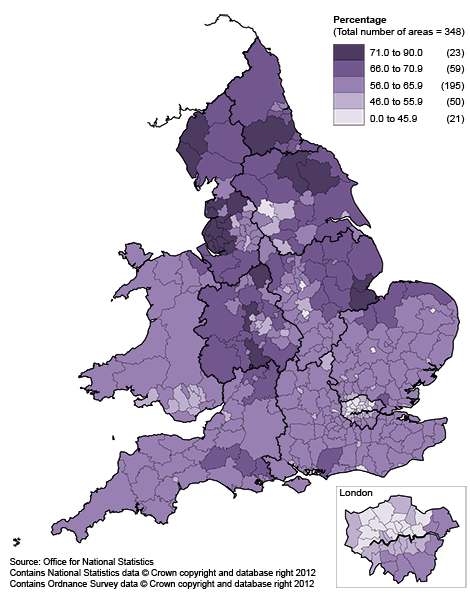
While on the evidence of the census, it is fascinating to note the substantial regional differences in religious affiliation, as the ONS map below indicates:

religionchristiansmallimage_tcm77-290514Spatial distribution of Christian population, 2011 (Source: ONS)

According to ONS figures, Christianity was the largest religion in all local authorities except Tower Hamlets where there were more people who identified as Muslim.  The spatial distribution of people with different religious affiliations is itself fascinating: the local authorities with the next highest percentage of Muslims were Newham, Blackburn with Darwen, Bradford and Luton; Hindu representation was highest in Harrow, Brent, Leicester, Redbridge and Hounslow; Sikhs were most represented in Slough, Wolverhamtpon, Hounslow, Sandwell and Ealing; Buddhists in Rushmoor, Greenwich, Kensington and Chelsea, Westminster and Hounslow; and Jews in Barnet, Hertsmere, Hackney, Bury and Camden.  One of the riches of Britain is indeed our cultural diversity.


3 Comments

Filed under Geography, Politics, Uncategorized

ICT Manager post at the Commonwealth Telecommunications Organisation

The Commonwealth Telecommunications Organisation (CTO) is advertising for an ICT Training Manager, with a closing date of 24th May. The Manager will serve as Head of its Capacity Development and Training Division. This exciting opportunity would suit applicants with a background in delivering effective capacity development and training in the ICT sector, preferably on an international level.

The key role of this position is to enhance and manage the delivery of the CTO’s capacity development and training programmes, both for member organisations and other entities working in the field of ICTs. It is expected that applicants will manage the appropriate delivery of relevant courses, and also undertake some of this training themselves. The role requires close liaison with the Head of Membership in managing and delivering the CTO’s distinct Programme for Development and Training, which currently forms a part of the Capacity Development and Training portfolio. Experience in the delivery of online training would be an advantage. Applicants must be from Full Member Countries of the CTO.

It should also be emphasised that the CTO is proactive in encouraging diversity in the workplace, and particularly encourages applications from women.

Leave a comment

Filed under Africa, Commonwealth, ICT4D