ICT4D Post at University of Cape Town

The University of Cape Town Department of Computer Science is seeking to make a permanent appointment at Professorial level in 2015. The candidate for this position will be a highly-motivated individual with a PhD in Computer Science and an excellent track record in leadership, teaching and research. The successful candidate will be expected to develop and teach Computer Science courses at undergraduate and postgraduate levels, supervise postgraduate students and provide a leadership role in academic strategy, research and innovation. The candidate should also demonstrate the ability to initiate research programmes, secure external funding, and develop industry and academic partnerships.

The Department hosts the UCT interdisciplinary Centre in ICT for Development. A specialist in ICT for Development would be preferred, but candidates with interests in any field of Computer Science are invited to apply. Our BSc Honours degrees are accredited by the British Computer Society and we have a large cohort of MSc and PhD students.

The annual remuneration package for 2014, including benefits, is R887 399 plus a 10% annual scarce skills allowance.

Application process:

To apply, please e-mail the completed UCT Application form (HR201) and all other relevant documentation as indicated on the form, plus a 2-3 page research and teaching statement, with the  subject line “Professor: Computer Science” followed by the reference number, to Ms Edith Graham at recruitment04@uct.ac.za

Address: Staff Recruitment and Selection, University of Cape Town, Private Bag X2, Rondebosch, 7700.
Telephone: +27 21 650 5405 Departmental website: http://www.cs.uct.ac.za

The application form can also be downloaded at http://web.uct.ac.za/depts/sapweb/forms/hr201.doc

An application which does not comply with the above requirements will be regarded as incomplete.

Reference number: SR031 /14 Closing date for applications: 15th September 2014

UCT is committed to the pursuit of excellence, diversity and redress. Our Employment Equity Policy is available at http://www.uct.ac.za/downloads/uct.ac.za/about/policies/eepolicy.pdf

Leave a comment

Filed under ICT4D, Universities

Multistakeholderism and consensus decision making in ICT4D

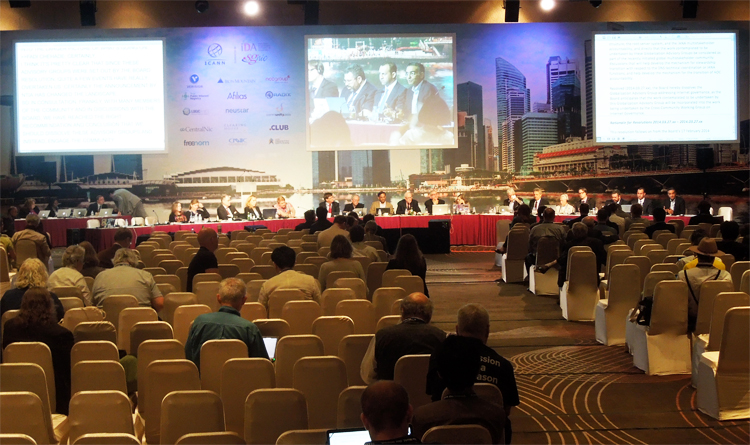
ICANNOne of the fundamental challenges facing ICANN, and regularly articulated at its recent 49th meeting in Singapore, is how to reach consensus amongst the many different stakeholders with interests in the future of the Internet.  Having been doing research over the last 15 years on how to ensure success in multi-stakeholder partnerships (see for example my recent 2013 post, and an older 2012 post on partnerships in education) as well as working with a range of groups on consensus decision making, I find these discussions fascinating, not least for their theatrical quality but also for the apparent lack of knowledge exhibited on the very extensive research that has already been done on managing multi-stakeholder partnerships.

Two  intersecting themes seem relevant, not only to ICANN, but also more widely to the many other ongoing international debates on global governance, particularly with reference to ICTs. These are hugely complex issues, far too challenging to resolve in a simple blog post, but what I want to do here is summarise what I see as being the main issues that require resolution:

  • Multi-stakeholderism representation.  I have to admit hugely to disliking the term multistakeholderism, despite the fact that I frequently plead for people to use the term “multi-stakeholder” rather than “public-private” to refer to the kinds of partnership that are necessary to deliver effective ICT for development initiatives.  “Multi-stakeholder” is preferable because it emphasises that such initiatives require a more diverse set of stakeholders than just the private and public sectors, and that they particularly need to involve civil society. Most research on multi-stakeholder partnerships has focused on how to bring partners together to deliver particular initiatives at a national or local scale, and far less in the context of reaching international agreements (although see Jens Martens’ important work on the latter). The use of the term “multi-stakeholder” has nevertheless been clearly recognised by ICANN (albeit defining it in a very particular way, as treating “the public sector, the private sector, and technical experts as peers”), but a fundamental challenge is to identify the means through which each group can, or should, be represented in international discussions on critical ICT issues.  Four issues seem particularly problematic and pertinent:
    • Defining multi-stakeholders groupings.  Most work on multi-stakeholder partnerships recognises a triadic typology of  “states”, the “private sector” and “civil society”.  However, there are additional types of entity over and beyond these that might be involved under these headings, including international organisations, foundations, and indeed user groups.  These are sometimes treated as sub-sets of civil society, but on other occasions as distinct entities in their own right that could be grouped into additional categories.
    • Numbers and scale.  In global bodies concerned with international treaties, such as UN bodies including the ITU, governments usually have the dominant say, albeit that this say is increasingly being challenged. It is relatively easy to choose the entities that represent governments – they are, after all, finite in number – but for the private sector and especially civil society it becomes much more problematic.  UNDESA’s integrated Civil Society Organizations (iSCO) System thus currently maintains a database of more than 24,000 entries (see also the UN Global Compact’s list).  How can representation from this diversity of stakeholders be included, especially when it is often unclear who exactly these civil society organisations represent?
    • Representative democracy.  Invariably it is only the larger and richer companies and civil society organisations that are able to participate in major international gatherings – often quite simply because of the cost of so doing – although many UN bodies do indeed welcome civil society participation once they have been recognised in some way as members.  In crafting such partnerships, and in line with the notion of representative democracy, there can be value in seeking to involve some kind of representative mechanism, whereby stakeholders elect from their membership people or institutions to speak on their behalf. This prevents the decision making process becoming too unwieldy, but those not elected onto the “Board” can feel aggrieved and not-represented.
    • Governance structures.  The mechanisms for selecting representatives also depend heavily on the kinds of governance structure that are deemed to be appropriate for the purpose in hand. Even here there are difficulties because someone has to determine these criteria in the first place.  At a simplistic level, it would be possible to imagine a multi-stakeholder decision making body made up of a set number of members from each of the three key sectors of “governments”, “companies” and “civil society”.  Within this, there would then need to be mechanisms for determining how the elections would take place, and what the constituencies should be.  In the ITU, for example, members of the Council and the Radio Regulation Board are elected based upon regional groupings.
  • Consensus decision making and democratic representation.  One of the most fascinating aspects of seeking to reach global agreement on particular issues is the choice of the process that is used to seek consensus. When combined with representative mechanisms, most consensus building models use an aggregative process, whereby agreement is sought at one level (for example the “local”), and then representatives from that level  meet at a higher level (such as the “regional”) to seek wider consensus.  This can be a very effective mechanism for reaching consensus, but the ways in which the governance of such structures operate can lead to very different outcomes.  This is highly pertinent to discussions about governance of the Internet and ICTs. Six main principles and issues seem particularly pertinent here:
    • Consensus building requires good will on behalf of all of those involved.  Put simply, if there is not a desire to reach agreement on the part of some of those involved, then no amount of skilled negotiation will reach a successful outcome.  The first stage of any consensus building process must therefore be the need to convict all participants of the benefits of reaching a consensus.  Ultimately, those not willing to commit to this need to be excluded in the interests of reaching agreement among those who are willing to engage in the process.
    • Generally speaking, it often makes sense to try to reach agreement on the most contentious issues at the lowest/local scale, because most time can usually be devoted to reaching consensus here.  For example, if it is expected that different ethnic groups have very different views on a subject, then it makes sense for the difficult issues to be resolved at the lowest scale that can combine these multiple different ethnic perspectives.  However, this does not always work, since unexpected disagreements can emerge later in the process, which can prevent the final reaching of a consensus.
    • Moderation of the consensus building process requires great skill and patience.  All too often, inexperienced chairs or moderators are charged with seeking to reach agreement among a particular constituency, and this can rapidly lead to dissatisfaction and disenfranchisement with the entire process.
    • The choice of representatives to carry forward the discussion at a higher level is critical.  Such people need to combine excellent negotiation skills with empathy for the different perspectives that they need to represent.  They also need to be trusted by their constituencies.
    • Despite a tendency to wish to return to the lowest level to get final agreement on the principles agreed at a higher level, this often leads to the unraveling of the process.  This is largely because consensus decision making requires skillful bargaining, and not everyone involved at the earliest stages of a process may be aware of the issues that emerge later in the process that require resolution.  It is, though, particularly useful if the higher level discussions are open to participation from anyone who wishes to be an observer from the lower levels in the process, since this can serve as a useful check on the probity of the representatives and negotiators.
    • Ultimately, those involved in building consensus need to adhere to the fundamental negotiating principle that they should focus particularly on “What can’t you live with; what can’t you live without“!

If, and it is a big if, the global Interent governance agenda is seen as being concerned with reaching agreement amongst “governments”, “private sector companies” and “civil society”, then drawing on the above two main alternative model structures can be conceptualised:

  • Model A – initial consensus building at a national level
    • The lowest level discussions take place in national forums that bring together representatives of governments, the private sector and civil society
    • National representatives (not necessarily drawn from governments) then meet to reach regional consensuses, such as for East, North, Southern and West Africa.
    • Finally, representatives from these global regions meet to thrash out global agreements.
  • Model B – initial consensus at a sectoral level
    • The lowest level discussions take place in regional sector-specific global forums one in each region (such as East, North, Southern and West Africa) for representatives of governments, another for the private sector and a third for civil society.
    • Representatives from each of these regional sector meetings (or indeed subdivisions within them) then meet to reach a global consensus.  For example, there would be a global private sector meeting bringing together regional private sector representatives, and similar fora for governments and for civil society.
    • Finally, representative of each of the three main groupings meet at a global meeting to bring together the three broad swathes of governments, the private sector and civil society.

To date, it would seem that Model B has often been the preferred modality of consensus building in discussions about Internet and ICT governance. The ITU, for example, holds regional meetings in advance of its major conferences, where it seeks to reach agreement on key issues.

Significantly, most of the major international bodies working in the field of ICTs and the Internet claim in some way to be multi-stakeholder. However, the driving force for each entity usually tends to be from one or the other sectors, be they governments, the private sector or civil society.  Against this context, broadly speaking, ICANN (a private sector, non-profit corporation) has tended to focus on the interests of the private sector, the IGF as a multi-stakeholder policy dialogue (purportedly supporting the UN Secretary General) is widely seen as being the main vehicle for civil society participation, and the ITU is the UN agency generally accepted as being a predominantly governmental body (although defining itself as a “public-private partnership”).  A real challenge is how to bring these together – or whether indeed there is actually real interest in so doing.  Attempts to create a truly global forum, including the ill-fated Global Alliance for ICTs and Development (GAID) have largely failed, although the WSIS+10 process led by the ITU and involving other UN agencies continues to strive to bring a wide range of participants together.

This post is already too long, and barely scratches the surface of these complex issues!  However, we have to find a way to stop holding the same conversations in different circles, and actually create structures and consensuses that serve the interests of the poorest and most marginalised!


4 Comments

Filed under ICT4D, Politics, Uncategorized

Religions in the UK’s 2011 census: David Cameron and his critics

The rather strange and surprisingly vehement exchange of views that has erupted following the UK Prime Minister, David Cameron’s, comments about “faith and the importance of Christianity in our country”,  and those who wrote a letter to the Daily Telegraph criticising his “characterisation of Britain as a ‘Christian country'”, made me explore some of the data that has been published on religious affiliation in the UK.  I found the results somewhat surprising.

Cameron’s critics claim that “Repeated surveys, polls and studies show that most of us as individuals are not Christian in our beliefs or our religious identities”.  So, I turned to the England and Wales Census of 2011, and the reports on it from the Office for National Statistics (ONS) for an update of the situation.  The question on religion was the only voluntary question in the 2011 census, and yet interestingly only 7.2% chose not to answer it.  This might be taken as suggesting that questions about religious affiliation are indeed something that do matter to the majority of people.  As the ONS notes, though, defining religion or religious affiliation is indeed complex: “The question (‘What is your religion?’) asks about religious affiliation, that is how we connect or identify with a religion, irrespective of actual practise or belief. Religion is a many sided concept and there are other aspects of religion such as religious belief, religious practice or belonging which are not covered in this analysis”.  The questions we ask undoubtedly influence the answers we get!

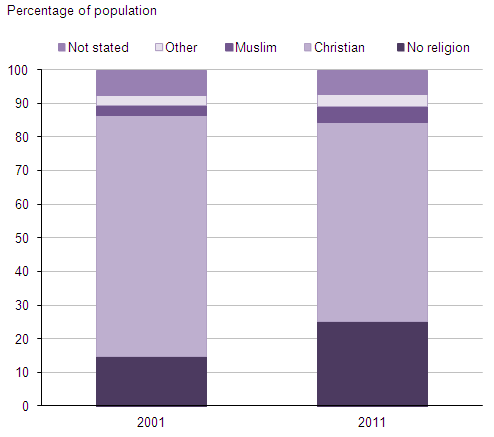
The responses to this question need to be treated with caution, but according to the census, the largest religion in the 2011 Census was Christianity with 33.2 million people, representing a substantial and surprising 59.3% of the population.  Muslims were the next largest religious group, although with only 4.8% of the population.  25.1% of the population said that they had no religion.  Of the other main religious groups: 817,000 people identified themselves as Hindu (1.5% of population); 423,000 people identified as Sikh (0.8% ); 263,000 people as Jewish (0.5% ) and 248,000 people as Buddhist (0.4% ).
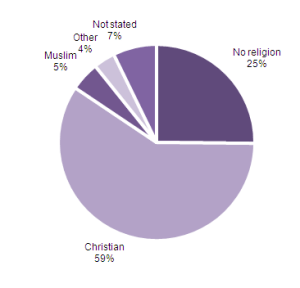
sctrfigure1_tcm77-290493Religious affiliation, England and Wales, 2011 (Source: ONS)

According to these figures, I find it very hard to accept the views of Cameron’s critics at face value.  As comparison with the 2001 census shows (see below), things are undoubtedly changing.  There has certainly been an increase in those reporting “no religion”, from 14.8% of the population in 2001 to 25.1% in 2011.  Likewise, there has been a substantial decline in those reporting to be Christian, from 71.7%  in 2001 to 59.3%  in 2011.
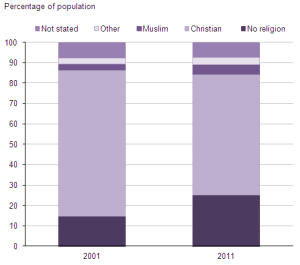
sctrfigure3_tcm77-290499Change in religious affiliation, England and Wales, 2001-2011 (Source: ONS)

However, at least based on these figures, which unlike representative surveys include responses from almost all of the population, it would indeed seem to be the case that England and Wales are still largely a Christian country, and that Cameron’s critics are wrong in claiming that “most of us as individuals are not Christian in our beliefs or our religious identities”.

The problem with this debate is that the two sides seem to be focusing on rather different meanings and interpretations.  Cameron’s critics have focused primarily on their argument that “most British people … do not want religions or religious identities to be actively prioritised by their elected government”, and they are critical of Cameron for introducing religion into politics; it would actually be quite interesting to see data on whether or not their claim is true. Cameron, on the other hand, seems to have been focusing both on his own faith, and on the heritage that Christianity has given to the country and its people.  Again, I have to side with Cameron on the second of these.  Whilst many other religions, and indeed non-religious perspectives, have shaped Britain in recent centuries, Christianity has been the major religious influence over the last 1500 years, and has had a very major impact on our society, culture, and indeed landscapes.

So, to me, this debate is largely a political one, and actually has rather little to do with religion or faith.  In terms of religious beliefs and people practising religions, it is clear that there has indeed been a dramatic decline in Christianity, with a Tearfund report in 2007 indicating that only 15% go to a church at least once a month, and most of the evidence suggests that churchgoing has continued to decline since then.  Accordingly, the moral values of the majority of people are indeed no longer based on a deep Christian faith – if ever they were – but this is something entirely different from saying that Britain is not a Christian country. Indeed, I have a sneaking suspicion that there is some truth in Cameron’s assertion that Britain is more welcoming to people of other faiths than many other countries, “precisely because the tolerance that Christianity demands of our society provides greater space for other religious faiths”.

While on the evidence of the census, it is fascinating to note the substantial regional differences in religious affiliation, as the ONS map below indicates:
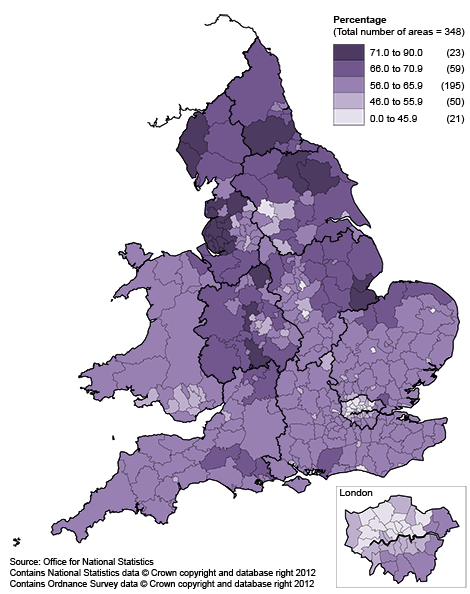
religionchristiansmallimage_tcm77-290514Spatial distribution of Christian population, 2011 (Source: ONS)

According to ONS figures, Christianity was the largest religion in all local authorities except Tower Hamlets where there were more people who identified as Muslim.  The spatial distribution of people with different religious affiliations is itself fascinating: the local authorities with the next highest percentage of Muslims were Newham, Blackburn with Darwen, Bradford and Luton; Hindu representation was highest in Harrow, Brent, Leicester, Redbridge and Hounslow; Sikhs were most represented in Slough, Wolverhamtpon, Hounslow, Sandwell and Ealing; Buddhists in Rushmoor, Greenwich, Kensington and Chelsea, Westminster and Hounslow; and Jews in Barnet, Hertsmere, Hackney, Bury and Camden.  One of the riches of Britain is indeed our cultural diversity.


3 Comments

Filed under Geography, Politics, Uncategorized

ICT Manager post at the Commonwealth Telecommunications Organisation

The Commonwealth Telecommunications Organisation (CTO) is advertising for an ICT Training Manager, with a closing date of 24th May. The Manager will serve as Head of its Capacity Development and Training Division. This exciting opportunity would suit applicants with a background in delivering effective capacity development and training in the ICT sector, preferably on an international level.

The key role of this position is to enhance and manage the delivery of the CTO’s capacity development and training programmes, both for member organisations and other entities working in the field of ICTs. It is expected that applicants will manage the appropriate delivery of relevant courses, and also undertake some of this training themselves. The role requires close liaison with the Head of Membership in managing and delivering the CTO’s distinct Programme for Development and Training, which currently forms a part of the Capacity Development and Training portfolio. Experience in the delivery of online training would be an advantage. Applicants must be from Full Member Countries of the CTO.

It should also be emphasised that the CTO is proactive in encouraging diversity in the workplace, and particularly encourages applications from women.

Leave a comment

Filed under Africa, Commonwealth, ICT4D

Towards a Commonwealth-wide Raspberry Pi initiative…

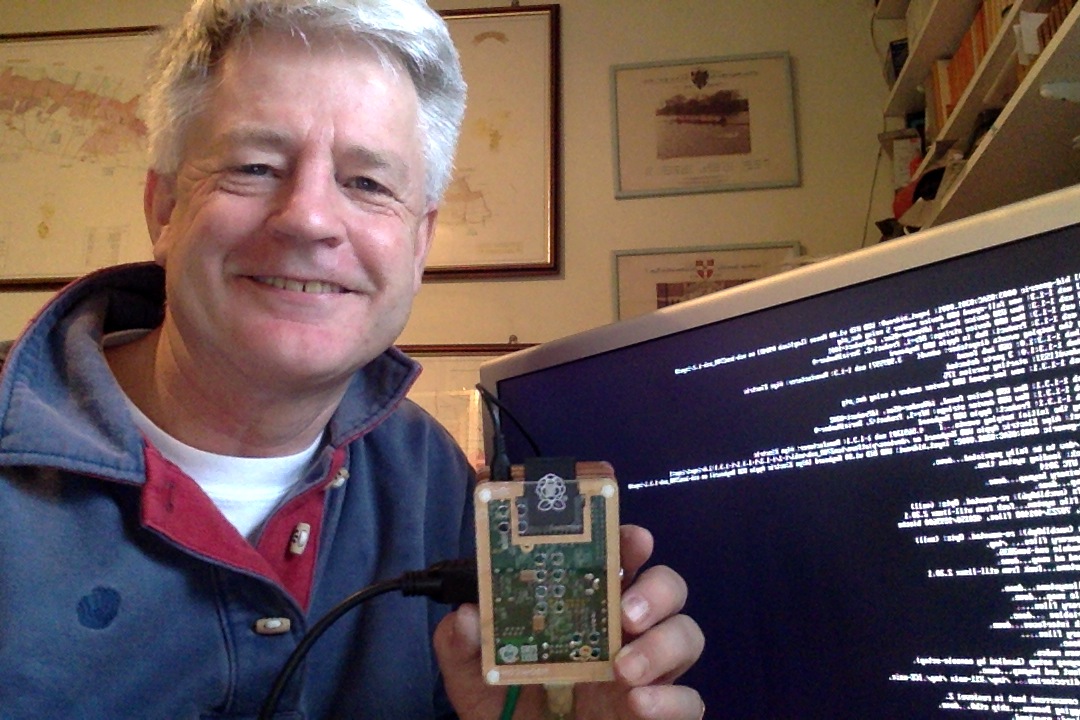
Me and Raspberry PiRaspberry Pi is transforming the ways in which young (and old!) people learn about computing, and provides a powerful, value for money means through which students across the world can gain skills relevant to Science, Technology, Engineering and Mathematics (STEM) curricula.  It is not only relevant to secondary education, but is also being used by undergraduates to develop their programming skills.  As yet, Raspberry Pis are not widely used in many of the poorer countries of the Commonwealth, but given their power and value for money they offer real potential for STEM education.  I had a great discussion earlier this week with Lance Howarth (CEO Raspberry Pi Foundation) during which I shared some of my ideas about how a multi-stakeholder partnership could be developed to help organisations in Commonwealth countries access and use Raspberry Pis effectively within their education systems.  Much would need to be done to implement such an initiative, but if enough interested parties could be brought together, we could make a real difference in helping to build relevant skills among young people across the Commonwealth.  Key things that would need to be put in place would include:

  • National champions willing to help take forward the initiative in initial countries;
  • Careful integration with relevant curricula at school and university level;
  • Establishing whether  current distribution channels enable easy access to hardware;
  • Appropriate support for teachers/lecturers (see details of the Picademy);
  • Funding support for enabling purchase of hardware

At this stage, it is important to gauge the level of interest that there might be in taking these ideas forward. If anyone is interested in helping to craft such an initiative, do please get in touch with me, and we can begin to build a coalition of the willing!  I think this is potentially very exciting, and it would be great to work with like-minded people to make it happen!  Do please respond in the comments below or on the ICT4D Facebook Group page.  Let’s make this happen!

24 Comments

Filed under Commonwealth, ICT4D

Majeka House – a lovely place to stay near Stellenbosch

For anyone seeking a comfortable and relaxed place to stay while exploring the wineries of Cape Province in South Africa I can thoroughly recommend the Majeka House, just outside Stellenbosch.  Hidden away in a quiet residential area, the hotel provides a wonderful oasis of luxury in which to unwind at the end of a busy day of tasting!  With a warm welcome, beautifully hand-crafted rooms, great views, a relaxing pool, and the fine Makaron Restaurant (one of the top 20 in South Africa), it is a very special place to stay.

This slideshow requires JavaScript.

Breakfasts are delicious, although I definitely preferred the anti-oxidant juice to the green revitaliser!  Also, beware the white pebbles in the birdcage at dinner – I dread to think of the teeth damage if someone bit hard on them!  As the above pictures illustrate, though, the food was innovatively presented, and of very high quality.  Make sure you book in advance, because the restaurant gets very full!

2 Comments

Filed under Africa, Restaurants, Wine

My favourite South African Wines…

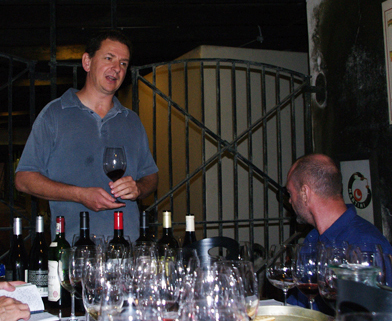
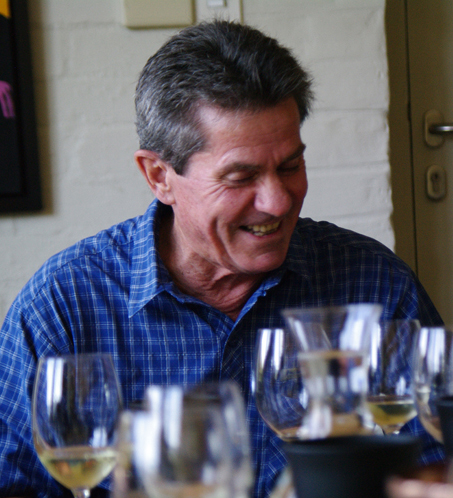
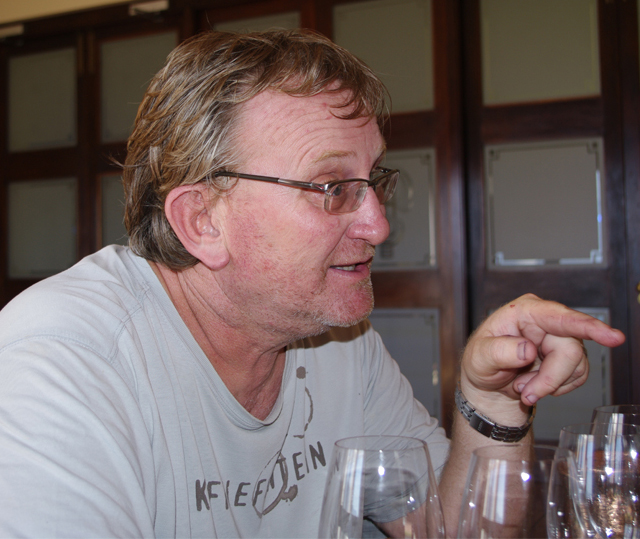
ThelemaA visit to the Cape Province of South Africa last week in order to help select wines for the Athenaeum provided a great opportunity to learn something about  recent changes in the wine industry in the Cape and to taste some of the really excellent wines that are now being produced there.  It is some 40 years since I last visited Stellenbosch and Paarl, and it is great to see the quality of wines now being made in the region.

Thanks to Stuart and George who arranged the itinerary, and the hospitality of many amazing wine makers, we had the privilege of tasting nearly 200 wines from Stellenbosch, the Cape Peninsula, Franschhoek and the hinterland of Hermanus.  While this represented only a small fraction of the many wines now being made in South Africa, it did highlight three significant things for me:

  • First, the quality of the wines has improved very dramatically indeed over the last 15 or so years.  There are without doubt now some really excellent wines being made in South Africa, and they are very good value indeed, with many of the best wines being priced at under ZAR 250 (£15) a bottle.  We scarcely tasted a poor bottle, and it was difficult to choose those that I preferred best for my list of favourite wines below!
  • Second, South African wine makers have definitely learnt and understood the importance of terroir. Given my geographical wine “upbringing” in Burgundy, I have always argued that the physical environment has a very important role in determining the character of a wine, and it is good to see the increasing differentiation that now exists in the planting locations of different grape varieties in the Cape area.  Many of the wines we tasted emanated from some of the cooler vineyard locations, higher up on the mountain slopes, in windier locations, and closer to the sea.
  • Third, South Africa’s vineyards have to be amongst the most beautifully situated in the world, with many of them being in very picturesque locations, as I hope the pictures below illustrate.  Whilst leafroll virus is a serious problem for grape-growers, it does have the merit of turning vines a beautiful red colour in the autumn!

This slideshow requires JavaScript.

Despite the pleadings of my colleagues, I am still not convinced by many of the Chenin Blanc wines we tasted, perhaps with the exception of some of the sweet dessert wines.  I’m sure that some of my reticence stems from tasting too many rough Steen wines when I was younger!  While I recognise that modern good quality Chenin Blanc wines are indeed being made, I simply don’t particularly like them, finding the astringent flavours that I encountered in my youth all too often still to be present.  Likewise, I have to confess not really to liking wines made from the Pinotage grape.  All too often they too retain bitter flavours, and I found many of those we tasted to be rather unbalanced and poorly structured – with one delicious exception!

So, to conclude, my favourite wines, in alphabetical order of producers were:

  • 4Buitenverwachting (with MD Lars Maack)

    • 2009 Christine – excellent open fruity nose; 14.5% alcohol; rich, rounded, soft tannins; red fruit flavours; 45% Cabernet Franc contributes to tobacco and chocolate flavours (with 45% Cabernet Sauvignon and 10% Merlot); well balanaced and good length
  • Chamonix (with Wine-maker Gottfried Mocke)

    • 2011 Pinotage – a very unusual wine made in a similar style to Ripasso, combining fresh wine refermenting with air dried grapes; half-picked very young and undergoes carbonic maceration; other half desiccated and refermented with first picking; grown at 440 m 9on Greywacke soils; 14.5% alcohol; kept mainly in one-year-old Pinot Noir barrels; dark red with complex green and dark fruit flavours; very soft tannins.
    • 2012 Chardonnay Reserve – 13.5% alcohol; 14 months in 228 l French oak; 30 year old vines which show character and personality; 80% barrel fermented with 20% in 600 l concrete eggs, which enable wine to be oxygenated and the lees stay in suspension for longer than using other fermenters; high acidity early grapes are put into concrete, with later pickings going into barrels; always goes through malo-lactic; tries to pick fruit at lower sugar levels to make wines more in a Burgundian style; 65% new oak used for this vintage, which remains very evident; need to keep for some time.
  • 5Cape Point (with Wine-maker Duncan Savage)

    • 2011 Late Harvest Noble 8 – only made when conditions are right, with some 2000 half bottles being produced in 2011; 160 grams residual sugar; 10.5% alcohol;  Sauvignon Blanc and Semillon botrytised blend; rich balanced fruit flavours; good length; acidity balances out the rich fruit; dried apricot flavours.
  • Delheim (with Viticulturist Vic Sperling)

    • 102009 Vera Cruz Shiraz – we had the last bottle in the cellar sadly; produced from bush vines; 14.5% alcohol; rich, intense fresh red fruits on the nose; fruity flavours of plums and jam; good length and complexity; their Vera Cruz wines are only made in years when the fruit is good enough; a powerful wine to be kept for a while.
    • 2013 Edelspatz Noble Late Harvest – botrytised Riesling from Simonsberg Mountain; good acid balance; not overly rich; classic slight petrol nose, but well structured and luscious flavours of honey and apricots.
  • Glenelly (with Wine-maker Luke O’Cuinneagain)

    • 12012 Oaked Chardonnay – light golden colour; blanche toasted 500 l barrels designed to keep as much natural fruit flavour as possible; fresh with good fruit expression; distinctive pear flavour, with slight citrus touches; richer and softer than their unoaked Chardonnay; good structure and depth.
    • 2010 Syrah – designed to be like a northern Rhône wine; 100% whole bunch fermented; purple-red colour; very clean, with slight smell of bacon; white pepper and floral aromas; relatively low alcohol at 13.9%; soft tannins, but needs time to develop.
  • Klein Constantia (Wine-maker Matthew Day)

    • 22013 Sauvignon Blanc – made with free-run juice from grapes from across the property; very pale in colour; up-front nose of gooseberry and blackcurrant leaves; 4 months in steel on lees; fresh in mouth, with balanced acidity on edge of tongue; quite light and eminently drinkable
    • 2008 Vin de Constance – classic dessert wine made from Muscat de Frontignan grapes, left to dry on the vine; good rich flavours of candied orange, with other fruits including a slight pineapple taste; good depth and length; balanced acidity.
  • Meerlust (with Chris Williams, Cellar Master)

    • 62012 Pinot Noir – a serious wine; lovely rich nose; has been made since 2004 on coolest hilltops, which catch the breeze being only 3 kms from the sea; vines grown on decomposed granite; picked at 4-6 tonnes per hectare; vinified in small batches, some with natural fermentation; has an interesting liquorice nose; quite soft tannins; needs keeping for several years.
    • 2009 Rubicon – excellent Bordeaux blend style wine (69% Cabernet Sauvignon, 20% Merlot, 10% Cabernet France and 1% Petit Verdot); very rich and intense rich blackcurrant fruit flavours; complex; good length; well structured; definitely for keeping.
  • Newton Johnson (with Bevan Newton Johnson, MD)

    • 32012 Family Vineyards Pinot Noir – really good wine, clean, well structured, medium length, and rich complexity of Pinot flavours resulting from use of grapes from three adjacent vineyards (20% from Mrs. M, 30% from Block 6, and 50% from Windansea); first made in 2008/9; red fruit rather than vegetal.
    • 2012 Windansea Pinot Noir – Pinot Noir from a single vineyard which has more clay than adjacent ones, giving a deeper colour; a bit closed and more restrained than the fruitier more open Mrs. M and Block 6; well structured with good acid balance; excellent finesse; red and black berry fruits.  A really excellent wine.
  • Spier
    • 21 Gables Sauvignon Blanc – hand harvested; made from grapes grown in Durbanville near the Atlantic on red gravel and clay soils; nose of new mown hay; acidity clearly felt at edge of tongue; but well structured; rich complex flavours of gooseberry and slight asparagus; 13.5% alcohol.
  • Thelema (with Cellar Master Gyles Webb)

    • 82011 Cabernet Sauvignon “The Mint” – made from the first Cabernet Sauvignon vines they planted, with eucalyptus trees nearby, which give the wine a distinctive minty nose and flavour; mid-red colour; well-balanced and good structure; will be long-lived.
  • Vergelegen (with Wine-maker Andre van Rensburg)

    • 2011 Merlot – the first 100% Merlot wine made at Vergelegen since 1998; although Andre sees himself mainly as a Cabernet Sauvignon producer, he believes they have the environment to produce excellent Merlot; lovely soft nose and very gently tannins; still a bit young, and lacking a bit in length, but overall very pleasant.
    • 72010 DNA – Cabernet Franc does well at Vergelegen, but the yield needs to be reduced down to around 4 tonnes per hectare; aim is to pick the fruit as late as possible; mid-red, quite intense colour; 65% Cabernet Franc, Merlot 21% and Cabernet Sauvignon 13%; fantastic high notes on nose; very soft tannins; not as strong a smoky nose as I would have expected with this amount of Cabernet Franc; wine is designed to be fruity rather than green.  Wine is made in recognition of Andre’s respect to Cheval Blanc, with the DNA often being thought of as being similar to terroir.  Others might think that it is short for “Dickhead ‘n Arsehole”!  Incidentally, the label is not a fingerprint, but rather the contours of a hill!

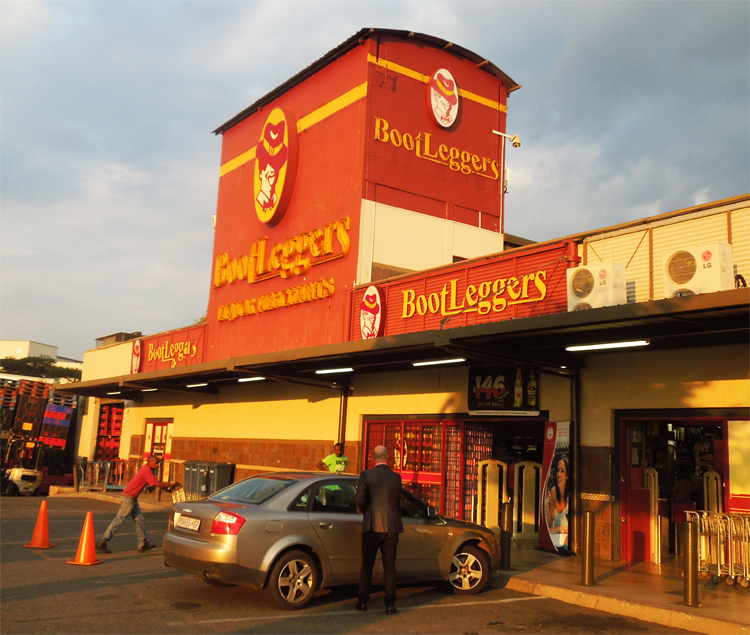
Finally, I have long appreciated the work that Charles Back has done at Fairview, and particularly his BootLeggerscommitment to social change in the region.  In 1997 he helped establish The Fairvalley Workers Association, which aims to help workers at Fairview to have their own land, and he was also the driving force behind the Fairvalley wine brand that is owned by the Workers Association, with profits from the sale of their wines (made using cellar facilities at Fairview, and FairTrade certified) being used to support community development initiatives.  Being in South Africa enabled me to access further wines that it is difficult to get in the UK, and so I particularly enjoyed the opportunity to explore the shelves of Bootleggers in Fourways Crossing and purchase additional wines, including some of Fairvalley’s remarkably good value 2009 Cabernet Sauvignon, which was delicious with boerewors, as well as  a bottle of Fairview’s 2010 Goat-Roti (Syrah/Viognier blend) that went especially well with barbecued fillet steak!

For those looking for somewhere quiet and relaxing to stay while exploring the vineyards of the Cape, I thoroughly recommend Majeka House, just outside Stellenbosch, which also houses the excellent Makaron Restaurant!


4 Comments

Filed under Africa, Photographs, Restaurants, Wine

Locusts at Walter Sisulu Botanical Garden

A short visit to Johannesburg provided an excellent opportunity to visit the beautiful Walter Sisulu Botanical Garden to learn something about the rich diversity of plant and bird life in South Africa.  While there, we encountered hundreds of locusts, and not only saw the devastation that they were doing to some of the plants, but also the amazing beauty of their colours when in flight.  They looked more like brightly coloured small birds than they did green locusts! Trying to capture them in photographs was, though, far from simple, not least since they would show no visible signs of taking off, and then suddenly lift off into the air and speed away.  Even using very fast shutter speeds it was difficult to capture them!  I hope, though, that the selection of images below captures not only their beauty, but also of the damage that they do.


This slideshow requires JavaScript.

Leave a comment

Filed under Africa, Photographs, Uncategorized

Jordan Wine Estate, Stellenbosch

It is some 40 years since I was last in Stellenbosch – and how it has changed!  Today, I had the privilege of being introduced to the wines of Jordan Wine Estate by Gary and Kathy Jordan – in the company of some good friends.  It is great to see the impact that UC Davis has on far-flung parts of the world, and also to meet wine-makers who combine expertise in geology and economics to produce some really very good wines!  Terroir is definitely alive and well here.  Sadly, I’m not yet able to share the flavours of the wines virtually, but I hope that the images below capture something of the beauty of this part of South Africa, as well as the care and attention to detail that marks out wine-making at Jordan Wine Estate!  Have to say that I particularly enjoyed the 2011 Cobblers Hill – and the lunch!

This slideshow requires JavaScript.

Leave a comment

Filed under Africa, Photographs, Wine

ICANN 49 Gala in Flower Dome, Singapore

The Gala Evening at ICANN 49 in Singapore was held at the amazing Flower Dome at Gardens by the Bay on the evening of Monday 26th March 2014.  With 3,332 panels of 42 varying shapes and sizes of spectrally selective glass, the dome was completed only a couple of years ago with a 1.2 hectare footprint and a height of 38 metres.  The temperature is kept at a constant 23°-25° C with humidity between 60% and 80%. It houses a wide range of plants from the Mediterranean and semi-arid subtropical regions, as well as having changing displays in its Flower Field.  Amongst its prize collection is an olive tree from Spain reputed to be a thousand years old!  This month, the English Wars of the Roses (1455-1487) between the Houses of York and Lancaster were fought out in red and white flowers.  Our guide mentioned that only three events a year are permitted in the Flower Dome, and so we were fortunate indeed to be able to enjoy such a location.  The images below do not really do it justice!  Thanks to the team at ICANN for giving us this opportunity!

This slideshow requires JavaScript.

Leave a comment

Filed under ICT4D, Photographs, Uncategorized