
ICTs and ecosystems

david_stoddartAs a young geographer, I had the privilege of learning from the extraordinary David Stoddart, and can never forget reading the numerous books and papers on small island ecosystems that he recommended to us in the mid-1970s – and being jealous that he was able to be doing research on beautiful far-away places such as Aldabra!  Likewise, Richard Chorley and Barbara Kennedy’s Physical Geography: a Systems Approach was required reading on several courses.  Although not quite as inspirational as David Stoddart’s physical presence,  I recall being enthused by this book to go back and read some of Ludwig von Bertalanffy’s work on General Systems Theory, and struggling to balance this with my own increasing interest in structuralism and Marxist theory.

Hence, I have always adopted a principled and historical understanding of the origins and development of the systems approach in academic discourse.  This has made me ever more infuriated by the irritating, and quite simply inappropriate, usage of the word “ecosystem” by so many people, particularly in the business sector, who persist in using the word ecosystem to describe the system of digital technologies, ICTs and telecommunications.  Better argued than most is the use of the word “ecosystem”, for example, in Martin Fransman’s The New ICT Ecosystem (Cambridge University Press, 2010), but it remains fundamentally misguided, and little is gained by adding the “eco” to the “system”!  Despite my constant pleading that such usage is quite simply wrong, and corrupts the meaning of the word “ecosystem”, I have never made headway on this, and so want to try to capture here the basis for my critique.

There are two main reasons why I am so offended by the usage of the word “ecosystem” to refer to digital ICT systems:

  • Perfectly camouflaged dragonflyFirst, the word “ecosystem” is fundamentally a biological concept, and refers to the interaction between organisms and the physical environment in which they live.  The term originated in the early 1930s in the work of Arthur Roy Clapham and was made popular through the writings of the ecologist Arthur Tansley, who particularly emphasised the flows of materials between organisms and the environment.  As an ecological term, it is the “eco” that differentiates “ecosystems” from any other kind of system (the notion of “eco” being derived from the ancient Greek οἶκος meaning “house” or “dwelling”).  I absolutely agree that the context of ICTs is complex and that a systems approach can be of help in understanding and describing it, but I simply cannot see what value there is in adding the fundamentally “biological” attribute implied by the addition of “eco”.  Moreover, the physical, technical character of most ICTs is so fundamentally non-biological, that it seems even more inappropriate to keep using this term.  To be sure there is  exciting work going on at the interface between biological humans and non-biological machines, but this is rather different from the ways in which the word “ecosystem” is traditionally used in the ICT sector.

  • Starehe computer gravey#C4CSecond, and linked to the above, the advent of ICTs has itself actually had huge, and often very negative, implications for the environment, and thus for the very essence of  the “eco” that lies at the heart of the meaning of “ecosystem”. It is great that certain technology companies and organisations are now beginning to take a more environmentally responsible attitude to the environmental implications of their work.  The GSMA for example has placed great emphasis on trying to ensure that its annual Mobile World Congress in Barcelona is carbon neutral.  Likewise, since 2009 Apple has placed considerable emphasis on environmental agendas, including environmental footprint, renewable energy and product reports.  However, many of the reports on the benefits of ICTs and telecommunications in terms of reducing human impacts on the environment are only partial, and vastly overstate the beneficial aspects of ICT use for the environment.  Again, there are interesting initiatives in this area, as for example with Ericsson’s environmental programme, or the ITU’s environment and climate change work.  However, insufficient research of rigorous quality has yet been done in this area, and the impact of ICTs is such that it seems fundamentally inappropriate to use any word that seeks to impute some kind of positive biological linkage.


So, can people please stop using the word ecosystem to refer to the field of ICTs and telecommunications.  The word “system” alone seems just fine to describe the complex interrelationships and flows of energy between components in whatever integral whole those working in the ICT field want to talk about!

7 Comments

Filed under ICT4D, ICT4D general

If m-learning is the answer, what is the question?

I was very privileged that Adrian Godfrey asked me to say a few words to introduce the session on m-education that the GSMA convened earlier today at the Mobile World Congress in Barcelona.  It was good to be with a fun group of panelists, and I hope that we gave them some food for thought.

So, this is what I said.  It was designed to be provocative, but its intent was to emphasise that there are many different interests in the use of mobile devices for learning, and that if we are going to take advantage of the enormous potential that they can offer for the poorest and most marginalised then we need to recognise these interests, and work together in carefully crafted partnerships to deliver effective learning opportunities.

“If m-learning is the answer, what is the question?
MaasaiLess than two weeks ago, I was in northern Tanzania.  Walking across the dry savannah, I entered the thorned enclosure of a boma, or small village. I was welcomed by the Maasai chief’s son, who engaged me in conversation.  I remembered seeing striking images in the international media around 2007 of Maasai warriors, resplendent in their red, “lion proof” robes, holding mobile ‘phones to their ears, and knowing that I was due to speak a world away, here in Barcelona today, I slowly began to explore the question of mobile telephony.  I should not have done so.  The conversation left me embarrassed and humbled.

As my friends used their smart-phones to take photos, I asked “Does anyone in the village have a mobile phone?”

“No” he said, in his excellent English.

One of my friends asked “Would a mobile ‘phone not be useful to call your friends in other villages?”

“Why?” he responded, “I can walk two or three hours to see them”.

And I admired his life.

Earlier, he had shown me the small hut where young children were learning the alphabet and counting in English. So I gently sought to explore the benefits of mobile learning: “But if you had a smart-phone, could you not use it to get learning resources for your children?”.

He looked bemused. My question meant little to him.  He had asked for chalk and books.

I changed the subject.

Of course, many Maasai – and indeed poor people in rural areas across Africa – do indeed use mobile ‘phones, for a wide range of purposes.  But this brief conversation re-emphasised many of the challenges of mobile-learning, and highlights the importance of the question: “if m-learning is the answer, what is the question”.

Let me therefore tease out just four of these questions here in my opening comments:

If m-learning is the answer, what is the question?
How do we increase our data traffic?”  To me, this is one of the most important questions –  all too often asked behind the closed doors of the luxurious offices of mobile operators – that is answered by the term “m-learning”.  It is nothing to do with education or learning. There is far more data capacity in the world than is currently used.  The arrival of the submarine cables across Africa in recent years has transformed connectivity, and much remains unused.  Mobile networks are expanding rapidly, but again there is insufficient demand for their use. Hence, it is crucial for operators to encourage the development of more services if they are to generate the profits that they seek.  Mobile banking has been one such successful service emanating from Africa; now mobile health services, and mobile-learning are seen as important means of moving beyond the simple data requirements of social media apps.

If m-learning is the answer, what is the question?
“How can we gain external funding from governments and donors so that we can extend our networks?”
The costs of putting networks into low-density rural areas, far from the fibre backbones of most countries, greatly outweigh the likely returns, at least in the short term. It is “uneconomic”.  In many poorer countries of the world, operators have been able to gain lucrative revenue opportunities from those living in the relatively small dense urban areas, and have been able to circumvent requirements to provide universal coverage, that would benefit all citizens. Hence, operators are always seeking to find sources of co-financing that can help them extend their networks into “marginal” areas.  Where they have to pay taxes into Universal Service (or Access) Funds, they naturally want a share back in extending networks.  They need a handle to persuade governments, and indeed donor agencies, to provide resources to enable them to extend their infrastructure. How better than to persuade them that by so doing they will enable all of their citizens to benefit from the opportunities that m-learning has to offer.  “If you will help fund the networks, you can then use them to ensure that every citizen has access to m-learning, alongside m-health and m-gov”.  This makes real sense.  With the drive to deliver the Millennium Development Goals, the thirst by the international donor community to ensure that “their” targets are reached, and the aspirations of “enlightened” governments really to deliver valuable services to their citizens, m-learning really is the answer.

If m-learning is the answer, what is the question?
“What is the best market opportunity for our company?”
  Education is no longer of value largely for its own sake; it is a commodity to be bought and sold; it has become a vibrant market.  Hence, there are considerable profits to be made by everyone in the education industry.  The company could be an app-developer, eager to find the “killer” education-app.  It could be a publisher, eager to extend its sales.  It could be a teaching company (often known as schools), eager to grow the market for the services offered by its teachers.  Academics in research companies (sometimes still known as universities) are eager to compete to gain prestigious research grants to study, or perhaps more usually to “prove”, the potential of m-learning, and fuel this thriving industry. The explosion of mobile telephony, and the expectation that it will soon become ubiquitous opens up vast new possibilities for companies to extend the reach of their educational “solutions”.  We truly can achieve education for all, if only we can ensure that the poorest people can still afford a cheap smartphone, and that we can have universal network coverage.   And that is the point, it is education for all. Unlike “health”, which is mainly for those who are ill, learning is something that everyone “must” do.  It is institutionalised in our education systems, and now we are all encouraged to partake in lifelong learning.  Education is 24 x 7 x 365 x 80 or so, depending on how long we live – the magic multiplier number is 6,384,000 times the number of people in the world! This is a market indeed.

If m-learning is the answer, what is the question?
“How can we reach the most marginalised in our societies, and give them the highest possible quality of learning opportunity?”
  I guess this is the question that most people would have expected me to begin with. Of course m-learning provides a wealth of opportunity for the enlightened, the altruists, those who care about reducing the inequalities that digital technologies otherwise enhance, and hopefully some governments and civil society organisations, who are committed to providing quality learning opportunities for the poorest and most marginalised in our societies – those living in isolated rural areas, street children, people with disabilities.  The ubiquity of networks and devices, their mobility – anywhere, anytime – and their simplicity of use, all make mobile devices – be they phones, tablets or laptops, wonderful platforms for learning.

But we still need to work harder to find what works best. We still need high-quality, locally produced content, and above all we still need teachers trained in ways of using these technologies in the best interests of pupils.  Perhaps mobile devices may even one day free us completely from what many people see as being the shackles of an outmoded school system…”

3 Comments

Filed under 'phones, Accessibility, Africa, Commonwealth, Development, Education, ICT4D

Contributions to GSMA MWC Ministerial discussion on mobile-learning

It was great to be on Monday’s panel on “Why put ‘mobile’ in education?” hosted by Adrian Godfrey during the GSMA’s Mobile World Congress Ministerial Programme in Barcelona.  Mike Trucano set the panel underway by giving an important keynote on “Education, jobs and national productivity – why mobile education matters”, which was as usual full of down-to-earth sensible suggestions.  I suggested that governments should try cloning him, and each then have one clone to help them implement effective ICT and education initiatives.

Rebecca Walton (British Council) then hosted a panel discussion that also included Carolina Jeux (Telefónica), Chris Penrose (AT&T), and Tarek Shawki (American University, Cairo), asking us each a pre-set question to get the ball rolling.  Mine was “What are the three things that policy makers should know about mobile technologies in education, and what are the three things that governments should do?”.  This is actually much tougher than it might appear – keeping the list down to only three things each!

Here was my response:

Three things policy makers should know about mobile technologies in education:

  • The focus should be on the learning and not on the technology
  • Never ignore the content – far too many initiatives focus on putting equipment into schools or into learners’ hands – but often there is insufficient relevant content – and pupils do not always know how to access this themselves
  • It is essential to provide high quality training for teachers in how to use technologies in the classroom – and particularly mobile devices of all kinds. Keep mobile switched on in classrooms (and beyond)!

Top three things governments should do:

  • Approach mobile learning in a holistic and integrated way – bringing together all relevant ministries – ICTs, energy, education…
  • Focus on the most marginalised.  The market will take care of the majority, and it is the responsibility of states to deliver services for their poorest citizens. Hence, governments must implement programmes to support those living in isolated rural areas, and that will enable people with disabilities to gain the benefits of mobile learning
  • Begin by ensuring that the basic infrastructure is in place – electricity and connectivity (preferably mobile broadband) as far as possible making this universal.

I wonder what your three answers to these questions might be?

1 Comment

Filed under 'phones, Accessibility, Africa, Commonwealth, Development, Education, ICT4D

Wind turbines in the Conca de Barberà

I have written previously about the landscape implications of wind turbines in the Conca de Barberà, but always somehow hope when I visit this beautiful part of Catalunya that I will not be annoyed by them as much as I have been on previous occasions!  It never works.  I was walking in the hills above Poblet today, and the view across the vineyards and fields, looking across to the snow covered Pyrenees Mountains in the distance were completely destroyed by these ‘urban’ conceptualised and created monstrosities in the rural landscape!  Have to admit that it tempts me to thoughts of how easy they would be to destroy…

This slideshow requires JavaScript.

Leave a comment

Filed under Photographs

Runnymede floods and Staines under Thames, 16th February 2014

What seems like the first bright sunny day for weeks provided an opportunity to take a photographic record that would capture something of the flooding along the Thames in Runnymede, Egham and Staines.  The pictures below provide a follow-up to those that I took earlier in the year in January on a rather more cloudy day, when the floods were less extensive.

Whilst I have every sympathy with those living in flooded areas, these images emphasise that flood plains are meant to be just that – plains where rivers flood!  We have had exceptional amounts of rainfall, and no-one should therefore be surprised that such flooding has occurred!

This slideshow requires JavaScript.

Leave a comment

Filed under Photographs

CTO visit to the Ngorongoro crater in Tanzania

The final day of the Commonwealth Telecommunications Organisation’s Digital Broadcasting Switchover Forum (DBSF) 2014 provided an opportunity for delegates to continue their discussions whilst visiting the magnificent Ngorongoro crater, a UNESCO World Heritage Site situated some three hours drive west of Arusha.  This event, along with many other aspects of the Forum was supported by the Tanzania Communications Regulatory Authority (TCRA), and I would like to take this opportunity to thank Professor John Nkoma (Director General, TCRA) for all of the effort that his magnificent team put into making this what was widely regarded as one of the best ever DBSF event convened by the CTO.  Particular thanks are especially owed to Habbi Gunze (Director of Broadcasting Affairs at TCRA) and to Innocent Mungy (Head of Corporate Communications, TCRA) for everything that they did to ensure that participants were able to hold fruitful and valuable discussions on Africa’s progress towards digital broadcasting switchover by August 2014.

The photos below provide a summary of the magnificent experiences that delegates had in the Ngorongoro crater, and also on the journey between Arusha and the crater.  As I hope these images indicate, the crater itself was very much bigger than I had been expecting and the range of wildlife was truly amazing.

This slideshow requires JavaScript.

After visiting the crater, we spent some time in a small Maasai boma.  A group of children were gathered in one of the tiny huts that served as a pre-school, and it was fun to sing ABCDEFG… with them, and hear them count from one to 10 in very good English.  It reminded me of the images that appeared around 2007 in European and north American media of Maasai warriors with their mobile ‘phones, giving the impression that such devices were becoming more or less universal amongst the Maasai, and were transforming their lives.  I asked one of the chief’s sons whether there were mobile ‘phones in the village, and slightly perplexed he said “No”.  One of my colleagues then asked whether he felt ‘phones would be useful for communicating with friends, and the “warrior’s” response was fascinating, saying much about the resilience of Maasai culture.  “Why do I need a mobile ‘phone?”, he said.  “If I want to see a friend, I walk, perhaps two or three hours to see them”.  I envied him.  What a privilege to walk through such a wonderful landscape, and not to feel the pressures of our modern digital lives.  Perhaps I should not have asked my next question, but he was proud of the children’s learning skills, and wanted to improve his own education.  So, I asked “But if you had a mobile ‘phone, could you not use it to access books and information so that you could learn?”  I should not have asked, because the question embarrassed him.  It reflected a world so different from his own, that it was incomprehensible.  I felt embarrassed too that, although he had given permission, friends with me were using their smart-phones to take pictures of the boma.  I left feeling very challenged.  I’ve long felt that we should never impose digital technologies on the lives of others.  Of course many people think that mobile ‘phones could indeed make the lives of the Maasai very much “better”, but it would certainly be at a cost.  I left just wanting to find a way to give them books for their children, which is what he had asked for.  Perhaps then we could make time to help work with the villagers to design technologies that might enable them to live the lives they want to, rather than the lives so many of “us” want to impose on them of being both a market and a labour force.

4 Comments

Filed under Africa, Photographs

Commonwealth Telecommunications Organisation’s Digital Broadcasting Switchover Forum, Arusha

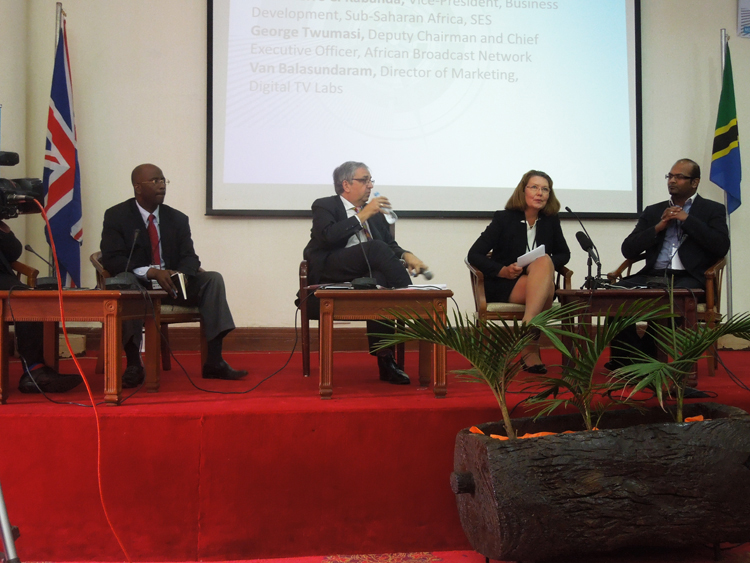
Just under 200 people (including regulators, the private sector and civil society groups) have come together to discuss critical issues surrounding the switchover/transition from analogue to digital broadcasting at the Commonwealth Telecommunications Organisation’s Digital Broadcasting Switchover Forum (#DBS2014) taking place from 11th-14th February 2014.  We were delighted that Hon Dr. Fenella E. Mukangara (Minister of Information, Youth, Culture and Sport of the United Republic of Tanzania) was able to open the Forum this morning.

With Nkoma and Mukangara

In my welcome address, as well as thanking the government of Tanzania and especially the Tanzania Communications Regulatory Authority, I took the opportunity to highlight four particular issues:

  • The importance for Africa –  digital transition/switchover has considerable potential, especially in terms of the diversity of services it can offer, as well as the digital dividend it will provide through the reallocation of spectra.  However, it must be used to  serve the interests of all of Africa’s people, especially the marginalised, such as people with disabilities and those living in sparsely populated rural areas.
  • The potential for Africa – people living in Africa should not be only learning from the experiences of other parts of the world in terms of good practices (part of the purpose of this Forum), but should also be developing innovative solutions for the context of Africa, that can in their turn be used in other international contexts. We must build on the richness of African innovation.
  • The challenges facing Africa – some of the many challenges facing Africa include:
    • it is not easy to deliver transition/switchover solutions at a cost that everyone can afford;
    • we must not fall into the trap of being forced to deliver to a time-schedule that may not  be realistically feasible;
    • ensuring indeed that the poor and marginalised – those who often currently benefit most from analogue radio and television – can indeed still afford to do access digital broadcasting;
    • ensuring quality standards of equipment such as set top boxes; and
    • ensuring that appropriate information is shared with everyone in a diversity of languages.
  • My own experiences of switchover – I recall my parents being really concerned about switchover in England, not fully understanding what was involved, but they were grateful that a free service for elderly people was provided to put in a set top box and help them to use it effectively.  My mother can now benefit from all that digital TV can offer! This particularly reminds that it is not so much the technology that is the challenge, but rather that the most difficult thing to get right is how to ensure that everyone, and particularly the elderly, the spatially marginalised and those with disabilities, can really benefit from digital switchover.

Sirpa OjalaImage from session on the future of African broadcasting

Leave a comment

Filed under Africa, ICT4D

The River Thames at night

Somewhat surprisingly, I had never been on a boat on the River Thames at night until yesterday.  I remember  as a child, when London seemed to have turned its back on the river, which always seemed cold, dark, smelly and unattractive!   Over the last 50 years this has all changed, especially with the opening up of the path along the south bank of the Thames, and the transformation of the old docks into modern offices and residential areas. I had not, though, appreciated just how beautiful it was at night, with the buildings all carefully lit.  I hope that the pictures below do it some justice!  Thanks to Dominc and Caroline for making this possible for delegates at the Education World Forum!

This slideshow requires JavaScript.

Leave a comment

Filed under Photographs

On “cyber” and the dangers of elision.

The use of the word “cyber” to refer to all matters relating to computers and the Internet has become ubiquitous.  Hence, the terms “cyberspace”, “cybergovernance”, “cybersecurity”, “cybercrime”, “cyberporn” and many other “cybers-” are commonplace, and feature prominently in current rhetoric about ICTs and governance of the Internet.

This has always made me uneasy for two basic reasons:

  • the original meaning of “cybernetics” had little to do with computers; and
  • there is a real danger of elision of meaning, when people use one cyber-word to refer to what other people use another cyber-word for.

A blog is no place for a detailed exegesis on these matters, but I have so often been asked about my views on them that I thought I would briefly summarise them here.

The meaning of “Cyber”
The word “cyber-” is usually seen as being taken from the concept of  “cybernetics”, which itself is derived from the ancient Greek κυβερνήτης, meaning steersman, pilot, or governor.  Hence, “cyber'” is fundamentally to do with governing or steering.  It is used in this sense to refer to the governance of peoples in the First Alcibiades, usually ascribed to Plato.

Cybernetics in its modern form came to be used in the first half of the 20th century to refer to control systems in biology, engineering, applied mathematics, electronics and other such fields, and so was always a very much broader concept than just relating to the field of computing.  As a discipline, cybernetics emerged in the late-1940s and 1950s, especially in the USA, the UK and France, championed by people such as Norbert Wiener and John von Neumann.  The importance of this is to emphasise that in origin, and even until very recently, “cyber-” has been associated with a very broad field of intellectual enquiry, across many disciplines, focusing especially on systems and their control mechanisms.

It therefore seems to me to be inappropriate for the term to have been appropriated quite so aggressively in the field of digital technologies, ICTs and the Internet, first because it causes confusion, and second because in some instances it is tautologous:

  • with respect to confusion, why do we need to speak about terms such as cybergoverance, cybersecurity and cybercrime, especially when there are other terminologies already in existence, such as e-governance, Internet governance, computer crime?  As discussed further below, the lack of consensus and agreement on terminology is problematic.
  • second, though, and of much more concern, it seems to me that the notion of cybergoverance is fundamentally flawed because it is tautologous.  If “cyber-” in essence is to do with governing, then all “cybergovernance” means is governing governance.

There have been many detailed critiques of the use of “Cyber-” in other fields, with Mark Graham’s critique of concepts of cyberspace in the Geographical Journal, being particularly useful.  However, few people have sufficiently emphasised this tautology in the notion of “Cybergoverance”.

Dangers of Elision
When concepts are used in such a slippery way, with meanings being appropriated and adapted so frequently, there is a considerable danger of misunderstanding, overlap, and ultimately of failure to deliver on practical action.  Moreover, behind every use of a concept there is also an interest.  This is very well illustrated by confusion over the terms cybergoverance, cybersecurity and cybercrime (or even cyber-goverance, cyber-security and cyber-crime).  All too often they seem to be used interchangeably, and there really must be clarity of meaning and understanding of such terms if progress in reaching consensus on these very important issues is to be made.  One person’s cybercrime is another’s cybersecurity, and an initiative set up to focus on just one aspect can readily seek to expand into another, thereby causing confusion, duplication of effort, and indeed mistrust.

Although, for the reasons above, I think that the term “Cyber-” should no longer be used at all with respect to work on the Internet, digital security, computer crime and the like, because it is far too broad, I recognise that unfortunately it is now in such common use that this plea will fall on deaf ears.  There are powerful interests who like this ambiguity, and wish to use such terms for their own ends!  Hence, let me offer a simple structure whereby some clarity might be injected into the discourse.  At least for me, there is a nested hierarchy of such terminology:

  • “cybergovernance” (ugh, the tautology still hurts me) should be used (if at all!) for the overarching notion of governance of ICT systems, including concepts such as Internet governance and e-governance;
  • “cybersecurity” can be seen as a subset of cybergoverance, and should be used to refer to all aspects of security with respect to ICT systems.  The concept of “cyber-resilience” can be seen as being closely allied to this, and might actually be a better term, since it is more positive, and takes away the sense of threat around security and the role of the military.
  • “cybercrime”, accordingly, is a subset of cybersecurity, focusing just on the aspects of criminality with respect to the use of ICTs.

Of course there is overlap between these terms, because fully to understand cybercrime, one needs to have a knowledge of cybersecurity, and to understand and act on that one needs to consider wider cybergoverance issues.

My preference is to abandon the use of this “Cyber-” terminology altogether and to use clearer more specific words for what we are talking about and seeking to implement.  Then, we might actually make some progress in ensuring that the poorest and most marginalised can indeed benefit from the potential of ICTs.  However, if these terms continue to be used, let’s first try to reach some better agreement on their bounds and contents.  Cybergovernance, cybersecurity and cybercrime are categorically different concepts, and the interests that seek so often to elide them need to be challenged!

4 Comments

Filed under Commonwealth, ICT4D

Moderating a group on Facebook

I first started using Facebook back in November 2006, and then set up the ICT4D Group in April 2007 to provide an opportunity for information sharing and networking amongst all those with interests in how ICTs can be used to contribute to ‘development’.  Over the years the Group has grown considerably, and during the last few months an increasing number of people have asked to join.  Along with this, we have had a sudden increase in the number of irrelevant posts, which has made me think that I should formalise the protocol that I have traditionally used to add people to the Group.  Another option would simply be to let anyone join, and hope that people in the Group report posts which offend them or are irrelevant.  However, this would damage the integrity of the Group, and having set it up I think that it still makes sense to try and restrict membership. Interestingly, I have also received requests from people managing other Groups that have been hit by an increase in spam for suggestions about how best to reduce this through the management of Group membership.

So, the process I use to judge whether or not to hit the “Add” button requires me to do a quick review of the Facebook profiles of all those who have asked to be added, or who have been recommended for adding.  What I look for, in approximate order of importance are the following:

  • Whether they already have Friends in the Group (+ve)
  • Whether they belong to other similar Groups (+ve)
  • Whether they are employed by an organisation working in the field (+ve)
  • Whether they studied at an institute or organisation relevant to the field (+ve)
  • Timeline – to see the content that’s there (can be +ve or -ve)
  • Noting if they have been suggested for nomination by an active member of the Group (+ve)
  • Photos – to see if there is anything relating to the field (+ve), or anything that I feel might be construed as offensive to members of the Group (-ve).  People who just post photos of themselves (or cats) are unlikely to be added!
  • Evidence that they use Facebook for advertising themselves or the products of a company (strongly -ve)
  • Whether they have a male identity (i.e. use “his”), but their profile photos are female (-ve).  This is a tricky one, because they could be women who have deliberately, or perhaps by accident, chosen to show their gender as male.

In so doing, I have discovered enormous differences in cultural practices on Facebook, and have been particularly struck by how blatant the use of sexual innuendo and imagery can often be.  I’m afraid that this is one of the main reasons why I choose not to add people to the Group.

I would be fascinated to know how other Group Administrators manage their choices about who to add or ignore.  I’m sure I do not always get the decisions right, but hope that members of the ICT4D Group will also self-regulate.  In the future, if we get many more requests, I guess I will have to try to automate this process somehow!

6 Comments

Filed under ICT4D