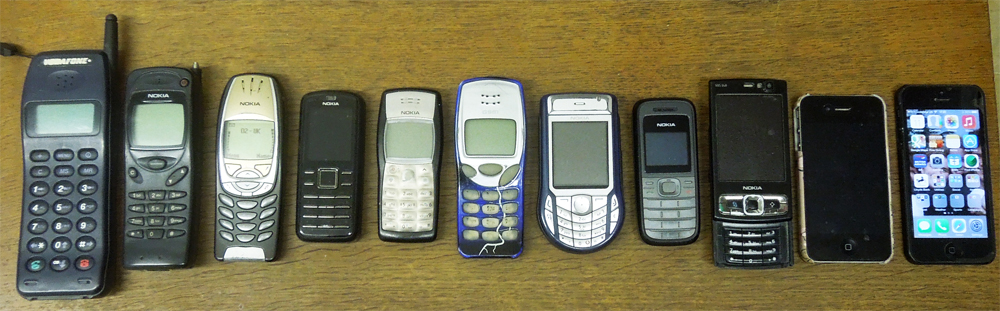
Mobile ‘phones since 1993…

I cannot believe that I bought my first mobile ‘phone in 1993!  Vodafone and British Airways had a deal encouraging the intrepid traveler to buy one of these “Pocket Phones” – an Orbitel 902 – and there it is at the left of my mobile timeline below.  There is so much I could write about this – the change from Nokia to Apple with the iPhones; the fact that the average life-span has been just under 2 years; how appalling the Nokia N95 was, with the Nokia 6630 not being much better; how I liked the Nokia 6510; how I am still using my brilliant little Nokia 6080; how battery life of iPhones is too short; how I object to everything moving onto the Cloud….  Sadly the Android based Sony Xperia with NFC that I got last year as well is not shown here – on loan to my son in Spain! Oh yes, and what does this have to say about the number of active mobile ‘phones in the world – most of these still work, and you should see my SIM card collection!

Mobile 'phones smallEnjoy the picture!

1 Comment

Filed under 'phones, ICT4D

Thames floods at Runnymede, January 2014

I have to admit to being a bit perplexed why so much fuss is being made over the recent flooding in the UK.  Yes, of course there has been damage to property and loss of life, there have been huge waves that have reshaped our coasts, and weeks of rain have given rise to extensive floods in the first few days of 2014.  However, floods are to be expected!  Anyone with the slightest bit of knowledge about rainfall and hydrological systems should know that flood periodicity occurs, and that this can be described statistically.  Thus, we refer to the notion of a 100-year flood as being a flood amount with a 1% probability of occurring in any one year; a 500-year flood has a 0.2% chance of occurring in any one year.  Big floods are expected; we just cannot predict exactly when!  Naturally, flood plains are those areas into which rivers overflow, and historically people knew this and built their properties above the usual flood level.  Looking at the photographs of flooded parts of England, it is fascinating to see that in most cases it is the ancient churches and oldest houses that are most frequently to be seen above the rising water levels.  River management systems seek to deal with the most frequent flood levels, and the challenge is to get the balance right between protection and cost.  Thus, the expense of protecting against 1000-year floods is often prohibitive, and it is generally argued that it is much better simply to pay for repair to the damage of these extreme events.  In Britain, the Environment Agency, for example, provides detailed maps of flood risk, which specifically identifies the areas at risk of 1000 year floods (in pale blue).

Unfortunately, a long period of relatively few floods in the UK in the 195os and 1960s led planners increasingly to build on flood plains, and although the amount of building on flood plains in Scotland and Wales is now very slight, 11% of new builds in England in 2011 were still in areas at risk of 100 year floods.  Some 5.2 million houses in England, representing 23.1% of existing properties are estimated to be at risk of such floods.  This demand by ‘developers’ shows no signs of abating, and a report in 2012 indicated that planning applications were submitted to build as many as 28,000 new homes on land that officials considered to be at serious risk of flooding. It is not nature, or any failings of the Environment Agency that are to blame for the misery of our present floods, but rather the demand for housing and the greed of those who want to maximise profits from house building and other construction on flood plains!  I have to say that with respect to the recent floods it would appear that the Environment Agency has actually done a remarkably good job, and I am dismayed at how critical so many people seem to have been of the flood protection efforts made by recent governments.

Whilst such floods are obviously very sad and damaging for those affected by them, they are a good reminder that nature is actually much more powerful than we often give it credit for, and waterscapes of flooding can indeed be very striking and beautiful.  Below I capture some images taken over the last couple of days of the Thames at Runnymede – as the National Trust sign says, “The birthplace of modern democracy”!

This slideshow requires JavaScript.

1 Comment

Filed under Photographs

Reflections on “corruption”…

I have long argued that people tend to use the word “corruption” mainly to describe cultural practices that differ from those with which they are familiar.  It is a term that is almost always used negatively. Re-reading Transparency International‘s 2013 Corruption Perceptions Index has very much reinforced this view, but in a way that I suspect will not be expected by those who read what follows!

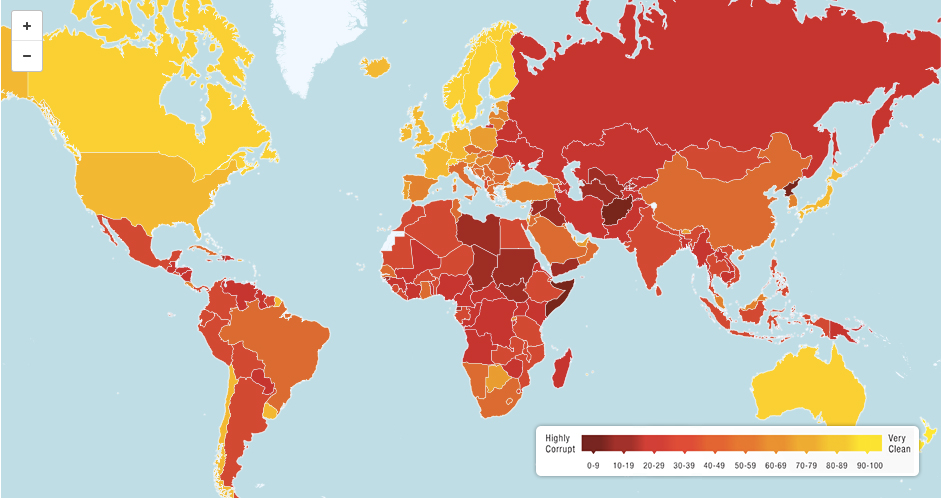
Corruption TI

I have huge admiration and respect for the work of Transparency International. The map above shows the perceived levels of public sector corruption in 177 countries in the world.  In brief, it indicates that 69% of countries have a score of less than 50%, indicating a serious corruption problem.

However, what stands out most to me about this map is that it is very largely the countries of northern Europe, northern America, and Australasia that are perceived as being least corrupt.  The yellow “holiness” is so marked against the “evil” red of corruption that swathes most of the rest of the world!

Corruption according to Transparency International can be defined  “Generally speaking as ‘the abuse of entrusted power for private gain’. Corruption can be classified as grand, petty and political, depending on the amounts of money lost and the sector where it occurs”.

Three ideas seem particularly pertinent in this context:

  1. The notion of corruption is intimately tied up with the nature of capitalism.  Put simply, the apparently least corrupt countries according to this definition are generally the most advanced capitalist countries.  This suggests that it serves capitalist interests to try to reduce “corruption” as much as possible. It is interesting to ponder why this might be.  One reason may be that reducing the abuse of entrusted power for private gain actually reduces the tendency for the rate of profit to fall.  However, it is difficult to see how this might happen, and it seems in stark contrast to a fundamental characteristic of capitalism which is that it is actually designed to ensure the maximum possible private gain for the capitalists.  I guess the reality may be that limiting or preventing private gain from entrusted power actually enables the market (i.e. the principles of capitalism) to flourish as effectively as possible.  By extension a reduction of all entrusted power (i.e. limiting the power of the state) could be seen to enhance the power of the market, and therefore increase the potential for private gain of those who do not hold political power.  Hence, keeping the power of the state as small as possible, and ensuring that it functions in a way that does not lead to private gain for the holders of power in the state, will ensure that the maximum surplus profit is available to the leaders of global corporations and their shareholders.
  2. However, it is very clear that there is also corruption in the leading capitalist states.  The countries shaded yellow on the above map may be perceived as being less corrupt than others, but corruption still abounds in them!  Hence, there is huge hypocrisy when leaders (and indeed others) in the “yellow” countries accuse those in the “red” countries of being corrupt.  Those in the banking sector, for example, who pay themselves and their staff huge salaries are surely also using their positions of power for private gain?  The amount of money spent in US Presidential elections is also an indication of the way in which “money speaks”: Obama thus raised $715,677,692 in the 2012 elections, and Romney raised $446,135,997.  Together, this sum of money was worth more than the GDP of 25 countries in 2012 (according to UN figures).  One needs huge amounts of money to be elected President of the US, and those who contribute this money expect the policies that the President introduces to benefit them – for private gain.  Likewise, in the UK in 2012, Michael Meacher in a letter to the Guardian newspaper noted that “that the richest 1,000 persons, just 0.003% of the adult population, increased their wealth over the last three years by £155bn. That is enough for themselves alone to pay off the entire current UK budget deficit and still leave them with £30bn to spare”.  Is not this also a form of corruption?
  3. Corruption is seen differently in countries where rampant capitalism and private financial gain may not be seen as the most important priorities.  According to the Transparency International report, most countries in the world are perceived as having a serious corruption problem.  This poses an interesting question: might their systems of priorities actually in some ways be better?  If they were not, why do these systems persist?  For a person living in a culture where ties to family and tribe are more important than individual private financial gain, it must seem very wrong not to give employment opportunities to members of one’s family, regardless of actual ability. Likewise, where personal loyalty matters more than direct monetary return, supporting a friend to achieve their particular job aspirations would seem much more appropriate than ensuring that there is a “fair” competence based application process.  Giving gifts to reciprocate for generous hospitality is merely a different way of redistributing and sharing financial benefits.  Moreover, much of what passes for probity in the “yellow” countries actually tends to be a smokescreen for traditional modes of “corruption”.  The appointments process is invariably biased through friendship ties – not least through the reference system and the use of headhunters – and is never purely competence based.  Likewise, the UK’s honours system is still very largely determined by personal friendship networks, rather than necessarily by ability or contribution to the common good.

In short, I am more than ever convinced that “corruption” is simply a pejorative term that people use to describe political, social and economic systems that are  different from their own.  In a world dominated by capitalist interests, it is scarcely surprising that less-advanced capitalist economies are perceived as being more corrupt than those where the search for individual gain and success is highest.  Yet this very focus on individual gain in capitalist societies is itself fundamentally “corrupt”, since it detracts from the communal good which, at least for me, is ultimately far more valuable.  I suggest that we may have much more to learn from the mutually supportive social and cultural networks that underlie such “corrupt” regimes, than we do from the economic interests that determine definitions of probity in the capitalist heartland. However, this is because I believe that the common good is far more important than private individual gain.

5 Comments

Filed under Africa, Commonwealth, Development, Entrepreneurship, Universities

Summary of Keynote for COL’s PCF7 in Abuja

Despite limited digital connectivity, I just thought I would upload a short summary of my upcoming keynote at the Commonwealth of Learning’s Seventh Pan-Commonwealth Forum this afternoon to encourage productive debate!  Its central argument is that we are not delivering as effectively as we could in using ICTs for education at all levels, because of very explicit interests that are serving to limit this effectiveness. (Later on 17th December: the slides that accompanied the keynote have now been made available by COL)

Good practices

I begin with a short overview of ten good practices that need to be in place to ensure effective use of ICTs in education:

  1. It’s the learning that matters, not the technology
  2. Teachers must be involved from the beginning
  3. Sustainability built in from the start
  4. Supporting infrastructure must be in place
  5. Appropriate content must be developed
  6. Equality of access for all learners
  7. Continual monitoring and evaluation
  8. Appropriate maintenance contracts
  9. Using the technology 24/7
  10. Good practices, rather than best

So, why are these not done?

I focus here first on the observation that ICTs generally increase inequalities unless very specific actions are taken to ensure that the poorest and most marginalised are able to benefit.

I then explore the various interests that tend to limit delivery of the above ten practices, focusing especially on the activities of the private sector, and especially hardware and software companies, connectivity companies and content developers.

In so doing, I also draw on some of the increasing amount of empirical evidence that the use of computers in education is actually damaging learning.

Implications for innovation

In the final section, I explore some of the implications of these trends for innovation and creativity, paying specific attention to five themes:

  1. Content replication
  2. Memory
  3. Language and literacy
  4. Personalised searching
  5. Privacy and failure

In conclusion

In drawing these reflections to an end, I argue that one way forward is to work towards new and effective models of multi-stakeholder partnerships for education, that address education as something much more important, much more complex, and much more exciting than merely as a vehicle for economic transformation.

Leave a comment

Filed under Africa, Commonwealth, Development, Education, Higher Education, ICT4D

CHOGM 2013 Opening Ceremony

This is the third time I have been privileged to attend an Opening Ceremony of the Commonwealth Heads of Government meeting.  As well as the formal speeches, and parading of heads of state, these occasions provide a fascinating opportunity to see how a country wishes to present itself, and I hope that the images below capture something of the essence of the opening ceremony just held in Sri Lanka. The Sri Lankans certainly put on a beautiful pageant, and there were thousands of young dancers lining the streets – they must have been exhausted by the time the ceremony was over!

This slideshow requires JavaScript.

1 Comment

Filed under Commonwealth, Politics

Transform Africa 2013 and a celebration of Rwanda

I had the great privilege – especially as a white Yorkshireman – to be invited to chair the session on Smart Education at Transform Africa 2013 held in Kigali, Rwanda – a conference led by Africans, for Africans.  It is some five year since I was last in Rwanda, and the changes that have been made in the country over this time, especially in the field of ICTs, are palpable.

It was really excellent to hear seven Presidents of east African countries champion the potential of ICTs to transform Africa, whilst also being realistic about the challenges that still remain in using them effectively to contribute to the social, political and economic development of their countries.

It was also good to experience some of the musical heritage of Rwanda – and even to have the chance of learning yet another different style of African dance!  This was especially so at the launch of Rwandapedia this evening – an excellent resource for those wishing to learn more about Rwanda’s turbulent history over the last 20 years or so.  Congratulations, too, to the Panorama Restaurant at the Des Mille Collines for what has to be one of the best dinners I have recently had in Africa!

The photos below catch but a glimpse of some of my experiences here over the last few days.

This slideshow requires JavaScript.

1 Comment

Filed under Africa, Commonwealth, Development, Education, ICT4D

DFID’s Digital Advisory Panel

The UK’s Department for International Development has recently created a Digital Advisory Panel to provide advice to the Department in line with its digital strategy announced in December 2012.  The role of the panel is to take an overview of DFID’s strategy for digital and technology matters in its organisation and programmes, and to provide advice and challenge to the organisation. The panel met for the first time on 22nd October, and started to discuss the scope and priorities for their work programme.

The Chair of the Panel is Tim Robinson, CEO of LGC, and he joined DFID’s board as a non-executive director in May 2013.  Other members of the Panel (in alphabetical order, and as described by DFID blogger Julia Chandler) are:

  • Ken Banks is the founder of kiwanja.net and creator of FrontlineSMS, a mobile messaging application aimed at the grassroots non-profit community.
  • Rebecca Enonchong is founder and CEO of AppsTech, and sits on the board of VC4Africa, the largest online community dedicated to entrepreneurs and investors building companies in Africa.
  • Mark Graham director of research at the Oxford Internet Institute.
  • Nick Hughes formerly head of Global Payments at Vodafone Group, where he started M-PESA, is now founder and strategy director of m-kopa.
  • Stephen King is a partner in Omidyar Network UK and was formerly chief executive of BBC Media Action.
  • Rick Robinson is an Executive Architect at IBM responsible for the development and delivery of Smarter City solutions and a member of the Academy of Urbanism.
  • Kathy Settle is deputy director for networks at the Government Digital Service, where she coordinates development of government’s overarching digital strategy, working alongside “digital leaders” to create complementary departmental strategies.
  • Tim Unwin has many roles, including Secretary General of the Commonwealth Telecommunications Organisation (CTO), Chair of the Commonwealth Scholarship Commission in the UK, Emeritus Professor of Geography and UNESCO Chair in ICT4D at Royal Holloway, University of London.
  • Amy Semple Ward is CEO of NTEN, the nonprofit technology network, based in Oregon, US.

I am delighted to have been invited to serve on this panel, and look forward to some lively discussion as we seek to guide DFID in its digital and technological practices.

Leave a comment

Filed under Development, ICT4D, UK

Seoul: cyberspace, hospitality and Seolleung

I had the privilege of being invited to participate in the recent Seoul Conference on Cyberspace, which provided me with an opportunity to visit Korea for the first time.  Although most of the three days I stayed there was spent in the COEX Convention Centre, the organisers had also arranged for some of us to go on an ‘industry tour’ which briefly took us out into the ‘countryside’ to the south of the city last Saturday.  The  hospitality of our hosts was both generous and humbling.  I post below some photos that seek to capture that hospitality, and the energy, tastes and beauty that we all experienced.

This slideshow requires JavaScript.

The slideshow captures images from the Seolleung and Jeongneung Royal Tombs,  the amazing music of Miji and the energy of TAL‘s Taekwondo performance at the Gala Dinner, Bongeunsa Buddhist temple, images from the conference, and some more general pictures of the Gangnam area of Seoul.

I left challenged and excited, determined to learn more about how the people of the Republic of Korea have transformed their economy and society in recent years.  Experiencing a tiny bit of Korea, makes me reflect all the more vividly on the observation that in 1960 Ghana and the Republic of Korea had the same per capita income, and I wonder all the more at the very different ‘development’ paths experienced subsequently in Africa and eastern Asia.

3 Comments

Filed under Development, ICT4D, Photographs, Politics

ICTs for Education Initiatives

I spent last week in Abuja for the Commonwealth Telecommunications Organisation‘s Annual Forum and Council meeting, during which there was also a meeting of ICT Ministers, at which many of them highlighted the importance of ICT initiatives for education in their countries.  One thing that particularly struck me about some of the discussions I had was, that despite such interest, there remains a surprising lack of knowledge about many of the challenges that exist in delivering such initiatives.  All too often it is simply taken for granted that such programmes must be successful, and that they will unquestionably lead to an improvement in education.  I find this deeply worrying, because one of the few things that we really know is that the majority of ICT for education initiatives in developing countries have actually been disappointing failures – at least as far as delivering effective educational change is concerned.  I have therefore spent some of today writing a page on the CTO’s site about this, trying to summarise some of the findings of work in which I have been engaged over the last decade.

boy with computer smallI am also making these ideas available on my personal blog to try to encourage debate around this important subject.  There is far too much duplication of effort, and reinventing the wheel in terms of how to deliver effective ICT for education initiatives.  This can be incredibly wasteful of valuable resources, and I hope that by providing links to some of the more important available resources people will at least have a starting point from which to work.  It would be good also if colleagues could add to the list of the most important references and websites/portals by leaving comments, thereby using this as a vehicle for sharing more information on the subject.

Based on my work over the last decade or so, I have come to the conclusion that ten key issues need to be considered if effective ICT in education initiatives are to be delivered:

  1. It is the learning that matters and not the technology. Many e-learning and m-learning initiatives place the emphasis on the technology – be it laptops or mobile ‘phones.  Effective initiatives begin with identifying the learning objectives, and then identify the technologies that are best suited to delivering them.
  2. Teachers must be closely involved in the implementation of ICT for education initiatives, and they need to be given effective training in advance of the roll-out of computers in schools.
  3. Sustainability issues must be considered at the very beginning.   Computers, laptops and mobile ‘phones are expensive.  Whilst it can be affordable to purchase these as a one-off investment, careful thought must be given to the budget costs of maintaining this equipment, and of how to provide it for the next generation of school-children.  Computers do not last forever, and a substantial budget stream must constantly be made available.
  4. The supporting infrastructure must be in place.  All too often insufficient attention is paid to ensuring that there is sufficient reliable electricity and Internet connectivity to enable the equipment to be used, and for teachers and students to gain access to the Internet.
  5. Appropriate content must be available to help deliver the curriculum and learning needs.  All too often ICT initiatives merely provide access to internationally available content delivered in foreign languages.  It is important that local content developers are involved in shaping learning content, and that as much attention is focused on using ICTs to provide new ways of communicating, and not just delivering information.
  6. Ensure equality of access to all learners.  ICTs enhance inequality between those who have access to them and those who do not.  It is essential therefore that attention is paid to ensuring that all learners are indeed able to access the benefits.  Usually, ICT for education initiatives start with those who are already privileged, through their wealth or by living in urban environments with the necessary infrastructures.  Enlightened initiatives actually begin with delivering learning solutions to the most marginalised people and those living in rural areas.  Remember that people with greater disabilities have more to gain from learning ICT skills than do those with fewer disabilities.
  7. Appropriate monitoring and evaluation must be undertaken from the very beginning to ensure that learning objectives are indeed being delivered, and that the initiative can be tweaked accordingly.
  8. Appropriate maintenance contracts for equipment and networks need to be established.  Training local people in the maintenance of learning technologies is essential so as to ensure that the equipment is used effectively. This can also provide a real boost to local economies.
  9. Use equipment and networks in schools for as long as possible each day.  ICT equipment and networks in schools should be used by local communities in out-of-school hours.  This maximises the use of expensive equipment, and can provide a source of income generation that can help defray the costs of its usage.
  10. Think creatively in your own context.  There are no best practices, only a range of good practices from which to choose.  Develop solutions that best fit your learning needs, and then get on with implementing them!

I  very much look forward to developing these ideas in more detail in my keynote address on technology in education at the Commonwealth of Learning’s seventh Pan-Commonwealth Forum to be held in Abuja this December.

It is hugely difficult to summarise the vast wealth of existing literature on ICTs and education in a development context, but I suggest that the following ten publications are essential reading for anyone engaged in delivering effective ICT for education initiatives, particularly through multi-stakeholder partnerships (listed alphabetically):

I have always found that the following websites on ICTs and education in a development context (listed alphabetically) contain a wealth of useful information:

4 Comments

Filed under Commonwealth, Development, Education, ICT4D

My keynote address at CTO Forum 2013 in Abuja

The Commonwealth Telecommunications Organisation is convening its Annual Forum and Council meeting in Abuja, kindly hosted by the Federal Ministry of Communication Technology and the Nigeria Communications Commission on behalf of the Federal Government of Nigeria, on the theme of Innovation through Broadband.  This is something I care passionately about, and my team permitted me to give a keynote opening address.  Several people have already asked me for the text – and so provide an abbreviated version below, which omits the diplomatic niceties and my heartfelt thanks to all who have made this event possible.

“Over the next few days we address critically important themes, and I specifically wanted to say a few words to challenge us all now, at the beginning of this event.  Quite simply, we cannot deliver on the title of this Forum, “Innovation through Broadband” unless we actually have broadband.  Many of the CTO’s members have less than 5% of their population connected to the Internet; my own country, the UK, still has 17% of its households not connected. For those of you from the corporate sector, this is indeed a great market opportunity!  However, the case I want to put before you is that, more importantly than merely the economic agenda, is a moral agenda.  These technologies are so important, so powerful, so life-changing, that we fail our brothers and sisters if we do not ensure that they too have access to broadband.

There are three simple things I would like you to take away from what I say this morning:

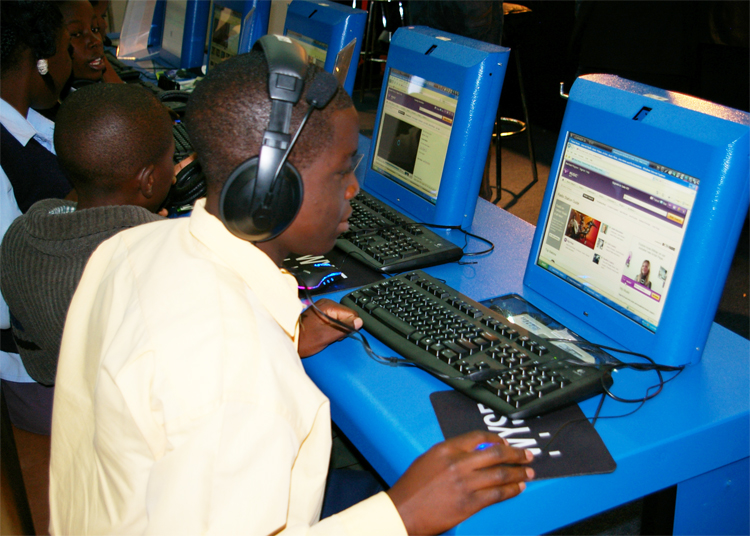
  1. Boy on streetFirst, the expansion of ICTs over the last decade has made the world a more unequal place.  Put simply, these technologies are hugely powerful.  Those who have access to them, and know how to use them, can benefit immensely.  But those who do not have access, who only have an old style mobile ‘phone, who cannot afford the costs of connectivity, are becoming increasingly disadvantaged.  This is not only a moral agenda, but also a very practical social and political one, because sooner or later, the disadvantaged will – and I have no doubt about this – seek to redress the balance by taking action into their own hands, as we see across so many parts of the world today. We must, and again there has to be no doubt about this, ensure that everyone has access to the Internet.  I am delighted to see that we have a session specifically on women and children at this Forum, and that (for a change) we do indeed have a distinguished woman on the platform here at the start.  But this is not enough.  As most of you know, I champion the use of ICTs by people with disabilities – at least 10% of the world’s population; we have to do more for them, so that they too can benefit from the use of ICTs.  Access for all is therefore my first point.
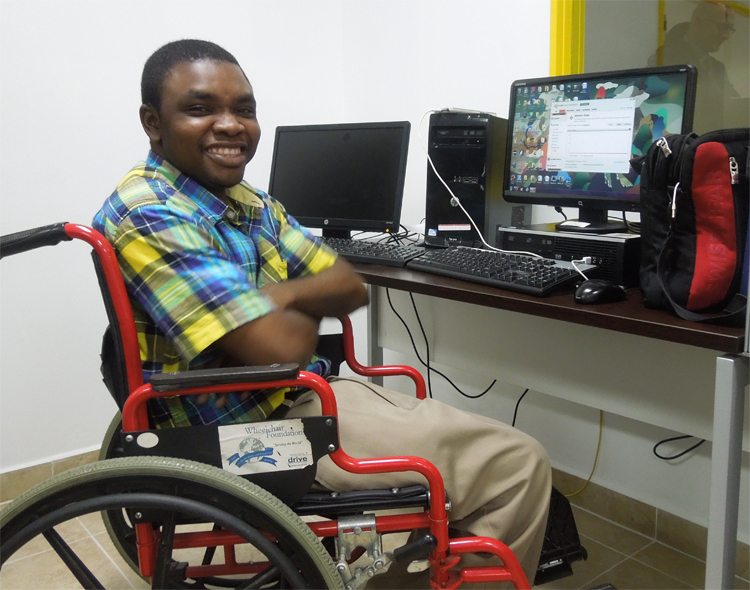
  2. Wheelchair computer technicianSecond, we need to develop new models through which such access can be provided at an affordable price to those who do not currently have access.  This is an immense challenge.  Put simply, the market will deliver solutions for many of our peoples.  We must therefore ensure that regulatory environments enable the market to deliver for the greatest number possible.  Regulators and companies must work together in an environment of trust to ensure that this happens.  However, the market will not deliver for everyone – for those living in the most peripheral rural areas, for the elderly, for those with severe disabilities.  Here, I believe passionately that we need to craft innovative multi-stakeholder partnerships to ensure such delivery.  These need to involve governments, the private sector, civil society, international organisations and bilateral donors in providing solutions that will serve the needs of everyone in our societies.  This is not easy.  Everyone talks ‘partnerships’ but few ICT4D partnerships have truly been successful.  It is here that the CTO can offer much in terms of partnership brokering, and working with all of our members to deliver such partnerships practically on the ground.  As many of you will know, broadband is one of the CTO’s six priority areas, and it is highly appropriate that we are here in Nigeria shortly after they have published their national broadband plan. … This emphasis on partnerships is also why I am so delighted that the CTO has joined the Alliance for Affordable Internet, and that they have privileged us by launching this very important initiative here in Abuja.My second point, is thus the need for carefully crafted multi-stakeholder partnerships to help deliver affordable broadband for all those for whom the market itself will not deliver solutions.
  3. children 2But third, providing broadband connectivity is only a beginning.  If we do not work with the poorest and most marginalised in our societies, truly to understand their needs, and then develop solutions that will be of explicit benefit to them, as much as to the privileged rich and elites, then the divisions within our societies will only increase yet further.  This is why this Forum focuses on “Innovation through Broadband”.  These innovations must not just be concerned with how to make yet greater profits from the telecommunications sector, or for governments to raise yet more revenue through levies and spectrum auctions – however important these are.  No.  This is only part of the story.  We are simply failing in our duties as responsible citizens, and indeed decent human beings, if we do not enable everyone to benefit from broadband: the young orphaned girl, bringing up her younger brother in the slums; the widow, gleaning an existence in the forests far from the capital city; the child soldier who had his arms lopped off and is now begging on the streets…

 My three messages are, I hope clear:

  • Enabling everyone to have access
  • The importance of multi-stakeholder partnerships to serve the most marginalised, and
  • Working with the poor and marginalised to enable them to develop solutions that are fundamentally in their interests

Distinguished colleagues and friends.  My final thanks are to you for being here.  We have a packed programme of inspirational speakers – I often think our events are far too packed!  Take time to talk with each other.  Use Wednesday morning to hold bilateral meetings and engage in productive discussions.  We are the privileged.  We are the elite – whether we like it or not.  We therefore have immense responsibilities.  The CTO has brought us all together.  But this is not enough.  I want every one of you to make a commitment – here and now in this room – not just to listen, not just to speak, but to act.  The time is almost too late.  The inequalities generated by ICTs have almost become too big for us to overcome.  Now is the time to make a difference.  Now is the time to turn rhetoric into reality.”

Leave a comment

Filed under Africa, Commonwealth, ICT4D