Antigua out of season…

The opportunity to spend a few days of holiday in Antigua was not one to be missed – even if it was in the middle of the ‘so-called’ Hurricane Season! Never having been to the island before, the first challenge was to find a hotel. This was by no means easy, since most were shut for September, and those that were open were mainly offering all-inclusive deals. Can you imagine having to eat in the same hotel restaurant every night, and being stuck on a beach miles from anywhere? Well, if you do, read no further!
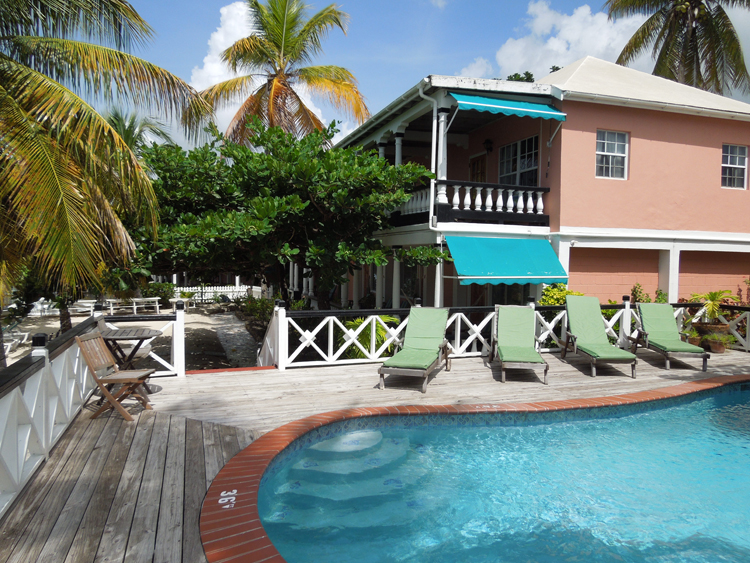
Catermaran Hotel 1Restless as we are, and eager to explore as much of where we are staying as possible, we searched long and hard to find a small, relatively hidden away, privately owned hotel. The result was the Catamaran Hotel in Falmouth Harbour – not far from Nelson’s Dockyard – and in the much-to-be-preferred south of the island (although only 30 minutes from the airport). The hotel advertises itself as “a peaceful getaway in an idyllic location” – and that it really was! From the first moment we arrived, the receptionist Annique made us feel incredibly welcome – and even offered us a room upgrade. The small hotel is right on the beach, with large self catering rooms. Although I don’t usually like using air conditioning, it was definitely necessary at this time of year, when the weather was regularly over 30 degrees C in the daytime, with high humidity as well. For most of the week we were here, we were the only guests, and had the swimming pool, a sailing dingy (thanks Robert for the great training), and the small beach all to ourselves. Just nearby is the excellent Bailey’s supermarket which provides most of the daily necessities (including excellent cherry coconut ice cream, plenty of Carib beer, and well-priced Cavalier rum), and a little further afield is the bit smarter Crab Hole Liquors at Cob Cross (where there is also a pharmacy).

Out of season, Antigua is incredibly quiet, with many of the restaurants and facilities shut. The two restaurants just by the Catamaran (the Captain’s Quarters and Cambusa) were both closed, as were most other restaurants on the island! Hence, a car was absolutely essential for getting around! We did our best to travel almost every road, and visit most of the island’s historical sites and beaches! Whilst the north-west of the island is where most of the light industry is located, with houses scattered almost everywhere across the countryside, the south is largely unspoilt with beautiful steep sloping wooded hillsides, and magnificent beaches. Sadly, many of the beaches have large modern hotels on them, largely preventing access to the beaches, and in some instances, as at Half Moon Bay, these hotels have simply been left to decay following storm damage.

Amongst our favourite beaches were:

  • Rendezvous Bay PanoramaRendezvous Bay (near to Falmouth in the south of the island) – needs quite a steep 30 minute walk (each way) to get to unless you have a 4 wheel drive vehicle, but definitely well worth the effort. Sadly, rumour has it that it is subject to development – which would be a huge pity. We had the bay almost to ourselves, and there were lots of fish to be seen snorkeling
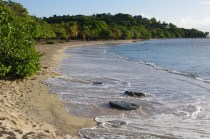
  • Windward BayWindward Bay (near Nelson’s Dockyard in the south of the island) – again, needs a short walk, but definitely worth it.
  • Pigeon Beach – a public beach popular with local people, and very near Nelson’s Dockyard. It is a short sail from the Catamaran – but do watch out for the poisonous Manchineel Tree!
  • Long Bay (in the north-east) – despite there being a hotel there, and even at this time of the year with lots of people, there were lots of fish to be seen snorkeling, especially at the eastern end.
  • Half Moon Bay (south-east of the island) is beautiful, despite the decaying hotel!
  • Morris Bay on the south-west coast is also the nicest beach on that part of the island.

Looking at some of the luxury hotels on the island – way beyond our price range – the nicest seemed to be:

  • the Carlisle Bay hotel – for those who can afford at least US$ 674 a night! Perhaps one day!

We took the time to visit many interesting parts of the island – and for those wanting to explore, rather than just getting sunburnt on a beach, the following were definitely worth visiting:
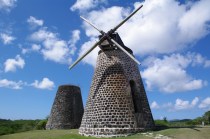
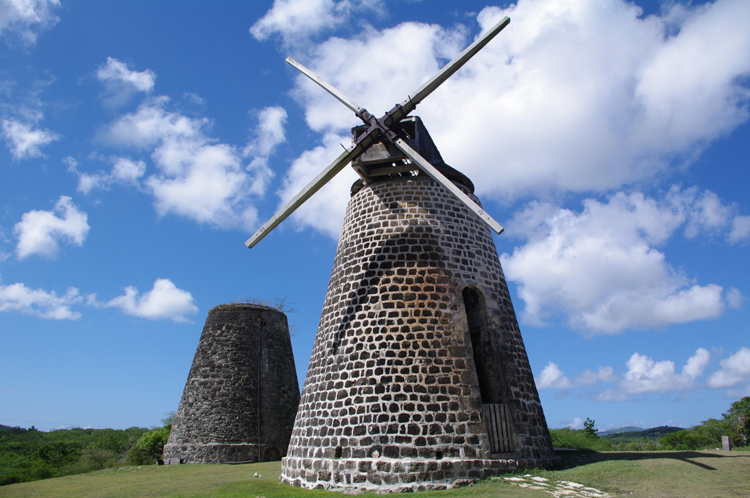
  • Betty's Hope sugar millBetty’s Hope – an old ruined sugar plantation – with a small museum – in the central east of the island
  • Fig Tree Drive – from the centre to the south-west of the island – through lush wooded hillsides, with an opportunity to buy the delicious Antiguan black pineapples from roadside stalls
  • Wallings reservoir – a Victorian reservoir just off Fig Tree Drive, with walking trails up into the hillsides
  • Christian Valley – an agricultural station with trails (hard to find!) from which a rich variety of Nelson's Harbour 3birdlife is visible (sadly now named Obama Mountain National Park – formerly Boggy Peak – seems after all quite appropriate!)
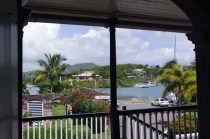
  • Nelson’s Dockyard – definitely worth visiting – the reconstructed 18th century dockyard where Nelson was based between 1784 and 1787 – a haven for English ships during their battles in the region, offering good protection against storms.
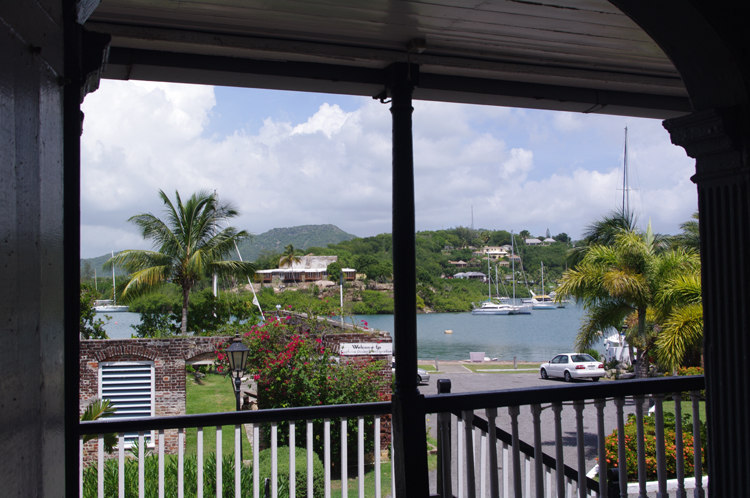
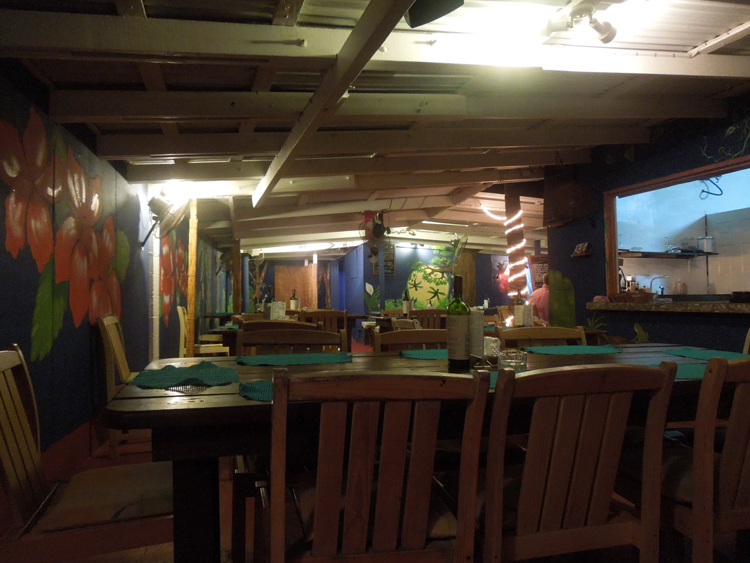
TrappasAs for restaurants, most were closed! We were very pleased, though, that Trappas was open (in English Harbour on the road to Nelson’s Dockyard) most of the days we were here, offering largely European style food, but with a touch of Caribbean flavour. The food was well-cooked, reasonably priced (ECD 25 for a starter, and ECD 50 for a main course), and there was a good atmosphere with locals and tourists alike. Nearby, the Mad Mongoose opened while we were here, and offered a livelier atmosphere (must definitely be very lively in season), with slightly cheaper, but still tasty, food.

The only bad eating experience we had was when we were tired and needed a quick drink and lunch in St John’s – and very unfortunately chose to sit down in Cheers. We thought the menu was in ECD (in line with most other restaurants) and only when the bill came, given to us by the unpleasant and supercilious front of house ‘waiter’, did we discover that a simple prawn salad cost US$ 27! Please avoid this horrid place at all costs! Much better would be to go to the nearby Quay Bar and Grill, which seemed much more atmospheric and well-priced – although sadly we did not eat at it!

Below are just a few photos that try to capture just what the beautiful island of Antigua is like out of season. When all of the yacht crews are here it must be very different, and much, much more lively, but taking a risk of the odd storm or even hurricane, and putting up with the higher temperatures and humidity, Antigua is definitely worth getting to know out of season!

This slideshow requires JavaScript.

1 Comment

Filed under Beer, Caribbean, Photographs

Reflections on Montserrat – crafting a viable economy for 5000 people

The chance to work with the Ministry of Communication and Works on the tiny island of Monserrat in the Caribbean last week gave me a rare opportunity to reflect not only on the economic viability of many of the UK’s Overseas Territories, but also on the ways that people living in small island states cope in the aftermath of physical disasters.  Montserrat was devastated by Hurricane Hugo in September 1989, leaving some 11,000 of the island’s population of 12,000 without homes.  Ten people were killed, 89 were injured, and the cost of the damage was reported to be at least $260 million.  In the years afterwards, substantial reconstruction took place, but then in 1995 the island’s Soufrière Hills volcano became active again.  The island’s capital, Plymouth, was soon buried by more than 12 metres of ash and mud, which also destroyed the airport and harbour.  The southern part of the island became uninhabitable, and a strict exclusion zone was introduced to limit future loss of life.  Then, in 1997 a pyroclastic flow passed down Mosquito Ghaut, overflowing the valley sides and killing 19 people who were in the exclusion zone.  Subsequently, there has been ongoing volcanic activity, mostly consisting of ash falls in the south of the island, but in 2009-10 further pyroclastic flows also occurred.  This double disaster had immense impact on the island’s population, with some 8,000 people choosing to leave, primarily for the UK which had granted the islanders full residency rights in 1999, and British citizenship in 2002.

Although I broadly knew about the island’s history, it is impossible to appreciate both the impact of these physical disasters, and the resilience of the people without actually visiting the island, and standing on the hillside overlooking the devastated city of Plymouth.  Having spent a couple of days with Montserratians before visiting Plymouth, and appreciating something of their warmth and generous hospitality, I was left with an overwhelming sense of sadness just standing on the edge of an ash filled swimming pool overlooking the devastated landscape of the island’s former capital.

This slideshow requires JavaScript.

Monserratians are determined people, and those who I met were adamant about not only their British citizenship, but also their love for the island and their wish to ensure that it has a viable economy for the future.  The cost of the necessary reconstruction and development is nevertheless very, very substantial.  Much is already being done: there are plans for a new harbour; geothermal drilling is underway to see whether it could provide a source of energy for the future; and a submarine cable is to be laid to support their international digital connectivity.  However, much still needs to be done to ensure that the island can once again be self-sufficient as it was before the volcanic eruptions.  The challenge is that it is extremely difficult to identify how best this can be achieved, especially with such a small population.

From my very short visit, it is not easy to see the niche areas that the Monsterratians can build upon to regain their economic vitality.  Thinking back to the late 1970s when the Beatle’s producer George Martin created the AIR studios, Montserrat was able to attract some of the world’s most famous musicians to its green and peaceful environment.  There are still beautiful landscapes on the island, but the nature of the recording industry has changed so much that it would be difficult to imagine such an ‘adventure’ working again.  Perhaps, though, George Martin’s house (Olveston House – on Penny Lane), which now serves as a most welcoming guest house for visitors, does indicate one way forward, in that the island could carve itself out as a niche for high quality, environmentally sensitive tourism.  It is certainly beautiful, and the people most friendly.  However, its airport is tiny, with the runway only able to take very small planes, and it requires a new, much larger harbour to attract cruise ships and yachts to the island. There remains, though, the inevitable “chicken and egg” problem: visitors will not come unless there are high quality facilities on the island, and few people are willing to invest without there being strong prospects for sufficient visitor numbers to enable them to recoup their investments.

On the more quirky side, any country has to turn to its strengths and opportunities.  The volcano itself is a source of interest to visitors on the neighbouring islands, with air tours regularly bringing people from Antigua to visit.  It seems a shame that Montserrat itself currently benefits relatively little from such initiatives, and it must be possible for innovative initiatives to be developed that could enable Montserratians to reap dividends from such opportunities.  For film makers wishing to produce films in apocalyptic settings, the old capital of Plymouth on Montserrat would make an ideal – albeit highly risky – setting!  The island is also known as the Emerald Isle of the Caribbean, not only because of its lush vegetation, but also because it was settled by Irish immigrants from St. Kitts.  The potential for its Irish heritage to be marketed much more strongly, could also foster enhanced tourism from Éire.  Some of the bays in the north of the island would also make ideal facilities for luxury yacht marinas, and their development could offer a very different kind of destination for those sailing the Caribbean.  Finally, the ultimate strength of any country is its people, and there is no doubt that better connectivity to the Internet will enable those who wish to stay on the island and build economic activity around the provision of digital services will  be able to do so much more effectively once the new cable is completed.  Already, one software company (Lavabits) is developing its business there, and with an educated population, well-connected to the diaspora living in the UK, there has to be further potential for the islanders to use the Internet, not only to attract tourism, but also to build a new digitally-based economy in Monsterrat.

It was a real privilege to spend time on the island.  I admire the resilience, fortitude and determination of those whom I met, and I greatly appreciated their warmth and generosity.

1 Comment

Filed under Caribbean, Commonwealth, ICT4D, Photographs, Politics, UK

Closing dates approaching for exciting jobs at Commonwealth Telecommunications Organisation

The Commonwealth Telecommunications Organisation is currently advertising vacancies for three exciting roles, as well as opportunities for Professional Fellowships.  The closing dates are rapidly approaching!  These are ideally suited to people who want to make a real difference on the ground in the use of ICTs for effective development

Manager, and Head of Capacity Development and Training Division
Closing Date: 15th September 2013

Manager, and Head of Events and Conferences Division
Closing Date: 20th September 2013

Senior Officer, Operations Division
Closing Date: 20th September 2013

Commonwealth Professional Fellowships
Please share with colleagues and friends who might be interested, and encourage them to apply!  Do note that all applicants must be from Commonwealth countries that are Full Member Countries of the CTO.

Leave a comment

Filed under Commonwealth, Development, ICT4D

How to make multi-stakeholder partnerships for ICT4D work

I have just finished revising a chapter on multi-stakeholder partnerships for ICT4D that will be appearing next year, and this gave me an interesting opportunity to revisit some of my previous thinking on the subject.

The chapter concludes with eight things that I have come to think are essential for any such partnership to work effectively, and although these are all crucial I guess that they are more or less in descending order of importance:

  1. A political and infrastructural environment that is conducive to the implementation of partnerships.  Without this, there is little point in starting.
  2. Engagement of all relevant stakeholders as early as possible in the initiative.
  3. The involvement of a high level champion, as well as leaders of all of the entities involved.
  4. The identification of clear and mutually agreed objectives for the partnership at the very start.
  5. Consistent monitoring and evaluation of the partnership and its intended outcomes. Again, this must be done from the beginning by ensuring a baseline study exists to enable impact and outcomes to be measured effectively.
  6. A clear and realistic resourcing framework, whereby each partner is explicit about the resources that they are willing to make available to the partnership, as well as their expectations of the benefits of being involved in the partnership.  Mechanisms must also exist for the inclusion of additional partners at stages during the process where new needs are identified.
  7. An ethical framework that emphasises a focus on transparency, and helps build trust within the partnership.
  8. A management office and/or partnership broker that will ensure the day-to-day and effective management and delivery of the partnership.

It would be really interesting to know what others think, and whether there  are more important factors that need to be included and I might have missed!

I have summarised the text in the image below (using Wordle):

Partnerships 2013

4 Comments

Filed under ICT4D

Commonwealth Professional Fellowship Round 3 2013 just announced

Professional Fellows smallThe Commonwealth Scholarship Commission in the UK has just announced the latest round of its exciting Professional Fellowships programme which is designed to enable citizens of ‘developing’ Commonwealth countries to spend time gaining relevant professional experiences in UK organisations.  Any UK organisations can apply to host people for the scheme (for between 1 and 6 months duration), and any interested individuals are recommended to contact organisations that have previously hosted such fellowships, or that might be interested in hosting them in the future, to see whether they would be willing to nominate them.  Individuals cannot apply directly to the Commission for these awards.  The closing date for organisations to submit nominations is 7th October 2013 for Fellows to start between January and December 2014.

Details of the scheme from the Commission’s website are given below:

Commonwealth Professional Fellowships

Commonwealth Professional Fellowships support mid-career professionals from developing Commonwealth countries to spend a period of time with a UK host organisation working in their field for a programme of professional development. Fellowships are typically three months but can be between one and six months in length, and can include limited time for attendance at short courses or conferences, as well as visits to other organisations.

Programmes must have demonstrable development impact in the Fellow’s home country and the Fellow must be able to show how the knowledge and skills they will gain during the Fellowship will be disseminated after their return home.

Organisations in any sector in the UK can apply to host a Professional Fellowship. A broad selection have done so over the 12 years since the scheme was established. Organisations previously selected to host Professional Fellows

Prospective host organisations might find it helpful to read about previously successful programmes:

Key features of Professional Fellowships

  • Applications must come from an organisation in the UK willing to set up a programme and host the Fellow(s), or have the agreement of a separate organisation in the UK to act as the host (if the latter is the case, a letter will need to be supplied at the time of application to confirm the agreement).
  • Organisations wishing to nominate a Fellow or Fellows will need to set up a suitable programme and identify the Fellow(s) themselves. A programme can include time spent within their own organisation, learning from colleagues in a structured manner and undertaking project work which meets their learning objectives, as well as time spent at other organisations within the UK and at conferences and a limited time on short courses.
  • Funding can be given for programmes of between one and six months (though typically for three months). Justification is required for awards of more than three months.
  • Applications are sought for programmes within the broadly defined fields of agriculture/fisheries/forestry, economic growth, education, engineering/science/technology, environment, governance, and public health.
  • Organisations can apply to host up to six Fellows in one year.
  • Fellows must be Commonwealth citizens, refugees, or British protected persons and must be permanently resident in a developing Commonwealth country.
  • Fellows must normally have at least five years’ relevant work experience in the field within which they wish to undertake the Fellowship.
  • A Commonwealth Professional Fellowship covers the living expenses for the Fellow as well as a return airfare to the UK. It also provides £800 funding support to the host organisation, with a budget of up to £3,000 available for attendance at conferences, on short courses, and other eligible costs.
  • Commonwealth Professional Fellowships are not for academic study or research of any sort. However, academics can be nominated for programmes of professional development in academic management.

Commonwealth Professional Fellowships 2013 prospectus – includes full details of the scheme and terms and conditions

2013 (Round 3) Professional Fellowships – information for prospective nominators/hosts

2013 (Round 3) Professional Fellowships – information for candidates


Leave a comment

Filed under Entrepreneurship, Higher Education

Latest round of Commonwealth Scholarships for citizens of ‘developing’ Commonwealth countries announced

Pakistan smallThe Commonwealth Scholarship Commission has just announced its application process for scholars wishing to study in UK universities for Master’s and PhD degrees from the 2014-15 academic year .  Its Electronic Application System is now live, and will close on 3rd December 2013.  All applications need to be made through national nominating agencies – full details of which are available on the Commission’s website.  Summary details of the application process taken directly from the Commission’s site are given below:

Commonwealth Scholarships – developing Commonwealth country citizens

Commonwealth Scholarships for students from developing Commonwealth countries are offered for Master’s, PhD, and split-site (PhD) study in the UK. These scholarships are funded by the UK Department for International Development (DFID).

Nominations

There is a nominating agency for Commonwealth Scholarships in each Commonwealth country. In addition, universities and university bodies in a number of developing Commonwealth countries are invited to nominate candidates to the CSC.

Each year, the CSC invites each nominating agency/university/university body to forward a specific number of nominations. Each nominating agency/university/university body is responsible for its own selection process, and in most cases they will set their own closing date, which will be before the CSC’s deadline for nominations (17 December 2013).

Approximately 300 scholarships are awarded each year. The CSC invites around three times more nominations than scholarships available – therefore, nominated candidates are not guaranteed to get a scholarship. There are no quotas for scholarships for any individual country. Candidates nominated by national nominating agencies are in competition with those nominated by universities/university bodies, and the same standards will be applied to applications made through either channel.

Terms and conditions and eligibility

Applications are considered according to the following selection criteria:

  • Academic merit of the candidate
  • Quality of the proposal
  • Likely impact of the work on the development of the candidate’s home country

See Selection criteria – 2014 Commonwealth Scholarships for developing Commonwealth country citizens for further details.

Please note that the CSC does not impose any age limit on applicants for its awards, but national nominating agencies may do so in line with their own priorities.

Candidates may also find the Feedback for unsuccessful candidates in 2013 useful.

Levels of study

You can apply for a Commonwealth Scholarship for the following levels of study:

  • Master’s (one-year courses only)
  • PhD
  • Split-site, where the CSC supports one year’s study at a UK university as part of a PhD being undertaken in your home country

All subject areas are eligible, although the CSC’s selection criteria give priority to applications that demonstrate strong relevance to development.

You are requested to apply for a course of study at a UK university with which the CSC has a part funding agreement.

How to apply

All applications must be made through your nominating agency (or university/university body, if applicable) in your home country. You must check with them in the first instance for specific advice on how to make an application and for their own closing date. The CSC cannot accept any applications direct from candidates.

The CSC expects all Commonwealth Scholarship candidates to be nominated by an approved nominating agency/university/university body, and to have completed an application form using our Electronic Application System (EAS).

Full help on how to apply using the EAS is provided in our guides, which should be read in full before making any attempt to use the EAS.

The EAS will close to applicants on 3 December 2013 and no further applications can be made after that date. The CSC will not accept any applications which are not submitted via the EAS to the nominating agency/university/university body in the candidate’s home country.

How to access the EAS

Please note that all enquiries about these scholarships should be directed to the nominating agency/university/university body in your home country.

Leave a comment

Filed under Development, Education, Higher Education, Universities

How will we communicate in 2113?

ScholarsAn invitation to speak on the theme of “How will we communicate in 2113?” at the third annual Commonwealth Residential School meeting at Cumberland Lodge provided an interesting opportunity (at least for me!) to explore some fascinating interests “at the edges” of communication and technology.

The outline of what I intended to say focused around the following themes:

  • Grounding prediction
  • Are there any certainties?
  • How do we communicate today, and why?
    • In whose interests?
  • Trends in communication and technology
  • Extending into the foreseeable future

In particular, I explored the implications of seven trends:

  • The observation that technology can be used for “good” or for “evil” – challenging the many instrumental views of technology in development that so often dominate thinking today
  • Making the case that technology is increasing inequality rather than reducing it – too few people really understand this, but to me it is critically important, and has very significant implications for the future
  • Those in power use technology to remain in power: both states and global corporations.  This is one of the key drivers for how ICTs will be designed and used in the future
  • The ways in which our understandings of privacy have been changed as a result of recent developments in ICTs, and the implications for the relationships between citizens, states, and global corporations
  • Cambridge telephone statueThe ICT sustainability crisis – not only in terms of the energy demands of ICTs, but much more importantly the ways through which corporations generate much of their profit through  making users buy new hardware and software on a regular basis
  • The implications for learning and literacy of next generation ICTs – we will no longer need to learn to read and write, we will be able to understand people speaking any language, and the changes to the brain caused by no longer needing to remember things.
  • The blurring of the human and the machine – and whether or not we want to become cyborgs (encouraging participants to see one of my favourite films – Blade Runner – and also to see the recently released Cloud Atlas!).

One of the fun things about the session was that for the first time I used Promethean’s ActivInspire to gauge participants’ thoughts on a range of issues around their current usage of ICTs.  This did not throw up any particularly novel views from the participants – although 25% felt that Edward Snowden was wrong in exposing the NSA’s mass surveillance programme, with 56%  agreeing that he was right to do so.

Ultimately, I found myself arguing that we have some very important ethical decisions that need to be made here and now with respect to our relationships with ICTs, because there are many forces at play that are seeking to make us increasingly intertwined, and unless we act very soon we may already be far too far down the path to turn back.

Leave a comment

Filed under Development, Ethics, ICT4D

CTO is currently advertising for post of Head of Research and Consultancy

The Commonwealth Telecommunications Organisation (CTO) is seeking to appoint a Manager to serve as Head of its Research and Consultancy Division. This exciting opportunity would suit applicants from diverse backgrounds, including academia, the private sector and the international development community. Ideally, candidates for this role will have worked for at least five years within a university research environment, a top-tier consultancy, or within the research department of a leading company within the Telecoms, Media, or Technology sectors. The key role of this position is to manage the delivery of the CTO’s research and consultancy work, both for member organisations and other entities working in the field of ICT for Development. It is expected that applicants will be able to attract new research and consultancy projects, and also to undertake some of this work themselves. The appointment will be at Manager level with a starting salary in the range £36,000-£38,938, and it will be permanent subject to satisfactory performance and a 6 month probationary period. The closing date is 1st September 2013.

Outline Job Description:

The successful applicant will:
  • Lead, manage and motivate staff in the Research and Consultancy Division
  • dentify appropriate research and consultancy opportunities for the CTO, and manage their effective delivery
  • Undertake research and consultancy work in their own areas of expertise
  • Manage the CTO’s priority areas and their advisory boards
  • Manage the CTO’s alumni networks
  • Ensuring that the CTO’s website is updated in all areas of its research and consultancy activities
  • Be responsible for the effective control and management of the Division’s finances, in collaboration with the Finance and Administration Department
  • Lead relationships with relevant entities in one or more of the CTO’s regions
  • Lead the CTO’s work in one or more of its priority areas.
  • Assist in any other aspect of the CTO’s work as assigned by the Secretary General, or by the Head of the Operations Department

Leave a comment

Filed under Commonwealth, ICT4D, Universities

Cultural Diplomacy in the Commonwealth

4I am fortunate – well, I think that’s the right word – to serve in two Commonwealth roles:

  • since 2004, I have served as a Commonwealth Scholarship Commissioner, and since 2009 have had the privilege of being Chair of the Commission; and
  • in 2011 I was appointed as Chief Executive Officer, and since 2012 have been Secretary General, of the Commonwealth Telecommunications Organisation.

At times, this gives rise to interesting comparisons – being Chair of one Commonwealth organisation, whilst Chief Executive of another!

Rarely, though, do I write specifically about the Commonwealth.  There is so much that could be written!  One day, I must definitely write something substantial on the subject.  However, an invitation to give a lecture on cultural diplomacy in the Commonwealth for the Academy for Cultural Diplomacy at the Romanian Cultural Centre in London on 10th July provided an opportunity to present some of my thoughts on the subject.

This identified six main challenges facing cultural diplomacy in the Commonwealth:

  1. A failure to understand each other – emphasising the immense cultural diversity that exists in the Commonwealth, as well as the remaining arrogance of so many of the privileged across the Commonwealth
  2. The dominance of an economic mentality – highlighting a world driven by simplistic economic imperatives, and the need to recalibrate our values to focus more on social and cultural agendas
  3. A damaging emphasis on the individual rather than the community – to be balanced by the need to reassert our responsibilities to each other rather than simply human rights
  4. The need for wise leadership – and the reticence of the metropolitan power.
  5. Failures of the international aid system – that have left many Commonwealth countries both poor and also focusing on economic growth rather than how to address inequality
  6. A lack of understanding of the huge potential of the Commonwealth – including its many shared values, its basis on Common Law, and the fact that its members are drawn from every continent.

In overcoming these challenges I suggested six practical ways forward:

  1. The need to focus more on ways of developing shared understandings – focusing especially on shared cultural values and the critical importance of agendas for peace
  2. A recognition of mutuality of interests and benefits – focusing on common interests and mutual benefits rather than competitive advantage
  3. It does not just happen – it is essential to spend considerable effort in fostering a coherent diplomatic strategic vision
  4. Recognition of the costs of cultural diplomacy – and therefore the need to quantify the very considerable long term mutual benefits of such diplomacy
  5. The potential for digital technologies to support new social networks and relationships between citizens and states.
  6. Balancing diversity with uniformity – and the need for clarity of cultural rather than simply economic agendas.

In conclusion, I emphasised that:

  • we must reassert the value of cultural diplomacy
  • we need to explain more clearly why the Commonwealth really matters
  • the common-weal is ultimately more important than individual success
  • we must invest more in the youth of the Commonwealth
  • we need to explore innovative ways through which ICTs can help foster shared values within the Commonwealth

Leave a comment

Filed under Commonwealth

Habton House Farm Bed and Breakfast: an excellent place to stay in Yorkshire

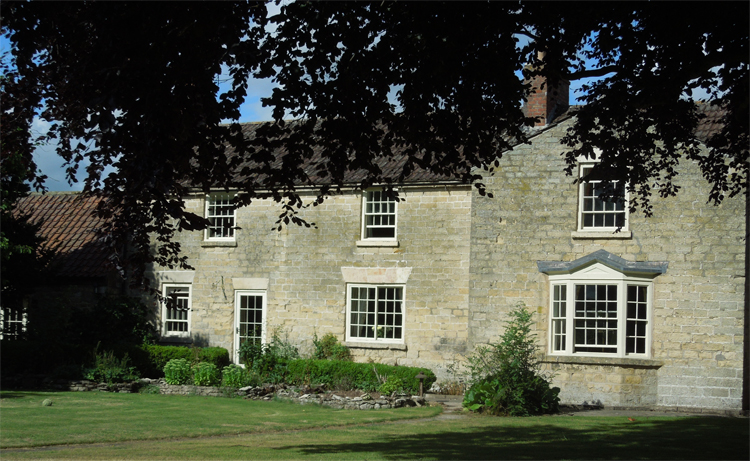
HH2For anyone looking for somewhere to stay to the north of York,  I’m adding to my periodic comments about interesting hostelries and places to stay by recommending Habton House Farm.  This is an exquisite, hidden-away 200 year old Grade II listed farmhouse situated in the small hamlet of Little Habton just to the north-west of Malton, and not far from Castle Howard.  It makes a great place from which to visit the North York Moors and the Vale of Pickering, with both York and Scarborough each being less than an hour away.  The rooms are beautifully decorated and the quality of furnishings and services offered have been chosen with great care and are of a very high standard. I particularly liked the choice of bath oils and soaps (Bamboo from Bath House if I recall correctly) – as well, of course, as the teas!

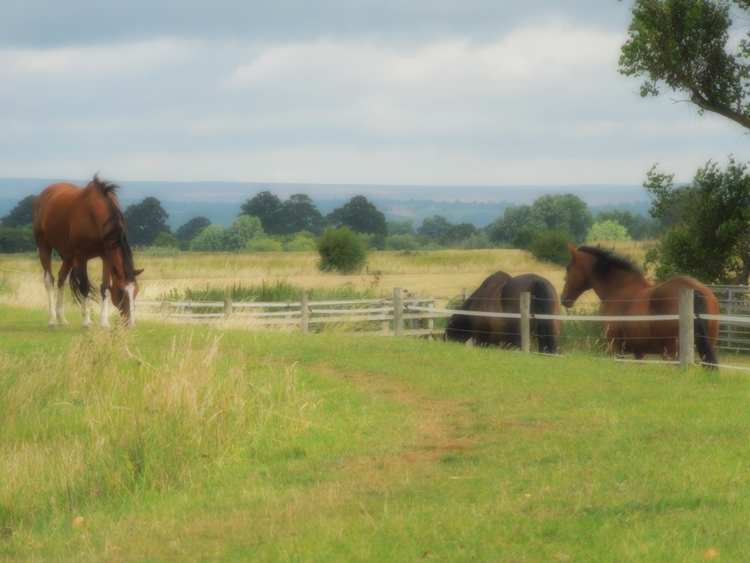
HorsesHowever, above all this, what really makes the place is the friendly, welcoming hospitality of James and Lucy who have worked enormously hard to create this very special place to stay.  They have a really magical touch of making guests feel very much at home, getting just right that difficult balance between being open and friendly, while at the same time giving space to guests who just want to escape and be alone.

The breakfasts are also really special!  They offer a good range of delicious food – from bacon and eggs produced on their smallholding, to porridge, smoked salmon and home-made jams and marmalade; and, for the healthier minded, don’t forget the fresh fruit salads and fruit compote!  All of the guests sit around one large breakfast table – which can be a bit daunting for some – but this offers a great opportunity for interesting conversation!

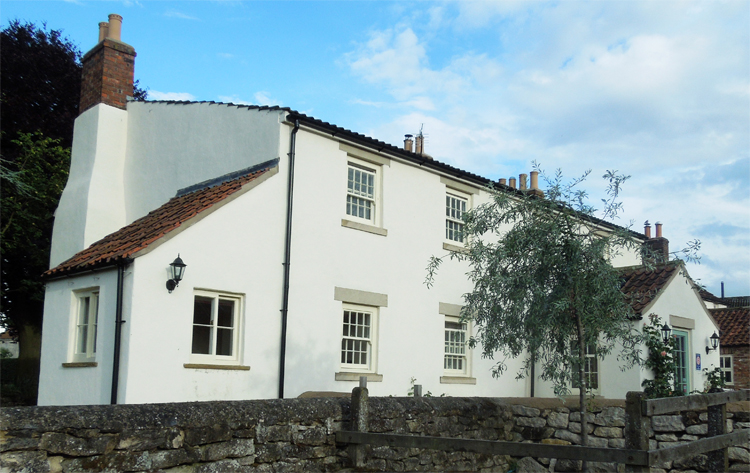
HH1With only three double rooms, there are never many people staying, and there is plenty of room to relax.  Guests have use of a lovely drawing room, which has a log fire in the winter, and for those who cannot escape being an appendage to a digital device there is good quality Wi-Fi, as well as a television in each room, and DVDs to borrow in the drawing room.  Nearby are several good restaurants, and James and Lucy are always on hand to recommend somewhere interesting to explore.  We certainly had a very pleasant pub dinner at The Grapes in Great Habton!

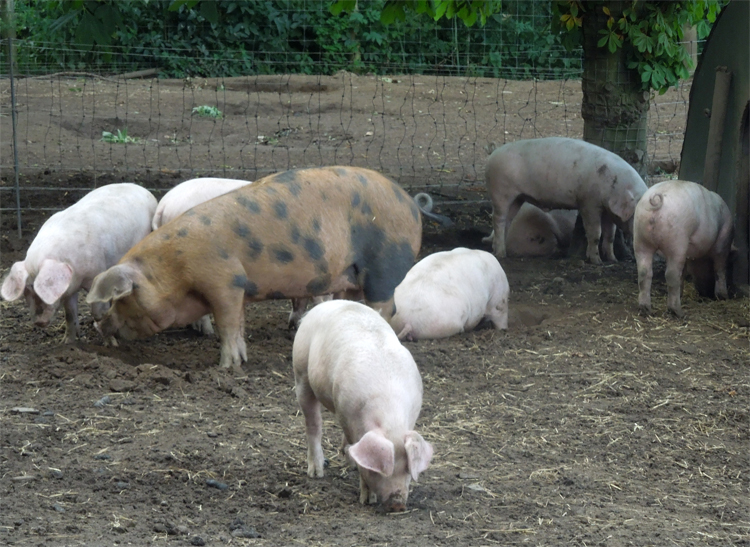
PigsTheir smallholding specialises in breeding and rearing rare-breed pedigree Oxford Sandy and Black pigs, and has pioneered the ultimate in food provenancing by enabling people to adopt a pig, and follow it throughout its life until the time comes to enjoy a wonderful porcine feast!  Mind you, the bacon at breakfast is also very, very good!

All in all, if you are looking for a quiet, luxurious place to stay in Yorkshire, at very good value, and with really friendly young hosts, this is definitely somewhere you should get to know!  I really hope that James and Lucy make a success of this venture – and that by encouraging others to come and stay I can express something of my gratitude to them for a really lovely weekend!

1 Comment

Filed under Photographs, Restaurants