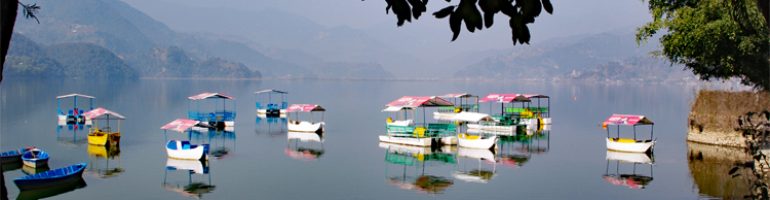
I have written previously about the landscape implications of wind turbines in the Conca de Barberà, but always somehow hope when I visit this beautiful part of Catalunya that I will not be annoyed by them as much as I have been on previous occasions! It never works. I was walking in the hills above Poblet today, and the view across the vineyards and fields, looking across to the snow covered Pyrenees Mountains in the distance were completely destroyed by these ‘urban’ conceptualised and created monstrosities in the rural landscape! Have to admit that it tempts me to thoughts of how easy they would be to destroy…
Runnymede floods and Staines under Thames, 16th February 2014
What seems like the first bright sunny day for weeks provided an opportunity to take a photographic record that would capture something of the flooding along the Thames in Runnymede, Egham and Staines. The pictures below provide a follow-up to those that I took earlier in the year in January on a rather more cloudy day, when the floods were less extensive.
Whilst I have every sympathy with those living in flooded areas, these images emphasise that flood plains are meant to be just that – plains where rivers flood! We have had exceptional amounts of rainfall, and no-one should therefore be surprised that such flooding has occurred!
Filed under Photographs
CTO visit to the Ngorongoro crater in Tanzania
The final day of the Commonwealth Telecommunications Organisation’s Digital Broadcasting Switchover Forum (DBSF) 2014 provided an opportunity for delegates to continue their discussions whilst visiting the magnificent Ngorongoro crater, a UNESCO World Heritage Site situated some three hours drive west of Arusha. This event, along with many other aspects of the Forum was supported by the Tanzania Communications Regulatory Authority (TCRA), and I would like to take this opportunity to thank Professor John Nkoma (Director General, TCRA) for all of the effort that his magnificent team put into making this what was widely regarded as one of the best ever DBSF event convened by the CTO. Particular thanks are especially owed to Habbi Gunze (Director of Broadcasting Affairs at TCRA) and to Innocent Mungy (Head of Corporate Communications, TCRA) for everything that they did to ensure that participants were able to hold fruitful and valuable discussions on Africa’s progress towards digital broadcasting switchover by August 2014.
The photos below provide a summary of the magnificent experiences that delegates had in the Ngorongoro crater, and also on the journey between Arusha and the crater. As I hope these images indicate, the crater itself was very much bigger than I had been expecting and the range of wildlife was truly amazing.
After visiting the crater, we spent some time in a small Maasai boma. A group of children were gathered in one of the tiny huts that served as a pre-school, and it was fun to sing ABCDEFG… with them, and hear them count from one to 10 in very good English. It reminded me of the images that appeared around 2007 in European and north American media of Maasai warriors with their mobile ‘phones, giving the impression that such devices were becoming more or less universal amongst the Maasai, and were transforming their lives. I asked one of the chief’s sons whether there were mobile ‘phones in the village, and slightly perplexed he said “No”. One of my colleagues then asked whether he felt ‘phones would be useful for communicating with friends, and the “warrior’s” response was fascinating, saying much about the resilience of Maasai culture. “Why do I need a mobile ‘phone?”, he said. “If I want to see a friend, I walk, perhaps two or three hours to see them”. I envied him. What a privilege to walk through such a wonderful landscape, and not to feel the pressures of our modern digital lives. Perhaps I should not have asked my next question, but he was proud of the children’s learning skills, and wanted to improve his own education. So, I asked “But if you had a mobile ‘phone, could you not use it to access books and information so that you could learn?” I should not have asked, because the question embarrassed him. It reflected a world so different from his own, that it was incomprehensible. I felt embarrassed too that, although he had given permission, friends with me were using their smart-phones to take pictures of the boma. I left feeling very challenged. I’ve long felt that we should never impose digital technologies on the lives of others. Of course many people think that mobile ‘phones could indeed make the lives of the Maasai very much “better”, but it would certainly be at a cost. I left just wanting to find a way to give them books for their children, which is what he had asked for. Perhaps then we could make time to help work with the villagers to design technologies that might enable them to live the lives they want to, rather than the lives so many of “us” want to impose on them of being both a market and a labour force.
Filed under Africa, Photographs
Commonwealth Telecommunications Organisation’s Digital Broadcasting Switchover Forum, Arusha
Just under 200 people (including regulators, the private sector and civil society groups) have come together to discuss critical issues surrounding the switchover/transition from analogue to digital broadcasting at the Commonwealth Telecommunications Organisation’s Digital Broadcasting Switchover Forum (#DBS2014) taking place from 11th-14th February 2014. We were delighted that Hon Dr. Fenella E. Mukangara (Minister of Information, Youth, Culture and Sport of the United Republic of Tanzania) was able to open the Forum this morning.

In my welcome address, as well as thanking the government of Tanzania and especially the Tanzania Communications Regulatory Authority, I took the opportunity to highlight four particular issues:
- The importance for Africa – digital transition/switchover has considerable potential, especially in terms of the diversity of services it can offer, as well as the digital dividend it will provide through the reallocation of spectra. However, it must be used to serve the interests of all of Africa’s people, especially the marginalised, such as people with disabilities and those living in sparsely populated rural areas.
- The potential for Africa – people living in Africa should not be only learning from the experiences of other parts of the world in terms of good practices (part of the purpose of this Forum), but should also be developing innovative solutions for the context of Africa, that can in their turn be used in other international contexts. We must build on the richness of African innovation.
- The challenges facing Africa – some of the many challenges facing Africa include:
- it is not easy to deliver transition/switchover solutions at a cost that everyone can afford;
- we must not fall into the trap of being forced to deliver to a time-schedule that may not be realistically feasible;
- ensuring indeed that the poor and marginalised – those who often currently benefit most from analogue radio and television – can indeed still afford to do access digital broadcasting;
- ensuring quality standards of equipment such as set top boxes; and
- ensuring that appropriate information is shared with everyone in a diversity of languages.
- My own experiences of switchover – I recall my parents being really concerned about switchover in England, not fully understanding what was involved, but they were grateful that a free service for elderly people was provided to put in a set top box and help them to use it effectively. My mother can now benefit from all that digital TV can offer! This particularly reminds that it is not so much the technology that is the challenge, but rather that the most difficult thing to get right is how to ensure that everyone, and particularly the elderly, the spatially marginalised and those with disabilities, can really benefit from digital switchover.
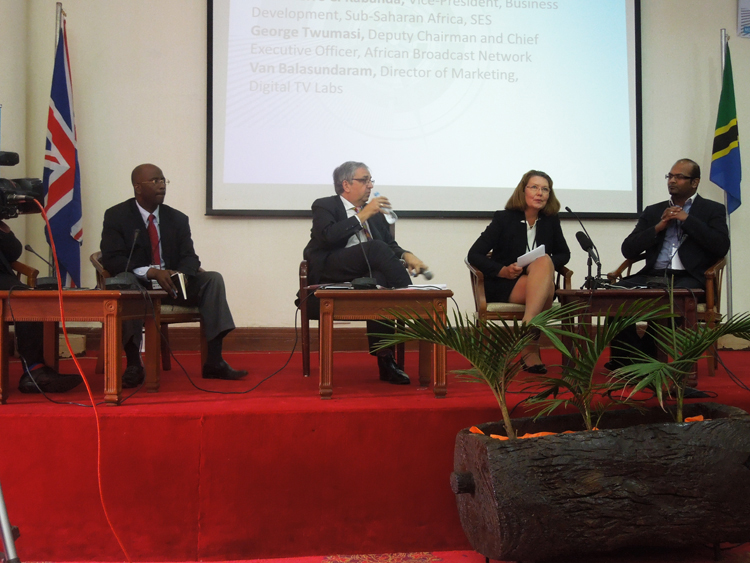 Image from session on the future of African broadcasting
The River Thames at night
Somewhat surprisingly, I had never been on a boat on the River Thames at night until yesterday. I remember as a child, when London seemed to have turned its back on the river, which always seemed cold, dark, smelly and unattractive! Over the last 50 years this has all changed, especially with the opening up of the path along the south bank of the Thames, and the transformation of the old docks into modern offices and residential areas. I had not, though, appreciated just how beautiful it was at night, with the buildings all carefully lit. I hope that the pictures below do it some justice! Thanks to Dominc and Caroline for making this possible for delegates at the Education World Forum!
Filed under Photographs
On “cyber” and the dangers of elision.
The use of the word “cyber” to refer to all matters relating to computers and the Internet has become ubiquitous. Hence, the terms “cyberspace”, “cybergovernance”, “cybersecurity”, “cybercrime”, “cyberporn” and many other “cybers-” are commonplace, and feature prominently in current rhetoric about ICTs and governance of the Internet.
This has always made me uneasy for two basic reasons:
- the original meaning of “cybernetics” had little to do with computers; and
- there is a real danger of elision of meaning, when people use one cyber-word to refer to what other people use another cyber-word for.
A blog is no place for a detailed exegesis on these matters, but I have so often been asked about my views on them that I thought I would briefly summarise them here.
The meaning of “Cyber”
The word “cyber-” is usually seen as being taken from the concept of “cybernetics”, which itself is derived from the ancient Greek κυβερνήτης, meaning steersman, pilot, or governor. Hence, “cyber'” is fundamentally to do with governing or steering. It is used in this sense to refer to the governance of peoples in the First Alcibiades, usually ascribed to Plato.
Cybernetics in its modern form came to be used in the first half of the 20th century to refer to control systems in biology, engineering, applied mathematics, electronics and other such fields, and so was always a very much broader concept than just relating to the field of computing. As a discipline, cybernetics emerged in the late-1940s and 1950s, especially in the USA, the UK and France, championed by people such as Norbert Wiener and John von Neumann. The importance of this is to emphasise that in origin, and even until very recently, “cyber-” has been associated with a very broad field of intellectual enquiry, across many disciplines, focusing especially on systems and their control mechanisms.
It therefore seems to me to be inappropriate for the term to have been appropriated quite so aggressively in the field of digital technologies, ICTs and the Internet, first because it causes confusion, and second because in some instances it is tautologous:
- with respect to confusion, why do we need to speak about terms such as cybergoverance, cybersecurity and cybercrime, especially when there are other terminologies already in existence, such as e-governance, Internet governance, computer crime? As discussed further below, the lack of consensus and agreement on terminology is problematic.
- second, though, and of much more concern, it seems to me that the notion of cybergoverance is fundamentally flawed because it is tautologous. If “cyber-” in essence is to do with governing, then all “cybergovernance” means is governing governance.
There have been many detailed critiques of the use of “Cyber-” in other fields, with Mark Graham’s critique of concepts of cyberspace in the Geographical Journal, being particularly useful. However, few people have sufficiently emphasised this tautology in the notion of “Cybergoverance”.
Dangers of Elision
When concepts are used in such a slippery way, with meanings being appropriated and adapted so frequently, there is a considerable danger of misunderstanding, overlap, and ultimately of failure to deliver on practical action. Moreover, behind every use of a concept there is also an interest. This is very well illustrated by confusion over the terms cybergoverance, cybersecurity and cybercrime (or even cyber-goverance, cyber-security and cyber-crime). All too often they seem to be used interchangeably, and there really must be clarity of meaning and understanding of such terms if progress in reaching consensus on these very important issues is to be made. One person’s cybercrime is another’s cybersecurity, and an initiative set up to focus on just one aspect can readily seek to expand into another, thereby causing confusion, duplication of effort, and indeed mistrust.
Although, for the reasons above, I think that the term “Cyber-” should no longer be used at all with respect to work on the Internet, digital security, computer crime and the like, because it is far too broad, I recognise that unfortunately it is now in such common use that this plea will fall on deaf ears. There are powerful interests who like this ambiguity, and wish to use such terms for their own ends! Hence, let me offer a simple structure whereby some clarity might be injected into the discourse. At least for me, there is a nested hierarchy of such terminology:
- “cybergovernance” (ugh, the tautology still hurts me) should be used (if at all!) for the overarching notion of governance of ICT systems, including concepts such as Internet governance and e-governance;
- “cybersecurity” can be seen as a subset of cybergoverance, and should be used to refer to all aspects of security with respect to ICT systems. The concept of “cyber-resilience” can be seen as being closely allied to this, and might actually be a better term, since it is more positive, and takes away the sense of threat around security and the role of the military.
- “cybercrime”, accordingly, is a subset of cybersecurity, focusing just on the aspects of criminality with respect to the use of ICTs.
Of course there is overlap between these terms, because fully to understand cybercrime, one needs to have a knowledge of cybersecurity, and to understand and act on that one needs to consider wider cybergoverance issues.
My preference is to abandon the use of this “Cyber-” terminology altogether and to use clearer more specific words for what we are talking about and seeking to implement. Then, we might actually make some progress in ensuring that the poorest and most marginalised can indeed benefit from the potential of ICTs. However, if these terms continue to be used, let’s first try to reach some better agreement on their bounds and contents. Cybergovernance, cybersecurity and cybercrime are categorically different concepts, and the interests that seek so often to elide them need to be challenged!
Filed under Commonwealth, ICT4D
Mobile ‘phones since 1993…
I cannot believe that I bought my first mobile ‘phone in 1993! Vodafone and British Airways had a deal encouraging the intrepid traveler to buy one of these “Pocket Phones” – an Orbitel 902 – and there it is at the left of my mobile timeline below. There is so much I could write about this – the change from Nokia to Apple with the iPhones; the fact that the average life-span has been just under 2 years; how appalling the Nokia N95 was, with the Nokia 6630 not being much better; how I liked the Nokia 6510; how I am still using my brilliant little Nokia 6080; how battery life of iPhones is too short; how I object to everything moving onto the Cloud…. Sadly the Android based Sony Xperia with NFC that I got last year as well is not shown here – on loan to my son in Spain! Oh yes, and what does this have to say about the number of active mobile ‘phones in the world – most of these still work, and you should see my SIM card collection!
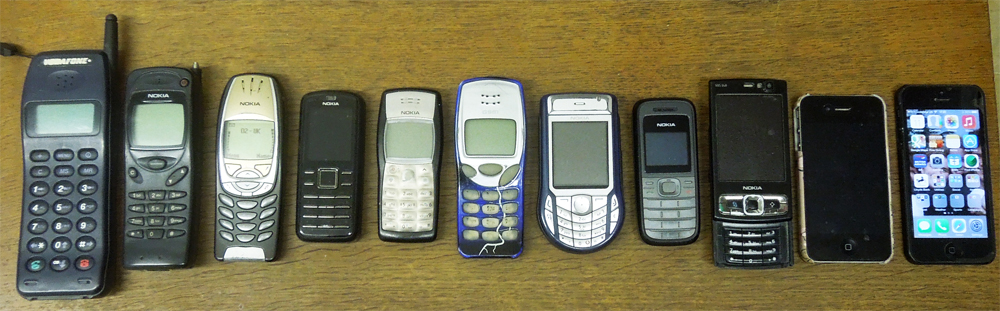 Enjoy the picture!
Thames floods at Runnymede, January 2014
I have to admit to being a bit perplexed why so much fuss is being made over the recent flooding in the UK. Yes, of course there has been damage to property and loss of life, there have been huge waves that have reshaped our coasts, and weeks of rain have given rise to extensive floods in the first few days of 2014. However, floods are to be expected! Anyone with the slightest bit of knowledge about rainfall and hydrological systems should know that flood periodicity occurs, and that this can be described statistically. Thus, we refer to the notion of a 100-year flood as being a flood amount with a 1% probability of occurring in any one year; a 500-year flood has a 0.2% chance of occurring in any one year. Big floods are expected; we just cannot predict exactly when! Naturally, flood plains are those areas into which rivers overflow, and historically people knew this and built their properties above the usual flood level. Looking at the photographs of flooded parts of England, it is fascinating to see that in most cases it is the ancient churches and oldest houses that are most frequently to be seen above the rising water levels. River management systems seek to deal with the most frequent flood levels, and the challenge is to get the balance right between protection and cost. Thus, the expense of protecting against 1000-year floods is often prohibitive, and it is generally argued that it is much better simply to pay for repair to the damage of these extreme events. In Britain, the Environment Agency, for example, provides detailed maps of flood risk, which specifically identifies the areas at risk of 1000 year floods (in pale blue).
Unfortunately, a long period of relatively few floods in the UK in the 195os and 1960s led planners increasingly to build on flood plains, and although the amount of building on flood plains in Scotland and Wales is now very slight, 11% of new builds in England in 2011 were still in areas at risk of 100 year floods. Some 5.2 million houses in England, representing 23.1% of existing properties are estimated to be at risk of such floods. This demand by ‘developers’ shows no signs of abating, and a report in 2012 indicated that planning applications were submitted to build as many as 28,000 new homes on land that officials considered to be at serious risk of flooding. It is not nature, or any failings of the Environment Agency that are to blame for the misery of our present floods, but rather the demand for housing and the greed of those who want to maximise profits from house building and other construction on flood plains! I have to say that with respect to the recent floods it would appear that the Environment Agency has actually done a remarkably good job, and I am dismayed at how critical so many people seem to have been of the flood protection efforts made by recent governments.
Whilst such floods are obviously very sad and damaging for those affected by them, they are a good reminder that nature is actually much more powerful than we often give it credit for, and waterscapes of flooding can indeed be very striking and beautiful. Below I capture some images taken over the last couple of days of the Thames at Runnymede – as the National Trust sign says, “The birthplace of modern democracy”!
Filed under Photographs
Reflections on “corruption”…
I have long argued that people tend to use the word “corruption” mainly to describe cultural practices that differ from those with which they are familiar. It is a term that is almost always used negatively. Re-reading Transparency International‘s 2013 Corruption Perceptions Index has very much reinforced this view, but in a way that I suspect will not be expected by those who read what follows!
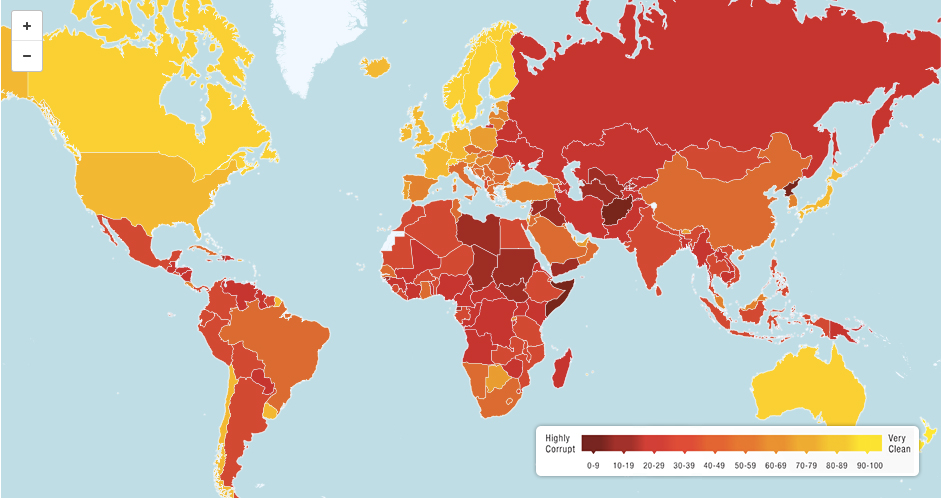
I have huge admiration and respect for the work of Transparency International. The map above shows the perceived levels of public sector corruption in 177 countries in the world. In brief, it indicates that 69% of countries have a score of less than 50%, indicating a serious corruption problem.
However, what stands out most to me about this map is that it is very largely the countries of northern Europe, northern America, and Australasia that are perceived as being least corrupt. The yellow “holiness” is so marked against the “evil” red of corruption that swathes most of the rest of the world!
Corruption according to Transparency International can be defined “Generally speaking as ‘the abuse of entrusted power for private gain’. Corruption can be classified as grand, petty and political, depending on the amounts of money lost and the sector where it occurs”.
Three ideas seem particularly pertinent in this context:
- The notion of corruption is intimately tied up with the nature of capitalism. Put simply, the apparently least corrupt countries according to this definition are generally the most advanced capitalist countries. This suggests that it serves capitalist interests to try to reduce “corruption” as much as possible. It is interesting to ponder why this might be. One reason may be that reducing the abuse of entrusted power for private gain actually reduces the tendency for the rate of profit to fall. However, it is difficult to see how this might happen, and it seems in stark contrast to a fundamental characteristic of capitalism which is that it is actually designed to ensure the maximum possible private gain for the capitalists. I guess the reality may be that limiting or preventing private gain from entrusted power actually enables the market (i.e. the principles of capitalism) to flourish as effectively as possible. By extension a reduction of all entrusted power (i.e. limiting the power of the state) could be seen to enhance the power of the market, and therefore increase the potential for private gain of those who do not hold political power. Hence, keeping the power of the state as small as possible, and ensuring that it functions in a way that does not lead to private gain for the holders of power in the state, will ensure that the maximum surplus profit is available to the leaders of global corporations and their shareholders.
- However, it is very clear that there is also corruption in the leading capitalist states. The countries shaded yellow on the above map may be perceived as being less corrupt than others, but corruption still abounds in them! Hence, there is huge hypocrisy when leaders (and indeed others) in the “yellow” countries accuse those in the “red” countries of being corrupt. Those in the banking sector, for example, who pay themselves and their staff huge salaries are surely also using their positions of power for private gain? The amount of money spent in US Presidential elections is also an indication of the way in which “money speaks”: Obama thus raised $715,677,692 in the 2012 elections, and Romney raised $446,135,997. Together, this sum of money was worth more than the GDP of 25 countries in 2012 (according to UN figures). One needs huge amounts of money to be elected President of the US, and those who contribute this money expect the policies that the President introduces to benefit them – for private gain. Likewise, in the UK in 2012, Michael Meacher in a letter to the Guardian newspaper noted that “that the richest 1,000 persons, just 0.003% of the adult population, increased their wealth over the last three years by £155bn. That is enough for themselves alone to pay off the entire current UK budget deficit and still leave them with £30bn to spare”. Is not this also a form of corruption?
- Corruption is seen differently in countries where rampant capitalism and private financial gain may not be seen as the most important priorities. According to the Transparency International report, most countries in the world are perceived as having a serious corruption problem. This poses an interesting question: might their systems of priorities actually in some ways be better? If they were not, why do these systems persist? For a person living in a culture where ties to family and tribe are more important than individual private financial gain, it must seem very wrong not to give employment opportunities to members of one’s family, regardless of actual ability. Likewise, where personal loyalty matters more than direct monetary return, supporting a friend to achieve their particular job aspirations would seem much more appropriate than ensuring that there is a “fair” competence based application process. Giving gifts to reciprocate for generous hospitality is merely a different way of redistributing and sharing financial benefits. Moreover, much of what passes for probity in the “yellow” countries actually tends to be a smokescreen for traditional modes of “corruption”. The appointments process is invariably biased through friendship ties – not least through the reference system and the use of headhunters – and is never purely competence based. Likewise, the UK’s honours system is still very largely determined by personal friendship networks, rather than necessarily by ability or contribution to the common good.
In short, I am more than ever convinced that “corruption” is simply a pejorative term that people use to describe political, social and economic systems that are different from their own. In a world dominated by capitalist interests, it is scarcely surprising that less-advanced capitalist economies are perceived as being more corrupt than those where the search for individual gain and success is highest. Yet this very focus on individual gain in capitalist societies is itself fundamentally “corrupt”, since it detracts from the communal good which, at least for me, is ultimately far more valuable. I suggest that we may have much more to learn from the mutually supportive social and cultural networks that underlie such “corrupt” regimes, than we do from the economic interests that determine definitions of probity in the capitalist heartland. However, this is because I believe that the common good is far more important than private individual gain.
Filed under Africa, Commonwealth, Development, Entrepreneurship, Universities

 Tim Unwin's Blog