Wildlife at Yala, Sri Lanka

A short holiday in Sri Lanka has enabled us to visit the wonderful Yala Nature Reserve covering some 98,000 hectares in the south-east corner of the country.  A seven hour drive from Colombo on Saturday has meant that we can spend a relaxed Sunday exploring the Park, and chilling out by the sea!  Yala is renowned for its elephants, leopards, deer, wild boar, buffalo, crocodiles, monkeys, jackals, sloth bears and some 135 species of birds.  Setting off at six this morning, we saw most of these – apart from the sloth bear!  We were amazingly fortunate to see a leopard keeping a watchful eye on a group of deer drinking from a pond, just too far away for it to pounce on them!

The photos below show just some of the rich diversity of wildlife to be found in this peaceful haven – definitely worth visiting for anyone who is coming to Sri Lanka!

This slideshow requires JavaScript.

1 Comment

Filed under Photographs, Wildlife

London Paralympics 2012

Thanks to the generosity of the Department for Culture, Media and Sport, who co-hosted the Commonwealth e-Accessibility Summit with the Commonwealth Telecommunications Organisation, I was able to attend the opening ceremony of the Paralympic Games.  The photos below seek to capture some of the amazing and inspirational atmosphere of the ceremony.

This slideshow requires JavaScript.

Leave a comment

Filed under Photographs

Save the Hobbit – that is, the pub in Southampton

I have often driven past the Hobbit pub in Portiswood, on the edge of Southampton, and although I have never been inside I have always thought that it was a great name for a pub – and it has been there for some 20 years.  So, I was more than a little concerned to read a recent BBC report that mentioned that the pub has been threatened with legal action by the Saul Zaentz Company (SZC) back in March 2012.  SZC owns the worldwide rights to various brands association with the author JRR Tolkien (acquired in 1976), including the Hobbit and The Lord of the Rings, and appears to be flexing its muscles to ensure that these rights are not infringed.  However, taking it out on an English pub seems to be going a bit too far.

It is good to see that others have come to the rescue of the Hobbit – that is, the pub!  Some 59,830 people have indicated that they like the Facebook page Save the Hobbit, Southampton, and actors Stephen Fry and Sir Ian McKellen have apparently offered to pay for the copyright licence fee so that the pub can carry on trading under its present name.

Tonight, there is a party at the pub to raise money to pay for legal fees to ensure that this dispute is resolved sensibly.  So, if you are anywhere near Southampton do get on down to the Hobbit and party for a cause.

Could this be a reason not to watch the Hobbit (in all its money making parts) when the film comes out?!

Leave a comment

Filed under Politics, Universities

Olympics hockey 2012 – night and day

We were among the thousands who did not get any tickets in the first round of applications for the 2012 Olympics, but were fortunate enough to get tickets for several of the hockey matches at the Riverbank Stadium – enabling us to see the Olympic Park both during the night (7th August – seeing GB (1) draw with Spain (1) and  New Zealand (5) draw with Germany (5)) and also during the scorching hot day (9th August – watching New Zealand (3) beat Argentina (1) and Pakistan (3) beat South Korea (2)).

The pictures below seek to catch something of the diversity and beauty of the London Olympics.

This slideshow requires JavaScript.

1 Comment

Filed under Photographs

Google admits it is in breach of UK data privacy

The BBC has reported that “Google has admitted that it had not deleted users’ personal data gathered during surveys for its Street View service. The data should have been wiped almost 18 months ago as part of a deal signed by the firm in November 2010. Google has been told to give the data to the UK’s Information Commissioner (ICO) for forensic analysis”.

When it was originally reported that Google had obtained private data from unsecured wireless networks whilst it was gaining images and spatial data for Street View, the company said it was a mistake and agreed to delete the data by the end of 2010.  However, Google has now contacted the UK’s Information Commissioner to say that not all of these data have been destroyed, asking what it should do with it.

As the BBC continued to report “Possessing data that should have been deleted ‘appears to breach’ the undertaking Google signed in November 2010, said the ICO in a statement. ‘The ICO is clear that this information should never have been collected in the first place and the company’s failure to secure its deletion as promised is cause for concern,’ it added”.

Leave a comment

Filed under Ethics, UK

World Bank report on maximising mobiles

The World Bank has just published a useful new report entitled Maximizing Mobile (full report .pdf).  This “report analyzes the growth and evolution of applications for mobile phones, focusing on their use in agriculture, health and financial services, as well as their impact on employment and government. It also explores the consequences for development of the emerging ‘app economy’, summarizing current thinking and seeking to inform the debate on the use of mobile phones for development. It’s no longer about the phone itself, but about how it is used, and the content and applications that mobile phones open”.

Individuals chapters address the use of mobile devices in agriculture, health, finance, entrepreneurship, and government.  A final chapter provides insights on financing mobile broadband.

Leave a comment

Filed under ICT4D

Vanuatu – gun running

Just seen this exciting report from Radio New Zealand International:

“Posted at 22:38 on 24 July, 2012 UTC

Vanuatu authorities have confiscated firearms after detaining a yacht, the Phocea.

16 crew members and the skipper, along with the owner’s girl friend have been arrested.

The owner, Anh Quan, was a Chinese national but became a Vanuatu citizen this year.

Local media has reported that police believe the vessel was being used to try to smuggle high-powered firearms and illegally acquired money into the country.

Authorities have also confiscated 16 allegedly fake diplomatic passports, and Vanuatu Maritime legal documents.

The passports reportedly include the fake signatures of the Principal Immigration Officer, Francois Batick, and a former Vanuatu Maritime Commissioner, Les Napuati.

Two government ministers, another MP and other politicians were spotted on the yacht before the authorities went on board on Sunday.

The yacht, which had been travelling from Italy to Papua New Guinea, was once owned by a former French government minister, Bernard Tapie.

News Content © Radio New Zealand International
PO Box 123, Wellington, New Zealand”.

And all this happened just after I left Vanuatu!

Leave a comment

Filed under Story-telling

Broadband in the Pacific

The Pacific Broadband Forum 2012, convened by the Commonwealth Telecommunications Oganisation and the International Telecommunications Union, together with regional partners PITA, PiRRC and SPC, is currently being hosted by the Fijian Ministry of Communications on Denarau Island, Fiji.  This morning’s session provided a wealth of information about the current status of broadband roll-out across the region.  Sadly, my fingers and brain were insufficiently co-ordinated to record everything that was said, but I hope that the following notes may be useful for those interested in ways through which ICTs are being developed in the region:

Cook Islands

  • No policy and regulations in place for broadband
  • There is a national ICT policy – based on 6 platforms
  • New national sustainable development plan – will have to align with this.
  • Legislation: 1989 Telecom Act; new draft bill in consultation; SPAM act 2008; electronics transactions bill; evidence act (needs to be updated); cyber crime legislation in development. But most need training in implementation.
  • Many challenges – budget, lack of implementation capacity, lack of consultation with stakeholders
  • Need to establish a regulator

Federated States of Micronesia

  • Connected with fibre optics with the Kwajalein to Guam (USA) since 2005 (spurs to Marshalls and elsewhere)
  • President Mori said need to connect all islands, and a regulator
  • 2007 ADB issued report on liberalisation, regulation and community service requirement
  • Hantru cable became operational in Pohnpei – eight 20 Gbps capacity to Guam; other islands are not yet connected.
  • Close links with World Bank who have conducted studies and due diligence
  • Optimising on current investments.
  • Debt servicing of DSDA loans that enabled what was originally done.
  • There will be sector reform to liberalise the market
  • Next challenges – to endorse the policy and the FSM Congres will need to endorse World Bank Assistance and the Telecommunications Sector Reform.

Kiribati

  • 33 atolls over 3.5 million km2; population of only 112,000
  • relies on satellite
  • fixed line 4.14%, mobile 1.04%; internet 2.07%
  • prices of telephony and internet are very high
  • monopolistic market TSKL sole ICT provider
  • World Bank funding for ICT review and advice
    • Policy and legal support
    • Regulatory support
    • Outer islands connectivity support
    • Project management support
  • 9 telecentres funded by government; PACRICS provided internet connectivity in 10 secondary school

Marshall Islands

  • 68,000 pop, 34 islands
  • broadband – 2 urban cities have cable installed; gsm sites in four islands. Telecentres. DAMA sites.  Aim to cove all country by end of 2012.
  • ICT policy should be in place by end of August and will provide for market liberalisation, regulator, cybercrime
  • Only 1% of submarine cable in being used
  • Remote area is getting connected for e-health, e-learning and climate change
  • Difficulties: connecting the unconnected; teamwork; perfect competition; consumer satisfaction; move small
  • Challenges
    • Costs of backbone
    • Geographical challenges for operations
    • Quality and reliability
    • Costs of bandwidth
  • 2008 National ICT Policy
    • NICTA regulator
    • Aims to have efficient ICT infrastructure as backbone
    • Open competition
  • 2012 National Broadband policy
  • LNG Fibre cable project announced – cable is piggy backing on the pipe

Nauru

  • Population less than 10,000
  • Regulator – enabling environment
  • Challenge of ability to provide broadband – only one service provider.  Bandwidth to increase by 30% in next month.  Talking with O3b to increase
  • If you cry hard enough you are bound to be heard.
  • Need to lay the foundations and have regulations in place
  • Major reforms in last decade in telecoms sector.  Telecom Act 2005 established regulator in 2006 which introduced competition
  • Competition has worked even in a small island
  • PM Chairs national IT committee – it is important to have leadership from the top
  • Draft masterplan for broadband supported by ITU
  • Universal access policy
  • Shared infrastructure
  • c. 95% coverage
  • Looking at 2nd submarine cable

Niue

  • Just one island – the Rock (260 sq kms); population 1600.
  • Telcom Niue – sole provider and regulator; two ISPs
  • Fixed line 60%; mobile 30% (only introduced July 2011); broadband 1% (introduced April this year)
  • Bills before Parliament (SPAM, Cybercrime, Draft ICT Policy)
  • Issues for Niue: very small market means lack of service and difficulties of setting prices; satellite bandwidth, but costs are too high for us; capacity building.
  • Free wifi access – arrangement with manager of top level domain nu – to develop access on the island.
  • OLPC has not really worked that well – laptops breakdown very easily and no back-up; and not managed properly. Children took them home and did not bring them to school except when they were broken.
  • Future plans – looking to develop services.

Palau

  • 240 islands; population 20,000
  • mobile coverage 98%; internet subscribers 6%; fixed broadband 2%
  • 113 mile long underground and submarine SONET cable connecting 3 islands.  Using VSAT to reach remote islands.  Radio also used in isolated areas for emergency.
  • PNCC (Palau National Communications Corporation) provides the majority of communications services
  • Palau Mobile Corporation commenced operations in 2006 and offers GSM services (3G hopefully will roll out next year).
  • Palau Telecoms licensed for Digital TV and internet – yet to start mobile service
  • Skyfy yet to offer services, but is licensed
  • Mobile services can reach 98% with mobile density being 80%
  • 2011-2014 Palau National ICT Policy (thanks to ITU)
  • Expanding broadband and international fibre optic cable connectivity

Solomon Islands

  • Cable plan 2013
  • Setting up 50 GSM sites
  • 3G services launched by Telekom and Bemobile
  • establishment of universal access fund policy
  • costs high

Tuvalu

  • No-cable islands dreaming for cable
  • Population 11,000; landlines 1182, mobiles 2525, Internet 4000
  • Monopoly
  • Current activities: e-government, national ICT policy, cyberlegislation, licensing
  • Challenges: funding, human capacity, geography (500,000 sq miles), high costs of ICT, poor energy supply
  • Plans: strengthening outer island connectivity, disaster risk reduction (very vulnerable – one tsunami would take us all across to Fiji), offsite backup

Vanuatu

  • Been challenged in court and politically, but has come through that as an independent regulator
    Minister was ‘in bed with’ one of the telcos and has now been taken off – so ICT responsibility is in the Prime Minister’s office.
  • Technical advisors funded by the World Bank and AusAid.
  • ICT for all (7 goals)
  • Very strong Universal Access policy in draft – has been sitting on Minister’s desk for a year – but will hopefully now go through (only raises funds from operators for specific projects)
  • Zero rate importation tax for all ICTs
  • 2015 access to broadband connectivity for 85% of population
  • Spectrum available 700 MHz LTE and 3G
  • Submarine cable being led by Interchange
  • Employment is growing in the sector – now 2500
  • Telcentres in Rensarie and Melsis high schools; Nebul and South West Bay health centres – need to provide many additional services in the centres.  Quite slow take up; importance of the manager; potential for agriculture.
  • All stakeholders must work carefully together
  • High schools and health centres are a priority
  • Using mapinfo to find the most cost effective way to deliver services

Leave a comment

Filed under ICT4D, ICT4D conferences

Fire and Water in Canberra

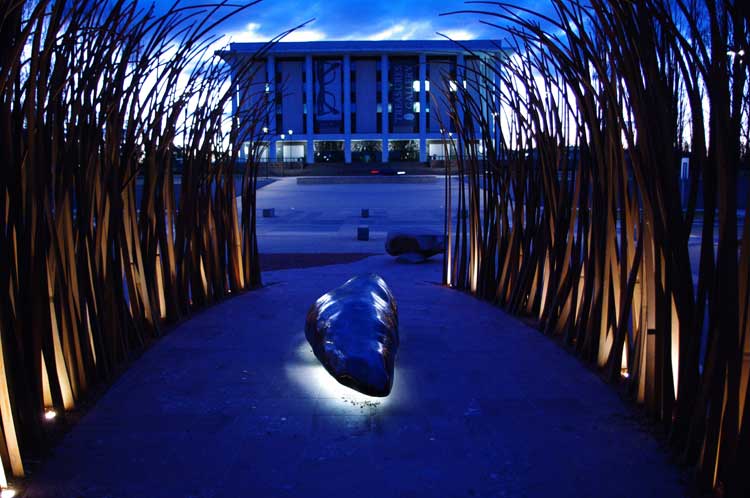
Just occasionally magic things happen – especially in Australia!  This evening, I went for a short walk at dusk along the lake-side in Canberra, watching the sun go down behind Parliament House and reading about the various pieces of artwork and sculptures scattered between the High Court and the National Library.  Near the latter, at Reconciliation Place, I came across a large sculpture, with curved brown ‘arms’ sticking up into the air, surrounding what appeared to be a large shiny black rock that looked a bit like a stranded seal, on a bed of largely grey tiles.

This was a piece of art called Fire and Water by Judy Watson, which has been described as follows: “Judy Watson’s Fire and Water artwork creates an evocative experience that saturates the senses and establishes a strong sense of place. Watson uses a series of sculptural elements, ephemeral water devices, floor inlays plantings and striking like ‘bower’ like screens to initiate the journey into Reconciliation Place.” Judy Watson is an Aboriginal descendant of the Waanyi people of north-east Queensland, and she “explores issues of heritage, identity and isolation in her public works. She has won national and international recognition for her work including an invitation to the 1997 Venice Biennale”.

The sky was darkening, and as I was taking photographs, lights suddenly came on and transformed the scene. The brown arms glowed orange, and the black stone shone in the thickening darkness.  But then, as I looked at the photos I had taken, the blackness turned to blue, capturing the flowing sense of water in a truly magical way: here really were fire and water, mingling together at a place of reconciliation…

1 Comment

Filed under Photographs

Latest round of Commonwealth Professional Fellowships

The Commonwealth Scholarship Commission has recently announced its latest round of Professional Fellowships.  UK organisations in all sectors are eligible to apply to host up to six Fellows for a programme of professional development designed to facilitate the exchange of knowledge, skills and good practice between the host organisation and the visiting Fellow(s) and provide the opportunity to develop new, and further existing links with them and their employing organisation.  Funding is available for programmes of between one and six months; a Fellowship covers the full cost of travel to and from the UK, living expenses, some UK travel and other approved short course and conference expenses for the Fellow(s), and a contribution to host organisation costs of £800.

All host organisations applying will need to be able to set up a comprehensive programme and to identify suitable Fellows themselves; both the host and the Fellow(s) will need to demonstrate in their application the planned development impact and outcomes both within the Fellow’s own profession and more widely within their home country.

The closing date for applications in the latest round – 2013 Round 1 –  is 1 October 2012 for Fellowships to start between 14 January 2013 and 31 December 2013. Further information, including a prospectus which sets out the full terms and conditions of the awards and information on applying either through this round or in subsequent ones, can be found at: http://cscuk.dfid.gov.uk/apply/professional-fellowships . The Commonwealth Professional Fellowships Scheme is funded by the UK Department for International Development (DFID), and run by the Commonwealth Scholarship Commission in the UK

Leave a comment

Filed under Uncategorized