Broadband in the Pacific

The Pacific Broadband Forum 2012, convened by the Commonwealth Telecommunications Oganisation and the International Telecommunications Union, together with regional partners PITA, PiRRC and SPC, is currently being hosted by the Fijian Ministry of Communications on Denarau Island, Fiji.  This morning’s session provided a wealth of information about the current status of broadband roll-out across the region.  Sadly, my fingers and brain were insufficiently co-ordinated to record everything that was said, but I hope that the following notes may be useful for those interested in ways through which ICTs are being developed in the region:

Cook Islands

  • No policy and regulations in place for broadband
  • There is a national ICT policy – based on 6 platforms
  • New national sustainable development plan – will have to align with this.
  • Legislation: 1989 Telecom Act; new draft bill in consultation; SPAM act 2008; electronics transactions bill; evidence act (needs to be updated); cyber crime legislation in development. But most need training in implementation.
  • Many challenges – budget, lack of implementation capacity, lack of consultation with stakeholders
  • Need to establish a regulator

Federated States of Micronesia

  • Connected with fibre optics with the Kwajalein to Guam (USA) since 2005 (spurs to Marshalls and elsewhere)
  • President Mori said need to connect all islands, and a regulator
  • 2007 ADB issued report on liberalisation, regulation and community service requirement
  • Hantru cable became operational in Pohnpei – eight 20 Gbps capacity to Guam; other islands are not yet connected.
  • Close links with World Bank who have conducted studies and due diligence
  • Optimising on current investments.
  • Debt servicing of DSDA loans that enabled what was originally done.
  • There will be sector reform to liberalise the market
  • Next challenges – to endorse the policy and the FSM Congres will need to endorse World Bank Assistance and the Telecommunications Sector Reform.

Kiribati

  • 33 atolls over 3.5 million km2; population of only 112,000
  • relies on satellite
  • fixed line 4.14%, mobile 1.04%; internet 2.07%
  • prices of telephony and internet are very high
  • monopolistic market TSKL sole ICT provider
  • World Bank funding for ICT review and advice
    • Policy and legal support
    • Regulatory support
    • Outer islands connectivity support
    • Project management support
  • 9 telecentres funded by government; PACRICS provided internet connectivity in 10 secondary school

Marshall Islands

  • 68,000 pop, 34 islands
  • broadband – 2 urban cities have cable installed; gsm sites in four islands. Telecentres. DAMA sites.  Aim to cove all country by end of 2012.
  • ICT policy should be in place by end of August and will provide for market liberalisation, regulator, cybercrime
  • Only 1% of submarine cable in being used
  • Remote area is getting connected for e-health, e-learning and climate change
  • Difficulties: connecting the unconnected; teamwork; perfect competition; consumer satisfaction; move small
  • Challenges
    • Costs of backbone
    • Geographical challenges for operations
    • Quality and reliability
    • Costs of bandwidth
  • 2008 National ICT Policy
    • NICTA regulator
    • Aims to have efficient ICT infrastructure as backbone
    • Open competition
  • 2012 National Broadband policy
  • LNG Fibre cable project announced – cable is piggy backing on the pipe

Nauru

  • Population less than 10,000
  • Regulator – enabling environment
  • Challenge of ability to provide broadband – only one service provider.  Bandwidth to increase by 30% in next month.  Talking with O3b to increase
  • If you cry hard enough you are bound to be heard.
  • Need to lay the foundations and have regulations in place
  • Major reforms in last decade in telecoms sector.  Telecom Act 2005 established regulator in 2006 which introduced competition
  • Competition has worked even in a small island
  • PM Chairs national IT committee – it is important to have leadership from the top
  • Draft masterplan for broadband supported by ITU
  • Universal access policy
  • Shared infrastructure
  • c. 95% coverage
  • Looking at 2nd submarine cable

Niue

  • Just one island – the Rock (260 sq kms); population 1600.
  • Telcom Niue – sole provider and regulator; two ISPs
  • Fixed line 60%; mobile 30% (only introduced July 2011); broadband 1% (introduced April this year)
  • Bills before Parliament (SPAM, Cybercrime, Draft ICT Policy)
  • Issues for Niue: very small market means lack of service and difficulties of setting prices; satellite bandwidth, but costs are too high for us; capacity building.
  • Free wifi access – arrangement with manager of top level domain nu – to develop access on the island.
  • OLPC has not really worked that well – laptops breakdown very easily and no back-up; and not managed properly. Children took them home and did not bring them to school except when they were broken.
  • Future plans – looking to develop services.

Palau

  • 240 islands; population 20,000
  • mobile coverage 98%; internet subscribers 6%; fixed broadband 2%
  • 113 mile long underground and submarine SONET cable connecting 3 islands.  Using VSAT to reach remote islands.  Radio also used in isolated areas for emergency.
  • PNCC (Palau National Communications Corporation) provides the majority of communications services
  • Palau Mobile Corporation commenced operations in 2006 and offers GSM services (3G hopefully will roll out next year).
  • Palau Telecoms licensed for Digital TV and internet – yet to start mobile service
  • Skyfy yet to offer services, but is licensed
  • Mobile services can reach 98% with mobile density being 80%
  • 2011-2014 Palau National ICT Policy (thanks to ITU)
  • Expanding broadband and international fibre optic cable connectivity

Solomon Islands

  • Cable plan 2013
  • Setting up 50 GSM sites
  • 3G services launched by Telekom and Bemobile
  • establishment of universal access fund policy
  • costs high

Tuvalu

  • No-cable islands dreaming for cable
  • Population 11,000; landlines 1182, mobiles 2525, Internet 4000
  • Monopoly
  • Current activities: e-government, national ICT policy, cyberlegislation, licensing
  • Challenges: funding, human capacity, geography (500,000 sq miles), high costs of ICT, poor energy supply
  • Plans: strengthening outer island connectivity, disaster risk reduction (very vulnerable – one tsunami would take us all across to Fiji), offsite backup

Vanuatu

  • Been challenged in court and politically, but has come through that as an independent regulator
    Minister was ‘in bed with’ one of the telcos and has now been taken off – so ICT responsibility is in the Prime Minister’s office.
  • Technical advisors funded by the World Bank and AusAid.
  • ICT for all (7 goals)
  • Very strong Universal Access policy in draft – has been sitting on Minister’s desk for a year – but will hopefully now go through (only raises funds from operators for specific projects)
  • Zero rate importation tax for all ICTs
  • 2015 access to broadband connectivity for 85% of population
  • Spectrum available 700 MHz LTE and 3G
  • Submarine cable being led by Interchange
  • Employment is growing in the sector – now 2500
  • Telcentres in Rensarie and Melsis high schools; Nebul and South West Bay health centres – need to provide many additional services in the centres.  Quite slow take up; importance of the manager; potential for agriculture.
  • All stakeholders must work carefully together
  • High schools and health centres are a priority
  • Using mapinfo to find the most cost effective way to deliver services

Leave a comment

Filed under ICT4D, ICT4D conferences

Fire and Water in Canberra

Just occasionally magic things happen – especially in Australia!  This evening, I went for a short walk at dusk along the lake-side in Canberra, watching the sun go down behind Parliament House and reading about the various pieces of artwork and sculptures scattered between the High Court and the National Library.  Near the latter, at Reconciliation Place, I came across a large sculpture, with curved brown ‘arms’ sticking up into the air, surrounding what appeared to be a large shiny black rock that looked a bit like a stranded seal, on a bed of largely grey tiles.

This was a piece of art called Fire and Water by Judy Watson, which has been described as follows: “Judy Watson’s Fire and Water artwork creates an evocative experience that saturates the senses and establishes a strong sense of place. Watson uses a series of sculptural elements, ephemeral water devices, floor inlays plantings and striking like ‘bower’ like screens to initiate the journey into Reconciliation Place.” Judy Watson is an Aboriginal descendant of the Waanyi people of north-east Queensland, and she “explores issues of heritage, identity and isolation in her public works. She has won national and international recognition for her work including an invitation to the 1997 Venice Biennale”.

The sky was darkening, and as I was taking photographs, lights suddenly came on and transformed the scene. The brown arms glowed orange, and the black stone shone in the thickening darkness.  But then, as I looked at the photos I had taken, the blackness turned to blue, capturing the flowing sense of water in a truly magical way: here really were fire and water, mingling together at a place of reconciliation…

1 Comment

Filed under Photographs

Latest round of Commonwealth Professional Fellowships

The Commonwealth Scholarship Commission has recently announced its latest round of Professional Fellowships.  UK organisations in all sectors are eligible to apply to host up to six Fellows for a programme of professional development designed to facilitate the exchange of knowledge, skills and good practice between the host organisation and the visiting Fellow(s) and provide the opportunity to develop new, and further existing links with them and their employing organisation.  Funding is available for programmes of between one and six months; a Fellowship covers the full cost of travel to and from the UK, living expenses, some UK travel and other approved short course and conference expenses for the Fellow(s), and a contribution to host organisation costs of £800.

All host organisations applying will need to be able to set up a comprehensive programme and to identify suitable Fellows themselves; both the host and the Fellow(s) will need to demonstrate in their application the planned development impact and outcomes both within the Fellow’s own profession and more widely within their home country.

The closing date for applications in the latest round – 2013 Round 1 –  is 1 October 2012 for Fellowships to start between 14 January 2013 and 31 December 2013. Further information, including a prospectus which sets out the full terms and conditions of the awards and information on applying either through this round or in subsequent ones, can be found at: http://cscuk.dfid.gov.uk/apply/professional-fellowships . The Commonwealth Professional Fellowships Scheme is funded by the UK Department for International Development (DFID), and run by the Commonwealth Scholarship Commission in the UK

Leave a comment

Filed under Uncategorized

Ensuring disability agendas are embedded effectively in national ICT strategies

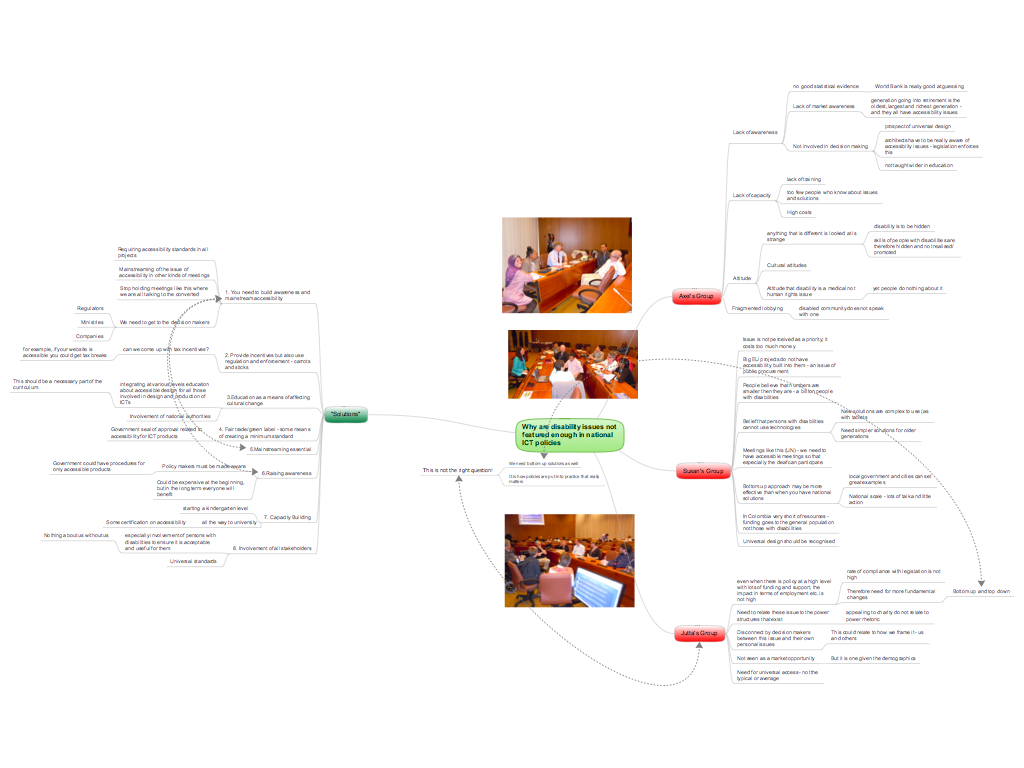
At today’s WSIS Forum session on ICTs and disability (#ICT4DD) led by the Commonwealth Telecommunications Organsation and the UNESCO Chair in ICTD at Royal Holloway, University of London, more than 35 people in Geneva and some 15 people participating externally came together to explore ways through which accessibility/disability issues can be included more effectively in national ICT strategies.  Three breakout groups came up with some 17 main reasons why disability issues are not more included within such policies and strategies, and then identified 7 practical ways through which these challenges can be overcome.  Details of the outcomes are summarised in the mind map below (click on the image itself for a larger version, or the link below for a full sized version).

WSIS Disability session

Solutions recommended included:

  1. The need to build awareness
  2. Mainstreaming accessibility
  3. Providing incentives, whilst also using regulation and enforcement
  4. Education as a means for affecting cultural change
  5. Using a quality label as a means for creating a minimum standard
  6. Capacity development
  7. The involvement of all stakeholders (Nothing about us without us)

Thanks to everyone who participated, and to all of the session partners including the ITU, G3ICT, the University of Michigan, OCAD University, the Daisy Consortium, and the Global Public Inclusive Infrastructure initiative.

2 Comments

Filed under Accessibility, ICT4D

Accelerating development using the Web

George Sadowsky’s new edited book entitled “Accelerating development using the Web: empowering poor and marginalised populations” has just been launched at the WSIS Forum in Geneva.  This contains some really excellent material, and is an important resource for those interested in exploring ways through which the Web can be used by some of the world’s poorest and most marginalised people to enhance their lives. Generously supported by the Rockefeller Foundation, and produced in partnership with the World Wide Web Foundation and the UNDP, this book is designed as “a compendium of articles by recognized experts describing the real and potential effects of the World Wide Web in all major aspects of economic and  social development”.  Many of the authors combine academic and practical experience, and so this book is much more than just an arid digest of academic thinking on the subject.  It also challenges many of the taken for granted assumptions about the Web, and examines the structural conditions that limit its use by the poorest of the world’s people.  Chapters cover the following main themes:

  • Chapter 1 – Introduction (George Sadowsky)
  • Chapter 2 – Fundamental Access Issues (Michael Jensen)
  • Chapter 3 – Technical Access Issues (Alan Greenberg)
  • Chapter 4 – Policy Access Issues (Cynthia Waddell)
  • Chapter 5 – Governance (Raúl Zambrano)
  • Chapter 6 – Agriculture (Shalini Kala)
  • Chapter 7 – Health (Najib Al-Shorbaji)
  • Chapter 8 – Education (Tim Unwin)
  • Chapter 9 – Commerce and Trade (Torbjörn Fredriksson)
  • Chapter 10 – Finance (Richard Duncombe)
  • Chapter 11 – Gender (Nancy Hafkin)
  • Chapter 12 – Language and Content (Daniel Pimienta)
  • Chapter 13 – Culture (Nnenna Nwakanma)
  • Chapter 14 – Conclusion

It was great fun working with George and the team on this project, and I do hope that those who read it will find a sense of our commitment, enthusiasm and, at times, outrage.  The Web is in danger of becoming a vehicle through which greater divides are created in our societies.  We have to take specific actions if the enormous benefits that it can provide are to be made available to all of the world’s people.  This is most definitely not the same as saying that access to the Web should be a human right – something that I  most profoundly disagree with.  However, it is most certainly to suggest that we cannot simply take it for granted that providing Internet access will without question benefit the poor. If the poor and the marginalised are indeed to benefit from the Web, there have to be clear mechanisms that enable them to use it to deliver on their needs and aspirations.

1 Comment

Filed under Development, ICT4D

WISE Awards 2012 – applications open until 31st May

The World Innovation Summit for Education (WISE) Awards are now open for applications – until 31st May 2012.  If you are aware of people working on innovation initiatives that have transformed educational delivery, do encourage them to apply!

The WISE Awards are specifically designed to identify, showcase and promote innovative educational projects from all sectors and regions of the world to inspire change in education. Each year, a Jury composed of leading experts from the education world selects six innovative projects for their concrete and positive impact on communities and societies. Each winning project gains global visibility through the Awards process and receives a prize of $20,000 (US).  Since the creation of the Awards in 2009, over 1,300 applications from 116 countries have been received, resulting in 98 Finalists and 18 winning projects from across the world.

In 2012, one of the six awards will be given explicitly to a project that has best delivered innovative financing of primary education.  This reflects the support of the Qatar Foundation’s Chairperson Her Highness Sheikha Moza bint Nasser for the United Nations MDG 2 on achieving universal primary education and it is designed to stimulate innovative projects targeted at achieving this goal.

All of the necessary details concerning the awards are available on the WISE Awards website, which provides specific information about:

All relevant applications are first reviewed by a Pre-Jury of distinguished educationalists.  They will  recommend 24 finalists who will then be invited to submit more detailed applications for consideration by the prestigious Jury of international experts.

It is particularly important that applicants explain clearly and in detail how their projects deliver on the nine criteria by which the WISE Awards are judged:

1. Educational Transformation: the overall extent to which the educational activity has transformed an aspect of education that has also had societal impact. Applicants must show what aspect of education they have sought to transform, and the impact that the project has achieved, not only in educational terms but also through the effect that this has had on society more generally.

2. Sustainable Financing: the extent to which the educational activity is funded in a sustainable way and achieves value for money to ensure its continuing viability. Applicants need to show how their projects have sought to ensure continuing financial viability.

3. Innovation: the extent to which the educational activity is innovative in design and/or practice, thereby transforming traditional means of educational delivery. Innovation can be of many different kinds, but it is important for applicants to emphasize what is particularly novel about their project.

4. Inclusion and Diversity: the extent to which the activity includes a diversity of beneficiaries and has enhanced equality of access to education. Successful applicants will have paid special attention to ways through which their project has ensured greater equality of access to education, particularly through an increase in the diversity of those participating in learning opportunities provided through the initiative.

5. Quality of Learning: the extent to which the transformation has contributed to the improvement of the quality of learning. Applicants need to indicate what they understand by quality of learning, and show explicitly how the intervention has indeed enhanced this.

6. Scalability: the extent to which there is evidence that the educational activity has the potential to be scaled up effectively, or has already been replicated at a larger scale than originally piloted. For more recent projects, it is essential that applicants show explicitly how they will ensure that the initiative can be scaled up effectively.

7. Partnership and Participation: the extent to which the educational activity has established effective partnerships and includes participation from beneficiaries and stakeholders. Applicants need to indicate the character of the partnerships involved, and be explicit about the ways through which beneficiaries and stakeholders participate in the design and implementation of the initiative.

8. Monitoring and Evaluation: the extent to which there is evidence of effective ongoing enhancement of the program through regular monitoring and also evidence of formal internal or external evaluation procedures. It is important that applicants show how ongoing monitoring procedures have enhanced the project, and also how formal evaluations after completion of specific stages have contributed to the initiative’s subsequent development.

9. Dissemination: the extent to which the organization has already effectively disseminated and shared educational practices with other practitioners in a diversity of ways. Applicants should provide evidence of how they have already shared their educational experiences with other practitioners.

Leave a comment

Filed under Education

Advice for students on ICT4D programmes…

I’ve just had a great question posed to me by Brooke Kania: “I was just wondering, what are you looking for in students who are coming out of IDEV or ICT4D programs – what do you think the field needs from academic training? What advice would you give to aspiring ICT4D professionals?”.  The question is easy; the answer is not!  Fueled by a couple of very good glasses of Chianti, let me have a go at responding.  Here then are the ten things I would look for, and also some reflections as to why:

  • A willingness to cross boundaries.  The great thing about ICT4D is that it is not (yet) a specific discipline, but brings together people from many different backgrounds.  Exciting things happen at the edges!  Get a computer scientist and a philosopher talking together, and great things can happen.  The only trouble is that most academic ‘life’ is now about becoming the global expert in a tiny field of academic enquiry, and despite the rhetoric of interdisciplinarity, old disciplinary boundaries remain strong!
  • Understanding the real needs of users.  Far too many ICT4D projects are invented by academics who have little clue about what the real needs of users actually are, and they are then surprised that the projects fail!  In part, this reflects the tyranny of the one year Master’s programme or three-year PhD, that limits the potential for a researcher to go into the field, really discover what would then make a difference to the lives of poor people, and then work with them to develop technologies that can really serve their interests.
  • Humility.  The Academy is all too often about ‘experts’ and people who claim to ‘have all the answers’.  In my experience, that is the death of enquiry and exploration.  There is much truth in the statement that “the more I know, the more I realise how little I know”.  Interestingly, I think I have met more ‘bright’ people outside universities than I have within them!  Far too often, academics create a language of obfuscation, to prevent others from understanding how ignorant they really are!
  • Being technically sound. ICT4D is fundamentally about technology – not necessarily in an instrumentalist way, but it is definitely concerned with technology, both how it is shaped by society, and also how it shapes society.  It is therefore essential that everyone working in the field of ICT4D does indeed have some technical grasp of technology.  That does not mean the impossible, in other words that everyone must understand all the relevant technologies, but it does mean that we should all have some pertinent technical expertise.  Thank goodness that  I learnt to programme in Fortran as a student!
  • A focus on really understanding ‘development’.  This is difficult, very difficult.  There are many definitions of what development is about, but anyone working in the field of ICT4D must address this question in their own way.  For me, development is about addressing the appalling inequalities that exist in our societies, and this is something very, very different from the hegemonic view that development is actually mainly about economic growth.  Capitalist economic growth can never eliminate poverty, and the sooner we abandon this misguided nonsense the sooner the world’s poor and marginalised people will be able to live the lives to which they aspire.
  • Get some real ‘development’ experience!  This is tricky for a student, but it is really impossible to understand the challenges and intricacies of ‘development’, however we define it, unless we have experienced it practically on the ground.  For some 20 years I did research and taught about development, but I never worked for a development agency, the private sector, or civil society organisation in that time.  In six months working for a bilateral donor agency, I learnt more about the practice of development than I did in most of my previous research on the subject!
  • Recognition that ICT4D is a moral, rather than a technical agenda.  This is closely linked to the above point, but I think it is different.  ICT4D should be about the normative – what should be – rather than what actually is.  Academics are generally quite good about describing what exists, but far too few go beyond this to suggest what they think should happen in the light of their analyses .  This is irresponsible!  Academics are hugely privileged, and they abrogate the trust placed in them by society if they do not use their research to make the world a better place.  They can only do this by having a vision for what the world could be like, and then engaging in political action to help shape that world.
  • An ability to engage in critical analysis.  This should lie at the heart of all academic enquiry, but all too often it doesn’t!  Far too much academic research repeats the obvious, albeit dressing it up in grandiose terms.  If we want to explain or understand a phenomenon, we have to keep asking the question “why?”.  I read so many papers that fail to do this!  If the interviews, questionnaires, or experiments that are undertaken do not seek to say why something is observed, then they remain purely descriptive and fail to add to our real understanding.  If you are a social scientist, just look at the questions asked in interviews, focus groups or questionnaires.  There will usually be many “what?”, “where?”, “when” or “who?” questions, but far fewer “how?” questions, and even fewer “why?” questions!  If we do not ask “why?”, we fail really to move knowledge forward.
  • Freedom to fail!  Far too much academic work is about getting students to regurgitate accepted truths – especially the opinions of those who teach them!  What we do not seem to allow students is the opportunity to experiment and fail.  I tend to think that people generally learn more from their mistakes than they do from their successes.  So, my advice would be to try something new, and not worry about the risk of failing.  That is where true innovation comes from.  In job interviews, I often tend to ask people about one of their failures, and then get them to think about what they learnt from it.  Those who claim never to have failed, don’t come up to the mark – especially in my book!
  • Be a good team player. It was difficult to think of a tenth piece of advice – there is so much that could be said.  However, I am convinced that ICT4D is about good team work.  None of us have all the necessary skills, and so if we are going to develop appropriate solutions, we must be able to work effectively together.  Far too much academic work is now about individual success – and we have lost the collective enterprise that so inspired me as a young academic.  Wisdom, scholarship and development are above all collective enterprises, and we need to embark on them together.

So, Brooke, I hope this gives you some ideas of my thinking right now.  Don’t get me wrong, this is not a tirade against the Academy.  Far from it.  Universities are a hugely precious element in our societies, and I value them enormously.  It is just, I fear, that too many institutions and individual academics have lost their way, and have become merely another tool in the hands of those who do not want us to be free.  Ultimately, it is hugely difficult for those committed to implementing real change in our societies to be based within universities; I have tremendous respect for those who remain fighting for their integrity and sanity.  ICT4D is about engagement, not just about writing papers in academic journals that few people will ever read.  Those who determine our research agendas should be the world’s poor and marginalised.

10 Comments

Filed under Higher Education, ICT4D

Digital Wars by Charles Arthur – excellent new book

Rarely do I use my blog to write book reviews, but rarely do I enjoy books as much as Charles Arthur’s new Digital Wars: Apple, Google, Microsoft and the battle for the Internet.  Not only is this highly informative, but it is extremely well written. I used every spare moment – in other words take offs and landings on recent flights, when laptops have to be switched off – to read it!  He somehow manages to craft an exciting thriller out of what could have been written in a very arid and boring way – the recent history of Apple, Google and Microsoft.  This really excellent book builds on Arthur’s journalistic work over the last 25 years, and combines deep insights about the evolution of these companies with fascinating interviews with people who have been involved from the inside in their evolution.

Digital Wars begins with accounts of some of the key personalities involved – Bill Gates, Steve Jobs, Larry Page and Sergey Brin.  His story then kicks off with Steve Ballmer’s elevation to CEO at Microsoft, and the aftermath of the Antitrust trial, which Arthur sees as having had an enormous effect on the company.  At a rapid pace, the book is then structured around four themes:

  • development and control of “search” – seen primarily as a conflict between Google and Microsoft
  • the innovative shaping of a digital music industry, in which Apple outplayed Microsoft
  • the creation of smartphones
  • the emergence of tablets

This book is a “must read” for anyone who really wants to understand some of the changes that have taken place in the ICT industry over the last 15 years.  In some ways, the book can be read as being about the demise of Microsoft, and the rise of Google to be the lead player in search, and Apple the dominant force in digital music (iTunes) and top-end telephony (iPhone).  However, it is much more than this.  Arthur manages to weave into the text fascinating insights into leadership, the ways through which small individual decisions – both good and bad – can shape the future of whole corporations, and the ebb and flow of recent corporate takeovers.

Do get hold of a copy and read it.  There is much to be learnt about the past from Digital Wars to help us shape the future.

Leave a comment

Filed under Entrepreneurship, ICT4D

Reflections on multi-stakeholder partnerships for education

At the end of the last decade, I had the real pleasure of working with colleagues at the World Economic Forum and UNESCO on their Partnerships for Education initiative.  Amongst many other things, this generated a number of useful materials for anyone interested in developing such partnerships in the future – but note that these are now based on the UNESCO site at http://www.unesco.org/pfore/ (and not at the former PforE site!).

I was therefore really delighted when Alex Wong at the Forum invited me last year to work with him on writing a reflection on all that the World Economic Forum’s Global Education Initiative (GEI) achieved.  My one condition was that anything we wrote should reflect not only the successes, but also the problems and challenges faced by the initiative!  I think we often learn more by our failures than our successes.  In writing the report, we interviewed many of those who had been involved in the GEI’s various initiatives, and sought to craft a document that included many of their insightful comments.

This report has recently been published, under the title Global Education Initiative: Retrospective on Partnerships for Education Development 2003-2011 (Geneva: World Economic Forum, 2012).  As well as providing an overview on all of the diverse elements of the GEI, it draws together our reflections on the nine key things necessary for the implementation of successful multi-stakeholder partnerships for education:

  • High level leadership
  • A partnership broker that is knowledgeable about the education sector
  • That broker also being trusted and neutral
  • Beginning with the educational outcomes in mind
  • The central role played by Ministries of Education
  • Effective project management
  • Adequate and timely resourcing
  • Consistent strategy and flexible delivery and
  • Effective internal and external communication

The sixty page report contains much more than this, though, and I really hope that it will provide a useful guide for anyone thinking of using multi-stakeholder partnerships to deliver effective educational initiatives.

1 Comment

Filed under Development, Education

Mobiles, Social Media and Democracy

The Commonwealth Telecommunications Organisation (CTO) and the ICT4D Collective and UNESCO Chair in ICT4D at Royal Holloway, University of London convened a session on Mobiles, Social Media and Democracy (#SocMed4Dem) on 15th March at the ICTD2012 conference hosted by Georgia Tech in Atlanta.

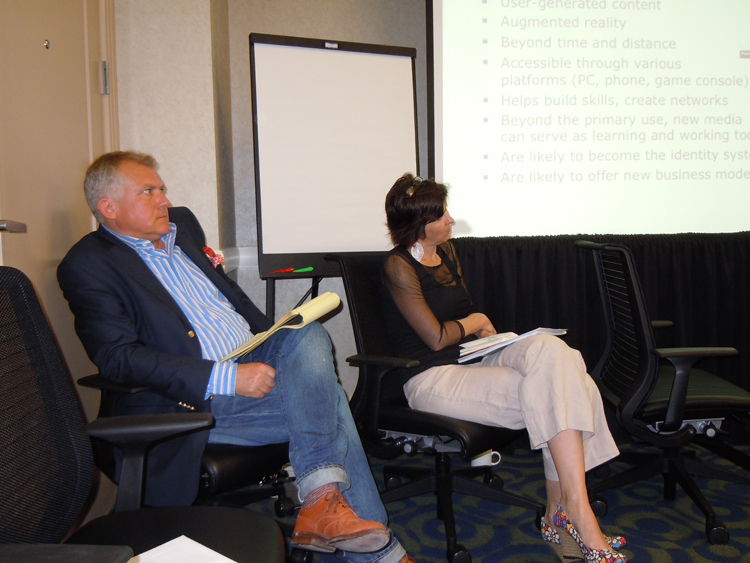
This began with a debate on the motion that This house believes that the use of mobile supported social media is an effective means of promoting democracy.  Breakfast planning, led to a slight change of schedule!  So, the session began with Mario Maniewicz (Chief of Department, Enabling Environment and E-applications, ITU) providing an overview of some of the issues surrounding this complex subject.  Then the debate began in earnest.  Katrin Verclas (Co-Founder and Editor of MobileActive.org) set the ball rolling arguing vehemently in favour of the motion, to be followed by a sound rebuttal by Adam Salkeld (Head of Programme, Tinopolis).  Then the real challenge – both for me and the audience!  To balance things up, I filled in the gap by seconding the motion in favour – even though I would have preferred to speak against the motion.  Half way through, when I was arguing that anarchy is the only true form of democracy, I suddenly realised that one might say things that one does not necessarily actually mean when one is debating.  My short intervention should have had a health warning!  And the debate concluded with a brilliant tour-de-force by Alan Fisher (Senior Correspondent, Washington DC, al Jazeera).  After numerous interventions from the floor, the final vote (including contributions by Tweets) was 21 in favour and 19 against!  Thanks to Caitlin Bentley so much for video streaming the debate and managing the Twitter feed!

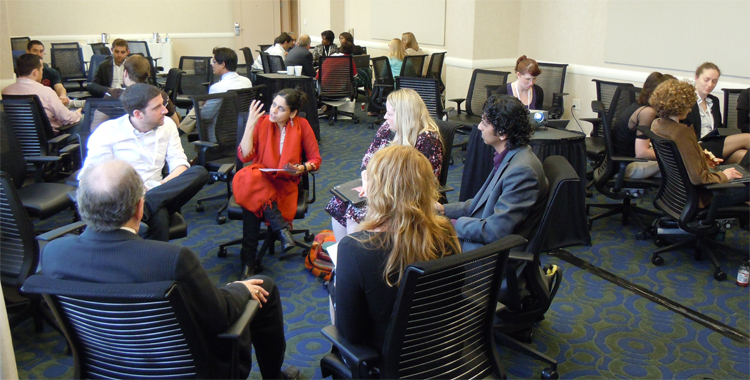
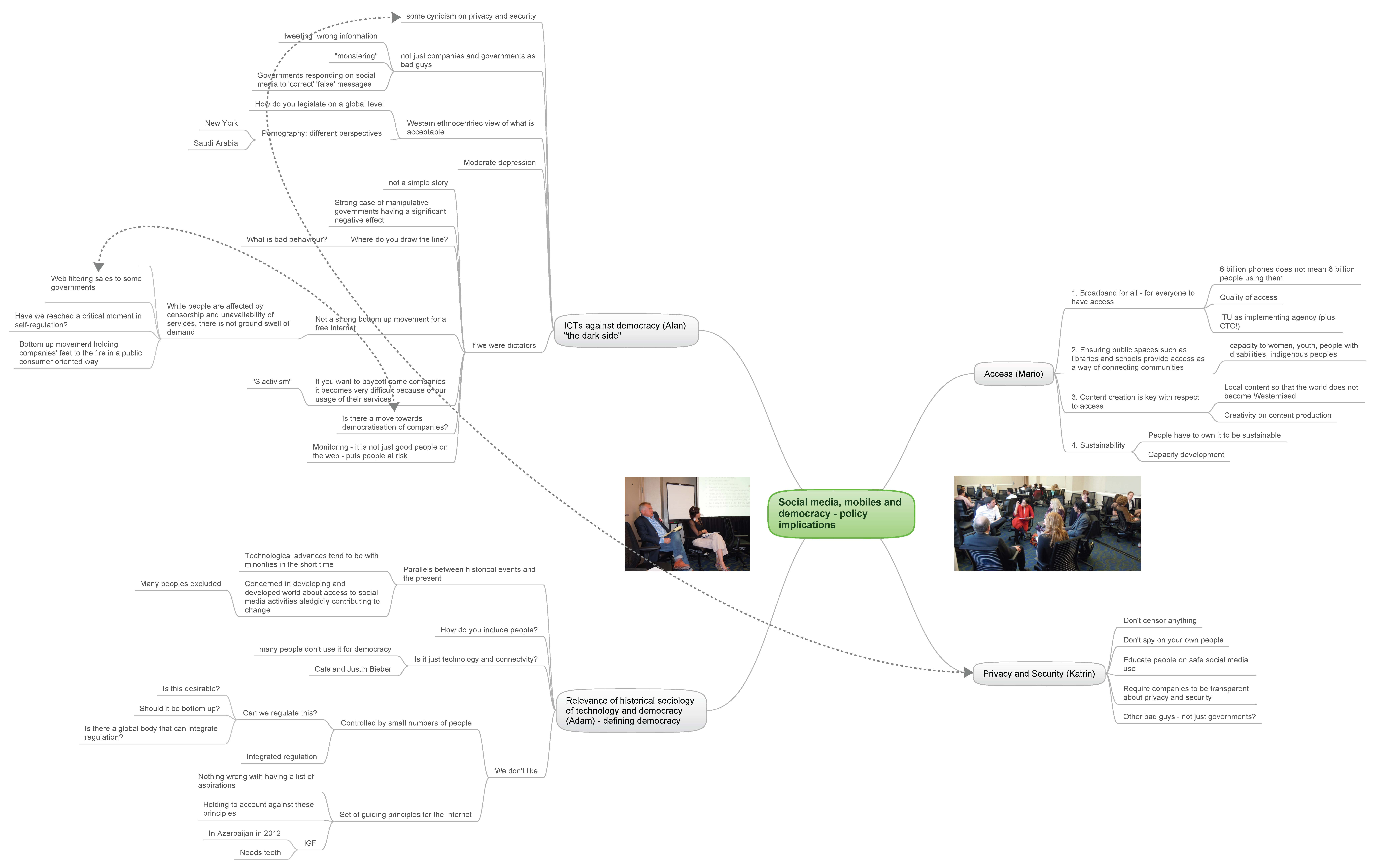
After the ‘refreshments’ break, we broke up into small discussion groups, each chaired by one of the speakers, to explore the policy implications of four of the most important themes to emerge from the debate: access (chaired by Mario), privacy and security (chaired by Katrin), the relevance of historical sociology of technology and democracy (chaired by Adam), and ICTs against democracy: the ‘dark side’ (chaired by Alan).

The mind map below provides a summary of the fascinating discussions as presented in the final closing plenary.

Click on the image for a large sized (readable) version!

Video of the debate

Caitlin Bentley has compiled a ‘story’ of the #SocMed4Dem debate at #ICTD2012 at http://storify.com/cbentl2/mobiles-social-media-and-democracy

2 Comments

Filed under 'phones, ICT4D