Never ever, ever, ever fly through Atlanta’s Hartsfield Jackson (so-called) International Airport

I have just spent almost two hours trying to escape from Atlanta’s so-called international airport, and have to say that it was without any doubt, far and away the worst experience I have ever had trying to leave an international airport – and I only had hand luggage!  The slowness, rudeness, incompetence, inefficiency and downright unpleasantness of the people and machines were unbelievable.

First, we had to queue for well over an hour to get through the passport check, fingerprints and retinal scans. We were herded like cattle through a very slow moving roped off set of alleyways.  There were only a handful of officials on duty, with many ‘gates’ empty.  It was designed to raise our temperatures, and if I had not been in a hurry it would have been faintly amusing listening to the comments in the queue.  The ‘officials’ seemed to be spending as long as they possibly could with each person arriving; there was no sense of urgency at all. Then, nearing the end, when I was in line to be ‘checked’, the officious official who was guiding us to the scanning point ordered me to move one foot to the left!  I could not believe it.  There was a wide open space and I had to move one foot to the left.

The sense of power and control that these unpleasant people have is quite unbelievable.  It is rather like many of those on baggage security checks across the world who take joy in making life as miserable as possible for travelers, ordering them around!

At last, I was in front of the person who was going to take my fingerprints and retinal scan.  In the old days – and they were good, very good – only criminals had their fingerprints taken.  Just think what the US government might do with all of our biodata.  So, I decided to be nice, and got a word in first, asking him what kind of day he had had, saying he looked as tired as I did.  It worked!  He smiled!  He had started work at 5.30 this morning, with a break for lunch, and it was by that time nearly 8.45 in the evening!  Anyway, I will give him credit – he processed me politely and swiftly, for which I am very grateful.  I certainly had vastly better treatment than many others in the queue.

I was lucky!  I only had hand luggage so did not then have to wait for any checked baggage – but I’m sure it would  in any case have come through by then!  So, next we had to queue to hand in our customs declaration form – just to show we were not bringing in anything that might be against US regulations.  Fortunately, I went through that fairly swiftly.  Any normal person would expect then to be able to walk out of the airport and get a taxi.

But no, not at Hartsfield Jackson International Airport.  Wait for it.  Can you imagine what happened next?  Yes, another bag check and full body scan. And this was simply to get out of the airport! I had to join yet another snaking queue, to have my bags checked.  Yet again, jackets off, shoes off, computers out with everything being put in trays.  Officials shouted at us to get in the correct lines.  One poor gentleman from India, was totally confused as to whether he was being shouted at or not.  And the stench!  I have no idea what it was, but it was definitely the most evil smell I have encountered in any airport in the world!  And then the body scan. Everything, even handkerchiefs has to be taken out of pockets, and some of us were chosen to be placed in this scanning device.  No notices about what it would do, any potential health issues, or what would happen to the images after they had been taken.  I was simply forced through.

At last, I thought I was free.  But they did not like the look of my laptop and notepad, so back it had to go through the bag scanner.  Even then, when of course nothing was found, it took a good 20 minutes to walk to the shuttle train that took me to the concourse from whence I was at last able to get a taxi.

How nice it was to see an Ethiopian driver, who brought with him a sense of history, of culture and of hospitality.  What on earth was he doing here in this land of oppression I asked myself.  What horrors had he left to make his home in this neo-fascist place I had arrived in.

It made me think of all the other airports I have visited recently.  Perhaps the best comparison is with Beijing airport.  What luxury!  What efficiency!  What civility!  It is so easy to get through Beijing, and one is treated with dignity and hospitality by the Chinese officials.  Perhaps this is a reflection that China has become the world superpower, and because it does not try to impose democracy on other countries at the end of a gun or bomb, it does not have to be so preoccupied with ‘protecting its borders’.  In Atlanta, the symbolism of officials shouting and ordering people around, herding them like cattle in pens, scanning them for biodata and personal information, reminds me of the fall of other empires.  Petty bureaucrats who get their kicks out of being deliberately unpleasant. The use of machines to control people’s freedom.  The sense of oppression and foreboding.

And then, I often hear USAns complaining about Heathrow airport.  What absolute hypocrisy and cheek! Heathrow is bliss compared with Atlanta.

You have been warned!  Never travel through Atlanta airport if you can possibly avoid it.  Better still, avoid Atlanta itself!  What a pity, I have such good friends here.
3 Comments

Filed under Ethics, Story-telling

Buddhist monuments at Anuradhapura

At the end of the Asia-Africa regulatory conference in Colombo, our hosts took us on a tour to the ancient capital of Anuradhapura in the central north of Sri Lanka.  It has an impressive collection of Buddhist monuments, spread over an area of some 16 square miles.  King Pandukanhaya made Anuradhapura his capital in the 4th century BC, and the organised plan of the city with its complex water systems suggests that it may have been designed according to a master plan. Under King Devanampiya Tissa, who ruled from 307 to 267 BC, Buddhism was introduced to Sri Lanka, and subsequently numerous dagobas (or stupas), as well as monastic buildings and pokunas (tanks for bathing or drinking water) were constructed.  A selection of images from the city – including birds, monkeys and a snake charmer – are in the slide show below.  Thanks to Anusha Palpita for his generous hospitality in enabling this ‘adventure’.

This slideshow requires JavaScript.

Leave a comment

Filed under Photographs

Sri Lankan dancing at the Africa-Asia Regulatory Conference

Every evening of the first Africa-Asia regulatory conference hosted by the Telecommunications Regulatory Commission of Sri Lanka and organised jointly with the Commonwealth Telecommunications Organisation we were entertained by different groups of dancers and musicians who shared something of the country’s rich and diverse cultural heritage.  I hope that the images below capture something of the beauty of Sri Lankan dancing.

This slideshow requires JavaScript.

Leave a comment

Filed under Photographs

Google and Facebook: privacy and security

I have long been critical of Google, but two thing have recently begun to make me begin to think again.  First, they have developed an amazing App – Google Translate!  Whilst the translations are by no means perfect, the idea behind the App is brilliant.  At its best, you can speak the phrase that you want translated, and the App will then give you a translation in more than 60 different languages, all as text and some as a sound file.  Using such software, someone can speak a phrase in Indonesian and then the App will translate it so that someone else can hear the phrase in Portuguese or Russian or Czech.  This is really beginning to use the potential of mobile technologies to help people from many different backgrounds communicate with each other.

However, this is not the main purpose of this note.  Anyone who uses Google software cannot but be aware of the changes to Google’s privacy policy that are due to come into force on 1st March.  This is the important thing – Google, for a change, appears to be trying to be much more open than ever before in explaining the reasons why it is adopting new privacy policies.  As they say, “We’re getting rid of over 60 different privacy policies across Google and replacing them with one that’s a lot shorter and easier to read. Our new policy covers multiple products and features, reflecting our desire to create one beautifully simple and intuitive experience across Google”. In clarifying the reasons for this, Google claims that it will make it easier to work across Google, it will be tailored for users, it will be easier to share and collaborate, that its fundamental principle of protecting user privacy has not changed, and that it helps users understand how Google uses their data.

Google has five core privacy principles:

  1. “Use information to provide our users with valuable products and services.
  2. Develop products that reflect strong privacy standards and practices.
  3. Make the collection of personal information transparent.
  4. Give users meaningful choices to protect their privacy.
  5. Be a responsible steward of the information that we hold”.

However, are these principles really as sound as they at first sight appear?  Google’s profits have been built around the fundamental notion that it encourages consumers to give information to the company that is of considerable value to Google  in exchange for ‘free’ services, such as the world’s best search engine, e-mails and document sharing.

An alternative perspective is offered by those who see this as a deliberate move to combine information about individuals from across the platforms that it now owns, and use this to generate even greater profits.  As the BBC has commented, “Critics have hit out at Google’s decision to merge personal data from YouTube, Gmail, search, social network Google+ and dozens of other services”.  As the BBC report goes on to note, “Data is a hugely valuable commodity as firms seek ways of making money from users’ web habits with ever more targeted adverts”.

It is not only Google, though, that is combining aspects of its various services, and the information it gleans from them.  As the competition between Google and Facebook hots up, Facebook is also combining the different data it holds about people.  Again, as the BBC comments “Facebook is also moving to merge people’s data, with tweaks to how user information is displayed. Its new feature, Timeline, shares users’ past history on the site in a more readable way. While it does not expose any more information that was previously available on its traditional profile page it does makes it easier to view older posts. Currently the system is voluntary, but Facebook is making it compulsory”.

The forthcoming IPO (initial public offering) of Facebook provides an interesting opportunity to reflect on the balance of power between the top valued companies that have built their businesses on the technologies of the Internet, and an apparently endless desire by people to find out about each other and share information about themselves.  A recent report by Keith Woolcock in Time Business captures this well: “The upcoming IPO of Facebook, the flak surrounding Twitter’s decision to censor some tweets, and Google’s weaker-than-expected 4th-quarter earnings all point to one of the big events of our times: The crazy, chaotic, idealistic days of the Internet are ending. Once, the Prairies were open and shared by everyone. Then the farmers arrived and fenced them in. The same is happening to the Internet: Apple, Amazon and Facebook are putting up fences — and Google is increasingly being left outside. The old Internet on which Google has thrived is still there, of course, but like the wilderness it is shrinking. Often these days, we sign up for Facebook or Amazon’s private version of the Internet. At other times, we use a smartphone and download an App instead of using Google search. Investors are already placing their bets on who the winners of the new Internet will be: Over the past five years Amazon’s shares, despite their recent fall, have risen 370%. Apple’s are up 438%. Google’s, meanwhile, have merely risen by 17% in all that time.  It is still the early days of this long-term trend, but my hunch is that this gap in performance will widen over the coming year — and that Google’s long slow decline has already begun”.

Perhaps I should start feeling sorry for Google after all.  At least I began this blog by encouraging people to start using their great translation App!  Ultimately, though, we should all reflect a bit deeper on what it is we are giving away for free when we sign up for a service that is free for us to use.  We should all also be much more careful about just how much information about ourselves we make available publicly – just in case one day we regret the profit that others have made out of it!

Leave a comment

Filed under ICT4D

Donating Computers to Schools

A young acquaintance from Europe visiting a country many miles away sent me an e-mail saying that she was about to set out on a programme to donate computers to schools, and asking my advice. Such enquiries are hard to answer.  On the one hand I want to support such commitment and enthusiasm, but on the other I know just how problematic so many such initiatives have been.

This is how I responded:

There are many initiatives that have been set up to ‘deliver’ computers into schools (and other places), many of which have been unsuccessful. Some of these have used refurbished computers (such as Computer Aid); others have been donated new by NGOs. Invariably, they are ‘given’ by people who know what computers can do – often based on their own experiences – and think that it would be great if less advantaged people could benefit likewise. However, invariably this is not a good use of money and resources. As you can imagine, there is a huge literature on this – but I guess your connectivity may not be that good in terms of wanting to download information!

So, a few key tips are:

  • begin with the teachers and ensure that everything is led by them, and integrated into what and how they teach.
  • much better to contribute to expanding an existing successful initiative, rather than starting up something from scratch
  • don’t try and reinvent the wheel – build on existing experience and good practices
  • ensure that there is effective electricity and connectivity – as well as the money to pay for it
  • ensure that any content is in local languages and integrated with the curriculum
  • ensure that the use of the computers is also about communication and not just content
  • use of computers in schools is far more than just teaching people to learn how to use office skills – so make sure they are really used for education
  • try to ensure that the computers are used 24/7 – by for example running adult training courses in the schools out of hours
  • try to identify how the computers can be used to generate an income, so that the school can then have enough money to buy more and replace the ones that break
  • ensure that there is technical back up and support, so that if minor things go wrong (like a plug being accidentally pulled out), then people can simply fix it
  • do not have a printer (it gets very expensive on paper and ink and usually breaks swiftly)
  • think of using COWS (Computers on Wheels) that can be rolled around from classroom to classroom, rather than having a computer lab
  • if there are only one or two computers, make sure that they do not finish up (unused) in the head teacher’s office
  • build usage of the computers around community needs – involving parents, siblings and the wider community – so that everyone can see their worth
  • if teachers and children have mobile ‘phones, think of building the learning solutions around them, rather than around computers

I wonder how others would have advised my young acquaintance…

7 Comments

Filed under Education, ICT4D

Latest UK Higher Education Statistics

The UK’s Higher Education Statistics Agency has just published its latest data on student enrolments and qualifications obtained for the academic year 2010/11.  Key findings include:

  • just over 2.5 million people are enroled in UK Higher Education Institutions (HEIs)
  • slightly more students are doing postgraduate courses (up 2% since 2009/10), with slightly fewer doing undergraduate ones
  • UK domiciled students account for 83% of all enrolments
  • there is some considerable volatility in subject areas: for undergraduates enrolments in agriculture and related subjects increased 11% between 2009/10, whereas for architecture, building and planning, they decreased 6%; for postgraduates the greatest increase was in mathematical sciences (8%), whereas computer science numbers declined 6%.
  • 64% of students gained an upper second or first class degree; more women than men achieved such degrees (65% of full-time students received such degrees; 51% of part-time students) (see Table 6 of HESA statistics).

One of the most striking of these findings is the continual grade inflation that is taking place in higher education.  In  2006/7 only 60% of all students gained upper second or first class degrees.  Going back in time, in 2000/01 only 54% of full-time students gained such degrees, and in 1994/95 it was 49% (HESA statistics).  Such inflation is hardly surprising, given that institutions are increasingly being judged externally by this measure.  I doubt that it is improvements in the quality of teaching that have led to such results.

Typical measures that universities use to inflate such results operate both at the institutional level through the mechanisms that are used to turn marks into overall grades, but also in the ways through which marks for courses are derived.  Institutionally, the following are typical mechanisms that have been used:

  • introducing systems that ignore the worst marks achieved
  • weighting the overall portfolio of marks in ways that lead to higher overall grades
  • introducing mechanistic processes for candidates just below a threshold that automatically elevate them to the higher grade
  • reducing the amount of unseen terminal examinations, and increasing the amount of easier types of assessment at which students perform better

At the more individual level, academics are also judged by the quality of results obtained by students doing their courses, and so it is quite common to find academics who:

  • give strong hints at the subject matter that will be coming up in unseen exams
  • give substantial amounts of help to students on assignments, such as dissertations, that are meant to be independent
  • decide to be that little bit more generous at the margins, choosing to emphasise the stronger points over the weaker ones
  • restructure their courses so that they contain elements that students find it easier to do well in

It could be argued that each of these is desirable, and that we should indeed be rewarding our good students for the efforts that they put in.  The fundamental point to be noted, though, is that getting a ‘good’ degree in 2011 means something very different from getting an upper second or first even a decade ago.

2 Comments

Filed under Higher Education, Universities

Data on Internet and social media usage

One of the interesting things about the Internet is actually how difficult it is to find out detailed and accurate information about its usage, especially with respect to social media. The International Telecommunications Union does, though, provide some useful high level data.  Given all of the emphasis on the apparent ‘ubiquity’ of Internet use, these provide some very salient reminders that in 2011

  • some 35% of the world’s population use the Internet – which means that 65% still do not!
  • although 45% of Internet users are under 25, 75% of the world’s under-25s still do not use the Internet.
  • there are twice as many mobile-broadband as there are fixed-broadband subscribers across the world

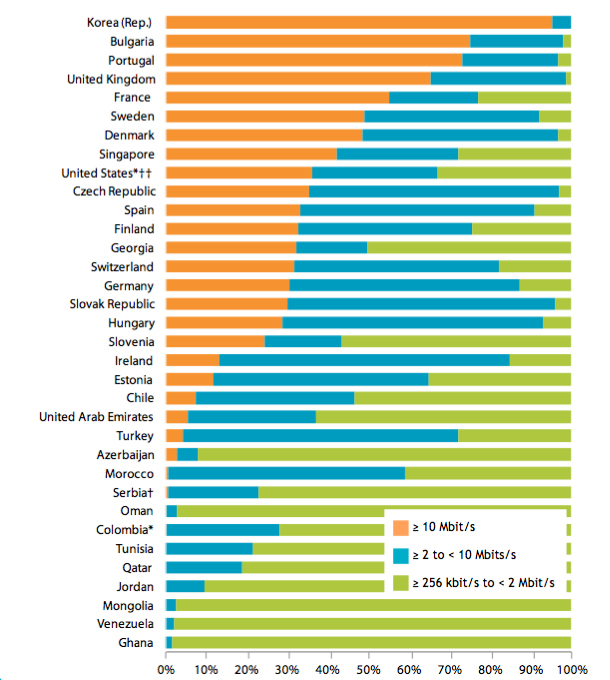
It is not just connectivity, though, that matters.  The available bandwidth and speed of connectivity are also crucial.  The following ITU graph (click on image for larger version) thus illustrates the enormous contrasts that still exist in this respect:

Whereas more than 95% of fixed broadband connections in South Korea have advertised speeds of ≥ 10 Mbit/s, some 98% of connections in Ghana, Venezuela and Mongolia have speeds of ≤ 2 Mbit/s.

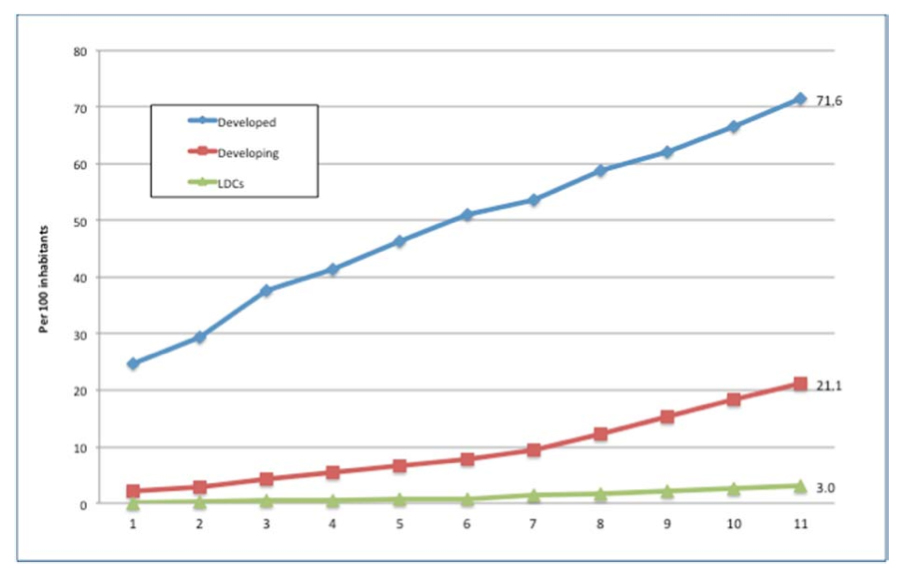
Of equal concern is the observation that the least developed countries are being left further and further behind in the race for digital connectivity.  In a striking report on the role of ICTs in the “least developed countries”, the ITU  shows this particularly graphically in the chart below (click on image for larger version), which illustrates the percentages of people who are Internet users:

This shows, for example, that the difference between the percentage of Internet users in the “developed” and the “least developed” countries in 2000 was only about 25 people per 100, whereas by 2010 it had leaped to more than 68 people per 100.  Despite growth in the number of Internet users in the developing countries, they were likewise still 50 people per 100 behind the “developed” countries in 2010.  The differences between rich and poor are thus getting dramatically bigger rather than lessening.

As 2012 gets underway, let us all commit ourselves more strongly than ever before to ensuring that these trends are reversed, and that the world’s poorest and most marginalised are indeed able to benefit from the ICTs that so many people living in the richest countries of the world now take for granted.

One aspect of data on Internet usage that I find particularly frustrating is the difficulty of finding accurate information on social media usage.  This is especially important when there is so much rhetoric about the ways in which such media are transforming social, economic, political and cultural life.  It seems to me that, once again, this may well be true of the world’s richest 10% or so of people, but is scarcely true of the majority!

Facebook, for example, is renowned for how little information it shares, with its statistics page only giving very sparse information about five categories of data, including the ‘fact’ that there are 800 million active users.  But what does “Active Users” mean?  According to Facebook it is people who have returned to the site in the last 30 days, although we are told that half of these (c.400 million) use Facebook every day.  If the world’s population is taken as being ‘approximately’ 6.984 billion, that means that about 1 in 17.46 people are using Facebook every day.  Before we get too carried away with the enormity of this figure, we should recognise that this is only 5.7% of the world’s population, which means that a huge 94.3% of the world’s people do not use Facebook daily!

It is likewise not that easy to find out detailed data from Twitter, although officially some 177 million Tweets were sent on 11 March 2011.  In the above vein, though, it should be noted that this is equivalent to only 1 per every 2.5% of the world’s population (some useful sites providing more comprehensive visual summaries of data on Twitter include MarketingGum and digitalbuzz, although these are becoming rather dated; see also report on CMSWire). In September 2011, Twitter announced that it had 100 million active global users logging in once a month – but again this only represents 1.4% of the world’s population!

When we read about how Facebook and Twitter are going to change the world, we therefore need to think very carefully about whose world, and the kind of world they might create.  To be sure, digital technologies have enormous potential to serve the interests of the poorest and most marginalised, and the numbers of users of services such as Twitter and Facebook are indeed increasing impressively, but with such low levels of global reach they are not yet the dominant force that many would claim them to be – or indeed some users might like to think they are!  So, how many people have more than 1000 followers on Twitter?!

1 Comment

Filed under ICT4D

Thanks to the Masters of Wine…

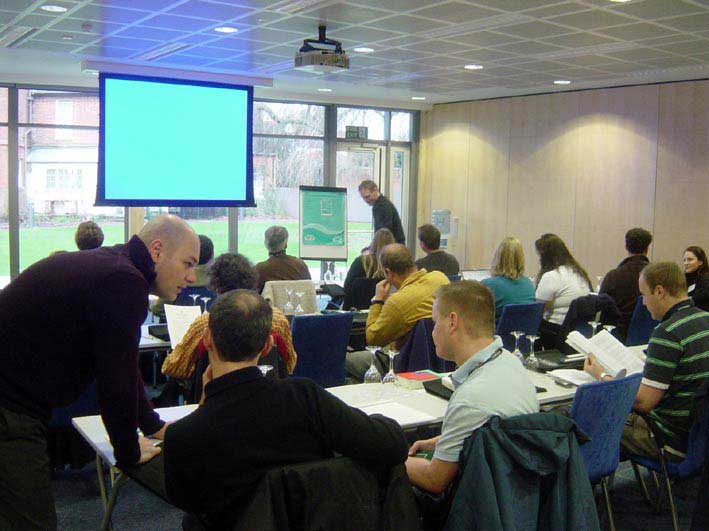
Without doubt, one of the most interesting and enjoyable aspects of my life in recent years has been serving as Academic Advisor and External Examiner for the Institute of Masters of Wine since 2004.  It has been fascinating working with some of the leading figures in the wine industry during this period, and helping them evolve their examination system to ensure that it remains at the cutting edge of good practice in professional examinations (the picture here is from one of the MW training days in Olney). One of the things I have been most impressed with is the way in which the Institute has continued to explore novel and exciting ways to assess understanding of grape growing and wine making, as well as wine tasting skills.  To be a Master of Wine, you really do need to have very considerable depth of knowledge and expertise!

This is rightly a qualification in the old medieval sense of the word ‘Master’, whereby someone only achieves the status when they have served an appropriate apprenticeship, learned the skills and knowledge requisite to become a journeyman, and then produced a master-piece that members of a guild thinks sufficiently highly of to elevate them to the status of a Master.   In this light, the dissertation can be seen as the ‘master-piece’ that all candidates have to produce before they are welcomed into the Institute!

One of the things that most impressed me was the way in which the Institute recently developed a policy of reasonable accommodation and special consideration, that specifically addresses ways through which students with a range of disabilities and other special circumstances can indeed participate in the examination process.

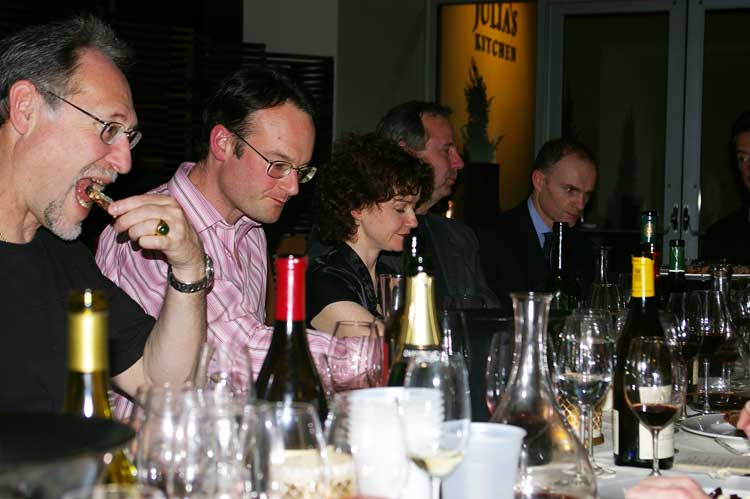
It was therefore with a real sense of sadness – at least for me – that pressures of work in my new role as CEO of the Commonwealth Telecommunications Organisation meant that in the autumn I decided that I could not continue in my role at the Institute.  I was overwhelmed by the generosity of so many members of the Institute who hosted me to a wonderful dinner at The Don in London (not the picture here, which is from a MW gathering in Napa).  Not only that, they each gave me a superb bottle of wine from their cellars, and I would just like to thank them all here for their amazing generosity.  What a wine list this makes (thanks to John for noting them down!):

The challenge will undoubtedly be to decide when to drink these very special wines – or perhaps more appropriately, with whom and alongside what food!

Thanks again so much to the Institute for all that I have learnt, and for the friendship of so many Masters of Wine.

1 Comment

Filed under Wine

Skiing in Kitzbühel

We took a risk and decided to take an early week’s holiday skiing in Kitzbühel.  Despite it being one of the warmest winters so far on record, and with forecasts suggesting that there would not be much snow around we have nevertheless managed to have a great time.  The 15th-17th December were cloudy and/or windy, with not much visibility – but runs from the top of the Hahnenkamm, and yesterday from the Hornbahn have been open.  Today, the sun came out, and more runs were open – so anyone here over Christmas can look forward to really excellent skiing!

This slideshow requires JavaScript.

Leave a comment

Filed under Photographs

ACU Session at WISE 2011: Doctorates, development and the brain drain

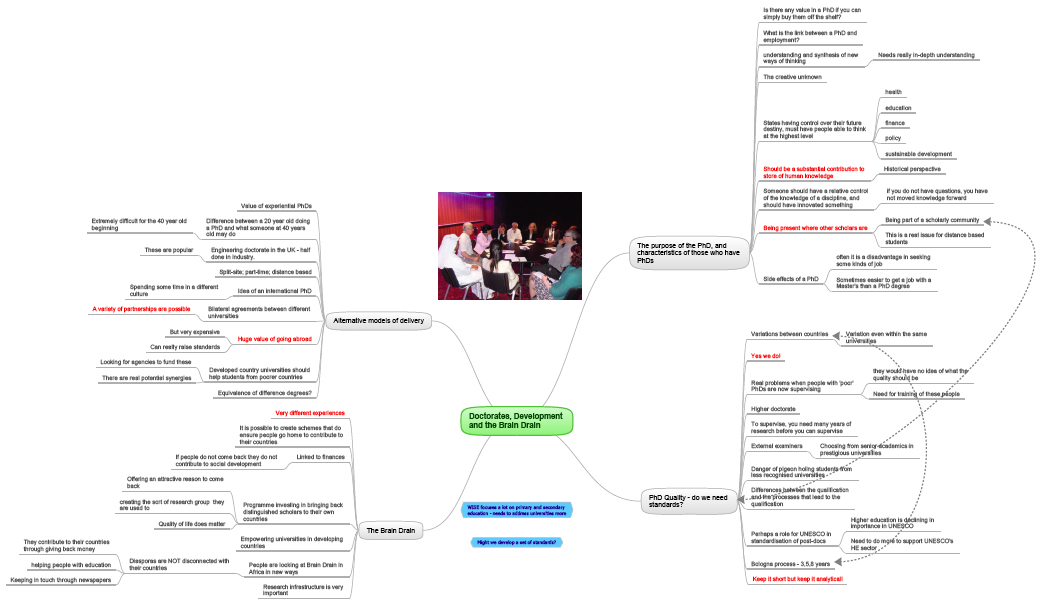
I was delighted to be able to help the Association of Commonwealth Universities run a workshop on “Doctorates, development and and brain drain” at the recent World Innovation Summit for Education (WISE) held in Doha from 1st-3rd November.  This focused on four key themes:

  • the purposes of a PhD and the characteristics of those who have PhDs
  • the quality of a PhD; do we need standards?
  • alternative modes of delivery for doctorates
  • the brain drain

Although the number of participants was small, the discussion was highly interesting, and the mind map below attempts to capture what we discussed (click WISE 2011 for a .pdf version).

Leave a comment

Filed under Commonwealth, Development, Education, Higher Education, Postgraduate supervision, Universities