On returning to Beijing…

For my first couple of days back here in Beijing, I had difficulty connecting to my WordPress account, but have at last found a way to do so, and can catch up on my digital thoughts.  The contrasts with my visit in the spring:

  • the cacophony of sound from invisible animals/insects in the trees in the evenings – amazing walking around Weiming lake
  • it is so much hotter (temperature today around 30 C) and more humid (only currently around 62%; data thanks to Weather Underground)!
  • I’ve never seen so many people using umbrellas as parasols to protect themselves from the sun
  • almost half the people on the subway/underground/metro seem to be using their mobile ‘phones, albeit often for games (somewhat more than I reckoned in the spring)
  • bicycles and motorised tricycles as ever carrying a diversity of goods across the university campus
  • very, very few people seem to be wearing watches – how do they tell the time?
  • last time I had not noticed all of the trackways for blind people crossing the city, but all too often they are blocked or eroded and I have never seen a blind person using them…

This slideshow requires JavaScript.

1 Comment

Filed under China, Photographs

On Chobham Common…

We are very privileged to live on the edge of Chobham Common, a Site of Special Scientific Interest, the largest National Nature Reserve in the south-east of England and one of the finest remaining examples of lowland heath in the world.  After days of summer rain, the sun shone through today, and I took time to wander across the common this morning, appreciating both the wide views across the heath as well as the beauty of the insects and flowers that flourish here.  Larks were singing in the sky, and gorse seeds cracked open in the warming sun; spiders lay in wait for their prey, while dried leaves caught in their webs.  It is a beautiful place as I hope the slide show below illustrates.

This slideshow requires JavaScript.

4 Comments

Filed under Photographs

Back copies of journals seeking a new home …

I am seeking to dispose of back copies of the journals I have collected over the last 30 years as an academic – but cannot find anyone who might be interested in having them!  I hate to see them simply going to a shredder, but even organisations that send publications to universities without the resources to purchase them now seem to shred back issues and use the money to support online subscriptions instead.

So, if anyone knows of a good home for the following journals, please let me know:

  • Advances in Horticultural Science (since c.1990)
  • Annals of the Association of American Geographers (since c.1980)
  • Area (since c. 1970)
  • Australian Wine Research Institute Technical Review (since c.1990)
  • Children’s Geographies (since 2002)
  • Environmental Ethics (since c.1995)
  • Geographical Journal (c. 1985-2000)
  • Journal International des Science de la Vigne et du Vin (since c.1990)
  • Journal of Geography in Higher Education (since c. 1985)
  • Landscape History (since 1980)
  • Philosophy and Geography (since 2001)
  • Professional Geographer (since c.1980)
  • Third World Quarterly (since c. 1990)
  • Transactions of the Institute of British Geographers (since c.1970)
  • Treballs de la Societat Catalana de Geografia (since c. 2000)
  • Vitis (since c. 1990)

It seems a great waste to consign these journals to a skip, but unless I have requests for them by the end of September they will have to be shredded.  Please help find a home for them!

6 Comments

Filed under Development, Education, Higher Education

In mourning with Norway

I am sure that many must share my feeling of helplessness in the face of the terrible events that happened yesterday in Norway: at least 7 dead from the bomb blast in Oslo, and 84 (now 85) killed on the tiny island of Utoeya. It is so difficult to know how to respond, other than to express sympathy with my Norwegian friends.  I simply place this flag here as a sign of respect – and of hope, that all of their friendship, openness, love, and commitment to making the world we live in a better place may continue to flourish in the years ahead. As the Norwegian Prime Minister said on TV last night “The answer to violence is more democracy, more humanity, but not more naivety”.

Leave a comment

Filed under Uncategorized

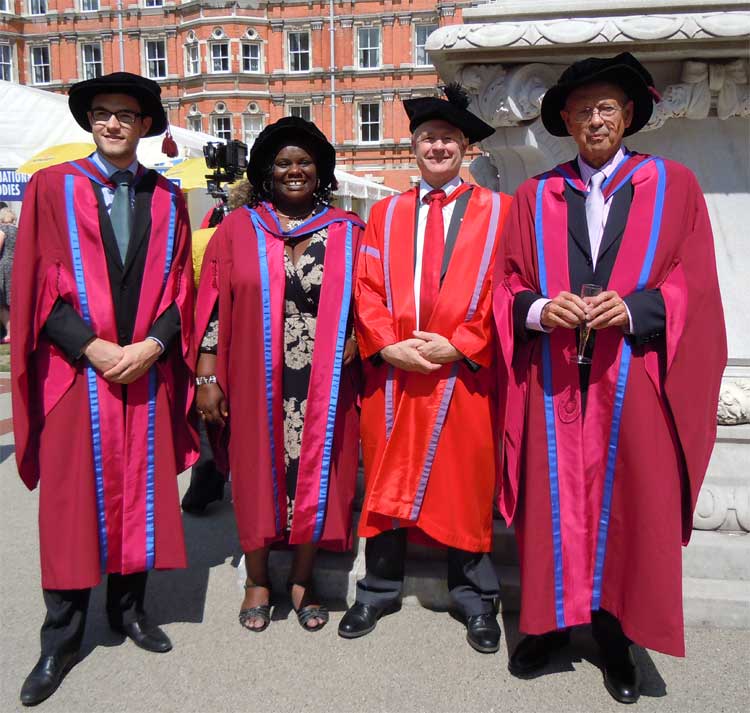
Graduation at Royal Holloway, University of London, 2011

Last Friday was graduation day for Geographers at Royal Holloway, University of London. It was great to see three of my former PhD students getting their degrees.  Many congratulations to:

Likewise, it was also good to see so many of our undergraduates – particularly those doing my course on ICT4D – gaining their well deserved degrees.  Three of them – Olly Parsons, Ben Parfitt and Jamie Gregory – are spending time this summer in Uganda undertaking research in support of the Ugunja Community Resource Centre.  To follow them, check out

Many congratulations to all of our graduates!

Leave a comment

Filed under Geography, Higher Education

Drought, poverty and famine in East Africa

Am I the only one who feels distinctly uneasy about the rhetoric surrounding the impending famine in East Africa?  Of course, we should do everything we can to sustain those who are starving.  Of course the images in our media of starving mothers and dying children are harrowing, but that it was they are intended to be.

I am minded of discussions that I once participated in at the offices of a major bilateral donor on the subject of their new programme of planned support for Ethiopia.  This was almost a decade ago, but I recall being shocked at how little support was intended for simple things such as the creation of effective small scale irrigation systems and grain storage facilities.  Drought happens.  It always has, and it always will.  Fluctuations in climate occur regardless of any human induced climate change.  Hence, programmes of development assistance should be doing all that they can to ensure that food production in poor countries is increased and that surpluses are retained to enable governments to withstand the droughts that will always come again.

According to DFID’s web-site the current top priorities for  its funding for Ethiopia are:

  • Addressing the underlying causes of poverty and fragility through new support for wealth creation, peace and security and tackling the effects of climate change
  • Ensuring better access to basic services, enabling millions of people to go to school, drink clean water and access basic health care”

Note that there is nothing here about agricultural production or food security.  Other donors are little different.  Might not more attention to sustaining effective agricultural production so that the devastating impact of drought could be mitigated have been sensible, so that the misery and suffering of so many poor people could have been reduced?  If some of the large sums of money now being spent on famine relief had been spent instead on effective drought mitigation methods, the severity of the crisis could have been reduced.

But this is not just the fault of donor policy.  The governments of the affected countries must also take their share of the blame.  Lawlessness, war, violence and high levels of military expenditure do not make for a stable background against which effective rural development programmes can be implemented. Piracy on the high seas is not a particularly good means of encouraging sustained agricultural production that could reduce the impact of drought.  For too long, governments of some poor countries have continued on development strategies that do not sufficiently address the needs of the poor, relying on the richer countries of the world to come to the rescue when their peoples are starving.  There will come a time when taxpayers in countries providing development assistance will start to realise just how inappropriate much so-called development expenditure really is, and ask questions about the continuing sense of helping such governments with continuing ‘aid’.  DFID is spending £331 million a year on average in support of the Ethiopia government until 2015.  This aid has clearly had insufficient impact on the ability of the country to prevent mass hunger.

For how long will people continue to respond to the media images pulling at our heart-strings to persuade us to fund the errors in development policy that mean that so many people in East Africa are now starving? The impending famine is not ultimately caused by drought, but rather by the policies of national governments, both donors and recipients of development assistance alike. The time has come for a radical re-think of such development assistance.  The time has also come for people to demand real and effective change from their governments in poor countries, so that the impact of drought will never again be felt in the way that the poor of East Africa are now suffering.

Leave a comment

Filed under Africa, Development

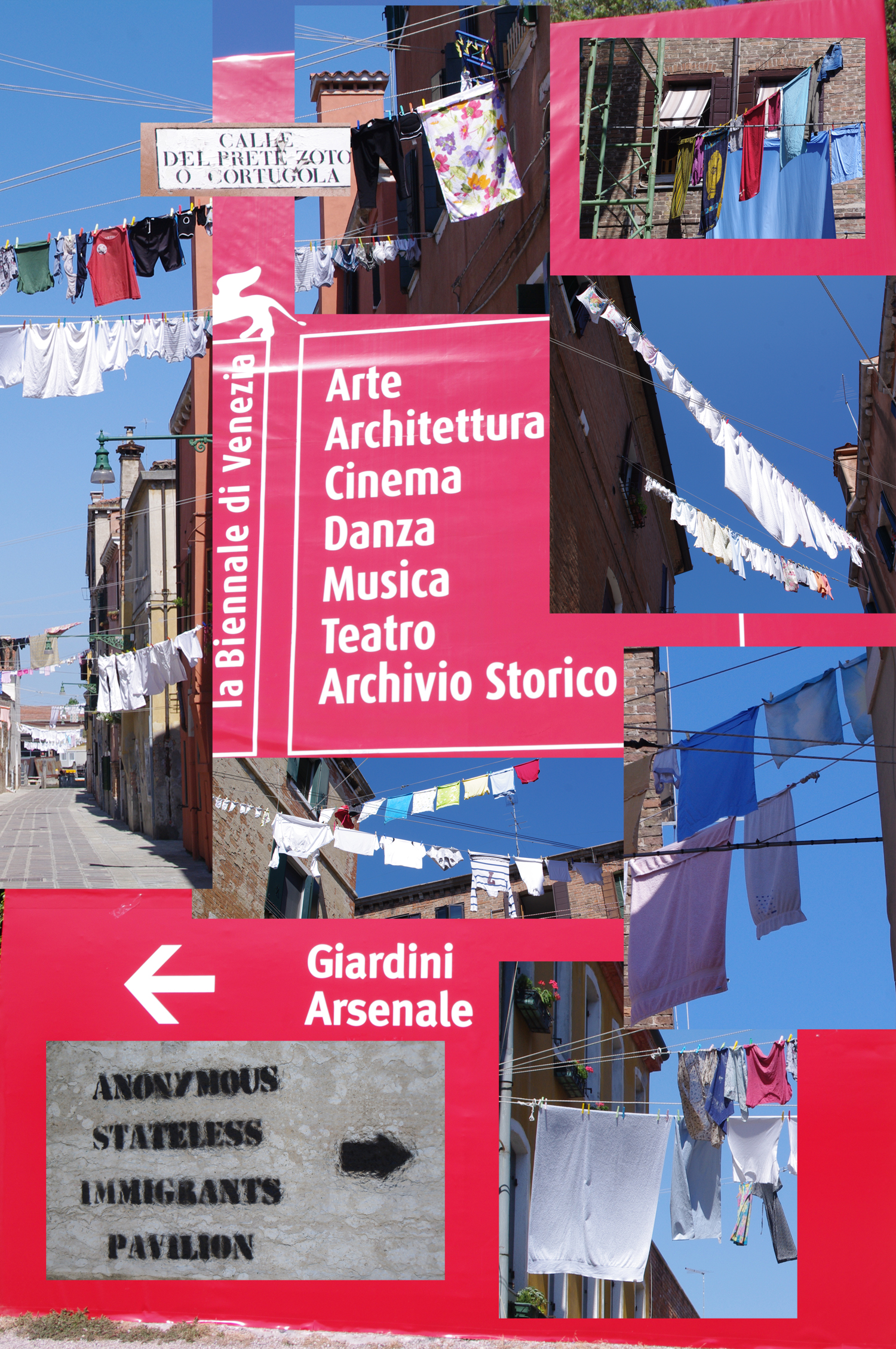
Venice on the Line at the Biennale

“The first in a remarkable series of images entitled Venice on the Line (I) that specifically challenges the rhetoric of this year’s Biennale in Venice.  It is explicitly intended as a play on the English expression ‘on the line’, both highlighting the artist’s intention to put his work ‘on the line’, but also emphasising  the lived experience of Venices’s urbanscape in which the daily clothing of Venetians is left to gather the city’s air ‘on the line’ for all to see.  It makes vivid use of the juxtaposition of the primary colours of red and blue: the red of the Biennale signage against the blue of the Venetian sky.  These colours are picked out  in the choice of clothing and bed linen: the red underpants and t-shirt against the blue sky and sheets; the blue sheets against the soft browns of the built fabric.  This is not the Venice of the canals and gondoliers, but rather the rectilinear residential blocks to the north of the Giardini and east of Arsenale as indicated in the signage in the lower third of the image.  Cleverly, this is opposed by the street name Calle del Prete Zoto o Cortugola.  This juxtaposition emphasises the combination of Arte and Architettura highlighted at the top of the Biennale sign, but removes it from the usual ‘place’ of the exhibitions and brings to attention the daily lives of poorer Venetians.  The dominant whiteness of most of the washing set against the blue sky, intentionally matches the whiteness of the writing against the red background of the signage. Dominant, at the bottom left of the image, and pointing away from the Giardini/Arsenale arrow, is the widespread Anonymous Stateless Immigrants Pavilion sign, emphasising the artist’s commitment to the alternative tradition exemplified by Venice on the Line (I).”

Leave a comment

Filed under Photographs

Reflections on Geography at Bedford College (and then Royal Holloway) in the 1980s

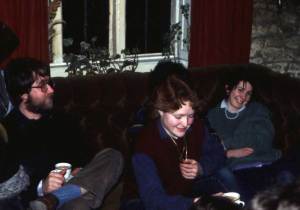
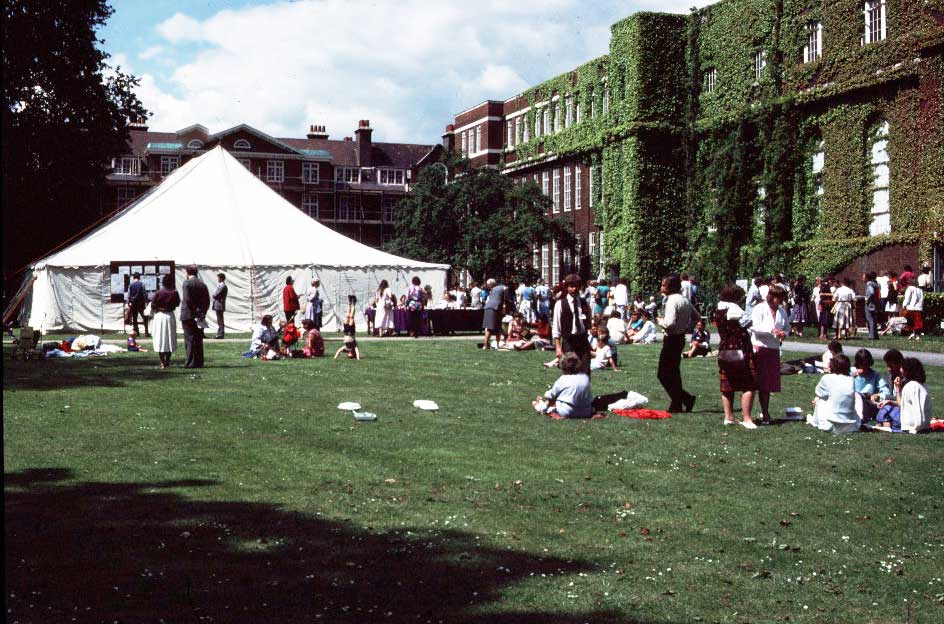
The Geography Department at Royal Holloway, University of London, is hosting an alumni event focusing on the 1980s to be held on 16th July.  As one of the last ‘surviving’ members of staff to have worked at Bedford College, I was asked by Klaus Dodds to write a few words about my recollections, so that they could be included on a poster in the Department.  Just thought that it might be interesting also to post them here, together with some imagery from 20-30 years ago!

The Department 30 years ago was so much smaller than today – fewer staff, fewer undergraduates, and fewer postgraduates.  It was a world largely without computers.  No e-mails!  One could think, and write, and teach students who were genuinely interested in learning.  It was brilliant!

I distinctly remember being appointed, and joining in 1981.  There were but a handful of jobs advertised in human geography that year.  I had been interviewed for a job at Exeter, but couldn’t hear properly what the panel chair was mumbling!  Needless to say I did not get that job!  My girlfriend was working in London, while I was still living in Durham and working at the Geography Department there.  Then this job came up at Bedford – amazingly the College where my mother had studied mathematics many years previously!  I remember being asked at the interview what it would mean for my personal life if I got the job, and responding that of course it would mean that Pam and I could get married. Imagine being asked such a thing in interviews today!
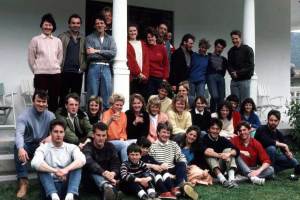
I was appointed to teach historical geography – and loved it!  I diligently used to write out my lecture notes in full – and read them to my students!!  Scarcely something that new lecturers would do now, in a world of PowerPoint!  But I did use slides on the old projector. I was very little older than the students were, and they forgave me for my nervousness.  I think my enthusiasm must have made up for a lot – medieval taxation documents, field systems, and prehistoric monuments!

One highlight was when the new electronic typewriter with a memory arrived; the precursor for word processors and personal computers.  One day, I was using it when the Departmental Secretary came in and threw me off, saying that she had something important to write.  Suppressing my fury, I left the dark room where it lived, and hit the wall outside with my fist.  My hand crumpled….  I then spent all afternoon running “The Green Revolution Game” with my students; my hand bent in pain.  Only in the early evening did I go to St Thomas’s – and of course they diagnosed a broken hand!

Then there were the great students doing the Master’s course in Third World development.  The course was led by Alan Mountjoy, and attracted bright people from all over the world – some of my favourite teaching ever; if only I was still in touch with some of them – particularly the Egyptian journalist who gave me a photograph of Jürgen Habermas.

And there was the IRA bombing in 1982.  I heard the first blast in Hyde Park whilst I was working at the RGS, and then got back to Bedford to see the debris remaining from the other blast that had taken place at the bandstand just nearby in Regent’s Park.  A sad day.

But the early 1980s was the time of mergers across London.  I became deeply involved in planning for the merger with King’s, and remember being saddened when it was announced that this had fallen through.  Going to Egham did, though, have one advantage in that we did not have to negotiate with another Geography Department already there; we could instead build our own identity from within.  On a personal level, we also decided to move from our rented flat in Kennington out to a newly built house in Englefield Green, on the Larksfield estate.  I remember this being a huge risk, since I had not been made permanent and we bought before it had definitely been confirmed that the merger would go through.
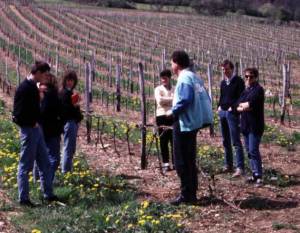
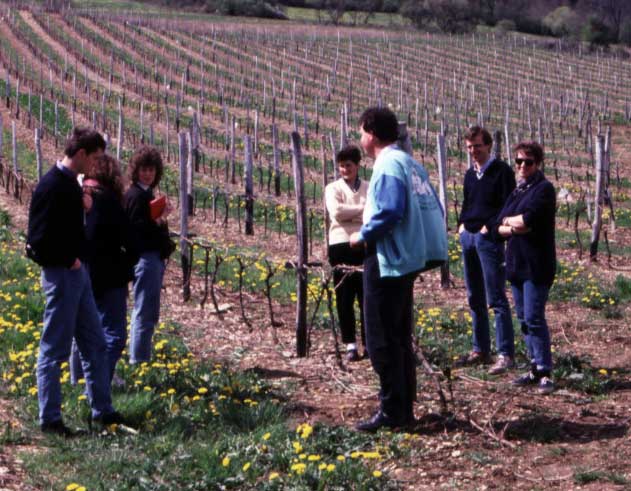
The move meant that we could reorganise our courses, and I recall working with Chris Green and others on a new teaching structure that would mean that our third year courses would become much more research oriented and also applied.  This provided the opportunity for me to launch my new course on the historical geography of viticulture and the wine trade.  At first, this was rejected by the University Geography board as being far too esoteric – but I resubmitted it again pointing out that if there was a course at SOAS on the geography of oil, surely we could teach about viticulture and wine.  After all, the wine trade has been in existence for millennia.  This course also provided an opportunity to work more closely with those in the wine trade, and highlights definitely included the wine tastings and the field trips to Burgundy and Champagne.  Imagine being allowed today to ‘race’ in minibuses across France from vineyard to vineyard and campsite to campsite.  How generous were the winemakers who shared their time and their wines with us!!
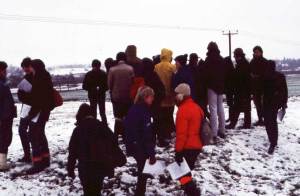
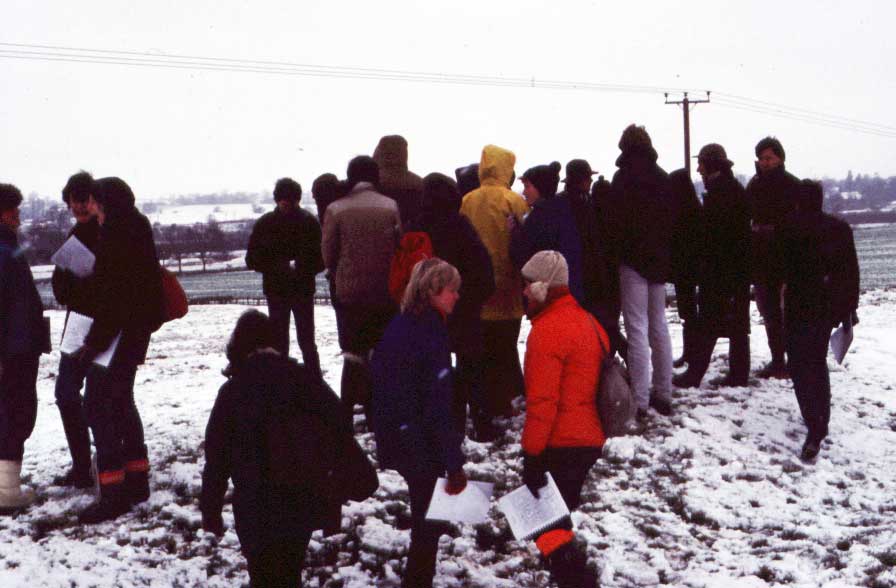
But I recall other field trips too: the day excursions to Northamptonshire and Bedfordshire for my second year students, exploring field systems and deserted medieval villages, more often than not in the snow; and then the second year trip to Portugal, again with generous hospitality from friends in the port wine trade.

There were great characters in the Department: Ron Halfhide, who became Departmental Superintendent, and was always the life and soul of the party, helping to arrange wonderful Geographical Society events; David Hilling, the ‘uncle’ figure, who cared for students (and rugby) in ways that we are no longer permitted to do; John Thornes, who as Head of Department told me that I should really make myself the specialist in one area of the discipline, such as the geography of Portugal.  John certainly taught me some lessons!  On his recommendation, I drafted two chapters of ‘the’ book on Portugal, and sent them to a publisher.  The academic referees liked them, but the publisher said that there was no market for a book on agricultural innovation in Portugal.  Never again have I written anything for a book publisher without a contract!

Above all, I remember those days as ones of amazing freedom – when we could craft new knowledge in the innocent ways we believed were right, when we could treat students as friends and not numbers, when collegiality rather than individual selfish career progression mattered.  They were good times”.

20 Comments

Filed under Geography, Higher Education, Universities

Resources for sharing development knowledges

Sitting in an interesting meeting of the International Advisory Group of IDS’s MK4D (Mobilising Knowledge for Development) initiative, it struck me that there are now a number of  similar initiatives, all trying to tackle the sharing of development knowledges in rather different ways, and yet no central place where these are all listed.  So, here is a list of some of the ones that I think are most interesting (sorted alphabetically!):

  • bytesforall – a citizen’s network in South Asia that identifies, discusses and builds network on emerging issues related to ICT and its impact to development
  • Comminit – The Comunication Initiative Network, where communication and media are central to social and economic development
  • Development Gateway – an international nonprofit organization with the mission to reduce poverty and enable change in developing nations through information technology (includes the Zunia programme)
  • Eldis – based at IDS and aiming  to share the best in development policy, practice and research (within the MK4D package for work at IDS)
  • Global Development Learning Network – cooordinated by the World Bank, the Global Development Learning Network (GDLN) is a partnership that collaborates in the design of customized learning solutions for individuals and organizations working in development
  • IDRC/CRDI (Canada’s International Development Research Centre) – supporting applied research to find local solutions that will have lasting impacts on communities around the world.
  • IICD – using ICTs to help people in Africa and Latin America access the information that can transform their lives
  • infoDev – supports global sharing of information on information and communication technologies for development (ICT4D), and helps to reduce duplication of efforts and investments
  • R4D (Research4Development)- the portal to DFID centrally funded research
  • Zunia Knowledge Exchange

3 Comments

Filed under ICT4D

Survey of mobile learning use by students

While in China recently, I was working with a group of colleagues to explore how students (undergraduate, Master’s and Doctoral) there are using mobile phones in support of their learning.  We designed a survey that is now being implemented to gain a broad understanding of such usage. Much previous research has focused on the effectiveness of specific ‘m-learning’ interventions, but what interests us is how students may (or may not) be using mobile ‘phones in a sense ‘organically’ to support their learning.

The idea then came that it would be very interesting to draw some international comparisons about the use of mobile learning, and so we have developed a short online survey that takes only between 10 and 15 minutes to complete. It would be great if you could circulate this link to any students that you know, and encourage them to complete the survey:

We would also like to make the survey available in different languages, and if there is anyone who might feel able to translate it into their own languages please let me know, so that I could send you a version in a text format for translation.  Any such assistance would of course be acknowledged with thanks in the reports that we write!

Do please publicise this as widely as possible.  Hopefully, the survey will be interesting for students to participate in!  The results will be posted in due course at http://www.ict4d.org.uk .

Leave a comment

Filed under 'phones, ICT4D, Universities