The future of the UK’s universities – a radical scenario

Earlier in the year at the ACU’s Executive Heads meeting in Hong Kong, I caused real offence to at least one participant when I argued that it made no sense at all  for 50% of the UK’s young people to study at university.  A damp bank holiday Monday gives me the opportunity to try to clarify my arguments for him – and for any others who might be interested.

First, let me make clear what I did not say.  I never said that young people should not receive training after they leave school.  I never said that people should be prevented from life-long learning.  Far from it.  All people should receive opportunities to gain the training that they  can benefit from, and  this training should be relevant and of high quality.  What I do not believe is that such training is best done at universities.  My argument is built on four main foundations:

  • the role of the university
  • the relationship between universities and economic growth
  • the abilities and interests of young people in the UK, and
  • the need to provide outstanding technical and professional education for all young people who want to gain such skills in the UK.

What should universities be for?

I believe passionately that universities have a central place in any civilised society.  Free and independent universities, funded by the state, play a crucial role in shaping the meaning and identity of our societies.  They are the places where creativity and innovation  happen, where the boundaries of knowledge are constantly moved forward, where questions that were once unthought are now uttered and answered.  They are the places where many of our brightest and most articulate scholars and scientists should want to work, and where young people who want to commit themselves to crafting new knowledges should indeed be able to learn from them.  Universities are places funded by those who believe that it is good to support a group of people – academics – whose role it is to reflect on the society of which they are a part, to understand the reasons why it is not functioning as it might, and ultimately to make that society a better one in which everyone can live richer lives.

Over the last 20 years, though, successive governments have overseen the destruction of such a vision.  Increased regulation and control of research has helped to extinguish much innovative thinking, and the flame of learning has been quenched by an increasingly regulated teaching environment. All too often claims that universities are elitist have led to a destruction of excellence, caused by a focus on  lowest common denominators. What saddens me hugely is that so many academics have been complicit in this agenda, fearful over their own jobs and the future of the institutions in which they work.  Let me make one thing absolutely clear.  Universities should not be where large numbers of students are taught to accept and regurgitate accepted truths – be they about the nature of our economy, or about the skills needed to become better managers.  Instead, they should be places where those who want to study hard, to grapple with complex and difficult ideas, to dream as yet undreamt dreams, and to change the ways in which we understand the world in which we live, can indeed do so.  They are not places where students should necessarily be taught; rather, they are places where ‘students’ have the opportunity to learn from the most brilliant minds in our society. Incidentally, I also think that this process needs time, and that a three year degree is probably about right for ideas to develop and mature to a sufficient level for someone to be worthy of a university degree.

The fundamental problem is that not many people are actually able to do this, and even fewer want to do so.  Many students seem simply to want to gain skills that will enable them to get a reasonable job, earn a satisfactory income, and live a comfortable life.  The provision of skills training for such a life is something entirely different from gaining the critical stance to knowledge that I believe a university should be all about.

Universities and economic growth

A dangerous myth has grown up in recent years that claims that having large numbers of young people trained in universities is somehow good for economic growth.  Building on this myth, Tony Blair’s Labour Party conference statement in 2000 said that he expected 50% of people in the UK to have benefited from higher education by the time they are 30. However, note the blurring of vocabulary, and the fundamentally important difference between ‘universities’ and ‘higher education’.  With the end of the distinction in the UK between universities and polytechnics in 1992, all institutions became merged into a general higher education sector and most chose to use the word university to describe themselves.  Universities and higher education in the UK became synonymous.

The trouble is that there is actually rather little evidence that having 50% of 30 year olds with a degree is necessarily good for a country’s economic growth.  Likewise, despite claims that those with degrees will be able to earn more during their lifetimes than those without, there is likewise very little evidence that having a degree will necessarily mean that all students will gain high paying jobs.  As many students graduating this summer are finding out, there simply is not  enough graduate employment  around for them all to find the sort of jobs that they had been led to believe they should get. As the BBC reported earlier this year, “One in five UK university leavers who entered the labour market failed to find a job last year, as graduate unemployment reached its highest level since 1995, government figures show”.

There is indeed a broad correlation between GDP per capita and the percentage of people in a country who have studied at a university.  However, the mere existence of such a correlation does not impute causality.  Much more research is needed on the precise trajectories of the relationships between economic growth and participation in universities in different countries.  While it is intuitive to think that having a certain number of people trained in universities will indeed contribute to the well being of a country, there is absolutely nothing intuitive about saying that having 50% participation rates will necessarily increase economic growth.  Indeed, the evidence would seem to suggest instead that the surplus created by having a higher GDP per capita actually enables more people to go to university.  Thus, above a certain level, it is probably GDP per capita that influences university participation rather than the other way round.

Moreover, some of the most thriving economies are actually those that have a clear distinction between technical higher education and traditional universities. In Germany, for example, substantial numbers of young people on leaving school go to a Berufsschule where they combine further academic study with  apprenticeships, whilst many others choose to attend Technische Hochschulen where they are trained for specific careers rather than entering more traditional universities.  Is it surprising that Germany has much higher levels of technical professional expertise than does the UK?

Abilities and interests of young people in the UK

It is my contention that many students in the UK choose to go to university as a lifestyle choice rather than with any real intent to move the boundaries of knowledge forward.  It is the expected thing to do.  They have been told that they will earn more if they have a university degree.  There are very few jobs available for young people in any case, and so why not spend three years having fun at university?  Whether apologists for the health of UK universities like to claim otherwise, this is the harsh reality of UK student choice today.  About the only positive thing about the introduction of yet higher fees is that it is is likely to make many students who would be much better off  not  studying at universities think again about so doing.

In a recent study, the Higher Education Policy Institute ( Figure 8 ) thus notes that some 80,000 university entrants in 2010 had between 1 and 240 UCAS tariff points (240 is equivalent to three Cs at A level).  I contend that most students with below 3 Cs at A level have not proven that they have the intellectual apparatus to push the boundaries of knowledge forward, nor do many of them really have the inclination to do so. Of course there are exceptions to this, and we need to ensure that those who are truly able to contribute to and benefit from university, but do poorly at A levels or wish to enter through other routes, can indeed do so.  However, my fundamental point is that universities (as defined above) are not the right places for such students to gain post-secondary learning opportunities.  We need an alternative solution to give them the skills that they need, and we must stop pretending that universities are the place to do this.  For too long there has been an intellectual elitism that suggests somehow that an ‘academic’ degree is better than a ‘technical’ one.

It is therefore scarcely surprising that many students studying at UK universities are not really inspired by their courses, and choose to spend their time doing other things.  However, the extent of this is scandalous. There are many estimates for the average number of hours students in UK universities actually spend studying, but most lie within the range of 25-30 hours a week in term time.  One of the most reliable and recent surveys, by the Centre of Higher Education Research and Information at the Open University in 2009, thus concludes that “students in the UK spent an average of about 30 hours a week on studying, the least amount of time compared to their counterparts in other European countries”.  Interestingly a couple of years ago some of my students did a survey of the amount of time that their peers spent in the bars on campus, and the average came out at about 25 hours a week!  Perhaps their friends were exceptional, but I’m not so sure.

I expect students to study a minimum of 40 hours a week, and am seen by many colleagues as expecting too much.  Typical comments are “You cannot expect this – they have to spend time earning money to pay for their degrees”, or “But university is about far more than just studying”, or “Your expectations are old fashioned; get with the times”.  Sorry, this is simply not acceptable.  I have recently returned from an amazing and intellectually stimulating time at Peking University (Beida), and you should see how hard students there work!  The university day starts at 08.00 and finishes at 18.00, albeit with two hours ‘off’ for lunch.  Most students then spend several hours studying every night.  There is a thirst to learn, to explore ideas, to think afresh.  This is such a contrast to life on many British campuses.  It is hardly surprising that China is the vibrant economy that it is.  If we want to compete on a global stage, we need completely to rethink what students should be expected to do at university in the UK.

Providing a valuable technical and professional education

It is not easy to estimate how many students are really interested in pursuing knowledge critically in the sense discussed above.  However, to be generous, let me suggest that perhaps 25% of the school leaving population have the aptitude and an interest in so doing.  To cater for them we therefore need perhaps half of the universities that we currently have in the UK.  If pushed to an extreme, I would say that universities should actually only provide places for about 10% of school leavers!

This means that we need a complete reorganisation of post-secondary education, to provide people with the skills necessary to gain useful employment and contribute to the economic growth beloved of our political and industrial leaders.  Because we persist in wanting to maintain our universities, this is a subject that is almost never raised.  Somehow, it is believed that universities as they are currently structured will provide the skills necessary to revitalise our economy.  What nonsense.  Over and over again we hear from industrial leaders how poorly equipped graduates are for the workplace.  A recent survey by AP Business Contacts in March 2011 thus reports that employers found graduates lacking in five main areas:

  • Lack of business acumen, commercial understanding and preparation for the ‘leap’ from the academic to commercial environment
  • Lack of personal and interpersonal skills, including communication, emotional intelligence and organisational skill
  • Poor English language skills, ranging from a difficulty in making the transition from academic writing to business writing, to basic inadequacies in grammar and spelling
  • Attitudinal issues, including the unrealistic expectations of their role and inflated views of their capability early on
  • Specialist skills needed for specific jobs e.g. engineering, computer science

This is indeed a damning indictment, and those in higher education need to wake up and do something about it.

So, instead of universities, I have long believed that we need to introduce a completely new style of institution, perhaps called academies (although this term has been captured by those wishing to create a new kind of secondary institution), that are specifically designed to provide training for, and qualifications in, the skills required to gain the sorts of jobs that those with below 2 BBs at A level can realistically consider applying for.  Perhaps such entities could be distributed regionally, with one of each type in eight different regions of the country. Where there are particular regional specialisms, there could be concentrations of relevant ‘academies’.  Ideally, these institutions would be set up in partnership with employers, and have embedded within them apprenticeships or placements.  Typical of the sorts of institution I have in mind would be academies for multimedia design, for plumbing, for dance, for football, for horticulture, for engineering technicians, for photographers, for metal working production fitters, for line repairers and cable jointers, for chefs… (many of these, of course, fall within the government’s Tier 2 Shortage Occupation List).  These courses could be of variable duration, and most would not need to be longer than two years of full time study.  They would present a far cheaper solution than universities, and would provide learners with valuable skills in the employment market. Qualifications from these academies should be seen as being far more valuable than literally ‘use-less’ university degrees.  However, we still need the universities to serve as our places of critical reflection and innovation.  Much of what universities would do would indeed have little practical value – but that is in part what being civilised is all about.

There are probably far too many vested interests in the present system for such a radical scenario to be accepted.  Not least, too many Vice Chancellors and academics are overly eager to hold on to their precious elite institutions.  Isn’t it ironic that breaking the binary divide between polytechnics and universities was meant to do just that, and to get rid of elitism.  How sad that ultimately it has meant that so many of our universities have become so third-rate in terms of global competitiveness, and that they continue to fail our young people in terms of giving them either the vision or the skills to craft a new future that is better than the one we have left them.  Let us not be blinded by the debate over how to fund a moribund higher education system that is over-bloated and suffering from gout.  Instead, let us grasp this moment, and use it for a radical and visionary transformation of higher education in the interests of the next generation of people whose task it will be to sort out the mess we have left them!
2 Comments

Filed under Higher Education, UK, Universities

How to make ICT4D partnerships better deliver real development impacts

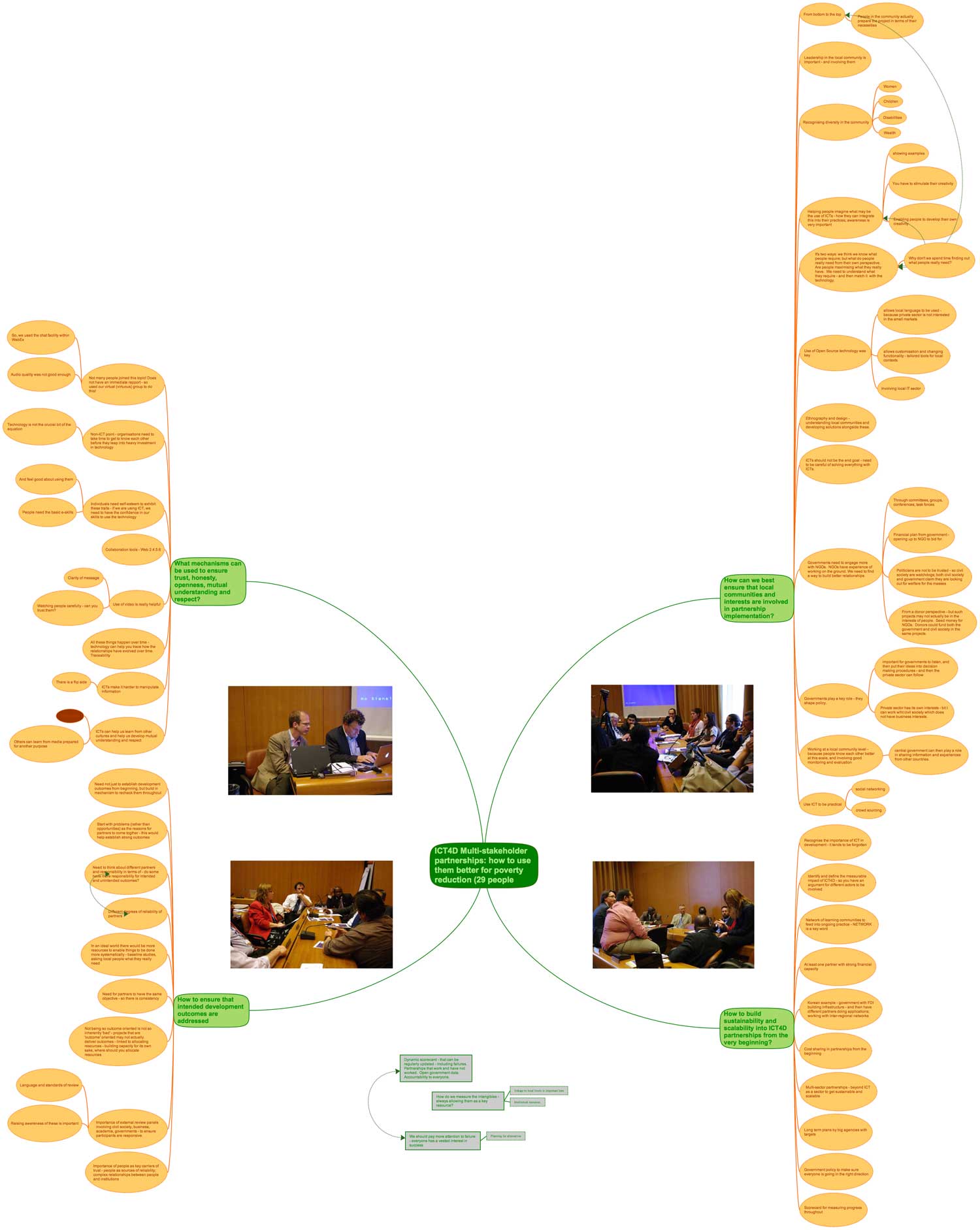
The ICT4D Collective hosted a workshop at the WSIS Forum in Geneva today on the key factors colleagues considered to be necessary to overcome four of the most important problems in delivering effective ICT4D partnerships.  The idea for the workshop stemmed from the systematic review of the impact of ICT4D partnerships completed by Marije Geldof, David Grimshaw, Dorothea Kleine and myself for DFID earlier this year.  This highlighted four main areas where further thought was required:

  • How can we best ensure that local communities and interests are involved in partnership implementation?
  • How to ensure that intended development outcomes are really addressed?
  • How to build sustainability and scalability into ICT4D partnerships from the very beginning?
  • What mechanisms can be used to ensure trust, honesty, openness, mutual understanding and respect?

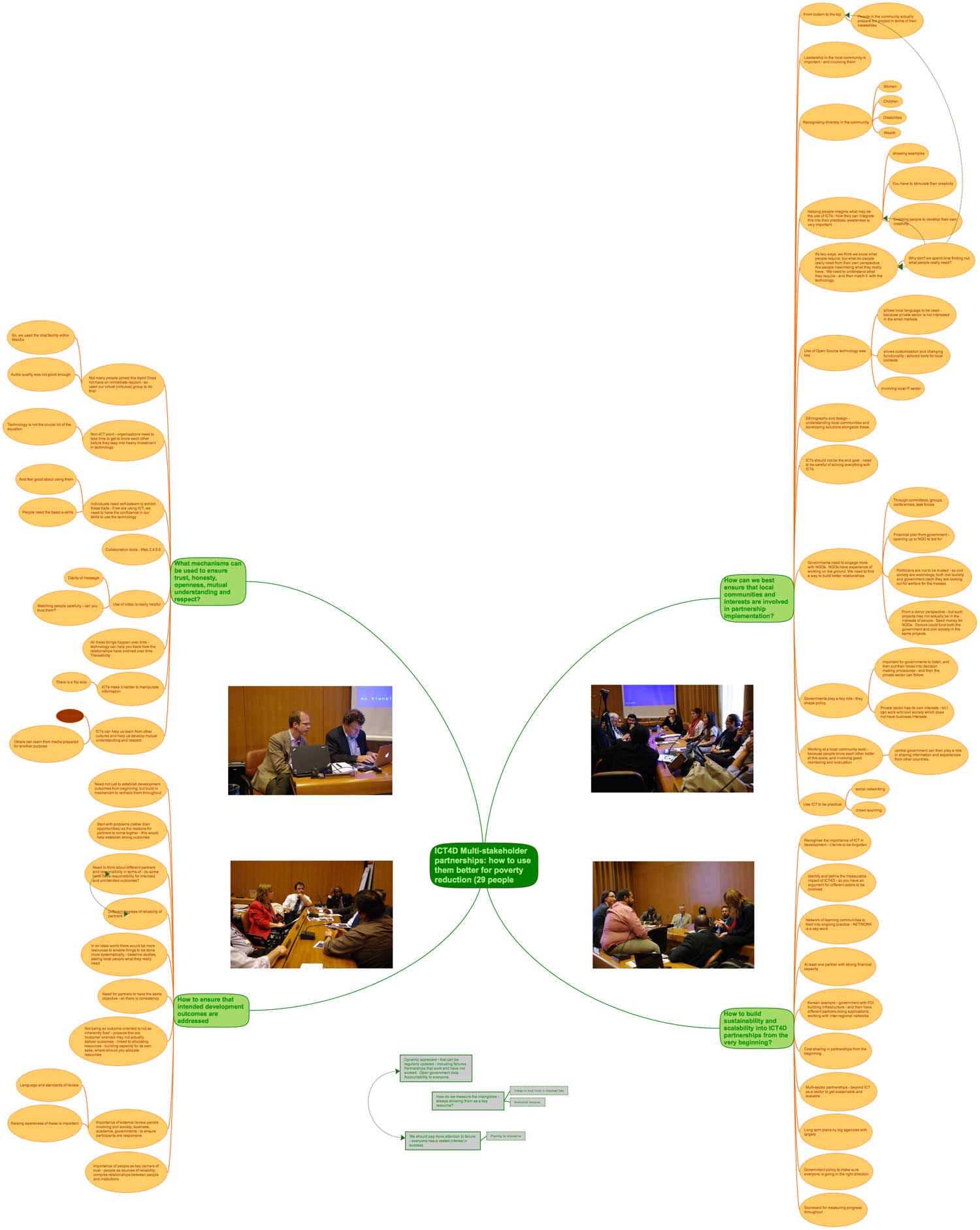
Following an opening presentation by David Grimshaw (Practical Action, and Royal Holloway, University of London), we divided up into four groups (chaired by Paola Uimonen from SPIDER, Peter Drury from Cisco, and Dorothea Kleine and myself from Royal Holloway, University of London), each discussing one of these themes, and the outcome was the following mind map (click on image for larger version) that reflected the collected views of the 30 or so people present, as well as those who joined by WebEx video conferencing services kindly provided by Cisco.


A more detailed .pdf file of the mind-map is available here: WSIS Forum 2011

Thanks to everyone who participated, and helped to make the discussions so interesting.

Leave a comment

Filed under ICT4D

World Telecommunication and Information Society Day

Today, May 17th, is World Telecommunication and  Information Society Day.  The theme is Better Life in Rural Communities with ICTs – which seems highly appropriate!  Let’s hope we can all do something to make this aspiration a reality!

Leave a comment

Filed under ICT4D

Remote participation at the 2011 WSIS Forum in Geneva

This week’s WSIS Forum is just about to get underway in Geneva.  The organisers have been very eager to ensure that people can participate remotely.  Full details of how to watch and engage in the discussions ‘at a distance’ are copied below:

“The WSIS Forum has a multi-stakeholder character. The WSIS Stakeholders include governments, civil society, private sector and international organizations from all parts of the world. Today, information and communication technologies (ICTs) provide the opportunity for representation and inclusion of all stakeholders in the WSIS Forum by way of remote participation. In order to ensure participation and inclusion of all WSIS Stakeholders, remote participation has been designed as an integral feature of the WSIS Forum 2011.

Building on the success of remote participation facilities initiated at WSIS Forum 2010, the organizers are working towards integrating the most user friendly and widely used tools for encouraging remote participation at WSIS Forum 2011. These easy to participate tools will enable two way communication, allowing the WSIS Stakeholders to participate in the WSIS Forum at their own convenience at the same time, disemminate information about the different sessions and happenings at the Forum.

Components of Remote Participation at WSIS Forum 2011

Webcast
Remote Participation will be a key feature of the WSIS Forum 2011 and you can follow all sessions via the video webcast (registration not required).
Webcast page: http://www.itu.int/ibs/WSIS/201105forum/index.html.

iWrite4WSIS
All Forum sessions will feature live reporting via twitter, as part of the iWrite4WSIS campaign.

Adobe Connect Conference Rooms
If you would like to participate actively in this conference as a remote delegate, you can do so by registering to participate via the Adobe Connect (virtual) conference rooms.   This will allow you to follow the video feed of the conference room, hear what is being discussed (English channel), see presentations and documents, and put questions to panelists via chat.   Each session will have 10-15 minutes for questions from remote delegates.  Participation, as a remote delegate, requires registration. (See registration page)

Short Video: Inside an Adobe Connect Meeting Room

The Adobe Connect Conference Rooms are provided below:

You can login to any of these rooms to have a look around, however they will only be active from Monday, 16 May at 08h45(Geneva time)

See also Frequently Asked Questions for Remote Participants

Leave a comment

Filed under ICT4D

New ITU report on the role of ICTs in advancing growth in the least developed countries

The ITU has just published a very important report on the role of ICTs in enhancing development in the least developed countries.  I was privileged to have been asked to write the foreword, in which I made the following comments:

  • “This important ITU report focuses explicitly on the experiences of people living in the world’s ‘Least Developed Countries’ (LDCs). It addresses not only how and why ‘outsiders’ have been eager to offer new ICTs as a means to encourage their ‘development’, but also how technical innovation can occur in some of the poorest countries of the world. Above all, it suggests that there is nothing automatic about the potential contribution of ICTs to ‘development’ processes, however these are defined. If marginalised people and poor countries are to take advantage of ICTs in transforming their fortunes, then specific efforts need to be made to address their needs and aspirations. The market by itself will not deliver on the information and communication requirements of the poorest and most marginalised people and communities”, and
  • “This exciting report points in many directions. It highlights both the successes and the failures of ICT initiatives and developments over the last decade, particularly with respect to LDCs. It emphasises the many challenges that still need to be overcome before we can claim that these technologies really have had the equalising benefits that many attendees at WSIS had hoped for. However, above all, it provides suggestions for innovative ways forward through which some of the poorest countries in the world can grasp the potential of ICTs to enhance the lives of their peoples”.

The charts and graphs contained within the volume provide very important evidence that many of the poorest countries and people in the world have not yet benefited from the potential of ICTs, and that very substantial effort is needed to ensure that ICTs do not actually lead to further increases in the differences in access between the world’s richer and poorer people.  This is essential reading for all involved in ICT4D.

2 Comments

Filed under Africa, Development, ICT4D

The development impact of ICT4D partnerships: join our discussion online at the WSIS Forum

Cisco is generously sponsoring the opportunity for anyone to participate in the session on the Development Impact of Multi-stakeholder Partnerships in ICT4D ( http://groups.itu.int/wsis-forum2011/Agenda.aspx?event=event_60) that the ICT4D Collective is convening from 16.30-18.00 Geneva time (15.30-17.00 UK time) on Tuesday 17th May at the WSIS Forum ( http://groups.itu.int/default.aspx?tabid=856).  Please share this information as widely as possible, so that colleagues across the world can join in our discussions and deliberations.

To join the online discussion, please use the following information (best to try to log-on about ten minutes in advance to download the applet and check the systems are working) :

Meeting Number: 608 639 429
Meeting Password: 123

——————————————————-
To join this meeting (Now from mobile devices!)
——————————————————-
1. Go to https://ciscosales.webex.com/ciscosales/j.php?J=608639429&PW=NYzY4NDE5MjI3
2. Enter the meeting password: 123
3. Click “Join Now”.
4. Follow the instructions that appear on your screen.

—————————————————————-
ALERT:Toll-Free Dial Restrictions for (408) and (919) Area Codes
—————————————————————-

The affected toll free numbers are: (866) 432-9903 for the San Jose/Milpitas area and (866) 349-3520 for the RTP area.

Please dial the local access number for your area from the list below:
–  San Jose/Milpitas (408) area:  525-6800
–  RTP (919) area:  392-3330

——————————————————-
To join the teleconference only
——————————————————-
1. Dial into Cisco WebEx (view all Global Access Numbers at
http://cisco.com/en/US/about/doing_business/conferencing/index.html
2. Follow the prompts to enter the Meeting Number (listed above) or Access Code followed by the # sign.

San Jose, CA: +1.408.525.6800  RTP: +1.919.392.3330

US/Canada: +1.866.432.9903  United Kingdom: +44.20.8824.0117

India: +91.80.4350.1111  Germany: +49.619.6773.9002

Japan: +81.3.5763.9394  China: +86.10.8515.5666

Leave a comment

Filed under ICT4D, ICT4D conferences

iPhone software update 4.3.3: limits tracking cache

Good to see that Apple has now released a software update (iOS 4.3.3) that means that iPhones will no longer retain information about where they have been!

As Apple, states:

“This update contains changes to the iOS crowd-sourced location database cache including:

  • Reduces the size of the cache
  • No longer backs the cache up to iTunes
  • Deletes the cache entirely when Location Services is turned off”

In effect, this means that the amount of information kept on the ‘phone is limited to a week’s usage, and the location data are no longer backed up on users’ computers.

In response to criticisms over iPhone location data being stored on the ‘phones and backed up on users’ computers, Apple claimed that iPhones were not actually logging locations – “Rather, it’s maintaining a database of Wi-Fi hotspots and cell towers around your current location, some of which may be located more than one hundred miles away from your iPhone, to help your iPhone rapidly and accurately calculate its location when requested. Calculating a phone’s location using just GPS satellite data can take up to several minutes. iPhone can reduce this time to just a few seconds by using Wi-Fi hotspot and cell tower data to quickly find GPS satellites, and even triangulate its location using just Wi-Fi hotspot and cell tower data when GPS is not available (such as indoors or in basements). These calculations are performed live on the iPhone using a crowd-sourced database of Wi-Fi hotspot and cell tower data that is generated by tens of millions of iPhones sending the geo-tagged locations of nearby Wi-Fi hotspots and cell towers in an anonymous and encrypted form to Apple”.

Apple went on to say that the fact that up to a year’s data was stored was the result of a bug: “The reason the iPhone stores so much data is a bug we uncovered and plan to fix shortly (see Software Update section below). We don’t think the iPhone needs to store more than seven days of this data”.  Further, their statement also emphasised that Apple believe that personal information security and privacy and important: “Yes, we strongly do. For example, iPhone was the first to ask users to give their permission for each and every app that wanted to use location. Apple will continue to be one of the leaders in strengthening personal information security and privacy”.

For further comment, see:

Leave a comment

Filed under 'phones, Ethics, ICT4D

Top Ten Tips for International Visitors to the Peking University (北京大學) campus

When I was planning on visiting Peking University (also know as Beida, an abbreviation for Beijing Daxue the pinyin for Peking University 北京大學) I searched on the Internet for advice and guidance – and found really rather little of help.

So, having been here for five weeks, I thought it might be useful to offer some simple tips for visitors from abroad so that they can start to enjoy themselves as much as I have done:

  1. The campus is approximately rectangular with the main gates in the middle of the east, south and west sides.  It is a haven of relative peace and quiet, amidst the noise and bustle of modern Beijing. Note that the pedestrian (northerly – illustrated) and vehicular (southerly) gates on the west side are separate, and there is a further pedestrian gate at the south-west corner.  Remember to take your campus card with you when you go off campus, so that you can get back in past security without any problems!  It takes about 15 minutes walk to cross the campus from west to east.
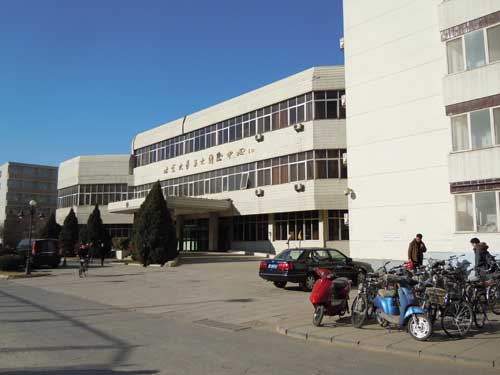
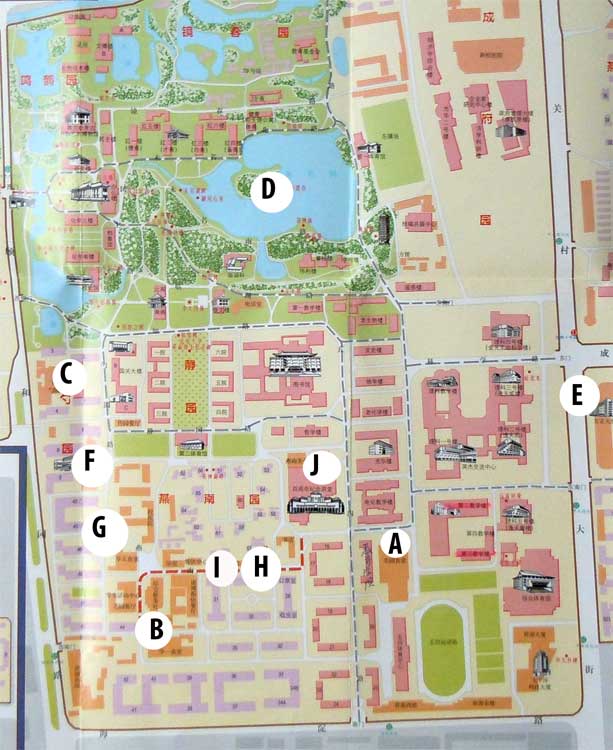
  2. Food: there are numerous different food outlets across the campus – for most of which you need a pre-charged card to purchase meals.  The largest, with the widest diversity of food is situated at A on the map below – but it can be noisy, and is definitely not the place for a quiet chat. If you don’t speak much Chinese, there is a self-service counter on the ground floor, and so it is very simple to choose the food one wants, and pay with your charge-card. One of my favourite places to buy delicious take away bing (a combination of a pancake and an omlette) is at B (illustrated).  ‘International-style’ breakfasts are available at C, as part of the Shao Yuan campus hotel complex.
  3. Weiming Lake (D) in the centre-north of the campus is a great place for an evening stroll – or somewhere to walk when one needs to think reflectively away from the office and the oppression of e-mails!  The blossom was really beautiful in spring, but I imagine that the cool of the lake makes it an equally pleasant place to escape in the heat of the summer as well.  Just to the west lies the university museum and art gallery, which are well worth a visit.
  4. There is a subway/metro/underground station just outside the East Gate  – known as East Gate of Peking University (at E on the map).  This is on Line 4 and provides ready access into the centre of the city, and all of the various tourist sites that can be visited.  It is best to buy a transport card (blue in colour), which can then readily be topped up.  Single journeys across the city cost a mere RMB 2, and the card must be swiped across the entrance/exit scanners when entering and leaving.  There are also airport style bag checking devices for scanning all bags being taken into the stations.  The underground system is excellent, safe and easy to use – with station names written in Chinese and English, and clear announcements warning in advance of the next station at which the train is due to arrive.  It takes about an hour to get to the airport by underground (lines 4 and 10 costing RMB 2) and then the airport express (costing RMB 25) – and unless you have a lot of baggage this is the easiest way to get there.
  5. Cash: contrary to what I was told on arrival, the cashpoint/ATM machines on campus do work with foreign cards (at least they did with my Visa Debit card), and so getting cash is simple. I tended to use the ones by H on the map (next to the Post Office)
  6. Accommodation: I was fortunate enough to stay in the university’s Chiatai International Centre (illustrated; part of the Shao Yuan complex at F on the map), which provides perfectly comfortable, clean accommodation, with a refrigerator, shower/bath, kettle and TV (you soon get to enjoy CCTV’s English language broadcast).  The hot water can be a bit hit and miss, but I generally found that it was fine at around 21.38 in the evenings.  The Centre gets very booked up well in advance, so if you plan to stay here do make sure that your hosts get you booked in.  It is by no means a modern 5* hotel, but I have really come to feel that it is home, and the staff are all incredibly kind and helpful.  There is an expensive restaurant and café on the ground floor (remember that in China this is known as the first floor). The one drawback is that not all of the US students staying there have yet acquired their hosts’ respect for other people’s ears!
  7. Internet access is generally good across campus.  The PKU wi-fi system works well (although you do need to get an appropriate username and password from the IT Services Department), and there is Ethernet connectivity at the Chiatai International Centre.  Skype (even video) works fine, and is a great way of keeping in touch with family and friends.
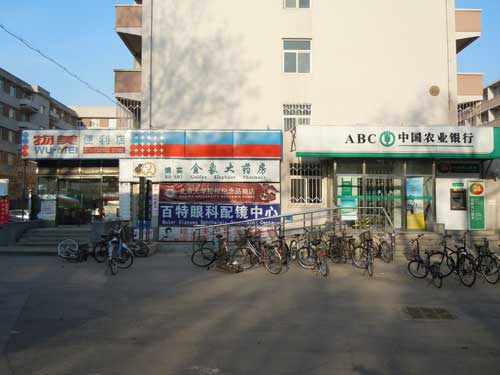
  8. Supermarkets: there are two main supermarkets on campus, with the nearest to Shao Yuan being Wu-Mei (G on map – illustrated; the other, slightly more modern and cleaner looking is at H, which has several cashpoint machines nearby). Although quite small, Wu-Mei provides most things one might want, including: bread, sliced cheese, cashew nuts, dried fruit, yoghurt, water, beer, fruit juice and wine. So, when you cannot manage the same basic sorts of Chinese food for breakfast, lunch and dinner, and just need to have a cheese sandwich or fruit yoghurt for breakfast, this is the place to go. You can also buy the ubiquitous large flasks there for filling with boiling water and using to top up your tea cup throughout the day.  Just at the top of the stairs going down into Wu-Mei there is a small stall selling SIM cards and top-ups, and this is the best place to purchase your mobile connectivity.
  9. ‘Western’ food.  Should you want a relatively quiet and peaceful place to eat, apart from the university canteens, try the Café of Luck (I on map – illustrated), which serves a range of dishes such as steak and rice, salads, and pizzas (and even if you don’t speak fluent Chinese you can always point to the pictures), as well as cold beer – I always opted for the Tsingtao (although when that was not available the Yanjing was also not bad). Hidden away under the Centennial Hall there is also a small café called Paradis (see J on map) where it is possible to find reasonable coffee and capuccino – remember that China is a tea drinking country, and this is about the only place on campus where reasonable coffee is to be found – for that moment, when you are desperate for that wonderful bitter flavour, and the kick to the body’s energy system.
  10. Remember to walk on the right! Traffic in Beijing travels on the right – and this is also true (generally) of pedestrians.  So, when it gets crowded on campus, with thousands of people and hundreds of bicycles rushing to and from lectures, you will find it easier to ‘go with the flow’ if you walk on the right side.  And, do watch out for the silent electric scooters – they travel much more quickly than bicycles, and I am not quite sure why I have seen so few accidents!

Colleagues and students at the campus have gone out of their way to show us immense hospitality.  If ever in doubt, do ask your hosts for advice – be it restaurants, places to visit, the best bus to take to an obscure part of town – anything!  Many will go out of their way to take you where you want to go themselves, despite their busy schedules.  They will also relish the opportunity to practise their English!  Enjoy Beida – it is a great place to teach, think and do research.

3 Comments

Filed under Beer, China, Photographs

Student Spring Trip to the Miyun area

Last weekend (23rd-24th April), I was invited to join students from the Graduate School of Education at Peking University on their spring trip to the area around Miyun, about 100 kilometres to the north-east of Beijing.  It was an amazing experience, and a real opportunity not only to visit places that I would never otherwise have seen, but also a chance to learn more about student life in China.

We began at Chateau Changyu – a winery built to look like a French château, with a hotel complex in the form of a French-style village, replete with church, nearby.  I was amazed by the scale of the enterprise, as well as the rather surreal experience of visiting somewhere that was meant to be like France, but was very definitely not.  The nearest I came to feeling ‘at home’ was touching and smelling the Seguin Moreau barrels in the cellar! The wines were most certainly not cheap, with the most expensive one I could see being priced at around £1000!  They also had a fascinating wine museum that told the history of the company from its roots in the 19th century to the present day.  My favourite moment was when I came across a banner with the English translation “Oak barrel – Tim fragrance of wines”!

After spending a couple of hours walking around the winery and estate, we then headed northwards to the little village of Shitanglu, which describes itself as Beijing’s most beautiful village.  This is a place that is developing rural tourism on a considerable scale, with lots of properties having smart new buildings constructed to host visitors.  Eighty of us were dispersed into a couple of these properties, each of which had a series of rooms surrounding a central courtyard. Kindly, or perhaps because they did not want to suffer my snoring, they felt that I should not share one of the large beds where they were sleeping, and I was given the privilege of having my own room.  After dinner, we walked down to a nearby lake at dusk, and my training as a geographer with an eye for place came in handy as we found our way back beneath the startlit sky to our rooms.  And then the card games and mahjong began!

The next morning we headed off for the Taoyuan Immortals’ Valley, where I was promised a walk.  What a walk it turned out to be!  All in all, we spent about five hours climbing up to the head of a ravine, and then coming back along a ridge and very steep, slippery descent.  Alongside waterfalls, beautiful areas of woodland, steep cliffs etched by ancient rivers, and small lakes, I was amazed to find patches of snow and ice still surviving from the winter.  We had our picnic lunches at the summit, and the views stretched away across the valley and lakes towards range upon range of mountains in the far distance.

It was a really excellent trip, and I’m most grateful to all the students who made me feel so welcome!

This slideshow requires JavaScript.

Leave a comment

Filed under China, Photographs

Your iPhone is being tracked

I wonder how many iPhone users are aware that their movements are automatically being logged in a small, easily accessible application on their ‘phones?  Recent, important work by Alasdair Allen and Pete Warden has shown just how easy it would be for unscrupulous people to access this information.  It also raises worrying questions about why Apple has done this, and why they have not clearly informed users that this information is so readily available?

Allen and Warden have written a neat Open Source application that enables users to visualise this information – down to a very high level of detail in space-time – called iPhoneTracker.  Essentially, Apple stores this information on the ‘phone in terms of latitude, longitude and time stamp.  The database of locations is stored on the iPhone, but is also on any backups that might have been made when synced with iTunes.

As Apple and Warden comment with respect to why Apple has done this, “It’s unclear. One guess might be that they have new features in mind that require a history of your location, but that’s pure speculation. The fact that it’s transferred across devices when you restore or migrate is evidence the data-gathering isn’t accidental.”

They also point to the very serious moral and ethical issues that this raises: “The most immediate problem is that this data is stored in an easily-readable form on your machine. Any other program you run or user with access to your machine can look through it. The more fundamental problem is that Apple are collecting this information at all. Cell-phone providers collect similar data almost inevitably as part of their operations, but it’s kept behind their firewall. It normally requires a court order to gain access to it, whereas this is available to anyone who can get their hands on your phone or computer. By passively logging your location without your permission, Apple have made it possible for anyone from a jealous spouse to a private investigator to get a detailed picture of your movements”.

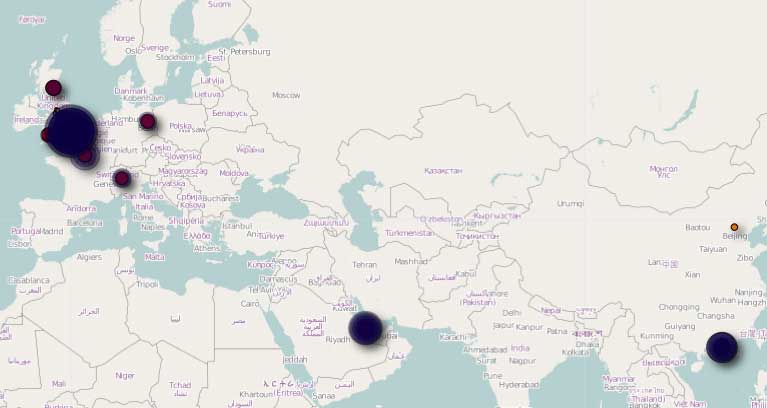
The screen grab from their visualiser shows where I have been using my iPhone in recent months. Perhaps colleagues who have been sceptical about why I have various different ‘phones and different SIM cards will now understand the reason!

We should all be immensely grateful to Alasdair Allen and Pete Warden for bringing this to our attention!

See also Jacqui Cheng’s recent article on this.

3 Comments

Filed under 'phones, Ethics, ICT4D