Earlier in the year at the ACU’s Executive Heads meeting in Hong Kong, I caused real offence to at least one participant when I argued that it made no sense at all for 50% of the UK’s young people to study at university. A damp bank holiday Monday gives me the opportunity to try to clarify my arguments for him – and for any others who might be interested.
First, let me make clear what I did not say. I never said that young people should not receive training after they leave school. I never said that people should be prevented from life-long learning. Far from it. All people should receive opportunities to gain the training that they can benefit from, and this training should be relevant and of high quality. What I do not believe is that such training is best done at universities. My argument is built on four main foundations:
- the role of the university
- the relationship between universities and economic growth
- the abilities and interests of young people in the UK, and
- the need to provide outstanding technical and professional education for all young people who want to gain such skills in the UK.
What should universities be for?
I believe passionately that universities have a central place in any civilised society. Free and independent universities, funded by the state, play a crucial role in shaping the meaning and identity of our societies. They are the places where creativity and innovation happen, where the boundaries of knowledge are constantly moved forward, where questions that were once unthought are now uttered and answered. They are the places where many of our brightest and most articulate scholars and scientists should want to work, and where young people who want to commit themselves to crafting new knowledges should indeed be able to learn from them. Universities are places funded by those who believe that it is good to support a group of people – academics – whose role it is to reflect on the society of which they are a part, to understand the reasons why it is not functioning as it might, and ultimately to make that society a better one in which everyone can live richer lives.
Over the last 20 years, though, successive governments have overseen the destruction of such a vision. Increased regulation and control of research has helped to extinguish much innovative thinking, and the flame of learning has been quenched by an increasingly regulated teaching environment. All too often claims that universities are elitist have led to a destruction of excellence, caused by a focus on lowest common denominators. What saddens me hugely is that so many academics have been complicit in this agenda, fearful over their own jobs and the future of the institutions in which they work. Let me make one thing absolutely clear. Universities should not be where large numbers of students are taught to accept and regurgitate accepted truths – be they about the nature of our economy, or about the skills needed to become better managers. Instead, they should be places where those who want to study hard, to grapple with complex and difficult ideas, to dream as yet undreamt dreams, and to change the ways in which we understand the world in which we live, can indeed do so. They are not places where students should necessarily be taught; rather, they are places where ‘students’ have the opportunity to learn from the most brilliant minds in our society. Incidentally, I also think that this process needs time, and that a three year degree is probably about right for ideas to develop and mature to a sufficient level for someone to be worthy of a university degree.
The fundamental problem is that not many people are actually able to do this, and even fewer want to do so. Many students seem simply to want to gain skills that will enable them to get a reasonable job, earn a satisfactory income, and live a comfortable life. The provision of skills training for such a life is something entirely different from gaining the critical stance to knowledge that I believe a university should be all about.
Universities and economic growth
A dangerous myth has grown up in recent years that claims that having large numbers of young people trained in universities is somehow good for economic growth. Building on this myth, Tony Blair’s Labour Party conference statement in 2000 said that he expected 50% of people in the UK to have benefited from higher education by the time they are 30. However, note the blurring of vocabulary, and the fundamentally important difference between ‘universities’ and ‘higher education’. With the end of the distinction in the UK between universities and polytechnics in 1992, all institutions became merged into a general higher education sector and most chose to use the word university to describe themselves. Universities and higher education in the UK became synonymous.
The trouble is that there is actually rather little evidence that having 50% of 30 year olds with a degree is necessarily good for a country’s economic growth. Likewise, despite claims that those with degrees will be able to earn more during their lifetimes than those without, there is likewise very little evidence that having a degree will necessarily mean that all students will gain high paying jobs. As many students graduating this summer are finding out, there simply is not enough graduate employment around for them all to find the sort of jobs that they had been led to believe they should get. As the BBC reported earlier this year, “One in five UK university leavers who entered the labour market failed to find a job last year, as graduate unemployment reached its highest level since 1995, government figures show”.
There is indeed a broad correlation between GDP per capita and the percentage of people in a country who have studied at a university. However, the mere existence of such a correlation does not impute causality. Much more research is needed on the precise trajectories of the relationships between economic growth and participation in universities in different countries. While it is intuitive to think that having a certain number of people trained in universities will indeed contribute to the well being of a country, there is absolutely nothing intuitive about saying that having 50% participation rates will necessarily increase economic growth. Indeed, the evidence would seem to suggest instead that the surplus created by having a higher GDP per capita actually enables more people to go to university. Thus, above a certain level, it is probably GDP per capita that influences university participation rather than the other way round.
Moreover, some of the most thriving economies are actually those that have a clear distinction between technical higher education and traditional universities. In Germany, for example, substantial numbers of young people on leaving school go to a Berufsschule where they combine further academic study with apprenticeships, whilst many others choose to attend Technische Hochschulen where they are trained for specific careers rather than entering more traditional universities. Is it surprising that Germany has much higher levels of technical professional expertise than does the UK?
Abilities and interests of young people in the UK
It is my contention that many students in the UK choose to go to university as a lifestyle choice rather than with any real intent to move the boundaries of knowledge forward. It is the expected thing to do. They have been told that they will earn more if they have a university degree. There are very few jobs available for young people in any case, and so why not spend three years having fun at university? Whether apologists for the health of UK universities like to claim otherwise, this is the harsh reality of UK student choice today. About the only positive thing about the introduction of yet higher fees is that it is is likely to make many students who would be much better off not studying at universities think again about so doing.
In a recent study, the Higher Education Policy Institute ( Figure 8 ) thus notes that some 80,000 university entrants in 2010 had between 1 and 240 UCAS tariff points (240 is equivalent to three Cs at A level). I contend that most students with below 3 Cs at A level have not proven that they have the intellectual apparatus to push the boundaries of knowledge forward, nor do many of them really have the inclination to do so. Of course there are exceptions to this, and we need to ensure that those who are truly able to contribute to and benefit from university, but do poorly at A levels or wish to enter through other routes, can indeed do so. However, my fundamental point is that universities (as defined above) are not the right places for such students to gain post-secondary learning opportunities. We need an alternative solution to give them the skills that they need, and we must stop pretending that universities are the place to do this. For too long there has been an intellectual elitism that suggests somehow that an ‘academic’ degree is better than a ‘technical’ one.
It is therefore scarcely surprising that many students studying at UK universities are not really inspired by their courses, and choose to spend their time doing other things. However, the extent of this is scandalous. There are many estimates for the average number of hours students in UK universities actually spend studying, but most lie within the range of 25-30 hours a week in term time. One of the most reliable and recent surveys, by the Centre of Higher Education Research and Information at the Open University in 2009, thus concludes that “students in the UK spent an average of about 30 hours a week on studying, the least amount of time compared to their counterparts in other European countries”. Interestingly a couple of years ago some of my students did a survey of the amount of time that their peers spent in the bars on campus, and the average came out at about 25 hours a week! Perhaps their friends were exceptional, but I’m not so sure.
I expect students to study a minimum of 40 hours a week, and am seen by many colleagues as expecting too much. Typical comments are “You cannot expect this – they have to spend time earning money to pay for their degrees”, or “But university is about far more than just studying”, or “Your expectations are old fashioned; get with the times”. Sorry, this is simply not acceptable. I have recently returned from an amazing and intellectually stimulating time at Peking University (Beida), and you should see how hard students there work! The university day starts at 08.00 and finishes at 18.00, albeit with two hours ‘off’ for lunch. Most students then spend several hours studying every night. There is a thirst to learn, to explore ideas, to think afresh. This is such a contrast to life on many British campuses. It is hardly surprising that China is the vibrant economy that it is. If we want to compete on a global stage, we need completely to rethink what students should be expected to do at university in the UK.
Providing a valuable technical and professional education
It is not easy to estimate how many students are really interested in pursuing knowledge critically in the sense discussed above. However, to be generous, let me suggest that perhaps 25% of the school leaving population have the aptitude and an interest in so doing. To cater for them we therefore need perhaps half of the universities that we currently have in the UK. If pushed to an extreme, I would say that universities should actually only provide places for about 10% of school leavers!
This means that we need a complete reorganisation of post-secondary education, to provide people with the skills necessary to gain useful employment and contribute to the economic growth beloved of our political and industrial leaders. Because we persist in wanting to maintain our universities, this is a subject that is almost never raised. Somehow, it is believed that universities as they are currently structured will provide the skills necessary to revitalise our economy. What nonsense. Over and over again we hear from industrial leaders how poorly equipped graduates are for the workplace. A recent survey by AP Business Contacts in March 2011 thus reports that employers found graduates lacking in five main areas:
- Lack of business acumen, commercial understanding and preparation for the ‘leap’ from the academic to commercial environment
- Lack of personal and interpersonal skills, including communication, emotional intelligence and organisational skill
- Poor English language skills, ranging from a difficulty in making the transition from academic writing to business writing, to basic inadequacies in grammar and spelling
- Attitudinal issues, including the unrealistic expectations of their role and inflated views of their capability early on
- Specialist skills needed for specific jobs e.g. engineering, computer science
This is indeed a damning indictment, and those in higher education need to wake up and do something about it.
So, instead of universities, I have long believed that we need to introduce a completely new style of institution, perhaps called academies (although this term has been captured by those wishing to create a new kind of secondary institution), that are specifically designed to provide training for, and qualifications in, the skills required to gain the sorts of jobs that those with below 2 BBs at A level can realistically consider applying for. Perhaps such entities could be distributed regionally, with one of each type in eight different regions of the country. Where there are particular regional specialisms, there could be concentrations of relevant ‘academies’. Ideally, these institutions would be set up in partnership with employers, and have embedded within them apprenticeships or placements. Typical of the sorts of institution I have in mind would be academies for multimedia design, for plumbing, for dance, for football, for horticulture, for engineering technicians, for photographers, for metal working production fitters, for line repairers and cable jointers, for chefs… (many of these, of course, fall within the government’s Tier 2 Shortage Occupation List). These courses could be of variable duration, and most would not need to be longer than two years of full time study. They would present a far cheaper solution than universities, and would provide learners with valuable skills in the employment market. Qualifications from these academies should be seen as being far more valuable than literally ‘use-less’ university degrees. However, we still need the universities to serve as our places of critical reflection and innovation. Much of what universities would do would indeed have little practical value – but that is in part what being civilised is all about.
There are probably far too many vested interests in the present system for such a radical scenario to be accepted. Not least, too many Vice Chancellors and academics are overly eager to hold on to their precious elite institutions. Isn’t it ironic that breaking the binary divide between polytechnics and universities was meant to do just that, and to get rid of elitism. How sad that ultimately it has meant that so many of our universities have become so third-rate in terms of global competitiveness, and that they continue to fail our young people in terms of giving them either the vision or the skills to craft a new future that is better than the one we have left them. Let us not be blinded by the debate over how to fund a moribund higher education system that is over-bloated and suffering from gout. Instead, let us grasp this moment, and use it for a radical and visionary transformation of higher education in the interests of the next generation of people whose task it will be to sort out the mess we have left them!

 The Department 30 years ago was so much smaller than today – fewer staff, fewer undergraduates, and fewer postgraduates. It was a world largely without computers. No e-mails! One could think, and write, and teach students who were genuinely interested in learning. It was brilliant!
 I was appointed to teach historical geography – and loved it! I diligently used to write out my lecture notes in full – and read them to my students!! Scarcely something that new lecturers would do now, in a world of PowerPoint! But I did use slides on the old projector. I was very little older than the students were, and they forgave me for my nervousness. I think my enthusiasm must have made up for a lot – medieval taxation documents, field systems, and prehistoric monuments!
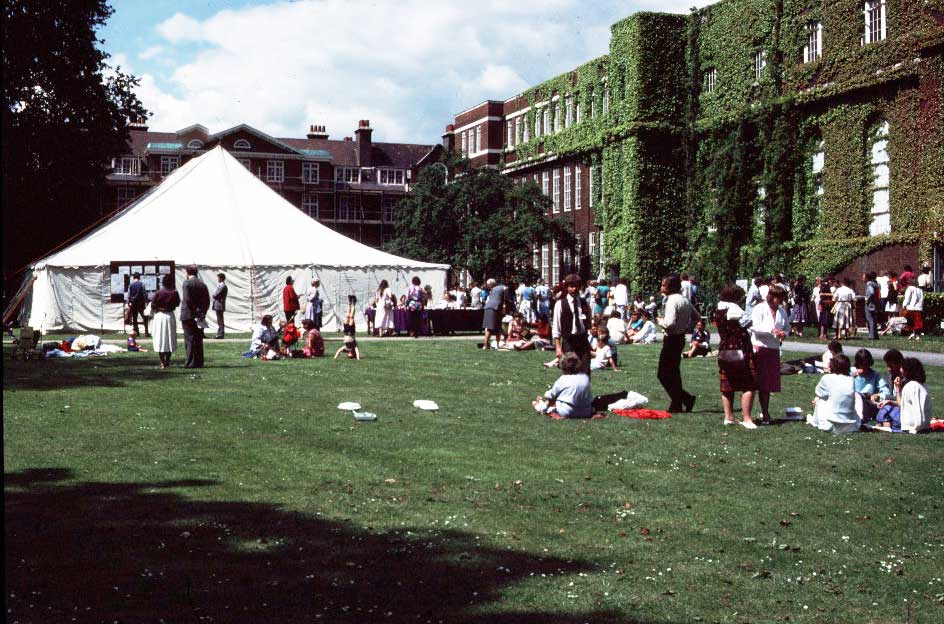 But the early 1980s was the time of mergers across London. I became deeply involved in planning for the merger with King’s, and remember being saddened when it was announced that this had fallen through. Going to Egham did, though, have one advantage in that we did not have to negotiate with another Geography Department already there; we could instead build our own identity from within. On a personal level, we also decided to move from our rented flat in Kennington out to a newly built house in Englefield Green, on the Larksfield estate. I remember this being a huge risk, since I had not been made permanent and we bought before it had definitely been confirmed that the merger would go through.
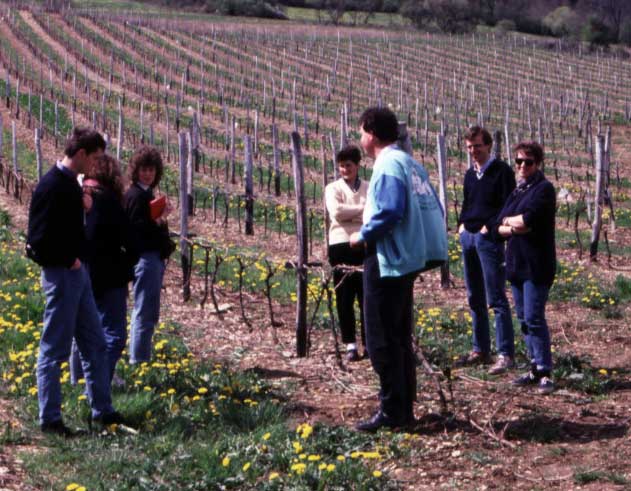 The move meant that we could reorganise our courses, and I recall working with Chris Green and others on a new teaching structure that would mean that our third year courses would become much more research oriented and also applied. This provided the opportunity for me to launch my new course on the historical geography of viticulture and the wine trade. At first, this was rejected by the University Geography board as being far too esoteric – but I resubmitted it again pointing out that if there was a course at SOAS on the geography of oil, surely we could teach about viticulture and wine. After all, the wine trade has been in existence for millennia. This course also provided an opportunity to work more closely with those in the wine trade, and highlights definitely included the wine tastings and the field trips to Burgundy and Champagne. Imagine being allowed today to ‘race’ in minibuses across France from vineyard to vineyard and campsite to campsite. How generous were the winemakers who shared their time and their wines with us!!
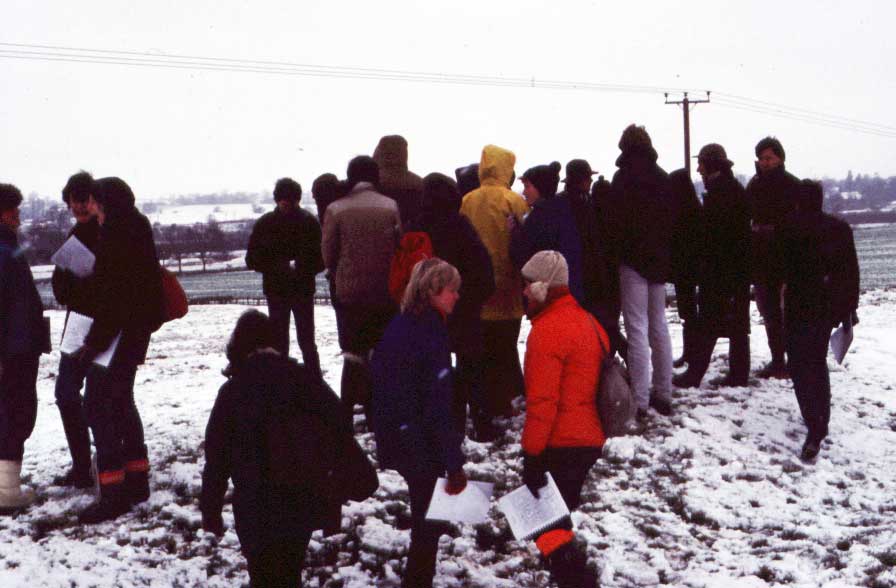 But I recall other field trips too: the day excursions to Northamptonshire and Bedfordshire for my second year students, exploring field systems and deserted medieval villages, more often than not in the snow; and then the second year trip to Portugal, again with generous hospitality from friends in the port wine trade.



 Tim Unwin's Blog