Top Ten Tips for International Visitors to the Peking University (北京大學) campus

When I was planning on visiting Peking University (also know as Beida, an abbreviation for Beijing Daxue the pinyin for Peking University 北京大學) I searched on the Internet for advice and guidance – and found really rather little of help.

So, having been here for five weeks, I thought it might be useful to offer some simple tips for visitors from abroad so that they can start to enjoy themselves as much as I have done:
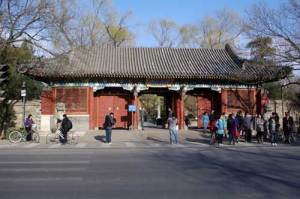
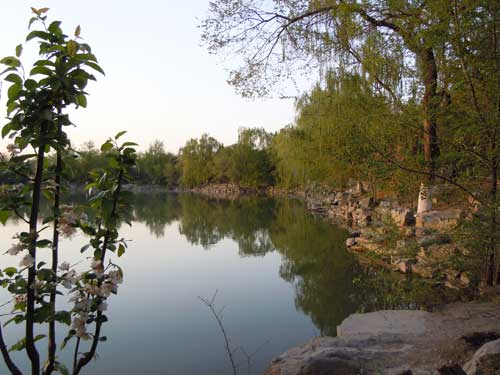
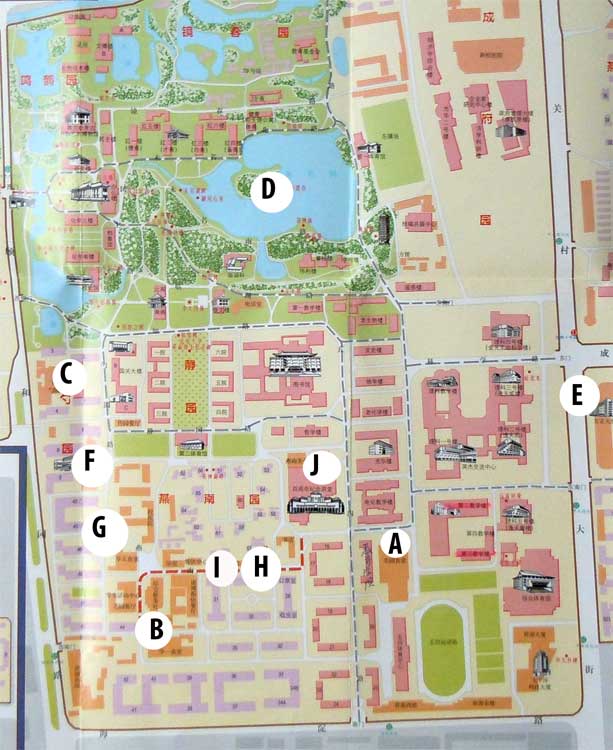
  1. The campus is approximately rectangular with the main gates in the middle of the east, south and west sides.  It is a haven of relative peace and quiet, amidst the noise and bustle of modern Beijing. Note that the pedestrian (northerly – illustrated) and vehicular (southerly) gates on the west side are separate, and there is a further pedestrian gate at the south-west corner.  Remember to take your campus card with you when you go off campus, so that you can get back in past security without any problems!  It takes about 15 minutes walk to cross the campus from west to east.
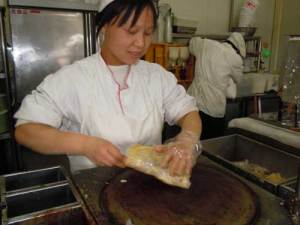
  2. Food: there are numerous different food outlets across the campus – for most of which you need a pre-charged card to purchase meals.  The largest, with the widest diversity of food is situated at A on the map below – but it can be noisy, and is definitely not the place for a quiet chat. If you don’t speak much Chinese, there is a self-service counter on the ground floor, and so it is very simple to choose the food one wants, and pay with your charge-card. One of my favourite places to buy delicious take away bing (a combination of a pancake and an omlette) is at B (illustrated).  ‘International-style’ breakfasts are available at C, as part of the Shao Yuan campus hotel complex.
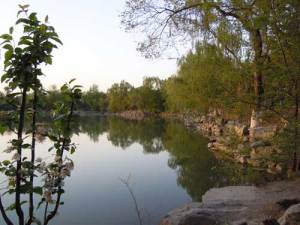
  3. Weiming Lake (D) in the centre-north of the campus is a great place for an evening stroll – or somewhere to walk when one needs to think reflectively away from the office and the oppression of e-mails!  The blossom was really beautiful in spring, but I imagine that the cool of the lake makes it an equally pleasant place to escape in the heat of the summer as well.  Just to the west lies the university museum and art gallery, which are well worth a visit.
  4. There is a subway/metro/underground station just outside the East Gate  – known as East Gate of Peking University (at E on the map).  This is on Line 4 and provides ready access into the centre of the city, and all of the various tourist sites that can be visited.  It is best to buy a transport card (blue in colour), which can then readily be topped up.  Single journeys across the city cost a mere RMB 2, and the card must be swiped across the entrance/exit scanners when entering and leaving.  There are also airport style bag checking devices for scanning all bags being taken into the stations.  The underground system is excellent, safe and easy to use – with station names written in Chinese and English, and clear announcements warning in advance of the next station at which the train is due to arrive.  It takes about an hour to get to the airport by underground (lines 4 and 10 costing RMB 2) and then the airport express (costing RMB 25) – and unless you have a lot of baggage this is the easiest way to get there.
  5. Cash: contrary to what I was told on arrival, the cashpoint/ATM machines on campus do work with foreign cards (at least they did with my Visa Debit card), and so getting cash is simple. I tended to use the ones by H on the map (next to the Post Office)
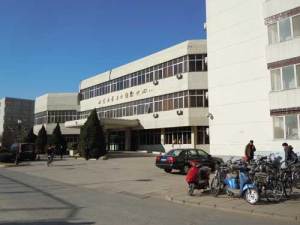
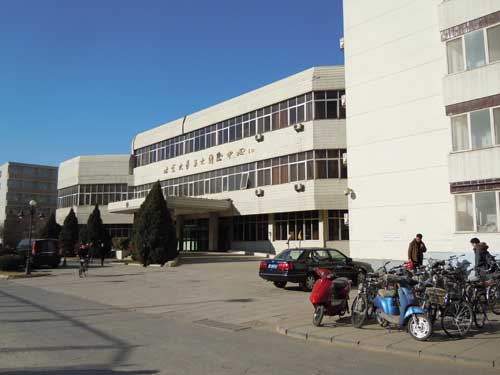
  6. Accommodation: I was fortunate enough to stay in the university’s Chiatai International Centre (illustrated; part of the Shao Yuan complex at F on the map), which provides perfectly comfortable, clean accommodation, with a refrigerator, shower/bath, kettle and TV (you soon get to enjoy CCTV’s English language broadcast).  The hot water can be a bit hit and miss, but I generally found that it was fine at around 21.38 in the evenings.  The Centre gets very booked up well in advance, so if you plan to stay here do make sure that your hosts get you booked in.  It is by no means a modern 5* hotel, but I have really come to feel that it is home, and the staff are all incredibly kind and helpful.  There is an expensive restaurant and café on the ground floor (remember that in China this is known as the first floor). The one drawback is that not all of the US students staying there have yet acquired their hosts’ respect for other people’s ears!
  7. Internet access is generally good across campus.  The PKU wi-fi system works well (although you do need to get an appropriate username and password from the IT Services Department), and there is Ethernet connectivity at the Chiatai International Centre.  Skype (even video) works fine, and is a great way of keeping in touch with family and friends.
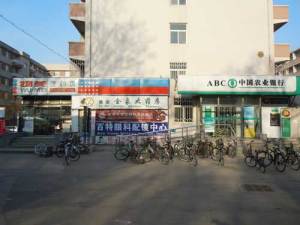
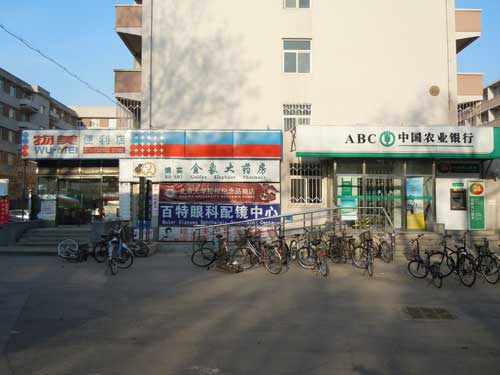
  8. Supermarkets: there are two main supermarkets on campus, with the nearest to Shao Yuan being Wu-Mei (G on map – illustrated; the other, slightly more modern and cleaner looking is at H, which has several cashpoint machines nearby). Although quite small, Wu-Mei provides most things one might want, including: bread, sliced cheese, cashew nuts, dried fruit, yoghurt, water, beer, fruit juice and wine. So, when you cannot manage the same basic sorts of Chinese food for breakfast, lunch and dinner, and just need to have a cheese sandwich or fruit yoghurt for breakfast, this is the place to go. You can also buy the ubiquitous large flasks there for filling with boiling water and using to top up your tea cup throughout the day.  Just at the top of the stairs going down into Wu-Mei there is a small stall selling SIM cards and top-ups, and this is the best place to purchase your mobile connectivity.
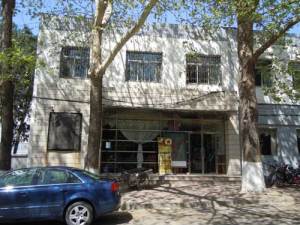
  9. ‘Western’ food.  Should you want a relatively quiet and peaceful place to eat, apart from the university canteens, try the Café of Luck (I on map – illustrated), which serves a range of dishes such as steak and rice, salads, and pizzas (and even if you don’t speak fluent Chinese you can always point to the pictures), as well as cold beer – I always opted for the Tsingtao (although when that was not available the Yanjing was also not bad). Hidden away under the Centennial Hall there is also a small café called Paradis (see J on map) where it is possible to find reasonable coffee and capuccino – remember that China is a tea drinking country, and this is about the only place on campus where reasonable coffee is to be found – for that moment, when you are desperate for that wonderful bitter flavour, and the kick to the body’s energy system.
  10. Remember to walk on the right! Traffic in Beijing travels on the right – and this is also true (generally) of pedestrians.  So, when it gets crowded on campus, with thousands of people and hundreds of bicycles rushing to and from lectures, you will find it easier to ‘go with the flow’ if you walk on the right side.  And, do watch out for the silent electric scooters – they travel much more quickly than bicycles, and I am not quite sure why I have seen so few accidents!

Colleagues and students at the campus have gone out of their way to show us immense hospitality.  If ever in doubt, do ask your hosts for advice – be it restaurants, places to visit, the best bus to take to an obscure part of town – anything!  Many will go out of their way to take you where you want to go themselves, despite their busy schedules.  They will also relish the opportunity to practise their English!  Enjoy Beida – it is a great place to teach, think and do research.
3 Comments

Filed under Beer, China, Photographs

Student Spring Trip to the Miyun area

Last weekend (23rd-24th April), I was invited to join students from the Graduate School of Education at Peking University on their spring trip to the area around Miyun, about 100 kilometres to the north-east of Beijing.  It was an amazing experience, and a real opportunity not only to visit places that I would never otherwise have seen, but also a chance to learn more about student life in China.

We began at Chateau Changyu – a winery built to look like a French château, with a hotel complex in the form of a French-style village, replete with church, nearby.  I was amazed by the scale of the enterprise, as well as the rather surreal experience of visiting somewhere that was meant to be like France, but was very definitely not.  The nearest I came to feeling ‘at home’ was touching and smelling the Seguin Moreau barrels in the cellar! The wines were most certainly not cheap, with the most expensive one I could see being priced at around £1000!  They also had a fascinating wine museum that told the history of the company from its roots in the 19th century to the present day.  My favourite moment was when I came across a banner with the English translation “Oak barrel – Tim fragrance of wines”!

After spending a couple of hours walking around the winery and estate, we then headed northwards to the little village of Shitanglu, which describes itself as Beijing’s most beautiful village.  This is a place that is developing rural tourism on a considerable scale, with lots of properties having smart new buildings constructed to host visitors.  Eighty of us were dispersed into a couple of these properties, each of which had a series of rooms surrounding a central courtyard. Kindly, or perhaps because they did not want to suffer my snoring, they felt that I should not share one of the large beds where they were sleeping, and I was given the privilege of having my own room.  After dinner, we walked down to a nearby lake at dusk, and my training as a geographer with an eye for place came in handy as we found our way back beneath the startlit sky to our rooms.  And then the card games and mahjong began!

The next morning we headed off for the Taoyuan Immortals’ Valley, where I was promised a walk.  What a walk it turned out to be!  All in all, we spent about five hours climbing up to the head of a ravine, and then coming back along a ridge and very steep, slippery descent.  Alongside waterfalls, beautiful areas of woodland, steep cliffs etched by ancient rivers, and small lakes, I was amazed to find patches of snow and ice still surviving from the winter.  We had our picnic lunches at the summit, and the views stretched away across the valley and lakes towards range upon range of mountains in the far distance.

It was a really excellent trip, and I’m most grateful to all the students who made me feel so welcome!

This slideshow requires JavaScript.

Leave a comment

Filed under China, Photographs

Your iPhone is being tracked

I wonder how many iPhone users are aware that their movements are automatically being logged in a small, easily accessible application on their ‘phones?  Recent, important work by Alasdair Allen and Pete Warden has shown just how easy it would be for unscrupulous people to access this information.  It also raises worrying questions about why Apple has done this, and why they have not clearly informed users that this information is so readily available?

Allen and Warden have written a neat Open Source application that enables users to visualise this information – down to a very high level of detail in space-time – called iPhoneTracker.  Essentially, Apple stores this information on the ‘phone in terms of latitude, longitude and time stamp.  The database of locations is stored on the iPhone, but is also on any backups that might have been made when synced with iTunes.

As Apple and Warden comment with respect to why Apple has done this, “It’s unclear. One guess might be that they have new features in mind that require a history of your location, but that’s pure speculation. The fact that it’s transferred across devices when you restore or migrate is evidence the data-gathering isn’t accidental.”

They also point to the very serious moral and ethical issues that this raises: “The most immediate problem is that this data is stored in an easily-readable form on your machine. Any other program you run or user with access to your machine can look through it. The more fundamental problem is that Apple are collecting this information at all. Cell-phone providers collect similar data almost inevitably as part of their operations, but it’s kept behind their firewall. It normally requires a court order to gain access to it, whereas this is available to anyone who can get their hands on your phone or computer. By passively logging your location without your permission, Apple have made it possible for anyone from a jealous spouse to a private investigator to get a detailed picture of your movements”.

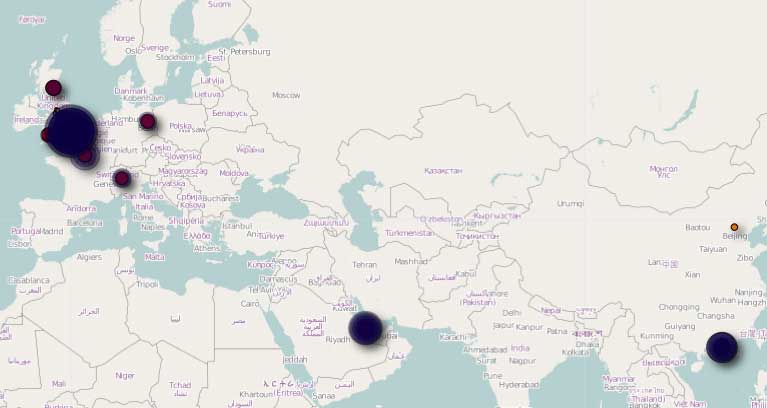
The screen grab from their visualiser shows where I have been using my iPhone in recent months. Perhaps colleagues who have been sceptical about why I have various different ‘phones and different SIM cards will now understand the reason!

We should all be immensely grateful to Alasdair Allen and Pete Warden for bringing this to our attention!

See also Jacqui Cheng’s recent article on this.

3 Comments

Filed under 'phones, Ethics, ICT4D

First impressions of Shenzhen

I flew down from Beijing to Shenzhen today for a 48 hour visit to meet with colleagues at the University.  This evening my good friend Man Xu kindly took me for an exploration of this extraordinary city.  Until 1979 when it became China’s first Special Economic Zone, it was little more than a fishing village just to the north of Hong Kong.  Over the last 30 years, it has come to symbolise China’s energy and dynamism, becoming one of the fastest growing cities of the world.

Thanks to Jack’s suggestion, I took the opportunity to visit the digital rabbit warren that is Huaqiangbei, where you can buy everything, and copies of everything, electronic that you could ever want – apparently except any accessibility related hardware!  Given my interest in disability, we explicitly asked repeatedly whether there were, for example, any Braille keyboards or other assistive technologies, but no-one seemed aware that such things could exist.

And then we visited one of the smart new malls (MIXC), replete with numerous luxury stores rather putting London’s Bond Street to shame! The wealth that has accumulated here in such a short time, fueled by the city’s high-tech industries and banking sector is quite extraordinary.

Oh yes, and why is it that so many models on the advertising hoardings across China are ‘Western’ and blonde?

This slideshow requires JavaScript.

2 Comments

Filed under China, ICT4D

香山公园 A day in the Fragrant Hills

I had to take a break from working and see something of China before I leave in ten days time – and so we headed to the Fragrant Hills to the north-west of Beijing today.  We caught the 696 bus just outside the university – squeezing onto an already overcrowded vehicle – and slowly, slowly made it eventually to the East Gate of Xiangshan after about 90 minutes.  Traveling on the buses is definitely an adventure in itself – and hanging on to the rails as the vehicle stops and starts meant we were exhausted before we arrived!

The gardens were very crowded, and there were many people also walking up to the top!  It took us about an hour to reach the summit, and we ate our sandwiches in a small pagoda just to the north with magnificent views.  On the way back down, though, we managed to find a longer route around the south-western wall which was almost deserted!  The Hills are definitely not somewhere that most European’s find their way to – no-one else from Europe was on the buses, and we only saw one other European all day!

Hopefully the pictures below capture something of the rugged beauty of the Hills.

This slideshow requires JavaScript.

1 Comment

Filed under China, Photographs

圆明园 Yuanmingyuan Old Summer Palace Ruins

After a hectic week at the excellent Association of Commonwealth Universities’ Executive Heads conference in Hong Kong, where I fear that my views on the future of higher education might have been a little too provocative, we arrived back in Beijing on Saturday.  Another glorious day on Sunday tempted us to walk north of the Peking University Campus and explore the vast 350 hectare Yuanmingyuan Park, or Garden of Perfect Splendour.  We managed to escape the crowds, and wandered leisurely around the lakes and ruins of what was once one of the most splendid of all Palaces and Gardens – known in its heyday as the “Garden of Gardens” and the “Versailles of the East”.  The summer resort of the Emperors, it reflected the sumptuosness of the Qing court in the 18th and 19th centuries, but was looted and burned by a British and French force in 1860 during the Opium Wars.  This wanton destruction, albeit in retaliation for the torture and execution of a small group of British and Indian troopers who had been sent to negotiate with the Chinese, is widely criticised as having been barbaric, and an act of vandalism.  Victor Hugo thus described it as ‘Two robbers breaking into a museum, devastating, looting and burning, leaving laughing hand-in-hand with their bags full of treasures; one of the robbers is called France and the other Britain”.  It is now difficult to imagine the scale and beauty of the Palaces and Gardens, but a model gives some indication of their magnificence and extent.  Today, in places where their predecessors were never permitted to set foot, thousands of people now share picnics, enjoy the spring blossom, fly kites and just walk amongst the ruins, reflecting on their past glory and on the changing balances of political power throughout history.  Having the previous weekend visited the New Summer Palace which was built to replace Yuanmingyuan, our visit to the Old Summer Palace gave rise to many complex reflections.

This slideshow requires JavaScript.

Leave a comment

Filed under China, Photographs

Juliano Mer Khamis killed in Jenin

It is with very great sadness that I reflect here on the murder of Juliano Mer Khamis, the Arab Israeli actor and one of the founders of the Freedom Theatre, who was killed on the 4th April in Jenin.  He was shot by a masked gunman who fired five bullets into the window of his car.

The Freedom Theatre has reported this tragic murder as follows: “Murdered the leader, thinker, fighter Juliano Mer-Khamis, Director of The Freedom Theatre, Jenin Refugee Camp, Occupied Terrirtories of the West Bank, Palestine. Today, the 4th of April 2011, at  16:00 o’clock at the entrance of The Freedom Theatre in Jenin Refugee Camp, a traitor’s hand shot and killed the Palestinian thinker Juliano Mer-Khamis who was stopped in his won car while driving along with his baby son and babysitter. Juliano was shot in his head and died in few instants, the remains of the bullet shot the babysitter in her arm. Juliano Mer-Khamis, actor, director, film-maker and cultural activist, son of Arna Mer and Saliba Khamis, was one of the founders of The Freedom Theatre in Jenin Refugee Camp in 2006. All his life Juliano longed to fight against occupation using the arts as a model of social change. The people in the camp refused what happened and called it “a coward’s act”.  The Palestinian Authority are doing an investigation and have contacted the Board of Management of The Freedom Theatre”

The Freedom Theatre was set up in Jenin in 2006 as a drama and community centre.  Juliano’s mother, Arna Mer, had previously worked there as a peace activist.  The theatre has done a considerable amount of work to foster peace, in circumstances that were never easy.  One of its recent projects was an initiative to empower young people in Jenin through the use of ICTs, and I was absolutely delighted to be able to include a short case study on this, written by Jonatan Stanczak, Ziad El-Khatib and Mohammad Moawia, in my recent book on ICT4D.

It is hugely sad to hear of the violent death of someone who worked so tirelessly for peace across cultures, ethnicities and religions.  Although I never had the pleasure of meeting him, my thoughts are with his family and friends.  Let us hope that his death – amongst so many others in Palestine in recent years – will not be in vain, and that others will relight the candle of peace that burnt so brilliantly in his life.

Leave a comment

Filed under ICT4D

颐和园 – Spring at the Summer Palace, Beijing

After the rain on Friday night, the warm sun came out again on Saturday, and we left the PKU campus for a few hours to wander around the monuments and gardens of the Summer Palace.  Just a few stops on the subway north-west from Peking University East Gate station, we arrived at Beigongmen, and explored the numerous buildings, winding paths, and museums at Liheuyan.  Particularly impressive were the Hall of Dispelling Clouds and the Pagoda of Buddhist Virtue, but the replica shops along Sizhou Street, either side of the canal in the north, were also interesting and surprisingly picturesque.  A great deal of restoration work was done in advance of the 2008 Olympic Games in Beijing, and the green, gold, blue and red painting on the buildings was resplendent in the sunlight.  This contrasts greatly with the much less restored buildings of the Garden of Virtue and Harmony.  It made a lovely day out, and a good escape from the tyranny of e-mails!

This slideshow requires JavaScript.

1 Comment

Filed under China, Photographs

Google and privacy

I am often criticised for my concerns over Google’s ethical claims. Most people seem to like the apparently ‘free’ services that the company offers, and are not greatly concerned about the implications of sharing private information with a corporate giant that claims to do no evil.  I was therefore very pleased to see a report yesterday on the the BBC’s news site that Google is to be audited over privacy concerns relating to its social network Buzz.  Highlights of the article noted that:

  • “Google will be subjected to independent privacy audits for the next 20 years over charges that it “violated its own privacy promises”.  The US Federal Trade Commission (FTC) said that the search giant wrongly used information from Google Mail users last year to create its social network Buzz”
  • “When companies make privacy pledges, they need to honour them,” said Jon Leibowitz, chairman of the FTC. “This is a tough settlement that ensures that Google will honour its commitments to consumers and build strong privacy protections into all of its operations.”
  • “Buzz’s launch in February 2010 came under heavy criticism from users. According to Google, the system was designed to bring together members’ personal and private lives. One widespread complaint was over a feature that allowed it to publicly list other Gmail contacts a user was most frequently in touch with. While this feature could be turned off, the default setting was to leave it on – potentially revealing a user’s contact with an ex-spouse, employer or similar.”
  • “The FTC said “deceptive tactics” were used to populate the network with personal data gained from use of Gmail, and that when users were given the change to opt-out of Buzz, they were still enrolled in some of its features”
  • “The FTC said Google violated its privacy policy which stated: “When you sign up for a particular service that requires registration, we ask you to provide personal information.”
  • “Reflecting on the latest settlement, Alma Whitten, Google’s director of privacy, product and engineering, said: “We’d like to apologize again for the mistakes we made with Buzz. “While today’s announcement thankfully put this incident behind us, we are 100 percent focused on ensuring that our new privacy procedures effectively protect the interests of all our users going forward.”

In another recent report from the BBC, it is also interesting to note that the US Department of Justice has approved a New York court ruling that blocked an agreement between Google and publishers over the publication of books online.  As the report noted, “An agreement between Google and publishers over the web firm’s publication of books online has been blocked by a US court. The web giant has scanned millions of books and made them available online via its eBooks platform. Google had negotiated the deal to settle a six-year-old class action suit claiming infringement of copyright. But the New York court said the deal would “simply go too far”, giving Google an unfair competitive advantage”.

Leave a comment

Filed under Ethics, ICT4D

北京大學 – Life on Peking University Campus

I have been here for 10 days – amazing how quickly the time has flown by.  Given how tired I am, though, I guess it has been time very well spent!  Life – both intellectual and quotidian – is intense.  The campus itself is a great place to work, and the buildings and lake on the northern part of the campus are lovely places to walk in the early evenings to relax. It is fascinating being on campus, and very much living surrounded by the students.  Reflecting on my time here so far, the following spring to mind:

  • spring is advancing – blossom buds were just opening on a tree as I walked to work this morning
  • good to see somewhere else that matches my own usual ‘office’ day from 8 in the morning until six in the evening (although they do have a two hour lunch break)!
  • walking across campus to work in the morning, students and bicycles are enthusiastically everywhere- long before their peers would even be awake on the Holloway campus back home!
  • the first thing to be done on getting into the office is to fill one’s hot water carrier (thermos equivalent) from the tank and then make a cup of green tea – which is subsequently refreshed throughout the day
  • the intellectual vitality and curiosity – amongst students and staff – is so refreshing! UK students – at least many with whom I come into contact – have much to learn from the commitment and dedication of their peers here.
  • yesterday’s session with ‘my’ group of Master’s students was on research design – and it was great to explore aspects of Habermas’s work with them, and briefly summarise my critique of grounded theory.  They are so knowledgeable about much existing European social and educational theory!  It’s a real pleasure to work with them – and my concerns that my participatory ‘teaching’ style might not be acceptable were certainly ill-founded.
  • much exciting research is being done at the Graduate School of Education – and I am having really useful (if a bit exhausting) discussions with colleagues about everything from designing online surveys, to the use of mobiles for schools and parents to communicate, to the government’s plans to have interactive whiteboards in every classroom!
  • the IT services are great – thanks to the IT Service@Peking University.  It is brilliant to have wireless access in my office and ethernet in our hotel room.  Mind you, I do wish that I did not have so many e-mails from my other lives that need to be answered!
  • The diversity of places to buy food is overwhelming – there are just so many, and such a diversity of different tastes and textures
  • I even bought a very palatable bottle of Great Wall Cabernet Sauvignon on campus last night for RMB 34 (about £3.50) – the first wine to have passed my lips since arriving!

The photos below give just a flavour of the diversity and intensity of life here.  Thanks to all those who have made Pam and me feel so welcome here at Beida!

This slideshow requires JavaScript.

Leave a comment

Filed under China, Higher Education, Photographs