
An early rise, and then a couple of bus journeys north took us to the Great Wall at Badaling. Without Chen Fei to guide us, we would never have found our way there and back by local transport! However, this definitely added to the adventure. On arrival, we chose to head south-westwards up the Wall, rather than north-east where most of the other visitors seemed to be heading. Even in March, though, the Wall was crowded, as the pictures below illustrate. It is an amazing construction, and it is hard to imagine the scale of the effort that went into its creation! Building the Wall across such inhospitable environments was an extraordinary feat!
故宫 – The Forbidden City
When I first visited Beijing in January 2004, I remember being amazed by the grandeur and beauty of the Forbidden City, experiencing it on a very cold day with almost no-one there. Returning today, in late March, the queues to enter were long, but the Palace somehow swallowed them all up. It had lost nothing of its impressive beauty and splendour. As well as the sheer scale of the buildings and courtyards, much of its beauty lies in the detail of the paintings and carvings. It is the small hidden courtyards of the north-eastern corner where much of its special enchantment can be found. The Forbidden City is by far and away the most impressive building complex I have ever visited.
Filed under China, Photographs
First signs of Spring at Peking University
The blossom has just started opening around Weiming Lake on Peking University’s campus. It’s a beautiful place simply to wander around in the early evening before the sun sets and the temperature drops to around freezing.
Filed under China, Photographs, Universities
Policy Brief on the Development Impact of ICT4D Partnerships
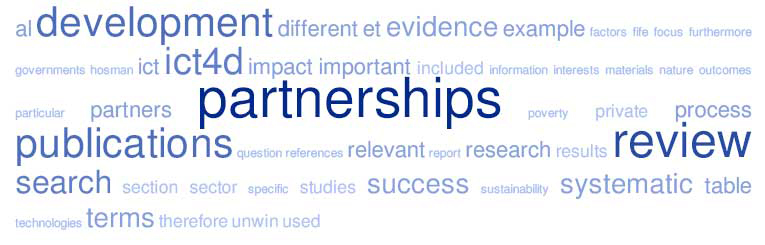 The Policy Brief resulting from the systematic review report by Marije Geldof, David Grimshaw, Dorothea Kleine and Tim Unwin on the development impact of ICT4D partnerships is now avalable from the R4D website (Policy Brief) and the ICT4D Collective website (Policy Brief).
This emphasises five key findings:
- Success is increased when detailed attention is paid to the local context and the involvement of the local community in partnership implementation.
- It is important for such partnerships to have clear and agreed intended development out-comes, even where constituent partners may themselves have different reasons for being involved in the partnership.
- Sustainability and scalability of the intended development intervention need to be built into partnership design at the very beginning.
- Successful partnerships are built on trust, honesty, openness, mutual understanding and respect.
- A supportive wider ICT environment needs to be in place, both in terms of policy and infrastructure, if such partnerships are to flourish and deliver effective development outcomes
Link to Full Systematic Review Report on ICT4D Partnerships (.pdf)
Filed under Development, ICT4D
First impressions of Peking University campus
My first 48 hours at the Graduate School of Education (GSE) in Peking University (PKU) has provided a wealth of contrasting impressions. Above all, though, I am incredibly grateful to the hospitality and friendliness of the staff and students. Without them I would feel incredibly lost! My language skills are improving, but need to do so very much more rapidly!
My main impressions so far:
- The colours are every shade of grey and brown – it is early Spring. The blossom is only just beginning to come into flower, and the deciduous trees have yet to burst into leaf
- The campus itself is like a quiet oasis, amidst the noise and traffic of Beijing – with its West, South and East Gates, it is like a calm village within the city
- Many of the buildings are striking and new – I am delighted to have an office in the splendid new Graduate School of Education; but there are also interesting old buildings, particularly around Courtyards Nos.1-6
- Shops of all kinds, and seven different main restaurants are scattered throughout the southern part of the campus – and one can eat so many different styles of food (there’s even a restaurant serving pizza, although I have not sampled Chinese-Italian food yet)
- Delighted to find a cashpoint machine that takes my bank card – on arrival had been told that it probably would not work!
- Pedestrians and bicycles jostle for space, and silent electric scooters weave their way swiftly between them
- Had real difficulties with my e-mails on arrival, but it turned out to be a problem back at Royal Holloway! No-one told me that work was being done on the servers, and I had to change my settings! Mind you, Twitter and Facebook are blocked…
Tomorrow, I have my first two-hour lecture – am not sure whether the students or I am more nervous – guess I probably am! If only humans (and I in particular) could adapt more swiftly to crossing time zones – I so dislike being 8 hours adrift!
Filed under China, Photographs
ICTD2012 Call for Papers
 The call for papers for the ICTD2012 conference has just been released – full details given below:
CALL FOR PAPERS
Fifth IEEE/ACM International Conference on Information and Communication Technologies and Development, Georgia Institute of Technology, Atlanta GA USA
Conference dates: March 12-16, 2012
Paper submission deadline: July 22, 2011 (11:59pm UTC)
Conference website: http://www.ictd2012.org
Contact us at: program@ictd2012.org
Twitter: @ICTD2012 Facebook: ICTD 2012 Atlanta
ICTD provides an international forum for scholarly researchers exploring the
role of information and communication technologies (ICTs) in social,
political, and economic development. The conference program and accepted
papers will reflect and deepen the multidisciplinary nature of ICTD
research, with anticipated representation from anthropology, computer
science, communication, design, economics, electrical engineering,
geography, information science, political science, public health, sociology,
and so on.
Submitted papers are subject to a rigorous and selective double-blind peer
review; accepted papers will appear in electronic conference proceedings and
will be archived in the ACM and/or IEEE systems. A subset of the papers will
also appear in a special issue of Information Technologies & International
Development.
ICTD2012 is the fifth of an ongoing series of conferences occurring every
one-and-a-half years; previous conferences have taken place in: Berkeley, CA
(USA) ICTD 2006; Bangalore (India) ICTD 2007; Doha (Qatar) ICTD 2009; and London (United Kingdom) 2010.
For the purposes of this conference the term “ICT” comprises electronic
technologies for information processing and communication, as well as
platforms that are built on such technologies. “Development” means
international development, including, but not restricted to, poverty
alleviation, education, agriculture, healthcare, general communication,
gender equality, governance, infrastructure, environment and sustainable
livelihoods. Papers considering novel designs, new technologies, project
assessments, policy analyses, impact studies, theoretical contributions,
social issues around ICT and development, and so forth will be considered.
Well-analyzed negative results from which generalizable conclusions can be
drawn are also sought.
Relevant papers reporting high-quality original research are solicited. Full
papers will be reviewed by a multidisciplinary panel, and evaluated
according to their novel research contribution, methodological soundness,
theoretical framing and reference to related work, quality of analysis, and
quality of writing and presentation. Authors are encouraged (but not
required) to address the diversity of approaches in ICTD research by
providing context, implications, and actionable guidance to researchers and
practitioners beyond the authors’ primary domains.
Only original, unpublished, full research papers in English will be
considered. Submissions not meeting a minimum bar of academic research
writing will be rejected without full review. Papers should contain a
maximum of 8000 words. Reviews are double blind, so papers should not
include author names or other information that would identify the authors
(references to previous work by the authors should be in the third person).
Authors should follow IEEE formats and styles
http://www.ieee.org/documents/stylemanual.pdf. Samples of this are also
available in PDF at http://www.ictd2012.org/ICTD2012_sample.pdf and MS Word
http://www.ictd2012.org/ICTD2012_sample.doc formats. Authors will be
required to sign a copyright release for publication in the conference
proceedings. Additional submission details will be posted on the conference
website at http://www.ictd2012.org, as the information becomes available.
As a new opportunity for 2012, we are offering a peer mentorship program for paper submissions. Submit your paper early (by May 1st, 2011) to this
program and get feedback from peer mentors ahead of the normal submission process and June deadline. See http://www.ictd2012.org/mentorship for details.
Atlanta is a world-class city with a rich and passionate history. Spring
comes early to Atlanta; March is likely to be sunny, crisp, and pleasant.
The conference venue is the Georgia Tech Hotel and Conference Center
(http://www.gatechhotel.com/). Georgia Tech is one of the top research
universities in the United States, distinguished by its commitment to
improving the human condition through advanced science and technology.
The conference website is http://www.ictd2012.org. Follow us on Twitter
@ICTD2012, or visit our Facebook page at “ICTD 2012 Atlanta”.
Contact us at program@ictd2012.org
Important dates:
Peer review mentor program submission deadline: May 1, 2011
Paper submission deadline: July 22, 2011
Acceptance notifications: September 16, 2011
Camera-ready papers due: January 16, 2012
Conference dates: March 12-16, 2012
Program Committee Chairs
Jonathan Donner, Microsoft Research India
Beki Grinter, Georgia Institute of Technology
Gary Marsden, University of Cape Town
General Conference Chairs
Michael Best, Georgia Institute of Technology
Ellen Zegura, Georgia Institute of Technology
Filed under Development, ICT4D, ICT4D conferences, ictd2010
Balancing democracies…
 An invitation to give the opening keynote address (video) at the “Commonwealth, Human Rights and Development” conference held at Cumberland Lodge from 11th-13th March 2011, gave me the opportunity to pull together some of my thoughts over the last couple of years concerning democracy and human rights. In particular, I sought to address:
- the diversity of meanings attributed to democracy;
- the coalescence of interest between the rhetorics of democracy and the free market following the collapse of the Soviet Union;
- the importance of the notion of democracy in the Commonwealth
- the character of democratic institutions; and
- the need to challenge widely taken for granted assumptions about the benefits of democracy and human rights.
In so doing, I drew six main conclusions:
- Notions of democracy and universal human rights should be contested and not accepted automatically as something ‘good’.
- We need to contest many of the claims to legitimacy of democratic states and rulers. In particular, attempts by powerful states to impose democracy on other states, seem to me to be highly hypocritical.
- Instead of seeking to impose democracy on others, those who believe in democratic values would be better advised to help support the development of democratic institutions, especially elected parliaments, the judiciary and political parties
- Discourses on rights should be balanced by ones on responsibilities; a shift of attention to responsibility might well be able to deliver more for the poor and the marginalised
- The communal traditions of Africa may offer interesting insights to counter the negative aspects of the individualism associated with human rights, democracy and capitalism.
- Finally, it seems to me that a practical focus on how we treat others, especially the poor and the marginalised, is of much more importance than claiming that they have universal human rights.
I remain to be convinced that humans do indeed have universal rights.
Filed under Commonwealth, Politics
Expanding range of countries now offering Commonwealth Scholarships
 Thanks to the Commonwealth Scholarship and Fellowship Plan (CSFP) Endowment Fund, Commonwealth scholarships and fellowships are now available in more countries than ever. New awards are available in Kenya, Mauritius, Tanzania, the South Pacific, Nigeria and South Africa.
A CSFP Press Release notes that: “Postgraduate students in Commonwealth countries can apply to study in a range of new destinations from 2011, thanks to a range of international scholarships launched this week. The first set of scholarships, set to start between September 2011 and February 2012, are for Master’s degree study in Kenya, Mauritius, Tanzania, and the South Pacific. A three-month Commonwealth Fellowship for an established academic at the University of Ibadan in Nigeria is also available. In addition, two Commonwealth Scholarships for PhD and postdoctoral study are also currently available at the University of Pretoria, in South Africa. These scholarships have been made available by the Commonwealth Scholarship and Fellowship Plan endowment fund. The fund, established to mark the 50th anniversary of Commonwealth Scholarships in 2009, has now raised over £2 million, through contributions from alumni and Commonwealth governments. According to Fund Secretary Dr John Kirkland, the stated aim of the fund is to broaden the range of destinations in which Commonwealth Scholarships can be held: ‘In the 1960s, there was a sizeable number of international students undertaking postgraduate research at universities in developing countries – particularly in Africa. Now, after a period of decline in the 1980s and 1990s, many of these universities are actively looking to recruit international students again’.”
Filed under Commonwealth
AGFUND Prize for Youth Empowerment Projects
Noted below is the call from the Arab Gulf Programme for Development for the AGFUND Prize 2011 focusing on Empowering Youth through Entrepreneurship and Job Opportunities. This is a very worthwhile initiative, and I would encourage people working in this area to apply.
“FOR UN AND INTERNATIONAL ORGANIZATIONS, NGOS, GOVERNMENTAL AGENCIES AND INDIVIDUALS
AGFUND ANNOUNCES THE OPENING OF NOMINATIONS FOR ITS PRIZE ON
YOUTH EMPOWERMENT PROJECTS
May 31st is the deadline
The Arab Gulf Programme for Development (AGFUND) has opened the door for nominations for the AGFUND International Prize for Pioneering Human Development Projects. It invites the United Nations, international, and regional organizations as well as NGOs, ministries, public institutions, universities, and research centres worldwide to submit their nominations for the Prize amounting to $500 000 in its four Categories. The theme of the prize for the year 2011 is ‘Empowering Youth through Entrepreneurship and Job Opportunities.’ subdivided to match the four categories of the Prize are as follows:
- First Category:The role of international organizations in supporting the developing countries’ national policies and programs for empowering youth through entrepreneurships and job opportunities. (For projects implemented by UN, international or regional organizations)
- Second Category: NGOs-led efforts to empowering youth through entrepreneurships and job opportunities. (For projects implemented by national NGOs).
- Third Category: The governmental bodies’ efforts in adoption of pioneering entrepreneurships for empowering youth and increasing their job opportunities. (For projects by government ministries and public institutions).
- Fourth Category: Individual-led efforts to empowering youth through entrepreneurships and job opportunities. (For projects initiated, sponsored and/or implemented by individuals).
The Communications Department is receiving nominations at the address of the Arab Gulf Programme for Development: Riyadh 11415, P.O. Box 18371, KSA; or the email address prize@agfund.org <mailto:prize@agfund.org> . For more information and for downloading the nomination form, please visit the AGFUND website http://www.agfund.org <http://www.agfund.org/> . Nomination forms will be accepted until May 31st, 2011.
The projects submitted for the Prize are evaluated with high objectivity and transparency by juries chosen every year with regard to the experience and specialization relevant to the Prize theme. The number of projects which have won the Prize since its inception in 1999 amounts to 38 projects, implemented by UN and international organizations as well as NGOs and individuals. More than one hundred developing countries in Asia, Africa, Latin America, and Eastern Europe have benefited from the prize.
The Prize Committee is composed a number of distinguished world personalities representing the world’s geographical regions. The Committee convenes annually to discuss the evaluation results of the nominated projects and to choose the winning projects. Prizes are presented in a ceremony to which representatives of the winning organizations, specialists and experts in the field of development, celebrities interested in development issues, and media representatives are invited.”
Filed under Development, Entrepreneurship
Important new report on the impact of ICT4D partnerships on development
Together with Marije Geldof, David Grimshaw and Dorothea Kleine from the ICT4D Collective, I have just completed a DFID funded systematic review on the development impact of ICT4D partnerships. This is part of the extensive programme of systematic reviews initiated recently by DFID, that draws very largely on the model of such reviews used in the medical sciences. DFID thus emphasises that ‘Systematic reviews have been used in health, education and social policy to meet this need. Systematic reviews are a well-established and rigorous method to map the evidence base in an unbiased way as possible, assess the quality of the evidence and synthesize it. Systematic reviews can then be mediated in specific ways to make it easier for policy makers and practitioners to rapidly understand the body of evidence and use this as a strong foundation on which to base policy and practice decisions’. Undertaking the review was both challenging and interesting, and we not only reached substantive conclusions about the role of ICT4D partnerships, but we also made considerable comments about the difficulties in undertaking rigorously defined systematic reviews on topics such as this.
Based on our review of 53 key publications in the field, we had five main substantive conclusions:
- Success of ICT4D partnerships is increased when detailed attention is paid to the local context and the involvement of the local community in partnership implementation
- It is important for such partnerships to have clear and agreed intended development outcomes, even where constituent partners may themselves have different reasons for being involved in the partnership
- Sustainability and scalability of the intended development intervention need to be built into partnership design at the very beginning
- Successful partnerships are built on trust, honesty, openness, mutual understanding and respect
- A supportive wider ICT environment needs to be in place, both in terms of policy and infrastructure, if such partnerships are to flourish and deliver effective development outcomes
In terms of our recommendations relating to the actual systematic review methodology, we suggest that
- When dealing with multidisciplinary issues such as this, it is crucial to retain some flexibility in search strategies, and procedures such as those often adopted in reviews of health interventions may sacrifice real understanding in the name of overly zealous adherence to claimed rigour
- External reviewers play a crucial role in guaranteeing the quality of such reviews, and they need to be rewarded for their contributions
- Many of the publications that we reviewed lacked a rigorous account of their research methodology, and we recommend that all funders of development related research should insist that researchers carefully document their methods in all of their publications, so that readers can judge the reliability of the findings
- Many publications on ICT4D partnerships do not specify either what they mean by partnerships or the real development outcomes that they were pursuing. It is therefore very difficult to identify the precise impact of partnerships on development. It may well be that interventions that claim to have benefited from partnerships could have been delivered more effectively through other contractual arrangements
Filed under Development, ICT4D


 Tim Unwin's Blog