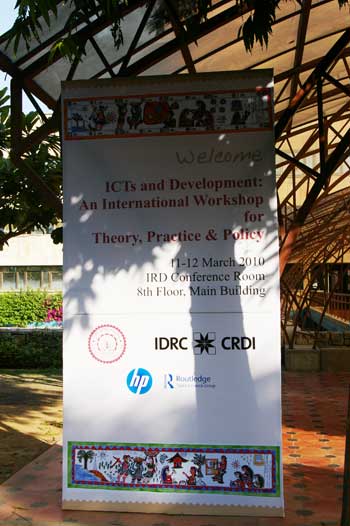
ICTs and Development: workshop at IIT Delhi (Day 1)

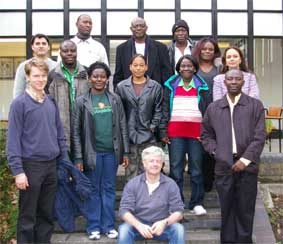
It is good to be back in Delhi – and to have an opportunity to reflect on the use of ICTs in development practice with colleagues from across the world.  Thanks to Vigneswara Ilavarasan and Mark Levy for bringing us all together at IIT Delhi.

Following introductions from Prof Amrit Srinivasan (Head of the Department of Humanities and Social Sciences, IIT Delhi), Prof. Balakrishnan (Deputy Director, IIT Delhi) and Phet Sayo (Senior Program Officer, IIT Delhi), we got underway with the real business.  Below are some of my reflections on some of the presentations:

Rohan Samarajiva (Chair and CEI Lirneasia, Sri Lanka) Invited Lead Talk 1

  • Highlighted the key importance of bringing mobile prices down which led to expanded usage
  • Competition played an important part in this – he argues that this will actually lead to greater use by the poor
  • Implications for broadband and internet connectivity – will this follow the same path as with mobiles?
  • Policy implications: role of regulation (must deregulate); need to bring prices down; need for ‘fat pipes’ (international broadband connectivity); problems associated with rent seeking; need to go gentle on quality of service regulation (he commented that “I am a lapdog of the capitalists, but I prefer to work for the bottom of the pyramid”); in the end, customers pay taxes that governments impose on companies, so we need to phase out universal-service levies (companies show they do not need to be persuaded to work in rural areas).
  • Competition will find its level – he is a strong believer that the market will provide the right solutions.  My experience does not confirm this – I do not accept that the market will indeed serve the interests of the poorest and most marginalised.
ICTs AND SMEs
Vigneswara Ilavarasan (IIT Delhi) and Mark Levy (Michigan State University) ICTs and micro-enterprises
  • Used a probability sampling strategy of small/micro enterprises in Mumbai
  • Fundamental conclusion was that there is a mis-match between the rhetoric and reality of ICT-use for business purposes
  • Mobile phones are used for contacting employees and some business contacts, but they are used much more for social purposes with family and friends
  • Fewer enterprises have computers than mobile ‘phones, but those who have computers do use them more extensively for business purposes (using them for stock inventories, employee records, and tracking business processes)
Khalid Rabayah (Arab American University, Palestine) ICT use among Palestinian enterprises
  • Survey of just under 3000 Palestinian enterprises
  • Most business owners do not see much use for computers or Internet for their enterprises
  • Those who do use the Internet primarily use it for e-mail and searching for information; main reason for using Internet is to save time
  • They primarily use the communicating aspect of ICTs, and therefore especially use mobile telephony
  • Internet is not used much for business – mainly for cultural reasons; 50% prefer doing business face-to-face
Godfred Kwasi Frempong (Science and Technology Policy Research institute, Ghana) Mobile ‘phones and micro/small enterprises in Ghana

  • Reported the high usage of mobile ‘phones by businesses in Ghana.  Most used voice and only 21% used SMS as a business tool. Key issue why SMS is not used more is because people have to be literate to read a SMS message
  • Missed calls (flashing) are very important – some 65% of enterprises use them as an important business tool
  • Only 1% of the sample  used mobile ‘phone banking (although 13% knew about this)

ICTs AND WOMEN
Shikoh Gitau (University of Cape Town) Job-seekers in Khayelitsha

  • Highlighted the growing importance of mobile Internet
  • Reported on training scheme for a small group of young women in Khayelitsha – main use was to explore ways of accessing the Internet for gaining jobs
  • Other reasons why people were using mobile Internet included gospel music, news and information, Facebook and MXit
  • Knowledge among other people that they knew how to use the Internet raised their social capital

S. Nandini (Working Women’s Forum, India) ICT and women in the informal sector

  • Survey of usage by group of women in the Working Women’s Forum
  • Emphasised that women had an unfilled real need for communication, and mobile ‘phones can indeed now provide this.  Women in the informal sector has facilitated them in juggling multiple roles (social, business, etc.)

ICTs AND AGRICULTURE
Mokbul Morshed Ahmad (Asian Institute of Technology) Mobiles in Kampong Thom, Cambodia

  • Mobile ‘phones are mainly used for social purposes, but farmers can save some costs in terms of time spent travelling; that having been said, they need to find the means to pay for them
  • Traders generally use ‘phones more than the farmers

Surabhi Mittal (Indian Council for Research on International Economic Relations) Mobile ‘phones as a catalyst for agricultural growth in India

  • Mobile ‘phones can help linkage between agricultural extension services and farmers, and this can improve farm profitability
  • Farmers subscribe to customised services – mainly seeking information on weather, market prices, inputs, government services…
  • Knowledge of better input prices and information do indeed enable higher productivity and thus enhanced farm profitability going up between 5 and 25%
3 Comments

Filed under ICT4D

Dumbing down in UK higher education – what’s new?

Three Appeal Court judges ruled on 24th February that Paul Buckland, a professor at Bournemouth University, who resigned in 2007 in a row over the alleged dumbing down of degrees, was treated unfairly.  In essence, Professor Buckland had given fail marks to a number of students, whose papers were subsequently remarked and permitted to pass (for a detailed summary of the case, see the University and College Union News). He had complained, and subsequently resigned as a result of the university’s investigatory process.  As UCU general secretary, Sally Hunt, said: “This is an important victory for everyone who values high standards and probity in our universities. Dr Buckland’s defence of academic standards and examination procedures must be congratulated. However, we are deeply concerned about the events that led to this tribunal. Staff need the confidence to be forthright and honest in their comments and assessment of work”.

This is an important and personal case, but what surprises me most about it is that few people or reports seem to have picked up on the fundamental underlying issue, which is that universities across the country have indeed been manipulating the degrees they have been awarding in recent years to give higher marks.  According to the then Department for Children, Schools and Families, between 1994/5 and 2005/6 the percentage of first class and upper second class degrees in HE institutions in the UK increased from 47% of all first degrees awarded to 56%. The latest HESA figures show that this percentage had risen to 62% in 2008/9.

Universities, just like schools, are subject to league tables, and one of the criteria they are frequently  judged by is the percentage of students getting good honours degrees, usually defined as upper seconds and firsts.  Is it therefore surprising that universities have sought means to maximise this figure as they compete in an increasingly competitive market?  Moreover, it is perfectly possible to manipulate the percentages of good degrees gained, even without any changes in the actual rigour of the marking. Typical of such ways are the following:

  • changing the mechanisms for awarding degree grades by, for example, ignoring the worst 20% of marks given
  • discounting the first year exam marks, when students often do worst as they get used to the university system
  • reducing the amount contributed by terminal exams to the overall assessment, and increasing the amount of coursework at which most students usually do better

There is also some evidence that actual marking is becoming more lenient, as universities seek to encourage more diverse expressions and interpretations in response to assignments that are set.  This was the issue that gave rise to the original disagreement at Bournemouth. Attention paid to the quality of written expression has, in many institutions, declined, and it is therefore scarcely surprising that employers regularly complain about the quality of these skills in apparently highly qualified graduates!  The nature of assignments has also in many instances changed to make them easier.  Typical of this is the expectation of what is required for an undergraduate research dissertation.  Years ago, it was expected that students would spend most of the summer vacation between their second and third years undertaking their dissertations – and I indeed still expect a substantial amount of empirical work to be done for a dissertation to gain a good mark.  However, on more than one occasion colleagues have berated me saying that this is completely unreasonable, because students have to gain paid employment over the summer to cover their fees, and that I should therefore be willing to accept what I consider to be paltry amounts of empirical work.

The situation is at least as bad in many Master’s degrees, especially where foreign students are concerned.  Many universities rely heavily on the financial income derived from fees paid by foreign students.  Despite the requirements imposed on such students to have high language scores as tested, for example, by the International English Language Testing System (IELTS), the reality is that many such students do not have sufficient language abilities to perform at a high level in written terminal examinations.  Many Master’s degrees which in the past were assessed by terminal examinations that required a high degree of competency in academic writing in English, are now being assessed purely by course assignments, and even in some cases largely by oral presentations!  As is well know, anyone who can use a word processor with  grammar and spelling checkers can produce a half-competent piece of written work, even when their ability to do so without such support is very much less!  The assessment requirements are less challenging, and therefore the pass rates remain high.  Universities are too desperate for the fees that such students bring in that they cannot be seen to be failing large numbers of them; the assessment system therefore has to change to accommodate the financial realities.

To make matters even worse, this percentage increase in ‘good degrees’ is taking place at a time when many universities have reduced the amount of time academic staff actually spend teaching students so that they are able instead to concentrate on research.  Across the country, class sizes have gone up, there are fewer and fewer personal or group tutorials, and undergraduates have less and less contact with academics!

This is of course not to deny that many students work incredibly hard, and get the good degrees that they deserve.  However, it is to claim that university degrees taken as a whole have seen very considerable dumbing down in recent years.  There is nothing extraordinary or surprising about this.  Universities do have some clever people working for them, and in a competitive market place where they are being judged in part on the number of ‘good degrees’ that they award, some of them are bound to find ways of manipulating the system!  There is nothing new in this.

2 Comments

Filed under Education, Higher Education

ICTs, Citizens and the State – seminar at Michigan State University

Thanks to colleagues in the Telecommunication, Information Studies and Media Department at Michigan State University for their valuable critique of some of my thoughts on the ethical dimensions of e-government initiatives following my seminar there today.  My paper examined the moral implications of the use of ICTs in e-government initiatives, focusing especially on national databases, identity cards and surveillance technologies.  It suggested that in resolving debates over these, we need to reach ethical resolutions concerning notions of trust, privacy and the law.  I also drew attention to the ethical problems that emerge in linking the notion of Universal Human Rights with the introduction of ICTs in developing countries.

In terms of general conclusions, the following seem particularly pertinent:

  1. First, there are indeed many complex ethical aspects associated with e-government, and while to date the emphasis among governments of developing countries, international agencies and donors has very largely been on their positive practical benefits, I suggest that we need to pay much more thorough attention  to their ethical grounding, and especially to the balance of rights and interests between citizens and the state.
  2. Second, in so doing, I suggest that three areas warrant particular attention, namely the ethics of trust, privacy and the law.   It is here that Geuss’s (2008) emphasis on existing real political contexts, rather than the imposition of some external ideal ethical solution, needs to reiterated.  The fundamental point I wish to emphasise is that in each country where e-government initiatives are introduced, people need to ask about the rights and wrongs of such proposals in terms of existing ethical understandings of trust, privacy and the law.
  3. I also sought to raise fundamental questions concerning the continuing validity of much of the human rights based policy and legislation that has dominated global agendas during the last 50 years – particularly in the context of e-government initiatives, and their implication for the rights of individuals and the responsibilities of states.  We need to open up for sensible debate the value of the emphasis placed on human rights, criticism of which is all too often seen as being politically incorrect and a taboo subject. However, if people do not actually have ‘rights’ that they can give up to a state, then we need to reconsider the whole edifice upon which such arguments are built.  An idealistic belief that people have universal rights has not been any protection for those who have suffered at the hands of those who do not believe in such rights.  There is therefore a strong argument that we need to shift the balance away from rights, and towards the responsibilities that people and states have for each other.  For example, rather than simply claiming that knowledge is some kind of human right, it might be a much more positive step to argue that states have a responsibility to enable their citizens to gain knowledge.
  4. Capurro (2007) has argued that ‘Western’ concepts of individual privacy are very different from the ‘African’ emphasis on communal traditions.  It may well therefore be that many of the existing models of e-government developed around European and north America notions of individual privacy are inappropriate in an African or Asian context, and that instead Africans and Asians should instead be designing new such initiatives around their own traditions and cultural practices
  5. Whatever the benefits to states, individuals and communities of e-government initiatives, there is no doubt that global corporations developing the hardware and software for such systems have been very great beneficiaries.  One of the difficult ethical questions that arise from this concerns how we judge whether it is better for poor and marginalised communities for such e-government initiatives to have been introduced, or whether they might actually be more advantaged if their governments did not spend vast sums of money on their implementation.  Just because it is possible to implement national citizen databases, to use biodata for ID cards, and to introduce sophisticated digital surveillance mechanisms does not mean that it is right to do so.

2 Comments

Filed under Africa, Ethics, ICT4D, My Lectures

Peer review – implications of ‘corruption’

Two separate events that occurred at the start of this month have made me reflect once again on the many myths surrounding the ‘hallowed’ peer review process on which so much academic credibility is seen to lie.

First, I received an e-mail from a friend for whom I had written a reference in connection with a grant application that they had submitted to one of the UK’s Research Councils.  They had received the disappointing news that despite two strong references, a third referee had been highly critical of the proposal, casting aspersions on their professional expertise and on the quality of the proposed research.  I was appalled by this.  The research proposal was one of the best I have recently read, and from what the Research Council said of the comments of the ‘third’ referee, they seemed to me to be completely inappropriate.  Either the referee was ignorant of the research field, or they had vested interests in ensuring that this research was not funded.

By coincidence, at about the same time, the BBC picked up on an open letter sent by a group of scientists last July that also criticised the traditional peer review process, but this time with respect to journal articles.  As the BBC Science Correspondent Pallab Ghosh commented, “Stem cell experts say they believe a small group of scientists is effectively vetoing high quality science from publication in journals. In some cases they say it might be done to deliberately stifle research that is in competition with their own”. The 14 scientists had written that “Stem cell biology is highly topical and is attracting great interest not only within the research community but also from politicians, patient groups and the general public. However, the standard of publications in the field is very variable. Papers that are scientifically flawed or comprise only modest technical increments often attract undue profile. At the same time publication of truly original findings may be delayed or rejected”.  To try to overcome this, they proposed that “when a paper is published, the reviews, response to reviews and associated editorial correspondence could be provided as Supplementary Information, while preserving anonymity of the referees”.

Peer review is one of the fundamental principles upon which the edifice of academic reputation – and financial reward – is based.  However, the system is inherently  flawed, and I find it somewhat surprising that it still retains such power.  Six issues warrant particular consideration:

  • First, peer review is based on a belief that ‘science’ is in some way value free; that individual prejudice, political beliefs, or social agendas have no effect on academics’ judgements as to the quality of research.  Whilst many academics do indeed try to reach impartial judgements about the quality of work that they review, they undoubtedly bring biases to such judgements as a result of their own lives and research practices.  Moreover, editors of journals and Research Council panels exercise immense power through their choices of whom to ask to act as referees for papers or grant applications.  Science is not, and never has been, value free.
  • Academic status is in part based upon the number of citations a paper receives.  Academics thus seek to publish in the most prestigious journals that have high citation indexes.  For a very long time, cartels of academics have therefore operated, deliberately citing each other’s works so as mutually to raise their profiles and status. Academics are only human, and it is scarcely surprising that they operate in this way.  There is nothing exceptional about this.  Some of us may not think it right, but it happens.
  • One way that new ideas can begin to find voice is through the creation of new journals.  However, these take time to become established, and when status relies so much on having papers published in the most prestigious journals, it remains very difficult for new approaches and ideas to find widespread expression in this way; rarely do the most eminent academics deliberately choose to publish in new and ‘unimportant’ journals!
  • Those who run the major journals and sit on grant-giving Research Council Boards have immense power, and most do their very best to be fair in the judgements that they reach.  However, by definition, the peer review system is designed more to endorse existing approaches to intellectual enquiry, rather than to encourage innovative research.
  • None of this would matter particularly, and could merely be dismissed as irrelevant academic posturing, if there was not so much money involved.  Academic prestige and income depend fundamentally on success in publications and grant applications.  The UK’s Research Councils thus invest some £2.8 billion annually in support of research, and it is crucial that this is dispersed wisely.  It is therefore extremely sad – albeit typical – that in the case of my friend who had their grant application rejected, there was no right of appeal against the decision.  Panel chairs and editors must have the guts to stand up and recognise when they see flawed decisions being made by referees.  It is thus extremely encouraging to see that some Research Councils, notably EPSRC, are trying to create exciting new ways to support research that do not place excessive emphasis on traditional peer review processes.
  • Finally, there is now a good case for exploring alternative ways of judging research ‘quality’.  ‘Publishing’ papers openly on freely available websites, and then assessing their quality by the number of ‘hits’ that they get would, for example, be a rather more democratic process than that through which a small number of ’eminent’ academics judge their peers.  Of course this would be as open to abuse as existing systems, but at least it would present an alternative viewpoint.

We must debunk the myth that there is something ‘pure’ or ‘objective’ about academic peer review.  It is a social process, just like any other social process.  It has strengths and weaknesses.  For long, it has served the academic community well.  However, as the 14 stem biologists who raised the lid of Pandora’s Box implied, it is a system that fails to encourage the most original research, and instead supports the system that gave rise to it.  After all, that is not so surprising, is it?

5 Comments

Filed under Higher Education

Indian Visa Application Centre, Hayes

PLEASE NOTE THAT THIS POST WAS FIRST WRITTEN IN FEBRUARY 2010 AND SOME OF THE INFORMATION IS NOW OUT OF DATE – from 23rd November 2010 a new online application system was introduced – details are available at http://in.vfsglobal.co.uk/.  However, the information contained below may well still be of interest for those seeking to get to the Hayes office – for which the blog was originally intended!

————————————————————————————————————————

After reading some of the horror stories online about applying for a visa to visit India, I embarked on the process, and thought some tips might be helpful for others – especially about actually getting to the Centre in Hayes!

  • Yes, the online system is a bit clunky – and it crashed on me once without saving what I had done – which was a pain! But by automatically checking for completeness it did save time filling out the forms, perhaps incorrectly, and therefore having to redo them again.
  • Before embarking on completing the forms online, do check you have all the information to hand – down to the level of detail required about the place of both parents’ birth!  Unfortunately, there is not an easy to find guide to completing the visa form available in the drop-down menus!  One solution is to print out a hard-copy form from those available, and then use this as a guide.  The trouble is that not all of the questions asked are unambiguous!
  • The automatic fee charging system did indeed seem to overcharge me – as least compared with the advertised fees for visas! Watch out for this!
  • Make sure that you submit all of the relevant required documents, or have them with you (together with two photographs) when you go to the Centre.
  • For those taking the application form to the Indian Visa Application Centre in Hayes, there are many comments on the Web about how difficult this is to find!  It is actually very simple!  The Centre is accessed on the south side of Uxbridge Road in Hayes, just by the Grand Union Canal.  For those driving from the M4, take the A312 north to its junction with the A4020, and then turn east towards Southall.  Don’t take the first right down Springfield Road, but watch out for the large Currys superstore just before the Fiat car showrooms. That is the best place to park! Walk a short distance (c. 100 yards) towards the canal, and turn right just beyond the Fiat garage. The entrance to the Application Centre is then through some large metal gates  just  after the car park behind the garage. This is just by the A4020 label next to the canal on this map!
  • Once inside, you will receive a numbered ticket, and will then have to wait in the large seated waiting hall.  There are around a dozen service desks, and so the queue moves relatively quickly.  At 08.30 in the morning, I only had to wait about 25 minutes to be ‘processed’.  Opening hours for submission of passports are 08.30-14.30 Monday to Friday; passport pickup (usually withing 2-3 working days) hours are 13.00-16.30 Monday to Friday.

27 Comments

Filed under Higher Education, ICT4D conferences, Politics

University Funding

The Higher Education Council for England (HEFCE) announced today its provisional funding distribution to universities and colleges in England for 2010-11.  The main decisions by the HEFCE Board were as follows:

  • “£4,727 million recurrent funding for teaching. This represents an increase of 0.4 per cent in cash terms or a decrease of 1.6 per cent in real terms, compared with 2009-10.
  • £1,603 million recurrent funding for research. This represents a £32 million or 2 per cent increase in cash terms (maintained in real terms) on the £1,571 million allocated for the 2009-10 academic year.
  • £562 million in capital funding, which represents a 14.9 per cent reduction in cash terms on the 2009-10 allocation.
  • £294 million in special funding for national programmes and initiatives. This represents a 7 per cent reduction in cash terms on 2009-10.
  • £150 million for the Higher Education Innovation Fund (HEIF), which compares with £134 million in 2009-10. This represents an 11.9 per cent increase”.

Responses from the university sector were not surprisingly highly critical.  As the BBC reported,  this represented a cut of £449 million, with teaching budgets being reduced by £215 million, a cut in real terms of 1.6% on 2009-10 levels, research being frozen, and the buildings budget being cut by 15%.  It is estimated that these cuts will lead to a reduction in student places in England of about 6,000 compared with 2009-10 levels.

Such cuts add fuel to the universities’ demands to be allowed to charge students higher fees.  But in an election year, the student vote may delay such apparently inevitable fee increases.  Again, as the BBC notes, “Students campaigning against an increase in tuition fees are targeting MPs who hold seats in a “hit list” of university cities in England. The National Union of Students says MPs must support their campaign against higher fees – or lose the student vote. Among the MPs identified as targets by students are three ministers – John Denham, Ben Bradshaw and Hilary Benn – and the chief whip, Nick Brown”.

While these cuts are in large part driven by the need for the government to reduce the deficit brought about by its efforts to overcome the financial crisis of 2008-9, they do highlight some important questions:

  • Do we already have too many students going to university?
  • What is so special about the notion that it is healthy to have 50% of our young people going to university?
  • Are universities providing appropriate learning opportunities for those who study there?

I live in hope that these cuts might be used sensibly to help provide responses to these questions.  Rather than trying to support an increasingly second-rate university system that fails not only its students and academics, but also the wider society of which we are all part, surely the time has come for a cull of universities?  Should we not close those that are least effective, and turn them into institutions that would provide the technical skills and expertise that our country so badly needs?  Let us stop pretending that half of our population somehow has a right to go to university, and instead use the limited amounts of funding available to support a truly outstanding research and learning culture in institutions that can properly call themselves universities.

For some practical suggestions on how we might achieve this, see my comment on “Solving the crises facing UK universities

1 Comment

Filed under Higher Education

Problems with the Climate Change mantra

“Climate change” has become one of the dominant rhetorics of the early 21st century.  It is “politically correct”, and is widely seen as the major threat facing human society.  The failure of the UN Climate Change Conference held in Copenhagen last year is thus bemoaned as being a tragedy.  Perhaps, though, it gives us an opportunity to reflect on some of the über-hype associated with the notion of “climate change”.  To be sure, the impact of human occupation of the earth, and our associated despoliation of many aspects of the physical world in which we live, should rightly give cause for concern.  Likewise, we should clearly seek to limit the amount of pollution of all sorts that we generate.  However, I believe strongly that much of the debate and argument, particularly in the popular and populist media, is misplaced.  Six issues seem to me to be highly problematic:

  • First, it is absolutely essential that we differentiate between “human induced climate change” and “climate change”.  The latter has occurred long before hominids walked the earth; the former has existed in some form ever since “humans” began making changes to the environments in which they live.  Yes, the amount of human influence has increased enormously over the last two centuries – but that largely reflects the increasing number of people living on the planet.  The important point to note here is that climate has changed very significantly over recent millennia – even without substantial human interference.  The term “climate change” has generally now become all encompassing, so that in the popular imagination all climate change is seen as being human induced – this is highly problematic.
  • Second, in the past, humans have adapted to changes in the climate in many ways.  The glacial and interglacial periods of the Quaternary have been associated with extensive global changes in flora and fauna, and early humans had to migrate in order to survive.  Indeed, for much of history, periods of climate change have been associated with human movement.  Perhaps the fundamental challenge of contemporary climate change (including both human-induced and natural change) is that our political, social and economic systems are not geared up to cater for the mass population movements that have been the human response to climate change in the past.  We are not going to be able to make substantial changes to the physical aspects of climate change in the short term; let us then adapt our “human” systems better to manage the resultant demographic movements that must happen.  We need to be placing even more research emphasis on these social, political and economic processes, and perhaps less on the physical sciences associated with climate change.  If we do not, the potential for violent conflicts, as vast numbers of people seek to leave lands increasingly subject to flooding or desiccation, will be huge.  We need to plan now for very large populations of people to move from one part of the world to another.
  • Third, far too much of the focus of the climate change debate has been about the adverse effects of climate change.  Yes, it is very concerning that our species is having such an impact on the climate – but just as some parts of the world are going to become less inhabitable, others are going to become more hospitable to human occupation.  Far too little research has yet been done on the potential positive impacts of climate change.  Will vast new areas of the globe become available for food production?  Where will be the most desirable place to live in 200 years time?  There are even those who suggest that human induced global warming over the last millennium may actually have prevented (or delayed) the descent into a very much colder climate when ice sheets would once again have covered many cities nearer the poles.  It is an interesting question to ponder whether we would prefer climate warming or climate cooling?
  • Fourth, I have huge concerns about the amount of money that has been directed towards “scientific” research on climate change, at the expense of other equally (if not more) important research.  Climate change scientists have been very successful in gaining the political limelight, and redirecting enormous sums of money to their institutes.  Indeed, it is often said that during the first decade of the 21st century, you more or less had to mention climate change in any scientific grant application, at least in the field of the earth sciences, if you were to have a hope of getting funded!  This distortion of scientific enquiry has been highly damaging to the interests of other aspects of science.  The recent controversies (e-mail leaks in November 2009, “errors” over Himalayan glaciers, “errors” in Amazon data) over the actual basis of some of the “science”, are just one part of this issue – science is not, and never has been, value free.  Those involved in climate change research have a range of very specific interests and agendas that influence their work.
  • Fifth, there have likewise been numerous interests involved in the agendas of gatherings such as the Copenhagen Summit.  Primarily, these have been driven by those who have something to gain from reaching a “global agreement”.  Fundamentally, most people involved in these discussions want to reach a solution that will not lead to a dramatic change in their lifestyles. They want to find new ways of generating “clean” energy, so that they can continue to consume; they want to reap greater profits from carbon trading.  We have to stop living in this fool’s paradise.  If we are really sincere about reducing “adverse” human impact on the globe, we need a fundamental change of lifestyles.  The voices of radical opposition movements to such global summits do need to be listened to.
  • Sixth, quite simple changes to our lifestyles can have a major impact on the amount of energy we use, and thus in the amount of carbon we pump into the atmosphere. Simply constructing buildings with thicker walls and better ventilation systems could dramatically reduce the energy demands of air conditioners and heating systems, but we continue to build energy inefficient constructions across the world.  Wearing warmer clothes in cool climates, recycling much more of our waste, switching off equipment when not in use…  All of these can make a difference.  But most of us are not prepared to do this.  Why?

I wonder, somewhat paradoxically, if our fetish about human induced climate change may not actually reflect a deep desire in people to be “in control” of “nature”.  If we say that we are responsible for “climate change” that implies we have control over it – but as the tragic earthquake in Haiti so clearly demonstrates, “nature” has a nasty habit of reminding us that actually we may not be as all powerful as some of us may like to think.  Ultimately, does it really matter if the human race goes the way of the dinosaurs?  If so, why, and what should we seek to do about it?

7 Comments

Filed under Higher Education, Politics

Learning Management Systems in Africa

Our research paper on Learning Management Systems in Africa resulting from the DelPHE funded collaboration with colleagues in the University of Education, Winneba (Ghana), Maseno University (Kenya), and Eduardo Mondlane University (Mozambique) has just been published as

  • Tim Unwin, with Beate Kleessen, David Hollow, James B. Williams, Leonard Mware Oloo, John Alwala, Inocente Mutimucuio, Feliciana Eduardo and Xavier Muianga (2009) Digital learning management systems in Africa: myths and realities, Open Learning: the Journal of Open and Distance Learning, 25(1), 5-23.

In summary, the paper  reports on a survey of 358 respondents across 25 African countries into their usage of learning management systems. It concludes that while there are some enthusiastic advocates of such systems, the reality is that most African educators as yet have little knowledge about, or interest in, their usage. There remain very considerable infrastructural constraints to be overcome before they can be widely adopted for open and distance learning across the continent, and there is still reluctance in many institutions to develop systems that can enable learning resources to be made available in this way. This does not mean that the potential of high-quality digital learning management systems should be ignored in Africa, but rather that much more sustained work needs to be done in human capacity development and infrastructural provision if African learners are truly to benefit from the interactive learning experiences that such systems can deliver.

Leave a comment

Filed under Africa, Education, Higher Education, ICT4D

ICTD2010 call for papers and sessions

The calls f0r papers and sessions for the major ICTD2010 international conference being held at Royal Holloway, University of London, between 13th and 16th December 2010 have just been released.

The second and third days of ICTD2010 will primarily be for paper and poster presentations, whereas the first and last days will be  for workshops, panels and alternative events which could include open spaces, performances and exhibitions.

The deadline for all proposals and submissions  is 2nd April 2010.

Leave a comment

Filed under ICT4D

Mandelson at the Learning and Technology World Forum

Following Ed Balls and Gordon Brown, Peter Mandelson gave an enthusiastic and committed speech today at the Learning and Technology World Forum held in London at the Queen Elizabeth II Conference Centre.  He argued strongly that the UK Higher Education sector can, and should, play a significant role in helping to expand Britain’s ‘exports’.  Amongst some of the many things he said, were the following:

  • Britain has a very strong higher and further education sector
  • Over the last decade real term funding for research in Britain has doubled
  • There is now a real challenge to develop this resource into one equipped for a digital knowledge economy
  • British higher education needs to pioneer new forms of learning – especially ones that fit around work or distance
  • We need to develop alternatives to the traditional  3 year university degree programmes for students straight out of school
  • We need to build on online and distance based degrees to support people wishing to gain degrees
  • The UK’s higher education sector must diversify and change its models – enabling it to fit into new ways of living to suit the individual ways of students
  • ICTs can make the whole process of learning more efficient – he claimed that efficiencies have saved more than £ 1 billion in HE staff time since 2005 – and this represents a huge area for international collaboration
  • We have to focus on to the fact that what we can do together in collaboration will enable us to get more out of this
  • Britain is a pioneer in online learning
  • He concluded by saying that the key is seeing the digital revolution as an agenda where the benefits of international collaboration are not zero sum

Despite the concerns that I have over much of this agenda (see my previous blogs on Mandelson’s vision for higher education) his comments today provided a clear statement of the government’s commitment to using ICTs innovatively to support alternative forms of higher education.

Leave a comment

Filed under Higher Education