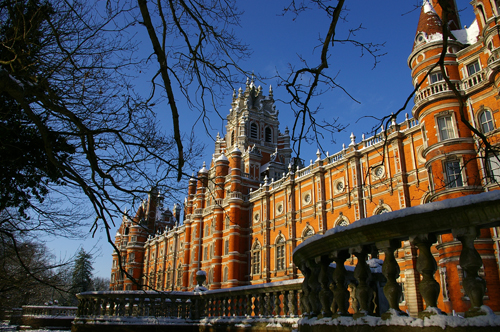
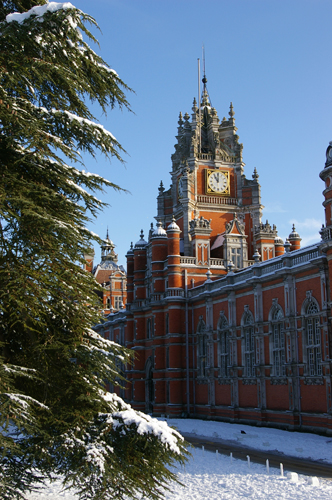
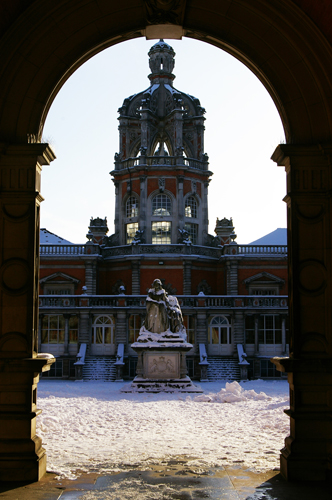
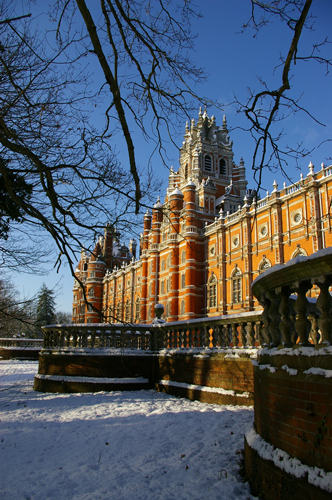
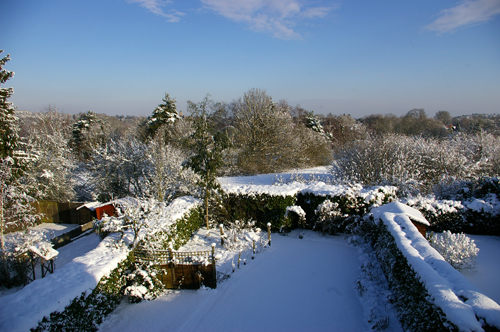
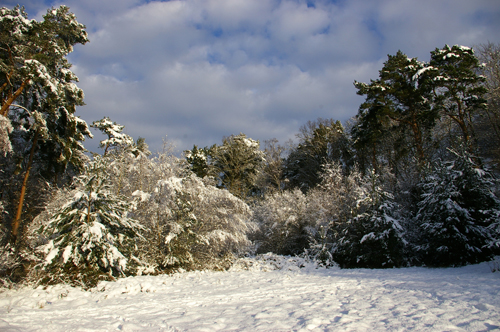
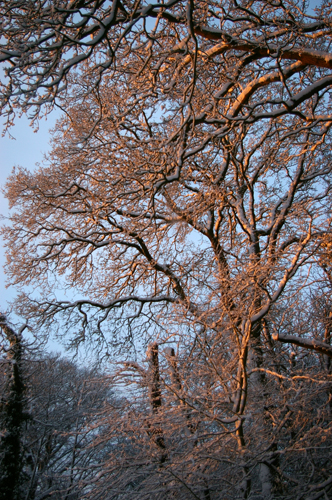
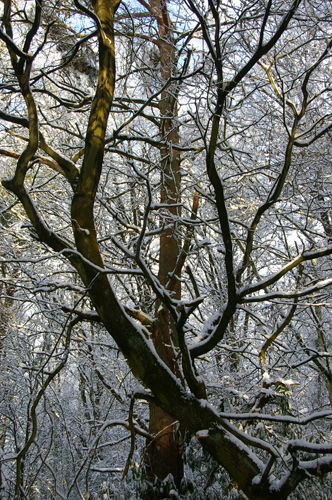
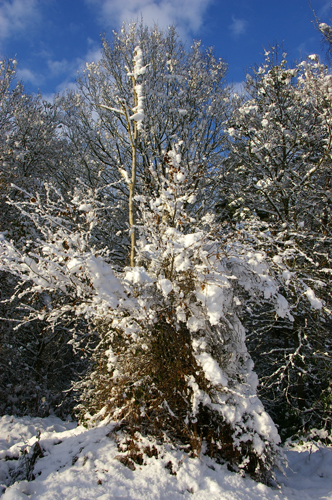
Royal Holloway, University of London in the snow, 9th January 2010

When I first arrived in the mid-1980s at Royal Holloway, University of London, I could not decide whether I actually liked the Founder’s Building, named after the College’s Founder Thomas Holloway.  It was certainly impressive, but it took a long time before its architectural qualities began to influence me for the better – now, after all these years, familiarity has led to friendship! Designed by the architect William Crossland, the Founder’s Building was inspired in part by the Château de Chambord in the Loire.

The unusual amount of snow that fell in the early days of January 2010 shows the building at its very best.  I hope these photographs illustrate why I have indeed come to admire those who conceived and constructed this impressive university building.

Please click on the above thumbnails for larger images

1 Comment

Filed under Higher Education, Photographs

… and then the sun came out, Virginia Water, 7th January 2010

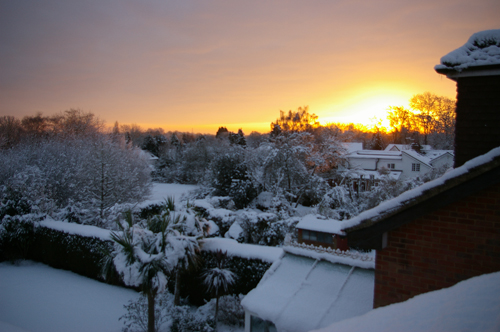
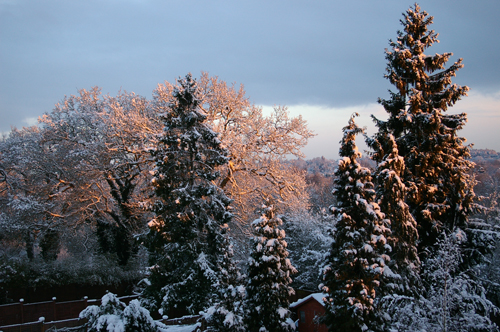
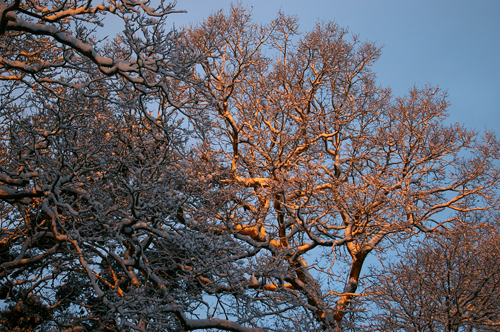
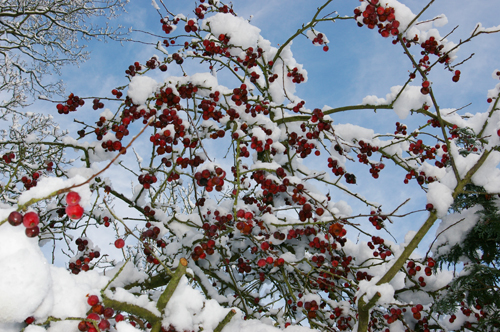
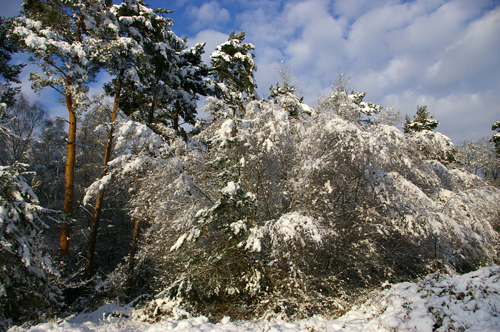
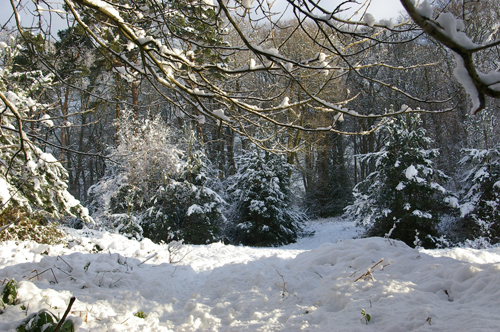
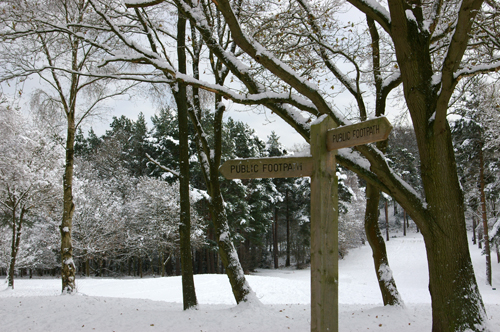
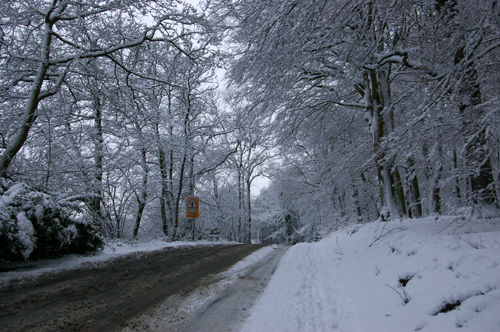
Following yesterday’s immense snowfall and dark skies, we awoke this morning to a gorgeous sunrise and freezing conditions.  Yes, the boiler stopped working again, but what does that matter when the weather takes its part in painting England at its best! Below is a selection of photographs of the scenery in Virginia Water, especially in the woodland surrounding the Wentworth golf course.  Enjoy!

For larger versions, just click on the images.

Leave a comment

Filed under Photographs, Story-telling

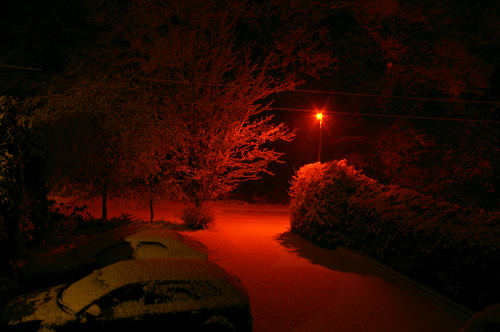
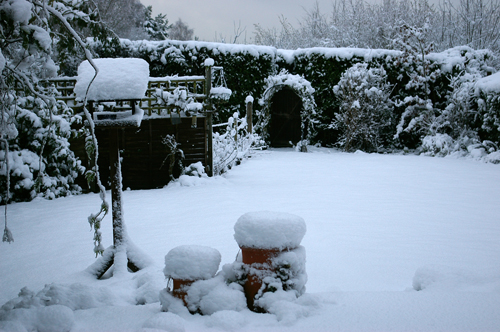
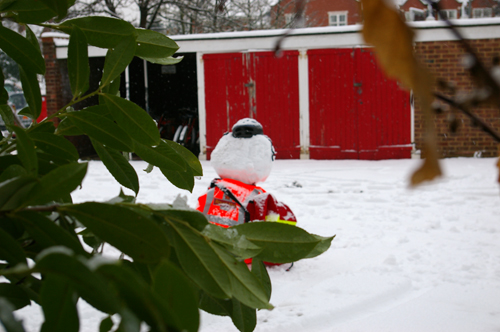
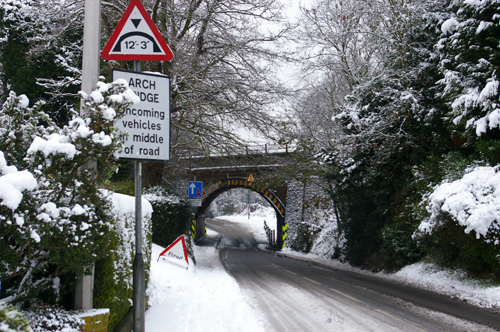
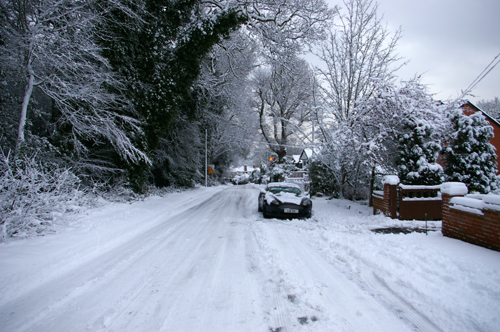
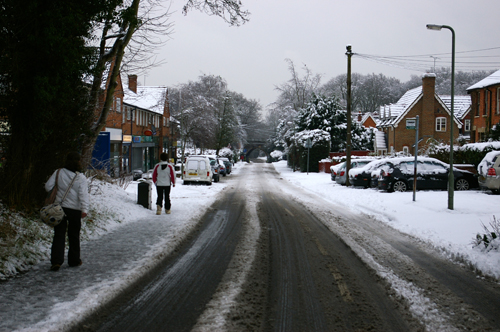
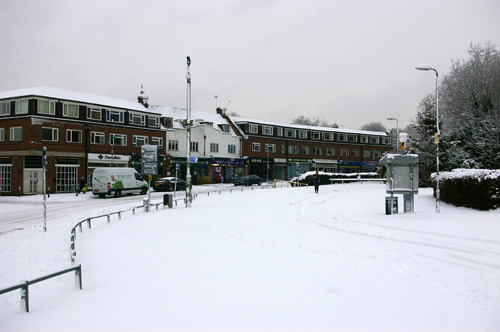
Snow in Virginia Water, 6th January 2010

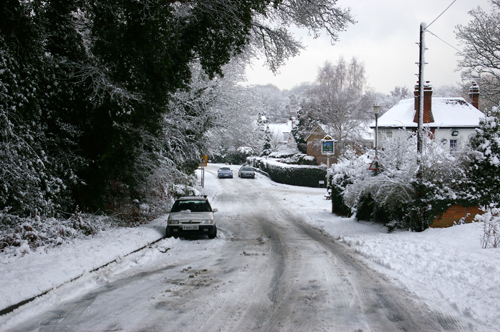
Many parts of the world are deep in snow with temperatures well below freezing – Moscow is predicted to have a maximum temperature of -14o C today.  Our weather in the UK palls in comparison!  However, last night saw some of the heaviest snowfalls in southern England for many a year, which somehow creates a sense of exhilaration. Minor roads across the region have not been cleared, leading to many an ‘incident’ with cars sliding all over the place, and not being able to get up even relatively slight inclines.  Early this morning, attempts to help push drivers stuck on the hill outside our house proved surprisingly futile!  Some young people nevertheless managed to ‘enjoy’ themselves, throwing snowballs at passengers waiting to get on to the few trains that were running!  I know that this amount of snow is unusual, but Surrey County Council has done a really bad job of keeping local roads ice and snow free this winter.  To be sure, the weather has been extreme, and main roads should take priority, but in the last 20 years the local roads in north-west Surrey have never been as dangerous as they have been this year.

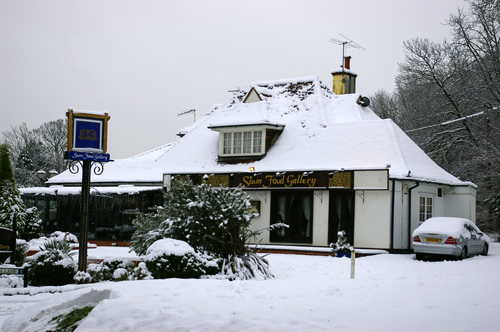
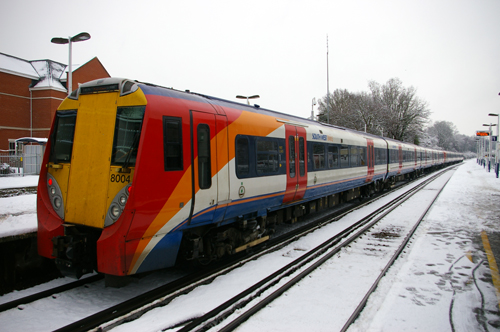
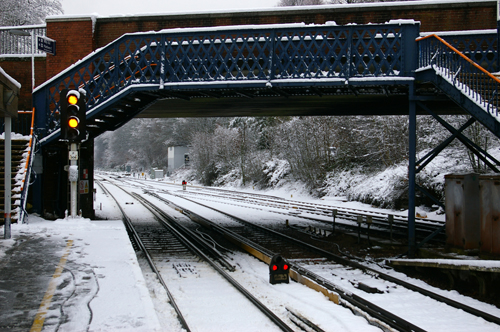
So, please enjoy these images from Virginia Water: snowing last night; at least 6″ of snow in the garden; the postmen had some fun at their depot; local rail bridge, not flooded for a change; Siam restaurant in the snow – a long way from Thailand; well done to South West Trains actually getting some trains to run; Wellington Avenue abandoned cars; the railway line; more abandoned cars; trees in the snow; Trumps Green Road trees; Trumps Green Road shops; and the car park by Station Parade.

1 Comment

Filed under Photographs, Story-telling

Voyager Estate, 1995 Cabernet Sauvignon and Merlot

Rarely do I use my blog to comment on a single wine, but exploring my ‘cellar’ over the Christmas period I came across a Voyager Estate Cabernet Sauvignon and Merlot (1995) that I had bought there when I visited the winery a decade ago in February 1999.  I had fully expected it to be past its best, but far from it, this was a rich, delicious wine that was well worth the wait!

The first surprise was the colour – still a surprisingly deep red, without anything like as much browning as I would have expected from a wine of this age.  The nose was very clean, combining the typical blackcurrant aromas I had expected, but with a very distinctive scent of tobacco – a definite touch of Monte Cristo Cuban cigars!

The taste was smooth and complex, with the fine tannins having mellowed and softened – rich, soft blackcurrant fruit with a touch of cedar.  Excellent depth of flavour – and full of subtle complexity that was difficult to describe.

The label had the following account of the wine: “The 1995 season was long and dry.  The vines carried a small crop, with intensely powerful fruit flavours and fine grained tannins.  The resultant red wines represent the ultimate in Margaret River wines. Intense cassis and concentrated mulberry are beautifully integrated with the toasty characters from 24 months maturation in French oak.  Its intense amount of flavour, complexity and abundance of fine tannin augur extremely well for a long and rewarding life.  While it will be drinking well from 1999 it will be at its sublime best in 12 years time and beyond”. [13.9% alc/vol].

So, if you can find a bottle, it is definitely worth buying – and drinking – although I guess there cannot be many bottles left of this really lovely wine!

1 Comment

Filed under Wine

Iran in 2010

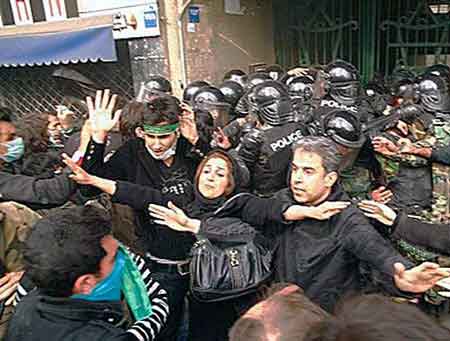
Recent events in Iran have made me think much about my friends there.  The highly respected Grand Ayatollah Hoseyn Ali Montazeri’s death on 19th December led to tens of thousands of people taking part in the procession in Qom that followed his funeral.  On 27th December opposition protests led to the deaths of at least 8 people, including Sayed Ali Mousavi, the nephew of the opposition leader Mir Hossein Mousavi, and today Mousavi  gave his first statement following this personal tragedy.  He sought to outline a five-step resolution to the political instability that has dominated the political scene since the disputed elections in June 2009, in which President Mahmoud Ahmadinejad claimed victory. Mousavi calls for the release of political prisoners, the rights of people to demonstrate, a transparent law for trustworthy elections, and the recognition of press freedoms. The government, though, shows little sign of responding positively or peacefully.

Opposition supporters continue to protest in the face of apparently increasingly violent repression by government forces.  My hope is that this violence can indeed be contained, and that peaceful negotiations may follow. Iran is a country of immense cultural heritage and importance, and it would be good to see its people living peaceful and fulfilled lives once more.

For those wishing to keep up-to-date with current news, the following links may be of interest:

2 Comments

Filed under Politics

Mandelson hammers another nail into the coffin of higher education in the UK

The Secretary of State for Business, Innovation and Skills, Peter Mandelson, hammered another nail into the coffin of UK higher education in his letter of 22nd December to the Chairman of the Higher Education Funding Council for England (HEFCE) confirming the Council’s budget for 2010/11. As has been widely reported (Independent, BBC, Daily Mail, Guardian) this announced that

  • an additional £135 million ‘adjustment’ will be required, over and above the ‘£180 million efficiency savings’ currently being implemented and the £83 million deduction announced in October 2008 (albeit noting that the government has agreed to switch £84 million from universities’ capital baselines so that the teaching gtant reduction can be held to £51 million);
  • ‘adjustments’ will be made to those institutions that have over-recruited, at a rate of £3,700 per full time under-graduate and PGCE student;
  • the net effect on funding will be a reduction in the HEFCE Grant Settlement from £7,809 million in 2009/10 to £7,291 in 2010/11;
  • HEFCE is being encouraged to develop proposals that will ‘provide significant incentives to enhance the economic and social impact of research’; and
  • the government wishes ‘to see more programmes, such as foundation and fast-track degrees, that can be completed full-time in two years’.

I have commented elsewhere in detail on Mandelson’s announcement in November concerning his Department’s new framework for the success (or should this be ‘failure’) of British higher education, but this latest announcement of cuts, alongside the notion of two-year degrees warrants further critique.  Six main points should be noted:

  • These policies are driven by the completely unsubstantiated belief that we need to have 50% of our population going through university.  Why?  No logical argument is given in support of this, and there is no evidence that this would benefit society, our economy or our young people.
  • Simply cutting university funding across the board is insane.  If these cuts are essential, then underperforming institutions should be closed, thereby enabling the fittest and healthiest to survive.
  • Rather than having two-year academic degrees, surely we should close down many universities and turn them into institutes specifically designed to train young people to be excellent in fields other than academic ones.  It is nonsensical to believe that half of our population is able to undertake and benefit from the highest quality academic degrees.  Surely it is better to provide these people with outstanding training in technical and other skills – be they plumbing, football, dance, culinary expertise, art and design, or marketing.  Some of our ‘competitor’ countries, such as Germany have a fine tradition in this arena – why do we not learn from their successes?  Much can indeed be taught and learnt intensively in two years in fields such as these.
  • For academic subjects – and yes, there is still a need to train young people to the highest level of academic excellence – it is important that time is spent exploring literatures, gaining a rich grasp of a subject, developing critical analytical expertise, and reaching the forefront of knowledge in a discipline.  This is not something that can be crammed into two years.
  • University academics are rightly encouraged to do research alongside their teaching – indeed, it is this combination of research and learning that lies at the heart of what a university is, or at least should be, about.  A university is not just a teaching institution.  If students are therefore to be ‘taught’ to the same level of achievement in two years, academics will quite simply not have enough time to do the research to drive their disciplines forward. UK higher education will not just stagnate as it is at present, but will plunge into terminal decline.
  • There are too many vested interests within the system, however, to enable the dramatic changes that I propose to take place.  The net effect will therefore be for student fees to rise higher than already predicted.  These cuts, alongside those announced in the pre-budget report, will lead to a dramatic increase in student fees, which are likely to reach on average around £5,000 a year by 2011, and £7,500 by 2013.  Why is it that so many other countries in Europe are still able to offer ‘free’ higher education to their populations and the UK has decided that it is unable to do so?  Our philistine government persists in seeing higher education as a private rather than a public good.  Before long, English born students will vote increasingly with their feet, and go and study for free in excellent universities oversees where more and more courses are now being taught in English.  What then for the UK’s remaining universities?

3 Comments

Filed under Higher Education

The Trout at Tadpole Bridge

For those seeking a quiet and relaxed, hidden away pub with accommodation, fine food and an excellent wine list, look no further than the Trout at Tadpole Bridge.  Set on the river Thames at Buckland Marsh, just to the east of Faringdon and only 15 miles west of Oxford, this lovely pub is a great place to escape and enjoy fine English dining at its best.  The owners, Helen and Gareth Pugh offer a really warm  welcome, and they are supported by friendly and enthusiastic staff.

The wine list is diverse, interesting and very reasonably priced.  Last weekend, we particularly enjoyed Simon Bize’s delicious Savigny-Les-Beaune, Auz Grands Liards, 2001, which went  especially well with the loin of venison! But alongside some classics from Burgundy (and Bordeaux) there is also a great selection of Italian and New World wines as well.

There are six comfortable rooms, most set around a small courtyard at the back of the pub, and a hearty breakfast is served for all guests – the traditionally cooked poached eggs were excellent!

It is not for nothing that the Trout gained the AA Pub of the Year award for 2009/10!

Leave a comment

Filed under Restaurants

Reflections on Obama’s acceptance speech

In response to my own blog earlier in the day,  I have to admit that Obama’s acceptance speech contains much that is good – I only hope that he is able to live up to these fine words!

It is good to see him acknowledge that there are others far more deserving: “Compared to some of the giants of history who have received this prize — Schweitzer and King; Marshall and Mandela — my accomplishments are slight. And then there are the men and women around the world who have been jailed and beaten in the pursuit of justice; those who toil in humanitarian organizations to relieve suffering; the unrecognized millions whose quiet acts of courage and compassion inspire even the most hardened of cynics.  I cannot argue with those who find these men and women — some known, some obscure to all but those they help — to be far more deserving of this honor than I”.

Likewise, it is good to read his statement that “I do not bring with me today a definitive solution to the problems of war.  What I do know is that meeting these challenges will require the same vision, hard work, and persistence of those men and women who acted so boldly decades ago. And it will require us to think in new ways about the notions of just war and the imperatives of a just peace”.

I cannot, though, agree with his statement that “the United States of America has helped underwrite global security for more than six decades with the blood of our citizens and the strength of our arms. The service and sacrifice of our men and women in uniform has promoted peace and prosperity from Germany to Korea, and enabled democracy to take hold in places like the Balkans”.  He claims that “We have borne this burden not because we seek to impose our will. We have done so out of enlightened self-interest”. I am quite convinced that there are many in the USA who have advocated war specifically because they want to impose their will on the world. The USA as a state has regularly promoted war  – in Iraq, in Vietnam, in Afghanistan, in Grenada…  Many people across the world have suffered explicitly because of US foreign policy – this is indeed self-interest; whether or not it is enlightened is a matter for debate.

Obama’s  agenda is in the interest of a capitalist US economy based on the individual rather than the communal values that so many people elsewhere in the world value so much.  He says, “Only a just peace based upon the inherent rights and dignity of every individual can truly be lasting”. To me, what matters more is how the individual behaves within the context of the communities that they are part of; it is the responsibilities that we have to others that are of more importance than a claim that we have any rights as individuals.

And, please, will he, along with other citizens of the USA, stop claiming that the USA is America. He claims that “America has never fought a war against a democracy, and our closest friends are governments that protect the rights of their citizens”.  This is debatable, but there is a huge difference between one country, the United States of America, and the entire continent, or indeed continents of America.

2 Comments

Filed under Politics

Nobel peace prize today …

Just to note the irony that US President Obama is receiving the Nobel Peace Prize today only a few days after committing to sending 30,000 more US troops to Afghanistan.  If he is as great as so many would have us believe, he should have listened to the advice of others and politely declined what used to be seen as an honour.  I wrote about this at greater length in October, but it still appalls me that the Nobel Committee could have sunk so low.  I used to believe that the Nobel Prize meant something valuable.  It has been hugely tarnished by this serious error of judgement.

1 Comment

Filed under Politics

Pre-Budget report: impact on higher education

The Chancellor’s pre-budget report makes grim reading for higher education.  The key paragraph notes the following savings:

  • “£600 million from higher education and science and research budgets from a combination of changes to student support within existing arrangements; efficiency savings and prioritisation across universities, science and research; some switching of modes of study in higher education; and reductions in budgets that do not support student participation”

This is one of the largest cuts, comparing with “at least £500 million by reducing duplication between organisations and streamlining Arms Length Bodies”, “£300 million by improving energy efficiency across the public sector”, “£350 million of savings from the Department for Children, Schools and Families to be found from central budgets,” or “£140 million from reducing the costs of the senior civil service”.

However, there is no strategic plan for how these cuts will be implemented.  Elsewhere, I have argued that we should indeed close many of Britain’s universities, and replace them with more appropriate institutions, but instead of this it appears that those who will have to pay will be future generations of students, who will now have to fork out even higher fees. Perhaps they will see sense, and realise that this is ridiculous.  They have plenty of other opportunities to gain good quality higher education for free in other European countries!

It is deeply sad that such cuts have been driven by the perceived need to bail out banks and bankers whose profligacy and greed largely caused the near-collapse of the global financial system.  It would, though, be naive to think that taxing bankers in the UK alone will make any difference at all.  Only when the greed of finance capitalism is seen for what it really is at a global scale, and people across the world unite to force the introduction of alternative communal banking systems, may we be able truly to escape from such arrogant selfishness.

1 Comment

Filed under Higher Education