Mandelson hammers another nail into the coffin of higher education in the UK

The Secretary of State for Business, Innovation and Skills, Peter Mandelson, hammered another nail into the coffin of UK higher education in his letter of 22nd December to the Chairman of the Higher Education Funding Council for England (HEFCE) confirming the Council’s budget for 2010/11. As has been widely reported (Independent, BBC, Daily Mail, Guardian) this announced that

  • an additional £135 million ‘adjustment’ will be required, over and above the ‘£180 million efficiency savings’ currently being implemented and the £83 million deduction announced in October 2008 (albeit noting that the government has agreed to switch £84 million from universities’ capital baselines so that the teaching gtant reduction can be held to £51 million);
  • ‘adjustments’ will be made to those institutions that have over-recruited, at a rate of £3,700 per full time under-graduate and PGCE student;
  • the net effect on funding will be a reduction in the HEFCE Grant Settlement from £7,809 million in 2009/10 to £7,291 in 2010/11;
  • HEFCE is being encouraged to develop proposals that will ‘provide significant incentives to enhance the economic and social impact of research’; and
  • the government wishes ‘to see more programmes, such as foundation and fast-track degrees, that can be completed full-time in two years’.

I have commented elsewhere in detail on Mandelson’s announcement in November concerning his Department’s new framework for the success (or should this be ‘failure’) of British higher education, but this latest announcement of cuts, alongside the notion of two-year degrees warrants further critique.  Six main points should be noted:

  • These policies are driven by the completely unsubstantiated belief that we need to have 50% of our population going through university.  Why?  No logical argument is given in support of this, and there is no evidence that this would benefit society, our economy or our young people.
  • Simply cutting university funding across the board is insane.  If these cuts are essential, then underperforming institutions should be closed, thereby enabling the fittest and healthiest to survive.
  • Rather than having two-year academic degrees, surely we should close down many universities and turn them into institutes specifically designed to train young people to be excellent in fields other than academic ones.  It is nonsensical to believe that half of our population is able to undertake and benefit from the highest quality academic degrees.  Surely it is better to provide these people with outstanding training in technical and other skills – be they plumbing, football, dance, culinary expertise, art and design, or marketing.  Some of our ‘competitor’ countries, such as Germany have a fine tradition in this arena – why do we not learn from their successes?  Much can indeed be taught and learnt intensively in two years in fields such as these.
  • For academic subjects – and yes, there is still a need to train young people to the highest level of academic excellence – it is important that time is spent exploring literatures, gaining a rich grasp of a subject, developing critical analytical expertise, and reaching the forefront of knowledge in a discipline.  This is not something that can be crammed into two years.
  • University academics are rightly encouraged to do research alongside their teaching – indeed, it is this combination of research and learning that lies at the heart of what a university is, or at least should be, about.  A university is not just a teaching institution.  If students are therefore to be ‘taught’ to the same level of achievement in two years, academics will quite simply not have enough time to do the research to drive their disciplines forward. UK higher education will not just stagnate as it is at present, but will plunge into terminal decline.
  • There are too many vested interests within the system, however, to enable the dramatic changes that I propose to take place.  The net effect will therefore be for student fees to rise higher than already predicted.  These cuts, alongside those announced in the pre-budget report, will lead to a dramatic increase in student fees, which are likely to reach on average around £5,000 a year by 2011, and £7,500 by 2013.  Why is it that so many other countries in Europe are still able to offer ‘free’ higher education to their populations and the UK has decided that it is unable to do so?  Our philistine government persists in seeing higher education as a private rather than a public good.  Before long, English born students will vote increasingly with their feet, and go and study for free in excellent universities oversees where more and more courses are now being taught in English.  What then for the UK’s remaining universities?

3 Comments

Filed under Higher Education

The Trout at Tadpole Bridge

For those seeking a quiet and relaxed, hidden away pub with accommodation, fine food and an excellent wine list, look no further than the Trout at Tadpole Bridge.  Set on the river Thames at Buckland Marsh, just to the east of Faringdon and only 15 miles west of Oxford, this lovely pub is a great place to escape and enjoy fine English dining at its best.  The owners, Helen and Gareth Pugh offer a really warm  welcome, and they are supported by friendly and enthusiastic staff.

The wine list is diverse, interesting and very reasonably priced.  Last weekend, we particularly enjoyed Simon Bize’s delicious Savigny-Les-Beaune, Auz Grands Liards, 2001, which went  especially well with the loin of venison! But alongside some classics from Burgundy (and Bordeaux) there is also a great selection of Italian and New World wines as well.

There are six comfortable rooms, most set around a small courtyard at the back of the pub, and a hearty breakfast is served for all guests – the traditionally cooked poached eggs were excellent!

It is not for nothing that the Trout gained the AA Pub of the Year award for 2009/10!

Leave a comment

Filed under Restaurants

Reflections on Obama’s acceptance speech

In response to my own blog earlier in the day,  I have to admit that Obama’s acceptance speech contains much that is good – I only hope that he is able to live up to these fine words!

It is good to see him acknowledge that there are others far more deserving: “Compared to some of the giants of history who have received this prize — Schweitzer and King; Marshall and Mandela — my accomplishments are slight. And then there are the men and women around the world who have been jailed and beaten in the pursuit of justice; those who toil in humanitarian organizations to relieve suffering; the unrecognized millions whose quiet acts of courage and compassion inspire even the most hardened of cynics.  I cannot argue with those who find these men and women — some known, some obscure to all but those they help — to be far more deserving of this honor than I”.

Likewise, it is good to read his statement that “I do not bring with me today a definitive solution to the problems of war.  What I do know is that meeting these challenges will require the same vision, hard work, and persistence of those men and women who acted so boldly decades ago. And it will require us to think in new ways about the notions of just war and the imperatives of a just peace”.

I cannot, though, agree with his statement that “the United States of America has helped underwrite global security for more than six decades with the blood of our citizens and the strength of our arms. The service and sacrifice of our men and women in uniform has promoted peace and prosperity from Germany to Korea, and enabled democracy to take hold in places like the Balkans”.  He claims that “We have borne this burden not because we seek to impose our will. We have done so out of enlightened self-interest”. I am quite convinced that there are many in the USA who have advocated war specifically because they want to impose their will on the world. The USA as a state has regularly promoted war  – in Iraq, in Vietnam, in Afghanistan, in Grenada…  Many people across the world have suffered explicitly because of US foreign policy – this is indeed self-interest; whether or not it is enlightened is a matter for debate.

Obama’s  agenda is in the interest of a capitalist US economy based on the individual rather than the communal values that so many people elsewhere in the world value so much.  He says, “Only a just peace based upon the inherent rights and dignity of every individual can truly be lasting”. To me, what matters more is how the individual behaves within the context of the communities that they are part of; it is the responsibilities that we have to others that are of more importance than a claim that we have any rights as individuals.

And, please, will he, along with other citizens of the USA, stop claiming that the USA is America. He claims that “America has never fought a war against a democracy, and our closest friends are governments that protect the rights of their citizens”.  This is debatable, but there is a huge difference between one country, the United States of America, and the entire continent, or indeed continents of America.

2 Comments

Filed under Politics

Nobel peace prize today …

Just to note the irony that US President Obama is receiving the Nobel Peace Prize today only a few days after committing to sending 30,000 more US troops to Afghanistan.  If he is as great as so many would have us believe, he should have listened to the advice of others and politely declined what used to be seen as an honour.  I wrote about this at greater length in October, but it still appalls me that the Nobel Committee could have sunk so low.  I used to believe that the Nobel Prize meant something valuable.  It has been hugely tarnished by this serious error of judgement.

1 Comment

Filed under Politics

Pre-Budget report: impact on higher education

The Chancellor’s pre-budget report makes grim reading for higher education.  The key paragraph notes the following savings:

  • “£600 million from higher education and science and research budgets from a combination of changes to student support within existing arrangements; efficiency savings and prioritisation across universities, science and research; some switching of modes of study in higher education; and reductions in budgets that do not support student participation”

This is one of the largest cuts, comparing with “at least £500 million by reducing duplication between organisations and streamlining Arms Length Bodies”, “£300 million by improving energy efficiency across the public sector”, “£350 million of savings from the Department for Children, Schools and Families to be found from central budgets,” or “£140 million from reducing the costs of the senior civil service”.

However, there is no strategic plan for how these cuts will be implemented.  Elsewhere, I have argued that we should indeed close many of Britain’s universities, and replace them with more appropriate institutions, but instead of this it appears that those who will have to pay will be future generations of students, who will now have to fork out even higher fees. Perhaps they will see sense, and realise that this is ridiculous.  They have plenty of other opportunities to gain good quality higher education for free in other European countries!

It is deeply sad that such cuts have been driven by the perceived need to bail out banks and bankers whose profligacy and greed largely caused the near-collapse of the global financial system.  It would, though, be naive to think that taxing bankers in the UK alone will make any difference at all.  Only when the greed of finance capitalism is seen for what it really is at a global scale, and people across the world unite to force the introduction of alternative communal banking systems, may we be able truly to escape from such arrogant selfishness.

1 Comment

Filed under Higher Education

Report on using technology to help at-risk youth and people with disabilities gain employment

Researchers at the Technology and Social Change Group in the University of Washington in Seattle (Joyojeet Pal, Jay Freistadt, Michele Frix, and Phil Neff) have recently released an important report on the impact of technology training on the employment prospects of at-risk youth and people with disabilities in five countries in Latin America.

The report’s findings are “broadly divided by the themes that emerged in the coded transcripts of our conversations on the ground. Under environmental factors, we discuss issues around the prevalent discourse of technology that underlines the ways in which the various stakeholders imagine the role of computers and technology training within the larger social and economic ecosystems. An important environmental factor is the aspirational environment, for the role it plays in peoples’ willingness to participate in such training programs. Finally, structural issues around the labor market form the third set of environmental factors that are extremely important, given that both populations discussed here have histories of geographical and institutional exclusion from formal employment opportunities”.

It is good to see these important issues examined in detail; ICTs can indeed make a significant difference to the lived experiences of people with disabilities and at-risk youth

2 Comments

Filed under Education

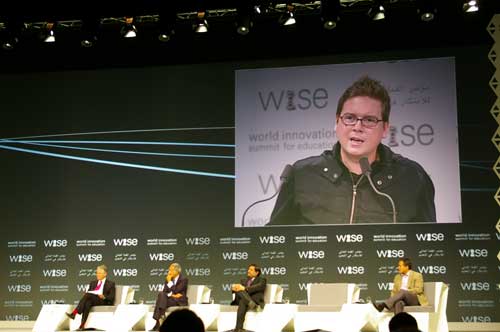
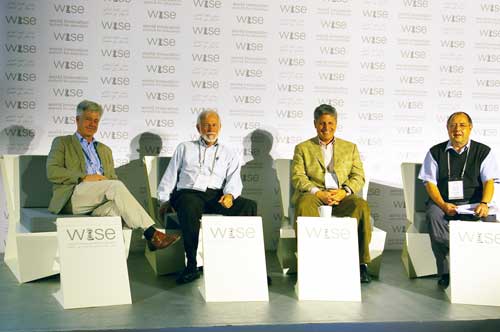
Reflections on WISE – The World Innovation Summit for Education

I do not usually like big conferences and summits.  All too often, people read prepared papers or speeches, and rarely inspire or speak from the heart.  However, the World Innovation Summit for Education held in Doha from 16th-18th November was surprisingly different.  Of course there were some fairly tedious presentations, but the Summit nevertheless did have a buzz about it.  People were talking, really talking, about the importance of education, and what we might be able to do enhance its sustainability, pluralism and innovation across the world.  There were also some really inspirational presentations – both by academics and by politicians!

However, the hosting of the conference  by the Qatar Foundation, bringing together 1000 of the world’s leading educationalists, and giving awards to six  outstanding examples of pluralism, sustainability and innovation in education, raised many interesting questions.  Why has so little yet been done globally to deliver on agreed educational targets? As the 2009 Global Monitoring Report summarised, “Progress towards the EFA goals is being undermined by a failure of governments to tackle persistent inequalities based on income, gender, location, ethnicity, language, disability and other markers for disadvantage”.

Three key inter-related issues come to mind:

  • All too often education is now being treated as a private good – people are being encouraged to pay for education in the expectation that it will bring them advantages in their future lives.  However, if we are to create a fairer, more equitable world, it is essential that education should be treated as a common rather than a private good.  An educated population is an integral factor in helping to ensure good governance, equality of opportunity, peaceful co-existence, and innovative solutions to poverty.
  • One of the reasons why governments across the world continue to provide insufficient funding for education, may be because in recent years they have come to believe that education is no longer a common good, but is instead a private one.  This enables governments to argue that people should pay for education themselves, rather than funding it from the common purse. Increasing fees for higher education in the UK are thus regularly justified by government ministers who argue that a degree brings increased lifetime earning capacity, and that individual students should therefore pay for it.  However, such arguments may also underlie the reticence of many governments across the world to fund education sufficiently.  Even though 23 countries contribute more than 7% of their GDP to public expenditure on education, 35 contribute less than 3%.  We need to work through existing global mechanisms more effectively to help ensure that all states fund education appropriately, so that all peoples can have equal and fair access to quality education.
  • How, though, do we do this?  How can we ensure that the enthusiasm and energy generated at events such as WISE is channeled effectively to initiatives that will actually make a difference?  UNESCO has for long sought to promote the importance of education across the world, but has been beset by too high expectations and too low levels of funding to have been able to make the impact that many of its staff would like to see.  How do we turn the energy that the Qatar Foundation released at WISE into systemic change?

Four more quirky observations from WISE:

  • I did not hear anyone publicly thank the French agency \Auditoire who did all of the organisation of the Summit on behalf of the Qatar Foundation. They were quite outstanding, and much of the success of the Summit was undoubtedly due to the experienced and dedicated team that they had in place.  Well done to all involved!
  • Carla Bruni attended – was I the only one who was left decidedly unimpressed?
  • Fidel Castro is alive and well in Doha – and can occasionally be seen in the Habanos bar in the Ritz Carlton – he did, though, look remarkably young – definitely in his prime!  But, it was nevertheless strange to see him there
  • I always thought that the role of a good master/mistress of ceremonies  was to ensure that everything keeps to time, that the speakers and participants are able to shine, and that they should do so by being almost invisible themselves.  It would appear that Nima Abu-Wardeh had been given a different set of instructions – or perhaps she simply had other ideas!

4 Comments

Filed under Education

Putting a value on the UK’s universities

The latest report on the ‘added value’ of universities in this country undertaken by academics at the University of Strathclyde for Universities UK, has found that “Universities in the UK now generate £59 billion for the UK economy putting the higher education sector ahead of the agricultural, advertising, pharmaceutical and postal industries, according to new figures published today”.

In more detail, Universities UK summarised the report’s findings as follows:

  • “The higher education sector spent some £19.5 billion on goods and services produced in the UK.
  • Through both direct and secondary or multiplier effects this generated over £59 billion of output and over 668,500 full time equivalent jobs throughout the economy. The equivalent figure four years ago was nearly £45 billion (25% increase).
  • The total revenue earned by universities amounted to £23.4 billion (compared with £16.87 billion in 2003/04).
  • Gross export earnings for the higher education sector were estimated to be over £5.3 billion.
  • The personal off-campus expenditure of international students and visitors amounted to £2.3 billion”.

These are generally interpreted as being very positive results; UK Universities contribute significantly to our economy. Indeed, the Guardian newspaper picks up on the report’s findings, noting in particular that “Higher education generates 2.3% of the UK’s gross domestic product, making it ‘one of the most effective sectors,’ said Ursula Kelly, another of the report’s authors. ‘As a producer of goods and services alone, the sector makes an evidentially large contribution to the UK economy of £19.5bn.’ Universities brought in £5.3bn from overseas students, international conferences and work conducted for overseas businesses. They provide the equivalent of 314,600 full-time jobs, or 1.2% of all full-time jobs in the UK. Those visiting universities from abroad and overseas students spent £2.3bn off-campus, the study found”.

But amidst all this economic justification, let us never forget what universities should be about.  Above all universities should be moving the research frontiers forward, developing innovative and creative science and scholarship, and engaging students in the challenge of using this knowledge to make the world a better place.  It would be worth doing this even if universities did not make an economic profit.  Their value is worth immeasurably more than these crude economic indicators might suggest. One hallmark of a civilised society is that it has a university sector that is vibrant, pursues excellence, and challenges taken for granted assumptions.  Access to such universities must remain free for the brightest and most able students.  We are in danger of becoming uncivilised.

2 Comments

Filed under Education, Higher Education

Against Mandelson’s view of higher education in Britain

On the 3rd November, Lord Mandelson announced what his Department of Business, Innovation and Skills described as “a new framework for the future success of higher education”.  Perhaps this could lead to a certain kind of success, but it hammers with renewed vigour another nail into the coffin of universities in the UK.

As his Department stated, key measures set out in the framework, along with my responses, are as follows

  • More competition between universities, giving greater priority to programmes that meet the need for high level skills – Universities are not, and should not be seen as being, merely about high level skill provision.  Obviously this depends on how we define ‘high level skills’, but alongside those needed to make a prosperous economy (look how dismally our bankers have delivered over the last couple of years), are those skills associated with critical reflection and an ability to challenge taken for granted assumptions about the ‘good’ of our contemporary capitalist society.  Competition is also most definitely not the answer.  Universities work best when there is collaboration and cooperation rather than competition.
  • Business to be more engaged in the funding and design of programmes, sponsorship of students, and work placements – yes, it is indeed important that universities work closely with the private sector – after all, they benefit hugely from the investment of the state in delivering the cannon fodder of global capitalism.  However, the suggestion that the private sector should increasingly fund higher education smacks of the government trying to find others to pay for its failed commitment to furnish our society with a fit for purpose university system.
  • Creating more part-time, work-based and foundation degrees to make it easier for adults to go to university, with routes from apprenticeships through to Foundation Degrees and other vocational programmes – universities should not fundamentally be about providing foundation degrees – leave these to other types of institution.  The central purpose of a university should be about pushing the boundaries of knowledge forward, through high quality research and the encouragement of able young people to engage in rigorous scientific and scholarly enquiry.
  • Encouraging universities to consider contextual data in admissions, as one way of ensuring that higher education is available to all young people who have the ability to benefit – this is social engineering.  Yes, of course universities should seek to provide outstanding learning opportunities to those most able to benefit, but the simple mechanisms recommended are simply not sophisticated enough to enable the identification of those who can contribute most to the UK’s universities.
  • Universities setting out clearly what students can expect in terms of the nature and quality of courses offered – yes, and the best already do so!  But please, universities are fundamentally about moving the boundaries of research forward, and encouraging the development of enquiring minds in the most able people rather than passing on existing accepted knowledge.
  • Sustaining our world class research base by continuing to focus on excellence, concentrating research funding where needed to secure critical mass and impact – the highest quality research does not necessarily need to be concentrated.  The  most innovative research is often delivered  by individuals working in isolation – indeed, concentrating research activity based on past success criteria, will actually restrict the development of novel and exciting innovation.  Real innovation usually happens ‘at the edges’.
  • Encouraging collaboration between universities on world class research, especially in high cost science – the rationale for this is that we cannot afford high cost science.  But we cannot afford not to!  Furthermore, not all world class research is expensive.  Indeed, many Nobel prize winners actually do low cost research!

As I have argued elsewhere, universities are about far more than providing a second rate ‘education’ for students not really interested in learning.  We can afford a high quality university sector by reducing the number of universities and the number of students wasting their time pretending to study at them.

Why is it that the UK wants to treat universities as businesses when so many countries in the world still provide free higher education to their people – look for example at Finland and many of the German Länder? Why is it that the government persists in destroying a university system that was once the pride of the world? Perhaps most surprisingly of all, why are students and academics not rising up in revolutionary protest as did our comrades in the late 1960s?

The time has come to stand up and be counted.  We must resist this Philistine, ignorant and damaging attempt to destroy what is left of our universities.

4 Comments

Filed under Higher Education

Google Dashboard

Readers of my Blog will be well aware of my previous criticisms of the company’s ambitions to gather all of the world’s knowledge on its servers, and my concerns over its infringement of traditional ideas about privacy.

It is therefore of considerable interest that Google has just launched Dashboard.  This is intended to provide users of Google services with a summary of all the information that Google currently lets users know that it stores about them.  This is what Google Dashboard shows when you visit the site:

googleAlways having refused to have a Gmail account, and limiting my use of Google, because I do not want the company to benefit too much from the information that they have about me (yes, of course, I use Google as a search engine  – albeit as little as possible – check out Cuil), I am delighted to see this limited opening up of their secrecy.  But just imagine, they will now be checking up on those who use Dashboard, and how they use it!
Google themselves claim under a heading Transparency and Choice that “At Google, we are keenly aware of the trust you place in us and our responsibility to protect your privacy. As part of this responsibility, we let you know what information we collect when you use our products and services, why we collect it and how we use it to improve your experience. The Privacy Center was created to provide you with easy-to-understand information about our products and policies to help you make more informed choices about which products you use, how to use them, and what information you provide to us”.

Brian Heater on PCMag comments as follows: “That whole ‘don’t be evil’ thing is all well and good, but when a company’s whole goal is cataloging the world’s information, it would–at the very least–be nice to know what Google knows about you. The company has just launched Dashboard, which aggregates the different information its gathered from 20 different Google products, including Gmail, Calendar, Docs, Web History, Orkut, YouTube, Picasa, Talk, Reader, Alerts, and Latitude. You’ll need to sign in to view your own personal information. Users can also edit account information from the page, such as privacy settings. Of course transparency doesn’t mean that you can’t still pat yourself on the back. The scale and level of detail of the Dashboard is unprecedented, and we’re delighted to be the first Internet company to offer this–and we hope it will become the standard,” Google said in a statement”.

So, will this actually make users realise exactly how much information and power they are giving Google, or will they consider that the benefits that they get from using Google’s services are worth it?  Google’s financial success has been based on persuading people to give them information for free from which they can then generate huge revenue. This has undoubtedly been one of the biggest business success stories – or cons, depending on how one looks at it – in recent years.  I watch with interest to see whether Google Dashboard will indeed persuade users that the company is as ‘innocent’ as it would like to appear to be.

1 Comment

Filed under Ethics, ICT4D