Hollywood, star brokers and influential charities

This recent article in the UK’s Sunday Times magazine is well worth a read.  In it, Jonathan Foreman provides  insights into the ways in which the power brokers of the talent agencies match influential charities with guilt-ridden celebrities.

I particularly enjoyed the following clips:

  • “Over the last decade and a half, the agency foundations have grown in influence as Hollywood has become obsessed by philanthropy and social activism. It is now all but socially unacceptable for Hollywood big shots ­— and wannabe big shots — not to have a cause. Yet little has been written about the foundations’ existence or the power they wield. Hollywood agencies are famously discreet, even secretive, as they must be for their clients to trust them. It stands to reason that their foundations operate in the same way.”
  • “Such is CAA’s influence that when the agency began to focus on malaria last year, this suddenly became a subject Hollywood people cared about. It was CAA that arranged for FC Barcelona to team up with the Fox soccer channel and to back Malaria No More, a charity that sends thousands of lifesaving $10 mosquito nets to Africa.”
  • “Hollywood’s obsession with philanthropy may also be a sign of deeper cultural shifts in the entertainment industry. The screenwriter Lionel Chetwynd, a prominent conservative, is convinced that it reflects a profound change in the way that actors see themselves. “People become actors because they want adoration and adulation,” he said. “But these days they’re surrounded by MBA types, and it often feels like being an actor is an immature thing to be. Their agents and publicists are better educated than they are. In the old days an agent was a high-school dropout too.”

Who gains most from such celebrity endorsement?  I wish it were really the world’s poorest and most marginalised – but I guess that’s not really going to be the case!
1 Comment

Filed under Africa, Ethics

European Technology Platforms in the field of ICT4D

Oct 2009 smallOne of the interesting things about the latest  EuroAfrica-ICT 7th Concertation Meeting held in Brussels on 1st October was the opportunity that it provided to learn about the large number of overlapping initiatives funded by the European Commission that are exploring ways in which ICTs can be used both to support development initiatives in Africa, and also to facilitate increased collaboration between European and African researchers and organisations.

In particular, presentations by four of the European Technology Platforms drew attention to the potential for the work that they are doing in this ‘space’:

1 Comment

Filed under Africa, ICT4D

Obama in Barcelona

ObamaWalking down the Gran Via de les Corts Catalanes in Barcelona last week I came across Obama – well, I guess not the Obama that most people will automatically think of!  What is the significance of “Obama – British Africa – Gin and Rhum”?  Could it be that Obama seeks to recreate a new empire in  the spirit of British Africa?
OK – it’s a bar/restaurant opened in 2008, and it being mid-morning on a trip to buy maps at Altair, I did not have time to check it out – but at least it served as a reminder of what might be behind the US administration’s current global agendas.

Leave a comment

Filed under Africa, Beer, Restaurants

Fake Aid: a critique of DFID’s rights based approach to development funding

The International Policy Network has recently published a damning critique of rights-based approaches to development, particularly as represented in the funding decisions of the UK’s Department for International Development.

Fake Aid concludes that:

  • ‘The value of DfID’s ideological rights-based approach for alleviating poverty is unclear’
  • ‘Even if DfID’s communications programmes succeed in spreading the view that people are entitled to certain services, there is scant evidence that declaring such rights actually improves conditions for the poor’
  • ‘By insisting on ill-defined rights-based practices through its partnerships with other organisations (NGOs, public-private initiatives, and foreign governments), DfID risks stifling innovative methods of aiding development by imposing a uniform, unproven standard across the sector’

There is much that is useful in this report, and certainly several of these conclusions coincide with some of my own recent writing on development aid and human rights.  However, the following observations would also seem appropriate:

  • DFID is not alone in supporting rights based approaches to development – this view of ‘development’ has over the last 15 years gained an increasingly prominent position in global rhetoric.  There is growing evidence that advocating rights actually has had little impact on delivering the needs of the poorest people in the world, and my own view is that we now need a fundamental rethink of human rights rhetoric and practice – not least to reflect the importance of communities and responsibilities.  This is the theme of my forthcoming keynote to the EuroAfrica-ICT meeting in Brussels on 1st October
  • Donors are increasingly encouraged to involve civil society organisations in dialogue and delivery – because they are seen as being more representative of the views of society at large.  Only a relatively small percentage of DFID’s total aid budget is actually spent directly through the privileged NGOs to which Fake Aid refers – although this still accounts for a considerable amount of money (c. £140 million on communications activities by NGOs)
  • It is crucial that DFID spends money on informing the British public about development issues.  Fake Aid strongly criticises the fact that DFID spends £13 million a year on promoting awareness of aid within the UK.  This criticism is misplaced.  If DFID did not spend this money, understanding of development issues by the UK public would fall and as a result support for our contributions to global development would diminish.  More importantly, it can be argued that the most legitimate way in which DFID can spend money is actually in the UK, influencing the views of the UK population – rather than using DFID’s budget to ‘interfere’ in other countries.  If UK consumption patterns, policies towards world trade , economic activities and international military intervention were to change as a result of public opinion, then many of the world’s poorest people would become far better off than they do through our present system of providing funding through the form of budget support mechanisms to foreign governments.
  • It is also dangerous to criticise all DFID’s funding of communications initiatives as though they had the same impact, as does the Fake Aid report.  Much of DFID’s work in supporting the use of information and communications technologies for development (ICT4D) over the last decade has indeed had significant impact on enhancing the lives of poor people, and this should be recognised.  Indeed, it is a real shame that such funding has now diminished significantly, and DFID’s role from being a leader in this field has now fallen to it very much being an also ran – which is a real shame.

Fake Aid is a very valuable report – but its conclusions do need to be tempered by a critical reading.

2 Comments

Filed under ICT4D

Google books – philanthropy or piracy?

In the Observer on 30th Augsut, William Skidelsky has added a contribution to the debate about Google’s plans to create the world’s biggest online library.  As he comments “Google has already scanned 10 million books in its bid to digitise the contents of the world’s major libraries, but a copyright battle now threatens the project, with Amazon and Microsoft joining authors and publishers opposed to the scheme”.

As he points out, Google claims that they are doing this for the good of society.  However, he notes that opponents have been critical on the grounds that:

  • “First, they have questioned whether the primary responsibility for digitally archiving the world’s books should be allowed to fall to a commercial company”, and
  • “The second, related criticism is that Google’s scanning of books is actually illegal”

As he concludes, “No one knows the precise use Google will make of the intellectual property it has gained by scanning the world’s library books, and the truth, as Gleick points out, is that the company probably doesn’t even know itself. But what is certain is that, in some way or another, Google’s entrance into digital bookselling will have a significant impact on the book world in years to come”.

See also

Leave a comment

Filed under Ethics, Higher Education, ICT4D

Prague – a selection of restaurants

Prague has to be one of my favourite cities in the world!  At any season, and despite the masses of tourists, it is possible to escape and find some wonderful hidden away places.  A short visit over the last couple of days provided the opportunity to explore some new restaurants that I would definitely recommend:

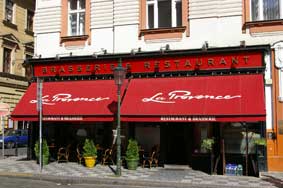
  • ProvenceLa Provence (Štupartská 9) – in the style of a French brasserie, serving really excellent food.  The salmon and steaks were delicious, but the desserts are indeed special: outstanding sorbet (beautifully presented) and fantastic Tarte tatin.  This restaurant is really worth searching out – and beneath the ground floor brasserie, there is a romantic cushioned dining room in the downstairs cellar.  An interesting wine list combines local Czech wines with fine French wines.
  • Mount Steak (Josefská 1) – a very different kind of restaurant from La Provence, and definitely not for vegetarians!  Mount Steak serves an enormously wide range of steaks from kangaroo to crocodile, but also has a good range of fulsome local Czech dishes with plenty of dumplings!  The pork and chicken were really good value and delicious.
  • Černý Slon (Týnská 1) – I first visited here almost a decade ago, and remember enjoying the traditional Czech food and wine.  Little has changed since then!  Hidden away near the Old Town Square, Černý Slon still serves good traditional Czech fare – the duck (with dumplings) is definitely worth trying as an example of old-style Czech cuisine.
  • Breakfast at the Hilton Old Town (V Celnici 7) also has to be one of the best international hotel starts to the day – with excellent friendly service and really fresh food.

3 Comments

Filed under Restaurants, Wine

25 years of PowerPoint

For some excellent advice on how not to use PowerPoint, see Max Atkinson’s recent article ‘celebrating’ 25 years of PowerPoint in the BBC’s online magazine.  It contains some great tips!

The BBC magazine also has a  selection of amusing PowerPoint experiences – 10 good ones, and ten bad!

Born on the 14th if August 1984, PowerPoint is still going strong – quite a testimony to the way our lives have been transformed by computer technologies.

Leave a comment

Filed under Communication, ICT4D general, Postgraduate supervision

Freedom on the Net

For those who may not have read it yet, Freedom House’s publication entitled Freedom on the Net: a Global Assessment of Internet and Digital Media and published in April 2009, provides a very valuable assessment of the balance of interests in the spread of the Internet and mobile telephony across the world.

As Freedom House’s blurb says, “As internet and mobile phone use explodes worldwide, governments are adopting new and multiple means for controlling these technologies that go far beyond technical filtering. Freedom on the Net provides a comprehensive look at these emerging tactics, raising concern over trends such as the “outsourcing of censorship” to private companies, the use of surveillance and the manipulation of online conversations by undercover agents. The study covers both repressive countries such as China and Iran and democratic ones such as India and the United Kingdom, finding some degree of internet censorship and control in all 15 nations studied.”

The overview essay by Karin Deutsch Karlekar and Sarah G. Cook argues that there is a growing diversity of threats to internet freedom and that governments have responded to the spread of new media by introducing new measures to control, regulate and censor content.  As they conclude “In a fast-changing digital world, vigilance is required if we are to ensure continued freedom on the net.”

Leave a comment

Filed under Ethics, ICT4D general

Bryan Appleyard on Steve Jobs

I have long been a Mac user, and so read with interest Bryan Appleyard’s piece in the Sunday Times magazine yesterday about Steve Jobs.  It’s fascinating how  Jobs provokes such contradictory opinions – very evident from the many blogs and comments that have followed the article.  It is indeed an interesting question as to what will happen to Apple when he eventually ‘goes’.  I just hope that Appleyard’s suggestion that a merger with Google might be on the cards is wide of the mark!

Leave a comment

Filed under Uncategorized

Croatia: seascapes, wine and food

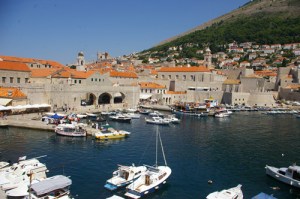
DubrovnikSo, I have been hiding away in the Dalmatian coast of Croatia for the last week – and greatly enjoying the amazing coastal scenery!
Dubrovnik – despite the thousands of tourists – has to be one of the most beautiful cities in Europe.  The opportunity to reconstruct it after the Serbian bombings of 1991-92, when an estimated 68% of the buildings in the old city were damaged, has been grasped imaginatively and effectively – the walk around the city walls is truly magnificent.

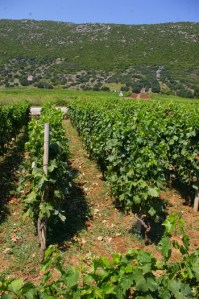
VinesI was hoping to explore some of Croatia’s vineyards and wineries during our stay – but with prices of most of the ‘quality’ wines for sale being between$30 and $50 a bottle, I swiftly changed my mind! To be sure, it is indeed possible to find some reasonable  wines at much less than this, but I cannot imagine who is willing to pay such prices – perhaps there are far too many over-rich tourists!  If Croatia wants to establish itself as a  reputable wine-making country, it needs to start making better value wines!
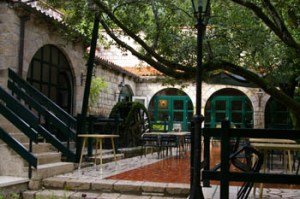
The food was also, sadly, a bit disapponting  – tasty enough, but we did not manage to find any restaurants that really impressed.Konavoski The best – and reasonably priced – was Konavoski Dvori near Gruda to the south of Dubrovnik.  The restaurant is in a restored watermill, and on a hot August day the swift-flowing river that runs past the dining tables provides a very welcome cool breeze!  Meat is cooked in an iron bell on charcoal – which keeps it succulent and moist.  Other restaurants worth visiting include:
  • Dubrovnik: Restaurant Orhan (Od Tabakarije 1) – situated at the foot of the Lovrjenac tower on the edge of a small bay some 200m away from the walls of the old city. Good seafood salads and grilled meats
  • Trogir: Alka restaurant (Obrov 10) – serving customers in the centre of the old town for 40 years, this restaurant has particularly good tradtional Dalmatian beef pašticada (marinated in vinegar, lemon and rosemary, and then cooked wth carrots, cloves, muscat nuts, red wine and prosciutto)

2 Comments

Filed under Restaurants, Wine