Solar power for mobile ‘phones

A query about  solar power solutions for mobile ‘phones made me think about posting this…pmexblue2
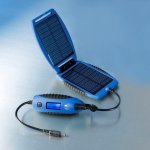
Towards the end of last year, a friend kindly gave me a Powermonkey eXplorer.  This is a great device, and I took it with me during field work in Tanzania in January – it did exactly what it said it would, and I was also able to power up other people’s ‘phones – for which they were very grateful!

The manufacturers describe it as follows: “Compatible with the majority of mobile phones, iPods (including 2nd Gen iPhone), MP3 / MP4, PDAs and portable games consoles including the Sony PSP and Nintendo DS & DS-Lite, powermonkey-eXplorer will recharge your devices – giving you 96 hours of standby on your mobile, 40 hours on your iPod, 5 hours on your games console, 48 hours on your PDA and 6 hours on MP3/MP4 players … Make sure your powermonkey-eXplorer’s got full power at all times by charging it with the handy solarmonkey, which can be attached to a rucksack, hung from a window, left in a car or taken anywhere the sun shines! Make sure the powermonkey-eXplorer unit is turned OFF when re-charging from the solar slave in order to reduce charging time!  You can even use the solarmonkey to recharge your device directly – so you have back up power at all times”

It may not be cheap, but it does show what can be done.

3 Comments

Filed under 'phones

Is the UK becoming a police state?

The Sunday Times published a front page report today noting that: ‘THE government is building a secret database to track and hold the international travel records of all 60m Britons. The intelligence centre will store names, addresses, telephone numbers, seat reservations, travel itineraries and credit card details for all 250m passenger movements in and out of the UK each year. The computerised pattern of every individual’s travel history will be stored for up to 10 years, the Home Office admits. The government says the new database, to be housed in an industrial estate in Wythenshawe, near Manchester, is essential in the fight against crime, illegal immigration and terrorism. However, opposition MPs, privacy campaigners and some government officials fear it is a significant step towards a total surveillance society.’

This is yet another example of the ways in which the state is using technology to gain unprecedented information about its citizens.  What right does it have to do so?

Even those who believe that the state can legitimately gather such information should be careful –  given the dismal failure of the state so far to keep such information from being ‘lost’ or ‘falling into the wrong hands’, what reassurances do we have that these data will be secure?

We need to encourgae a vigorous and participatory debate about these issues.

4 Comments

Filed under Ethics, ICT4D general

Is the UK becoming a surveillance state?

The BBC has today highlighted a recent House of Lords’ debate, noting that:

‘Electronic surveillance and collection of personal data are “pervasive” in British society and threaten to undermine democracy, peers have warned. CCTV cameras and the DNA database were two examples of threats to privacy, the Lords constitution committee said. It called for compensation for people subject to illegal surveillance. The government said CCTV and DNA were “essential” to fight crime but Liberty said recent abuses of power meant “even the innocent have a lot to fear”‘.

The BBC report goes on to note that:

‘Human rights campaigners Liberty welcomed the report. Director Shami Chakrabarti said: “Liberty’s postbag suggests that the House of Lords is more in touch with public concerns that our elected government. “Over the past seven years we’ve been told ‘nothing to hide, nothing to fear’ but a stream of data bungles and abuses of power suggest that even the innocent have a lot to fear.”‘

and

‘Jim Killock, executive director of the Open Rights Group, urged the government to “reassert” its control over the use of data.He said: “Governments tend to think that gathering new information on citizens is a good thing. But that’s not true if our privacy is undermined and our data isn’t secure.”We need to see privacy by design: you can’t bolt on privacy at the end of big government IT projects, we need privacy safeguards built into systems right at the start.”‘

It is good to see this debate taking place.  Britain has more digital surveillance than anywhere else in the world, and this provides the context for very real ethical questions.  There are those who say that states are too inefficient to be able to manage this wealth of data effectively – and there is some evidence to support this.  However, even if this is true at a practical level, it does not negate the importance of the ethical questions.  ICTs are enabling fundamental changes to take place in the relationship between states/governments and societies, and we need to ask whether these are ‘right’.  Just because it is possible to use these new technologies for surveillance purposes,  does not mean that it is right to do so

Leave a comment

Filed under Ethics, ICT4D

Google and privacy

A BBC report raises concerns about privacy issues associated with Google’s new tracking service, Latitude.  This uses data from mobile phone masts, GPS, or wi-fi hardware to update a user’s location automatically.  Although it is an opt-in service, there are fears that not everyone may know that their phone is broadcasting their location.

There is, though, huge potential for such a service – not just as a fun way for friends to ‘keep in touch’, but also possibly for people concerned about relatives with dementia, or others who might get ‘lost’.

As ever, Google is pushing the boundaries in terms of how society uses technology, and the ways in which that technology in turn shapes society.

1 Comment

Filed under Ethics, ICT4D general, Uncategorized

Innovative global networking…

How’s this for a story?  Told to me by one of my PhD students…

A colleague in Ethiopia had just bought a MP3 player, but found some data already on it – so guessed it had been stolen! He could not translate the data, so sent it to a friend in the UK. Thinking it might be Korean, this friend then asked a Korean colleague in the UK to see if the owner’s name might be somewhere in the data – and it was! So the name was swiftly dispatched back to Ethiopia, together with the name of a primary school that was mentioned in the files. Armed with this information, the challenge was then to find out whether that person was actually still in Ethiopia. Via the school the Korean owner was tracked down and eventually they were able to meet up in person so that the MP3 player and the original owner could be reunited!

Lots of ideas come out of this: theft, friendship, digital music, linguisitic diversity, space-time and the inteconnected world, the lives of machines…

Leave a comment

Filed under ICT4D general, Postgraduate supervision

Submarine cables for Africa

Does anyone know of a simple one-stop shop to find out more about the progress of submarine cable development around Africa – particularly East Africa?  The following main initiatives are underway:

  • EASSy (The Eastern Africa Submarine Cable System) – MoU signed in December 2003
  • SAFE (South Africa Far East) – Commissioned in 2002 and built by Tyco Submarine Systems of the USA
  • SAT-2 – in service since 1993 linking South Africa with Tenerife
  • SAT-3/WASC (South Atlantic/West Africa Submarine Cable) –  linking Portugal and Spain to South Africa
  • SEACOM (South East Asian Telecommunication Cable) – commercial launch due June 2009 (Update from The Daily  Nation, Kenya)
  • TEAMS (The East African Marine System) – in 2006 the Kenyan government partnered with Etisalat to build its own fibre optic cable; in October 2007 Alcatel-Lucent was awarded the contract to lay the cable linking Mombasa with Fujairah in the United Arab Emirates
  • West Africa Cable System – formed from Infraco AWCC, SAT-4 and Uhurunet
  • MainOne Submarine Cable project from Portugal to Ghana and Nigeria (thanks for the link Jon) – first phase expected to be completed by June 2010 led by the Nigerian Main One Cable Company

Useful links include:

Please do add comments below relating to other sources of useful information about this topic.

17 Comments

Filed under Cable

OECD report on demography and higher education

The OECD has recently (2008 ) published an important monograph entitled Higher education to 2030 (Volume 1): demography (read only version)  In summary, this assumes that:

  • There will be continued expansion of student participation, with majority female participation, greater variation in student profiles and increased emphasis on issues of access and equality.
  • The academic profession is to become more internationally oriented and increasingly mobile. There will also be greater variety in academic employment contracts and a movement away from the traditional concept of a self regulated community of professionals.
  • Society will contain a greater proportion of graduates which will have implications for social well-being and economic growth, the gap between the number of graduates from OECD area and from emerging economies (especially China and India) will be significantly reduced and issues around the social exclusion of those without HE qualifications will rise.

It is a long – but interesting – read, and includes syntheses of much useful data.  It is good to see a chapter by Serge Enersold on ‘Adapting higher education to the needs of disabled students’.

1 Comment

Filed under Accessibility, Higher Education

Refurbished assistive technology hardware

I have long thought that it is close to obscene that ICTs designed to suport who-is-disabled1people with disabilities are often much more expensive than the standard computers and mobile ‘phones that most of us take for granted.  In large part, this is because of relatively low demand for assistive technologies.

However, ICTs can transform the lives of people with serious disabilities much more than they can help those of us who have fewer disabilities.

There is a huge debate about the value (or otherwise) of refurbished computers being sent to the poorer countries of the world – and there are clearly examples of good and bad practices in this field.  Ideally we should strive to bring down prices of assistive technology so that people in poorer countries can afford them – but the reality is that this is unlikely to happen.  It is great to see some companies such as Apple, building its universal access software into every computer it sells – but everyone is not so enlightened.

I am therefore exploring the possibility of working with companies producing assistive technology hardware and existing computer refurbishment organisations to collect and distribute such hardware to people in the poorer countries of the world.  I would be really interested in people’s thoughts on this – and particularly on offers of help.

In the meanwhile, the ICT4D Collective has a page on accessibility/disability which might be of interest to readers of this blog!

Leave a comment

Filed under Accessibility

Grassroots comics

I’ve just come across an excellent small book on how to use comics in grassroots development work, writtencomic2 by Leif Packalen and Sharad Sharma, and published in 2007 by The Ministry of Foreign Afairs of Finland.  Entitled Grassroots Comics – a development communication tool, it includes a wealth of practical guidance about how to use comics in development work, as well as examples  from across the world about ways in which comics have been used to support grassroots development initiatives.
Leave a comment

Filed under Communication

Social networking sites and surveillance

Christian Fuchs has recently published the results of a fascinating survey of the ways in which students in Salburg use and know about the surveillance implications associated with the use of social networking sites.  It presents a balanced critical account of the wider issues surrounding this important subject, as well as empirical evidence of student use.  In essence, they suggest that although students are generaly aware of surveillance issues, they are willing to take the risk because of the value they place on such communication.

Fuchs, Christian. 2009. Social Networking Sites and the Surveillance Society. A Critical Case Study of the Usage of studiVZ, Facebook, and MySpace by Students in Salzburg in the Context of Electronic Surveillance. Salzburg/Vienna: Research Group UTI. ISBN 978-3-200-01428-2.

Leave a comment

Filed under Ethics, ICT4D