Tag Archives: Book

Next three podcasts on Digital Inclusion in an Unequal World (episodes 4-6)

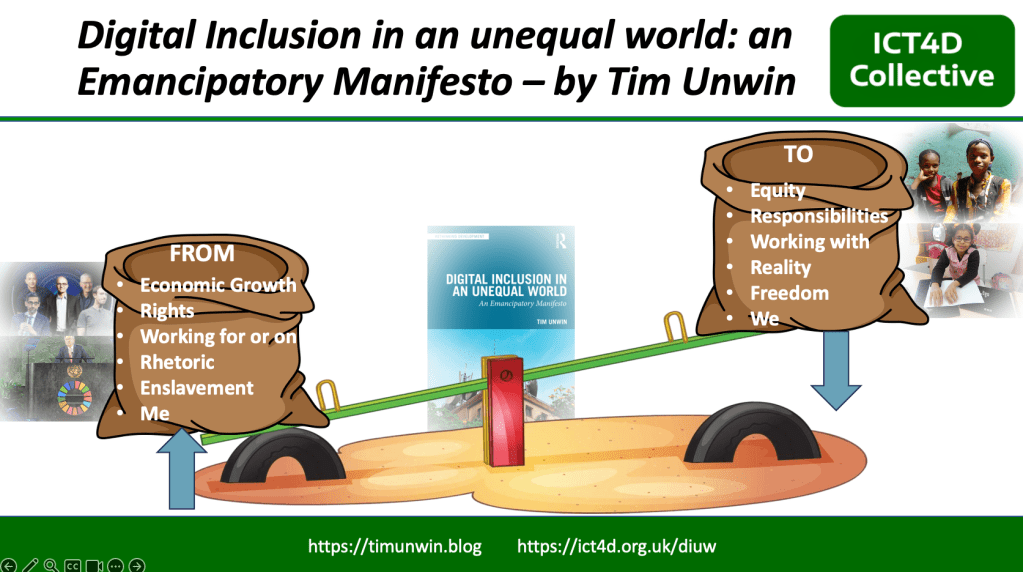
The ICT4D Collective has recently launched a podcast channel on Apple Podcasts which contains audio versions of the vignettes in my upcoming book Digital Inclusion in an Unequal World: An Emancipatory Manifesto. The second three episodes are now available as follows:

Digital Inclusion in an Unequal World (Episode 4) – Pari Esfandiari’s contribution to “Nigel Hickson: a digital life well lived for others”

This is the fourth episode of our podcast based on the vignettes contributed by friends and colleagues to Tim Unwin’s new book Digital Technologies in an Unequal World: An Empancipatory Manfesto. Our dear friend and colleague, Nigel Hickson was to have written one of these vignettes based on his wealth of experience working on Internet Governance, especially for the British Government and ICANN, but his untimely death meant that he was unable to complete it. Instead, some of his friends have contributed very short pieces on what it was that made him so special, and a model to follow for anyone wishing to work at the policy level to ensure that the poorest and most marginalised can benefit from the use of digital tech. The full vignette can be read here.

Digital Inclusion in an Unequal World (Episode 5) – Domenico Fiormonte on “The Geopolitics of Digital Knowledge”.

This is the fifth episode of our podcast based on the vignettes contributed by friends and colleagues to Tim Unwin’s new book Digital Technologies in an Unequal World: An Empancipatory Manfesto. In it, Domenico asks the important question “So who has the power today to ‘represent’ digitally the world’s languages, the core of human cultures?”. He answers: “It is a group of Western, predominantly English-speaking and U.S.-based corporations”. However, he concludes optimistically that “the real Web is becoming multilingual and multicultural, regardless of all its hegemonic and mainstream representations”

Audio in Italian

The full vignette can be read in English here.

Digital Inclusion in an Unequal World (Episode 6) – Mei Lin Fung on “Learning from Land Rights so Data Rights are Right from the Get Go”.

This is the sixth episode of our podcast based on the vignettes contributed by friends and colleagues to Tim Unwin’s new book Digital Technologies in an Unequal World: An Empancipatory Manfesto. In it, Mei Lin Fung suggests that “The painful history of poorly defined land rights, which in the past led to displacement through lack of formal documentation, offers a crucial lesson for the digital age”. She concludes optimistically that “We still have time to shape the digital future so that it reflects the dignity of everyone it touches — and ensures meaningful participation for anyone, anywhere”

The full vignette can be read in English here, and it can also be watched on video here.

Leave a comment

Filed under Equity, ICT4D, inclusion, Inequality

Our podcast on Digital Inclusion in an Unequal World

The ICT4D Collective has recently launched a podcast channel on Apple Podcasts which contains audio versions of the vignettes in my upcoming book Digital Inclusion in an Unequal World: An Emancipatory Manifesto. The first three episodes are now available as follows:

Tendani Mulanga Chimboza on the exploitation of young women: digital tech at the heart of the immoral economy

This is the first episode of our podcast based on the vignettes contributed by friends and colleagues to Tim Unwin’s new book Digital Technologies in an Unequal World: An Empancipatory Manfesto. In it, Tendani highlights how digital tech is being used to exploit young women in southern Africa. The vignette can also be read here.

Marine Al Dahdah on The Digital Privatisation of India’s Administration

This is the second episode of our podcast based on the vignettes contributed by friends and colleagues to Tim Unwin’s new book Digital Technologies in an Unequal World: An Empancipatory Manfesto. In it, Marine focuses critically on aspects of the digital privatisation of India’s administrative systems. The vignette can also be read here.

Ken Banks on Memories of Innovation for the Most Marginalised

This is the third episode of our podcast based on the vignettes contributed by friends and colleagues to Tim Unwin’s new book Digital Technologies in an Unequal World: An Empancipatory Manfesto. In it, Ken focuses perceptively on the reasons why so many digital initiative notionally intended to help the poor often fail to do so. As he says “I worked for 15 years trying to give a voice to, and support, the work of grassroots organisations through digital tech, butmy frustration in a wider development system that didn’t seem to want to do what they knew was best for those they were meant to serve eventually forced me to step away”. The full vignette can be read here.

Leave a comment

Filed under Equity, ICT4D, inclusion, Inequality

Reclaiming Information and Communication Technologies for Development

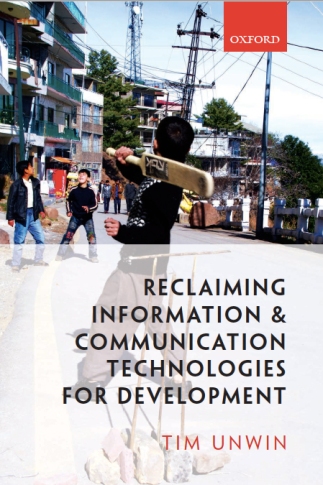
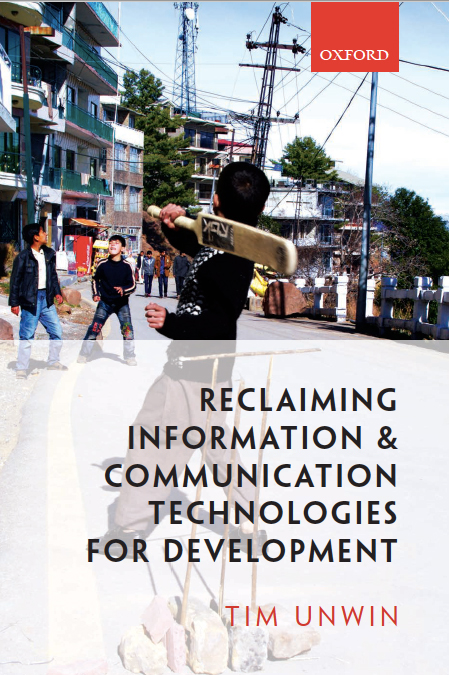
recict4dIt is always exciting to have finished the page proofs and done the index of a book, especially when this has to be completed between Christmas and the New Year as it was with Reclaiming ICT4D at the end of 2016! However, when the cover has been agreed and it appears on the publisher’s  website, then one knows that it is actually going to appear in several months time!

This is  OUP’s overview of the book:

  • Combines understanding of both theoretical and practical aspects of ICT for development (ICT4D)
  • Challenges existing orthodoxy and offers alternatives that can make a practical difference in the field
  • Addresses the interests underlying the use of technology in development
  • Wide ranging in coverage, including discussion of regulation, partnership, technological innovation, and the darker side of ICTs

I like being involved in the design of different aspects of my books, and I am so grateful to OUP for agreeing to publish Reclaiming ICT4D in two fonts, one to represent theory and the other practice.  I am also immensely happy that they were willing to use one of my pictures on the cover to represent much of what the book is about.  In case it is not immediately obvious, this picture taken a year ago in Murree (Pakistan) represents many things: a hope for the future, with the young boy vigorously hitting the ball way over his friends’ heads; cricket itself acknowledges the complex heritage of colonialism and imperialism; in the background is a telecommunications mast, providing the connectivity that has the potential to be used to reduce inequalities, but all too often increases them; the electricity so essential for powering ICTs is very visible;  and women are absent, representing another dimension of inequality that is addressed in the book.  It is also much more than this.  My father visited Murree 71 years ago, and may have walked along this street; I went there with friends, and the book is very much a personal story of how I have learnt from them and the many people who have shared their wisdom and experiences with me over the years; it is above all about how people like these boys, playing on the street, can use ICTs to transform their lives for the better, rather than becoming the cyborg cannon-fodder that global capitalism seeks to devour for the benefit of the rich and powerful.

A little more formally, this is how OUP describe the contents of the book on their website:

“The development of new Information and Communication Technologies (ICTs) has transformed the world over the last two decades. These technologies are often seen as being inherently ‘good’, with the ability to make the world better, and in particular to reduce poverty. However, their darker side is frequently ignored in such accounts.

ICTs undoubtedly have the potential to reduce poverty, for example by enhancing education, health delivery, rural development and entrepreneurship across Africa, Asia and Latin America. However, all too often, projects designed to do so fail to go to scale, and are unsustainable when donor funding ceases. Indeed, ICTs have actually dramatically increased inequality across the world. The central purpose of this book is to account for why this is so, and it does so primarily by laying bare the interests that have underlain the dramatic expansion of ICTs in recent years. Unless these are fully understood, it will not be possible to reclaim the use of these technologies to empower the world’s poorest and most marginalised.”

Its seven chapters are entitled as follows:

Preface
1: A critical reflection on ICTs and ‘Development’
2: Understanding the Technologies
3: The International Policy Arena: ICTs and Internet Governance
4: Partnerships in ICT4D: Rhetoric and Reality
5: From Regulation to Facilitation: The role of ICT and Telecommunication Regulators in a Converging World
6: Reflections on the Dark Side of ICT4D
7: …in the Interests of the Poorest and Most Marginalized.

It is also being made available as an Ebook, and publication date is estimated as 25th May 2017.

To request a review copy, do contact OUP directly using their request form.

11 Comments

Filed under Africa, Asia, Books, Development, ICT4D, Photographs, Uncategorized

Indexing “Reclaiming ICT4D”

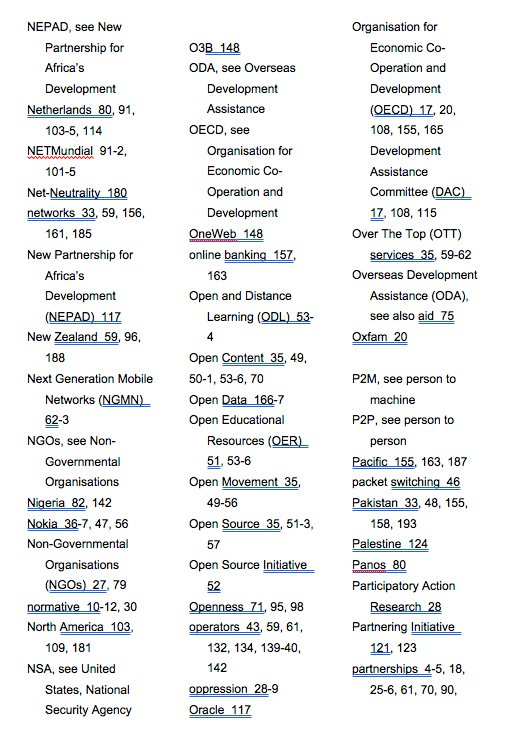
I always enjoy indexing my own books, although it can at times be brain-numbingly tedious!  So, I have spent the last few days proof-reading Reclaiming ICT4D, and at the same time constructing the index!  It has taken much longer than I had anticipated, but I am delighted that it really does capture the essence of what I have tried to write about.  It is always fascinating to see the juxtaposition of words: “holistic” next to “honour killings”; “operators” next to “oppression”; and “poverty” next to “power”…  However, having just finished it, I now wonder just how many people ever actually read indexes!

Anyway, for those who want to know what the book is really about, I am therefore posting the index for everyone to see if their favourite ICT4D topic is included – and a glimpse of part of it is shared below!  I very much hope that you find something of interest in it!

Now it will only be a few months for OUP to print the book!

index

7 Comments

Filed under Books, ICT4D, ICTs, Inequality, Universities