Tag Archives: ICT4D

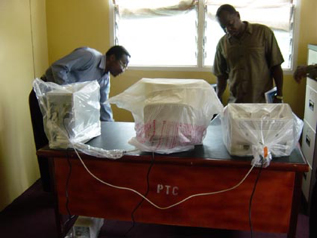
Participating in the e-Borneo Knowledge Fair 6 held in Ba’Kelalan, 25-27 October 2017

Far too many ICT4D initiative are thought up by the rich and privileged, often, but not always, with the intention of using technology to improve the lives of poor and marginalised peoples.  More often than not, well-intentioned researchers and academics in Europe and north America, or those living in major urban centres of economically poorer countries, try to develop new “solutions” that will help to eliminate poverty or deliver on some aspect of the Sustainable Development Goals agreed by the global elite.  Invariably, they have little understanding of the real needs of poor people or marginalised communities, and all too often such initiatives prove to be unsustainable once the initial funding for them has dissipated.

Some initiatives do, though, run counter to this all too familiar tale of woe.  One of these is the work of the Institute of Social Informatics and Technological Innovations at the Universiti Malaysia Sarawak, which has over many years sought to work with local communities in some of the most isolated areas of Sarawak.  This action research started almost 20 years ago with the creation of the e-Bario telecentre initiative in 1998. It was therefore a real privilege to be invited to give a keynote presentation at their 6th e-Borneo Knowledge Fair, held on the theme of community-based sustainability in Ba’Kelalan from 25-27 October (EBKF6).  The first e-Bario Knowledge Fair was held in 2007, and a decade on the change of name indicates a broadening of its focus beyond the village of Bario to be more inclusive of other initiatives across Borneo.

The central belief underlying these knowledge fairs has been the importance of sharing understandings between communities and researchers in co-creating new knowledge.  In a fundamental reversal of the normal conference format, where participants usually meet in major cities of the world, the e-Bario and now e-Borneo Knowledge Fairs have been held in isolated rural communities, with participating academics being encouraged to learn as much from those living there as the latter do from the conference and workshop speakers.  To emphasise this difference, outside participants were encouraged this year to travel to Ba’Kelalan on a nine-hour journey along roads cut through the forests initially by logging companies.

The knowledge fair consisted mainly of a series of workshops that placed as much emphasis on the views of the inhabitants of Ba’Kelalan and other isolated communities in Malaysia as they did on the experiences and knowledge of outside academics.  Great credit is due to the Co-Chairs of EBKF6, Narayanan Kulathu Ramaiyer and Roger Harris, and their team, for having brought together an amazing group of people.  The pictures below hopefully capture something of the refreshing energy and excitement of these workshops (link here to the official video).  Many things impressed me about them, not least the commitment of all involved to work together collaboratively to focus on delivering solutions to the needs and wants of people living in these very isolated communities, and ensuring that “development” does not irrevocably damage the essential elements of life that they wish  to maintain.  It was also very impressive to see three community healthworkers present, who were offering a free service of health checks (blood pressure and blood sugar levels) for those participating.

This slideshow requires JavaScript.

The most important feature of the Sixth e-Borneo Knowledge Fair for me was that it was all about working with isolated communities rather than for them.  I came away  I am sure very much more enriched by the experience than will other participants have been by my keynote!  For those interested in what I had to say, though, the slides from my keynote are available here: Safeguarding the interests of the marginalised: rhetoric and reality of global ICT4D initiatives designed to deliver the SDGs.

Thanks again to everyone involved for making this such a special event!

5 Comments

Filed under Conferences, Development, Environment, ICT4D, ICT4D conferences, ICTs, Inequality, Malaysia, Photographs, Sustainability

ICT4D: Mainstreaming the Marginalised

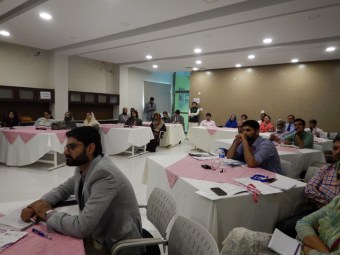
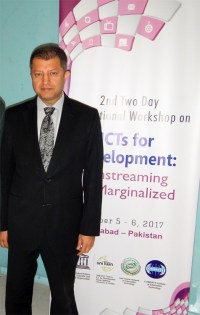
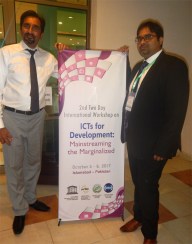
People in workshopIt was great to be back in Islamabad to participate in the second two-day workshop organised by the Inter-Islamic Network on Information Technology and COMSATS Institute of Information Technology with the assistance of the UNESCO Chair in ICT4D, and held on 5th and 6th October.  It was fascinating to see the progress that has been made in Pakistan since the first such workshop that we convened in January 2016,  particularly in terms of policy making, awareness, and entrepreneurial activity.  It was also very good to see such a diverse group of participants, including academics, entrepreneurs, civil society activities, government officials, and representatives of bilateral donors engaging in lively discussions throughout both days about how best we can turn rhetoric into reality.

Following the official opening ceremony, there were seven main sessions spread over two days:

  • shahUnderstanding the ICT4D landscape, in which the main speaker was Dr. Ismail Shah, the Chairman of the Pakistan Telecommunication Authority
  • The road to facilitation: financial technologies for the marginalised, with a plenary given by Qasif Shahid (FINJA) about making payments frictionless, free and real time.
  • Addressing the digital gender gap, at which I had the opportunity to talk about why this is a pressing concern, and it gave me a chance to talk about the new UN-led EQUALS initiative for gender equality in a digital age, as well as some of the challenges that face women in using ICTs (slide deck).
  • No tech to low tech to high tech: an entrepreneur’s tale, with a plenary by Muhammad Nasrulla (CEO INTEGRY).
  • Tech innovationServing the most marginalised: accessibility and disability, with a plenary by David Banes on access and inclusion using ICTs, which included a very useful framework for considering digital accessibility issues.
  • Developing technologies for the rural/urban slum needs, during which Muhammad Mustafa spoke about his vision of enabling all 700 million illiterate adults in the world to go online through his Mauqa Online initiative.
  • Educating the marginalised, where I spoke about educating marginalised children (slide deck) and Shaista Kazmi from Vision 21 described their Speed Literacy Program.

Each session combined enthusiastic discussion around the themes addressed by the plenary speakers, and it was excellent to learn from all those involved  about using ICTs in very practical ways to deliver on the needs of poor and marginalised people and communities in Pakistan.

Atiq and AlberFull details of the event can be found on the INIT site, where copies of the slide decks from each main presentation will also be available.  Very many thanks go to all of the organisers, especially Tahir Naeem, Akber Gardezi and Muhammad Atiq from COMSATS IIT and INIT for all of the hard work that they put into making the event a success.  We look forward to convening the next such workshop in about a year’s time, once again bringing together people from all backgrounds intent on using ICTs to support  Pakistan’s most marginalised communities.

3 Comments

Filed under ICT4D, ICT4D conferences, Pakistan, Photographs

ICTs, sustainability and development

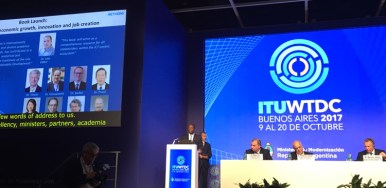
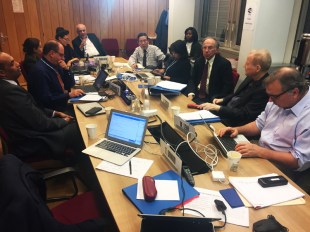
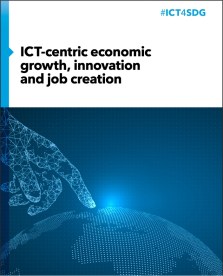
LaunchI am delighted to see my chapter on ICTs, sustainability and development just published in the ITU’s new book on ICT-Centric Economic Growth, Innovation and Job Creation launched yesterday at the World Telecommunication Development Conference (WTDC) in Buenos Aires.  This was part of a fascinating project that emerged when Dr. Ahmed Sharafat (Professor of Electrical and Computer Engineering at Tarbiat Modares University, Tehran, Iran) and Dr. Eun-Ju Kim (from the ITU) brought together a group of academics from across the world to explore issues around the ways through which ICTs can contribute to the Sustainable Development Goals (SDGs), focusing especially on economic growth and employment.  We held several meetings together over the last year, and particularly met up for a fortnight in Geneva in January 2017 to work through ideas and share drafts of manuscripts.

IMG_8860 smallIt is the first time I have actually worked on such a collectively authored project, and its publication says much about the willingness of all involved to collaborate supportively together under the leadership of Ahmed and Bill Lehr, who was later brought on board to co-edit the book.  Each of us took the lead on a single chapter, but everyone contributed to the ideas contained within the book.  The process of negotiation and discussion around the concepts and ideas within each chapter was fascinating, especially since it required us to hone our arguments very finely and precisely.  Most of the contributors were economists, and although at times I struggled with accepting some of their arguments, I know that their contributions very much improved the chapter on which I led.  Moreover, I am very grateful to Ahmed as editor, for letting me write what I did, since it enabled me to craft my most critical piece of work on the sustainability of the ICT sector.

ICT4SDGThe second chapter (on which I led) examines the interface between ICTs and sustainability, especially focusing on environmental issues and the conditions that need to be in place for ICT initiatives to be sustainable socially and economically. It focuses specifically on the importance of universal infrastructure, the affordability of technologies, the need for appropriate skills and awareness, and the importance of locally relevant content. For these to be delivered, the chapter emphasises that those who develop policies and implement programmes and projects to use ICTs to promote sustainable development need to address issues of empowerment, focus on the needs of the poorest, develop innovative technological solutions and new business models, legislate new kinds of regulation through which governments facilitate the ICT and telecommunication sector, and ensure that there is effective security and resilience within the systems being developed. The chapter concludes with a brief analysis of the role of multi-stakeholder partnerships in implementing such initiatives.

Where I think it makes the most significant new arguments is at the interface between ICTs and sustainability.  It does this in three main contexts:

  1. First, although this is indeed a book published by the ITU, a UN agency, and we therefore had to be very careful in our arguments, the chapter does nevertheless challenge some of the assumptions behind, and implementation of, the SDGs. In particular it draws attention to the tensions between sustainability (implying maintenance or stability) and development (implying change or growth).
  2. Second, it provides a strong critique of the environmental credentials of the ICT sector.  For example, while it acknowledges that some companies have sought to show their environmental concerns through delivering on carbon emissions,  it notes that there has been no comprehensive and rigorous environmental audit of the sector as a whole.  In particular, I recall some challenging discussions during our work on the book about the increasing amount of debris accumulating in space as a result of satellite launches, and I am pleased that colleagues eventually allowed me to include an, albeit toned down, section on this, which argues that space pollution should indeed be included as an environmental impact.
  3. Third, the chapter argues strongly that many of the main business models adopted by the private sector in rolling out ICTs are fundamentally unsustainable.  It is therefore contradictory to assert that ICTs are an important vehicle through which the Sustainable Development Goals can be implemented (even if it is accepted that these can indeed reduce poverty).  To give but one example, the mobile phone and app/content sectors function as an ever increasing spiral of unsustainability.  New devices require new apps and operating systems, which then in turn require another generation of new devices with more memory and functionality.  Hence, instead of the old landline telephones that lasted for years, most people are now encouraged to purchase new upgraded phones every couple of years.  This is unsustainability built in by the very design of the technology and business models, and it is enhanced and encouraged by the companies’ focus on marketing, modernity and fashion.

Several case studies to support these chapters are also included in the book, but sadly two of mine had to be excluded because of space, and so I will shortly be posting them separately here on my blog.

Once again, I would like to take this opportunity to thank everyone involved in this co-created book, many of whom have now become good friends.  It was a privilege to work with you all on this project, and I am so grateful to colleagues in the ITU for inviting me to participate.


3 Comments

Filed under ICT4D, SDGs, Uncategorized

Reflections on ICTs, the SDGs and innovation adoption

The contrast between attending a series of side events around the UN General Assembly in New York immediately following a marvellous two weeks in India has made me reflect again on the rhetoric and reality of using ICTs for development, especially in the interests of the poorest and most marginalised.
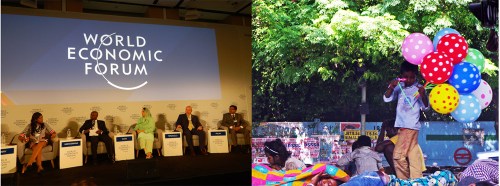
Contrast

My latest book, Reclaiming Information and Communication Technologies for Development (OUP, 2017) provides an overview of the interests underlying the use of ICTs for “development”, and what needs to be done so that the poorest and most marginalised can indeed benefit from ICTs.  However, working in India, and then listening to the rhetoric of the rich and famous in New York makes me wonder whether I was sufficiently vehement in what I wrote in that book.  It also makes me return to thinking about the research I did 30 years ago on innovation adoption by farmers.  This convinced me that Rogers’ well accepted theoretical arguments around innovation adoption, the S-shaped curve (see below), and the classification of people into categories (innovators, early adopters, really majority, late majority and laggards) is fundamentally flawed.
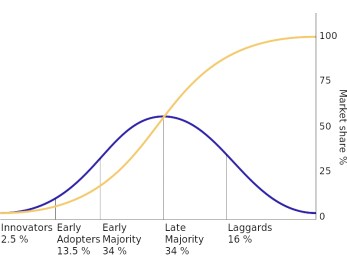
Rogers

There was very widespread agreement amongst the world’s leaders meeting in New York last week – and most other people as well – that ICTs can contribute very significantly to delivering the Sustainable Development Goals (SDGs), and that these will eliminate poverty.  The challenge, according to them, is how to connect the “next billion” to the Internet (mobile broadband), or in Rogers’ terminology the “late majority”.  As I have argued elsewhere, this will actually further increase global inequality, and most attention should instead be paid  to connecting the “first” (because they are most important) billion, or what Rogers termed the “laggards”.

The interests underlying connecting the next billion

The global focus on rolling out broadband to deliver the SDGs (even if that was possible) is not primarily in the interest of the world’s poorest people.  Instead it is mainly driven by:

  • private sector corporations and companies, from ISPs and mobile operators to the powerful multi-service giants such as Facebook and Google, who are all primarily interested in expanding their markets and profits;
  • national governments, eager to reduce costs through the use of digital technologies (although this is often a flawed assumption), as well as to control  “their” citizens;
  • UN agencies, keen to have a role to play in delivering the SDGS; and
  • NGOs, wanting to publicise their work more widely, and continue to receive project funding for their ICT-based initiatives.

These have little to do with the real interests and needs of the poorest and most marginalised.  The language of global corporations and governments is nearly always about providing access and creating demand for digital services.  But why should poor people necessarily want to go online?

Reasons not to be online…

Masai welcomeI recall a wonderful conversation a couple of years ago with a Maasai chief in Tanzania. He was speaking with a group of techies about the use of mobile devices, and they were trying to persuade him of the value of mobile phones, even just to call his friends in a village the other side of the hills.  He, wisely, remained unconvinced.  For him, walking across the hills, enjoying the landscape, spending time experiencing the physicality of nature, and just thinking about life, were a crucial part of going to, and speaking with, his friend in the next village.

For the wise poor and marginalised, there are many reasons for not being connected:

  • they remain outside a world where increasingly all human actions are monetised by  profit seeking corporations who use digital technologies to track their users and generate profit from selling such information;
  • they remain free from the prying eyes of governments, whose actions may not be in their interests;
  • there is little of interest to them in solving their real needs on the Internet;
  • they do not have to spend large amounts of their very limited cash on paying for digital services that they do not really need;
  • they do not suffer from the increasing amount of online abuse and harassment from trolls and others seeking to make them suffer;
  • their small amounts of cash are not subject to online theft from hackers of mobile money systems;
  • they do not become entrapped in a social media world, where every tweet or blog can adversely influence  their thoughts and senses of well-being;
  • they do not suffer from endless messages or e-mails, the senders of which increasingly expect an immediate response; and
  • they can enjoy being truly human in the analogue physical world (of all the senses), rather than trading this for the synthetic, and much less adequate digital virtual world (of mainly the two senses of sight and sound).

To be sure, there are many advantages of being connected, but the above list (and there are numerous other reasons that could be added) emphasises that there are also many negative aspects of Internet use, especially for the poor and marginalised.

The poor are not ignorant laggards who need to be convinced to go online…

One of the fundamental flaws of the widely accepted innovation adoption model proposed by Rogers is that it classifies people into “heroic” innovators and “ignorant” laggards; it is something about the people that influences whether or not they adopt an innovation, such as mobile broadband.  Such a view is held by many of those who seek to promote the global roll-out of the Internet: those who use the latest technologies are seen as being wise, whereas those who do not are seen as being lazy, ignorant laggards.

Rogers’ formulation is fundamentally problematic because it suggests that it is something about the people themselves that determine whether or not they are leaders or laggards.  This largely ignores the structural factors that determine whether people adopt something new.  With the adoption of agricultural innovations, for example, many poor people act perfectly rationally, and choose the option that they consider suits them best.  Poor people often make very rational, wise decisions not to adopt an innovation, often because the innovation increases the risks of crop failure, and they cannot afford this risk.  Moreover, if they do not have access to innovations it is scarcely surprising that they do not adopt them; the spatial distribution of outlets for herbicides, hybrid seeds or inorganic fertilizers is the main factor influencing whether people adopt them, rather than something about their propensity to innovate.  In the ICT sector, it is hardly surprising that people living in areas without electricity, let alone connectivity, do not see the need to have the latest generation of smartphone connected to the Internet.

If progress is to be made in helping poor and marginalised people benefit from the Internet, it is essential to do away with this flawed model of innovation adoption, and understand instead the structural factors and interests underlying why wise poor people, who know the contexts of their poverty very well, do not choose to adopt such technologies.  The rich elites of the world could begin by trying to understand the real conditions of poverty, rather than simply believing that ICTs can eliminate poverty through the SDGs.

Development in the interests of the poor

children 2ICTs will never deliver on reducing inequalities in the world unless there is a fundamental sea-change in the attitudes of those leading the global private sector corporations that currently shape the world of the Internet.  It is perfectly logical for them to sign up to the SDGs formulated by the UN system, and to seek to show that expanding their digital empires will necessarily deliver the SDGs.  This is a powerful additional weapon in their armoury of market expansion and profit generation.  The problem is that these agendas will continue to increase inequality, and as yet remarkably little attention has been paid to how ICTs might actually help deliver SDG10.  Until corporations and governments really treat the link between ICTs and inequality seriously, peoples of the world will become every more divided, and if poverty is defined in a relative sense then poverty will actually increase rather than decrease as a result of roll out of the Internet.

 

3 Comments

Filed under Africa, agriculture, Asia, Development, Education, Entrepreneurship, ICT4D, India, Inequality, Rural, SDGs, Urban

SDG Stories: reflections on sustainability of ICT systems

E_Logo_No UN Emblem-01In the run-up to this year’s UN General Assembly, the Office of the DG of the UN Office in Geneva has launched a novel initiative on big conversations driving the big goals of the SDGs as part of their Perception Change Project.  The UNESCO Chair in ICT4D is delighted to have been invited to participate in this initiative, alongside other leading figures in the ICT4D world including Houlin Zhao (SG of the ITU, and one of our Honorary Patrons), Kathy Calvin (President and CEIO, UN Foundation), and Nicholas Negroponte (Founder MIT Media Lab).
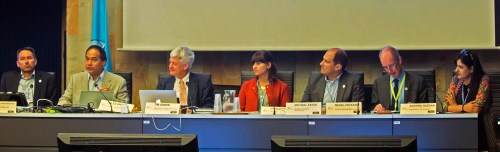
Our stories are about the question “What are the biggest hopes and challenges we face in providing reliable ICT access to communities as we work towards improved sustainable development?

This was my response:

Seeing the eyes of a group of street children in Ethiopia light up when I let them play with my laptop in February 2002 convinced me in an instant of the potential of technology to be used effectively for learning by some of the poorest people in the world.  However, the plethora of global initiatives that have been designed to use ICTs to contribute to reducing poverty through economic growth over the last 15 years have had the consequence of dramatically increasing inequality at the same time.  The poorest and most marginalised have not benefited sufficiently from the promise of ICTs.

Few people pay appropriate attention to the dark side of technology, and yet we must understand this, and change it, if this potential is fully to be realised for all.  In the context of the SDGs, there is a fundamental challenge.  To be sure ICTs can contribute to the achievement of the SDGs, but few people sufficiently highlight their unsustainability: ICTs have seriously negative environmental impacts, and their usual business model is built on a fundamentally unsustainable logic.  In terms of environmental impact, for example, they have contributed to substantially increased electricity demand, and the amount of waste in space is now presenting very serious threats to future satellite deployment.  The business model, whereby people are encouraged to replace their mobile phones every couple of years, and new hardware often requires the next generation of software, which in turn then requires new hardware, is good for business, but not for sustainability.

If we are serious about using ICTs for sustainable development, we must do much more to address negative aspects such as these, so that the poorest individuals, communities and countries can indeed benefit.

Follow the stories at: http://www.sdgstories.com, or on Twitter using #sdgstories.E_Logo_No UN Emblem-01

Leave a comment

Filed under ICT4D, SDGs, Uncategorized

Reclaiming ICT4D – output from workshop at WSIS 2017

Thanks so much to everyone who contributed to our workshop this morning at WSIS Forum 2017 in Geneva on what we need to do to ensure that the poorest and most marginalised can indeed be empowered through the use of ICTs.

Reclaiming small

Our co-created mindmap is available here in .pdf format and by clicking on the image below:

Reclaiming small

A special thank you to our panel:

  • Alex Wong (Head, Global Challenge Partnerships & Member of the Executive Committee; Head of the Future of the Internet Global Challenge Initiative, World Economic Forum) on The power of partnership
  • Dr. Bushra Hassan (School of Psychology, University of Sussex) on The wisdom of marginalised women
  • Charlotte Smart (Digital Policy and Programme Manager, Department for International Development, UK) on The delivery of donors
  • Michael Kende (Senior Advisor, Analysis Mason, and former Chief Economist of the Internet Society) on The trust in technology
  • Nigel Hickson (VP IGO Engagement, ICANN) on The design of the domain name system
  • Torbjörn Fredriksson (Head of ICT Analysis Section of the Division on Technology and Logistics, UNCTAD) on The energy of entrepreneurship

1 Comment

Filed under ICT4D, Uncategorized

Reclaiming ICT4D at the WSIS Forum 2017

BookTo coincide with the recent publication of my new book entitled Reclaiming Information and Communication Technologies for Development (Oxford University Press, 2017), the UNESCO Chair in ICT4D is convening a workshop on Friday 16th June from 11.00-12.45 in ITU Room Popov 1 at the 2017 WSIS Forum being held in Geneva.  The key premise of the workshop is that the global spread of ICTs has increased inequality, and that the poorest and most marginalised have therefore failed sufficiently to benefit.  The workshop will explore whether the continued focus on the ways through which ICTs can contribute to economic growth will inevitably lead to ever increasing, and dangerous, inequality, and will make recommendations as to how different stakeholders can best ensure that the poorest and most marginalised can indeed benefit from their use.
It will begin with short (5 minute) perspectives from some amazing people (listed in alphabetical order of first names):

  • Alex Wong (Head, Global Challenge Partnerships & Member of the Executive Committee; Head of the Future of the Internet Global Challenge Initiative, World Economic Forum) on The power of partnership
  • Dr. Bushra Hassan (School of Psychology, University of Sussex) on The wisdom of marginalised women
  • Charlotte Smart (Digital Policy and Programme Manager, Department for International Development, UK) on The delivery of donors
  • Michael Kende (Senior Advisor, Analysis Mason, and former Chief Economist of the Internet Society) on The trust in technology
  • Nigel Hickson (VP IGO Engagement, ICANN) on The design of the domain name system
  • Torbjörn Fredriksson (Head of ICT Analysis Section of the Division on Technology and Logistics, UNCTAD) on The energy of entrepreneurship

Following these short, and undoubtedly provocative, presentations there will be an open discussion focusing on participants’ thoughts as to what are the most important priorities for action that different stakeholders must take so that the poorest and most marginalised people and communities can indeed be empowered through the use of ICTs.

The workshop is open to everyone with interests in ways through which ICTs can indeed benefit poor people, and there will also be an opportunity after the workshop for participants to purchase copies of Reclaiming Information and Communication Technologies for Development at a 40% reduction from list price.

I very much look forward to seeing you there!

3 Comments

Filed under Books, Conferences, ICT4D, ICT4D conferences, Uncategorized

Reclaiming Information and Communication Technologies for Development

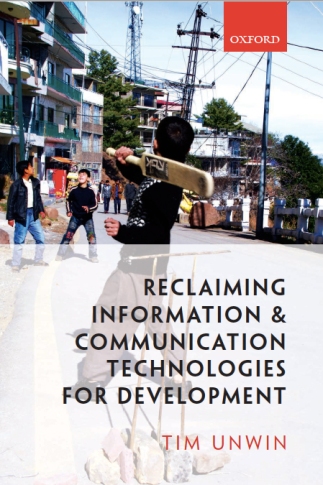
recict4dIt is always exciting to have finished the page proofs and done the index of a book, especially when this has to be completed between Christmas and the New Year as it was with Reclaiming ICT4D at the end of 2016! However, when the cover has been agreed and it appears on the publisher’s  website, then one knows that it is actually going to appear in several months time!
This is  OUP’s overview of the book:

  • Combines understanding of both theoretical and practical aspects of ICT for development (ICT4D)
  • Challenges existing orthodoxy and offers alternatives that can make a practical difference in the field
  • Addresses the interests underlying the use of technology in development
  • Wide ranging in coverage, including discussion of regulation, partnership, technological innovation, and the darker side of ICTs

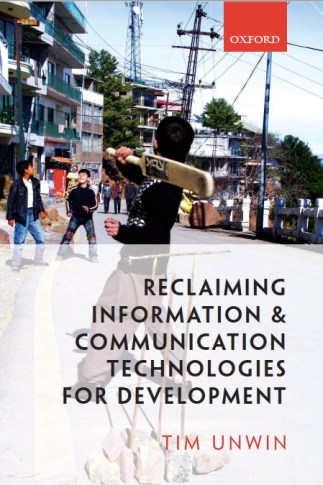
I like being involved in the design of different aspects of my books, and I am so grateful to OUP for agreeing to publish Reclaiming ICT4D in two fonts, one to represent theory and the other practice.  I am also immensely happy that they were willing to use one of my pictures on the cover to represent much of what the book is about.  In case it is not immediately obvious, this picture taken a year ago in Murree (Pakistan) represents many things: a hope for the future, with the young boy vigorously hitting the ball way over his friends’ heads; cricket itself acknowledges the complex heritage of colonialism and imperialism; in the background is a telecommunications mast, providing the connectivity that has the potential to be used to reduce inequalities, but all too often increases them; the electricity so essential for powering ICTs is very visible;  and women are absent, representing another dimension of inequality that is addressed in the book.  It is also much more than this.  My father visited Murree 71 years ago, and may have walked along this street; I went there with friends, and the book is very much a personal story of how I have learnt from them and the many people who have shared their wisdom and experiences with me over the years; it is above all about how people like these boys, playing on the street, can use ICTs to transform their lives for the better, rather than becoming the cyborg cannon-fodder that global capitalism seeks to devour for the benefit of the rich and powerful.

A little more formally, this is how OUP describe the contents of the book on their website:

“The development of new Information and Communication Technologies (ICTs) has transformed the world over the last two decades. These technologies are often seen as being inherently ‘good’, with the ability to make the world better, and in particular to reduce poverty. However, their darker side is frequently ignored in such accounts.

ICTs undoubtedly have the potential to reduce poverty, for example by enhancing education, health delivery, rural development and entrepreneurship across Africa, Asia and Latin America. However, all too often, projects designed to do so fail to go to scale, and are unsustainable when donor funding ceases. Indeed, ICTs have actually dramatically increased inequality across the world. The central purpose of this book is to account for why this is so, and it does so primarily by laying bare the interests that have underlain the dramatic expansion of ICTs in recent years. Unless these are fully understood, it will not be possible to reclaim the use of these technologies to empower the world’s poorest and most marginalised.”

Its seven chapters are entitled as follows:

Preface
1: A critical reflection on ICTs and ‘Development’
2: Understanding the Technologies
3: The International Policy Arena: ICTs and Internet Governance
4: Partnerships in ICT4D: Rhetoric and Reality
5: From Regulation to Facilitation: The role of ICT and Telecommunication Regulators in a Converging World
6: Reflections on the Dark Side of ICT4D
7: …in the Interests of the Poorest and Most Marginalized.

It is also being made available as an Ebook, and publication date is estimated as 25th May 2017.

To request a review copy, do contact OUP directly using their request form.

11 Comments

Filed under Africa, Asia, Books, Development, ICT4D, Photographs, Uncategorized

Indexing “Reclaiming ICT4D”

I always enjoy indexing my own books, although it can at times be brain-numbingly tedious!  So, I have spent the last few days proof-reading Reclaiming ICT4D, and at the same time constructing the index!  It has taken much longer than I had anticipated, but I am delighted that it really does capture the essence of what I have tried to write about.  It is always fascinating to see the juxtaposition of words: “holistic” next to “honour killings”; “operators” next to “oppression”; and “poverty” next to “power”…  However, having just finished it, I now wonder just how many people ever actually read indexes!

Anyway, for those who want to know what the book is really about, I am therefore posting the index for everyone to see if their favourite ICT4D topic is included – and a glimpse of part of it is shared below!  I very much hope that you find something of interest in it!

Now it will only be a few months for OUP to print the book!

index

7 Comments

Filed under Books, ICT4D, ICTs, Inequality, Universities

Making money from meeting the SDGs? An overarching approach to sustainable development

I am delighted to have been asked to moderate the session on “Making money from meeting the SDGs?” at ITU Telecom World in Bangkok on Monday 14th November (4:45 PM – 6:00 PM, Jupiter 10), although I wonder a little why I have been chosen for this task given my past criticisms of the SDGs!  Perhaps the “?” in the session title will give me a little freedom to explore some of the many challenges and complexities in this theme.  Following in the footsteps of the Millennium Development Goals (2000), the globally agreed Sustainable Development Goals (SDGs) still generally focus on the idea that economic growth will eliminate poverty; indeed, they assert that poverty can truly be ended.  This is a myth, and a dangerous one. For those who define poverty in a relative sense, poverty will always be with us.  It can certainly be reduced, but never ended.   It is therefore good to see the SDGs also focusing on social inclusion, with SDG 10 explicitly addressing inequality.  We need to pay much more attention to ways through which ICTs can thus reduce inequality, rather than primarily focusing on their contribution to economic growth, which has often actually led to increasing inequality.

This session will explore the implications of such tensions specifically for the role of ICT businesses in delivering the SDGs.  Key questions to be examined include:

  • How can the ICT sector contribute to accelerating the achievement of the SDGs by providing ICT-enabled solutions and building feasible business models?
  • Is the SDG agenda relevant for the ICT industry?
  • What roles should the ICT industry, and its corporate social responsibility (CSR) departments in particular, play in working towards the SDGs?
  • Can the SDG framework provide an opportunity to accelerate transformative ICT-enabled solutions around new solutions like big data or IoT?

Underlying these are difficult issues about the ethics of making money from development, and the extent to which the ICT sector is indeed sustainable.  All too often, the private sector, governments and even civil society are now using the idea of “development” to build their ICT interests, rather than actually using ICTs to contribute to development understood as reducing inequalities; we increasingly have “development for ICTs” (D4ICT) rather than “ICTs for development” (ICT4D).  To be sure, businesses have a fundamentally important role in contributing to economic growth, but there is still little agreement, for example, on how best to deliver connectivity to the poorest and most marginalized, so that inequality can be reduced. As my forthcoming book argues, we need to reclaim ICTs truly for development in the interests of the poorest and most marginalized.

We have a great panel with whom to explore these difficult questions.  Following opening remarks by Chaesub Lee (Director of ITU’s Telecommunication Standardization Bureau, ITU), we will dive straight into addressing the above questions with the following panelists (listed in alphabetical order of first names):

  • Astrid Tuminez (Senior Director, Government Affairs. Microsoft)
  • Lawrence Yanovitch (President of GSMA Foundation)
  • Luis Neves (Chairman Global e-Sustainability Initiative (GeSI), and Climate Change and Sustainability Officer, Executive Vice President, at Deutsche Telekom Group)
  • Ola Jo Tandre (Director and Head of Social Responsibility, Telenor ASA, Norway)
  • Tomas Lamanauskas (Group Director Public Policy, VimpelCom).

Magic happens when people from different backgrounds are brought together to discuss challenging issues.  This session will therefore not have any formal presentations, but will instead seek to engage the panelists in discussion amongst themselves and with the audience.  We will generate new ideas that participants will be able to take away and apply in their everyday practices.  Looking forward to seeing you on the Monday afternoon of Telecom World in Bangkok!

3 Comments

Filed under Conferences, Development, ICT4D, SDGs, Sustainability