Episode 16. Benita Rowe on “The Tech Will Save Her’ – False Promises in Digital Gender-Based Violence (GBV) Solutions”
This is the sixteenth episode of our podcast based on the vignettes contributed by friends and colleagues to Tim Unwin’s new book Digital Technologies in an Unequal World: An Empancipatory Manfesto. In it, Benita Rowe illustrates how “Digital interventions aimed at preventing or responding to gender-based violence (GBV) have re-emerged in recent years in cyclical form, each positioned as a world-first innovation”. Yet, she argues that “Despite differences in format, these interventions often replicate a flawed set of design assumptions that consistently fail to account for lived realities”.
All audio files relating to the book are also available on our podcast with a new episode every week.
Episode 15. Nimmi Rangaswamy on “Social, Shared and Sustainable: Whatever Happened to the Community Internet?”
This is the fifteenth episode of our podcast based on the vignettes contributed by friends and colleagues to Tim Unwin’s new book Digital Technologies in an Unequal World: An Empancipatory Manfesto. In it, Nimmi Rangaswamy concludes that “What was once imagined as a shared, empowering infrastructure has become a personalised, pay-per-use playground — curated for binge and scroll rather than community or collective good. The Internet in India today is more a screen in the palm than a shared window. It entertains more than it empowers, and connects more to content than to community”.
All audio files relating to the book are also available on our podcast with a new episode every week.
Episode 14. Nnenna Nwakanma on “Working WITH, not FOR”
This is the fourteenth episode of our podcast based on the vignettes contributed by friends and colleagues to Tim Unwin’s new book Digital Technologies in an Unequal World: An Empancipatory Manfesto. In it, Nnenna Nwakanma tells the story of her experiences having asked to visit a “school that the media has touted as the ‘model’” of good use of digital tech in education in a West African country. As she notes, “I needed to see things for myself, where the rubber hits the road. I also refused any ‘official’ or ‘media-related’ accompaniment”. The vignette reports on the schocks she encountered when she visited. As she concludes “When are we going to stop working FOR stakeholders and start working WITH them?”
All audio files relating to the book are also available on our podcast with a new episode every week.
Épisode 13 en français. Yuliya Morenets sur « Au-delà du rôle symbolique: repenser l’inclusion des jeunes dans les forums mondiaux »
Voici le treizième épisode de notre podcast, inspiré des témoignages d’amis et de collègues qui ont contribué au nouveau livre de Tim Unwin, «Digital Technologies in an Unequal World: An Empancipatory Manfesto». Yuliya Morenets y raconte sa rencontre dans le hall d’inscription d’un événement IGF, illustrant comment l’inclusion des jeunes privilégie souvent la familiarité à l’innovation. Elle conclut : « Si nous voulons une véritable participation, nous devons dépasser le symbolisme. Nous devons investir dans les jeunes, non seulement comme des acteurs, mais aussi comme des bâtisseurs : imparfaits, passionnés et toujours en apprentissage. L’important n’est pas de polir chaque voix, mais d’écouter celles qui n’ont pas encore été entendues ».
Tous les fichiers audio relatifs au livre sont également disponibles sur notre podcast, avec un nouvel épisode chaque semaine.
Episode 13 in English. Yuliya Morenets on “Beyond the Token Seat: Rethinking Youth Inclusion in Global Forums”
This is the thirteenth episode of our podcast based on the vignettes contributed by friends and colleagues to Tim Unwin’s new book Digital Technologies in an Unequal World: An Empancipatory Manfesto. In it, Yuliya Morenets tells the story of an encounter in the registration lobby of an IGF event to show how youth inclusion often rewards familiarity over innovation. She concludes that “If we want real participation, we must move beyond tokenism. We need to invest in youth not just as performers, but as builders—messy, passionate, and still learning. The point is not to polish every voice but to hear the ones that haven’t been heard”.
All audio files relating to the book are also available on our podcast with a new episode every week.
Episode 12. David Hollow on “Evidence-driven decision-making in the use of digital technologies in education”
This is the twelfth episode of our podcast based on the vignettes contributed by friends and colleagues to Tim Unwin’s new book Digital Technologies in an Unequal World: An Empancipatory Manfesto. In it, David Hollow argues that building a cuture of evidence-driven decision making can help ensure that EdTech is used wisely to mitigate the global learning crisis. He argues that everyone can contribute to building such a culture of evidence-based decision-making in EdTech by asking the following question: will this use of technology lead to an impact on learning outcomes that is cost-effective and works at scale?
All audio files relating to the book are also available on our podcast with a new episode every week.
Episode 11. Janet Longmore on “The Youth-led Imperative”
This is the eleventh episode of our podcast based on the vignettes contributed by friends and colleagues to Tim Unwin’s new book Digital Technologies in an Unequal World: An Empancipatory Manfesto. In it, Janet Longmore provides a summary of the six main learnings from the work of Digital Opportunity Trust with young people drawing especially on their recent experiences in Rwanda and Uganda. Implementation of these learnings can provide a fundamental ‘mindset shift’ that reflects new skills and an entrepreneurial socially responsible spirit, resiliency and adaptability among young people that are critical for navigating employment and self-employment opportunities in a digital economy.
I’m so grateful to the amazing award-winning Indian cartoonist Alok Nirantar (see @cartoonistalok) for sharing this challenging cartoon as a visual interpretation of the themes underlying my new book Digital Inclusion in an Unequal World(Routledge 2026). This image captures many aspects of the book, raising questions about who really benefits from digital tech (represented by the mobile phone): a rich young boy surfs the Internet, as an older and poorer man tries to hold on at the back to grasp some benefits; the direction of travel from the economically poor village to the smart city (shown below the mobile phone) also hints at the wider spatial implications of the processes of digitalisation.
An important dimension of the book is the inclusion of a diversity of voices and representations – not only images, but also 31 vignettes written by a rich diversity of people of different ages, ethnicities and experiences. Some of these are also available in audio, with new ones being made available on our podcast on a weekly basis. This visualisation is thus a great addition to the book, written by one of India’s best political cartoonists. It is indeed an honour that he crafted this cartoon for me. See Alok’s work on Facebook at https://www.facebook.com/CartoonistAlok.
Digital Inclusion in an Unequal World (Episode 10) – Nick Hughes OBE on “The Power of Micro-Transactions”
This is the tenth episode of our podcast based on the vignettes contributed by friends and colleagues to Tim Unwin’s new book Digital Technologies in an Unequal World: An Empancipatory Manfesto. In it, Nick Hughes argues that “we must use technology to create new economic wealth by either helping someone make money or save money: market-creating innovation“. He then provides insights into how he thinks this can happen, suggesting that “The next phase of development will see digital payments linked to real-time economic output data. The use-cases are multiple, with the following being just a few: clean energy from distributed solar; earnings from tiny retail outlets unlocking working capital; and the lock-up of carbon into biochar rewarding buyers and sellers in the carbon markets”
All audio files relating to the book are also available on our podcast with a new episode every week.
Digital Inclusion in an Unequal World (Episode 9) – Emily Hickson’s contribution to “Nigel Hickson: a digital life well lived for others”
This is the ninth episode of our podcast based on the vignettes contributed by friends and colleagues to Tim Unwin’s new book Digital Technologies in an Unequal World: An Empancipatory Manfesto. Our dear friend and colleague, Nigel Hickson was to have written one of these vignettes based on his wealth of experience working on Internet Governance, especially for the British Government and ICANN, but his untimely death meant that he was unable to complete it. Instead, some of his friends have contributed very short pieces on what it was that made him so special, and a model to follow for anyone wishing to work at the policy level to ensure that the poorest and most marginalised can benefit from the use of digital tech. The full vignette can be read here.
All audio files relating to the book are also available on our podcast with a new episode every week.
Digital Inclusion in an Unequal World (Episode 8) – Judith Hellerstein’s contribution to “Nigel Hickson: a digital life well lived for others”
This is the eighth episode of our podcast based on the vignettes contributed by friends and colleagues to Tim Unwin’s new book Digital Technologies in an Unequal World: An Empancipatory Manfesto. Our dear friend and colleague, Nigel Hickson was to have written one of these vignettes based on his wealth of experience working on Internet Governance, especially for the British Government and ICANN, but his untimely death meant that he was unable to complete it. Instead, some of his friends have contributed very short pieces on what it was that made him so special, and a model to follow for anyone wishing to work at the policy level to ensure that the poorest and most marginalised can benefit from the use of digital tech. The full vignette can be read here.
All audio files relating to the book are also available on our podcast with a new episode every week.
Digital Inclusion in an Unequal World (Episode 7) – G. ‘Hari’ Harindranath – How May Academics Help to Empower Marginalised Communities Through Digital Tech?
This is the seventh episode of our podcast based on the vignettes contributed by friends and colleagues to Tim Unwin’s new book Digital Technologies in an Unequal World: An Empancipatory Manfesto. In it, Hari argues that “Empowering marginalised groups through our work with digital technologies, and striving to make the world a better place as a result may be lofty aspirations, but they are worth pursuing. That will require us all to get out of our comfort zones and find ways to prioritise outcomes, commit time and resources, and engage with communities on the ground, rather than in the ivory towers, to learn and gather evidence of impact and outcomes of using digital tech in the service of the world’s poorest and most marginalised”
The full vignette can be read in English here and all audio files relating to the book are also available on our podcast.
Digital Inclusion in an Unequal World (Episode 4) – Pari Esfandiari’s contribution to “Nigel Hickson: a digital life well lived for others”
This is the fourth episode of our podcast based on the vignettes contributed by friends and colleagues to Tim Unwin’s new book Digital Technologies in an Unequal World: An Empancipatory Manfesto. Our dear friend and colleague, Nigel Hickson was to have written one of these vignettes based on his wealth of experience working on Internet Governance, especially for the British Government and ICANN, but his untimely death meant that he was unable to complete it. Instead, some of his friends have contributed very short pieces on what it was that made him so special, and a model to follow for anyone wishing to work at the policy level to ensure that the poorest and most marginalised can benefit from the use of digital tech. The full vignette can be read here.
Digital Inclusion in an Unequal World (Episode 5) – Domenico Fiormonte on “The Geopolitics of Digital Knowledge”.
This is the fifth episode of our podcast based on the vignettes contributed by friends and colleagues to Tim Unwin’s new book Digital Technologies in an Unequal World: An Empancipatory Manfesto. In it, Domenico asks the important question “So who has the power today to ‘represent’ digitally the world’s languages, the core of human cultures?”. He answers: “It is a group of Western, predominantly English-speaking and U.S.-based corporations”. However, he concludes optimistically that “the real Web is becoming multilingual and multicultural, regardless of all its hegemonic and mainstream representations”
Digital Inclusion in an Unequal World (Episode 6) – Mei Lin Fung on “Learning from Land Rights so Data Rights are Right from the Get Go”.
This is the sixth episode of our podcast based on the vignettes contributed by friends and colleagues to Tim Unwin’s new book Digital Technologies in an Unequal World: An Empancipatory Manfesto. In it, Mei Lin Fung suggests that “The painful history of poorly defined land rights, which in the past led to displacement through lack of formal documentation, offers a crucial lesson for the digital age”. She concludes optimistically that “We still have time to shape the digital future so that it reflects the dignity of everyone it touches — and ensures meaningful participation for anyone, anywhere”
The full vignette can be read in English here, and it can also be watched on video here.
Tendani Mulanga Chimboza on the exploitation of young women: digital tech at the heart of the immoral economy
This is the first episode of our podcast based on the vignettes contributed by friends and colleagues to Tim Unwin’s new book Digital Technologies in an Unequal World: An Empancipatory Manfesto. In it, Tendani highlights how digital tech is being used to exploit young women in southern Africa. The vignette can also be read here.
Marine Al Dahdah on The Digital Privatisation of India’s Administration
This is the second episode of our podcast based on the vignettes contributed by friends and colleagues to Tim Unwin’s new book Digital Technologies in an Unequal World: An Empancipatory Manfesto. In it, Marine focuses critically on aspects of the digital privatisation of India’s administrative systems. The vignette can also be read here.
Ken Banks on Memories of Innovation for the Most Marginalised
This is the third episode of our podcast based on the vignettes contributed by friends and colleagues to Tim Unwin’s new book Digital Technologies in an Unequal World: An Empancipatory Manfesto. In it, Ken focuses perceptively on the reasons why so many digital initiative notionally intended to help the poor often fail to do so. As he says “I worked for 15 years trying to give a voice to, and support, the work of grassroots organisations through digital tech, butmy frustration in a wider development system that didn’t seem to want to do what they knew was best for those they were meant to serve eventually forced me to step away”. The full vignette can be read here.
Are you or your organisation thinking of endorsing the Global Digital Compact (GDC)? Has your organisation already endorsed it? If so, please think again, and make a valuable political statement by not endorsing it. Endorsing it gives validity to a flawed process and a deeply problematic document. If it only receives a few endorsements those behind it cannot claim legitimacy, despite it having been agreed by governments participating in the UN Secretary General’s Summit of the Future. Those behind the GDC state that it is a “roadmap for global digital cooperation to harness the immense potential of digital technology and close digital divides”. Put simply, as it is currently structured it cannot deliver on this (for some of the reasons why see Reflections on the Global Digital Compact, Why “we” (the people of the world) need to reject the Global Digital Compact, and Scientism, multistakeholderism and the Global Digital Compact). The endorsement process “calls on all stakeholders to engage in realizing an open, safe and secure digital future for all”. As it is currently worded, it will never deliver this.
Choosing not to endorse the GDC is a positive action that will save a huge amount of unnecessary time and effort – and thus money – that could better be spent on delivering effective digital futures in the interests of the many rather than the few. Here are six things to think about before you make a decision:
Have you read it all? You cannot endorse the document unless you agree with it. I also wonder how many people in the 106 organisations that have already signed it have actually read the full document, and do indeed agree with its content? If you do not agree with all of it, how can you endorse it?
Does the UN Secretariat have the capacity (both quantitatively and qualitatively) to manage the envisaged GDC process. Despite the planned dramatic expansion of the Office of the Tech Envoy, do you think there is capacity within the UN Secretariat to manage all of the endorsements and engage you actively in future processes and activities? Anyone who is aware of the time and effort that have already been spent by UN agencies in delivering previous global digital initiatives (and processes such as WSIS and the IGF) will know how complex and difficult this is. Do you have faith that the UN Secretariat can effectively deliver the required management of the GDC process? What indeed will this involve?
Whose interests does the GDC really serve? Is it anything more than a vanity project for a few leaders within the UN Secretariat, and the powerful interests that they serve? Will it really deliver benefits in the interests of the world’s poorest and most marginalised? If you do not think so, you should not endorse it.
Is your organisation merely signing it for appearance’s sake? Are you afraid that you might miss out on an opportunity? Is it just a chance to rebrand what you are already doing, and be seen to be supporting a “global” initiative that has the UN label behind it?
Are you endorsing it primarily in your own interests? Are you doing this in the hope that there could be possible future advantages for your own organisation in doing so? Are you really committed to doing things differently so that digital technology can indeed be used by everyone in their own interests? That means everyone, not just the rich and powerful. Are you really going to change fundamentally what you are doing so that you work in the interests of those without power, without a voice, who are being enslaved by those driving the future of digital tech?
How can you endorse the GDC if you do not yet know exactly what this means in terms of your future commitments? Apparently endorsing the GDC merely means that you endorse its vision and principles. Do you really endorse all of them? If not, can you endorse it? The endorsement protocol also states that “Organisations and associations can specify action areas where they are involved in and/or interested in contributing, regardless of whether they have endorsed the Compact”. Yet, this does not say what is meant by “contributing”. What do you really want to contribute, and how will you do so?
Please think twice before endorsing the GDC. Do you really think that it provides a sufficiently rigorous or comprehensive framework for crafting a future for the design and use of digital tech that will serve the interests of the world’s poorest and most marginalised people and communities. If you care deeply about these issues, can you really endorse it?
Recent AI global summit in Geneva: the glitz and glamour of digital tech
The Internet and World Wide Web have been used to bring many benefits across the world, but they have also been used to cause very significant harms. To deny this, is to fall into the trap of scientism, science’s belief in itself. Science is not neutral and value free as many scientists would have us believe. Above all, scientific enquiry and innovation are not inherently “good”, however that is defined. Moreover, science is not necessarily the best or only way of making truth claims about our existence on planet earth.
The recent “Open Letter to the United Nations” by a distinguished group of 37 scientists, notably including Vint Cerf (described in the letter as Internet Pioneer) and Sir Tim Berners-Lee (described as Inventor of the World Wide Web), raises very important issues around the nature of digital technologies and the so-called multistakeholder model. In essence, it seeks to persuade those involved in the Global Digital Compact “to ensure that proposals for digital governance remain consistent with the enormously successful multistakeholder Internet governance practice that has brought us the Internet of today”.
While I profoundly disagree with the agenda and process of the Global Digital Compact, I do so from the other end of the spectrum to the arguments put forward in their Open Letter. I have three fundamental objections to their proposal: that they largely ignore their responsibility for the harms; that their interpretation of multistakeholderism as being bottom up is flawed; and that, in effect, they represent the corporate interests that have for long sought to subvert the UN system in their own interests.
Science and innovation are not necessarily good
The Internet and World Wide Web were originally invented by scientists (“engineers” as they are referred to in the Open Letter), who were caught up in the excitement of what they were doing. As many of their subsequent statements have suggested, I’m sure these engineers believed that they were doing good. Thus, as the letter goes on to state, the success of those involved in the subsequent development of the Internet and the Web “can be measured by where the Internet is today and what it has achieved: global communication has flourished, bringing education, entertainment, information, connectivity and commerce to most of the world’s population”. While they acknowledge later in their letter that there are indeed harms resulting from the use of the the Internet and Web, they say little about the causes of these harms , nor about the structures of power in their design and propagation. By claiming that the basic architecture of the Internet must not be changed, because it is empowering, they fail sufficiently to take into consideration the possibility that it was their original design of that architecture that was flawed and enabled the rise of the very many harms associated with it.
There is nothing inherently “good” about science; it serves particular sets of interests. Scientists are therefore as responsible for the harms, unintended or deliberate, caused by their inventions as they are for any “good” for which they are used. The letter claims that the technical architecture of the Internet and Web cannot on its own address the harms it is used to cause, but offers no evidence in suport of this argument. If the Internet and Web had not been created as they were, if the architecture had been different, might not the harmful outcomes have been avoided? Did the engineers and others involved take the time to consider the full implications of what they were doing? Did they consider the views of philosophers and social scientists who have studied the diffusion of innovations and their potential harms in the past? Or were they caught up in the technical interests of positivist science? I do not know the answer to these questions, but I do know that they are as responsible for the scale of the harms caused through the use of their inventions, as they are for any good.
On multistalkeholderism
The arguments of the Open Letter are based on the notion that multistakeholder processes have been “enormously successful” in bringing us “the Internet of today”, and that the Global Digital Compact should not damage these by replacing it with “a multilateral process between states”. Accordingly, the authors should also recognise that it is these same multistakeholder processes that have also brought us the harms associated with the Internet and Web. Moreover, the claim that this multistakeholder model of Internet governance is “bottom-up, collaborative and inclusive” is also deeply problematic. Just over a decade ago, I wrote a critique of multistakeholderism (see also my Reclaiming ICT4D) in which I highlighted that despite such aspirations and the efforts of those involved to try to achieve them, the reality is very different. Those arguments apply as much today as they did when I first wrote them. In essence, I argued that there are two fundamental problems in the practice of multistakeholderism: unequal representation, and the decision making process. I challenge the claim that in practice these processes are indeed bottom-up, collaborative and inclusive. The following are just some examples in support of my case:
The world’s poorest and most marginalised people and communities do not participate directly in these gatherings.
how many people with disabilities or ethnic minorities actually contribute directly?
Most of the organisations claiming to represent such minorities sadly usually have their own interests more at heart than they do of those they claim to speak for.
There is a very significant power imbalance between those individuals, organisations and states who can afford to participate in these deliberations and those who do not have the financial resources or time to contribute.
Small Island states are notable in their absence from many of these processes, simply because of the cost and time involved in such participation.
The large, rich global corporations can afford to engage and lobby for their interests, whereas the poorest and most marginalised face almost impossible difficulties in seeking to compete with them.
There are enormous linguistic and cultural barriers to full and active engagement.
This applies as much to the technical language and processes used in these deliberations as it does to the dominance of a few interrnational languages in the discussions.
The processes of consensus decision making are extremely complex, and require considerable experience of participation before people can have the confidence to contribute.
Almost by definition, minority voices are unlikely to be heard in such processes of reaching a consensus.
I could highlight many more examples of these challenges from my 25 years of experience in attending international “multistakeholder” gatherings, from the Digital Opportunities Task Force (DOT Force), to the regular cycle of subsequent WSIS, IGF, ICANN, and UN agency gatherings. This is not to deny that many such multistakeholder gatherings do indeed try to support an inclusive approach, but it is to claim that the reality is very different to the aspiration. The image below from the GDC’s page on its consultation process suggests where the power really lies.
It is surely no coincidence that the third of these sub-headings focuses on the $5tn+ represented by the market cap of private sector companies. This need not have been so. They could instead have given a clear breakdown of the exact numbers of submissions from different types of organisation.
The corporate interests underlying the UN digital system and the Global Digital Compact
It is somewhat ironic that this Open Letter is written by “scientists” who in reality largely represent or serve the interests of the digital tech companies, in an effort to roll back what they see as the growing interests of governments represented in the GDC drafts. In stark contrast, I see the entire GDC process as already having been over-influenced by private sector companies (see my 2023 critique of the GDC process). In theory, states should serve the interests of all their citizens, and should rightly be the sector that determines global policy on such issues. It is right that regulation should serve the interests of the many rather than the few.
Here I just briefly focus on three aspects of these challenges: the notion that the Internet is a public good or global commons that serves the interests of all the world’s people; the private sector representation of the scientific community; and the undermining of UN priorities and agendas by the private sector in their own interests. Before I do so, though, I must emphasise that there are many individual scientists who do seek to serve the interests of the poor rather than the rich, and a few of these do also have considerable knowledge and understanding of ethics and philosophy more generally. I also acknowledge the problem of what to do about disfunctional and self-seeking governments.
The Internet as public good
The arguments that the Internet and Web are public (or for some “common”) goods that should be kept free so that everyone can benefit, and at its extreme that access to the Internet should be considered a human right, are fundamentally flawed. People do not benefit equally from such goods (these arguments go back to Aristotle, and can in part be seen in Hardin’s Tragedy of the Commons). Those who benefit the most are the rich and powerful who have the finance, knowledge and ability to do so. This is why digital tech has become such a driver for increased global inequality at all scales. Those who are creating the contemporary digital system are doing so largely in the interests of global capital (for much more detail see my arguments in my Reclaiming ICT4D, Power hierarchies and digital oppression: towards a revolutionary practice of human freedom, and Freedom, enslavement and the digital barons: a thought experiment).
An unhealthy relationship between science and private sector companies
Not all science and innovation are funded or inspired by the interests of private sector corporations, but it is increasingly becoming so, especially in the digital tech sector. Not all scientists or engineers fail to consider the possible unintended consequences of their research and innovation, but many do. All of us have choices to make, and one of those is over whether we seek to serve the interests of the world’s poorest and most marginalised, or the interests of the rich and powerful. Moreover, it is important to recognise that historically it has usually been the rich and powerful who have used technology to serve and reinforce their own interests. There is a strong relationship between power and science (see my The Place of Geography, and Reclaiming ICT4D, both of which draw heavily on Habermas’s Critical Theory, especially Erkenntnis und Interesse). Scientists cannot hide behind their claim that science is neutral or value free.
These challenges are especially problematic in the digital tech sector. Thus, leadership and membership of entities such as the Internet Engineering Steering Group (IESG) of the Internet Engineering Task Force (IETF), the Internet Architecture Board (IAB), and the W3C (Board of Directors) are all heavily dominated by representatives from private sector companies and computer scientists with close links to such companies. It is just such people who have signed the Open Letter.
The private sector subverting the UN system in its own interests
It is entirely apropriate that there should be close dialogues between governments and private sector companies. Likewise, it is important for there to be dialogue between UN agencies and companies. Indeed, international organisations such as the ITU and the Commonwealth Telecommunications Organisation have facilitated such engagements between companies and governments since their origins, to ensure that informed decisions and agreements are reached about telecommunications and digital tech policy and practice across the world. However, despite the neo-liberal hegemony that aspires to roll back the role of government, it is still governments that wield the political power – rightly so.
Constructive criticisms of the Global Digital Compact are always welcome. There is, though, a strange irony that representatives of the very interests that played such a strong role in shaping the GDC should now be criticising the way it has developed. My earlier strident criticisms of the GDC were in part that it already reflected too much private sector interest, and that it would do little in practice to mitigate the very considerable harms and digital enslavement caused through the design and use of digital tech (see my Use it or lose it – our freedom). Perhaps I should therefore be grateful that computer scientists and corporate interests are so critical of the draft. This raises some important questions that could be explored in much further detail:
Could the architecture of the Internet and Web have been designed differently so as to ensure that it was not used to cause the harms and abuses that are so prevalent today? My hunch is that the answer to this is “yes”, but that it would have been much more difficult, and would have required very considerable more work and thought about its design at that early stage.
Are those who designed and created the Internet and Web responsible for these harms? Again my answer to this is “yes”, but I appreciate that not everyone will accept this. In origin, the earliest engineers and computer scientists working in this field were focused primarily on the “science” of these innovative technologies. I have never asked them the extent to which they considered the ethics of what they were doing at that time, or how much they examined the potential unintended consequences. However, almost all these “scientists” were the products of an education system and “scientific community” that was grounded in empirical-analytic science and logical positivism (see my critique in The Place of Geography). Moreover, these scientific communities were always closely engaged with private sector companies (and indeed with the USAn military-industrial complex). There is little doubt that the evolution of the Internet and Web over the last 20 years has been driven primarily by the interests of private sector companies, and they too must be brought to justice with respect to the damage they cause. As for the signatories of this Open Letter, if they claim to be responsible for its positive aspects, then they should also accept that they are responsible for its more reprehensible features.
What do we do now about it? This is the really important question, and one that is too complex for those involved in the Gobal Digital Compact to resolve. At best, the GDC can perhaps be seen as a statement of intent by those with interests in promulgating it. It can be ignored or kicked into the long grass. It is impossible to reach a sensible conclusion to these discussions in time for the so-called Summit of the Future in three months’ time. In the meanwhile, all of us who are interested in the evolution of digital technologies in the interests of the world’s poorest and most marginalised must continue to work tirelessely truly to serve their interests. One way we can do this is to work closely with those from diametrically opposed views to try to convict them of their responsibility to craft a fairer, less malevolent digital infrastructure. The geni is out of the box, but it is surely not beyond the realms of human ability to tame and control it. The “scientists” behind the Internet need to step up to their responsibilities to humanity, and start playing a new tune. Some are indeed doing just this, but we need many more to step up to the mark. The so called “bottom up, collaborative and inclusive model of Internet governance” has notwell “served the world for the past half century”. It has served some incredibly well, but has largely ignored the interests of the poorest and most marginalised, and has done immeasurable harm to many others. Governments have a fundamental role in helping scientists and companies to make a constructive difference through approproiate regulation and legislation. Whether or not they will choose to do so is another matter entirely.
Whenever I mention my criticisms of Bill Gates and the Bill & Melinda Gates Foundation, I am usually met with quizzical looks, and in some instances by downright disbelief. Now I know I am not alone. Tim Schwab’s really excellent new book The Bill Gates Problem: Reckoning with the Myth of the Good Billionaire (Penguin Business, 2023) provides a detailed and rigorous account of why we all need to be concerned about the harm caused by Gates, and others like him (those I frequently refer to as The Digital Barons). It is essential reading for anyone who has received, or is considering applying for, funding from the Gates Foundation. Although the book is not without its problems, and it should be noted that the right wing (and digital) press has been far less generous than I am about it (see, for example, reviews by Ben Wright and David Enrich), it is a timely and salutary account of why Gates’ work has been so hugely problematic for “international development” and in particular for the lives of the world’s poorest and most marginalised communities.
I have long been critical of Gates, but have only occasionally written or spoken in any detail about the reasons for this. The publication of Schwab’s book provides a catalyst for me to articulate my own concerns, and compare them briefly with some of Schwab’s very apposite observations.
A problem with Microsoft
I confess that I have never particularly liked Microsoft’s products, and ever since the mid-1980s I have always purchased Apple devices and software (apart from also using Linux and Open Office). Originally, I think this was probably because I was beguiled by the slightly anarchic image of Apple’s products at that time, and because they just seemed easier and more intuitive to use. I have so often found Microsoft’s products (especially software such as Excel, Sharepoint and Teams) to be so clunky and counter-intuitive! To be fair, I increasingly now also have serious concerns over Apple’s business model, especially with respect to their environmental impact, right to repair issues, and cost, but I must be open about my early bias against Microsoft. That having been noted, I nevertheless retain some very good friends who have worked, or are indeed still working, within Microsoft.
My main criticisms of Microsoft in the 1980s and 1990s tended to be at quite an abstract level: that it seemed to be trying to create a global monopoly of operating systems and generic “office” software; that it was proprietary and “closed”; that it was too expensive for the world’s poorest to use (which is why there were so many pirated versions of its software in circulation across the world); that it was primarily a sales-led company; and that it was generating very large profits, often at the expense of those who could little afford it. These profits provided the foundation for Gates’ enormous wealth. To put this into perspective, Gates’ total net worth according to Forbes in 2023 was around $134 billion, although the actual amount he has earnt from Microsoft is impossible to calculate. According to the World Bank, only 60 countries in the world in 2022 had an annual GDP of more than this. Gates’ total wealth was about the same as the annual GDP produced by Morocco in 2022, and was more than that of countries such as Ethiopia ($127 billion) and the Slovak Republic ($115 billion), let alone the remaining 140 countries of the world who generated very much less.
At a more theoretical level, my intellectual background in Marxist theory, the Critical Theory of the Frankfurt School (especially that of Jürgen Habermas – see my The Place of Geography, 1992), my commitment to reducing global inequalities, and my concerns with the increasingly dominant power of US Imperialism (and “American Exceptionalism”) all no doubt also helped to shape my opinions about Microsoft.
In the early 2000s, I had the privilege to lead Tony Blair’s Imfundo initiative based with the UK’s Department for International Development (DFID), which was charged with creating partnerships to use ICTs for education in Africa. This brought me face to face in a very practical way with the harsh realities of the enormous inequalities that exist across the world, and how digital technologies might be used to reduce these. Microsoft’s business model did not sit well with our practice, and guided especially by my colleagues Bas Kotterink and Jason Monty we became proud advocates of Open Source “solutions” and the use of thin client Linux systems in Africa. I fondly recall the energy and enthusiasm of people such as Ed Holcroft (NetDay) and Shafika Isaacs (SchoolNet Africa) who contributed so passionately to this work, and also the commitment of private sector companies such as Cisco, Virgin and Marconi who seconded staff to work with us. Since my earliest research in rural India in the mid-1970s I had argued that “development” should be more about reducing inequalities than about increasing economic growth. My work with Imfundo convinced me even more of this “truth” (see myNo end to poverty, 2007).
Working in DFID at that time also made me acutely aware of changes taking place in the global structuring of Official Development Assistance (ODA), particularly the role of Poverty Reduction Strategy Papers (PRSPs; see IMF and World Bank, 2001), and the Paris Declaration, (2005) and Accra Agenda for Action (2008) (see OECD). I felt that things were beginning to change, and that the global donor community was at last repositioning itself to try to work collaboratively with, and more in the interests of the world’s poorest countries. I have absolutely no doubt that many of the then senior leadership team within DFID believed in this agenda. Hence, I could not help but feel that private foundations that could do what they wanted undermined the ongoing global efforts towards responding to the real needs of poor people and countries, rather than imposing our own ideologies and practices on them. The Bill & Melinda Gates Foundation (created in 2000 from the merger of the William H Gates Foundation formed in 1994 and the Gates Learning Foundation) was thus hugely problematic to me in its conceptualisation. Whilst I can understand the founders’ desire to do something different about poverty and try to overcome many of the long-standing problems of “aid”, it struck me that to create what seemed to be a parallel system was only going to make matters worse. From talking with colleagues at DFID working in the health sector, I also became all the more convinced of these distortions through the negative impacts of Gavi, the Vaccine Alliance, that had been created in 2000 with substantial support from Gates.
Meeting Bill Gates
In 2009 I had the opportunity as part of a small group of people working in the field of ICTs and development to meet with Bill Gates. I remember greatly looking forward to this opportunity to discuss some of my experiences with him, to explore why he had not yet really supported the use of digital tech in “development”, and to try to persuade him of the potential for Microsoft to use its considerable expertise to do “good” in the world through digital tech. Most of the people at the meeting seemed to be completely in awe of Gates. Perhaps my own enthusiasm at this opportunity served to fuel the sense of disillusionment and disappointement that I felt afterwards.
He was so arrogant; he did not brook any real discussion. He swiftly closed down any attempt to engage in critique. He just wanted us to accept what he said as being “the truth”. He conveyed the impression that because he had been successful in business it was only right and proper that he should know how to solve poverty. He seemed to know very little about the actuality of the lives of the world’s poor. He implied that he had a right to try to change the world in his own image because of his success and wealth. He appeared to have no comprehension at all that digital tech drives global inequalities and its use can cause immense harm. In short, I found the brief meeting to be extraordinary and disappointing.
Despite this, having heard that he was an avid reader, I remember arranging for my recent edited book on ICT4D to be sent to him in the naïve expectation that he might read it and learn something. Unsurprisingly, I never heard back…
I have often thought about this encounter, not least because it fundamentally influenced my subsequent attitudes to both him and his Foundation. At the centre of my concerns was that Bill Gates is funding development practices based primarily on his own (flawed) vision of the economic growth model, with apparently little understanding of the impacts that this has on inequality and its negative effects on the lives of many of the world’s poorest people – especially with respect to the use of digital tech. I was therefore delighted to read such similar thoughts in Tim Schwab’s critique in The Bill Gates Problem (pagination from 2023 Penguin Business edition):
The Foundation is “… an institution that thrives on the grotesque economic inequalities that govern the globe, that counts on the rest of us to be too poor or too stupid to say no to its largesse” (p.18).
“Why have we allowed Bill Gates to take so much power from us for so long”? (p.19).
“The simple fact is Bill Gates doesn’t have expertise, training, or education in most of the topics where he asserts it” (p.127).
“While Bill Gates is widely celebrated as the most generous man on earth, during his tenure as the world’s leading philanthropic donor, he has managed to nearly double his personal wealth” (p.178).
“Bill Gates’s public persona is very much wrapped up in his identity, as a businessman and then as a philanthropist. But underpinning his success, in Gates’s own mind, is his superior intelligence” and “most journalists have embraced the Gates-as-genius narrative” (p.202).
“Giving away money is not supposed to magnify the asymmetries in power that govern society, but to collapse them. And this is precisely why, in many respects, Bill Gates mght be better described as a misanthrope – if he does not hate his fellow man, then he certainly views himself as superior” (pp.242-3).
These are just a tiny sample of the content and style of Schwab’s critique, but based on my brief conversation with Bill Gates, and listening to some of Gates’ wider rhetoric, they resonate completely with my own experience and understanding. To be sure, Schwab does not sufficiently justify his own position, and has been widely criticised for his anti-capitalist stance, for his claims around neo-colonialism, for over-generalising based on scant evidence (despite the book’s 104 pages of detailed supporting notes), and above all for not proffering an alternative vision for the future. I would also add to these criticisms that the book is written very much from a USA’n perspective in which the voices of the world’s poor are largely, although not completely, absent. However, this was not his point in writing the book, which was above all else to lay bare some of the evidence and contradictions concerning Gates’ life, his business tactics, his political influence, his philanthropy and his exercise of power without accountability.
And the Bill & Melinda Gates Foundation
The Gates Foundation has been built largely on Bill Gates’ own ideology, experience and practice, and it closely reflects his own approach to business and power. I have always found it difficult to accept the comments from people I have spoken with who work in or near to the Foundation who deny this, and who claim that Gates only provides the funding and lets them get on with delivering the development. It was therefore very refreshing to read Schwab’s detailed account of the ways through which Gates does indeed influence the policies and practices of the Foundation. At the most basic level, people who are critical of the approach and style of Gates and his Foundation are unlikely to apply to work there, let alone be appointed. However, even I was surprised at the extent of Schwab’s revelations about the levels of secrecy and control that pervade the Foundation for those who are indeed employed there. A real problem for anyone wanting to find out about the Foundation is that so few people are willing to speak truthfully on the record about it, and it may be that not everything Schwab suggests is therefore recognisable to its employees, or to those who are so eager to accept its funding. However, the overall thrust of his argument again seems to accord with my own experiences and those of people I know who have worked with the Gates Foundation.
The most important issue for me is the way that the Gates Foundation seeks to provide direction, or control, over the individuals and organisations that it funds. However, it is not a sine qua non that all foundations should necessarily behave in the same way. One of the potentially valuable things about non-governmental funding (be it through foundations or charitable trusts) is that it can be a bit anarchic and its recipients need not necessarily be tied by the parameters and reporting mechanisms required through tradiutional bilateral aid systems. Mackenzie Scott (former wife of Jeff Bezos of Amazon fame), for example, has a notoriously hands-off, trust-based approach that has raised many eyebrows amongst traditional philanthropists, in part because of her aversion to micromanagement (Candid, 2023; the Chronicle of Philanthropy). Her style is very far removed from that of Bill Gates.
I have often thought that the Gates Foundation is a bit like like a virus that gets inside an organisation in which is it interested, and then seeks to control it. This comparison has always struck me as being appropriate, not least because of the Gates Foundation’s strong support for vaccines and several of the large pharmaceutical companies. I have never therefore sought funding from Gates, and one of the reasons why I resigned from my role as Chair of the Intellectual Leadership Team and Non-Executive Director of the DFID and World Bank funded EdTech Hub in 2019 was because the Gates Foundation was also about to become one of its funders. I saw the writing on the wall, and was not willing to be party to this decision.
In conclusion: please never accept funding from the Bill & Melinda Gates Foundation
I have written this post for two main reasons: first to encourage others to read Tim Schwab’s accomplished book to help them make up their own minds as to whether or not Gates is indeed a “good billionaire”; and second to try to encourage anyone thinking of applying for funding from the Gates Foundation to think again. In a very practical sense, the best way to decompose and decapacitate the Gates Foundation is to refuse knowingly to accept its funding. I add the word “knowingly” because it is often difficult to tell exactly where research funding comes from. This will be difficult for many organisations and researchers because of the extent that they already rely upon the Foundation for support. But is not that itself an indication of how dangerous the Foundation actually is? The Foundation will cease to exist in its present form if no-one is willing to accept its tarnished money. Do we really want a world built in the image of Bill Gates? If not, we need to work consciously and assiduously to undermine what the Foundation is trying to do, and take apart the power structures that it has created. Above all we need to forge a new development discourse built around reducing inequalities rather than maximising economic growth.
Let me leave the last word to Tim Schwab with the closing words of his book:
Billionaire philanthropy, as practiced by someone like Gates, preys on our cultural biases to disguise its influence. It makes us believe that a billionaire’s giving away his vast fortune is an unimpeachable act of charity that must be exalted, rather than a tool of power and control that must be challenged.
I recently spent three hours completing an online financial expenses claim form for the finance department of our university relating to an overseas research trip. There were only 20 items of expenditure to be entered. However, each of the receipts had to be copied, reduced in size to suit the requirements of the software and uploaded into the system, along with separate details of the credit card payments for them. These had to be matched with numbered explanatory entries on another page of the online form, none of which could be automatically generated, and each of which required separate keyboard entry. On average, it therefore took me nine minutes per entry. I’m sure that anyone who has been forced to use Unit4’s Agresso software will know just what a cumbersome and time-consuming piece of software this is. Of course, it purports to reduce the time spent by staff in the accounts department, thus reducing the university’s expenditure on staffing, but this is at a significant cost in terms of the amount of time that I, as a user, have to spend. In the past, using hard copy receipts and forms, this task would have taken me much less than an hour to complete. My time is precious, and this represents a significant waste of time and money for myself and the university, over and above the costs that the university has incurred in purchasing the software and training staff in its use.
This is but one example of the ways in which digital tech is being designed and used to shift the expenditure of labour from the top downwards, and from the centre to the periphery (see my 2020 post on this for more examples). End users now have to do the work that those at the centre of networks (such as organisations, institutions, or governments) previously had to do; end users produce and upload the data that the centre formerly collected and processed. This is one of the main reasons why workers and citizens are now forced to spend considerably longer time and more effort completing mundane tasks, for the benefit of more powerful centres (and people) who give them no choice, and force them to conform to the digital systems that they control.
Examples of everyday digital oppression
There are many examples of this tendency, but the following currently seem to be most problematic (over and above the ever present challenge of spam, hacking and online fraud; I do not, though, address issues such as digital violence and sexual harassment here because I have written about them elsewhere, and want in this piece to focus instead on the everyday, normal processes through which structural imbalances are designed and enforced in the everyday use of digital tech):
The (ab)use of e-mails, especially when disseminated by the centre to groups of people. It is easy to send e-mails from the centre to many people at the periphery or down the hierarchy, but the total burden of time and effort for all the recipients can be enormous. This is particularly with respect to copy correspondence, which adds considerably to the burden (see my e-mail reflections written in 2010 but still valid!). It is increasingly difficult for many people to do any constructive work, because they are inundated with e-mails.
Being forced to download attachments and print them off for meetings. Some people “at the centre” still require those attending meetings to print off hard copies of documents before attending. This is quite ridiculous, since it vastly increases the total amount of time and effort involved. If hard copy materials are required, these should always be produced and distributed by the centre and not the end user.
Extending the working day through access to and use of digital tech. The above two observations are examples of the general principle that digital tech has been used very widely to extend the working day, without paying staff for this increase. The idea that e-mails can be answered at home after “work”, or personal training done in “spare time”, are but two ways through which this additional expropriation of surplus value is achieved.
Companies requiring users to complete online forms and upload information. This widespread practice is one of the most common ways through which companies reduce their own labour costs and increase the burden on those for whom they are intended to be providing services. Creating online accounts, logging on with passwords, and then filling in online forms has become increasingly onerous for users, especially when the forms and systems are problematic or don’t have options for what the consumer wants to enquire about. Such systems also take little consideration of the needs of people with disabilities or ageing with dementia who often have very great difficulty in interacting with the technology.
Users having to download information, rather than receiving it automatically at their convenience. Centres, be they companies or organisations, now almost universally require users to log on to their systems and go through complex, time-consuming protocols to gain access to the information that centres wish to disseminate (banks, financial organisations, and utility companies are notorious for this). In the past, such material was delivered to users’ letter boxes and could simply be accessed by opening an envelope. Again, this is to the benefit of the centres rather than the users.
Useless Chatbots, FAQs, online Help options and voice options on phone calls. Numerous organisations require consumers/users to go through digital systems that are quite simply not fit for purpose and often take a very considerable amount of users’ time (and indeed costs of connectivity). While some systems do provide basic information reasonably well, the majority do not, and require users to spend ages trying to find out relevant information. Many organisations also now make it very difficult for users to find alternative ways of communicating with them, such as by telephone. Even when one can get through to a telephone number and negotiate the lengthy and confusing numerical or voice recognition options, it frequently takes an extremely long time (often well over 30 minutes, or a 16th of the working day) before it is possible to speak with someone. Sadly, human responders once contacted are also often poorly trained and frequently cannot give accurate answers.
Having to use yet another digital system chosen by centres and leaders to exploit you in their own interests. There are now so many different online cloud systems for communicating with each other at work (or play), such as Microsoft’s Teams, Google’s Workspace, Slack, Trello, Asana, and Basecamp (to name but a few). None of us can expect to be adept at using all of them. However, leaders of organisations and teams generally impose their own preferred software solution (or those ordained by their organisation) on members. Rarely are they willing to change their own preferences to suit those of other team members. Hence, this reinforces power relationships and those lower down the food chain are forced to comply with solutions that may well not suit them.
Filling in forms online that are badly designed, crash on you, and often don’t have a save function for partially completed material. I am finding this to be an increasingly common and very frustrating form of hidden abuse. The number of times I have had to fill in forms online that take far longer than just writing a document or sending an e-mail is becoming ever greater. This is particularly galling when the software freezes or the save function does not work, and everything gets lost, forcing me to start all over again. The hours I have lost in this way (particularly in completing documents for UN agencies) are innumerable.
Time wasted in having to scroll through quantities of inane social media to find a message that someone has sent you and is complaining that you have not yet responded to it. The answer to this is simply not to use social media, and especially groups (see my practices), or to “unfriend” people who do this, but increasingly this is yet another means through which centres seek to control and exploit those at the peripheries or lower down the work hierarchy.
Centres simply failing to respond to digital correspondence, especially with complaints, and forcing users to keep chasing them online. I have lost count of the number of times I have had to fill in an online form, usually about something I have been asked to do by a company or agency, or concerning an appointment or complaint, only for them never to reply. This forces me to waste yet further time trying to contact them about why they haven’t responded!
This list of examples could be added to at great length, and mainly reflects my own current angst (for earlier examples see On managerial control and the tyranny of digital technologies). To be sure, not all digital systems are as appalling as the above would suggest, and credit should be given where due. The UK’s digital service, https://gov.uk is generally a notable positive exception to this generalisation, and I was, for example, very impressed when I recently had to use it to renew a passport. However, to change this situation it is necessary to understand its causes, the most important of which are discussed below.
The rise of digital capitalism and the causes of digital oppression
Five main causes lie at the heart of the above challenges. Underlying them all, though, is the notion that it is right and proper for companies to seek to expand their markets and lower their costs of production in the pursuit of growth. Capital accumulation is one of the defining (and problematic) characteristics of all forms of the capitalist mode of production, and new digital technologies have two key attributes in supporting this process: first, the use of digital tech very rapidly accelerates all forms of human interaction; and second, their use can replace much human labour (thus increasing the human labour productivity of those remaining in employment) . On the assumption that the cost of introducing digital tech is cheaper than the cost of human labour, then digital tech can be used dramatically to increase the rates of capital accumulation and surplus profit acquisition by the owners of the means of production. However, if there is insufficient demand in the market, not least because of falling purchasing power as a result of reduced levels of human labour, then the twin crises of realisation and accumulation will inevitably ultimately cause fundamental problems for the system as a whole. It must also be realised that (as yet) digital tech does not actually have any power of its own. The power lies with those who conceive, design, construct and market these technologies in their own interests. As the apparent AI ethical crisis at the moment clearly indicates, the scientists who support this process are as much to blame for its faults as are the owners of capital who pay them. Five aspects of this underlying principle can be seen at work in leading to the current situation whereby those at the system peripheries or the bottom of hierarchies are being increasingly oppressed through the uses of digital tech (as described in the examples above):
First, labour costs have generally long been perceived as being the critical cost factor in many industrial and commercial sectors. The digital tech sector has therefore been very adept at persuading other companies and organisations to do away with human labour and replace it with technology in the productive process. The labour that is left must be forced to work longer hours while also increasing its productivity. However, companies and organisations have also been persuaded that they can make further significant cost savings by ensuring that consumers and staff lower down the hierarchy do much of the work for themselves by, for example, filling in online forms and using chatbots as discussed above. Digital tech is used to shift the balance of time spent on tasks to the consumers or users. This insidious shift of emphasis is a classic expression of the digital oppression that is now increasing being felt by people across the world.
A second significant feature of capitalist enterprises is their need to create as uniform a market as possible so that they are then able sell as many of the same products or services as they can. This emphasis on uniformity requires users to adjust their previously diverse human behaviours to conform to the uniform digital systems that are imposed on them. It lowers overall costs, and enables markets rapidly to be expanded. We experience this every time we have to choose which of a number of options we are given on a phone call, or fill in an online form, where what we are concerned about does not easily fit in to any of the options we are given. Similarly, we encounter it every time someone wanting us to do something requires us to use their software package or app rather than our preferred one. Again, we encounter a different form of digital oppression.
Third, the increasing emphasis and reliance on digital systems means that the human labour remaining in organisations and companies becomes increasingly overstretched. Without adding to the amount of time that they work, staff having to use digital systems through which they are constantly bombarded with requests and actions become ever more oppressed. Furthermore, the difficulty of finding qualified and knowledgeable staff competent enough to give a good service to clients and customers, means that organisations are increasingly not capable of responding satisfactorily to those who don’t fit into the uniform-demanding digital systems that they now operate. This is why some companies make it as difficult as possible for clients and customers actually to speak with a human being among their staff, and why the quality of service they provide can be so bad. Some turn to call centres overseas, which often provide a dire service on poor quality phone lines staffed by people who cannot competently speak or understand the language of the customers.
Fourth, much of the software and systems that governments, organisations and companies are persuaded to buy by the tech sector is poorly designed, poorly constructed and poorly implemented. As but one example, in 2015 the abandoned NHS patient record system in the UK had “so far cost the taxpayer nearly £10bn, with the final bill for what would have been the world’s largest civilian computer system likely to be several hundreds of millions of pounds higher, according a highly critical report from parliament’s public spending watchdog” (The Guardian, 2015). The quality of design and programming in many apps, especially when outsourced to countries with very different cultures of coding, is often very low, and it is unsurprising that the functionality of many digital systems is so dire. Despite much rhetoric about human-computer interaction and user-centred design, the reality is that much tech is still built by people with little real knowledge and expertise in what users really want and how best to make it happen. All too often, they are themselves brought up within the culture of uniformity that limits real quality innovation.
Finally, the scientism (science’s belief in itself) that has come to dominate the tech sector and its role in human societies has largely served the interests of the rich and powerful, not least through the hope that aspirant digital scientists have to join that elite themselves. Ultimately, this serves the interests of the few rather than the many. Those on the peripheries or at the lower end of hierarchies have instead become increasingly oppressed and enslaved as a result of the propagation of digital tech across all aspects of human life (see my Freedom, enslavement and the digital barons: a thought experiment). It is becoming ever more crucial to challenge scientism, and counter the belief that science in general, and digital tech in particular, has the ability to solve all of the world’s problems.
What’s to be done
None of these challenges and none of the reasons underlying them need to be as they are. There is nothing sacrosanct or inevitable about the design, creation and use of digital tech. We do not need it to be as it is. It is only so because of the interests of the scientists who make it and the owners of the companies who pay them to do so.
There are numerous ways through which we can challenge the increasingly dominant hegemony of the digital tech sector in human society at both an individual and an institutional level. I concentrate here on suggestions for individual actions that can help us regain our humanity, leaving the discussion of the important regulatory transformations that are essential at a structural level for a future post. After all, it is only as individuals in our daily actions that we can ever regain any real power over the structures that oppress our “selves”. Any actions that can help change the underlying structures and practices giving rise to the oppressions exemplified at the start of this post are of value, and they will vary according to our individual space-time conjuctures. I offer the following as an initial step to what might be termed a revolutionary practice of digital freedom:
Create multiple identities for ourselves. As individuals we are much more complex than the uniformity that digital systems wish to impose on us. We are so much more than a single digital identity. Hence, we must do all we can to create multiple identities for ourselves as individuals, and resist in every way possible attempts to control and surveil us through the imposition of such things as single digital identities.
We must resist being forced to use specific digital technologies. We should always refuse to use digital tech when we can do something perfectly well without it. We must likewise very strongly resist attempts by companies, governments and organisations to force us to use a single piece of tech (hardware or software) to do something, and always demand that they provide a solution through our individually preferred technologies. At a banal level, for example, if you are happy with using Zoom and Apple’s Keynote, Mail, Numbers and Pages, you should never be forced by anyone to use Microsoft Teams or Google Workspace. If people or organisations are not willing to adapt to your individual needs they are probably not worth working with (or for) anyway. Many societies now require restaurants to provide details of all possible food preferences and allergies, so why should we accept being oppressed by digital tech companies who only wish us to conform to one uniform system?
We should never accept poor quality digital systems. If you cannot do something you want to through an organisation’s digital systems, then it is always worth complaining about it. Writing a letter of complaint, copied widely to relevant ombudsmen, is not only quicker than trying to use poor quality tech systems, but numerous complaints can cumulatively help to change organisations.
We must always challenge scientism, and emphasise the importance of the humanities in answering the questions that scientists cannot answer. Our particular structure of science primarily serves the interests of scientists, who work in very particular ways. This model of science is overwhelming dominant in the way in which digital tech is created. Although scientists can produce impressive results, they are not the guardians of all knowledge, and they are by no means always right. Almost every theory that has ever been constructed, for example, has at some later time been disproved. We must therefore resist all efforts to make science (or STEM subjects) dominant in our education systems. We must cherish the arts and humanities as being just as valuable for the future health of the societies of which we are parts.
We should identify and challenge the interests underlying a particular digital development. All too often innovations in digital tech are seen as being inevitable and natural. This is quite simply not the case. All developments of new technology serve particular interests, almost always of the rich and powerful. To create a fairer and more equal society this must change. The scientists who have developed generative AI, for example, are completely responsible for its implications, and it is ridiculous that they should now be saying that it has gone too far and should somehow be controlled. They did not have to create it as it is in the first place.
We need to implement our own digital systems to manage emails and social media. It is perfectly possible to reduce the amount of digital bombardment that we receive, but we need to manage this consciously and practically (see my Reflections on e-mails). Simple ways to start doing this are: file all copy correspondence separately; always remove yourself from mailing lists unless you really want to receive messages (you can always rejoin later); limit your participation in social media (especially WhatsApp) group; and keep a record of the time you spend each day doing digital tasks (it will amaze you) and think of how you could use this time more productively!
Take time offline/offgrid to regain our humanity. It is perfectly possible still to live life offline and offgrid. Many of the world’s poorest people have always done so. The more we are offline, the more we realise that we do not need always to be connected digitally. Some time ago I created the hashtag #1in7offline, to encourage us to spend a day a week offline, or, if we cannot do that, an hour every seven hours offline. Not only does this reduce our electricity consumption (and is thus better for the physical environment), but it also gives us time to regain our experience of nature, thereby regaining our humanity. The physical world is still much better than the virtual world, despite the huge amount of pressure from digital tech companies for us to believe otherwise. Remember that if we don’t use physical objects such as banknotes and coins, or physical letters and postcards, we will lose them. Think, for example, of the implications of this, not least in terms of the loss of the physical beauty of the graphics and design on banknotes or stamps, key expressions of our varying national identities (not again that digital leads to bland uniformity). Remember too that every digital transaction that we make provides companies and governments with information about us that they then use to generate further profit or to surveil us ever more precisely. Being offline and offgrid is being truly revolutionary.
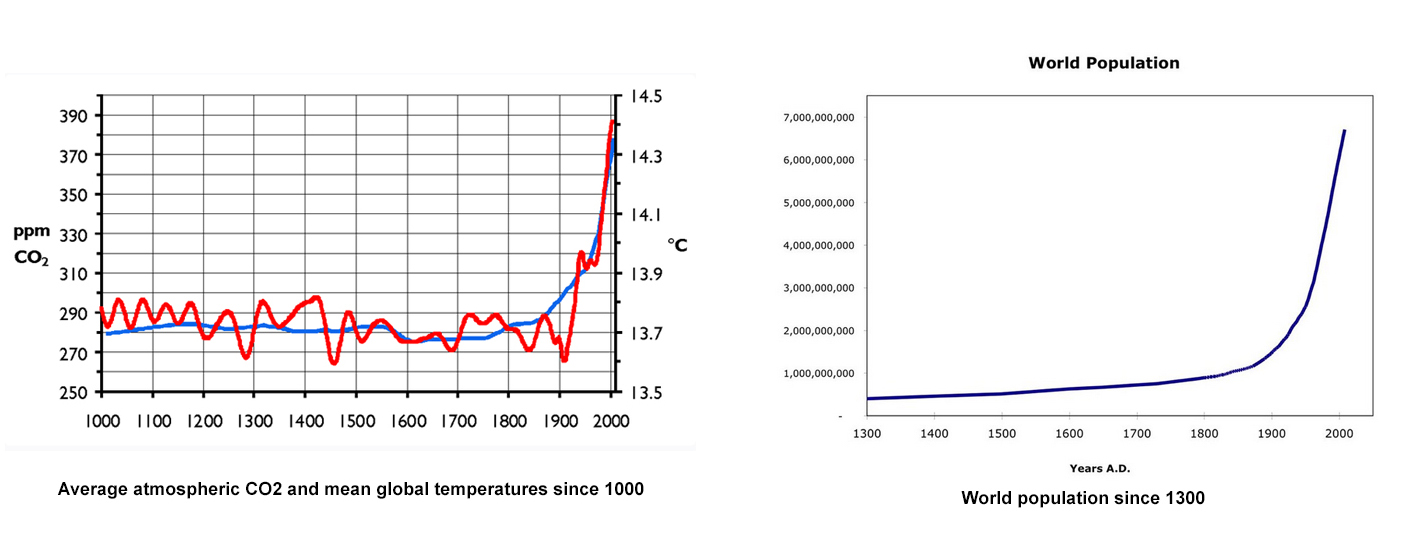
This post argues that a coalition of interests around economic and demographic growth has not only created significant inequalities across the world, but has also been the main factor driving global environmental degradation. It is demographic growth in combination with a particular form of tech-led capitalist economic growth that has been the main driver of global environmental change, of which climate change is but a small part.
Economic Growth
Economic growth has for many decades been seen by economists and international organisations alike as the key means through which poverty can be eliminated, especially in the economically poorer countries of the world. This powerful mantra lay at the heart of the Millennium Development Goals (MDGs, 2000-2015) and has more recently been central to aspirations for the achievement of the Sustainable Development Goals (SDGs, 2015-2030). Yet, as I have frequently argued elsewhere,[i] these aspirations have never been achieved, they focus on absolute poverty rather than relative poverty, and the resultant unfettered economic growth has almost always been associated with an increase in inequalities. For those concerned with equity and who define “development” primarily as the reduction of inequalities, policies designed to increase growth alone are doomed to failure and need to be replaced.
National policies and international frameworks focused on growth primarily support the interests of those private sector companies and global corporations that have worked so assiduously to shape the UN rhetoric around economic growth and innovation. Digital tech companies have long been at the forefront of this, not only driving growth, but also reaping the benefits of so doing.[ii] Economic growth is deemed to be essential both to expand markets and also to increase labour productivity, whereby owners of the means of production can extract surplus value.
In trying to consider alternative models of socio-economic activity, I have often used the notion a “no-growth” economy as a heuristic device, encouraging audiences to consider how economic activity might be organised if growth was somehow prohibited. Although there are many potential outcomes, one of the most interesting is the thought that the pressures to achieve a reduction in inequalities might increase under such conditions, thus leading to a fairer and more equitable society. I have also found the work of the Post-Autistic Economics Network to be a helpful source of inspiration, challenging as it does many of the usually taken for granted assumptions of neo-classical (and indeed neo-liberal) economics.[iii]
Demographic growth
Recent debates about the balance between the positive and negative impacts of demographic growth on the economy have highlighted their inextricable intertwining with the rhetorics of economic growth.[iv] On the one hand there are those who argue that ageing populations with few young and economically productive people are deeply problematic for economic growth, and that policies to encourage higher birth rates or immigration are essential to enable economic viability. Years ago, I thus well remember the French advertising campaign to encourage families to have more children, beautifully encapsulated in this postcard:
On the other, are those who point to a demographic dividend in Africa, through which increasing numbers of young people are going to drive the economy forward, fuelled especially by the potential of digital tech. See for example, this image below from Invest Africa in an article entitled How can Africa harness its demographic dividend (and note its emphasis on digital tech).
Both arguments are deeply problematic. In the African case, this naïve dream is only going to be possible if young people are well educated and jobs are available for them; it seems more likely that this will actually be a demographic millstone rather than a dividend. The “problem” of an ageing population likewise only becomes serious if systems are put in place to extend human life at high cost for long periods of time, or if labour productivity stagnates or declines.[v]
Much of the international debate concerning demographic change has been articulated around its interconnectedness with economic growth. Put simply, the interests underlying the continued drive for economic growth are frequently the same as those that advocate for population increase as being positive and that technology can continue to ensure a healthy lifestyle for a very much larger human population. Rather less interest has surprisingly been devoted to what human experiences of such changes might be. This is especially so when the twin mantras of economic growth and demographic growth are confronted by their combined impact on the environment. This is particularly evident in the reactions over the last 50 years to The Club of Rome’s 1972 report on Limits to Growth,[vi] and to the much more recent and controversial film Planet of the Humans, produced by Michael Moore in 2019.
Limits to Growth, Planet of the Humans and the legacy of Thomas Malthus
In 1972, the Club of Rome published its prescient report entitled Limits to Growth, which argued that if the then growth trends in population, industrialisation, resource use and pollution continued unchecked, then the carrying capacity of the earth would be reached some time within the following century.[vii] I remember distinctly the wake-up call that this provided for me as an undergraduate, and thinking back to those days have been fascinated by how its message seemed increasingly to be ignored in the ensuing decades. Few countries apart from China (see below) really responded to this message, although some such as India made tentative efforts to address it. I distinctly remember, for example, being in Sonua market in what was then South Bihar (now Jharkhand) in 1976 and seeing this painted slogan of two parents and two children that formed part of the government’s 20 point programme during the 21 month state of emergency declared by Indira Gandhi.
India’s population was then 637.45 million; in 2023 it is 1,428.63 million. The policy was not a success.
Interestingly, 30 years after the Club of Rome report, the authors published an update, in which they concluded that “it is a sad fact that humanity has largely squandered the past 30 years in futile debates and well intentioned, but halfhearted, responses to the global ecological challenge”. This is an overly generous observation, largely because of the very specific interests that have underlain economic and demographic change in subsequent years. In essence, as noted above, the owners of the world’s major companies, supported by many economists have argued convincingly that both economic and demographic growth are essential for the future success of humanity, that the new SDGs are indeed sustainable,[viii] and that technology can continue to provide innovative solutions to the increasing problems caused by the pressure of people on the planet. I find it extraordinary to think that in my lifetime the world’s population has risen by 288% from 2.77 billion people to 8 billion people. What I find more frightening, though, is that there is nothing in the UN’s development goals really about population growth,[ix] and there was almost universal condemnation in the world’s capitalist countries when China adopted its 1 child per family policy when it was introduced in 1980.[x] Widespread criticism of the Club of Rome’s report and others who held their views was based primarily on the grounds that they were neo-Malthusian,[xi] and that the world was coping perfectly well, in large part through technological advances that were overcoming the challenges of an increasing population. Indeed, the observation that very much higher levels of population have been able to live on the planet over the last 50 years would seem to support such a view. However, this fails to recognise that very many of those people live in abject poverty and misery, and that the environmental impact of such growth has been very significant indeed. Unfortunately, much of the focus of the international community has been captured by the rhetoric around climate change, which has served to reduce emphasis on the wider environmental impact caused by the double mantra of economic and demographic growth. Climate change causes nothing; it is the factors giving rise to changes in the climate that are the ultimate cause and the real problem that needs addressing.
These issues were brought to the fore by the film Planet of the Humans produced by Michael Moore, and directed by Jeff Gibbs in 2019. This has been very widely criticised by those within the so-called environmental and green lobbies on the grounds that it was outdated and misleading, especially concerning the scientific evidence and more recent developments in renewable energy. However, many of these criticisms miss the fundamental point of the film, which was that our economic system, based on the present model of capitalist growth is fundamentally unsustainable, particularly in the context of continued demographic growth.[xii]
Many of these arguments might appear to smack of neo-Malthusianism which has been almost universally condemned from a wide range of angles, as were the criticisms of Malthus’ original works.[xiii] Engels, writing in 1844,[xiv] put it this way: technological and scientific “progress is as unlimited and at least as rapid as that of population”. Many continue to agree with Engels’ proposition, or at least hope that he was right. However, the scale of human impact on the environment today is vastly different from when Malthus first wrote his Essay on the Principle of Population at the end of the 18th century, and the world’s population is now more than twice as much as it was when Limits to Growth was first published. People are seriously talking about and investing in the colonisation of outer space to provide continued sustenance for the world; technology once again to the fore. My emphasis in this piece, though, is not so much to take issue with the many diverse arguments of those who challenge neo-Malthusianism, but rather, and much more simply, to suggest that the dominant global focus on climate alone is hugely damaging because it fails to address the wider environmental impacts of our thirst for growth.
Environmental implications
“Climate change” has become a popular focus of concern and political protest, but as I have argued extensively elsewhere[xv] it is a deeply problematic notion conceptually, especially when abbreviated to just these two words “climate” and “change”, ignoring the words “human” and “induced”. All too often, it is used in a way that externalises it as being somehow separate from the human actions that cause weather patterns to change, while at the same time also implying that humans can somehow solve it without addressing the deeper structural problems facing the world. Likewise, all too frequently, the answer to the problem of “climate change” is naïvely deemed to be an over-simplified reduction in carbon emissions. Leaders of the digital tech sector, with their voracious appetite for growth and innovation are eager to comply with this agenda, while failing almost completely to recognise the enormous harms that they are causing to other aspects of the environment. By focusing largely on “climate change” they can feel good whilst also maintaining their life blood of economic and demographic growth that drives their creation of profit.
This is most definitely not to suggest that changes in temperature, rainfall, and wind patterns are unimportant; very far from it. But it is to argue that these are caused fundamentally by the twin mantras of economic and demographic growth that have increasingly dominated the world over the last century, rather than by some exogenous notion of climate change. More worryingly, these mantras have been fuelled still further by the unachievable and unsustainable Sustainable Development Goals that have become part of the problem rather than a solution. Contrary to much popular rhetoric, the very dramatic increases in global carbon emissions do not appear to have begun until the beginning of the 20th century, and coincide very closely with increases in world population.[xvi] Put another way, had global population not increased as dramatically as it has done over the last century, then those living here would not have been faced with the impending crisis that we now urgently need to address.
Moreover, and I would suggest more importantly, the emphasis on “climate change” has largely distracted attention from the crucial effort that must be placed on the wider environmental impacts of economic-demographic growth. Climate is but a small part of the physical environment, which includes the lithosphere, biosphere and hydrosphere, alongside the atmosphere. By focusing so heavily on climate, and ways that digital tech can be used to reduce carbon emissions, activists, academics, politicians, business leaders, civil society organisations and citizens alike are missing the bigger picture. The design and use of digital tech is causing significant environmental harms that tend to be ignored in the search for a solution to climate change.[xvii]
In conclusion: a new beginning
This post has contributed to my previous body of work by articulating five main inter-related propositions:
There has been a coalition of interests between those advocating economic and demographic growth, largely reflecting the determinant structures of contemporary global capitalism.[xviii]
This is archetypically reflected in the power of the digital tech sector, which has permeated the UN system.[xix]
The dramatic impact of the digital tech sector on the wider physical environment has been largely hidden by an overwhelming global emphasis on climate change, and ways through which digital tech can reduce carbon emissions.
It is important to understand climate change as a result and not a cause, and therefore focus on doing something about the real causes of climate change (the economic-demographic growth mantra) rather than primarily addressing carbon emissions.
It is essential to understand changes to the climate as but a part of the much wider negative environmental impacts of the coalition of interests underlying the economic-demographic growth mantra.
Are we facing a new era of increasing mass-migration, famine, disease and warfare? Is the economic growth model that has dominated the last century going to consume itself in a falò delle vanità? Might there be less inequality and poverty in the world if there were fewer people and the wealth that was created was shared more equally? Can we imagine a beautiful physical environment that could be created out of the desolate and scourged world we are currently creating? How might digital tech be used to serve the interests of the poorest and most marginalised more than those of the rich and powerful? These questions are all inter-related, and we need to find answers to them before it is too late.
[iii] For a brief history, see http://www.paecon.net/HistoryPAE.html; see also Stiglitz, J.E. (2019) People, Power and Profits: Progressive Capitalism for an Age of Discontent, Allen Lane, and Stiglitz, J.E. (2002) Globalization and its discontents, New York: W.W. Norton & Company
[v] Efforts by the Digital Barons (leaders of major US digital corporations) to extend human life far beyond its present span, such as those by Zuckerberg (see CNET, 2013), Larry Page (founding Calico, an Alphabet subsidiary, in 2013), Jeff Bezos (with his investment in Altos Labs, MIT Technology Review in 2021) and Larry Ellison (founder of Oracle, investing in ageing research, see Time, 2017) to name it a few are deeply worrying, both because only the rich will be able to afford such treatments, but also because they will inevitably mean an even greater population load on the planet; Elon Musk’s reported criticism of such practices (The Independent) is about the only occasion I have ever agreed with him about something!
[vii] See also the raft of activities undertaken by the Club of Rome in 2022 to celebrate the 50th anniversary of the report, https://www.clubofrome.org/ltg50/.
[viii] Which, in case it is unclear from the thrust of my argument, most of them definitely are not.
[xi] See further below on Thomas Malthus; in essence, critics of neo-Malthusianism have suggested that these arguments were overstated and premature, and that technology would enabled very much higher population levels to be sustained.
[xvii] See http://desc.global which is attempting to understand the relative balance between environmental harms and benefits of digital tech.
[xviii] In essence, demographic growth has been co-opted to serve the interests of the private sector (capitalism) in seeking to overcome the tendency towards a falling rate of profit. Put simply, population must grow to provide both an expanded market and more labour to ensure economic growth.

















 Tim Unwin's Blog